

Single-use Medical Device Reprocessing Market Size and Share Analysis- Growth Trends and Forecasts (2026-2033)
The Single-use Medical Device Reprocessing Market size is anticipated to grow at a CAGR of 15.7%, with USD 1.35 Bn in 2026 and is expected to reach approximately USD 3.76 Bn in 2033. The primary drivers are largely defined by increasing hospital cost-containment initiatives, growing adoption of reprocessed single-use devices, rising healthcare sustainability and medical-waste reduction targets, and greater regulatory clarity supporting safe device reprocessing. According to the Association of Medical Device Reprocessors (AMDR), hospitals using reprocessed single-use devices saved approximately USD 495.5 Million in 2025, while 39.4 Million reprocessed devices were sold back into healthcare use during the year.
Key Takeaways
- The cardiovascular catheters segment is likely to dominate the product type category with approximately 37.0% in 2026. The segment’s growth is owing to the high unit value of cardiovascular devices, recurring utilization in catheter-based procedures, established reprocessing protocols, and increasing regulatory clearances for complex cardiology and electrophysiology devices. In January 2026, Innovative Health received its 50th U.S. FDA clearance for reprocessing devices used in cardiology and electrophysiology laboratories, with the latest clearance allowing Abbott’s Agilis NxT Steerable Introducer to be reprocessed for two additional uses.
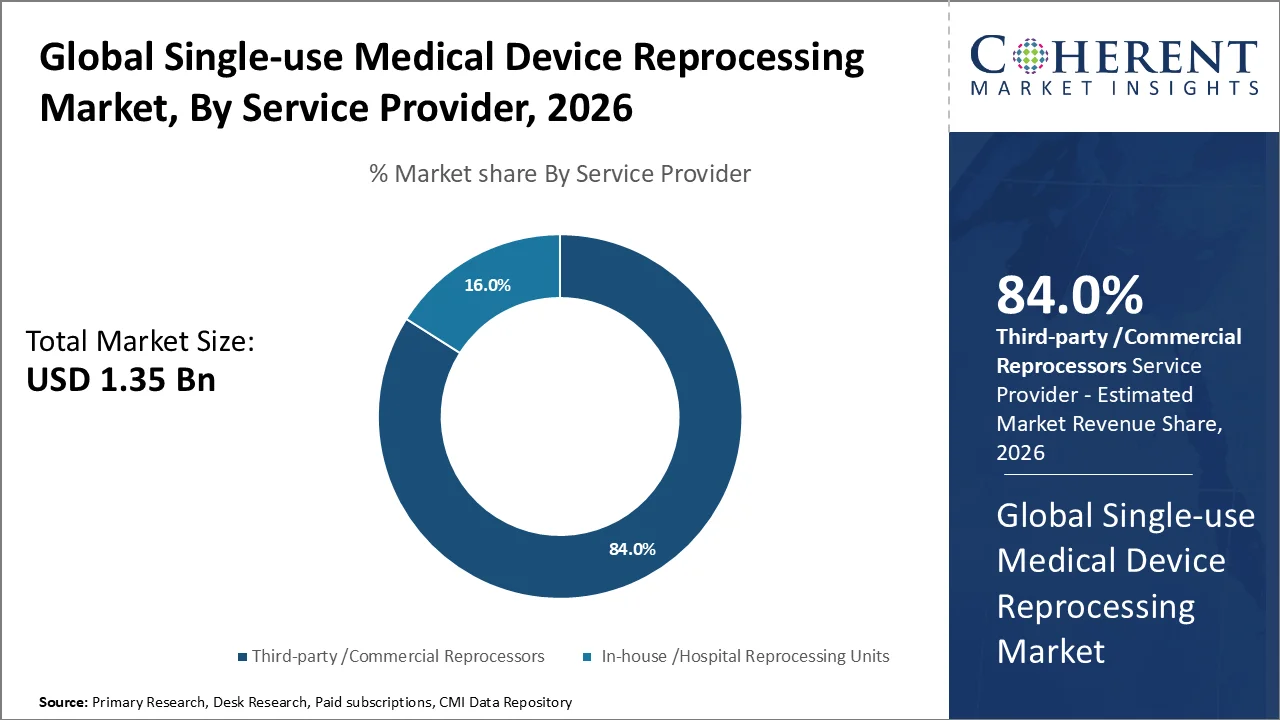
- The third-party / commercial reprocessors segment is set to lead the service provider category with approximately 84.0% in 2026. The segment’s growth is owing to economies of scale in collection and logistics, specialized cleaning and sterilization infrastructure, advanced functional testing, and greater ability to manage regulatory and quality-system requirements compared with individual hospital-based units. The U.S. FDA considers third-party reprocessors to be medical-device manufacturers, requiring them to comply with applicable registration, labeling, quality-system, medical-device reporting, and premarket notification requirements, including validation data for applicable reprocessed SUDs.
- The cardiology segment is expected to dominate the application category with approximately 40.0% in 2026. The segment’s growth is owing to the high volume and cost of electrophysiology and interventional cardiology devices, greater availability of FDA-cleared reprocessed catheters, and increasing focus of hospitals on reducing cardiovascular procedure costs.
- The hospitals & surgical centers segment is likely to lead the end-user category with approximately 63.8% in 2026. The segment’s growth is owing to high single-use device consumption, large surgical and catheterization procedure volumes, established collection infrastructure, and growing hospital initiatives focused on procurement savings and medical-waste reduction. According to the Association of Medical Device Reprocessors (AMDR), its members sold approximately 39.39 million reprocessed single-use devices back to hospitals and surgical facilities in 2025, representing an 8.26% year-over-year increase.
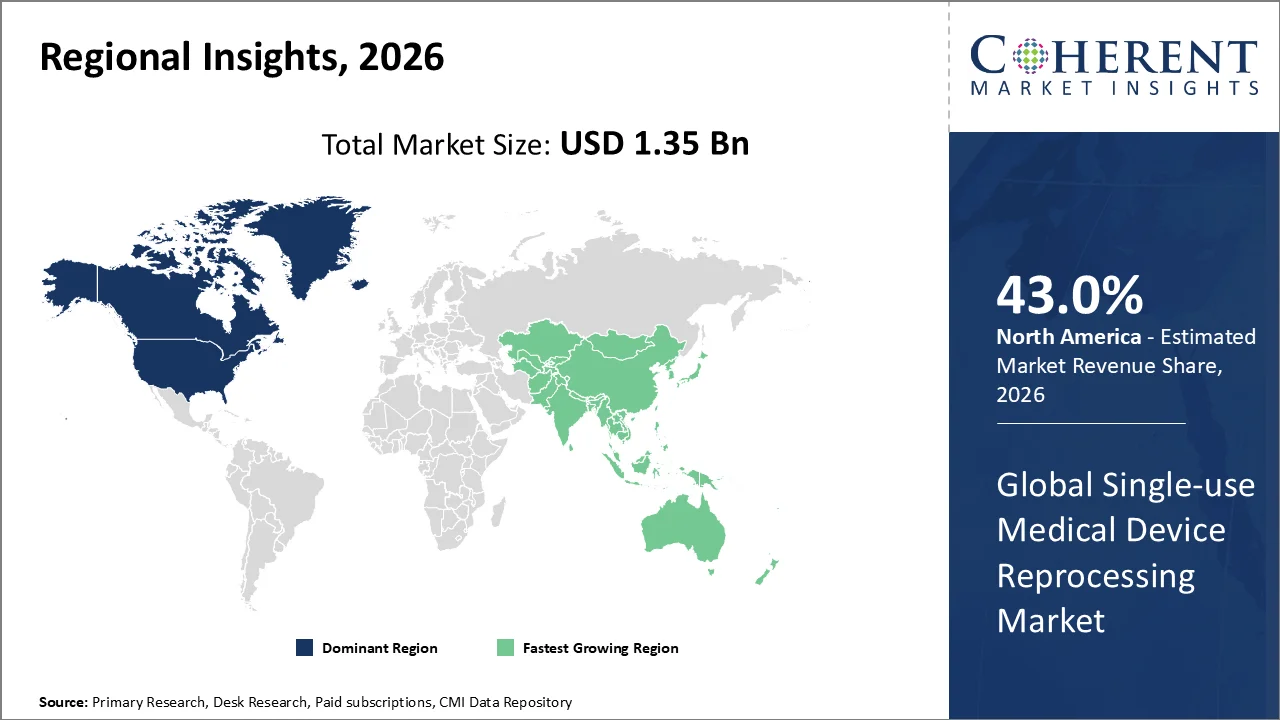
- North America is expected to acquire the prominent share of approximately 43.0% in 2026 in the Single-use Medical Device Reprocessing Market. The region’s growth is owing to the well-established FDA regulatory framework for reprocessed single-use devices, strong penetration of third-party commercial reprocessors, increasing hospital sustainability programs, and growing integration of reprocessing into healthcare procurement and operating-room waste-reduction strategies. According to Practice Greenhealth’s 2025 Sustainability Benchmark, based on 493 participating healthcare facilities in the U.S. and Canada, approximately 50% of facilities were taking action to reduce plastic use through initiatives including medical-device reprocessing, elimination of unnecessary use, and adoption of alternative products.
Market Drivers
Hospital Cost-Containment Initiatives are Accelerating Adoption of Single-use Medical Device Reprocessing
Increasing pressure on hospitals to control procedure and supply-chain costs is strengthening the adoption of reprocessed single-use medical devices. Reprocessing allows hospitals to extend the economic utility of eligible devices while reducing dependence on purchasing new devices for every procedure. This is particularly important in operating rooms, electrophysiology laboratories, and other high-volume procedural settings where disposable medical devices account for a considerable portion of supply expenditure.
According to Practice Greenhealth’s 2025 Health Care Sustainability Metrics Report, hospitals in its network reported savings of approximately USD 1,000–3,000 per operating room annually through medical-device reprocessing programs. The organization identifies third-party reprocessing as one of the major opportunities for simultaneously reducing operating-room supply costs and regulated medical waste.
Growing Healthcare Sustainability Investment is Expanding Reprocessing Programs
Healthcare providers are increasingly incorporating circular procurement, waste reduction, and Scope 3 emission reduction into institutional sustainability strategies. Single-use device reprocessing supports these objectives by retaining eligible medical products within the healthcare supply chain for additional validated uses instead of immediately directing them toward disposal.
According to Practice Greenhealth’s 2025 Sustainability Benchmark, participating healthcare facilities generated more than USD 200 Million in savings from sustainability initiatives, of which approximately USD 103 Million was associated with Greening the Operating Room programs.
Current Events and Their Impact
Current Event | Description and its Impact |
U.S. FDA Implements the Quality Management System Regulation (QMSR) for Medical Device Manufacturers and Reprocessors (2026) |
|
European Commission Proposes Major Revision of MDR Article 17 Governing Single-use Devices and Reprocessing (2025–2026) |
|
- Current Industry Events of 2026
- Market Size Estimation
- Regional Breakdown
- Competitive Landscape
- Customer Intelligence
- Segmental Analysis
- Pricing Analysis
- Key Market Drivers, Challenges & Future Trends
- Customized Insights Section
Segmental Insights
Why are Cardiovascular Catheters Acquiring the Largest Share?
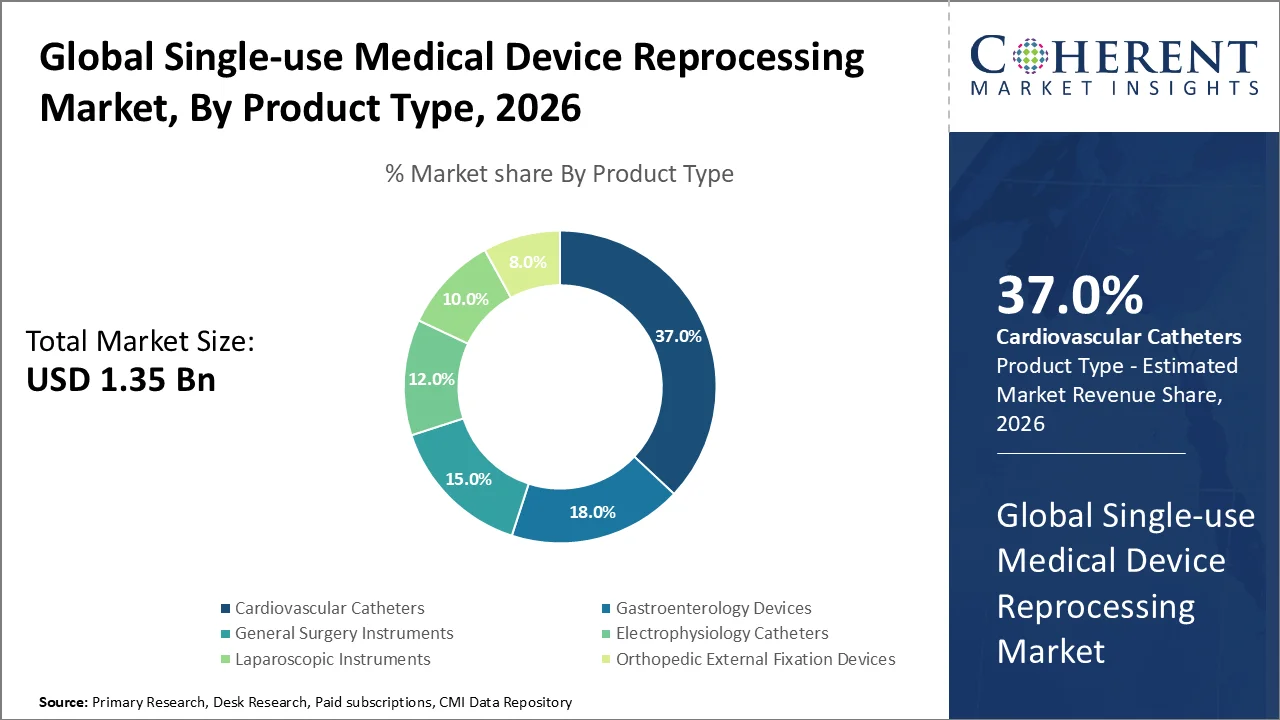
On the basis of product type, the cardiovascular catheters segment is projected to account for the largest Single-use Medical Device Reprocessing Market share of approximately 37.0% in 2026. The segment’s growth is owing to the high utilization of cardiovascular catheters in interventional and electrophysiology procedures, relatively high acquisition cost of original devices, established collection workflows in cath and EP laboratories, and continued expansion of FDA-cleared reprocessing options.
In January 2026, the U.S. FDA granted 510(k) clearance K250305 to Innovative Health for the Reprocessed Agilis NxT Steerable Introducer, classified under the cardiovascular specialty. The FDA determined the reprocessed device to be substantially equivalent to its predicate device.
Why are Third-party / Commercial Reprocessors Acquiring the Largest Share?
On the basis of service provider, the third-party / commercial reprocessors segment is projected to lead the Single-use Medical Device Reprocessing Market with approximately 84.0% share in 2026. The segment’s dominance is owing to specialized sterilization and validation capabilities, large-scale collection and logistics networks, regulatory expertise, advanced functional testing, and the ability to spread compliance and processing costs across large device volumes.
According to Practice Greenhealth’s Sustainability Benchmark, 339 participating healthcare facilities had implemented medical-device reprocessing programs with an FDA-approved third-party reprocessor. Among these facilities, several device categories had already achieved substantial collect-and-purchase penetration, demonstrating the institutional preference for outsourced professional reprocessing rather than fully in-house SUD processing.
In April 2026, Cardinal Health announced that its Sustainable Technologies business announced to open a new single-use medical device remanufacturing facility in Australia, representing the company’s first such facility outside the United States.
Why is Cardiology Acquiring the Largest Share?
On the basis of application, the cardiology segment is projected to account for the largest Single-use Medical Device Reprocessing Market share of approximately 40.0% in 2026. The segment’s growth is owing to high procedural volumes in electrophysiology and interventional cardiology, substantial expenditure on catheter-based devices, growing availability of reprocessed EP and intracardiac imaging devices, and strong economic incentives for hospitals to reduce per-procedure device costs.
Practice Greenhealth data show particularly high adoption of reprocessing among cardiovascular devices. Of healthcare facilities operating third-party reprocessing programs, 57% both collected and purchased reprocessed EP catheters, while 55% both collected and purchased reprocessed EP diagnostic catheters.
In April 2026, Innovative Health announced at Heart Rhythm 2026 that recent changes in the electrophysiology market were improving the operating environment for medical-device reprocessing.
Why are Hospitals & Surgical Centers Acquiring the Largest Share?
On the basis of end user, the hospitals & surgical centers segment is projected to lead the Single-use Medical Device Reprocessing Market with approximately 63.8% share in 2026. The segment’s dominance is owing to high surgical and interventional procedure volumes, concentrated consumption of disposable medical devices, established device-collection infrastructure, centralized procurement capabilities, and increasing pressure to control supply and medical-waste disposal costs.
A 2026 Practice Greenhealth case study of the 250-bed OSF Saint Anthony Medical Center found that a targeted reprocessing initiative increased collection rates for one eligible device from 23% to 31% within six months, demonstrating that hospitals can materially increase device recovery through workflow optimization and staff engagement.
Single-use Medical Device Reprocessing Market Trends
- The growing outsourcing of single-use device reprocessing to specialized third-party providers is strengthening the commercial reprocessing model across hospitals and surgical facilities. According to Practice Greenhealth’s latest Greening the OR benchmark data, 79% of participating healthcare facilities had implemented a medical-device reprocessing program with an FDA-approved third-party reprocessor, with adoption reaching 87% among large facilities.
- The increasing focus on circular procurement and operating-room cost optimization is encouraging healthcare systems to collect more eligible devices and repurchase reprocessed alternatives. Practice Greenhealth reported that participating facilities collected approximately 2.01 million pounds of medical devices for reprocessing and achieved approximately USD 66.65 million in combined annual savings from reduced purchasing costs and avoided waste-disposal expenses.
- The geographic expansion of commercial reprocessing infrastructure is accelerating adoption beyond the established North American market. In April 2026, Cardinal Health announced a new Sustainable Technologies remanufacturing facility in Australia, representing its first facility of this type outside the United States. The facility will initially remanufacture compression sleeves for hospitals in Australia and New Zealand.
Regional Insights
North America Dominates Owing to the Mature Commercial Reprocessing Ecosystem and Established Regulatory Framework
North America is expected to account for the largest share of approximately 43.0% of the Single-use Medical Device Reprocessing Market in 2026. The region’s dominance is owing to the established U.S. FDA regulatory framework, high penetration of third-party commercial reprocessors, growing hospital procurement focus on cost reduction, and widespread integration of reprocessing programs across operating rooms, electrophysiology laboratories, and surgical departments.
The scale of adoption is also demonstrated within the U.S. federal healthcare system. In April 2025, the Defense Health Agency reported that Womack Army Medical Center remained the leading Department of Defense facility for single-use device reprocessing for the seventh consecutive year. During 2024, the medical center generated approximately USD 933,023 in reprocessing-related savings, while diverting more than 51,000 devices and nearly 15,000 pounds of waste from landfills.
In May 2026, Connecticut-based NEScientific announced that the U.S. Patent and Trademark Office had allowed its patent application for a proprietary technology designed to restore kinked single-use catheters that would otherwise be discarded during the reprocessing cycle.
Asia Pacific Single-use Medical Device Reprocessing Market Trends
Asia Pacific is expected to be the fastest-growing region in the Single-use Medical Device Reprocessing Market, with an estimated 16.88% CAGR through 2031. The region’s growth is owing to increasing hospital cost pressures, development of regulated commercial reprocessing infrastructure, expanding healthcare sustainability initiatives, and increasing acceptance of remanufactured single-use devices across countries such as Japan and Australia.
Japan is demonstrating increasing commercialization of reprocessed single-use devices. According to HOGY MEDICAL’s 2025 Integrated Report, the company had launched a cumulative 12 types of remanufactured single-use medical devices as of the fiscal year ended March 2025. These products are collected from medical institutions and processed, inspected, cleaned, and sterilized by licensed medical-device manufacturers before being supplied for another validated use.
In February 2026, WA Country Health Service announced an expansion of its partnership with Medsalv across hospitals in Geraldton, Karratha, Derby, Busselton, Kununurra, and Broome for collection and remanufacturing of devices including hover mats, DVT sleeves, blood-pressure cuffs, and tourniquets.
Established FDA Framework and Growing Circular Procurement are Accelerating the Single-use Medical Device Reprocessing Market in the United States
The U.S. Single-use Medical Device Reprocessing Market is witnessing sustained growth owing to its established regulatory pathway, mature commercial reprocessor base, increasing hospital focus on supply-chain resilience, and rising integration of reprocessed devices into federal and private healthcare facilities.
According to the Association of Medical Device Reprocessors (AMDR), commercial SUD reprocessing supported approximately 3,348 green manufacturing jobs in the U.S. in 2025. Furthermore, 60 U.S. military healthcare institutions were using regulated reprocessed single-use devices, highlighting the increasing institutional acceptance of reprocessing beyond conventional private hospital systems.
In June 2025 National Academy of Medicine analysis reported that healthcare accounts for approximately 8.5% of total U.S. greenhouse-gas emissions, while Scope 3 activities account for around 82% of healthcare emissions.
Strict Single-use Restrictions and Expanding Device Traceability are Shaping the China Single-use Medical Device Reprocessing Market
China represents a fundamentally different regulatory environment for Single-use Medical Device Reprocessing. Under Article 49 of China's Regulations for the Supervision and Administration of Medical Devices, medical devices formally designated for single use cannot be reused and must be disposed of and documented after use.
In January 2026, the National Medical Products Administration (NMPA) issued updated Unique Device Identification requirements stating that reusable medical devices requiring reprocessing before each use should generally carry a direct UDI marking on the device itself, enabling identification and traceability through repeated use cycles.
Who are the Major Companies in Single-use Medical Device Reprocessing Industry
Some of the major key players in Single-use Medical Device Reprocessing Market are Stryker Corporation, Medline ReNewal, Centurion Medical Products Corporation, Midwest Reprocessing Center, SterilMed Inc., Vanguard AG, Hygia Health Services Inc.
Key News
- In September 2025, Medline announced an expansion of its ReNewal single-use device reprocessing program.
- In August 2025, Stryker Sustainability Solutions received U.S. FDA 510(k) clearance K250898 for three configurations of Reprocessed HARMONIC 700 Shears 23 cm, 36 cm, and 45 cm.
Market Report Scope
Single-use Medical Device Reprocessing Market Report Coverage
| Report Coverage | Details | ||
|---|---|---|---|
| Base Year: | 2025 | Market Size in 2026: | USD 1.35 Bn |
| Historical Data for: | 2020 To 2024 | Forecast Period: | 2026 To 2033 |
| Forecast Period 2026 to 2033 CAGR: | 15.7% | 2033 Value Projection: | USD 3.76 Bn |
| Geographies covered: |
| ||
| Segments covered: |
| ||
| Companies covered: | Stryker Corporation, Medline ReNewal, Centurion Medical Products Corporation, Midwest Reprocessing Center, SterilMed Inc., Vanguard AG, Hygia Health Services Inc. | ||
| Growth Drivers: |
| ||
| Restraints & Challenges: |
| ||
Analyst Opinion
- The Single-use Medical Device Reprocessing Market is moving from a sustainability-led initiative toward an established hospital procurement strategy, primarily because healthcare providers can simultaneously address supply expenditure and operating-room waste. Practice Greenhealth’s 2026 Environmental Excellence Awards cycle covered more than 700 healthcare facilities, and participating organizations reported that medical-device reprocessing projects generated median annual savings of approximately USD 48,000 per organization.
- The market’s long-term growth is also supported by the high concentration of disposable-device consumption and waste within procedural departments. A 2025 National Academy of Medicine analysis reported that operating rooms can generate more than 50% of a hospital facility’s waste, while single-use medical and surgical devices represent an important component of healthcare supply-chain emissions.
- From a regulatory perspective, the market is becoming increasingly favorable to large, technically sophisticated commercial reprocessors. The U.S. FDA’s Quality Management System Regulation became effective on February 2, 2026, incorporating ISO 13485:2016 into the U.S. medical-device quality framework. Reprocessors must also demonstrate that applicable devices remain safe and functional through the maximum validated number of reprocessing cycles.
Speak to the analyst
Want personalized insights?
Take the findings above to one of our principal consultants, or have the report rebuilt around the segments, geographies and competitors you actually track.
Market Segmentation
- By Product Type (Revenue, USD Bn, 2021-2033)
- Cardiovascular Catheters
- Electrophysiology Catheters
- Laparoscopic Instruments
- Gastroenterology Devices
- Orthopedic External Fixation Devices
- General Surgery Instruments
- By Service Provider (Revenue, USD Bn, 2021-2033)
- Third-party /Commercial Reprocessors
- In-house /Hospital Reprocessing Units
- By Application (Revenue, USD Bn, 2021-2033)
- Cardiology
- Gastroenterology
- Orthopedics
- Urology
- General Surgery
- By End User (Revenue, USD Bn, 2021-2033)
- Hospitals & Surgical Centers
- Ambulatory Surgical Centers
- Specialty Clinics & Cath Labs
- Academic & Research Institutes
- Global Single-use Medical Device Reprocessing Market , By Region (Revenue, USD Bn, 2021-2033)
- North America
- U.S.
- Canada
- Latin America
- Brazil
- Mexico
- Argentina
- Rest of Latin America
- Europe
- Germany
- U.K.
- France
- Italy
- Spain
- Russia
- Rest of Europe
- Asia Pacific
- China
- India
- Japan
- Australia
- South Korea
- ASEAN
- Rest of Asia Pacific
- Middle East
- GCC
- Israel
- Rest of Middle East
- Africa
- South Africa
- Central Africa
- North Africa
- North America
- Key Players
- Stryker Corporation
- Medline ReNewal
- Centurion Medical Products Corporation
- Midwest Reprocessing Center
- SterilMed Inc.
- Vanguard AG
- Hygia Health Services Inc.
Sources
Primary Research Interviews
- Single-use medical device reprocessing companies
- Hospital procurement and supply chain managers
- Operating room and sterile processing department managers
- Electrophysiology and catheterization laboratory managers
- Medical device regulatory and quality assurance professionals
- Hospital sustainability and waste management managers
- Surgeons, interventional cardiologists, and electrophysiologists
- Medical device distributors and healthcare procurement organizations
- Key opinion leaders (KOLs) in medical device reprocessing and infection prevention
Databases
- U.S. Food and Drug Administration (FDA) – 510(k) Premarket Notification Database
- FDA Establishment Registration & Device Listing Database
- European Commission – EUDAMED
- Australian Register of Therapeutic Goods (ARTG)
- Pharmaceuticals and Medical Devices Agency (PMDA), Japan
- World Health Organization (WHO)
- Organisation for Economic Co-operation and Development (OECD)
- World Bank
Magazines
- Medical Device and Diagnostic Industry (MD+DI)
- Medical Product Outsourcing
- Healthcare Purchasing News
- OR Today
- Medical Device Network
- Healthcare Facilities Today
Journals
- American Journal of Infection Control
- Journal of Hospital Infection
- Journal of Healthcare Engineering
- Journal of Cleaner Production
- Resources, Conservation & Recycling
- The Lancet Planetary Health
- BMJ Open
Newspapers
- Reuters
- The Wall Street Journal
- Financial Times
- The New York Times
- The Guardian
- The Economic Times
Associations
- Association of Medical Device Reprocessors (AMDR)
- Practice Greenhealth
- Association for the Advancement of Medical Instrumentation (AAMI)
- Association of periOperative Registered Nurses (AORN)
- Healthcare Sterile Processing Association (HSPA)
- Advanced Medical Technology Association (AdvaMed)
- European Association of Medical Devices Reprocessors (EAMDR)
Public Domain Sources
- Company annual reports and sustainability reports
- Company press releases and product announcements
- U.S. FDA regulatory guidance and 510(k) clearance documents
- European Commission Medical Device Regulation publications
- National medical device regulatory authority publications
- Hospital sustainability and device reprocessing case studies
- Government healthcare procurement and waste management publications
- Clinical studies and peer-reviewed research publications
- Public healthcare procurement and tender documents
- Patent databases such as WIPO, USPTO, and Google Patents
- Company product catalogs and technical documentation
Proprietary Elements
- CMI Data Analytics Tool
- Proprietary CMI Existing Repository of Information for the Last 10 Years
Get access to 250+ pages report
Every segment, forecast, competitor profile and data table behind the analysis above — available for instant download.
- ESOMAR Member
- ISO 9001:2015 Certified
- D-U-N-S Registered
- GDPR & CCPA Compliant
Missing comfort of reading report in your local language? Find your preferred language:
Transform your Strategy with Exclusive Trending Reports
Frequently Asked Questions
The Single-use Medical Device Reprocessing Market is expected to reach approximately USD 3.76 Billion in 2033, compared with USD 1.35 Billion in 2026.
The cardiovascular catheters segment is expected to hold the largest product-type share, accounting for approximately 37.0% in 2026, owing to high utilization in interventional and electrophysiology procedures and continued expansion of FDA-cleared reprocessing options.
The stringent regulatory and validation requirements and limited reprocessability of certain single-use devices are the key factors hampering growth of the market.
The increasing adoption of reprocessed single-use medical devices across hospitals and surgical centers and rising focus on healthcare cost reduction and procurement savings are key factors driving growth of the market.
The Single-use Medical Device Reprocessing Market is anticipated to grow at a CAGR of approximately 15.7% between 2026 and 2033.
Among regions, North America is expected to account for the largest market share, with approximately 43.0% in 2026, supported by an established FDA regulatory framework, strong penetration of third-party commercial reprocessors, and increasing hospital adoption.
Single-use medical device reprocessing involves the collection, inspection, cleaning, processing, testing, and sterilization of eligible medical devices so that they can be supplied for another validated use under applicable regulatory and quality requirements.