

Electric Wheelchair Market Size and Forecast – 2026 to 2033
Electric Wheelchair Market is estimated to be valued at USD 10.73 Bn in 2026 and is expected to reach USD 22.56 Bn in 2033, exhibiting a compound annual growth rate (CAGR) of 11.2% from 2026 to 2033.
Key Takeaways
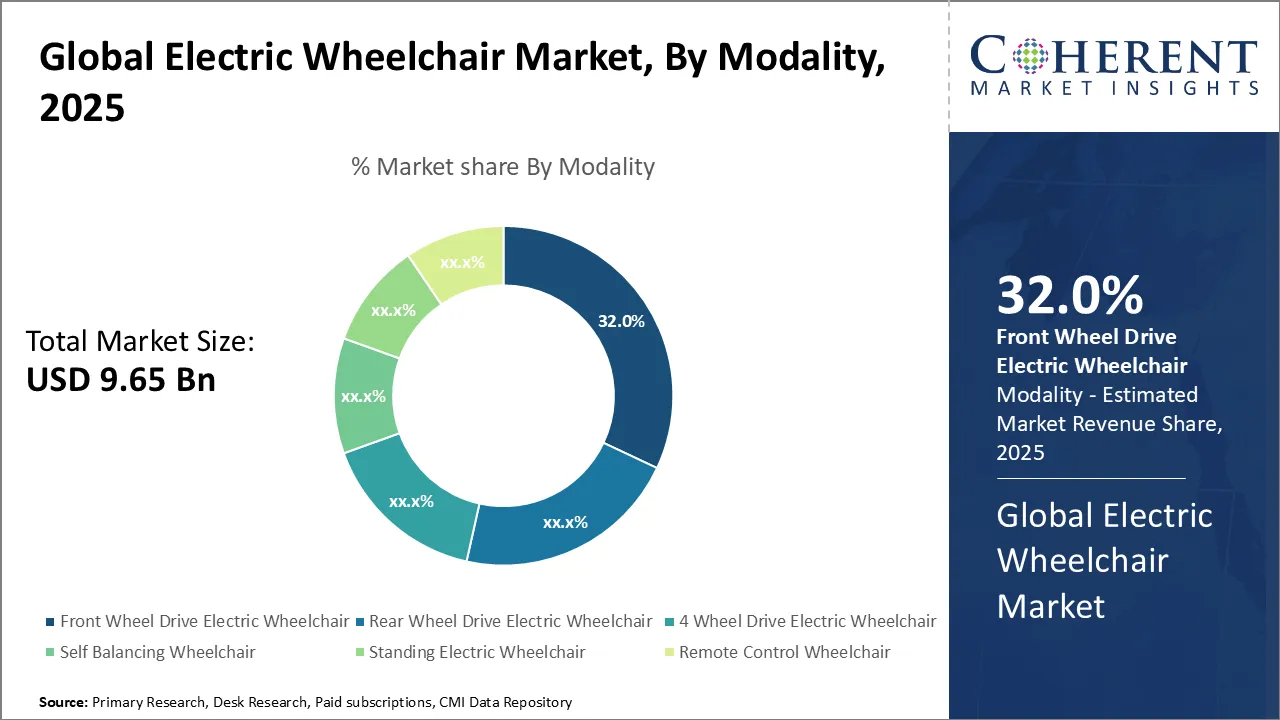
- By Modality, Front Wheel Drive Electric Wheelchair hold the largest market share of 33% in 2026 owing to its enhanced outdoor mobility.
- By Age group, >60 years expected to hold largest market share in 2026 owing to the aging population and increased mobility needs.
- By End user, Consumer acquired the prominent market share in 2026 owing to its prevalence of disabilities.
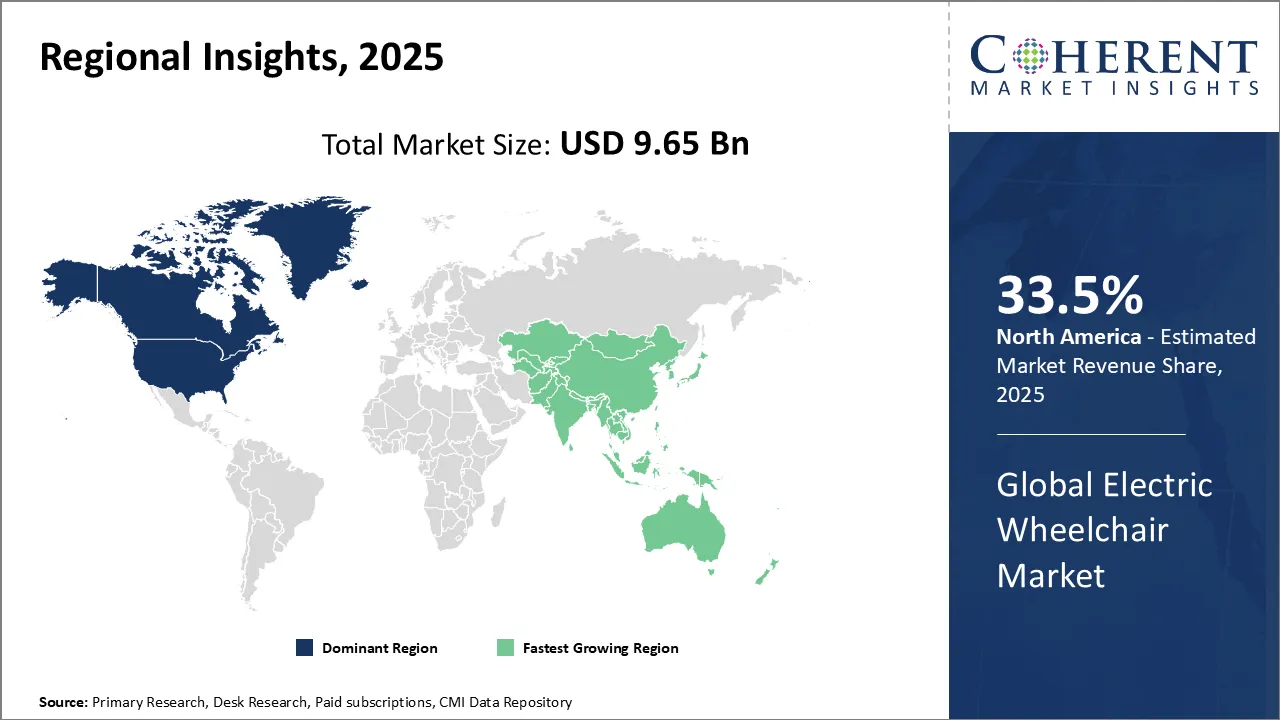
- By Region, North America dominates the overall market with an estimated share of 33.5% in 2026 owing to the reimbursement policies and government support.
Market Overview
The global electric wheelchair market is rapidly growing as more elderly individuals and people with physical disabilities seek mobility aids. Manufacturers are enhancing wheelchair efficiency, comfort, and accessibility through technological advancements, making them easier for users to operate. Increasing awareness of independent living, along with supportive government policies and broader insurance coverage, is driving adoption. Meanwhile, e-commerce platforms are enabling consumers to access a wide range of models, and innovations in smart and all-terrain wheelchairs continue to shape market trends.
Current Events and their Impact on the Electric Wheelchair Market
Current Events | Description and its impact |
Technological Advancements in Battery and Mobility Technologies |
|
Regulatory and Healthcare Policy Changes |
|
Regional Healthcare Infrastructure Development |
|
Segmental Insights
- Current Industry Events of 2026
- Market Size Estimation
- Regional Breakdown
- Competitive Landscape
- Customer Intelligence
- Segmental Analysis
- Pricing Analysis
- Key Market Drivers, Challenges & Future Trends
- Customized Insights Section
Electric Wheelchair Market Insights, by Modality: Front Wheel Drive Electric Wheelchair contribute the highest share of the market owing to its improved stability and obstacle navigation.
Front Wheel Drive Electric Wheelchair hold the largest market share of 33.0% in 2026. Consumers are increasingly choosing front-wheel drive electric wheelchairs for their excellent maneuverability and stability, particularly on uneven and outdoor surfaces. The design enables users to tackle slopes, curbs, and obstacles more easily, improving overall mobility. Rising awareness of personalized mobility solutions, along with technological enhancements such as lightweight frames, extended battery life, and smart control systems, is fueling demand. Furthermore, growing adoption in areas with expanding elderly populations and active outdoor lifestyles continues to propel the market for these adaptable wheelchairs. For instance, in June 2024, Ottobock UK launched the Juvo B7, an advanced power wheelchair designed to keep users with complex positioning and mobility needs comfortably in control all day. It comes in mid- or front-wheel drive options.
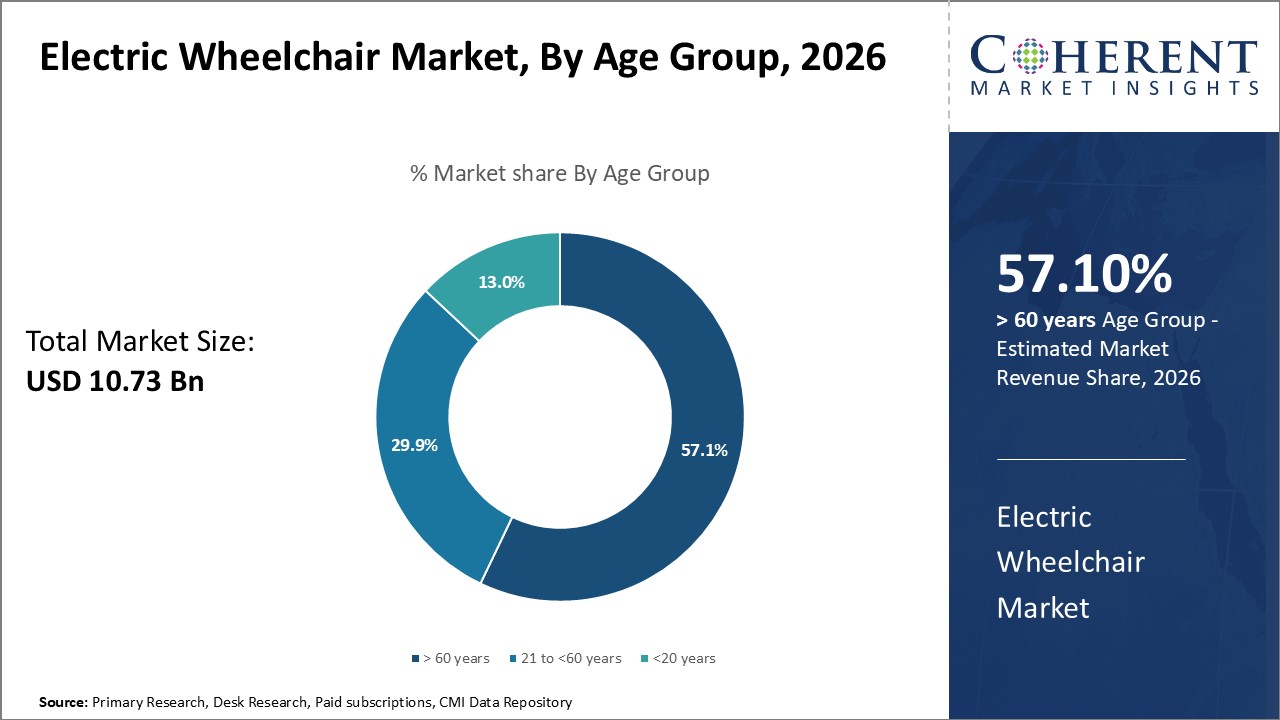
Electric Wheelchair Market Insights, by Age group: >60 years contribute the highest share of the market owing to its desire for independence and quality of life.
Individuals over 60 are increasingly adopting electric wheelchairs to maintain their independence and mobility as age-related physical limitations emerge. Conditions such as arthritis, osteoporosis, and decreased strength drive their reliance on assistive devices. Manufacturers have made wheelchairs more appealing to seniors through lightweight designs, ease of use, and enhanced comfort. At the same time, supportive healthcare policies, insurance coverage, and the convenience of online shopping are making electric wheelchairs more accessible, encouraging elderly users to embrace them for safety and daily freedom.
Electric Wheelchair Market Insights, by End User: Consumer contribute the highest share of the market owing to its e-commerce accessibility.
Consumers are driving growth in the electric wheelchair market share as they seek independence, convenience, and a better quality of life. Individuals with mobility challenges turn to these devices to perform daily activities more easily and comfortably. Manufacturers are boosting appeal through technological innovations, including lightweight designs, intuitive controls, and long-lasting batteries. At the same time, wider availability via online platforms, along with supportive insurance and healthcare programs, is making electric wheelchairs more accessible and encouraging more people to adopt them for enhanced mobility and autonomy. For instance, in November 2024, Paiseec, a leading mobility solutions brand, revolutionized the wheelchair industry with its W3—a 3-in-1 device that elevates the mobility experience for users.
Regional Insights
North America Electric Wheelchair Market Trends
North America dominates the overall market with an estimated share of 33.5% in 2026. The North American electric wheelchair market is advancing as manufacturers introduce notable innovations. Companies are improving user experiences through technological enhancements, which are driving higher adoption. By integrating lithium-ion batteries, they are providing longer usage times and faster charging, overcoming earlier limitations. Meanwhile, the growth of e-commerce platforms allows consumers to easily compare models and read reviews before buying. Expanding government programs and insurance coverage are also helping make electric wheelchairs more affordable, enabling a wider population to access these mobility solutions. For instance, in August 2026, Airchair introduced the Airchair II, a lightweight but sturdy onboard wheelchair that meets new US accessibility regulations and improves passenger comfort.
Europe Electric Wheelchair Market Trends
The European electric wheelchair market is evolving as demographic changes, technological innovations, and supportive policies shape demand. Aging populations in countries like Germany and France are driving increased need for mobility solutions. Manufacturers are introducing advanced technologies, including brain-controlled wheelchairs and smart features, to improve user experience and promote greater independence.
United States Electric Wheelchair Market Trends
The U.S. electric wheelchair market revenue is advancing as manufacturers introduce key innovations. Companies are improving user experiences through technological advancements, which are driving higher adoption. By incorporating lithium-ion batteries, they provide longer usage times and faster charging, overcoming previous limitations. Meanwhile, the growth of e-commerce platforms allows consumers to easily compare models and read reviews before buying. Expanding government programs and insurance coverage are also helping make electric wheelchairs more affordable, enabling a wider population to access these mobility solutions. For instance, in August 2026, OAS Mobility launched the OAS Air Pro, a next-generation electric wheelchair that redefines portability, safety, and user independence.
United Kingdom Electric Wheelchair Market Trends
The United Kingdom’s electric wheelchair market is transforming as manufacturers introduce advanced technologies, respond to an aging population, and adapt to evolving healthcare policies. Companies are enhancing user autonomy and comfort through innovations like brain-controlled wheelchairs and smart features. The growing elderly population is increasing demand for mobility solutions, while NHS funding programs are helping more people access electric wheelchairs. At the same time, the expansion of e-commerce platforms allows consumers to explore a wider range of models, further boosting market growth. For instance, in May 2026, Kia unveiled the PV5 WAV, an electric wheelchair-accessible vehicle, at the Financial Times’ Future of the Car Summit in London, highlighting its commitment to inclusive and sustainable mobility in partnership with Motability Operations Ltd.
End-user Feedback and Unmet Needs in the Electric Wheelchair Market
- Limited Customization Options: Users often find electric wheelchairs lacking in personalization, such as adjustable footrests, seat widths, or aesthetic choices. This lack of customization can lead to discomfort and dissatisfaction, as individuals have unique physical needs and preferences that are not always addressed by standard models.
- Weight and Portability Challenges: Despite efforts to create lightweight models, many electric wheelchairs remain heavy and cumbersome. This makes transportation difficult, especially for individuals with limited upper body strength, and can hinder the ability to travel independently or use public transportation effectively.
- Accessibility and Terrain Limitations: Users frequently report that their electric wheelchairs struggle on uneven terrains, curbs, or narrow spaces, limiting their mobility in various environments. This issue is particularly prevalent in urban settings where infrastructure may not accommodate wheelchair users adequately.
Electric Wheelchair Market Trend
Integration of Smart Technologies
Manufacturers are incorporating advanced technologies like collision avoidance, automatic braking, and self-diagnosis capabilities into electric wheelchairs. These features enhance user safety and autonomy, particularly benefiting seniors and individuals with cognitive impairments. Additionally, connectivity with smartphones allows users to monitor battery life, modify settings, and track usage patterns, improving the overall user experience and extending the device's lifespan.
Emphasis on Lightweight Materials
The adoption of materials such as aviation-grade aluminum and carbon fiber is increasing in electric wheelchair manufacturing. These materials reduce the overall weight of the wheelchairs, making them more portable and easier to maneuver. This trend addresses user concerns regarding the heaviness of traditional electric wheelchairs, facilitating greater independence and mobility.
Electric Wheelchair Market Opportunity
Voice-Controlled and AI-Integrated Wheelchairs
Recent advancements have led to the development of AI-powered wheelchairs capable of navigating based on voice commands. These devices utilize sensors and cameras to detect obstacles and follow pre-set paths, enhancing user autonomy. Such innovations cater to individuals with severe mobility impairments, presenting opportunities for manufacturers to create more intuitive and accessible mobility solutions.
Market Report Scope
Electric Wheelchair Market Report Coverage
| Report Coverage | Details | ||
|---|---|---|---|
| Base Year: | 2025 | Market Size in 2026: | USD 10.73 Bn |
| Historical Data for: | 2020 To 2024 | Forecast Period: | 2026 To 2033 |
| Forecast Period 2026 to 2033 CAGR: | 11.2% | 2033 Value Projection: | USD 22.56 Bn |
| Geographies covered: |
| ||
| Segments covered: |
| ||
| Companies covered: | Invacare Corporation, Sunrise Medical (US) LLC, Permobil Inc., Pride Mobility Products Corporation, Drive Devilbiss Healthcare, Hoveround Corporation, Ottobock Healthcare, 21st Century Scientific, Inc., Meyra GmbH, LEVO AG, Merits Co. Ltd., Segway Inc., Scewo, GF Health Products Inc., Karman Healthcare, Inc., KYMCO Healthcare, SOWECARE B.V, and Nanjing Jin Bai He Medical Apparatus Co., Ltd. | ||
| Growth Drivers: |
| ||
| Restraints & Challenges: |
| ||
Electric Wheelchair Market News
- In August 2025, Daihatsu Motor Co. introduced a new electric wheelchair for the elderly, capable of reaching 6 kilometres per hour and covering 12 kilometres on a single charge, operable without a driver’s license.
- In July 2025, KERDOM, a leading mobility brand, launched the DX05-F20, its most powerful and comfort-focused electric wheelchair yet, built to give seniors and larger users greater freedom and support on any terrain.
- In August 2025, ELFIGO Mobility launched the Ultra-Lite Carbon V2, the world’s lightest electric wheelchair at 10.8 kg without the battery, surpassing its previous model, the 11 kg Black Diamond.
- In July 2025, ANA Holdings (ANA HD) launched a trial program called “MoVA,” offering rental services for self-propelled wheelchairs, electric wheelchairs, and strollers at Kansai International Airport (KIX).
Analyst Opinion (Expert Opinion)
- The electric wheelchair market is undergoing a significant transformation, driven by technological advancements, demographic shifts, and evolving healthcare policies. However, beneath the surface of this growth lies a complex interplay of factors that demand critical examination.
- Technological innovation stands at the forefront of this evolution. The integration of artificial intelligence (AI), Internet of Things (IoT), and sensor technologies has led to the development of smart wheelchairs equipped with features such as autonomous navigation, obstacle avoidance, and health monitoring. These advancements are particularly beneficial for individuals with severe mobility limitations or neurological disorders, offering them greater independence and quality of life.
- Demographic trends further underscore the need for innovation in the electric wheelchair market. The global aging population is increasing the demand for mobility solutions. In countries like Japan and China, where population decline is already evident, the need for advanced mobility aids is becoming more pronounced.
- Healthcare policies play a crucial role in shaping the accessibility of electric wheelchairs. In France, for example, the government has announced plans to fully reimburse wheelchairs through public health insurance starting December 1, 2025.
Speak to the analyst
Want personalized insights?
Take the findings above to one of our principal consultants, or have the report rebuilt around the segments, geographies and competitors you actually track.
Market Segmentation
- Global Electric Wheelchair Market, By Modality
- Rear Wheel Drive Electric Wheelchair
- 4 Wheel Drive Electric Wheelchair
- Front Wheel Drive Electric Wheelchair
- Self Balancing Wheelchair
- Standing Electric Wheelchair
- Remote Control
- Global Electric Wheelchair Market, By Age Group
- > 60 years
- 21 to <60 years
- <20 years
- Global Electric Wheelchair Market, By End User
- Consumer
- Care
- Hospitals
- Clinics
- Care Homes
- Regional Insights (Revenue, USD Mn, 2021 - 2033)
- North America
- U.S.
- Canada
- Latin America
- Brazil
- Argentina
- Mexico
- Rest of Latin America
- Europe
- Germany
- UK
- Spain
- France
- Italy
- Russia
- Rest of Europe
- Asia Pacific
- China
- India
- Japan
- Australia
- South Korea
- ASEAN
- Rest of Asia Pacific
- Middle East
- GCC Countries
- Israel
- Rest of Middle East
- Africa
- South Africa
- North Africa
- Central Africa
- North America
- Key Players Insights
- Invacare Corporation
- Sunrise Medical (US) LLC
- Permobil Inc.
- Pride Mobility Products Corporation
- Drive Devilbiss Healthcare
- Hoveround Corporation
- Ottobock Healthcare
- 21st Century Scientific, Inc.
- Meyra GmbH
- LEVO AG
- Merits Co. Ltd.
- Segway Inc.
- Scewo
- GF Health Products Inc.
- Karman Healthcare, Inc.
- KYMCO Healthcare
- SOWECARE B.V
- Nanjing Jin Bai He Medical Apparatus Co., Ltd.
Sources
Primary Research Interviews
- Interviews with engineers and designers involved in the development of smart wheelchair technologies, such as the CoNav Chair, which integrates shared control navigation algorithms and obstacle avoidance to enhance user autonomy and trust in built environments.
- Discussions with healthcare professionals and caregivers regarding the adoption and challenges of advanced mobility aids in clinical and home care settings.
Databases
- PubMed
- IEEE Xplore
Magazines
- New Mobility: A U.S.-based magazine for active wheelchair users, covering topics such as health, disability rights, adaptive technology, and lifestyle.
- Disability Horizons: An online magazine offering insights into disability-related topics, including reviews of mobility aids and personal stories.
Journals
- Journal of Rehabilitation Research and Development (JRRD): Publishes research on rehabilitation technologies, including studies on electric wheelchairs.
- Assistive Technology: An international journal focusing on the development and application of assistive devices, including mobility aids.
Newspapers
- The New York Times: Provides coverage on healthcare policies and technological advancements in assistive devices.
- The Guardian: Offers articles on accessibility issues and innovations in mobility aids.
Associations
- National Mobility Equipment Dealers Association (NMEDA): A trade association representing mobility equipment dealers, offering resources on vehicle modifications and adaptive equipment.
- Rehabilitation Engineering and Assistive Technology Society of North America (RESNA): A professional association for the advancement of rehabilitation and assistive technology.
Public Domain Sources
- United Nations Population Division: Provides demographic data and projections, useful for analyzing the aging population and its impact on the demand for mobility aids.
- World Health Organization (WHO): Offers reports and statistics on disability prevalence and the need for assistive devices globally.
Proprietary Elements
- CMI Data Analytics Tool, and Proprietary CMI Existing Repository of information for last 8 years
Get access to 250+ pages report
Every segment, forecast, competitor profile and data table behind the analysis above — available for instant download.
- ESOMAR Member
- ISO 9001:2015 Certified
- D-U-N-S Registered
- GDPR & CCPA Compliant
Missing comfort of reading report in your local language? Find your preferred language:
Transform your Strategy with Exclusive Trending Reports
Frequently Asked Questions
The Electric Wheelchair Market is estimated to be valued at USD 10.73 Bn in 2026, and is expected to reach USD 22.56 Bn by 2033.
The CAGR of the Electric Wheelchair Market is projected to be 11.2% from 2026 to 2033.
Increasing organic strategies such as product launches and an increasing geriatric population are expected to drive the global electric wheelchair market’s growth.
Limited accessibility and infrastructure are expected to hinder the market over the forecast period.
Rear wheel drive electric wheelchair is the leading modality segment in the market.
Major players operating in the market are Invacare Corporation, Sunrise Medical (US) LLC, Permobil Inc., Pride Mobility Products Corporation, Drive Devilbiss Healthcare, Hoveround Corporation, Ottobock Healthcare, 21st Century Scientific, Inc., Meyra GmbH, LEVO AG, Merits Co. Ltd., Segway Inc., Scewo, GF Health Products Inc., Karman Healthcare, Inc., KYMCO Healthcare, SOWECARE B.V, and Nanjing Jin Bai He Medical Apparatus Co., Ltd.