

Hospital-Acquired Disease Testing Market Size and Share Analysis - 2026 to 2033
The hospital-acquired disease testing market was valued at USD 18.6 Bn in 2026 and is forecast to reach a value of USD 49.4 Bn by 2033 at a CAGR of 15.5% between 2026 and 2033.
Key Takeaways
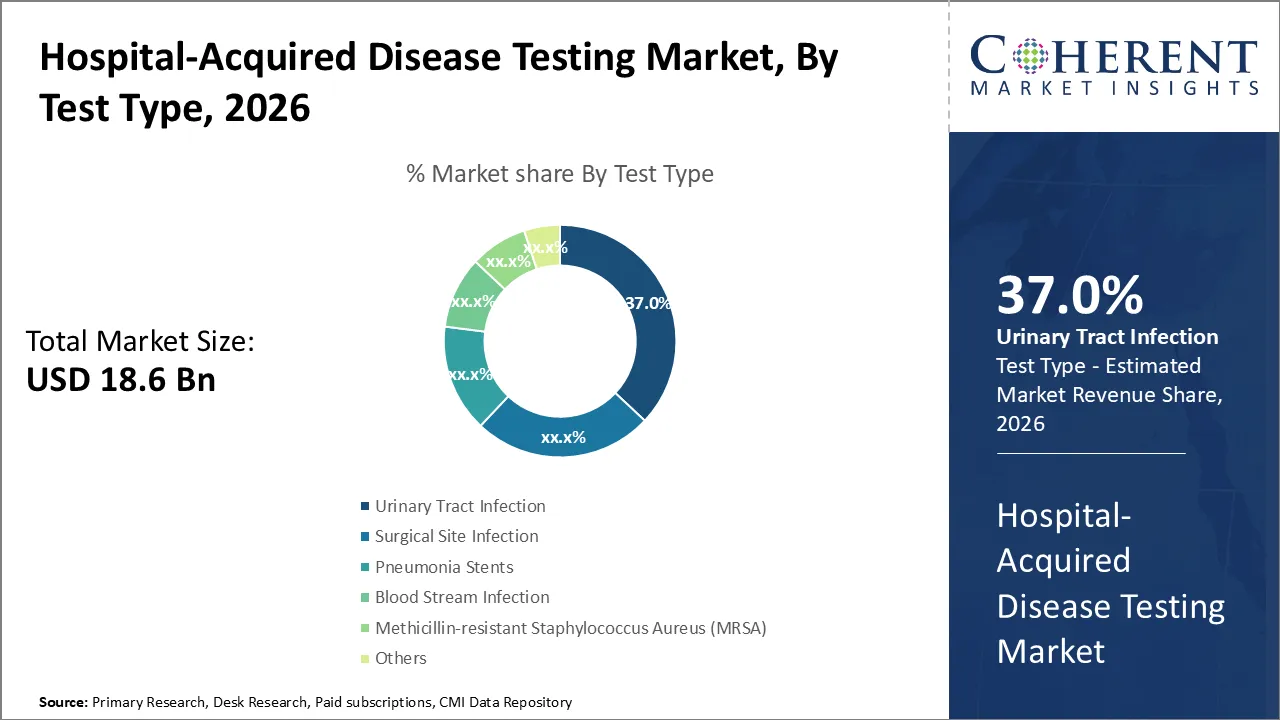
- Based on test type, the urinary tract infection segment is expected to hold 37% share of the market in 2026.
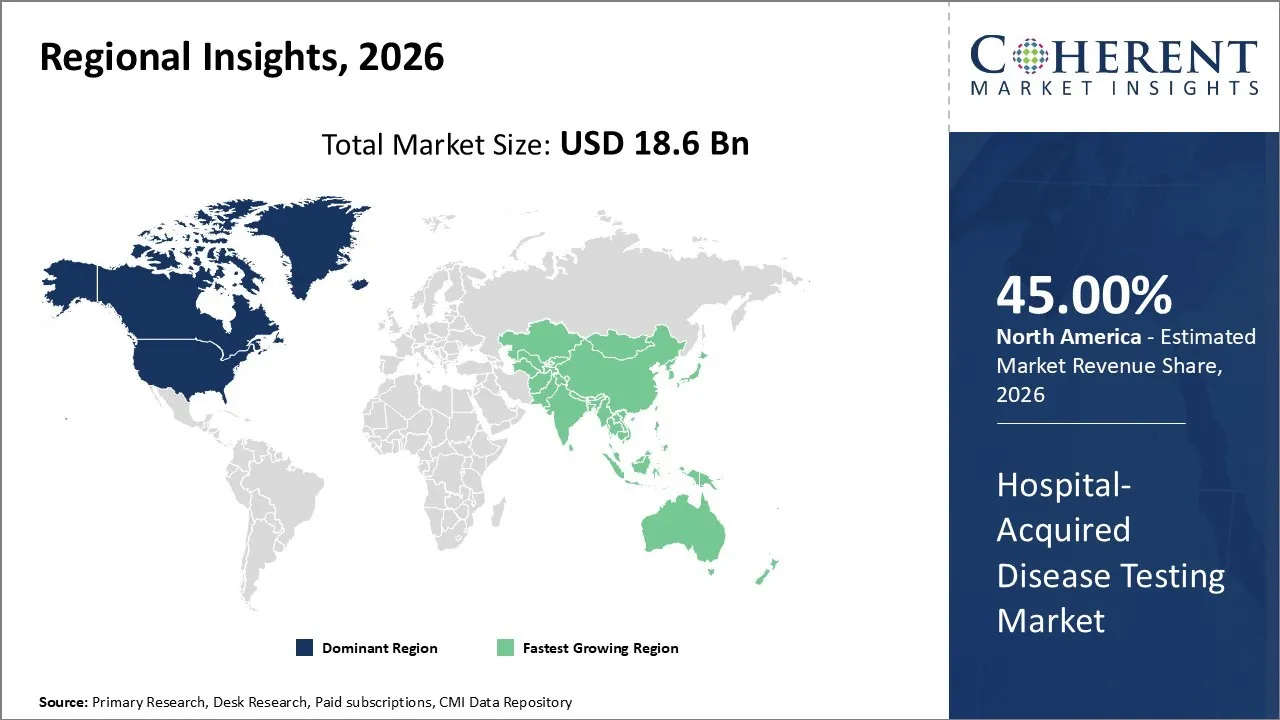
- Based on Region, North America is set to lead the Hospital-Acquired Disease Testing market with 45% share in 2026. While, Asia Pacific is anticipated to be the fastest growing region.
Market Overview
The hospital-acquired disease (HAD) testing market is primarily driven by the rising prevalence of healthcare-associated infections (HAIs), including bloodstream infections, pneumonia, and surgical site infections, which increase the need for timely and accurate diagnostics. Growing antimicrobial resistance further accelerates demand for advanced testing solutions. Additionally, an aging population and higher incidence of chronic diseases lead to longer hospital stays, increasing infection risk. Technological advancements such as molecular diagnostics and PCR-based methods improve detection speed and accuracy, boosting adoption. Increasing healthcare expenditure, regulatory mandates for infection control, and greater awareness of patient safety and hospital hygiene also significantly contribute to market growth.
Current Events and their Impacts on the Hospital-Acquired Disease Testing Market
Current Event | Description and its Impact |
Technological Innovations in Rapid Diagnostics |
|
Market Expansion along with Strategic Partnerships |
|
Segmental Insights
- Current Industry Events of 2026
- Market Size Estimation
- Regional Breakdown
- Competitive Landscape
- Customer Intelligence
- Segmental Analysis
- Pricing Analysis
- Key Market Drivers, Challenges & Future Trends
- Customized Insights Section
Hospital-Acquired Disease Testing Market Insights, By Test Type: Urinary Tract Infection represent the largest share
In terms of test type, the urinary tract infection segment is expected to lead the market with 37% share in 2026, owing primarily to the prevalence, impact, and clinical complexity of healthcare-associated urinary tract infections, which continue to be a significant burden in hospitals worldwide. Urinary Tract Infections are among the most common hospital-acquired infections, with a major association with in dwelling catheter use, which remains widespread in clinical settings.
Regional Insights
North America Hospital-Acquired Disease Testing Market Analysis & Trends
North America is expected to dominate the Hospital-Acquired Disease Testing market with 45% share in 2026, owing to several region-specific attributes that underscore its leadership position. A key factor driving this dominance is the well-established healthcare infrastructure combined with substantial investments in advanced diagnostic technologies. The U.S. Centers for Disease Control and Prevention (CDC) reports that hospital-associated infections affect approximately 1 in 31 hospital patients on any given day in the United States, which has escalated the urgency for comprehensive testing and monitoring programs in healthcare facilities across North America.
For instance, in June 2025, bioMerieux, a leading company in medical testing, bought Day Zero Diagnostics, a U.S. company that uses genome sequencing and AI to fight antibiotic-resistant infections. This deal will aid bioMérieux improve rapid testing and next-generation sequencing, showing its commitment to better healthcare and smarter use of antibiotics.
Asia Pacific Hospital-Acquired Disease Testing Market Analysis & Trends
Asia Pacific is expected to exhibit the fastest growth, due to a combination of expanding healthcare infrastructure, increasing governmental focus on infection control, as well as rising awareness around antibiotic stewardship and rapid pathogen detection technologies. Countries such as China, India, Japan, and South Korea are experiencing high investments in hospital modernization and diagnostic lab expansions aimed at combating the growing threat of nosocomial infections exacerbated by high patient turnover and urbanization.
For instance, India’s National Centre for Disease Control (NCDC) recently reported that enhanced surveillance programs implemented in major metropolitan hospitals have resulted in increased early detection of hospital-acquired pathogens via PCR-based assays and cartridge-based nucleic acid amplification tests (CBNAAT).
Hospital-Acquired Disease Testing Market Outlook Country-Wise
The U.S. Hospital-Acquired Disease Testing Market Trends
The U.S. contributes the highest share in the Hospital-Acquired Disease (HAD) Testing market in the region owing to its well-established healthcare infrastructure, high adoption of advanced diagnostic technologies, as well as stringent regulatory frameworks that emphasize infection control. The U.S. focuses on preventing infections in hospitals, with help from federal agencies like the CDC and NIH, which fund research and promote the best ways to fight hospital-acquired infections.
For instance, in 2023, the CDC launched several updated guidelines on the testing and management of multidrug-resistant organisms (MDROs), which propelled hospitals and labs to adopt sophisticated molecular diagnostics and rapid testing platforms to curb the spread of HAIs.
China Hospital-Acquired Disease Testing Market Trends
China contributes the highest share in the Hospital-Acquired Disease (HAD) Testing Market within the region owing to several critical factors. China leads the market because it has a large healthcare system and the government is actively working to prevent infections in hospitals. Authorities have invested a lot in programs and better diagnostic tools to fight hospital-acquired infections.
Market Report Scope
Hospital-Acquired Disease Testing Market Report Coverage
| Report Coverage | Details | ||
|---|---|---|---|
| Base Year: | 2025 | Market Size in 2026: | USD 18.6 Bn |
| Historical Data for: | 2020 To 2024 | Forecast Period: | 2026 To 2033 |
| Forecast Period 2026 to 2033 CAGR: | 15.5% | 2033 Value Projection: | USD 49.4 Bn |
| Geographies covered: |
| ||
| Segments covered: |
| ||
| Companies covered: | Luminex Corporation, Diatherix Laboratories, Life Technologies, Cantel Medical Corporation, Meridian Biosciences Inc, Nordion Inc, Qiagen GmbH, F.Hoffmann-La Roche Ltd., Biomerieux, and Cepheid | ||
| Growth Drivers: |
| ||
| Restraints & Challenges: |
| ||
Hospital-Acquired Disease Testing Market Driver
Rising incidence of healthcare-associated infections (HAIs)
The rising incidence of healthcare-associated infections (HAIs) is majorly driving the expansion of the hospital-acquired disease testing market, as healthcare systems globally are under high pressure to monitor, detect, and control these infections promptly. HAIs, which include infections such as bloodstream infections, surgical site infections, and pneumonia, present considerable challenges to patient safety and healthcare quality.
Stringent regulatory requirements for infection control and patient safety
Stringent regulatory requirements focused on infection control and patient safety are highly steering the growth of the hospital-acquired disease (HAD) testing market. Hospitals and healthcare facilities globally face mounting pressure to adhere to rigorous standards that prevent the transmission of infections within clinical environments. Regulatory bodies such as the U.S. Centers for Disease Control and Prevention (CDC) as well as the World Health Organization (WHO) target strict infection prevention protocols, including comprehensive screening and testing procedures for pathogens responsible for hospital-acquired infections (HAIs).
Hospital-Acquired Disease Testing Market Opportunity
Development of point-of-care testing devices for rapid infection detection
The development of point-of-care (POC) testing devices for rapid infection detection represents a major opportunity within the hospital-acquired infection (HAI) testing market due to the instant need for timely diagnosis and intervention to curb the spread of infections. Hospital-acquired infections, such as bloodstream infections, surgical site infections, ventilator-associated pneumonia, etc., pose major challenges globally, usually leading to prolonged hospital stays, increased healthcare costs, and higher patient mortality.
Analyst Opinion (Expert Opinion)
The hospital-acquired disease (HAD) testing market is experiencing significant momentum driven by rising awareness about healthcare-associated infections and the critical need for early diagnosis and containment. Rising incidences of multidrug-resistant organisms (MDROs) and pathogens such as Clostridium difficile, MRSA, and VRE are compelling healthcare institutions to adopt advanced diagnostic solutions.
Fast and accurate tests help treat patients sooner, make them healthier, and reduce stress on hospitals. Additionally, strict regulations and guidelines by health authorities focus routine surveillance, further bolstering demand for HAD testing.
However, innovation in molecular diagnostics, point-of-care testing, as well as automation presents substantial opportunities to improve testing efficiency and accessibility. Emerging technologies like next-generation sequencing (NGS) are poised to revolutionize pathogen identification as well as antimicrobial resistance detection, thereby expanding market surge.
Geographically, North America dominates the HAD testing market owing to robust healthcare infrastructure, higher adoption of advanced diagnostics, as well as favorable reimbursement policies. Conversely, the Asia-Pacific region is the fastest-growing market segment, fueled by rising healthcare investments, improving infrastructure, as well as increasing prevalence of hospital-acquired infections.
Speak to the analyst
Want personalized insights?
Take the findings above to one of our principal consultants, or have the report rebuilt around the segments, geographies and competitors you actually track.
Global Hospital-Acquired Disease Testing Market: Key Developments
- In February 2026, MedGenome, a diagnostics company in India, has added a new test called MetaSeq. This blood test can detect over 1,400 different disease-causing germs in one go.
- In March 2026, the BD BACTEC FXI Culture System will be available soon. It is a new lab test system that helps laboratories improve how they detect infections and care for patients.
- In March 2026, MeMed BV Flex is a new test that can quickly tell if an infection is bacterial or viral by looking at the body’s immune response. It has been given Breakthrough Device Designation by the FDA, showing it is an innovative tool for diagnosing infections in hospitals.
Market Segmentation
- By Test Type
- Urinary Tract Infection
- Surgical Site Infection
- Pneumonia Stents
- Blood Stream Infection
- Methicillin-resistant Staphylococcus Aureus (MRSA)
- Others
- By Region
- North America
- U.S.
- Canada
- Latin America
- Brazil
- Argentina
- Mexico
- Rest of Latin America
- Europe
- Germany
- U.K.
- Spain
- France
- Italy
- Russia
- Rest of Europe
- Asia Pacific
- China
- India
- Japan
- Australia
- South Korea
- ASEAN
- Rest of Asia Pacific
- Middle East
- GCC Countries
- Israel
- Rest of Middle East
- Africa
- South Africa
- North Africa
- Central Africa
- North America
- Key Players
- Luminex Corporation
- Diatherix Laboratories
- Life Technologies
- Cantel Medical Corporation
- Meridian Biosciences Inc
- Nordion Inc
- Qiagen GmbH
- Hoffmann-La Roche Ltd.
- Biomerieux
- Cepheid
Sources
Primary Research Interviews
- Hospital Laboratory Directors and Managers
- Infection Control Specialists and Healthcare Epidemiologists
- Clinical Microbiologists and Laboratory Technicians
- Healthcare IT Solution Providers
- Others
Databases
- WHO Global Health Observatory Database
- CDC Healthcare-Associated Infections Database
- OECD Health Statistics Database
- National Healthcare Safety Network (NHSN)
- Others
Magazines
- Laboratory Equipment Magazine
- Healthcare IT News Magazine
- Infection Control Today Magazine
- Clinical Laboratory Management Magazine
- Medical Laboratory Observer
- Others
Journals
- American Journal of Infection Control
- Journal of Clinical Microbiology
- Infection Control & Hospital Epidemiology
- Others
Newspapers
- Healthcare Finance News
- Modern Healthcare
- FierceHealthcare
- Healthcare Dive
- Medical Device Network
- Others
Associations
- Association for Professionals in Infection Control and Epidemiology (APIC)
- Clinical and Laboratory Standards Institute (CLSI)
- American Hospital Association (AHA)
- Society for Healthcare Epidemiology of America (SHEA)
- International Association for Healthcare Communications & Marketing (IAHCM)
- Others
Public Domain Sources
- Centers for Disease Control and Prevention (CDC)
- World Health Organization (WHO)
- U.S. Food and Drug Administration (FDA)
- European Centre for Disease Prevention and Control (ECDC)
- National Institute for Occupational Safety and Health (NIOSH)
- Others
Proprietary Elements
- CMI Data Analytics Tool
- Proprietary CMI Existing Repository of Information for the Last 8 Years
Get access to 250+ pages report
Every segment, forecast, competitor profile and data table behind the analysis above — available for instant download.
- ESOMAR Member
- ISO 9001:2015 Certified
- D-U-N-S Registered
- GDPR & CCPA Compliant
Missing comfort of reading report in your local language? Find your preferred language:
Transform your Strategy with Exclusive Trending Reports
Frequently Asked Questions
The global hospital-acquired disease testing market size was valued at USD 18.6 Bn in 2026 and is expected to reach USD 49.4 Bn in 2033.
Major players operating in the market include Luminex Corporation, Diatherix Laboratories, Life Technologies, Cantel Medical Corporation, Meridian Biosciences Inc, Nordion Inc, Qiagen GmbH, F.Hoffmann-La Roche Ltd., Biomérieux, and Cepheid
Among test type, the urinary tract infection segment estimated significant revenue in 2026.
Increasing incidence of hospital acquired infections is one of the major factors that is expected to propel growth of the market over the forecast period
The market is estimated to exhibit a CAGR of 15.5% till 2033.
Among region, North America is expected to witness significant growth over the forecast period.