

Disposable IV Therapy Products Market Size and Share Analysis- 2026 To 2033
The Disposable IV Therapy Products Market size is anticipated to grow at a CAGR of 5.9% with USD 3.35 Bn in 2026 and is expected to reach USD 4.99 Bn in 2033. The growth is owing to rising hospital admissions, surgical procedures, chronic disease management, and the need for safer single-use IV administration products. Advanced approaches such as closed IV sets, smart infusion pumps, needleless connectors, antimicrobial access devices, and precision flow-control systems are improving therapy safety and infection prevention. Approximately 25 million people receive hospitalized intravenous therapy.
Key Takeaways
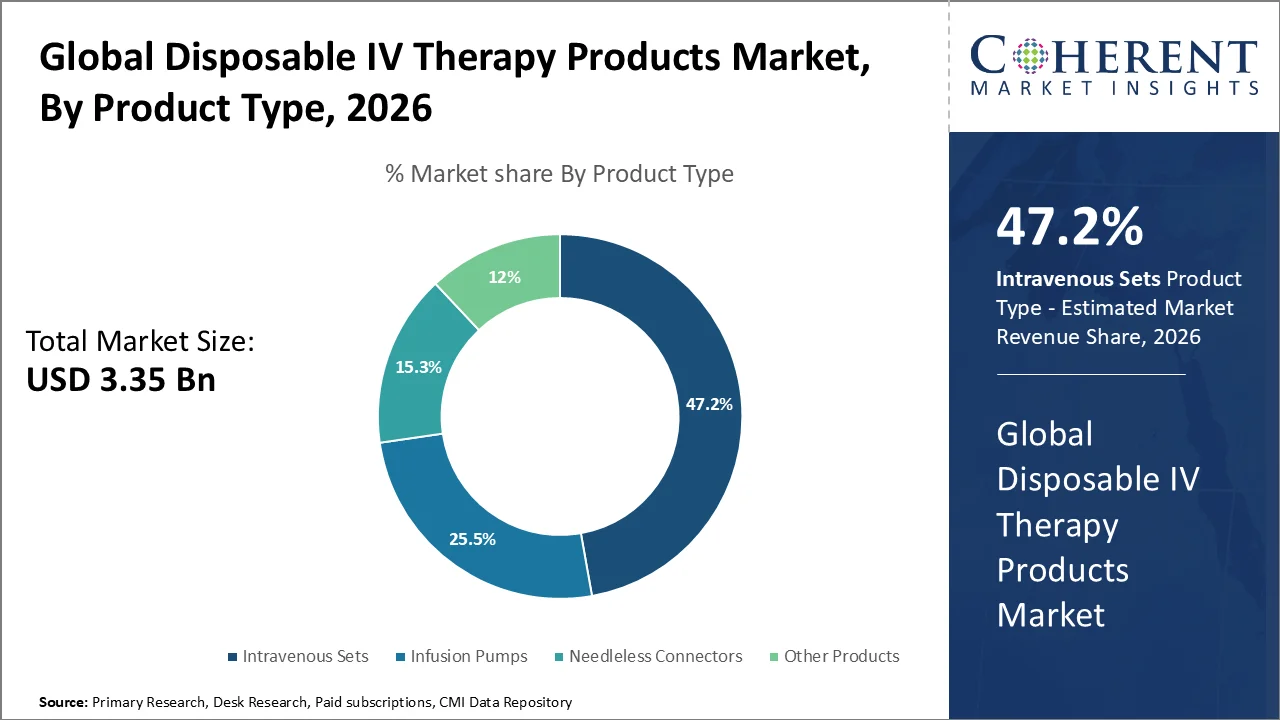
- Intravenous sets segment is expected to account for the largest share of 47.2% in 2026. The segment’s growth is owing to its extensive use in fluid administration, medication delivery, blood transfusion, and perioperative care, supported by rising preference for sterile, disposable products to reduce infection risks. According to clinical practice data, up to 80% of hospitalized patients receive peripheral IV fluid administration as part of routine care, underlining widespread use of IV sets in clinical settings.
- The hospitals segment is expected to hold 53.6% market share by 2026. The growth is attributable to the high patient admission rate, emergency care procedures, surgical volumes, ICU utilization, and continuous demand for IV therapy products across inpatient, outpatient, oncology, and critical care departments. Government and clinical surveillance data show approximately one in 31 hospital patients has at least one healthcare
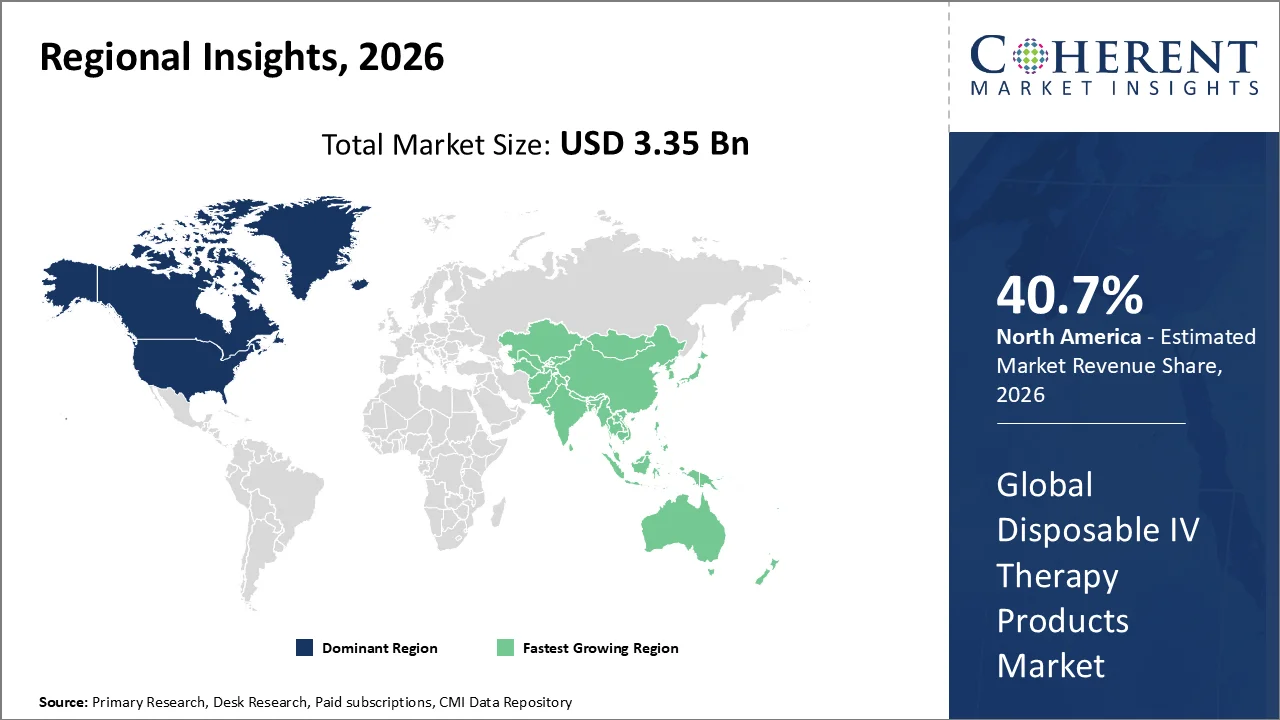
- North America is expected to acquire the dominant share of 40.7% in 2026. The region’s growth is owing to the advanced healthcare infrastructure, high adoption of single‑use infusion products, strict infection‑control standards, large hospital networks, and increasing use of IV therapy in chronic disease management, surgery, and home infusion care. CDC national surveillance systems cover data from more than 38,000 U.S. healthcare facilities reporting HAI prevention efforts, reflecting the extensive IV therapy utilization and infection‑prevention infrastructure.
Segmental Insights
Why is Intravenous Sets Segment Acquiring the Highest Share in the Market?
Intravenous sets segment is projected to account for the largest Disposable IV Therapy Products Market share of 47.2% in 2026. The segment’s growth is owing to its pervasive clinical use in fluid management, parenteral drug delivery, and emergency care, as well as stringent infection‑control guidelines that emphasize safe, single‑use consumables.
Official surveillance data from the U.S. Centers for Disease Control and Prevention (CDC) indicate that an estimated 18,100 central lineunderscoring the ongoing priority on sterile IV device use. Globally, peripheral intravenous
In April 2026, BD announced the launch of its redesigned peripheral IV administration set with enhanced infection barrier features to support safe infusion delivery, a development aligned with rising regulatory emphasis on reducing device
- Current Industry Events of 2026
- Market Size Estimation
- Regional Breakdown
- Competitive Landscape
- Customer Intelligence
- Segmental Analysis
- Pricing Analysis
- Key Market Drivers, Challenges & Future Trends
- Customized Insights Section
Hospitals holds the Largest Market Share
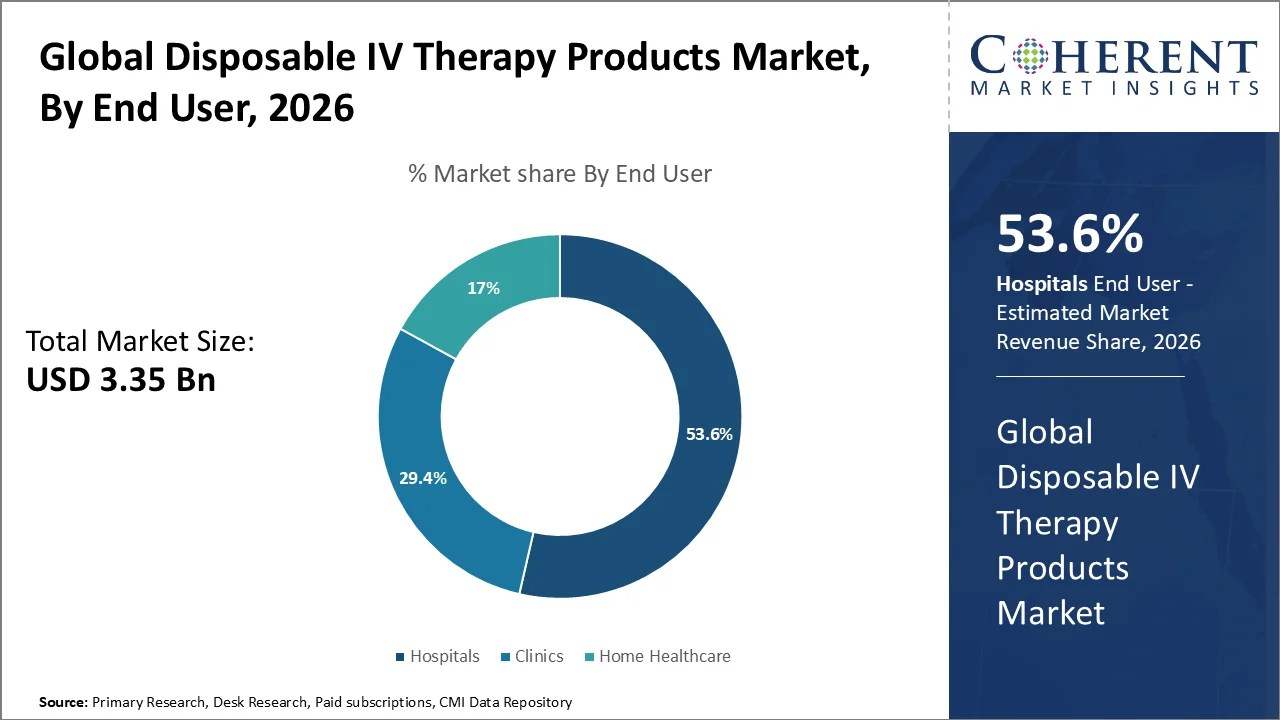
Based on end user, the hospitals segment is poised to dominate the market and accounts for a considerable 53.6% share in 2026. The segment’s growth is owing to the high volume of inpatient admissions, emergency care, surgeries, oncology infusions, antibiotic therapy, hydration support, blood transfusion support, and critical care drug delivery handled inside hospitals.
AHRQ reported 32.9 million U.S. hospital stays in 2022, reflecting the large treatment base where disposable IV sets, catheters, connectors, and infusion accessories are routinely consumed. The CMS 2024 data recorded 14.4 million operating room procedures in U.S. hospitals, thereby highlighting the substantial demand for IV therapy during surgical as well as perioperative care.
In May 2025, the FDA cleared Capillary Biomedical’s SteadiSet Infusion Set as substantially equivalent under 510(k), thereby supporting the continued product development in safer infusion delivery. This makes hospitals the primary purchasing point for sterile, single-use IV consumables.
Market Drivers
Shift Toward Home Infusion and Alternate-Site Care is Transforming the Disposable IV Therapy Products Industry in the US
Shift toward home infusion and alternate site care is transforming the Disposable IV Therapy Products Market in the US because infusion delivery is moving beyond hospital beds. CMS defines home infusion therapy as intravenous or subcutaneous drug administration at home, supported by pumps, nursing services, and supplies such as tubing and catheters.
CMS’ February 2026 monitoring report recorded an average of 6,991 home infusion therapy service visits per quarter from Q1 2023 to Q2 2025, showing sustained use of disposable infusion supplies in non hospital settings. The same report recorded 193,567 home DME prescription fills and 16,507 home infusion users in 2024 for drugs qualifying for the HIT benefit.
In June 2025, the U.S. Food and Drug Administration cleared ICU Medical’s Class II Clave Neutral‑Displacement Needlefree IV Connectors. It enabling broader marketing of sterile IV connectors intended for infusion fluid pathways, thereby reinforcing demand for disposables in both home and clinical infusion environments.
Smart Pump-Compatible IV Sets: A Key Advancement in Disposable IV Therapy Products
Smart pump compatible IV sets are emerging as a key advancement in disposable IV therapy because hospitals depend on accurate, software guided infusion for fluids, antibiotics, chemotherapy, parenteral nutrition, and blood products. These sets must work precisely with pump hardware and drug library software, making compatibility a safety critical parameter rather than only a procurement preference.
In September 2025, the FDA posted an update on BD Alaris pump infusion sets after performance variations were identified when the BD Alaris Pump Module model 8100 was used with a subset of compatible infusion sets. This highlighted how small differences in disposable set performance can affect flow accuracy as well as patient safety.
In April 2024, Baxter announced the U.S. FDA clearance for its Novum IQ large volume infusion pump with Dose IQ Safety Software. The launch strengthens the demand for disposable IV sets designed for connected, intelligent infusion platforms.
Current Events and Their Impact on the Disposable IV Therapy Products Market
Current Event | Description and its Impact |
FDA Quality Management System Regulation (QMSR) Implementation for Medical Devices (2026) |
|
EU EUDAMED Mandatory Registration and MDR Traceability Rollout (2026) |
|
Disposable IV Therapy Products Market Trends
- The rising hospitalization, emergency care, and chronic infusion therapy is increasing the demand for single-use IV sets, catheters, connectors, extension lines, and fluid administration disposables in hospitals and clinics.
- The growing infection-prevention focus is supporting the adoption of sterile, disposable, safety-engineered IV components, closed systems, needleless connectors, and single-patient-use consumables to reduce contamination and bloodstream infection risks. Globally, the WHO notes at least 16 billion injections are administered each year.
- Expansion of home infusion and ambulatory care strengthens demand for easy-to-use disposable IV sets, pump-compatible tubing, securement devices, and needleless connectors for antibiotics, biologics, hydration, and parenteral therapies. In the U.S., Medicare’s home infusion therapy benefit covers certain IV/subcutaneous drugs administered through durable medical equipment pumps.
- Rising sepsis, oncology, diabetes, renal, and post-surgical care volumes increase use of IV fluids, antibiotics, chemotherapy, nutrition, and supportive therapies. CDC states that at least 1.7 million adults in the U.S. develop sepsis each year, supporting high IV therapy utilization.
- Stronger regulatory focus on infusion safety, microbial ingress testing, device compatibility, and adverse event reduction is pushing manufacturers toward safer IV administration sets, improved connectors, better labeling, and higher-quality disposable infusion components.
Regional Insights
North America Disposable IV Therapy Products Market Leadership Driven by High Care Volume and Regulated Infusion Safety
North America is set to account for the leading position in the Disposable IV Therapy Products Market. The region occupies a substantial 40.7% share in 2026. The growth is mainly driven by the region’s inpatient volumes, infection control standards, and consistent use of IV administration across hospitals, outpatient centers, and home care.
In the U.S., AHRQ’s National Inpatient Sample estimates over 33 million hospitalizations nationally each year, creating recurring demand for IV sets, cannulas, tubing, syringes, saline flushes, and disposable products. Canada also supports the regional demand, with the CIHI reporting 3.14 million acute inpatient hospitalizations in 2024 to 2025.
In January 2024, Linear Health Sciences was awarded a national group purchasing agreement with Premier, Inc. for IV Therapy Needleless Connectors. The agreement allows the Premier members to access pre-negotiated pricing and terms for the Orchid SRV force-activated separation device. This development underscores the adoption and accessibility of innovative disposable IV therapy products.
Asia Pacific Disposable IV Therapy Products Market Trends
The Asia Pacific region is poised to be as the fastest-growing region through 2026-2033. The region’s growth is owing to the rising hospital admissions, wider insurance coverage, and higher use of sterile IV sets, cannulas, extension lines, and infusion pump administration sets.
In India, AB PM-JAY authorized 11.69 crore hospital admissions worth Rs. 1.73 lakh crore as of February 28, 2026, across 1,961 procedures and 27 medical specialties, indicating a large base of inpatient treatments requiring IV access. In Australia, the AIHW reported 12.8 million hospitalizations and 43.6 million outpatient services in 2024 to 2025, thereby supporting the demand for disposable IV consumables.
In May 2025, Stada Pharmaceuticals Australia Pty Ltd registered its electric infusion pump administration set (ARTG ID 488606) as a Class IIb medical device. This registration supports the product adoption in Australia, thereby enhancing safe and precise infusion delivery.
Infection Prevention and Safety-Focused Innovations Accelerates Disposable IV Therapy Products Adoption in United States
The United States Disposable IV Therapy Products Market has seen robust growth. The growth is driven by the safety‑focused innovations and rising clinical use across acute and outpatient care. According to CDC
In March 2026, the U.S. Food and Drug Administration issued 510(k) clearance for Fresenius Kabi Plasmacell‑C Disposable Set (BK251289), a single‑use IV disposable set designed to support safe administration workflows.
China Disposable IV Therapy Products Market Trends
China’s disposable IV therapy products market is supported by high hospital treatment volumes and tighter device quality oversight. In 2024, the National Health Commission reported 10.15 billion medical institution visits and 311.92 million inpatient admissions, indicating sustained demand for IV sets, cannulas, connectors, and sterile administration consumables across hospitals and primary care.
In January 2024, Beijing Volt Technology Co., Ltd. received national medical device registration for its disposable light-proof infusion set with needle. This approval supports localized IV set availability in hospitals in China.
Who are the Major Companies in Disposable IV Therapy Products Industry
Some of the major key players in Disposable IV Therapy Products industry are B. Braun Melsungen AG, Baxter, Becton Dickinson & Company, Caesarea Medical Electronics, ICU Medical, Inc., JMS Co. Ltd., Lily Medical Corporation, Smiths Medical, and Terumo Corporation.
Key News
- In October 2025, SQ Innovation announced FDA approval of Lasix ONYU, a drug-device combination enabling subcutaneous furosemide infusion for heart failure patients outside hospital settings. This approval underscores innovation in disposable IV therapy products, offering cost-effective, at-home treatment alternatives.
- In October 2025, Takeda announced FDA approval and U.S. availability of HyHub and HyHub Duo, dedicated devices designed to simplify HYQVIA preparation. These devices reduce the number of steps and ancillary supplies compared to pooling bags, enabling patients 17 years and older to safely transfer dual vial units for subcutaneous infusion in home or clinical settings.
- In November 2024, Avanos Medical announced that CMS confirmed separate Medicare payment for its ON-Q elastomeric infusion pump and ambIT disposable electronic infusion pump under the NOPAIN Act. This milestone highlights increased reimbursement support and adoption of disposable IV therapy products for non-opioid pain management in hospitals and ASCs.
- In September 2024, Braun Medical received FDA 510(k) clearance for the Introcan Safety 2 Deep Access IV Catheter, an advanced IV device designed to access deeper veins and extend catheter dwell time. The catheter integrates the proven technologies of the Introcan Safety 2 Multi-Access and Deep Access devices, offering fully automatic passive needlestick protection and multi-access blood control.
Market Report Scope
Disposable IV Therapy Products Market Report Coverage
| Report Coverage | Details | ||
|---|---|---|---|
| Base Year: | 2025 | Market Size in 2026: | USD 3.35 Bn |
| Historical Data for: | 2020 To 2024 | Forecast Period: | 2026 To 2033 |
| Forecast Period 2026 to 2033 CAGR: | 5.9% | 2033 Value Projection: | USD 4.99 Bn |
| Geographies covered: |
| ||
| Segments covered: |
| ||
| Companies covered: | B. Braun Melsungen AG, Baxter, Becton Dickinson & Company, Caesarea Medical Electronics, ICU Medical, Inc., JMS Co. Ltd., Lily Medical Corporation, Smiths Medical, and Terumo Corporation. | ||
| Growth Drivers: |
| ||
| Restraints & Challenges: |
| ||
Analyst Opinion
- Disposable IV therapy products are driven by growing clinical need. Nearly 16 billion injections are administered globally each year, and a significant portion of these rely on IV delivery. That means the market is not growing because of trends. It is growing because hospitals and clinics still need safe and effective fluid and medication administration.
- Hospital and emergency care usage is one of the largest drivers of disposable IV demand. Estimates show about 35.7 million hospital admissions and 155.4 million emergency department visits happen annually in the U.S. alone, generating continuous demand for IV sets, infusion pumps, and needleless connectors.
- Single-use, sterile IV products are gaining significant traction, with clinical data showing that proper usage can reduce healthcare-associated infections by up to 70%. This high safety and patient care impact further drive growth in the disposable IV therapy market, encouraging wider adoption of advanced infusion technologies across both established and emerging markets.
Speak to the analyst
Want personalized insights?
Take the findings above to one of our principal consultants, or have the report rebuilt around the segments, geographies and competitors you actually track.
Market Segmentation
- By Product Type (Revenue, USD Bn, 2021-2033)
- Intravenous Sets
- Infusion Pumps
- Needleless Connectors
- Other Products
- By End User (Revenue, USD Bn, 2021-2033)
- Hospitals
- Clinics
- Home Healthcare
- By Region (Revenue, USD Bn, 2021-2033)
- North America
- U.S.
- Canada
- Latin America
- Brazil
- Mexico
- Argentina
- Rest of Latin America
- Europe
- Germany
- U.K.
- France
- Italy
- Spain
- Russia
- Rest of Europe
- Asia Pacific
- China
- India
- Japan
- Australia
- South Korea
- ASEAN
- Rest of Asia Pacific
- Middle East
- GCC
- Israel
- Rest of Middle East
- Africa
- South Africa
- Central Africa
- North Africa
- North America
Sources
Primary Research Interviews
- Disposable IV Therapy Product Manufacturers
- IV Catheter, Cannula & Infusion Set Manufacturers
- Hospital Procurement Managers
- Infusion Therapy Nurses & Vascular Access Specialists
- Hospital Infection Control Specialists
- Medical Device Distributors & Suppliers
- Ambulatory Care & Home Infusion Service Providers
- Regulatory & Quality Compliance Consultants
- Others
Databases
- Bloomberg Terminal
- Thomson Reuters Eikon
- IQVIA
- GlobalData Medical Devices
- S&P Global Market Intelligence
- UN Comtrade
- FDA Medical Device Databases
- Others
Magazines
- Medical Device Network
- Medical Design & Outsourcing
- Healthcare Purchasing News
- Infection Control Today
- MassDevice
- MedTech Dive
- Others
Journals
- Journal of Infusion Nursing
- Journal of Vascular Access
- American Journal of Infection Control
- Clinical Infectious Diseases
- BMJ Quality & Safety
- The Lancet Infectious Diseases
- Others
Newspapers
- Financial Times
- The Wall Street Journal
- Reuters
- Bloomberg News
- Business Standard
- The Economic Times
- Others
Associations
- Infusion Nurses Society
- Association for Vascular Access
- Association for Professionals in Infection Control and Epidemiology
- Advanced Medical Technology Association
- MedTech Europe
- Association for the Advancement of Medical Instrumentation
- Others
Public Domain Sources
- U.S. Food and Drug Administration
- Centers for Disease Control and Prevention
- World Health Organization
- National Institutes of Health
- European Medicines Agency
- European Commission – Medical Devices Regulation
- Centers for Medicare & Medicaid Services
- NHS England
- World Bank Open Data
- Others
Proprietary Elements
- CMI Data Analytics Tool
- Proprietary CMI Existing Repository of Information for the Last 10 Years
Get access to 250+ pages report
Every segment, forecast, competitor profile and data table behind the analysis above — available for instant download.
- ESOMAR Member
- ISO 9001:2015 Certified
- D-U-N-S Registered
- GDPR & CCPA Compliant
Missing comfort of reading report in your local language? Find your preferred language:
Transform your Strategy with Exclusive Trending Reports
Frequently Asked Questions
The Disposable IV Therapy Products Market is expected to reach USD 4.99 Bn in 2033.
Major players operating in the global Disposable IV Therapy Products Market include B. Braun Melsungen AG, Baxter, Becton Dickinson & Company, Caesarea Medical Electronics, ICU Medical, Inc., JMS Co. Ltd., Lily Medical Corporation, Smiths Medical, and Terumo Corporation.
The stringent regulatory compliance for single-use plastics, soaring costs of advanced safety devices, environmental concerns leading to biomedical waste scrutiny, and a shortage of trained professionals to manage complex infusion technologies are the key factors hampering growth of the market.
The rising prevalence of chronic diseases, an aging global population, and a surging demand for infection-control measures is boosting demand for Disposable IV Therapy Products.
The Disposable IV Therapy Products Market is anticipated to grow at a CAGR of 5.9% between 2026 and 2033.
Among regions, North America is expected to account for a largest market share in the global Disposable IV Therapy Products Market over the forecast period.
Disposable IV (Intravenous) therapy products are single-use medical devices designed to safely deliver fluids, medications, or nutrients directly into a patient's bloodstream.