

Lab Automation Market Size and Share Analysis: (2026-2033)
The lab automation market size is anticipated to grow at a CAGR of 7.2% with USD 8.37 Bn in 2026 and is expected to reach USD 13.62 Bn in 2033. The primary drivers are largely defined by increasing diagnostic workloads, as CDC notes nearly 14 billion laboratory tests are conducted annually and 70% of medical decisions depend on laboratory results. Some of the other drivers include rising labor costs, shortage of skilled professionals, increased R&D spending, and the need for standardized workflows, particularly in genomics and clinical testing
Key Takeaways
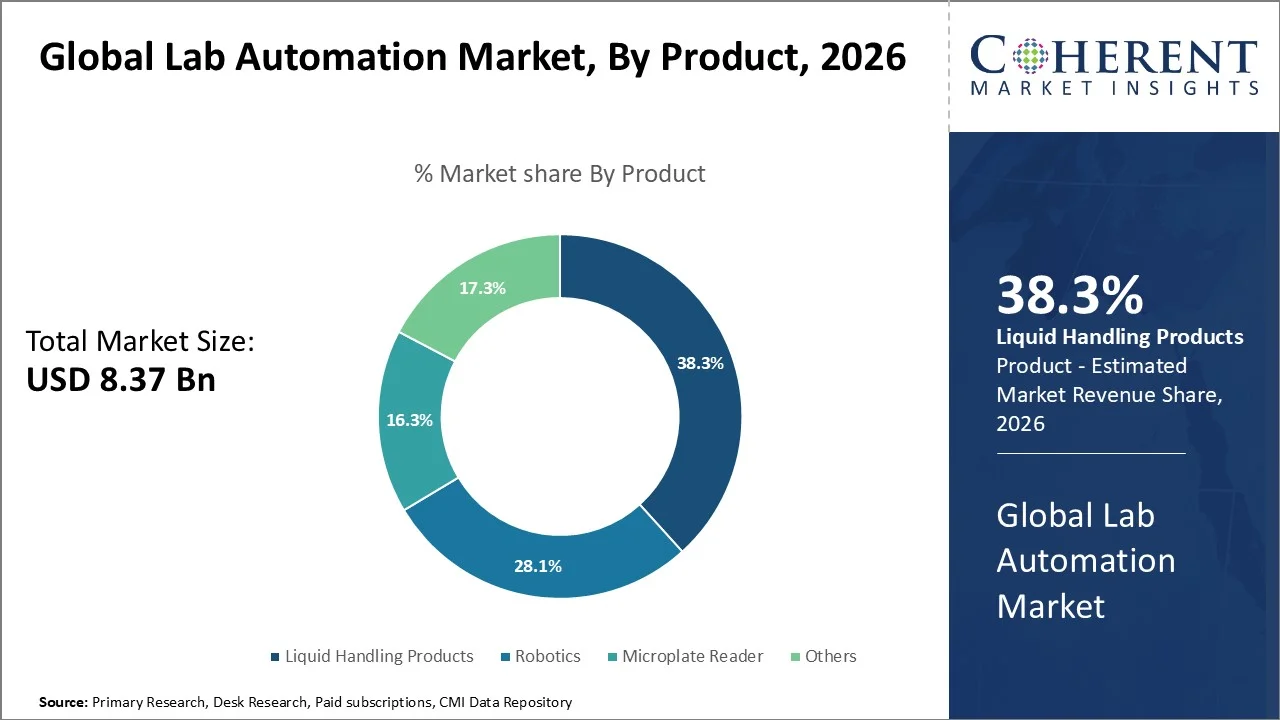
- Liquid handling products is expected to account for the largest share of 38.30% in 2026. The segment is growing because these products help automate diagnostic lab workflows, reduce manual errors, and improve the efficiency of routine testing. For instance, in April 2026, SPT Labtech collaborated with EMBL GeneCore to advance fully walkaway automated genomics workflows using its firefly + all-in-one liquid handling platform.
- On the basis of end user, biopharmaceuticals and pharmaceuticals is set to lead with 42.50% in 2026. The segment’s growth is owing to increasing demand for biologics, precision medicine, drug discovery, and automated laboratory workflows for sample preparation, assay development, and quality control. In 2025, the FDA approved 46 novel drugs, indicating strong pharmaceutical and biologics development activity.
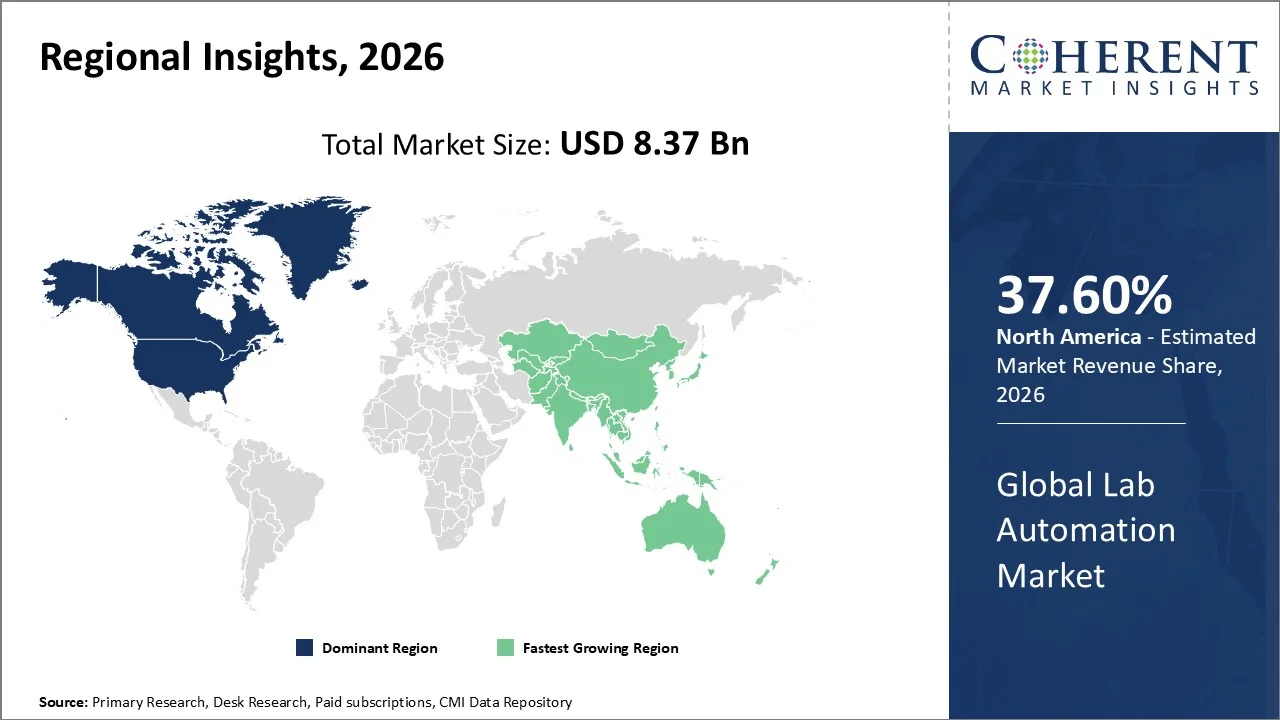
- North America is expected to acquire the prominent share of 37.60% in 2026. This is due to region’s advanced healthcare infrastructure, strong clinical research ecosystem, and high adoption of automation systems across clinical laboratories, hospitals, and research facilities. gov currently lists 582,629 studies with locations across all 51 U.S. states and 225 countries/territories, thereby showing the scale of clinical research activity supporting lab automation demand.
Segmental Insights
Why is Liquid Handling Products Acquiring the Largest Share?
On the basis of product, the liquid handling products is projected to account for the largest lab automation market share of 38.3% in 2026. The segment is gaining the highest share because liquid handling is required at the most repetitive and error-sensitive stage of laboratory workflows, including sample preparation, reagent dispensing, assay setup, serial dilution, PCR preparation, ELISA workflows, microplate processing, and high-throughput screening.
The demand is especially strong in clinical diagnostics, pharmaceutical research, biotechnology, academic labs, and CROs. This is because laboratories need faster turnaround time, lower manual variation, and higher reproducibility. The regulatory alignment is also contributing to the adoption. For example, in May 2025, the FDA recognized multiple CLSI laboratory automation standards covering specimen container barcodes, specimen carriers, instrument communication, specimen identification data, and IT security, which strengthens interoperability as well as confidence in automated workflows.
In July 2025, These factors directly justify why liquid handling products continue to hold the largest share in the lab automation market.
- Current Industry Events of 2026
- Market Size Estimation
- Regional Breakdown
- Competitive Landscape
- Customer Intelligence
- Segmental Analysis
- Pricing Analysis
- Key Market Drivers, Challenges & Future Trends
- Customized Insights Section
Biopharmaceuticals and Pharmaceuticals hold the Largest Market Share
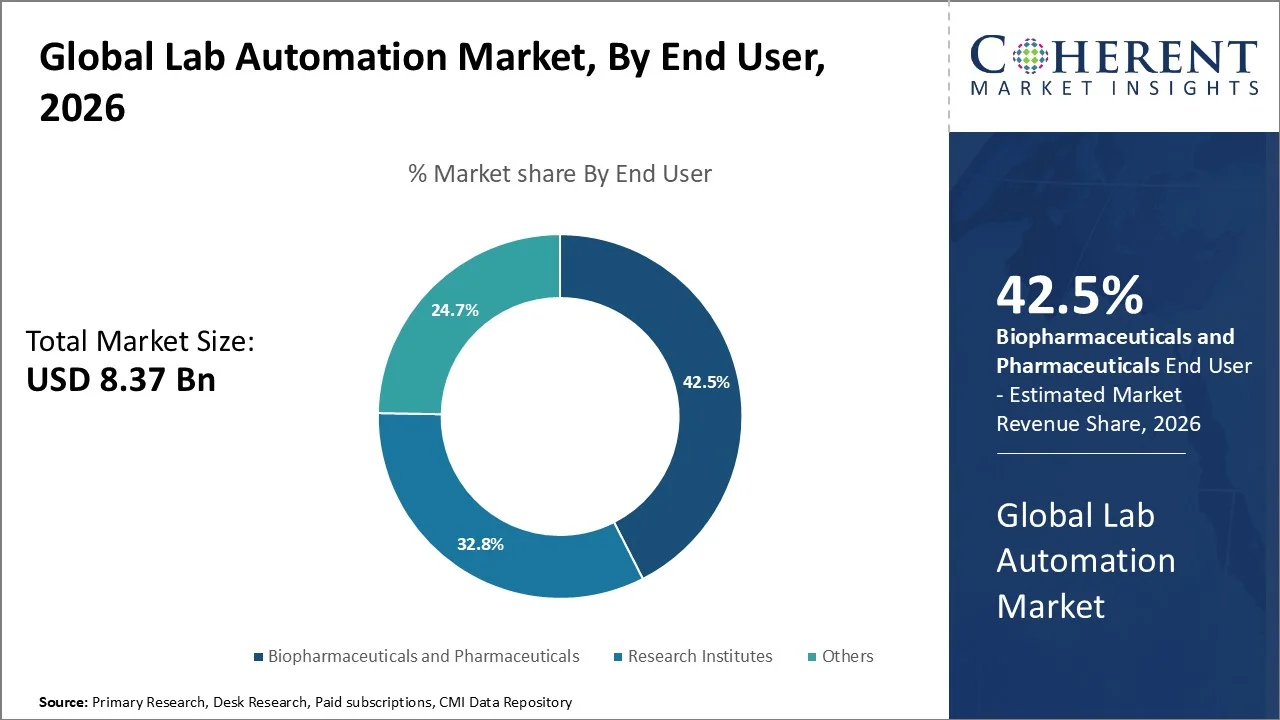
Biopharmaceuticals and pharmaceuticals lead with a major 42.50% share in 2026. These laboratories depend heavily on automated workflows for drug discovery, assay development, sample preparation, stability testing, batch release testing, quality control, and regulatory documentation.
The segment is supported by strong R&D intensity, as the pharmaceutical industry spent USD 129 billion on R&D in 2022, while active product-indication combinations in global development more than doubled between 2013 and 2023, reaching 41,370. The data from OECD also shows that retail pharmaceutical expenditure averaged USD 766 per capita in 2023. The prescription medicines accounted for more than 75% of spending in most countries, thereby reflecting high regulated medicine volumes that require testing and compliance workflows.
Chronic therapy consumption further supports testing demand, with antihypertensive medicine use rising around 6% and lipid-modifying agents rising almost 65% during 2013–2023. A relevant product update is Beckman Coulter’s Biomek i-Series. The family added the Biomek i3 Benchtop Liquid Handler in Fall 2025, thus strengthening automation adoption in pharma and biopharma labs.
Market Innovations
Technological Advancements is Transforming the Lab Automation Market in the US
The technological advancements are revolutionizing the U.S. lab automation market. This is because the clinical laboratories are increasingly adopting faster, standardized, and more efficient workflows. Technologies like automated liquid handling, barcoding, specimen tracking, robotic sample preparation, digital data capture, and AI-driven interpretation are crucial for reducing errors and increasing efficiency in high-volume diagnostic environments.
In 2025, the FDA’s recognition of CLSI laboratory automation standards, which covers specimen carriers, barcodes, system operations, and specimen identification, will further facilitate the development of interoperable automated platforms. The FDA-approved Oncomine Dx Express Test showcases the power of automation in laboratory workflows, thereby underscoring how automated library preparation, sequencing, analysis, and reporting can be done with only 20 minutes of hands-on time.
In addition, the 2025 reversal of the FDA’s LDT rule will continue to focus on CLIA-based validation, quality control, and scalable laboratory workflow compliance, thereby ensuring that automated clinical testing environments in the U.S. adhere to high standards.
Major Breakthrough: AI ‑Powered End ‑to ‑End Lab Automation Platforms
AI-powered end-to-end lab automation platforms are emerging as a major breakthrough as laboratories move beyond standalone instruments toward fully connected digital workflows. These platforms now support the complete laboratory cycle like sample intake, specimen tracking, testing, data analysis, reporting, quality control, and compliance management. The regulatory momentum is also strengthening this transition. For instance, in May 2025, the U.S. FDA completed its first AI-assisted scientific review pilot and announced plans to scale AI use in all centers by June 2025. Also, in June 2025, the FDA launched Elsa, an AI tool mainly designed to speed up clinical protocol reviews, shorten scientific evaluations, summarize adverse events, compare labels, and support database development.
The foundation for automated laboratory operations is further strengthened by the FDA-recognized CLSI standards which covers laboratory barcodes, specimen carriers, system operations, instrument communication, LIS data transfer, autoverification, remote access, specimen data content, and IT security. One of the product developments is LabVantage’s CORTEX, launched in March 2026. The platform integrates AI, analytics, automation, agentic AI, cloud-native workflows, IoT connectivity, digital twins, predictive maintenance, automated compliance monitoring, and workflow assistance into the LIMS environment.
Current Events and Their Impact on the Lab Automation Market
Current Event | Description and its Impact |
FDA Recognition of Laboratory Automation Standards (2025) |
|
FDA Recognition of Laboratory Automation Standards (2025) |
|
Lab Automation Market Trends
- The global rise in diagnostic test volumes is boosting the demand for automated systems like sample handling, liquid handling, analyzers, middleware, and LIMS platforms in order to reduce manual errors and improve turnaround times. In the U.S., more than 7 billion laboratory tests are conducted per year, thereby highlighting the need for scalable automation solutions.
- A shortage of skilled laboratory professionals is accelerating the shift toward automation in hospitals and diagnostic centers. Projections indicate 22,600 annual openings for clinical laboratory technologists and technicians in the U.S. between 2024 and 2034, which further intensifies the need for automated systems to address workforce shortages.
- AI-powered automation platforms are gaining traction in laboratories, particularly for automating tasks like data extraction, compliance monitoring, and scientific reviews.
- Regulatory bodies are standardizing laboratory automation, fostering greater industry-wide adoption. For example, in May 2025, the FDA recognized CLSI standards for laboratory automation, covering aspects like specimen barcodes, system communication, and operational requirements, enhancing interoperability between laboratory equipment and IT systems.
- Pharmaceutical, biotechnology, and clinical research sectors are experiencing increased automation adoption. With growing demand for high-throughput screening, robotic liquid handlers, and microplate systems, labs are investing in automation to manage large sample volumes and ensure consistent, reproducible results.
- The regulatory shifts related to laboratory-developed tests (LDTs) are creating a stronger push for automation in laboratories. As the FDA continues refining regulations, the laboratories are focusing on upgrading automation systems to ensure compliance with quality control, audit trails, and data traceability requirements for LDTs.
Regional Insights
North America Dominates Owing to the Strong Base of Certified Clinical Laboratories
The North America region accounts for 37.60% of the market share in 2026. The region’s growth is owing to the strong base of certified clinical laboratories, high diagnostic test volumes, advanced biopharma R&D, and faster adoption of robotics, liquid handlers, automated sample preparation, and laboratory information systems.
In the U.S., CMS states that CLIA covers approximately 320,000 laboratory entities, creating a large installed base where automation is required to improve throughput, quality control, compliance documentation, and turnaround time. The CDC’s 2025 data-modernization update also highlights expanded access to clinical laboratory data across more than 200 reportable conditions, supporting demand for connected and automated lab workflows.
One key product development was Ginkgo Bioworks’ official launch of Ginkgo Cloud Lab in March 2026, a new platform that enables researchers to seamlessly shift their benchwork to Ginkgo’s autonomous lab infrastructure through a web browser.
Asia Pacific Lab Automation Market Trends
Asia Pacific is expected to witness strong growth in lab automation market over the forecast period. The region’s growth is owing to rapid expansion of public diagnostic infrastructure, higher infectious-disease surveillance needs, and rising pressure on clinical laboratories to process samples faster with fewer manual errors.
In India, PM-ABHIM has approved 744 Integrated Public Health Labs and 2,151 Block Public Health Units, while the program targets one integrated lab in each of 730 districts, directly increasing demand for automated biochemistry, hematology, microbiology, molecular, and sample-management systems.
One such product development is Roche’s new cobas® 6800/8800 systems version 2.0 and software version 2.0.1 in December 2025. The upgraded systems are designed to improve laboratory efficiency by optimizing resource use, minimizing downtime, consolidating testing menus, and increasing overall throughput.
Rising Laboratory Workloads is Accelerating the Lab Automation Demand in United States
The demand for lab automation in the United States is being driven by rising laboratory workloads and the need for faster, high‑throughput testing across clinical, research, and public health environments. According to the American Clinical Laboratory Association’s official data, more than, thereby underscoring the scale of workload that automation can help manage with improved efficiency and accuracy.
At the regulatory end, a major FDA action to roll back enhanced oversight for lab‑developed diagnostic tests (LDTs) was finalized in 2025, thus reducing compliance burdens that previously slowed diagnostic innovation and indirectly supporting broader automation adoption.
In product developments, Clarapath launched its FDA
China Lab Automation Market Trends
China’s lab automation market is shifting from standalone instruments to integrated, high-throughput workflows as hospitals, disease control laboratories, genomic centers, and biopharma labs manage rising sample volumes.
Official 2025 statistics show China had 1.107 million medical and health institutions, including 38,000 hospitals, 3,478 disease control and prevention centers, 13.40 million medical technical personnel, 10.58 billion medical visits, and 300 million hospital discharges, creating strong demand for faster testing, sample tracking, and reduced manual error.
At the product level, Shenzhen-based MGI Tech expanded its automation portfolio in January 2024 across sample pre-treatment, automated sample preparation, and integrated testing, supporting automated nucleic-acid extraction, sequencing library preparation, and multi-omics diagnostics.
Who are the Major Companies in Lab Automation Industry
Some of the major key players in lab automation market are Tecan Trading AG, PerkinElmer Inc., Danaher, Thermo Fisher Scientific, QIAGEN, Agilent Technologies, Inc., Hamilton Company, COPAN Diagnostics Inc., Abbott, Merck KGaA, F. Hoffmann-La Roche Ltd, Siemens Healthcare Private Limited, UiPath, and Porvair Sciences, SPT Labtech Ltd, Endress+Hauser Group Services AG, Automata, accroma, Molecular Devices, LLC, Beckman Coulter, Inc., BD, Reshape Biotech, Peak Analysis & Automation.
Key News
- In April 2026, Thermo Fisher Scientific Inc., announced the launch of the Applied Biosystems PowerFlex Thermal Cycler, a next-generation PCR instrument developed to support modern molecular biology laboratories. The PowerFlex Thermal Cycler helps laboratories manage complex PCR workflows with higher efficiency and confidence.
- In April 2026, Invivoscribe, a global leader in precision diagnostics and measurable residual disease (MRD) testing, has announced the launch of the PrepQuant System. This innovative sample preparation platform combines nucleic acid extraction, concentration, and quantification into a single automated instrument.
Market Report Scope
Lab Automation Market Report Coverage
| Report Coverage | Details | ||
|---|---|---|---|
| Base Year: | 2025 | Market Size in 2026: | USD 8.37 Bn |
| Historical Data for: | 2020 To 2024 | Forecast Period: | 2026 To 2033 |
| Forecast Period 2026 to 2033 CAGR: | 7.2% | 2033 Value Projection: | USD 13.62 Bn |
| Geographies covered: |
| ||
| Segments covered: |
| ||
| Companies covered: | Tecan Trading AG, PerkinElmer Inc., Danaher, Thermo Fisher Scientific, QIAGEN, Agilent Technologies, Inc., Hamilton Company, COPAN Diagnostics Inc., Abbott, Merck KGaA, F. Hoffmann-La Roche Ltd, Siemens Healthcare Private Limited, UiPath, and Porvair Sciences, SPT Labtech Ltd, Endress+Hauser Group Services AG, Automata, accroma, Molecular Devices, LLC, Beckman Coulter, Inc., BD, Reshape Biotech, Peak Analysis & Automation | ||
| Growth Drivers: |
| ||
| Restraints & Challenges: |
| ||
Analyst Opinion
- Lab automation is driven by workload pressure, not just technology adoption. In the U.S., around 14 billion laboratory tests are performed annually, and laboratory results influence nearly 70% of medical decisions. This means automation demand is increasing because laboratories need faster, more accurate, and repeatable workflows for sample handling, testing, reporting, and quality control.
- The market is supported by the large number of regulated laboratories. The data from CMS states that CLIA covers approximately 320,000 laboratory entities, thereby showing the scale of laboratories that must follow quality, accuracy, and compliance requirements. This creates steady demand for automated analyzers, robotic liquid handlers, barcode tracking, LIMS integration, and digital reporting systems.
- The workforce pressure is making automation more necessary. The U.S. Bureau of Labor Statistics projects around 22,600 openings per year for clinical laboratory technologists and technicians from 2024 to 2034, mainly due to replacement needs. Automation helps laboratories manage rising test volumes even when skilled laboratory staff availability remains limited. This is further creating opportunities in the market.
Speak to the analyst
Want personalized insights?
Take the findings above to one of our principal consultants, or have the report rebuilt around the segments, geographies and competitors you actually track.
Market Segmentation
- By Product (Revenue, USD Bn, 2021-2033)
- Liquid Handling Products
- Microplate reader
- Robotics
- Others
- By End User (Revenue, USD Bn, 2021-2033)
- Research Institutes
- Biopharmaceuticals and Pharmaceuticals
- Others
- By Region (Revenue, USD Bn, 2021-2033)
- North America
- U.S.
- Canada
- Latin America
- Brazil
- Mexico
- Argentina
- Rest of Latin America
- Europe
- Germany
- U.K.
- France
- Italy
- Spain
- Russia
- Rest of Europe
- Asia Pacific
- China
- India
- Japan
- Australia
- South Korea
- ASEAN
- Rest of Asia Pacific
- Middle East
- GCC
- Israel
- Rest of Middle East
- Africa
- South Africa
- Central Africa
- North Africa
- North America
- Key Players
- Tecan Trading AG
- PerkinElmer Inc.
- Danaher
- Thermo Fisher Scientific
- QIAGEN
- Agilent Technologies, Inc.
- Hamilton Company
- COPAN Diagnostics Inc.
- Abbott
- Merck KGaA
- Hoffmann-La Roche Ltd
- Siemens Healthcare Private Limited
- UiPath, and Porvair Sciences
- SPT Labtech Ltd
- Endress+Hauser Group Services AG
- Automata
- Accroma
- Molecular Devices, LLC
- Beckman Coulter, Inc.
- BD
- Reshape Biotech
- Peak Analysis & Automation
Sources
Primary Research Interviews
- Primary Research Interviews
- Lab Automation Equipment Manufacturers
- Laboratory Robotics & Liquid Handling System Providers
- LIMS, ELN & Laboratory Informatics Solution Providers
- Pharmaceutical & Biotechnology Laboratory Heads
- Clinical Diagnostic Laboratory Managers
- Contract Research Organization (CRO) Laboratory Operations Teams
- Academic & Research Laboratory Directors
- Laboratory Automation System Integrators
- Others
Databases
- Bloomberg Terminal
- Thomson Reuters Eikon
- Factiva
- PubMed
- Others
Magazines
- Lab Manager Magazine
- Laboratory Equipment Magazine
- Clinical Lab Products
- Genetic Engineering & Biotechnology News
- The Scientist
- BioPharm International
- Others
Journals
- SLAS Technology
- Journal of Laboratory Automation
- Journal of Pharmaceutical and Biomedical Analysis
- Clinical Chemistry
- Bioanalysis
- Journal of Clinical Laboratory Analysis
- Analytical Chemistry
- Others
Newspapers
- Financial Times
- The Wall Street Journal
- Reuters
- Bloomberg News
- Business Standard
- The Economic Times
- Others
Associations
- Society for Laboratory Automation and Screening (SLAS)
- Association for Diagnostics & Laboratory Medicine (ADLM)
- Clinical and Laboratory Standards Institute (CLSI)
- International Society for Biological and Environmental Repositories (ISBER)
- Association of Biomolecular Resource Facilities (ABRF)
- International Federation of Clinical Chemistry and Laboratory Medicine (IFCC)
- Others
Public Domain Sources
- U.S. Food and Drug Administration (FDA)
- Centers for Disease Control and Prevention (CDC)
- National Institutes of Health (NIH)
- European Medicines Agency (EMA)
- World Health Organization (WHO)
- U.S. National Library of Medicine
- World Bank Open Data
- Others
Proprietary Elements
- CMI Data Analytics Tool
- Proprietary CMI Existing Repository of Information for the Last 10 Years
Get access to 250+ pages report
Every segment, forecast, competitor profile and data table behind the analysis above — available for instant download.
- ESOMAR Member
- ISO 9001:2015 Certified
- D-U-N-S Registered
- GDPR & CCPA Compliant
Missing comfort of reading report in your local language? Find your preferred language:
Transform your Strategy with Exclusive Trending Reports
Frequently Asked Questions
The lab automation market is expected to reach USD 13.62 Bn in 2033.
Major players operating in the global lab automation market include Tecan Trading AG, PerkinElmer Inc., Danaher, Thermo Fisher Scientific, QIAGEN, Agilent Technologies, Inc., Hamilton Company, COPAN Diagnostics Inc., Abbott, Merck KGaA, F. Hoffmann-La Roche Ltd, Siemens Healthcare Private Limited, UiPath, and Porvair Sciences, SPT Labtech Ltd, Endress+Hauser Group Services AG, Automata, accroma, Molecular Devices, LLC, Beckman Coulter, Inc., BD, Reshape Biotech, Peak Analysis & Automation.
The high initial capital investment, significant maintenance costs, and a shortage of skilled personnel to operate complex systems are the key factors hampering growth of the market.
The rising R&D spending, a shortage of skilled laboratory professionals, the, need for stringent regulatory compliance, and the integration of AI, robotics, and cloud-enabled software is boosting the demand for lab automation.
The lab automation market is anticipated to grow at a CAGR of 7.2% between 2026 and 2033.
Among regions, North America is expected to account for a largest market share in the global lab automation market over the forecast period.