

U.S. Clinical Nutrition Market Size and Share Analysis - Growth Trends and Forecasts (2026-2033)
The U.S. Clinical Nutrition Market size is anticipated to grow at a CAGR of 9.1% with USD 14.2 Bn in 2026 and is expected to reach USD 24.8 Bn in 2033. The market is growing with the prevalence of chronic and cancer‑related conditions rises, driving greater demand for disease‑specific nutritional support. The clinical nutrition helps in managing the treatment side effects and also assists in improving results for patients with complex needs. In 2022, the US reported 1,851,238 new cancer cases, thereby highlighting the substantial clinical incidence. This has led to a greater use of personalized nutrition in cancer care and other chronic conditions.
Key Takeaways
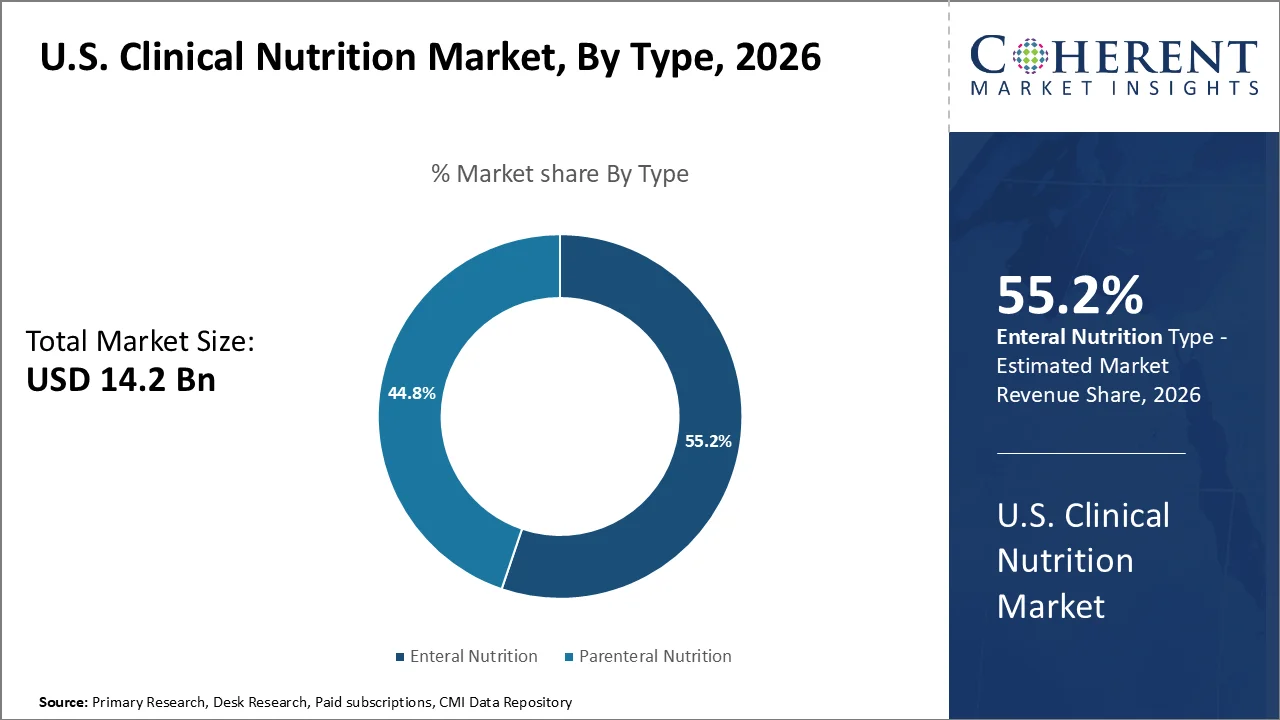
- The enteral nutrition segment is projected to account for the largest share of 55.2% in 2026. The segment growth is due to the growing prevalence of chronic diseases, which require specialized nutrition. Enteral nutrition therapy, which is critical for patients unable to eat orally, is supported under Medicare coverage policies. Medicare’s improper payment rate for enteral nutrition claims was 23.8% in the 2024 reporting period.
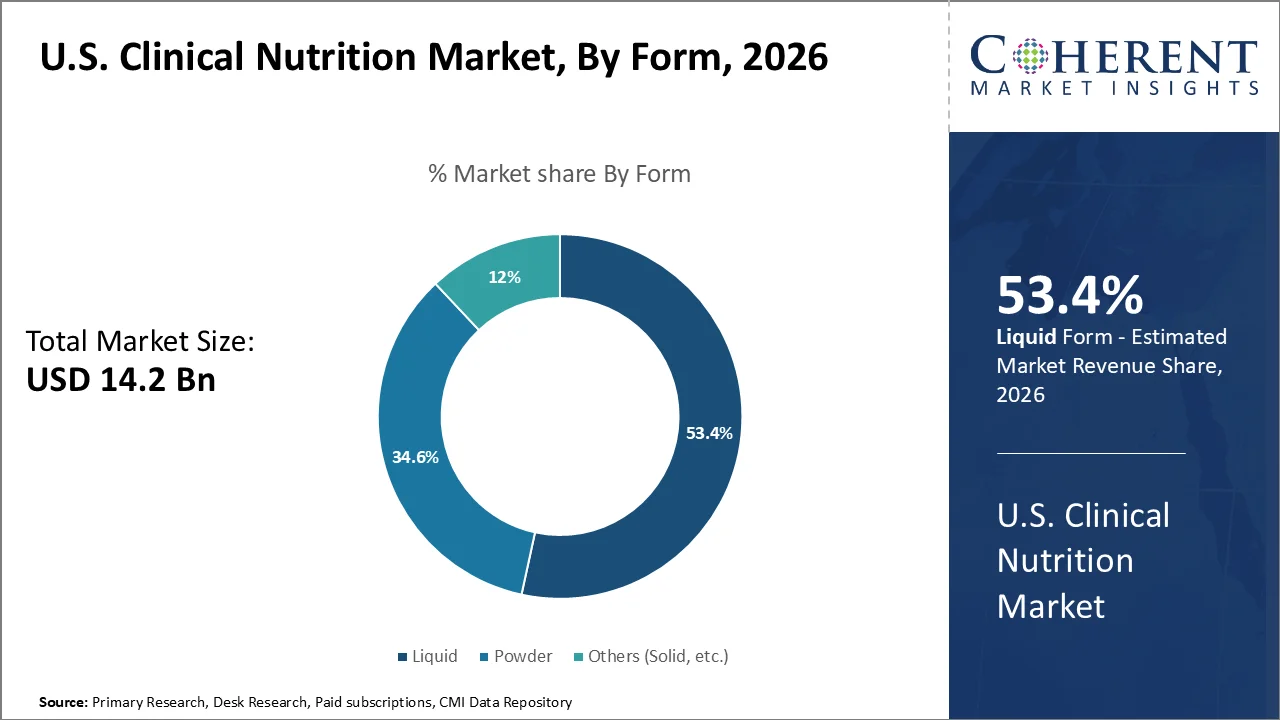
- The liquid segment is projected to account for the largest share of 53.4% in 2026. The segment’s growth is due to ease of consumption, quicker absorption, and better patient compliance, especially among those with swallowing difficulties. According to the National Health and Nutrition Examination Survey (NHANES), 57.6% of U.S. adults aged ≥20 years reported using at least one dietary supplement (including liquid supplement forms) in the past 30 days.
- The geriatric nutrition segment is projected to account for the largest share of 49.5% in 2026. The growth is owing to the rising elderly population, who are more susceptible to chronic conditions that require nutritional intervention. Nutrition needs in older adults are a major public health focus in the U.S. According to CDC data, approximately 47.8 % of adults age 65 and older have diagnosed arthritis and over 36 % have hypertension, highlighting the prevalence of chronic health conditions that clinical nutrition supports in this age group.
- The diabetes segment is projected to account for the largest share of 26.80% in 2026. The rising prevalence of diabetes among the population in the US is a key factor in driving clinical nutrition demand. CDC reports that about 12% of the U.S. population has diabetes.
- The hospitals segment is projected to account for the largest share of 53.40% in 2026. The growth is owing to the increasing hospital admissions and the rising demand for nutritional support for patients. CDC data shows that about 7.9 % of U.S. persons had at least one overnight hospital stay, underscoring hospitals’ role in delivering medical nutrition
Segmental Insights
Which Type Segment Dominates the Market?
On the basis of type, the enteral nutrition segment accounts for the largest U.S. clinical nutrition market share of 55.20% in 2026. The growth of the segment is mainly driven by the growing need for enteral feeding among patients unable to meet their nutritional requirements orally. Chronic disease prevalence significantly contributes to this demand.
In 2023, nearly 129 million adults in the United States reported having at least one chronic disease like heart disease, cancer, diabetes, obesity, hypertension, and more. This creates a large population which requires clinical nutrition assistance.
According to the National Health and Nutrition Examination Survey (NHANES), more than 40% of US adults aged 20 and older were living with obesity between August 2021 and August 2023, and nearly 10% having severe obesity conditions. These are often linked to malnutrition risks and require enteral nutrition solutions.
In addition, the recent product developments have also boosted the segment's growth. In November 2025, This approval allows for more precise fat hydrolysis during enteral feeding, improving the effectiveness of enteral nutrition for patients across all age groups.
- Current Industry Events of 2026
- Market Size Estimation
- Regional Breakdown
- Competitive Landscape
- Customer Intelligence
- Segmental Analysis
- Pricing Analysis
- Key Market Drivers, Challenges & Future Trends
- Customized Insights Section
Liquid Segment to Secure the Largest Share
On the basis of form, the liquid segment accounts for the largest U.S. clinical nutrition market share of 53.4% in 2026, owing to the increasing use of liquid nutrition products in oral nutritional supplements, enteral tube feeding, and parenteral nutrition. The demand for liquid nutrition is fueled by the significant number of individuals requiring medical nutrition support, particularly in chronic disease management.
According to the Centers for Disease Control and Prevention (CDC), 9 in 10 older U.S. adults have at least one chronic condition, which heightens the need for specialized nutritional products. Additionally, the National Institute of Diabetes and Digestive and Kidney Diseases (NIDDK) reports that 38.4 million Americans, or 11.6% of the population, have diabetes, further driving the demand for liquid nutrition formulas tailored to disease management.
On the product development front, in May 2024, Baxter received FDA approval for Clinolipid, a lipid injectable emulsion designed for neonatal and pediatric parenteral nutrition. This approval expands access to essential nutrients for children who cannot be fed orally, improving clinical nutrition support in pediatric care.
Geriatric Nutrition Segment to Secure the Largest Share
On the basis of age group, the geriatric nutrition segment accounts for the largest U.S. Clinical Nutrition Market share of 49.50% in 2026. The segment’s growth is owing to the rising elderly population, higher chronic disease burden, and greater need for oral, enteral, and disease-specific formulas during recovery, frailty management, and hospital-to-home care.
In June 2025, the U.S. Census Bureau reported that the population aged 65 and older rose 3.1% from 2023 to 2024, reaching 61.2 million people. CDC data also shows that diabetes prevalence increased with age, reaching 28.8% among adults aged 65 years or older, while 31.3 million seniors had prediabetes. This supports demand for high-protein, diabetes-specific, and calorie-dense clinical nutrition products.
In July 2025, NCOA and Nestlé Health Science’s BOOST brand partnered to develop education materials for older adults on balanced nutrition, reinforcing brand-level focus on geriatric nutrition support in outpatient, long-term care, and home-care settings.
Diabetes Segment to Occupy the Highest Share
The diabetes segment is projected to account for the largest share of 26.8% in 2026. The segment’s growth is attributable to the large U.S. diabetic and prediabetic population requiring physician-guided nutrition support for glycemic control, weight management, muscle maintenance, and meal replacement during hospital and home care.
CDC’s 2026 U.S. Diabetes Report Card notes that 40.1 million people have diabetes, or about 1 in every 8 people, while 115.2 million American adults—more than 2 in 5—have prediabetes. This creates a wide patient base for diabetes-specific oral nutrition supplements and low-glycemic clinical formulas.
For instance, in June 2023, the American Diabetes Association (ADA) and Abbott partnered to introduce a pioneering clinical nutrition program for individuals with diabetes. The collaboration aims to enhance the understanding of how diabetes technologies like continuous glucose monitoring (CGM) systems can support people in making informed decisions about their nutrition and lifestyle.
Which End User Segment is Leading in the Market?
On the basis of end user, the hospitals segment is projected to account for the largest share of 53.40% in 2026. The growth is owing to inpatient demand for enteral and parenteral nutrition therapies in acute, critical, and surgical care settings.
The federal public health data highlight the clinical burden of metabolic diseases in the United States. The Centers for Disease Control and Prevention (CDC) reported 40.1 million Americans (about 12 % of the population) living with diabetes in 2023, many of whom require specialized nutritional management as part of comprehensive care. In addition, the CDC surveillance indicates that approximately 15.8 % of U.S. adults have either diagnosed or undiagnosed diabetes, thereby underscoring the scale of nutrition‑related chronic conditions that propel clinical nutrition utilization in hospitals.
The U.S. Food and Drug Administration granted 510(k) clearance in April for the Luminoah FLOW™ enteral nutrition system. It is a portable, connected feeding device designed to enhance clinical and home enteral nutrition delivery, with commercial rollout planned in the United States.
Market Drivers
A Major Breakthrough: Personalized and Precision Nutrition Driven by AI and Genomics
The U.S. clinical nutrition sector is making notable strides toward precision nutrition, leveraging cutting-edge technologies like genomics and AI. One such major initiative is the Nutrition for Precision Health (NPH) program which was launched by the National Institutes of Health (NIH). The program focuses on creating personalized nutrition recommendations based on individuals' genetic makeup, metabolism, and microbiome. This approach aims to provide more effective dietary strategies for disease prevention as well as health optimization. The program is also a part of the All of Us Research Program, which has enrolled thousands of participants in order to ensure diverse population representation.
In 2023, the NIH funded 5,054 nutrition research projects, allocating approximately USD 2.23 billion for nutrition science. This funding demonstrates the growing importance of nutrition in addressing chronic diseases along with facilitating public health initiatives.
In January 2026, LLENA (AI) Health Solutions Inc. launched LLENA (AI) Version 2 (V2). This upgraded platform integrates personalized nutrition planning, AI-driven coaching, and exercise resources into a seamless experience. It also increases access to food and health essentials in the U.S. as well as Canada.
Current Events and Their Impact
Current Event | Description and its Impact |
NIH-FDA Nutrition Regulatory Science Program and FDA Human Foods Program Priorities (2026) |
|
CMS Enteral Nutrition Compliance and Medicare Coverage Focus (2026) |
|
U.S. Clinical Nutrition Market Trends
- The increasing prevalence of chronic diseases like diabetes, heart disease, and obesity is propelling the demand for specialized clinical nutrition. The Centers for Disease Control and Prevention (CDC) reported that 40 million U.S. adults have diabetes, and 42% of adults suffer from obesity, both of which require tailored nutrition management.
- The aging population is increasing the need for geriatric nutrition products, particularly for elderly individuals suffering from malnutrition and frailty. The data from CDC reports that, in 2024, more than 61 million U.S. adults were aged 65 and older. This demographic is expected to grow to 95 million by 2060.
- Personalized nutrition solutions are becoming more popular, with treatments tailored to individuals' genetic profiles and medical conditions.
- the liquid and ready-to-use formulas are gaining traction due to their convenience and effectiveness. According to the National Library of Medicine, more than 70% of Americans take some form of dietary supplement daily, thereby contributing to a booming supplement industry worth over USD 28 billion.
- Telehealth and digital health technologies are growing in importance for nutrition management. According to the CDC, the telehealth use increased by 154% during the pandemic, and 30.1% of U.S. adults utilized telemedicine services in 2022, thereby supporting remote consultations for personalized nutrition plans.
- Home-based care solutions are on the rise, particularly among elderly patients with long-term conditions.
- Product innovations in oncology-specific nutrition, gastrointestinal support formulas, and metabolic disorder management are broadening the clinical nutrition market to address specialized patient needs.
Who are the Major Companies in U.S. Clinical Nutrition Market
Some of the major key players in U.S. Clinical Nutrition Market are Abbott Laboratories, Baxter International Inc., Fresenius Kabi AG, Nestlé S.A., DANONE S.A., B. Braun Melsungen AG, Mead Johnson & Company LLC, Perrigo Company PLC., Leprino Foods Company, GSK plc., Sun Pharmaceutical Industries Ltd., Sanofi, BASF SE and DSM.
Key News
- In July 2025, Kate Farms, a leader in wholesome, clinically-precise nutrition, has introduced the High Protein Nutrition Shake as the latest addition to its plant-based product line. This shake is clinically developed and trusted by doctors. It is designed to support muscle health, aid in weight management, and assist those undergoing GLP-1 treatment.
- In March 2025, Danone agreed to purchase a majority stake in Kate Farms, a U.S. producer of plant-based organic drinks. This acquisition will complement Danone's specialized nutrition portfolio.
Market Report Scope
U.S. Clinical Nutrition Market Report Coverage
| Report Coverage | Details | ||
|---|---|---|---|
| Base Year: | 2025 | Market Size in 2026: | USD 14.2 Bn |
| Historical Data for: | 2020 To 2024 | Forecast Period: | 2026 To 2033 |
| Forecast Period 2026 to 2033 CAGR: | 9.1% | 2033 Value Projection: | USD 24.8 Bn |
| Segments covered: |
| ||
| Companies covered: | Abbott Laboratories, Baxter International Inc., Fresenius Kabi AG, Nestlé S.A., DANONE S.A., B. Braun Melsungen AG, Mead Johnson & Company LLC, Perrigo Company PLC., Leprino Foods Company, GSK plc., Sun Pharmaceutical Industries Ltd., Sanofi, BASF SE and DSM | ||
| Growth Drivers: |
| ||
| Restraints & Challenges: |
| ||
Analyst Opinion
- The U.S. clinical nutrition market is driven by a growing medical need. Approximately 60% of U.S. adults suffer from at least one chronic disease, and 40% have two or more. This means that the market is not merely growing due to trends, but because there is an ongoing, critical need for nutrition support to manage conditions such as diabetes, heart disease, obesity, and cancer recovery.
- Malnutrition in hospitals continues to be a significant issue. According to the Agency for Healthcare Research and Quality (AHRQ), 7% of nonmaternal and nonneonatal hospital stays in the U.S. are for patients with malnutrition, which creates substantial demand for enteral nutrition, parenteral nutrition, oral nutrition supplements, and disease-specific formulas.
- The aging population in the U.S. is increasing the demand for clinical nutrition. In 2024, the U.S. population aged 65 and older reached 61.2 million, which is fueling a higher need for geriatric nutrition products, protein-rich formulas, liquid supplements, and home-based care to support elderly individuals with chronic conditions, frailty, and recovery after hospital stays.
Speak to the analyst
Want personalized insights?
Take the findings above to one of our principal consultants, or have the report rebuilt around the segments, geographies and competitors you actually track.
Market Segmentation
- By Type (Revenue, USD Bn, 2021-2033)
- Enteral Nutrition
- Standard Nutrition
- Disease Specific Nutrition
- Parenteral Nutrition
- Amino Acids
- Carbohydrates
- Vitamins and Minerals
- Others (Fibers, etc.)
- Enteral Nutrition
- By Form (Revenue, USD Bn, 2021-2033)
- Powder
- Liquid
- Others (Solid, etc.)
- By Age Group (Revenue, USD Bn, 2021-2033)
- Infant Nutrition
- Adult Nutrition
- Geriatric Nutrition
- By Application (Revenue, USD Bn, 2021-2033)
- Diabetes
- Gastrointestinal Diseases
- Cancer
- Neurological Disorder
- Metabolic Syndrome
- Other (Critical Care, etc.)
- By End User (Revenue, USD Bn, 2021-2033)
- Hospitals
- Home Care Setting
- Long Term Care Facilities
- Ambulatory Surgical Centers
- Others (Research Institutes, etc.)
- Key Players
- Abbott Laboratories
- Baxter International Inc.
- Fresenius Kabi AG
- Nestlé S.A.
- DANONE S.A.
- Braun Melsungen AG
- Mead Johnson & Company LLC
- Perrigo Company PLC.
- Leprino Foods Company
- GSK plc.
- Sun Pharmaceutical Industries Ltd.
- Sanofi
- BASF SE
- DSM
Sources
Primary Research Interviews
- Clinical Nutrition Manufacturers
- Healthcare Providers (Hospitals, Clinics)
- Dieticians and Nutritionists
- Nutritional Supplement Manufacturers
- Health & Wellness Coaches
- Hospital Supply Chain Managers
- Others
Databases
- Bloomberg Terminal
- Thomson Reuters Eikon
- IHS Markit
- Euromonitor International
- S&P Global Market Intelligence
- Frost & Sullivan
- Others
Magazines
- Clinical Nutrition Journal
- Nutrition Today
- Advances in Nutrition
- Nutrition Reviews
- Healthcare and Nutrition Magazine
- Others
Journals
- Journal of Clinical Nutrition
- American Journal of Clinical Nutrition
- European Journal of Clinical Nutrition
- International Journal of Obesity
- The Journal of Nutrition
- Others
Newspapers
- The New York Times (Health Section)
- The Wall Street Journal (Healthcare Section)
- Reuters Health News
- USA Today (Health News)
- Others
Associations
- American Society for Parenteral and Enteral Nutrition (ASPEN)
- Academy of Nutrition and Dietetics (AND)
- Clinical Nutrition Society (CNS)
- International Society for Clinical Nutrition and Metabolism (ISCM)
- National Association of Nutrition Professionals (NANP)
- Others
Public Domain Sources
- U.S. Food and Drug Administration (FDA)
- U.S. Department of Agriculture (USDA) - Dietary Guidelines
- Centers for Disease Control and Prevention (CDC)
- National Institutes of Health (NIH) - Office of Dietary Supplements
- World Health Organization (WHO) – Nutrition Resources
- Others
Proprietary Elements
- CMI Data Analytics Tool, Proprietary CMI Existing Repository of Information for the Last 10 Years
Get access to 250+ pages report
Every segment, forecast, competitor profile and data table behind the analysis above — available for instant download.
- ESOMAR Member
- ISO 9001:2015 Certified
- D-U-N-S Registered
- GDPR & CCPA Compliant
Missing comfort of reading report in your local language? Find your preferred language:
Transform your Strategy with Exclusive Trending Reports
Frequently Asked Questions
The U.S. Clinical Nutrition Market is expected to reach USD 24.8 billion in 2033.
The high cost of specialized products, stringent FDA regulatory compliance, and reimbursement obstacles for home care are the key factors hampering growth of the market.
The high prevalence of chronic metabolic diseases, an aging geriatric population, and the rising demand for personalized nutrition, specialized formulas, and home-based enteral/parenteral care is boosting demand for clinical nutrition.
The U.S. Clinical Nutrition Market is anticipated to grow at a CAGR of 9.1% between 2026 and 2033.
Among type, the enteral nutrition segment is expected to account for a largest market share in the U.S. Clinical Nutrition Market over the forecast period.
The demand for clinical nutrition is growing as many patients need ongoing nutritional support for long-term disease management, recovery, age-related weakness, and transition from hospital to home care.
Clinical nutrition is a specialized healthcare field focusing on the prevention, diagnosis, and management of nutritional changes related to chronic diseases and acute medical conditions.