

Post-Traumatic Stress Disorder Treatment Market Size and Share Analysis - 2026 to 2033
The post-traumatic stress disorder treatment market was valued at USD 1,259 Mn in 2026 and is forecast to reach a value of USD 1,783.5 Mn by 2033 at a CAGR of 5.1% between 2026 and 2033.
Key Takeaways
- Based on Drug Class, the antidepressants segment is expected to hold 37.2% share of the market in 2026.
- Based on Route of Administration, the oral segment is projected to account for 72.8% share of the market in 2026.
- Based on Age Group, the adults segment is expected to lead the market with 66.4% share in 2026.
- Based on Distribution Channel, the hospital pharmacies segment is projected to capture 48.1% share in 2026.
- Based on Region, North America is set to lead the post-traumatic stress disorder treatment market with 42.7% share in 2026. While, Asia Pacific is anticipated to ebt he fastest growing region.
Market Overview
Post-traumatic stress disorder (PTSD) is a mental health condition that gets activated by a traumatic event either experienced or witnessed such as natural disaster, serious accident, sexual violence, a terrorist act, etc. PTSD can occur in people of all ages. Some of the major symptoms of post-traumatic stress disorder are intrusive memories, avoidance, negative changes in thinking and mood, as well as changes in emotional and physical reactions. The common drugs prescribed by doctors for PTSD are antidepressants, anti-anxiety medications, fluoxetine, and others.
Current Events and their Impacts on the Post-traumatic Stress Disorder Treatment Market
Current Event | Description and its Impact |
Technological Advances in PTSD Treatment |
|
Social and Cultural Shifts Affecting Awareness and Diagnosis |
|
Who Is Most Affected by PTSD?
Demographic / Risk Factor | Prevalence / Data | Source |
Lifetime prevalence (global) | 3.9% of world population has had PTSD at some stage | WHO |
Lifetime prevalence (U.S. adults) | ~6% (3 in 50 adults) will experience PTSD | NIMH |
Women vs. Men (U.S.) | Women: 9.7% lifetime prevalence; Men: 3.6% | NIMH |
Military women | 13.4% prevalence | NIMH |
Civilian women | 8% prevalence | NIMH |
Age group most affected | Adults aged 45–49 years: 9.2% prevalence | PTSD Statistics 2026 |
Veterans (U.S.) | 11–23% experience PTSD in a given year | PTSD Statistics 2026 |
Cause: Sexual violence | Accounts for 33% of PTSD cases | WHO |
Rape victims | 94% develop PTSD symptoms within 2 weeks | PTSD Statistics 2026 |
Trauma exposure (U.S.) | ~50% of adults experience at least one traumatic event, but most do not develop PTSD | NIMH |
- Current Industry Events of 2026
- Market Size Estimation
- Regional Breakdown
- Competitive Landscape
- Customer Intelligence
- Segmental Analysis
- Pricing Analysis
- Key Market Drivers, Challenges & Future Trends
- Customized Insights Section
Segmental Insights
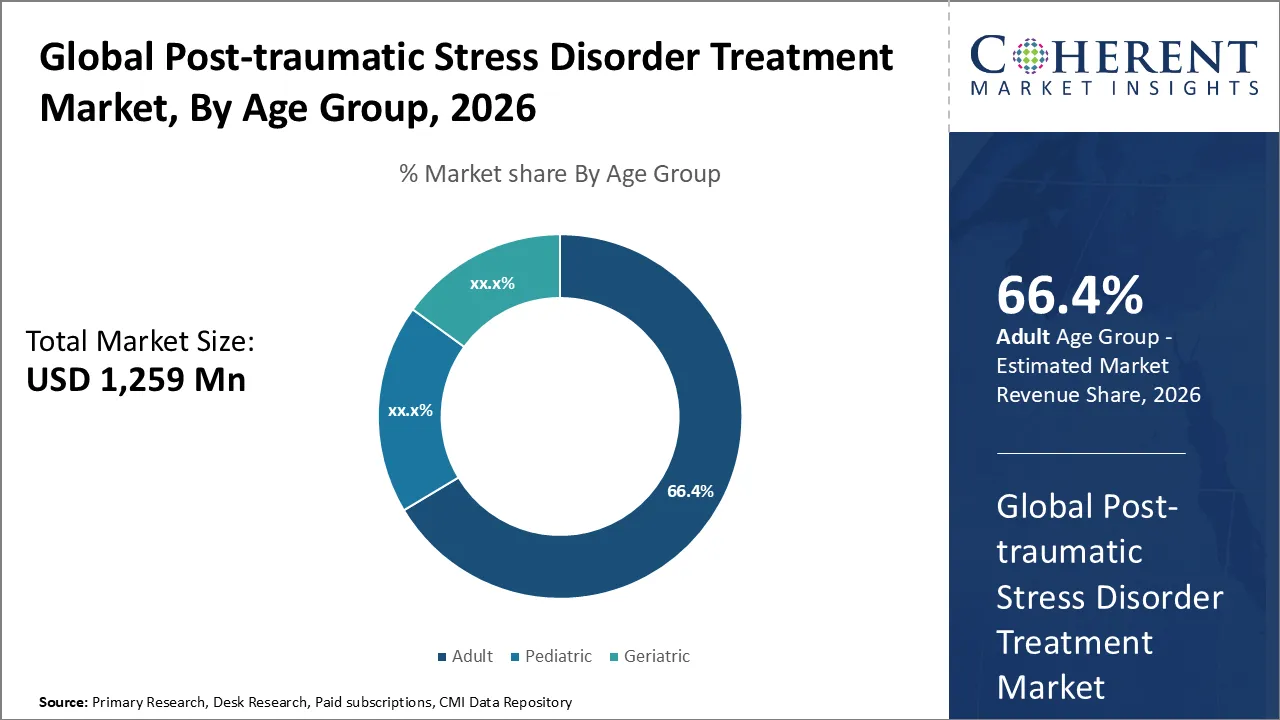
Post-traumatic Stress Disorder Treatment Market Insights, By Age Group: Adults represent the largest PTSD patient base, especially veterans, trauma survivors, and frontline workers.
In terms of age group, the adults segment is expected to lead the market with 66.4% share in 2026, due to high prevalence of military veterans, trauma survivors, and frontline workers have it. This group frequently pursues treatment within organized healthcare systems, thereby increasing the demand for medications and therapies. Their dominance reflects both the realities of epidemiology and the way healthcare resources are given to adults with mental health issues.
For instance, in December 2025, Wayne State University started groundbreaking research on cannabis for veterans with PTSD and depression. This study is mostly about adults, where PTSD is most common, especially among military service members. The initiative investigates cannabis as a prospective therapeutic alternative, seeking to enhance mental health outcomes and broaden treatment approaches for adult veterans.
Post-traumatic Stress Disorder Treatment Market Insights, By Drug Class: Antidepressants dominate PTSD treatment as SSRIs and SNRIs remain the most prescribed drug class
In terms of drug class, the antidepressants segment is expected to hold 37.2% share of the market in 2026. Antidepressants, especially SSRIs and SNRIs, are the most common way to treat PTSD as they have strong clinical evidence, are approved by the FDA, and doctors prefer them. They focus on the main symptoms, such as intrusive thoughts, hyperarousal, and mood swings. They are the most prescribed drug class as they are widely available, have a proven safety record, and are covered by insurance.
For instance, in September 2025, the FDA sent Otsuka and Lundbeck a Complete Response Letter about REXULTI® (brexpiprazole) and sertraline for PTSD in adults. The application was mostly about sertraline, an SSRI antidepressant. The FDA stated that the current evidence was not strong enough for approval. This news is directly related to the use of antidepressants in PTSD treatment plans.
Post-traumatic Stress Disorder Treatment Market Insights, By Route of Administration: Oral administration leads because pills and capsules ensure convenience, adherence, and widespread clinical acceptance
In terms of route of administration, the oral segment is projected to account for 72.8% share of the market in 2026. Oral administration is preferred due to patient convenience, dosing simplicity, and established clinical tradition. Compared to injections or nasal sprays, pills and capsules are more likely to be taken as prescribed. The oral route also supports mass production and distribution, making it cost-effective and accessible, reflecting in dominance in PTSD treatment delivery.
For instance, in July 2025, the FDA provided methylone, a psychedelic drug being studied for PTSD, the breakthrough therapy label. Methylone is a new type of treatment that is different from traditional antidepressants. It was given to people in capsule form during clinical trials. This name emphasizes its potential to transform PTSD treatment, directly connecting the news to ways of giving it through oral administration.
Post-traumatic Stress Disorder Treatment Market Insights, By Distribution Channel: Hospital pharmacies dominate as primary hubs for initiating and managing PTSD therapies
In terms of distribution channel, the hospital pharmacies segment is projected to capture 48.1% share in 2026, because PTSD treatment usually starts in a clinical or inpatient setting, especially for severe cases that need close monitoring. Hospitals provides quick access to specialized care, psychiatric help, and controlled medication distribution. Their main job is to start therapy and handle complicated cases, which gives them the biggest share of the distribution channel.
Regional Insights
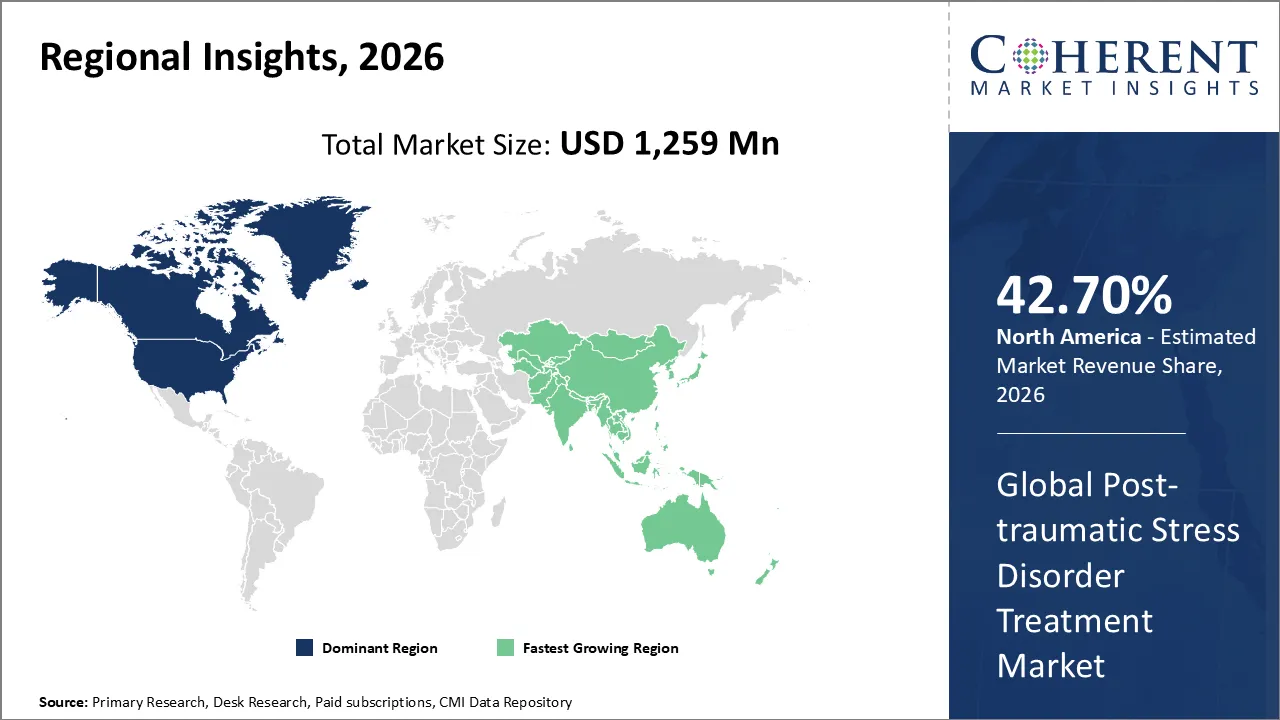
North America Post-Traumatic Stress Disorder Treatment Market Analysis & Trends
North America is expected to dominate the post-traumatic stress disorder treatment market with 42.7% share in 2026, due to large population of veterans, the healthcare system is well-developed, there are strong government support programs, and new therapies are widely available. All of these things together make the region's mental health landscape dominant and keep demand high.
For instance, in February 2026, the FDA provided Palisades Therapeutics its approval to start a Phase 2a trial of PT150 in U.S. veterans with PTSD. This study, which took place in the United States, is mostly about testing PT150 works as a new treatment. The trial underscores persistent endeavors to broaden treatment alternatives for adult PTSD patients.
Asia Pacific Post-Traumatic Stress Disorder Treatment Market Analysis & Trends
Asia Pacific is expected to exhibit the fastest growth, due to growing awareness of mental health issues, healthcare infrastructure is growing, and government programs are becoming more common. The region is the fastest-growing in the world because it has large volume of patients, pharmaceutical companies are investing more, and people are becoming more aware of mental illnesses.
For instance, in February 2026, The Japan Patent Office granted Silo Pharma a patent for SPC-15, a drug that treats PTSD through the nose. The patent covers ways and compositions that prevent or minimize fear, depression-like behavior, and anxiety-like behavior that are caused by stress. This makes Silo's portfolio stronger and shows how committed it is to finding new ways to treat PTSD.
Post-traumatic Stress Disorder Treatment Market Outlook Country-Wise
The U.S. Post-traumatic Stress Disorder Treatment Market Trends
The U.S. PTSD treatment market is extremely competitive in 2026 as there are an increasing number of veterans, a large number of trauma-related disorders, a well-developed healthcare system, and strong government support. Widespread access to new therapies, more people becoming aware of them, and big investments from drug companies all help the market stay strong and keep treatment demand high across the country.
For instance, in January 2026, Compass Pathways stated that the FDA had approved its IND application for COMP360 psilocybin therapy for PTSD and depression that is unresponsive to other treatments. This milestone, which is mostly in the US, shows that regulations are moving forward with new ways to treat PTSD. The company, which has offices in London and New York, works on new treatments for adults that go beyond traditional antidepressants.
South Korea Post-Traumatic Stress Disorder Treatment Market Trends
The PTSD treatment market in South Korea highly demanding in 2026 because more people are aware of mental health issues, stress-related disorders are on the rise, and the government is supporting efforts to improve psychiatric care. The growth and demand is observed with more people can get advanced therapies, people are more accepting of psychological treatment, and there is an enormous amount of funds being put into healthcare infrastructure.
For instance, in August 2025, Researchers at South Korea's Institute for Basic Science and Ewha Womans University found excessive astrocytic GABA can cause PTSD symptoms. They tried KDS2010, a selective MAOB inhibitor, on mice and found that it reversed PTSD-like effects. KDS2010 is already being tested on people, and it looks like it could be a great new way to treat PTSD.
Market Report Scope
Post-traumatic Stress Disorder Treatment Market Report Coverage
| Report Coverage | Details | ||
|---|---|---|---|
| Base Year: | 2025 | Market Size in 2026: | USD 1,259 Mn |
| Historical Data for: | 2020 To 2024 | Forecast Period: | 2026 To 2033 |
| Forecast Period 2026 to 2033 CAGR: | 5.1% | 2033 Value Projection: | USD 1,783.5 Mn |
| Geographies covered: |
| ||
| Segments covered: |
| ||
| Companies covered: | Jazz Pharmaceuticals plc., Madrigal Mental Care, Allergan PLC, Otsuka Pharmaceutical Co., Ltd., apex laboratories Pvt. Ltd., H. Lundbeck A/S (Lundbeck), Neurovation Labs, Inc., Eli Lilly and Company, GlaxoSmithKline PLC, Sun Pharmaceuticals Pvt Ltd, Bristol-Myers Squibb, Johnson and Johnson, Pfizer Inc., Aurobindo Inc., Amneal Pharmaceuticals LLC, Teva Pharmaceuticals Industries Ltd., And Mylan Pharmaceuticals (Viatris Inc.) | ||
| Growth Drivers: |
| ||
| Restraints & Challenges: |
| ||
Post-traumatic Stress Disorder Treatment Market Driver
Rising Prevalence of PTSD
The growing number of traumatic events like natural disasters, terrorist attacks, armed conflicts, and accidents is making the need for effective therapies even more urgent. Large portion of individuals are affected are veterans, healthcare workers, and emergency service workers. This makes up a large patient base. The increasing number of people with PTSD is directly driving the Post-traumatic Stress Disorder Treatment Market growth, due to drug companies and healthcare providers are working harder to address the new ways to treat both the mental and physical aspects of PTSD.
Growing Mental Health Awareness
Advocacy and public health campaigns are helping to lower the stigma around mental health, which is making more people seek to get professional help. Governments and NGOs, especially in North America and Europe, are heavily investing into programs that raise awareness and make easier to access care. More people are willing to go through therapy and take medication, which is driving the Post-traumatic Stress Disorder Treatment Market demand. The focus on early diagnosis and treatment options makes the market even stronger by making sure consistent adoption of treatment options.
Post-traumatic Stress Disorder Treatment Market Opportunity
Advancements in Personalized Medicine
Precision psychiatry and biomarker-driven approaches are making major modifications in PTSD is treated. Healthcare providers can find out how each patient responds to treatment by using genetic profiling and neuroimaging. This leads to more effective and targeted therapies. This customization not only improves treatment results, but it also cuts down on trial-and-error prescribing. Drug companies can use these new ideas to make their products stand out and give themselves a stronger competitive edge. As these technologies get better, they are likely to have an immense impact on the Post-Traumatic Stress Disorder Treatment Market forecast, which will lead to long-term growth.
Analyst Opinion (Expert Opinion)
The PTSD treatment market is shaped by a large and persistent patient pool, with demand anchored in measurable prevalence and chronicity. The World Health Organization states 3.9% of the world's population has PTSD at some point in their lives. This shows that PTSD is a major reason why people use mental health services around the world. National estimates in the United States show that 3.6% of adults have PTSD in a given year and 6.8% meet lifetime criteria. This is more common in women than men, which shows that there is a long-term need for treatment, follow-up care, and management of comorbidities.
The market shows both the use of medications and the delivery of high-intensity psychotherapy. The PTSD treatment market is growing, due to more people getting screened, diagnosed, and seeking care. However, the pharmacotherapy landscape is still limited: only sertraline and paroxetine are FDA-approved specifically for PTSD, which means that most prescriptions are for SSRIs and a significant off-label use happens when symptom clusters (sleep disruption, hyperarousal, comorbid depression/anxiety) continue.
Pipeline uncertainty also affects the structure of the market. For example, an FDA advisory panel vote in July 2025 against a proposed combination approach shows how hard it is to show long-lasting, clinically meaningful symptom reduction in trials.
Increasingly, service and technology are driving growth in care delivery. Digital mental health modalities, telehealth, app-supported care, and virtual reality are broadening the treatment options and making it possible to use more than one type of therapy at the same time, especially when there aren't enough clinicians. Psychotherapy volume, SSRI-centered medication demand, and scalable digital care pathways are likely to continue to drive the market as a whole. Differentiation will increasingly depend on measuring outcomes, providing adherence support, and providing integrated care for comorbid conditions.
Speak to the analyst
Want personalized insights?
Take the findings above to one of our principal consultants, or have the report rebuilt around the segments, geographies and competitors you actually track.
Global Post-traumatic Stress Disorder Treatment Market: Key Developments
- In February 2026, Researchers at Tel Aviv University in Israel used noninvasive brain stimulation to help adults with PTSD get rid of unwanted traumatic memories. Early results showed a big improvement in symptoms, which is a good sign for a new way to treat the disease. This study underscores novel PTSD treatment strategies developed by Israeli academic and clinical research institutions.
- In November 2025, Dr. Jennifer Sumner, a researcher at UCLA, found that antidepressant treatment can lower the risk of heart disease in women veterans with PTSD. The study shows that treating PTSD with medication or therapy is good for both mental and physical health in the long term. It was performed in the United States and stresses the importance of integrated care for people who have been through trauma.
Market Segmentation
- By Drug Class
- Antidepressants
- Anti-anxiety
- Antihypertensive
- Monoamine Oxidase (MAOs)
- Antipsychotics or Second-Generation Antipsychotics (SGOs)
- Beta-Blockers
- Others (Benzodiazepines and Others)
- By Route of Administration
- Oral
- Parenteral
- Nasal
- By Age Group
- Pediatric
- Adult
- Geriatric
- By Distribution Channel
- Hospital Pharmacies
- Retail Pharmacies
- Online Pharmacies
- By Region
- North America
- U.S.
- Canada
- Latin America
- Brazil
- Argentina
- Mexico
- Rest of Latin America
- Europe
- Germany
- U.K.
- Spain
- France
- Italy
- Russia
- Rest of Europe
- Asia Pacific
- China
- India
- Japan
- Australia
- South Korea
- ASEAN
- Rest of Asia Pacific
- Middle East & Africa
- GCC Countries
- Israel
- Rest of Middle East & Africa
- North America
- Key Players
- Jazz Pharmaceuticals plc.
- Madrigal Mental Care
- Allergan PLC
- Otsuka Pharmaceutical Co., Ltd.
- apex laboratories Pvt. Ltd.
- Lundbeck A/S (Lundbeck)
- Neurovation Labs, Inc.
- Eli Lilly and Company
- GlaxoSmithKline PLC
- Sun Pharmaceuticals Pvt Ltd
- Bristol-Myers Squibb
- Johnson and Johnson
- Pfizer Inc.
- Aurobindo Inc.
- Amneal Pharmaceuticals LLC
- Teva Pharmaceuticals Industries Ltd.
- Mylan Pharmaceuticals (Viatris Inc.)
Sources
Primary Research Interviews
- Psychiatrists (PTSD pharmacotherapy prescribers)
- Clinical Psychologists / Trauma-Focused Therapists (CBT, CPT, EMDR providers)
- Hospital & Behavioral Health Center Administrators
- PTSD Specialty Clinics / Trauma Centers (clinical directors, program managers)
- Community Mental Health Service Providers
- Telepsychiatry & Digital Mental Health Platform Executives
- Clinical Trial Investigators & Key Opinion Leaders (KOLs) in PTSD
- Military/Veteran Health System Clinicians (where applicable)
- Pharmacy Directors / Formulary & P&T Committee Members
- Patient Advocacy Groups & Care Navigators
- Others
Databases
- Bloomberg Terminal
- Thomson Reuters Eikon
- IQVIA (sales, prescription, and treatment trend datasets)
- Clarivate (Cortellis/DRG where applicable)
- ClinicalTrials.gov database
- WHO Global Health Observatory
- OECD Health Statistics
- Others
Magazines
- Psychiatric Times
- The Lancet Psychiatry (news/features section)
- Nature Reviews Drug Discovery (industry coverage)
- The Pharmaceutical Journal
- Managed Healthcare Executive
- Modern Healthcare
- Others
Journals
- JAMA Psychiatry
- The American Journal of Psychiatry
- The Lancet Psychiatry
- British Journal of Psychiatry
- Journal of Traumatic Stress
- Depression and Anxiety
- PTSD: National Center for PTSD (research publications)
- Cochrane Database of Systematic Reviews
- New England Journal of Medicine (relevant clinical trials)
- Others
Newspapers
- Financial Times
- The Wall Street Journal
- Reuters
- Bloomberg News
- The New York Times (health section)
- The Guardian (health/science)
- Others
Associations
- International Society for Traumatic Stress Studies (ISTSS)
- American Psychiatric Association (APA)
- American Psychological Association (APA – trauma divisions/guidance)
- World Psychiatric Association (WPA)
- Royal College of Psychiatrists (RCPsych)
- European Psychiatric Association (EPA)
- Others
Public Domain Sources
- World Health Organization (WHO)
- U.S. National Center for PTSD (U.S. Department of Veterans Affairs)
- U.S. National Institutes of Health (NIH)
- U.S. Centers for Disease Control and Prevention (CDC)
- U.S. FDA (drug labels, approvals, safety communications)
- European Medicines Agency (EMA)
- UK National Institute for Health and Care Excellence (NICE) guidelines
- Cochrane Library (evidence reviews)
- World Bank Open Data (health system indicators)
- OECD (health indicators)
- Others
Proprietary Elements
- CMI Data Analytics Tool
- Proprietary CMI Existing Repository of Information for the Last 8 Years
Get access to 250+ pages report
Every segment, forecast, competitor profile and data table behind the analysis above — available for instant download.
- ESOMAR Member
- ISO 9001:2015 Certified
- D-U-N-S Registered
- GDPR & CCPA Compliant
Missing comfort of reading report in your local language? Find your preferred language:
Transform your Strategy with Exclusive Trending Reports
Frequently Asked Questions
The global Post-traumatic Stress Disorder Treatment Market size was valued at USD 1,259 Mn in 2026 and is expected to reach USD 1,783.5 Mn in 2033.
Major players operating in the market include Jazz Pharmaceuticals plc., Madrigal Mental Care, Allergan PLC, Otsuka Pharmaceutical Co., Ltd., apex laboratories Pvt. Ltd., H. Lundbeck A/S (Lundbeck), Neurovation Labs, Inc., Eli Lilly and Company, GlaxoSmithKline PLC, Sun Pharmaceuticals Pvt Ltd, Bristol-Myers Squibb, Johnson and Johnson, Pfizer Inc., Aurobindo Inc., Amneal Pharmaceuticals LLC, Teva Pharmaceuticals Industries Ltd., and Mylan Pharmaceuticals (Viatris Inc.)
Among drug class, the antidepressant segment estimated significant revenue in 2026.
Rising prevalence of PTSD and growing mental health awareness are expected to drive the market.
The market is estimated to exhibit a CAGR of 5.1% till 2033.
Among region, North America is expected to witness significant growth over the forecast period.