

Middle Ear Implants Market Size and Forecast – 2026 to 2033
The Middle Ear Implants Market is anticipated to grow at a CAGR of 7.9% with USD 56.4 Bn share in 2026 and is expected to reach USD 103.2 Bn in 2033. Rising hearing loss, greater awareness of implantable solutions, and advances in minimally invasive technologies are driving demand for middle ear implants. By 2050, nearly 2.5 Bn people are projected to experience some degree of hearing loss.
Key Takeaways
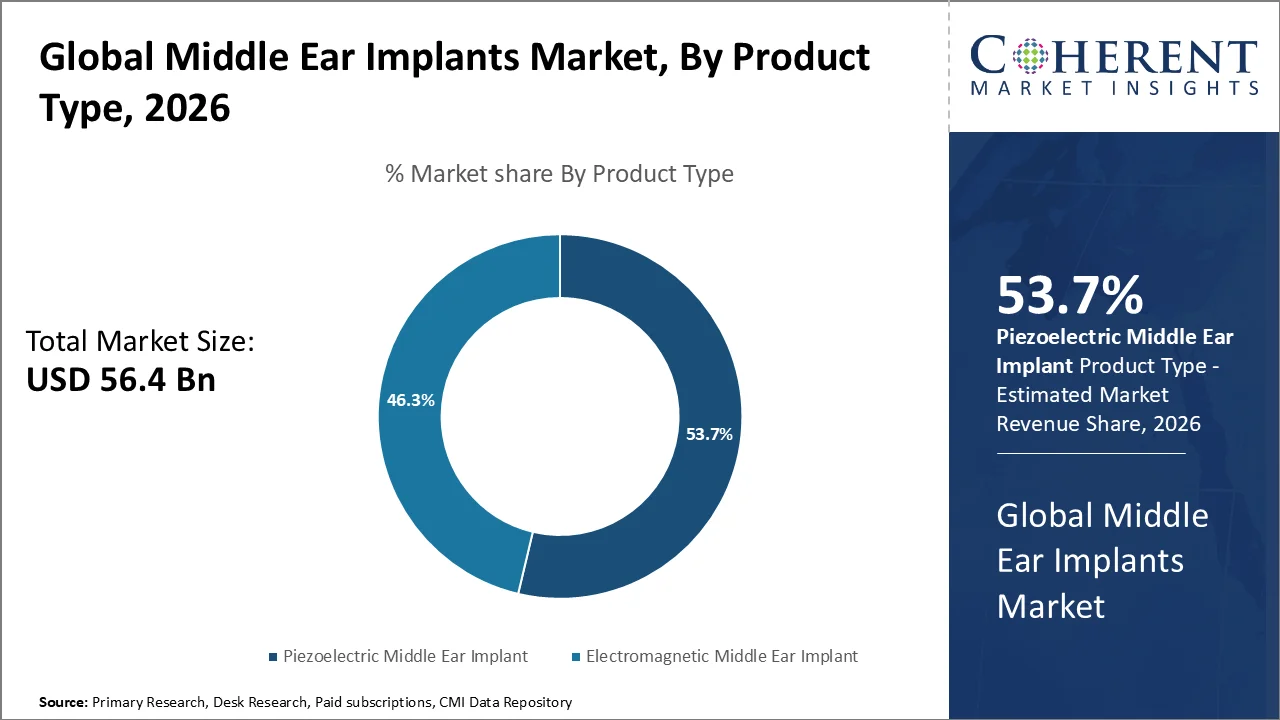
- Piezoelectric Middle Ear Implant hold the largest market share of 53.7% in 2026 owing to the rising prevalence of hearing loss. Middle ear implants address conductive and sensorineural hearing loss by directly stimulating the ossicles.
- Conductive expected to hold largest market share of 42.7% in 2026 owing to its limitations of conventional hearing aids.
- Hospitals acquired the largest market share of 45.5% in 2026 owing to the availability of multidisciplinary ENT teams. India has more than 69,000 public and private hospitals.
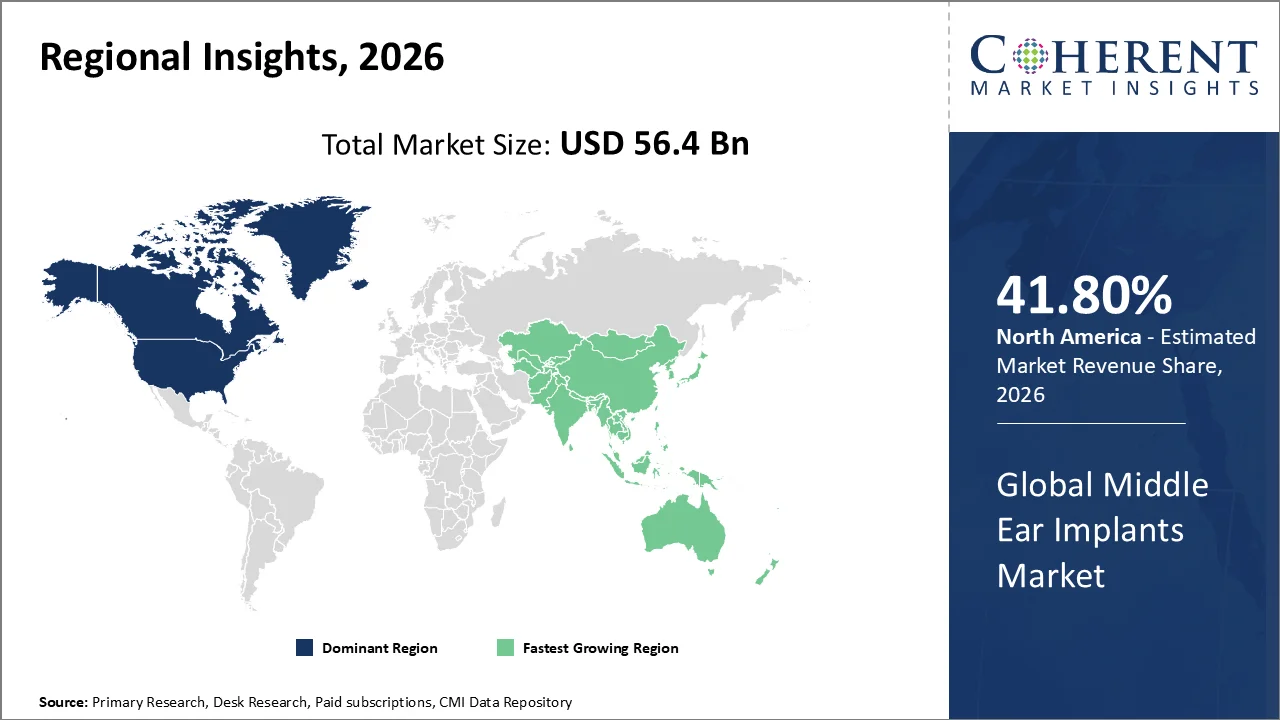
- North America is expected to acquire the dominant share of 41.8% in 2026 owing to the advanced healthcare infrastructure. In 2024, U.S. healthcare spending reached USD 5.3 trillion, or approximately USD 15,474 per person, representing 18.0% of GDP.
Current Events and Their Impact on the Middle Ear Implants Market
Current Event | Description and its Impact |
Australia: MSAC supports MBS listing for active middle ear implants for sensorineural hearing loss |
|
FDA regulatory activity for the Esteem totally implanted middle ear hearing system |
|
Segmental Insights
- Current Industry Events of 2026
- Market Size Estimation
- Regional Breakdown
- Competitive Landscape
- Customer Intelligence
- Segmental Analysis
- Pricing Analysis
- Key Market Drivers, Challenges & Future Trends
- Customized Insights Section
Why is Piezoelectric Middle Ear Implant Acquiring the Largest Market Share?
Piezoelectric Middle Ear Implant hold the largest market share of 53.7% in 2026. The Piezoelectric Middle Ear Implant market is growing as more people experience hearing loss and seek alternatives to conventional hearing aids. These implants directly stimulate the ossicular chain, improving sound transmission and hearing performance. Their low power consumption, compact design, broad frequency response, and compatibility with fully implantable systems make them increasingly attractive. Manufacturers continue to advance transducer technology, while patients increasingly prefer discreet hearing solutions. Expanding clinical applications and improved implant technologies further support the adoption of piezoelectric middle ear implants. In June 2026, Princess Lalla Asmaa chaired Morocco’s first Patient Day for people with hearing loss in Rabat, highlighting efforts to expand hearing care. She also reviewed active piezoelectric bone conduction technology designed for children who cannot benefit from conventional cochlear implants.
Conductive expected to hold largest market share
Conductive expected to hold largest market share of 42.7% in 2026 owing to its advantages of direct mechanical stimulation. The conductive segment of the Middle Ear Implants Market is expanding as more patients seek effective hearing rehabilitation for chronic ear diseases, congenital abnormalities, and ossicular disorders. Active middle ear implants directly stimulate the ossicular chain and bypass damaged middle-ear structures to improve sound transmission. Patients who gain limited benefits from conventional hearing aids increasingly consider these implants as an alternative. Advances in transducer coupling technology and broader clinical applications for conductive and mixed hearing loss further encourage adoption and support segment growth. Cochlear Limited received FDA clearance for the new Cochlear Osia 3 Sound Processor, the latest advancement in its Osia System. The bone conduction solution supports children and adults with conductive or mixed hearing loss and single-sided deafness.
Which End User segment dominates the market?
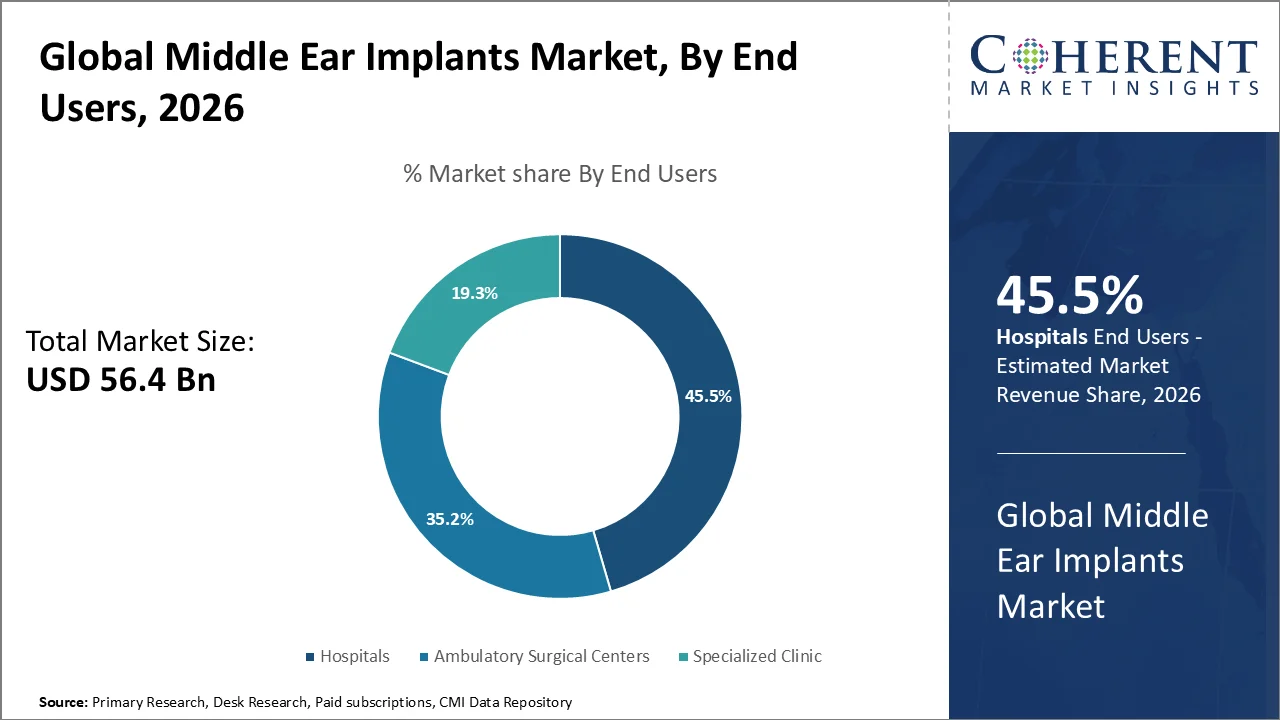
Hospitals acquired the largest market share of 45.5% in 2026. The hospitals segment of the Middle Ear Implants Market is expanding as hospitals strengthen specialized ENT infrastructure, adopt advanced diagnostic equipment, and build multidisciplinary clinical teams. Hospitals support the complete implant pathway, including patient evaluation, surgical implantation, device programming, and post-operative rehabilitation. More patients who gain limited benefits from conventional hearing aids are seeking implant procedures. In addition, broader clinical applications, increasing availability of experienced otologists, and greater investment in specialized hearing-implant programs are encouraging hospitals to adopt middle ear implant technologies.
Middle Ear Implants Market Trends
- Rising adoption of active and fully implantable hearing devices enhances hearing rehabilitation by providing discreet solutions and reducing dependence on conventional external hearing aids. Clinical evidence supports the use of active middle ear implants in appropriately selected patients. In one long-term study of 103 patients receiving 118 Vibrant Soundbridge devices, the average duration of implant use was 6.7 years, and 91 patients (77.1%) were still using their devices at the end of the observation period.
- Growing demand for personalized hearing rehabilitation encourages clinicians to select implant configurations and coupling techniques according to individual anatomy, hearing-loss severity, and residual auditory function. Evidence from long-term clinical research includes patients with both sensorineural and conductive/mixed hearing loss; in one study, 77 devices were implanted for sensorineural hearing loss and 41 for mixed or conductive hearing loss.
- Increasing preference for alternatives to conventional hearing aids supports middle ear implant adoption among appropriately selected patients who experience limitations with acoustic hearing aids. FDA clinical data for the Vibrant Soundbridge found that 42 of 49 patients (86%) reported satisfaction with sound clarity and tone, compared with 15 of 49 (31%) for their own hearing aids. In addition, 44 of 47 patients (94%) reported improved satisfaction with overall sound quality when using the implant compared with their own hearing aids.
Regional Insights
North America dominates owing to technological advancements in implant systems
North America is expected to acquire the dominant share of 41.80% in 2026. North America’s Middle Ear Implants Market is expanding due to the region’s high prevalence of hearing loss, aging population, advanced healthcare infrastructure, and strong awareness of hearing rehabilitation. Established ENT and audiology networks facilitate diagnosis, implantation, programming, and follow-up care. Patients increasingly seek alternatives to conventional hearing aids, while technological advancements improve implant performance and accessibility. The presence of specialized otology centers, supportive reimbursement frameworks, strong healthcare spending, and ongoing investments in innovative medical technologies further encourage the adoption of middle ear implants across the region. In June 2026, Envoy Medical submitted the first module of its Modular PMA application to the FDA for its Breakthrough Device-designated hearing solution. The company pioneered fully implanted devices, including the Esteem active middle ear implant, commercially available in the U.S.
Asia Pacific Middle Ear Implants Market Trends
The Asia Pacific middle ear implants market is growing as more people experience hearing loss, especially older adults, and seek advanced hearing restoration solutions. Healthcare providers are expanding infrastructure and specialized ENT centers, while greater access to otological surgeries supports implant adoption. Rising disposable incomes and healthcare investments enable more patients to afford implant procedures. Technological innovations improve hearing outcomes and patient comfort. In addition, government hearing-health programs, surgeon training initiatives, and growing acceptance of implantable hearing solutions continue to drive market demand across the region. In December 2025, Nanavati Max Super Speciality Hospital launched Max Suno, a cochlear implant and hearing rehabilitation programme focused on early detection, precision surgery, and long-term auditory-verbal therapy for people with severe-to-profound hearing loss.
United States Middle Ear Implants Market Trends
The United States middle ear implants market continues to grow as hearing loss becomes more common, especially among the aging population. Patients increasingly seek advanced hearing restoration solutions because conventional hearing aids have limitations. Manufacturers drive adoption through technological innovations such as improved sound processing, wireless connectivity, smaller devices, and minimally invasive implantation techniques. The country’s strong healthcare infrastructure, growing access to specialized ENT professionals, broader insurance support, and increased awareness of untreated hearing loss also encourage more patients to consider middle ear implants. Cochlear Limited introduced the Nucleus 7 Sound Processor, the first Made for iPhone cochlear implant sound processor. FDA-approved in June, it also became the smallest and lightest behind-the-ear cochlear implant sound processor available at the time.
Japan Middle Ear Implants Market Trends
Japan’s middle ear implants market benefits from the country’s aging population and the growing incidence of hearing impairment, which increase demand for advanced hearing rehabilitation. Patients and healthcare providers increasingly recognize implantable hearing solutions, while improved clinical expertise and technological advancements in active middle ear implants encourage adoption. Japan’s well-developed healthcare infrastructure and reimbursement policies also improve access to approved auditory implants. Furthermore, patients increasingly seek discreet and effective alternatives to conventional hearing aids, while broader treatment options for conductive and mixed hearing loss support market growth.
Who are the Major Companies in Middle Ear Implants Industry
Some of the major key players in Middle Ear Implants are Envoy Medical, Ototronix, MED-EL Corporation, Medtronic, CENTILLION, and Cochlear.
Key News
- In August 2026, Qatar Charity launched a cochlear implant program for children at Doha Hospital in Khartoum, restoring specialized hearing services in Sudan after the war began.
Market Report Scope
Middle Ear Implants Market Report Coverage
| Report Coverage | Details | ||
|---|---|---|---|
| Base Year: | 2025 | Market Size in 2026: | USD 56.4 Bn |
| Historical Data for: | 2020 To 2024 | Forecast Period: | 2026 To 2033 |
| Forecast Period 2026 to 2033 CAGR: | 7.9% | 2033 Value Projection: | USD 103.2 Bn |
| Geographies covered: |
| ||
| Segments covered: |
| ||
| Companies covered: | Envoy Medical, Ototronix, MED-EL Corporation, Medtronic, CENTILLION, and Cochlear. | ||
Analyst Opinion
- Middle ear implants are being driven by a clinical gap that conventional hearing aids cannot fully address. The strongest demand comes from patients with conductive or mixed hearing loss who cannot obtain adequate benefit from conventional amplification. Clinical evidence for active middle ear implants has demonstrated meaningful improvements in aided hearing performance and speech recognition, making these devices particularly compelling for patients who experience feedback, occlusion, chronic ear disease, or poor hearing-aid tolerance. The market should therefore be viewed as clinically need-driven rather than trend-driven, with specialist ENT recommendations playing a decisive role in adoption.
- The addressable patient pool is substantial, but the real opportunity lies in converting appropriate hearing-loss patients into implant candidates. The World Health Organization estimates that more than 430 million people worldwide require rehabilitation for disabling hearing loss, including around 34 million children. However, middle ear implants remain a highly selective intervention rather than a mass-market hearing solution. This selectivity strengthens the market’s value proposition: manufacturers that demonstrate superior speech outcomes, reliable long-term performance, and clear advantages over conventional hearing aids will have greater influence on physician and patient decisions.
- Clinical outcomes will remain the most powerful adoption lever. Studies of active middle ear implants have reported significant improvements in hearing thresholds and speech perception, while long-term follow-up has shown sustained functional benefits in appropriately selected patients. For example, clinical evaluations of MED-EL’s VIBRANT SOUNDBRIDGE have reported durable hearing improvements among patients with conductive, mixed, and sensorineural hearing loss.
- Japan illustrates why reimbursement and specialist confidence can matter more than consumer awareness. Japan has a highly developed ENT infrastructure and a large elderly population, but middle ear implants require careful patient selection and specialist evaluation. The strongest commercial opportunity therefore sits with companies that can build clinical evidence, surgeon training, and referral networks simultaneously.
- Technological refinement is likely to shift competition toward usability and surgical efficiency. Smaller implant profiles, improved coupling mechanisms, MRI compatibility, and better fitting capabilities can directly influence surgeon preference and patient acceptance. This is particularly important because middle ear implantation involves a significantly greater clinical commitment than purchasing a conventional hearing aid.
Speak to the analyst
Want personalized insights?
Take the findings above to one of our principal consultants, or have the report rebuilt around the segments, geographies and competitors you actually track.
Market Segmentation
- By Product Type (Revenue, USD Bn, 2021-2033)
- Piezoelectric Middle Ear Implant
- Electromagnetic Middle Ear Implant
- By Type of Hearing Loss (Revenue, USD Bn, 2021-2033)
- Conductive
- Sensorineural
- Mixed (conductive and sensorineural)
- By End Users (Revenue, USD Bn, 2021-2033)
- Hospitals
- Ambulatory Surgical Centers
- Specialized Clinic
- By Region (Revenue, USD Bn, 2021-2033)
- North America
- U.S.
- Canada
- Latin America
- Brazil
- Mexico
- Argentina
- Rest of Latin America
- Europe
- Germany
- U.K.
- France
- Italy
- Spain
- Russia
- Rest of Europe
- Asia Pacific
- China
- India
- Japan
- Australia
- South Korea
- ASEAN
- Rest of Asia Pacific
- Middle East
- GCC
- Israel
- Rest of Middle East
- Africa
- South Africa
- Central Africa
- North Africa
- North America
Sources
Primary Research interviews
- Otolaryngologists and ENT surgeons specializing in implantable hearing devices
- Audiologists and hearing rehabilitation specialists
- Cochlear and middle ear implant surgeons
- Hospital procurement and clinical department specialists
- Medical-device regulatory and reimbursement experts
- Clinical researchers involved in middle ear implant studies
Databases
- U.S. Food and Drug Administration (FDA) medical device databases
- PubMed / MEDLINE
- ClinicalTrials.gov
- National Institutes of Health (NIH) databases
- Cochrane Library
- Embase
- World Health Organization (WHO) Global Health Observatory
- National health and medical-device databases
Magazines
- Hearing Health & Technology Matters
- The Hearing Review
- AudiologyOnline
- ENT & Audiology News
- Hearing Tracker
Journals
- Otology & Neurotology
- The Laryngoscope
- JAMA Otolaryngology–Head & Neck Surgery
- International Journal of Audiology
- Hearing Research
- Ear and Hearing
- Clinical Otolaryngology
- Journal of Hearing Science
- Acta Oto-Laryngologica
Newspapers
- The New York Times
- The Wall Street Journal
- The Guardian
- The Japan Times
- Nikkei
- The Asahi Shimbun
- Yomiuri Shimbun
Associations
- American Academy of Otolaryngology–Head and Neck Surgery (AAO-HNS)
- American Speech-Language-Hearing Association (ASHA)
- American Academy of Audiology (AAA)
- British Society of Audiology (BSA)
- European Academy of Otology and Neurotology (EAONO)
- International Society of Audiology (ISA)
- Japan Audiological Society
- Japan Otological Society
Public Domain sources
- U.S. Food and Drug Administration (FDA)
- National Institutes of Health (NIH)
- National Institute on Deafness and Other Communication Disorders (NIDCD)
- World Health Organization (WHO)
- ClinicalTrials.gov
- PubMed Central
- European Medicines Agency (EMA)
- U.S. Centers for Medicare & Medicaid Services (CMS)
- Japan Ministry of Health, Labour and Welfare (MHLW)
- Japan Pharmaceuticals and Medical Devices Agency (PMDA)
Proprietary Elements
- CMI Data Analytics Tool
- Proprietary CMI Existing Repository of information for last 10 years
Get access to 250+ pages report
Every segment, forecast, competitor profile and data table behind the analysis above — available for instant download.
- ESOMAR Member
- ISO 9001:2015 Certified
- D-U-N-S Registered
- GDPR & CCPA Compliant
Missing comfort of reading report in your local language? Find your preferred language:
Transform your Strategy with Exclusive Trending Reports
Frequently Asked Questions
The Middle Ear Implants Market is anticipated to grow at a CAGR of 7.9% with USD 56.4 Bn share in 2026 and is expected to reach USD 103.2 Bn in 2033.
Demand is primarily driven by patients who receive inadequate benefit from conventional hearing aids or cannot tolerate them because of feedback, ear-canal irritation, or anatomical conditions.
The core population includes patients with moderate-to-severe sensorineural hearing loss and selected patients with conductive or mixed hearing loss.
Unlike hearing aids, which amplify sound acoustically, active middle ear implants convert incoming sound into mechanical vibrations and deliver those vibrations directly to middle-ear structures or the inner ear.
Clinical evidence is critical because implantation requires surgery and careful patient selection.