

U.S. & Asia Pacific Portable Medical Oxygen Concentrators Market Size and Forecast: 2026-2033
The U.S. & Asia Pacific Portable Medical Oxygen Concentrators Market is estimated to be valued at USD 1,304.7 Mn in 2026 and is expected to reach USD 1,689.8 Mn by 2033, exhibiting a compound annual growth rate (CAGR) of 5.3% from 2026 to 2033.
Key Takeaways
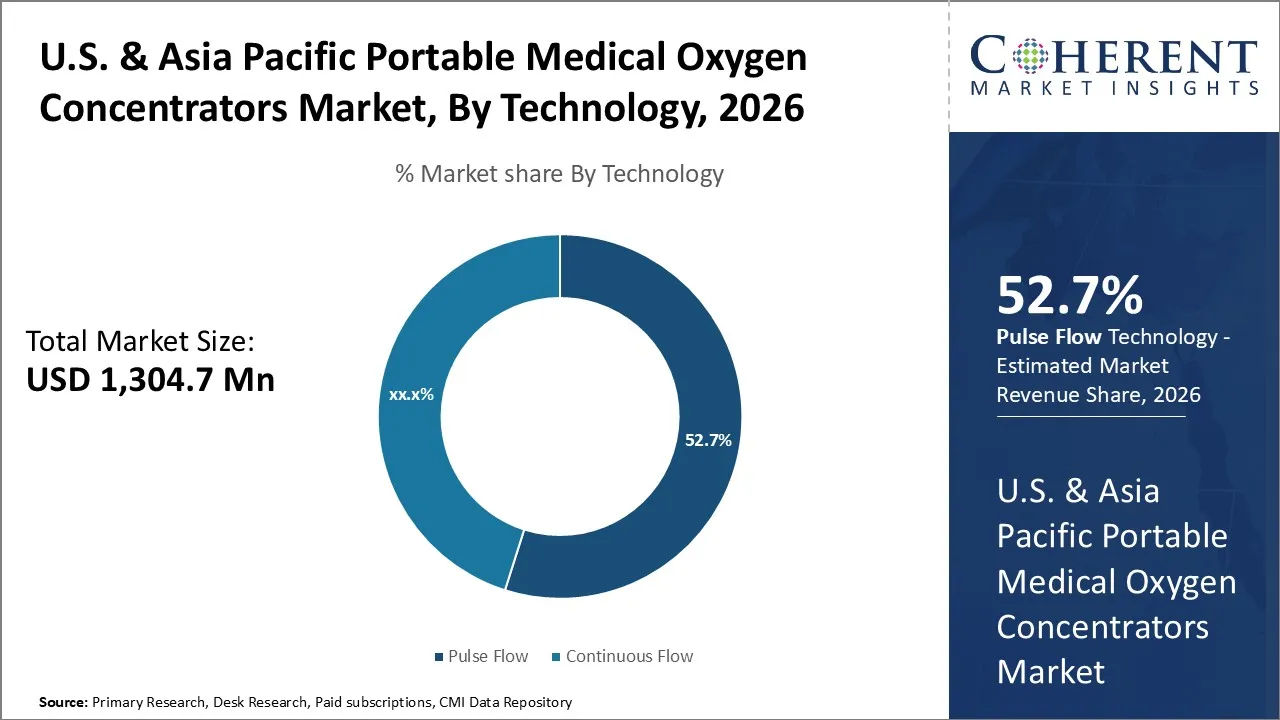
- By Technology, Pulse Flow hold the largest market share of 52.7% in 2026 owing to the miniaturization & portability.
- By Application, Respiratory Distress Syndrome expected to hold largest market share of 42.7% in 2026 owing to its impact on portable oxygen concentrators.
- By End User, Hospitals acquired the prominent market share of 43.7% in 2026 owing to the critical care & ICU dependency.
- By Country, United States dominates the overall market with an estimated share of 41.1% in 2026 owing to the shift to home healthcare.
Market Overview
Rising respiratory diseases, aging populations, and increasing demand for home healthcare are steadily expanding the United States and Asia Pacific portable medical oxygen concentrators market. The United States leads the market with its advanced healthcare infrastructure, strong reimbursement support, and widespread adoption of portable devices, especially for chronic conditions. Meanwhile, Asia Pacific is rapidly growing as healthcare access improves, pollution-related illnesses increase, and medical infrastructure develops. Ongoing technological advancements, such as lightweight and battery-efficient devices, along with a strong shift toward patient mobility and home-based care, continue to accelerate market growth.
Current Events and their Impact on the U.S. & Asia Pacific Portable Medical Oxygen Concentrators Market
Current Events | Description and its impact |
Geopolitical and Regulatory Developments |
|
Economic and Healthcare Infrastructure Trends |
|
Technological Innovations and Industry Advances |
|
Segmental Insights
- Current Industry Events of 2026
- Market Size Estimation
- Regional Breakdown
- Competitive Landscape
- Customer Intelligence
- Segmental Analysis
- Pricing Analysis
- Key Market Drivers, Challenges & Future Trends
- Customized Insights Section
U.S. & Asia Pacific Portable Medical Oxygen Concentrators Market Insights, By Technology - Pulse Flow contribute the highest share of the market owing to its mobility-focused design
Pulse Flow hold the largest market share of 52.7% in 2026. Pulse flow technology is gaining strong traction in the United States and Asia Pacific portable medical oxygen concentrators market as it offers high efficiency and portability. It delivers oxygen only during inhalation, which conserves energy and extends battery life, making it suitable for active and homecare patients. In the United States, lifestyle needs and advanced devices drive high adoption, while expanding home healthcare fuels rising demand in Asia Pacific. The growing preference for lightweight, travel-friendly solutions continues to accelerate the adoption of pulse flow systems. For instance, Inogen Inc has introduced the Inogen Rove 4 Portable Oxygen Concentrator in the U.S., delivering up to 840 ml/min of medical-grade oxygen across four flow settings in a compact design weighing less than 3 lbs.
U.S. & Asia Pacific Portable Medical Oxygen Concentrators Market Insights, By Application - Respiratory Distress Syndrome contribute the highest share of the market owing to its growing use cases for POCs in RDS
Respiratory Distress Syndrome expected to hold largest market share of 42.7% in 2026. Respiratory Distress Syndrome drives demand in the United States and Asia Pacific portable medical oxygen concentrators market, especially in acute care settings. Healthcare providers actively use oxygen therapy to treat breathing difficulties during emergencies and post-hospitalization phases. Hospitals manage severe cases with high-flow systems, while portable concentrators support patient recovery and home-based care. In the United States, advanced healthcare systems ensure effective management, while Asia Pacific experiences rising cases due to pollution and expanding healthcare infrastructure, which increases the need for accessible oxygen solutions. For instance, Omron Healthcare has launched a portable, molecular sieve-based oxygen concentrator that delivers a continuous high-purity oxygen supply of 5 L per minute with over 90% concentration, supporting homecare providers in managing therapy and daily needs for patients with COPD and other respiratory conditions.
U.S. & Asia Pacific Portable Medical Oxygen Concentrators Market Insights, By End User - Hospitals contribute the highest share of the market owing to its role of portable oxygen concentrators in hospitals
Hospitals acquired the prominent market share of 43.7% in 2026. Hospitals drive the largest end-user demand in the United States and Asia Pacific portable medical oxygen concentrators market. They use stationary systems to provide acute and critical care in ICUs and emergency situations, while deploying portable concentrators for patient transport, discharge, and step-down care. In the United States, hospitals actively prescribe and distribute portable devices for homecare. In Asia Pacific, expanding hospital infrastructure and growing patient volumes increase the use of both stationary and portable oxygen solutions.
Country Insights
United States Portable Medical Oxygen Concentrators Market Trends
United States dominates the overall market with an estimated share of 41.1% in 2026. The United States portable medical oxygen concentrators market is rapidly evolving as rising chronic respiratory conditions, an aging population, and growing demand for home-based care drive adoption. Patients and healthcare providers actively choose lightweight, battery-efficient, and travel-friendly devices that enhance mobility and independence. Pulse flow technology and smart, connected systems improve usability and convenience. Hospitals prescribe portable concentrators for post-discharge care, while homecare adoption continues to expand. Strong reimbursement support and advanced healthcare infrastructure further promote widespread use of portable oxygen solutions. For instance, in June 2025, Inogen, Inc., a medical technology leader in home respiratory products, launched the Voxi 5 stationary oxygen concentrator to improve access to high-quality oxygen therapy for long-term care patients in the U.S.
China Portable Medical Oxygen Concentrators Market Trends
China’s portable medical oxygen concentrators market is expanding as rising respiratory diseases, urbanization, and increased healthcare awareness drive demand. Patients and healthcare providers actively choose portable, lightweight, and energy-efficient devices for homecare and mobility. Hospitals prescribe and distribute concentrators, while expanding medical infrastructure supports their use in both clinical and home settings. Technological advancements, such as pulse flow systems and battery-efficient designs, enhance convenience and accessibility. Government initiatives and healthcare investments further promote the adoption of portable oxygen solutions across urban and semi-urban areas.
End-user Feedback and Unmet Needs in the U.S. & Asia Pacific Portable Medical Oxygen Concentrators Market
- Device Portability and Weight Concerns: Users often report that while PMOCs are marketed as portable, many devices remain heavy or cumbersome for daily travel. Elderly patients or those with mobility limitations struggle with carrying and maneuvering the units, leading to a need for lighter, more ergonomic designs that don’t compromise oxygen output.
- Battery Life Limitations: Patients highlight that limited battery life is a major barrier, especially during long commutes, travel, or outdoor activities. Frequent recharging interrupts mobility and independence. There is demand for longer-lasting, faster-charging, and easily replaceable batteries to support uninterrupted oxygen therapy in real-life scenarios.
- Noise Levels During Operation: Many users find PMOCs noisy, causing discomfort during sleep, conversations, or public use. High decibel levels can reduce social acceptance and compliance. An unmet need exists for quieter, vibration-free units that provide therapeutic oxygen without drawing attention or disrupting daily routines.
U.S. & Asia Pacific Portable Medical Oxygen Concentrators Market Trend
Aging Population & Technology Adoption
In the United States, demand for portable medical oxygen concentrators is driven by an aging population with chronic respiratory conditions such as COPD, asthma, and post‑COVID complications. Patients increasingly prefer lightweight, battery‑powered units that support mobility and home‑based oxygen therapy. Advanced features like pulse‑dose delivery, longer battery runtimes, and smart connectivity are becoming key differentiators as manufacturers focus on comfort, portability, and ease of use in daily life.
Home Care & Reimbursement Support
U.S. healthcare trends show a shift toward home‑based oxygen therapy, supported by broader insurance reimbursement policies and durable medical equipment channels. Patients and caregivers are choosing portable concentrators that integrate with telehealth services and remote monitoring. Direct‑to‑consumer sales and rental programs have expanded access. Continuous innovation from major producers creates competitive pressure, fostering more user‑friendly, quieter devices that appeal to active patients who want independence beyond clinical settings.
U.S. & Asia Pacific Portable Medical Oxygen Concentrators Market Opportunity
Local Manufacturing & Affordable Solutions
Opportunities in Asia Pacific include scaling local production and assembly to reduce costs and improve accessibility. Domestic manufacturing initiatives can help address import dependence and meet varied regulatory requirements across countries. There is scope for tailored distribution strategies in emerging economies, including tier‑2 and tier‑3 cities, where clinical infrastructure is still developing. Affordable models with simplified maintenance, extended battery life, and bilingual user interfaces can appeal to a broad patient base and support wider adoption in homecare and outpatient settings.
Market Report Scope
U.S. & Asia Pacific Portable Medical Oxygen Concentrators Market Report Coverage
| Report Coverage | Details | ||
|---|---|---|---|
| Base Year: | 2025 | Market Size in 2026: | USD 1,304.7 Mn |
| Historical Data for: | 2020 To 2024 | Forecast Period: | 2026 To 2033 |
| Forecast Period 2026 to 2033 CAGR: | 5.3% | 2033 Value Projection: | USD 1,689.8 Mn |
| Geographies covered: |
Asia Pacific: China, India, Japan, Australia, South Korea, ASEAN, and Rest of Asia Pacific | ||
| Segments covered: |
| ||
| Companies covered: | Chart industries, OxyGo HQ Florida, LLC, Koninklijke Philips N.V., ResMed Inc., Precision Medical, Inc, O2 CONCEPTS, LLC, GCE Group, Nidek Medical Product, Besco Medical Limited, CAIRE INC., BPL Medical Technologies, CONTEC MEDICAL SYSTEMS CO.,LTD., NAREENA LIFESCIENCES PRIVATE LIMITED, Drive DeVilbiss Healthcare llc | ||
| Growth Drivers: |
| ||
| Restraints & Challenges: |
| ||
U.S. & Asia Pacific Portable Medical Oxygen Concentrators Market News
- In January 2026, Oxymed, a leading Indian home oxygen concentrator manufacturer, has introduced the Oxymed Cure, a 5 LPM oxygen concentrator that delivers reliable, medical-grade oxygen therapy with strong after-sales support at a more affordable price.
Analyst Opinion (Expert Opinion)
- In the U.S. portable medical oxygen concentrators segment, structural demand is rooted in established home healthcare frameworks and reimbursement stability, which have effectively de‑risked long‑term adoption. Reliable surveys reveal that a significant proportion of U.S. adults—over 9 %—self‑report asthma, contributing to sustained pressure on oxygen therapy utilization outside institutional settings, with COPD prevalence compounding this dynamic and strengthening baseline demand. This depth of chronic respiratory morbidity means device penetration is less speculative and more reflective of long‑standing clinical need, distinguishing the U.S. market from regions where adoption has historically been nascent.
- Incumbents with diversified portfolios and robust regulatory credentials—such as multinational manufacturers that combine pulse and continuous flow capabilities—are systematically consolidating share. The imperative now is on differentiated product features, including extended battery life, leaner form factors, and integrated digital interfaces for remote care, given that commoditization pressure from lower‑cost units has already begun to compress margins in less sophisticated segments.
- The Asia Pacific landscape reflects a duality of explosive relative growth and persistent structural bottlenecks. Regulatory accelerations in key markets like China have driven a steep uptick in device registrations, while India’s medical device ecosystem continues to depend on imported technology for the majority of supply, underscoring an ongoing opportunity for partnerships that localize assembly and reduce cost barriers. Yet this growth trajectory is not uniform; disparities in healthcare infrastructure, uneven reimbursement schemas, and logistical constraints in rural regions temper the pace at which device adoption translates into profitable scale.
- A broader trend reinforcing both regions is the shifting competitive dynamics induced by recent safety and compliance developments. Incidents prompting severe recall actions by U.S. regulators highlight the reputational and financial risks tied to quality assurance lapses, elevating compliance capital as a differentiator beyond pure innovation. Concurrently, Asia Pacific markets, while offering the fastest compound growth rates globally, compel vendors to balance premium product positioning with aggressive cost strategies to penetrate price‑sensitive segments.
- Overall, the portable medical oxygen concentrators market is evolving into a bifurcated competitive environment where innovation and regulatory stewardship command a premium in the U.S., and adaptable, cost‑aware strategies define success across diverse Asia Pacific healthcare ecosystems.
Speak to the analyst
Want personalized insights?
Take the findings above to one of our principal consultants, or have the report rebuilt around the segments, geographies and competitors you actually track.
Market Segmentation
- By Technology
- Pulse Flow
- Continuous Flow
- By Application
- Chronic obstructive pulmonary disease (COPD)
- Asthma
- Respiratory Distress Syndrome
- Others
- By End User
- Hospitals
- Homecare Settings
- Ambulatory Surgical Centers
- Others
- By Regional Insights
- U.S
- Asia Pacific
- China
- India
- Japan
- Australia
- South Korea
- ASEAN
- Rest of Asia Pacific
- Key Players Insights
- Chart industries
- OxyGo HQ Florida, LLC,
- Koninklijke Philips N.V.
- ResMed Inc.
- Precision Medical, Inc
- O2 CONCEPTS, LLC
- GCE Group
- Nidek Medical Product
- Besco Medical Limited
- CAIRE INC.
- BPL Medical Technologies
- CONTEC MEDICAL SYSTEMS CO.,LTD.
- NAREENA LIFESCIENCES PRIVATE LIMITED
- Drive DeVilbiss Healthcare llc
Sources
Primary Research Interviews
- Interviews with respiratory therapists and pulmonologists across U.S. and Asia Pacific
- Discussions with medical device distributors and home healthcare providers
- Insights from hospital procurement managers and clinical administrators
- Inputs from product managers and engineers in portable oxygen concentrator manufacturing
- Consultations with regulatory experts and biomedical consultants
Databases
- U.S. Food and Drug Administration (FDA) medical device database
- National Health Service (NHS) supply chain data
- Centers for Medicare & Medicaid Services (CMS) datasets
- World Health Organization (WHO) health statistics database
- United Nations Comtrade database
- OECD health data repository
Magazines
- Medical Device and Diagnostic Industry (MD+DI) Magazine
- Healthcare Business & Technology Magazine
- Asia Pacific Biotech News
- MedTech Innovation Magazine
Journals
- Journal of Respiratory Medicine
- American Journal of Pulmonary and Critical Care Medicine
- The Lancet Respiratory Medicine
- Journal of Clinical Medicine
- Respiratory Care Journal
Newspapers
- The New York Times (healthcare section)
- The Wall Street Journal (health & business coverage)
- The Guardian (global health news)
- The Economic Times (India healthcare sector news)
- South China Morning Post (Asia healthcare developments)
Associations
- American Thoracic Society (ATS)
- European Respiratory Society (ERS)
- Asia Pacific Society of Respirology (APSR)
- Medical Device Manufacturers Association (MDMA)
- Advanced Medical Technology Association (AdvaMed)
Public Domain Sources
- Government health department publications (U.S., China, India, Japan, Australia)
- Annual reports and investor presentations of medical device companies
- Clinical trial registries (ClinicalTrials.gov)
- Import-export trade statistics and customs data
- Regulatory approvals and product filings
- White papers and technical documentation from manufacturers
Proprietary Elements
- CMI Data Analytics Tool
- Proprietary CMI Existing Repository of information for last 8 years
Get access to 250+ pages report
Every segment, forecast, competitor profile and data table behind the analysis above — available for instant download.
- ESOMAR Member
- ISO 9001:2015 Certified
- D-U-N-S Registered
- GDPR & CCPA Compliant
Missing comfort of reading report in your local language? Find your preferred language:
Transform your Strategy with Exclusive Trending Reports
Frequently Asked Questions
The U.S. & Asia Pacific Portable Medical Oxygen Concentrators Market is estimated to be valued at USD 1,304.7 Mn in 2026 and is expected to reach USD 1,689.8 Mn by 2033.
The market is estimated to be valued at USD 1,304.7 Mn in 2026.
Chart industries, OxyGo HQ Florida, LLC, Koninklijke Philips N.V., ResMed Inc., Precision Medical, Inc, O2 CONCEPTS, LLC, GCE Group, Nidek Medical Product, Besco Medical Limited, CAIRE INC., BPL Medical Technologies, CONTEC MEDICAL SYSTEMS CO.,LTD., NAREENA LIFESCIENCES PRIVATE LIMITED, Drive DeVilbiss Healthcare llcre some of the prominent players operating in the U.S. & Asia Pacific portable medical oxygen concentrators market.
The market is expected to be valued at USD 1,689.8 Mn in 2033.
Increasing prevalence of respiratory disorders, increasing number of product launches by market players are some of the driving factors, which are expected to the market.