

Global Airway Management Devices Market Size and Forecast- 2026-2033
The Airway Management Devices Market is estimated to be valued at USD 2.74 Bn in 2026 and is expected to reach USD 4.35 Bn by 2033, exhibiting a compound annual growth rate (CAGR) of 6.8% from 2026 to 2033.
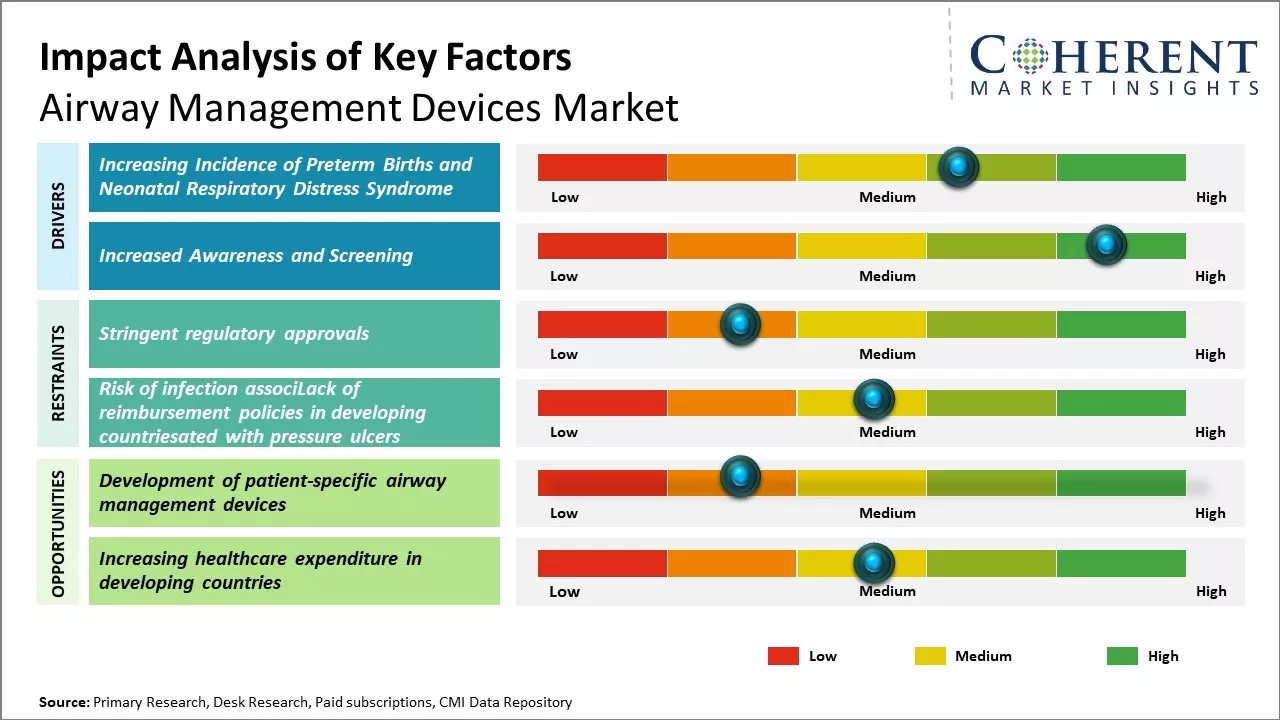
Key Takeaways
- Based on use, Single Use segment is anticipated to maintain the highest market share at 62.0% in 2026, which is due to a growing preference for safer and less costly solutions in healthcare facilities.
- By Device Type, Supraglottic Airway Management Devices segment is set to dominate with a 36.6% market share in 2026, due to continuous innovations that improve the safety and convenience of using these devices.
- By Patient Type, Adult Patient category will account for the highest contribution of 81.6% in 2026, driven by the expanding elderly population across the globe, raising the rate of respiratory illness and comorbidities requiring intensive care and expertise in airway management.
- Regionally, North America is predicted to be the leading regional market, holding 39.7% of the market share in 2026. The developed and massive healthcare facilities in nations such as the U.S. are key to this dominance.
Airway Management Devices Market Overview
The market for airway management devices is increasing as respiratory diseases rise, the population ages, and there are advancements in technology such as AI and AR. Increasing demand for safe, single-use airway management devices and better patient outcomes is fuelling adoption in hospitals, emergency services, and home care. Growing development of healthcare infrastructure, particularly in emerging economies, is expanding the market as firms innovate to address changing needs for airway management solutions. Additionally, increasing investment by key players to develop advanced airway management devices and growing number of surgical procedures will further aid in the market growth. However, lack of skilled professionals and high costs associated with emergency care devices are factors challenging the market growth.
Current Events and Its Impact on the Airway Management Devices Market
Current Events | Description and its impact |
Technological Improvements |
|
Increased Demand for Single-Use Devices |
|
Pricing Analysis
Device Type | Typical Price Range (USD) |
Guedel (oropharyngeal) airway | ~$3 – $50 per unit |
Nasopharyngeal airway (disposable) | $0.05 – $0.9 per unit |
Disposable LMA | ~$40 per unit |
Reusable LMA | > $200 per unit |
OEM Disposable LMA (bulk) | $1.2 – $8 per unit |
Disposable basic video laryngoscope | $500 – $1,500 |
Mid-range reusable video scope | $1,500 – $4,000 |
High-end video laryngoscopes | $4,000 – $10,000+ |
Full kits with accessories | $2,000 – $15,000+ |
Vimac video laryngoscope set | $2,250 – $5,500 per unit |
- Current Industry Events of 2026
- Market Size Estimation
- Regional Breakdown
- Competitive Landscape
- Customer Intelligence
- Segmental Analysis
- Pricing Analysis
- Key Market Drivers, Challenges & Future Trends
- Customized Insights Section
Growing Prevalence of Preterm Deliveries and Neonatal Respiratory Distress Syndrome
The increasing prevalence of preterm birth and neonatal respiratory distress syndrome has been one of the key drivers of demand for airway management devices. Preterm birth, defined as birth before 37 weeks of pregnancy, is on the increase globally. Preterm birth accounts for more than 1 in 10 babies born worldwide every year, as per recent estimates by the World Health Organization. The most severe preterm birth rates occur in Africa and North America. All of the above increases have played roles such as lifestyle changes which lead to postponed childbearing, maternal conditions of chronic nature such as diabetes and hypertension, and growing use of treatments for infertility which lead to births with more than one offspring. For example, based on ACS estimates published in 2022, approximately 236,740 Americans were projected to be diagnosed with lung cancer in that year. Suctioning becomes increasingly required as the incidence of lung cancer is projected to increase. Suctioning can prevent lung cancer patients suffering from a respiratory emergency from getting infected. During the forecast period, this is expected to enhance the market growth.
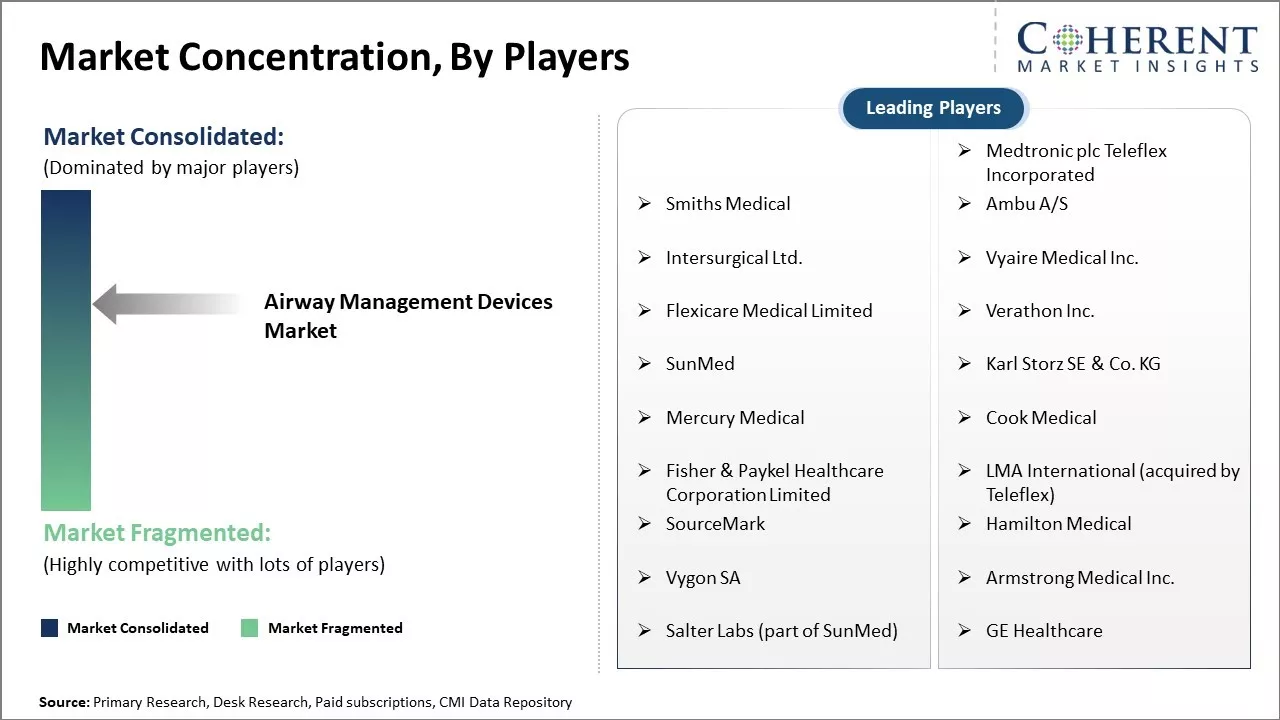
Market Concentration and Competitive Landscape
Airway Management Devices Market Trends : Technological Innovations Resulting in Product Innovations
The airway management devices market has registered tremendous advancement over the last few years as a result of continued product development and design enhancements. Major companies have invested heavily in research and development to develop new devices that feature improved safety, effectiveness, and ease of use. One of the exciting technology developments includes high-end ventilators with closed-loop volume guarantee and pressure control, which further support better patient care and outcome.
Airway Management Device Market Challenge – Tight Regulatory Approvals
Stringent regulatory approvals for airway management devices are one of the key drivers that is inhibiting the growth of this market. Such medical devices are utilized in lifesaving interventions and thus exposed to intense clinical trials and examination before being sanctioned for patient applications. The procedure entails pre-clinical experiments on animal models to ensure the device works correctly and is biocompatible. Only after satisfactory animal studies, selective human clinical trials are allowed that takes approximately 1-2 years to acquire sufficient safety and efficacy data. In this interim period, manufacturers are not able to commercialize or sell the devices. The clinical trial cycle involves recruitment of large numbers of patients from a number of different hospitals that offers tremendous logistical as well as capital-intensive challenges for manufacturers.
Market Opportunity – Emerging Opportunities in the Airway Management Device Industry
An aging and expanding global population will drive emergency and airway management procedure demand. New products with better performance than current devices could have good uptake if they perform well in clinical trials. There is also potential for innovation in single-use devices for cost reduction and in transportable devices for pre-hospital use.
Segmental Insights
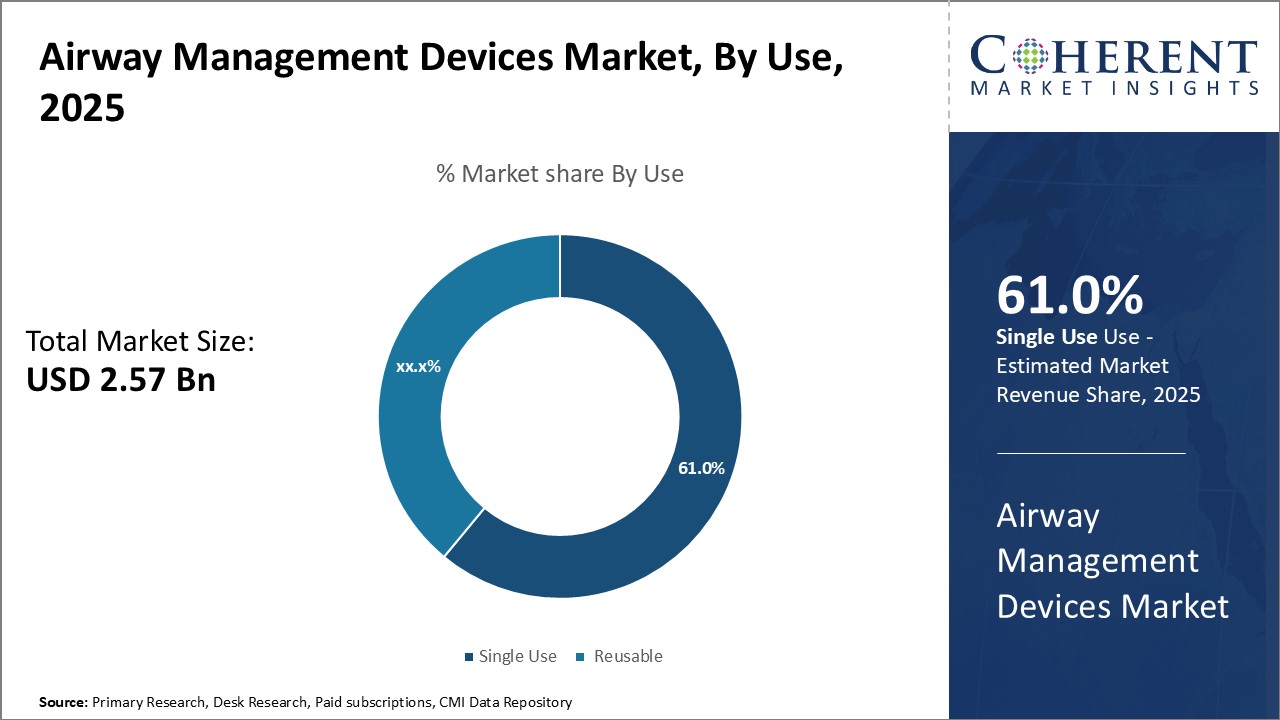
Airway Management Devices Insights, By Use: Growing preference for safer and cost-effective options drives the single use segment
In terms of Use, the Single Use segment contributes the highest share of the market 62% In 2026 owing to growing preference for safer and more cost-effective options across healthcare facilities. Single use airway management devices eliminate the risk of cross-contamination associated with reusable devices. This is a major driver considering patient safety is the top priority in the medical industry. Single use variants also help reduce facility reprocessing costs as no sterilization or high-level disinfection is required between each use. Managing large volumes of patients more efficiently using disposable tools has significant return on investment benefits. Additionally, as invasive procedures continue rising globally due to growing disease incidence, demand for single use disposable variants will rise in tandem as they enable quick turnover and optimal workflow in packed schedules.
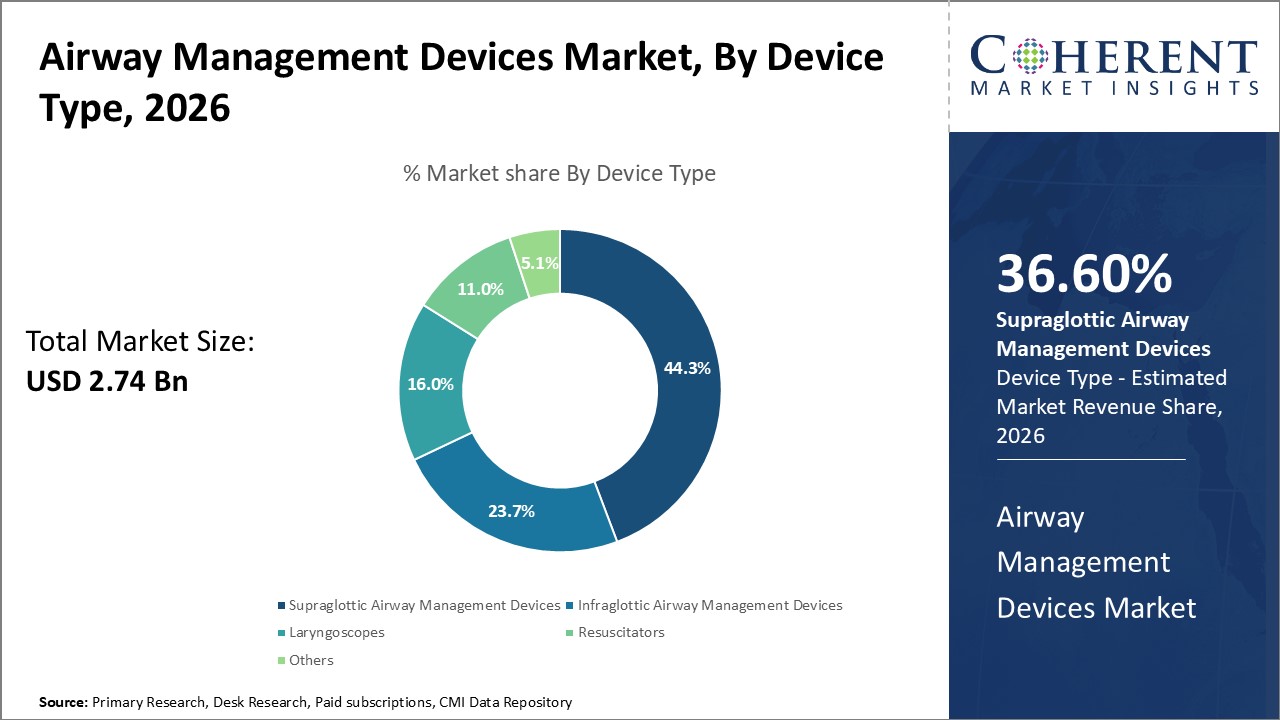
Airway Management Devices Insights, By Device Type: Advancements in technology and design fuel supraglottic options
Among device types, the Supraglottic Airway Management Devices segment contributes the highest share 36.6% In 2026 owing to continued innovations making these safer and easier to place. Features like integral bite blocks, drainage ports and gastric access channels have enhanced performance. Adoption is also improved by self-advancing tip designs requiring minimal manual manipulation during insertion. This addresses placement challenges often faced during emergency situations. Added user-safety through self-guiding balloon tipped and pre-formed anatomical contour variants further augment the segment. Ongoing developments in material science to improve softness, stability and sealing capabilities of supraglottic masks are also stimulating preference over other device types.
Airway Management Devices Insights, By Patient Type: Growing elderly demographic boosts adult patient segment growth
In terms of patient type, the Adult Patient segment contributes the highest share 81.6% In 2026 driven by the rising geriatric population worldwide. Ageing increases the risk of respiratory diseases and comorbidities requiring intensive care and skilled airway management. For example, elderly patients undergoing surgeries are more prone to developing complications necessitating post-operative ventilation support. Equipping operating rooms, emergency units and ICUs with a wide range of adult-sized airway gadgets thus becomes imperative. This steady growth in addressable patient pool underscores the need for developing enhanced adult airway management solutions tailored for the specific age.
Regional Insights
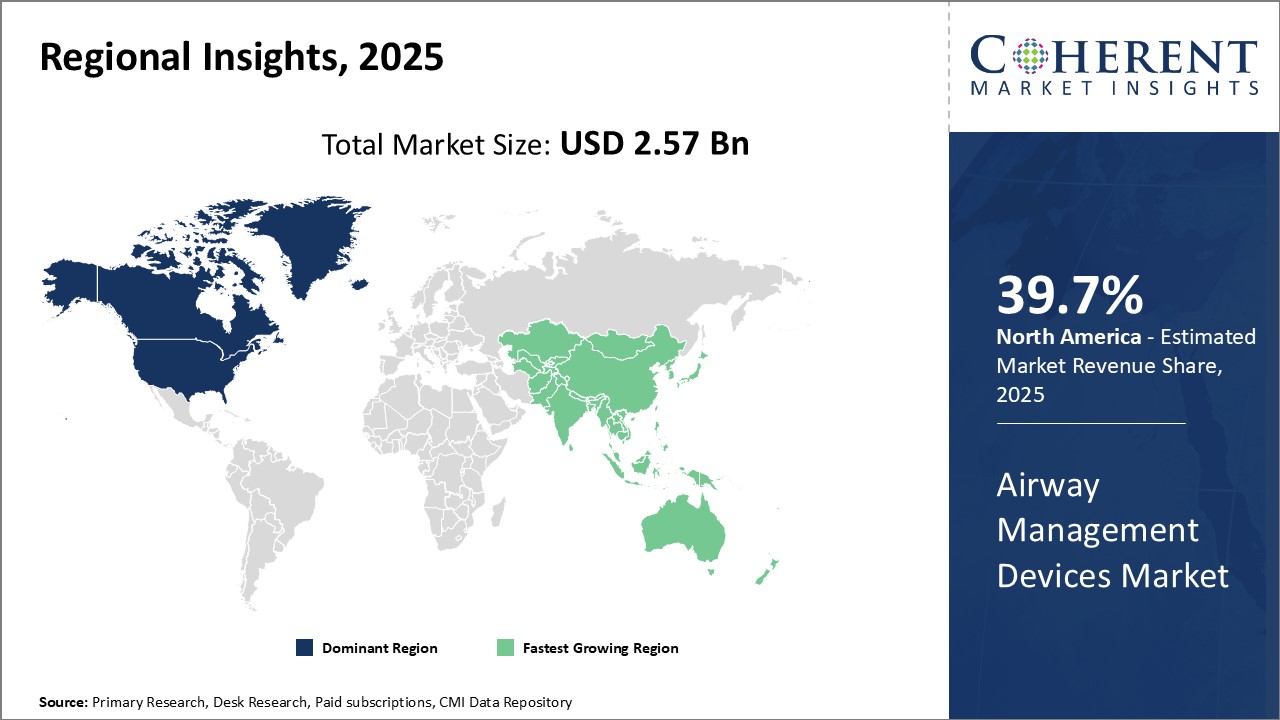
North America has emerged as the leading regional market for airway management devices in the world with highest share of 39.7% in 2026. The extensive size and complexity of the healthcare infrastructure in nations such as the U.S. have been a major factor in its leading position. Sophisticated airway management technologies have been extensively used in hospital and pre-hospital environments to facilitate effective care. In addition, the presence of professionals skilled in working with complex processes has enabled various innovative products to become popular. Top medical device firms have also established their bases in the area, launching cutting-edge products with a regular pace. This has provided physicians and patients with exposure to the newest solutions.
Stringent regulation has assisted in raising quality levels as well as encouraging ongoing R&D investments by industry players. Reimbursement policies also encourage adoption of high-end devices for critical care. A well-established multi-layer distribution network rounds out the value chain, distributing equipment seamlessly over the large geography. With the economic strength of the region and emphasis on surgical specialties such as trauma management, airway management will continue to be at the core of clinical workflows. In the future, consolidation in the emergency medical services industry could further drive demand for portable and single-use devices.
The Asia Pacific market has become the most rapidly growing market for airway management devices globally. Nations like China, India, and Japan are witnessing significantly high economic growth coupled with an increasing patient population in need of critical care. With enhanced access to healthcare insurance and growing medical tourism sectors, increasingly complex surgeries are being undertaken. This has led to hospitals and anesthesia service providers increasingly investing in sophisticated airway solutions to ensure safer procedures.
Market Report Scope
Airway Management Devices Market Report Coverage
| Report Coverage | Details | ||
|---|---|---|---|
| Base Year: | 2025 | Market Size in 2026: | USD 2.74 Bn |
| Historical Data for: | 2020 To 2024 | Forecast Period: | 2026 To 2033 |
| Forecast Period 2026 to 2033 CAGR: | 6.8% | 2033 Value Projection: | USD 4.35 Bn |
| Geographies covered: |
| ||
| Segments covered: |
| ||
| Companies covered: | Medtronic plc Teleflex Incorporated, Smiths Medical, Ambu A/S, Intersurgical Ltd., Vyaire Medical Inc., Flexicare Medical Limited, Verathon Inc., SunMed, Karl Storz SE & Co. KG, Mercury Medical, Cook Medical, Fisher & Paykel Healthcare Corporation Limited, LMA International (acquired by Teleflex), SourceMark, Hamilton Medical, Vygon SA, Armstrong Medical Inc., Salter Labs (part of SunMed), and GE Healthcare | ||
| Growth Drivers: |
| ||
| Restraints & Challenges: |
| ||
Airway Management Devices Industry News
- On March 12, 2025 Surgicure Technologies announced, the successful completion of a $1.785 million seed funding round, which was led by Launchpad Venture Group and contributed to by Gurtin Ventures and other investors. The proceeds will expedite the commercialization of their lead product, the Horseshoe™, a new device that aims to improve the safety and reliability of endotracheal tube (ETT) securement.
- In 2024 The Baska Mask™ has been proposed as a third-generation supraglottic airway device with a self-inflating membranous cuff, built-in bite block, and sump cavity with ongoing suction.These advances are intended to improve airway seal pressures as well as minimize the aspiration risk during procedures.
Market Segmentation
- Use Insights (Revenue, USD Bn, 2021 - 2033)
- Single Use
- Reusable
- Device Type Insights (Revenue, USD Bn, 2021 - 2033)
- Supraglottic Airway Management Devices
- Laryngeal Mask Airway
- Oropharyngeal Airway
- Nasopharyngeal Airway
- Infraglottic Airway Management Devices
- Endotracheal Tubes
- Tracheostomy Tubes
- Laryngoscopes
- Conventional Laryngoscope
- Video Laryngoscopes
- Resuscitators
- Others (Cricothyrotomy Kits, etc.)
- Supraglottic Airway Management Devices
- Patient Type Insights (Revenue, USD Bn, 2021 - 2033)
- Adult Patient
- Pediatrics
- End User Insights (Revenue, USD Bn, 2021 - 2033)
- Hospitals
- Ambulatory Surgery Centers
- Others (Home Care, etc.)
- Regional Insights (Revenue, USD Bn, 2021 - 2033)
- North America
- U.S.
- Canada
- Latin America
- Brazil
- Argentina
- Mexico
- Rest of Latin America
- Europe
- Germany
- U.K.
- Spain
- France
- Italy
- Russia
- Rest of Europe
- Asia Pacific
- China
- India
- Japan
- Australia
- South Korea
- ASEAN
- Rest of Asia Pacific
- Middle East
- GCC Countries
- Israel
- Rest of Middle East
- Africa
- South Africa
- North Africa
- Central Africa
- North America
- Key Players Insights (Revenue, USD Bn, 2021 - 2033)
- Medtronic plc Teleflex Incorporated
- Smiths Medical
- Ambu A/S
- Intersurgical Ltd.
- Vyaire Medical Inc.
- Flexicare Medical Limited
- Verathon Inc.
- SunMed
- Karl Storz SE & Co. KG
- Mercury Medical
- Cook Medical
- Fisher & Paykel Healthcare Corporation Limited
- LMA International (acquired by Teleflex)
- SourceMark
- Hamilton Medical
- Vygon SA
- Armstrong Medical Inc.
- Salter Labs (part of SunMed)
- GE Healthcare
Sources
Primary Research Interviews of the following stakeholders
Stakeholders
- Interviews with medical device manufacturers, healthcare providers, and clinical specialists in airway management.
- Specific stakeholders Product managers in medical device companies, physicians who specialize in anesthesia and emergency medicine, hospital procurement managers, regulatory affairs professionals, and healthcare technology experts.
Databases
- Statista
- Euromonitor International
- IBISWorld
Magazines
- Medical Device and Diagnostic Industry (MDDI)
- MedTech Innovator
- Healthcare Business News
- Clinical Engineering Journal
- Fierce MedTech
Journals
- Journal of Clinical Anesthesia
- Anesthesia & Analgesia
- Journal of Airway Management
- Respiratory Care
- Journal of Medical Devices
Newspapers
- The New York Times (Health Section)
- The Wall Street Journal (Healthcare Section)
- Reuters (Health Section)
- The Guardian (Health Section)
Associations
- American Society of Anesthesiologists (ASA)
- International Anesthesia Research Society (IARS)
- American Association of Respiratory Care (AARC)
- Society for Airway Management (SAM)
- European Society of Anaesthesiology (ESA)
Public Domain Sources
- U.S. Food and Drug Administration (FDA)
- European Medicines Agency (EMA)
- World Health Organization (WHO)
- International Trade Administration (ITA)
- National Institutes of Health (NIH)
Proprietary Elements
- Internal market research studies and proprietary analysis tools produced by the research team.
- Proprietary information on trends in consumer acceptance of airway management technologies, such as adoption rates in critical care units and hospitals.
Get access to 250+ pages report
Every segment, forecast, competitor profile and data table behind the analysis above — available for instant download.
- ESOMAR Member
- ISO 9001:2015 Certified
- D-U-N-S Registered
- GDPR & CCPA Compliant
Missing comfort of reading report in your local language? Find your preferred language:
Transform your Strategy with Exclusive Trending Reports
Frequently Asked Questions
The Airway Management Devices Market is estimated to be valued at USD 2.74 Bn in 2026, and is expected to reach USD 4.35 Bn by 2033.
The CAGR of the Airway Management Devices Market is projected to be 6.8% from 2026 to 2033.
Increasing incidence of preterm births and neonatal respiratory distress syndrome and increased awareness and screening are the major factors driving the growth of the airway management devices market.
Stringent regulatory approvals and risk of infection, lack of reimbursement policies in developing countries associated with Airway Management Devices are the major factors hampering the growth of the airway management devices market.
In terms of Use, Single Use is estimated to dominate the market revenue share in 2026.
Medtronic plc Teleflex Incorporated, Smiths Medical, Ambu A/S, Intersurgical Ltd., Vyaire Medical Inc., Flexicare Medical Limited, Verathon Inc., SunMed, Karl Storz SE & Co. KG, Mercury Medical, Cook Medical, Fisher & Paykel Healthcare Corporation Limited, LMA International (acquired by Teleflex), SourceMark, Hamilton Medical, Vygon SA, Armstrong Medical Inc., Salter Labs (part of SunMed), and GE Healthcare are the major players.
North America is expected to lead the airway management devices market.