

Global 3D Rendering Market Size and Forecast – 2026 To 2033
The global 3D rendering market is expected to grow from USD 6.80 Bn in 2026 to USD 18.75 Bn by 2033, registering a compound annual growth rate (CAGR) of 8% from 2026 to 2033. The global 3D rendering market is driven by the expansion of digital twin applications in manufacturing construction and smart cities. On October 9, 2024, Bentley Systems Inc. announced a strategic partnership with Google to integrate Google’s high-quality geospatial content with Bentley’s infrastructure engineering software and digital twin platform to improve the way infrastructure is designed, built, and operated.
Key Takeaways of the Global 3D Rendering Market
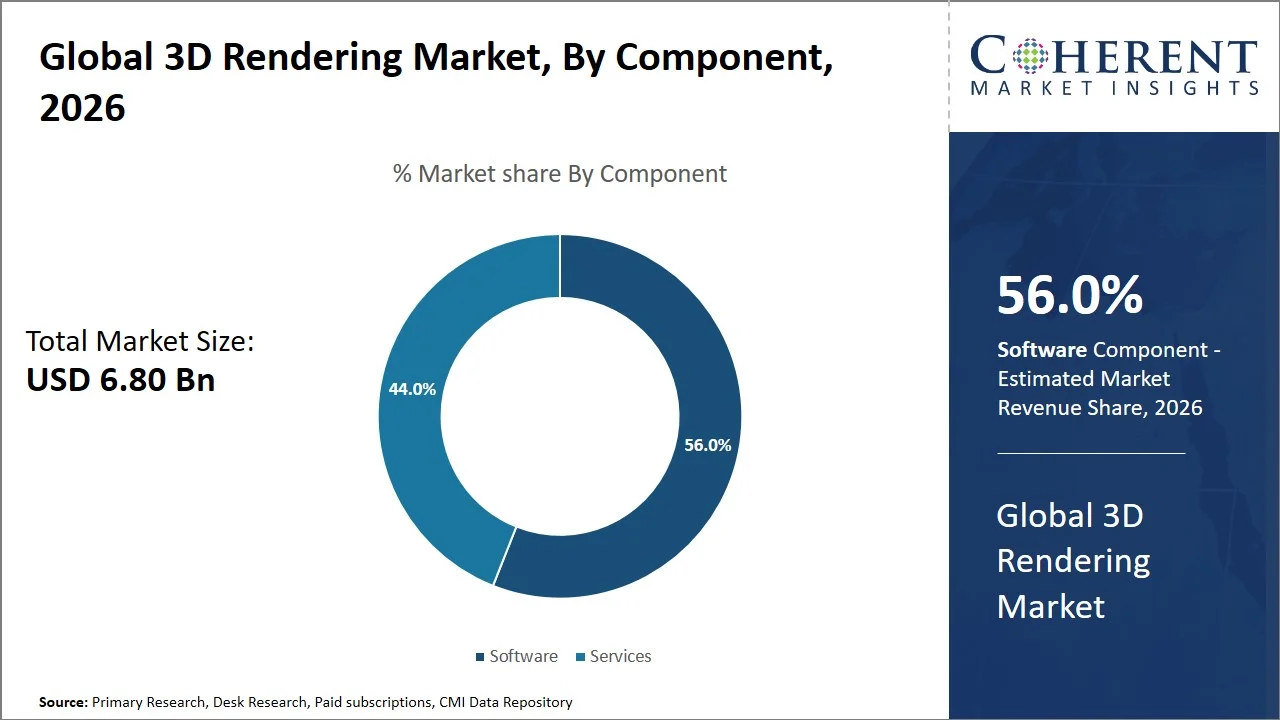
- The software segment is expected to account for 56.0 % of the global 3D rendering market share in 2026. Increasing demand for immersive AR VR and metaverse experiences is driving the growth of the segment. On June 10, 2025, Niantic Spatial Inc. and Snap Inc. signed a strategic multi-year partnership to jointly build a next generation AI map that will serve as the foundation for AR glasses and AI agents to understand, navigate and interact with the real world.
- The cloud segment is estimated to capture 63.0 % of the market share in 2026. Growing investments in cloud based rendering infrastructure is majorly driving the growth of the segment. On April 3, 2024, Amazon Web Services launched AWS Deadline Cloud, a fully managed cloud rendering service that enables animation studios, architectural firms, and visual effects companies to deploy scalable rendering farms without managing rendering infrastructure.
- The real time rendering segment is estimated to capture 59.0 % of the market share in 2026. Rising demand for photorealistic visualization in e commerce and retail is driving the growth of the segment. On March 31, 2025, Covision Media secured USD 5.7 million in seed funding to accelerate deployment of its artificial intelligence and 3D scanning platform that creates digital twins of retail products for photorealistic e-commerce visualization and virtual try on.
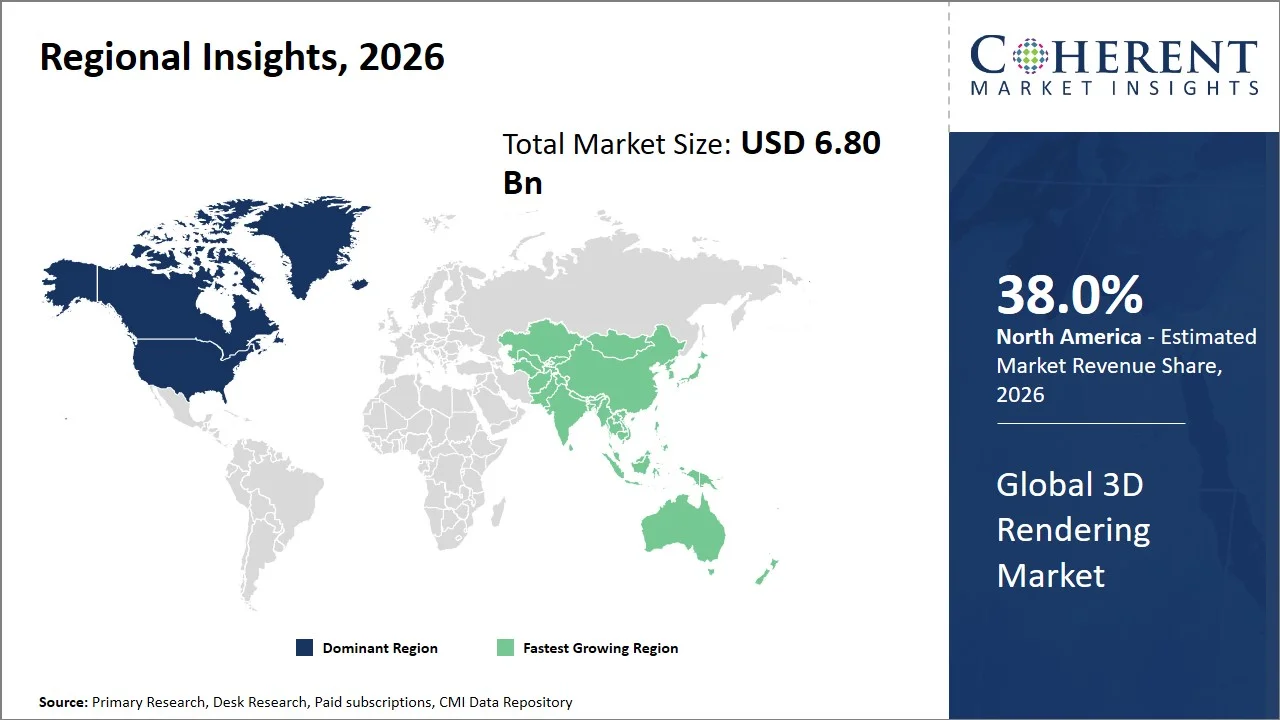
- North America is expected to dominate the 3D rendering market in 2026 with a market share of 38.0 %. Growth of virtual production in film and media industries in North America is driving the growth of the regional market. On February 11, 2024, Cinesite launched Cinesite VIS, a dedicated visualization division providing previs, techvis, postvis, and virtual production services for feature films and episodic content.
- Asia Pacific is expected to account for 21.0 % of the market share in 2026 and is projected to record the fastest growth over the forecast period. Increasing use of 3D rendering in healthcare education and simulation across Asia Pacific is driving the growth of the regional market. On May 12, 2026, D Y Patil International University signed a Memorandum of Understanding (MoU) with Dassault Systemes to establish an advanced Digital Engineering and Digital Manufacturing Experience Centre inside its campus in Pune, India.
Segmental Insights
Why Does Software Dominate the Global 3D Rendering Market?
The software segment is expected to account for 56.0% of the global 3D rendering market share in 2026. The software division is still the leader, being the central platform for the creation, editing, simulation and presentation of high quality three dimensional information across numerous industries. Continuous progress in rendering engines, AI assisted workflows, real time ray tracing, cloud collaboration and cross platform interoperability has greatly improved the possibilities of rendering software while increasing productivity and reducing project turnaround times. The extensive use of such technologies in architecture, engineering, gaming, animation, manufacturing and media production has made advanced rendering software an integral part of digital content generation and visualization processes in the contemporary day. On September 10, 2024, Maxon announced the availability of ZBrush for iPad, a professional digital sculpting platform for Apple tablets that fits seamlessly into desktop workflows and allows artists to generate detailed 3D materials that can be rendered in Cinema 4D and Redshift production environments.
- Current Industry Events of 2026
- Market Size Estimation
- Regional Breakdown
- Competitive Landscape
- Customer Intelligence
- Segmental Analysis
- Pricing Analysis
- Key Market Drivers, Challenges & Future Trends
- Customized Insights Section
Why is Cloud the Most Preferred Deployment Type?
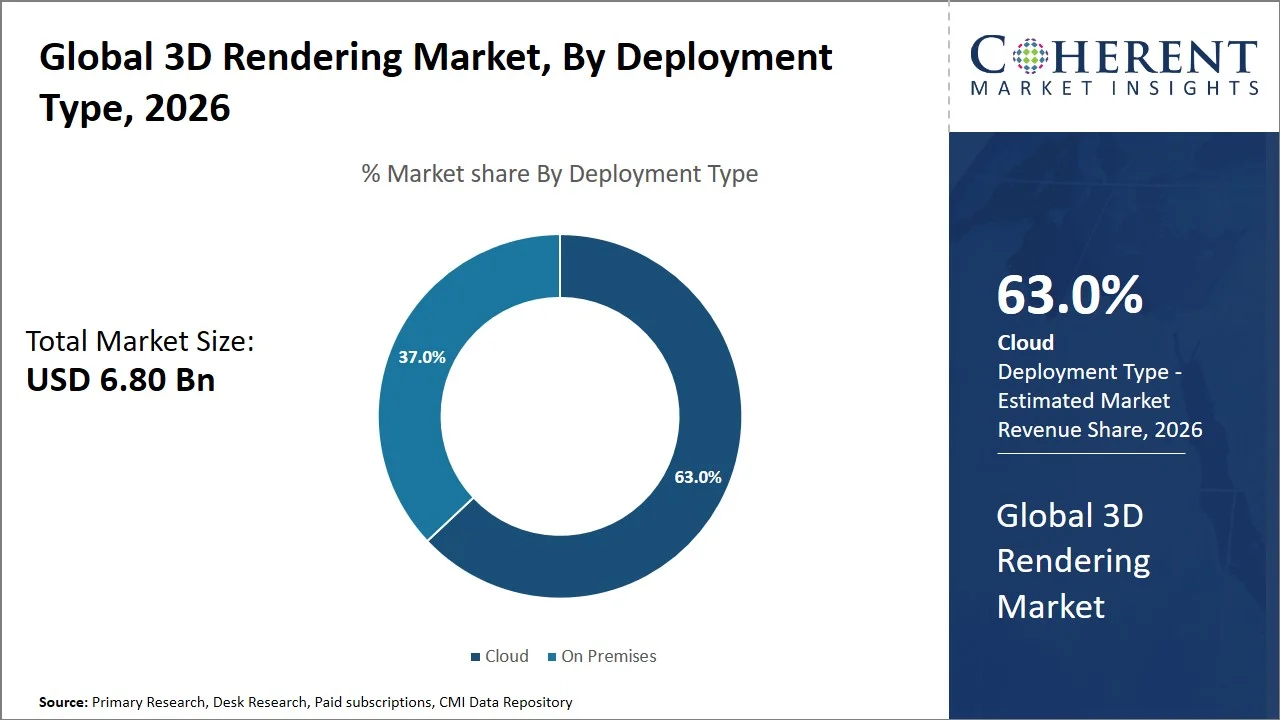
The cloud segment is expected to account for 63.0% of the global 3D rendering market share in 2026. Cloud deployment is preferable, since it offers almost unlimited computing power that can be expanded on demand for computationally intensive rendering applications without the need for major investment in high performance local hardware. Organizations may utilize powerful GPU capabilities, expedite rendering times, facilitate remote communication between scattered teams, and only pay for the computer capability they use. This helps architecture firms, animation studios, game developers and manufacturing enterprises to quickly work on huge rendering projects, while cutting infrastructure costs, simplifying software upgrades and increasing overall operational efficiency. On June 11, 2025, Google Cloud announced G4 virtual machines to help customers speed graphics demanding tasks such as 3D rendering, visualization, virtual workstations, and game development using NVIDIA GPUs. Google has designed the new GPU instances to give faster rendering performance at a lower cost to the cloud infrastructure for creative professionals.
Real Time Rendering Dominates the Global 3D Rendering Market
The real time rendering segment is expected to account for 59.0% of the global 3D rendering market share in 2026. Real time rendering is becoming more popular due to the rising demand for fast visualization and interactive design workflows in industries such as gaming, architecture, automotive, manufacturing and media production. Unlike traditional offline rendering, real time rendering lets users see changes to lighting, textures, materials and design instantly, enabling faster decision making and more effective cooperation. Continuous improvements in GPU performance, ray tracing technology and artificial intelligence based rendering optimization have further improved image quality while maintaining high rendering speeds. Real time rendering is an essential technology for immersive applications and rapid product development. On July 20, 2026, at SIGGRAPH 2026, NVIDIA announced groundbreaking graphics innovations, including new RTX rendering technologies, AI-powered simulation capabilities, OpenUSD workflow enhancements, and next-generation real-time graphics tools for media production, robotics, industrial digital twins, and immersive visualization.
Current Events and their Impact
Current Events | Description and its Impact |
European Union – AI Act |
|
United States - Executive Order on Advancing United States Leadership in Artificial Intelligence Infrastructure |
|
Global 3D Rendering Market Dynamics
Market Drivers
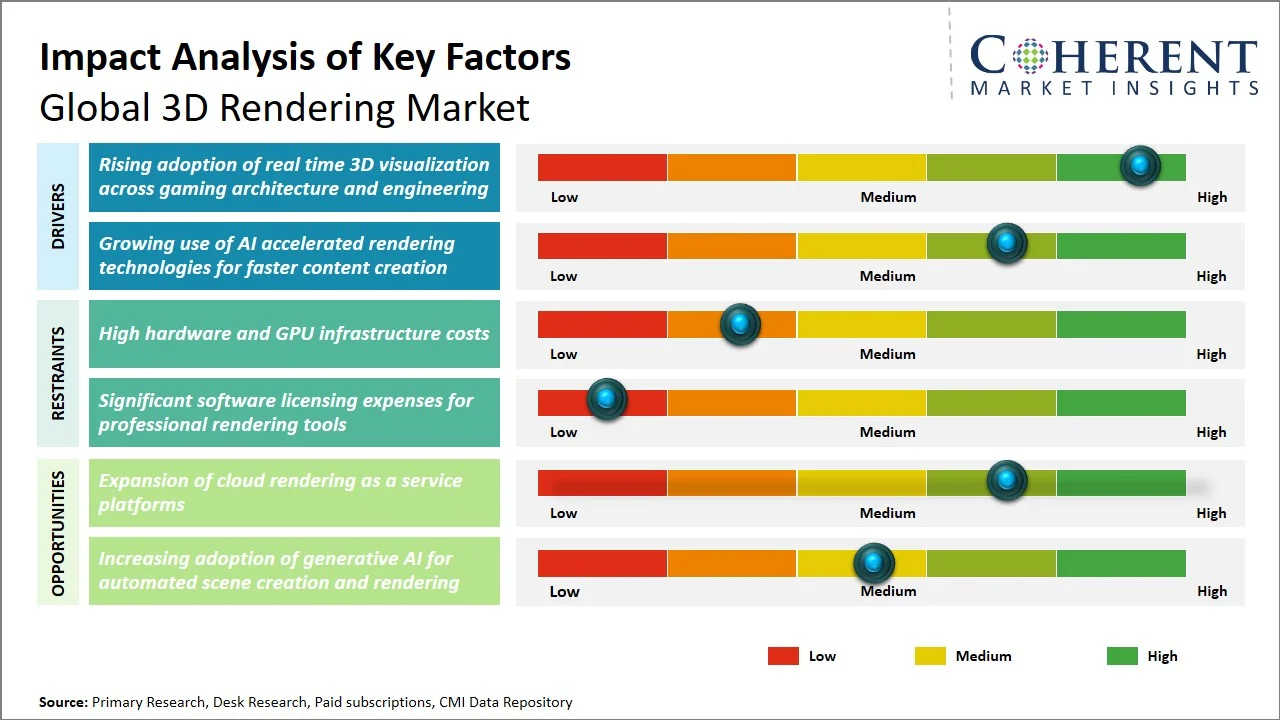
- Rising adoption of real time 3D visualization across gaming, architecture, and engineering
The growing demand for real time 3D visualization is majorly driving the growth of the global 3D rendering market as industries need instant, interactive, and highly realistic digital experiences. Game developers apply real-time rendering to create a full gameplay experience with dynamic lighting and physics, and architecture and engineering firms employ technology to visualize design changes instantaneously, enhance stakeholder collaboration, and hasten project approvals. Advanced graphics processing units, ray tracing and visualization platforms allow enterprises to use interactive digital models to shorten development cycles and improve decision-making.
On January 6, 2025, NVIDIA DLSS 4 Introduced multi frame generation & enhancements for all DLSS technologies. NVIDIA DLSS is a suite of neural rendering technologies powered by GeForce RTX Tensor Cores that boosts frame rates while delivering crisp, high-quality images that rival native resolution rendering, as part of over 700 RTX games and apps.
Growing use of AI accelerated rendering technologies for faster content creation
AI is being integrated into rendering processes, automating repetitive operations and drastically lowering rendering times, hence revolutionizing content creation. AI-driven technologies optimize denoising, texture production, lighting changes, scene enhancement and image upscaling, allowing designers, animators and visual effects artists to create photorealistic outputs in a more efficient manner. AI accelerated rendering is meeting the need from creative sectors for faster project delivery and higher quality visual output, boosting productivity while reducing computational requirements and operational expenses. On July 22, 2026, Autodesk revealed new AI capabilities coming to Maya, 3ds Max, Flow Production Tracking, and Arnold that solve certain time-consuming portions of animation and visual effects production.
Emerging Trends
- Integration of generative AI into rendering workflows: 3D rendering software is seeing increased integration of generative AI to automate scene development, material generation, lighting optimization, texture synthesis, and image improvement. These capabilities are minimizing the manual design labor, speeding up the production timeframes and allowing creative professionals to create photorealistic material more efficiently.
- Expansion of cloud native rendering platforms: Cloud based rendering solutions are becoming popular as companies search for scalable edge computing resources rather than purchasing expensive on premises hardware. Cloud native platforms allow for remote collaboration, elastic GPU allocation, centralized project management and faster rendering for internationally scattered design and production teams.
- Growing adoption of real time ray tracing technologies: Real time ray tracing is becoming a standard feature in gaming, architecture, automobile design, and virtual production by providing highly realistic lighting, reflections, and shadow effects with little latency. With continuous developments in GPU architectures and rendering engines, cinematic grade visualization is becoming increasingly available for interactive applications.
- Increasing use of 3D rendering for digital twin and immersive visualization: Organizations are turning to 3D rendering more often to enable digital twin creation, industrial simulation, smart city design and immersive virtual experiences. High resolution visualization with real time data is transforming design validation, operational monitoring, predictive maintenance and decision making across manufacturing, infrastructure and engineering sectors.
Regional Insights
Why is North America a Strong Market for 3D Rendering?
North America is expected to account for a market share of 56.0% in 2026. North America continues to be the top geographical market for 3D rendering, owing to the presence of a large number of software developers, GPU manufacturers, film production studios, and architecture and engineering organizations. Industry leaders in the region include Autodesk, NVIDIA, Adobe, Pixar Animation Studios, Epic Games, Unity Technologies, OTOY and Chaos who continue to pour significant investments into AI assisted rendering, real time ray tracing and cloud rendering platforms. The growing use of virtual production in Hollywood with game engines such as Unreal Engine has increased the need for high performance rendering solutions. Large architectural firms are employing digital twins and building information modeling with photorealistic rendering for commercial infrastructure projects. North America also benefits from the enormous hyperscale cloud architecture of AWS, Microsoft Azure, and Google Cloud, which allows for the creation of rendering farms that drastically cut production times for animation, visual effects, and industrial design workflows.
Why Does the Asia Pacific 3D Rendering Market Exhibit High Growth?
Asia Pacific is projected to account for 63.0% of the global 3D rendering market in 2026 and is expected to register the fastest growth. The fastest expanding regional market is Asia Pacific with the fast expansion of gaming, animation, manufacturing, and smart city projects in China, Japan, South Korea, India, and Southeast Asia. China and Japan have become centers for the creation of digital content, while South Korea’s gaming industry keeps increasing investments in real-time rendering technology driven by high-performance GPUs. “Digital twin projects have been widely adopted in the region, particularly in manufacturing and urban infrastructure, for example, China and Singapore, where photorealistic visualization is integrated into smart city planning. Automakers such as Toyota, Hyundai, Honda, BYD and Geely are using 3D rendering for virtual prototyping and vehicle visualization. Meanwhile, regional cloud providers are expanding GPU-enabled cloud infrastructure to support scalable rendering workloads for media, engineering and industrial applications.
Global 3D Rendering Market Outlook for Key Countries
Why is the U.S. Emerging as a Major Hub in the 3D Rendering Market?
The U.S. is the largest national market for 3D rendering enabled by its software innovation, semiconductor, entertainment, gaming and engineering services supremacy. NVIDIA is pushing the envelope with its RTX GPUs, Omniverse, and AI accelerated rendering technologies. Autodesk is developing industry leading visualization solutions for architecture, engineering, manufacturing and construction. Real time rendering and virtual production are becoming more and more important for blockbuster films and streaming content for major film studios such as Disney, Pixar, DreamWorks, Industrial Light & Magic and other visual effects businesses. Game makers like Epic Games, Electronic Arts, Activision and Take Two Interactive continue to incorporate advanced ray tracing and AI based rendering techniques into next generation titles. High quality rendering is widely used by large aerospace and automotive firms such as Boeing, Tesla, General Motors, Lockheed Martin, and others for engineering simulation, product visualization and digital twin creation.
Is China the Next Growth Engine for the 3D Rendering Market?
Fast development of digital entertainment, industrial digitalization and smart manufacturing have made China one of the largest 3D rendering markets in the world. Technology companies such Tencent, NetEase, Alibaba Cloud and Huawei Cloud continue to build out GPU accelerated cloud computing capabilities that enable big scale rendering workloads. Advanced rendering is increasingly being adopted by car makers like as BYD, NIO, XPeng and Geely for virtual vehicle development and consumer visualization platforms. China’s smart city schemes and industry digital transformation programs have sped up the deployment of digital twins for transportation networks, manufacturing facilities and urban infrastructure. Domestic animation studios, gaming companies, and architecture firms are also expanding investment in AI-enabled rendering tools to enhance production efficiency and visual quality.
Germany 3D Rendering Market Analysis and Trends
The automotive, industrial engineering and manufacturing industries in Germany are globally competitive and are therefore a significant market for 3D rendering in Europe. Photorealistic rendering is used extensively by companies like BMW, Mercedes Benz Group, Volkswagen Group, Porsche, Siemens, Bosch and Dassault Systèmes for the digital product development, factory planning and engineering simulations of their customers. The country’s aggressive embrace of Industry 4.0 has hastened the deployment of digital twin platforms that demand high quality visualization and real time rendering for predictive maintenance and production optimization. German architectural and industrial design firms are also leveraging advanced rendering tools together with BIM workflows to increase project visibility, engineering correctness and client involvement across commercial and infrastructure projects.
Japan 3D Rendering Market Analysis and Trends
Japan continues to strengthen its position in the 3D rendering market through leadership in gaming, animation, robotics, automotive engineering, and electronics manufacturing. Global companies including Sony, Nintendo, Capcom, Square Enix, Bandai Namco, and Sega increasingly utilize advanced rendering technologies to deliver high quality visual experiences in console and mobile gaming. Automotive manufacturers such as Toyota, Honda, Nissan, Subaru, and Mazda extensively apply real time rendering and digital visualization for vehicle design validation and virtual prototyping. Japan's animation industry continues adopting GPU accelerated rendering and AI assisted production workflows to improve efficiency in creating high resolution animated content, while robotics and industrial equipment manufacturers increasingly integrate rendered digital twins into engineering and operational processes.
U.K. 3D Rendering Market Analysis and Trends
The U.K. has built a strong position in the worldwide 3D rendering market through its superior visual effects, gaming, architecture and engineering industries. World-leading visual effects studios such as Framestore, DNEG and Industrial Light and Magic London are using advanced rendering technologies on internationally-acclaimed films and television productions, and game developers such as Codemasters, Creative Assembly and Frontier Developments continue to invest in real time rendering and photorealistic graphics. Advanced rendering is being used more and more in the country’s architecture industry in conjunction with BIM for large commercial, transportation and urban regeneration projects. Research in computer graphics, visualization, artificial intelligence and rendering technologies is being undertaken at University College London, Imperial College London and University of Cambridge, allowing further innovation across the industry.
Global 3D Rendering Market - Enterprise Adoption of Rendering-as-a-Service Platforms (2025)
Industry Vertical | Estimated Enterprise Adoption (%) |
Media & Entertainment | 82% |
Architecture, Engineering & Construction | 74% |
Gaming & Interactive Media | 71% |
Automotive | 67% |
Manufacturing | 61% |
E-commerce & Retail | 58% |
Healthcare & Medical Imaging | 46% |
Education & Research | 43% |
Real Estate | 64% |
Industrial Design | 69% |
How is the Expansion of Cloud Rendering as a Service Platforms Creating New Growth Opportunities in the Global 3D Rendering Market?
The explosion of cloud rendering as a service platform is providing massive growth potential for enterprises to leverage enterprise grade GPU capacity without the need to build dedicated rendering farms. Major cloud providers, including AWS Thinkbox Deadline Cloud, Microsoft Azure with NVIDIA RTX Virtual Workstations, Google Cloud RTX Virtual Workstations, Oracle Cloud Infrastructure GPU instances, and CoreWeave, are enabling animation studios, architecture firms, automotive manufacturers, and game developers to rapidly scale rendering resources on demand during peak production periods. Visual effects studios can run thousands of rendering jobs in parallel on cloud GPU clusters for feature films, and architecture firms can produce photorealistic BIM visualizations remotely for clients all over the world without the need to operate a local high performance computing infrastructure.
Automotive businesses are also leveraging cloud rendering to enable collaborative car design across engineering centers in several countries, while game developers are tapping into elastic GPU resources to quickly render assets during production. Pay per use GPU computing, integrated rendering orchestration tools, remote desktop access and AI accelerated rendering services are encouraging small and medium sized studios to adopt professional rendering workflows that were previously only accessible to large enterprises. This is expanding the addressable market for cloud based 3D rendering solutions.
On May 21, 2024, Autodesk acquired Wonder Dynamics, adding cloud native AI-powered 3D animation and visual effects technology to its Media and Entertainment portfolio. The acquisition reinforces Autodesk’s objective of supplying cloud-based content production and rendering workflows to film, television and gaming studios.
Market Players, Key Development, and Competitive Landscape
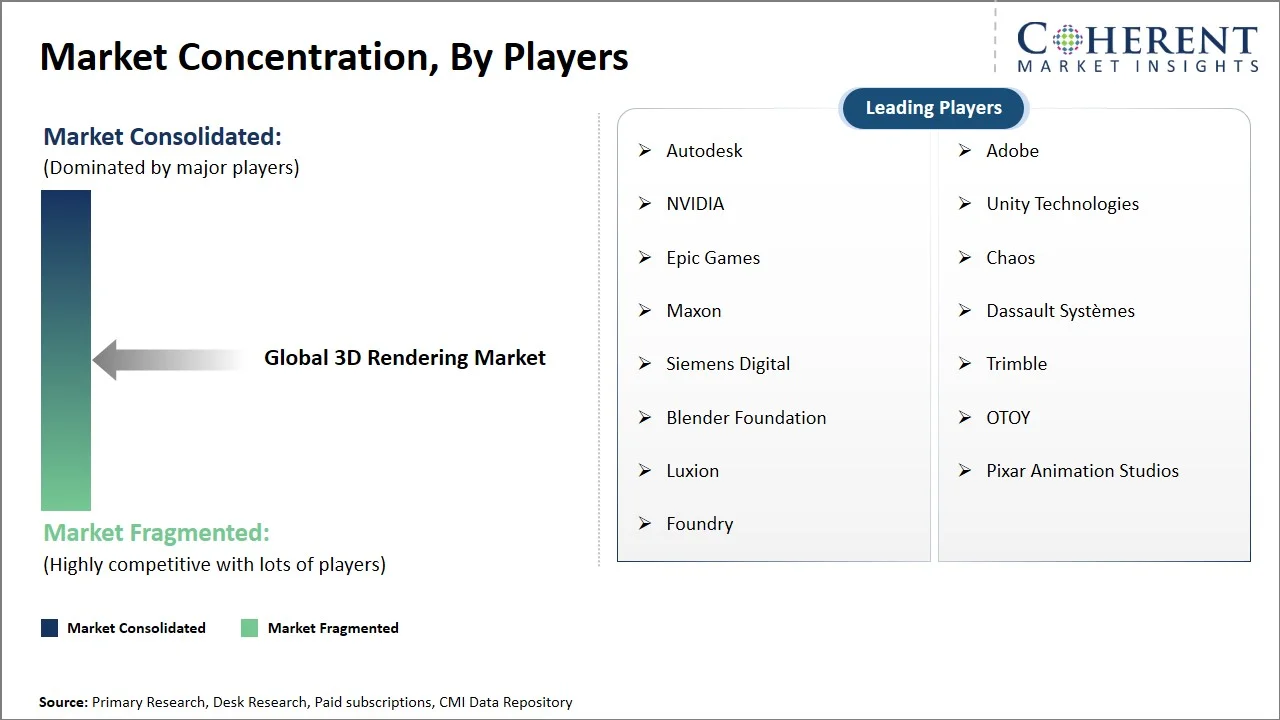
Key Developments
- On April 15, 2026, Chaos announced the V-Ray 7, Update 3 for SketchUp, Rhino and 3ds Max, delivering real-time rendering directly inside the V-Ray viewport, alongside new AI-powered tools and collaboration improvements that streamline projects from first concept to final delivery.
- On March 16, 2026, CoreWeave, Inc. announced an expansion of its purpose-built AI cloud platform at NVIDIA’s GTC conference. The expansion brings NVIDIA HGX B300 to the CoreWeave Cloud, unlocking a new generation of performance for AI workloads, alongside new Weights & Biases capabilities that streamline reinforcement learning (RL) and agent development workflows.
Competitive Landscape
The global 3D rendering market is highly competitive, with leading companies focusing on artificial intelligence integration, GPU acceleration, cloud rendering, and real time visualization rather than traditional offline rendering alone. With its RTX platform, Omniverse, DLSS, and AI-powered rendering technologies, NVIDIA is cementing its position in the industry by enabling industrial digital twins, automobile design, and virtual production. Autodesk is adding cloud connected visualization features to Autodesk Construction Cloud, Revit, Maya and 3ds Max, integrating rendering directly into engineering and architectural workflows. Epic Games is leading the charge for Unreal Engine usage in virtual production, automotive visualization and real-time architectural rendering. Chaos continues to embed AI denoising and GPU rendering capabilities into V-Ray and Corona for design professionals.
Adobe is building Firefly generative AI into Creative Cloud apps to automate content creation, while Unity Technologies is ramping up investment in industrial digital twin visualization and immersive enterprise apps. Strategic partnerships between software vendors and cloud infrastructure providers such as NVIDIA with Microsoft Azure, Oracle Cloud Infrastructure, and AWS are accelerating the commercialization of cloud native rendering platforms capable of handling large scale enterprise workloads.
Market Report Scope
3D Rendering Market Report Coverage
| Report Coverage | Details | ||
|---|---|---|---|
| Base Year: | 2025 | Market Size in 2026: | USD 6.80 Bn |
| Historical Data for: | 2020 To 2024 | Forecast Period: | 2026 To 2033 |
| Forecast Period 2026 to 2033 CAGR: | 8% | 2033 Value Projection: | USD 18.75 Bn |
| Geographies covered: |
| ||
| Segments covered: |
| ||
| Companies covered: | Autodesk, Adobe, NVIDIA, Unity Technologies, Epic Games, Chaos, Maxon, Dassault Systèmes, Siemens Digital, Trimble, Blender Foundation, OTOY, Luxion, Pixar Animation Studios, and Foundry | ||
| Growth Drivers: |
| ||
| Restraints & Challenges: |
| ||
Analyst Opinion (Expert Opinion)
- The future of the industry is expected to be shaped by the convergence of generative artificial intelligence, real time ray tracing, cloud GPU infrastructure, and digital twin platforms rather than incremental improvements in conventional rendering engines. Industrial visualization, virtual production, and interactive simulation are likely to become larger revenue contributors than traditional animation rendering as enterprises increasingly digitize engineering and operational processes.
- The most attractive opportunities are expected to emerge in real time rendering software for manufacturing and automotive digital twins in the United States, cloud rendering services for animation and gaming studios in Japan, and AI enabled rendering platforms supporting smart manufacturing and infrastructure visualization in China. Architecture, engineering, and construction firms adopting cloud based BIM visualization are also expected to represent one of the fastest growing enterprise customer groups.
- For competitive advantage, industry participants must focus on AI assisted rendering automation, cloud native GPU orchestration and seamless connectivity with CAD, BIM, game engines and digital twin platforms. Companies that establish strategic partnerships with hyperscale cloud providers, optimize software for next generation NVIDIA RTX and AMD GPU architectures, and deliver subscription based rendering services with integrated collaboration, security, and workflow automation capabilities are expected to strengthen customer retention and expand their enterprise presence.
Speak to the analyst
Want personalized insights?
Take the findings above to one of our principal consultants, or have the report rebuilt around the segments, geographies and competitors you actually track.
Market Segmentation
- Component Insights (Revenue, USD Billion, 2021 - 2033)
- Software
- Services
- Deployment Type Insights (Revenue, USD Billion, 2021 - 2033)
- Cloud
- On Premises
- Rendering Type Insights (Revenue, USD Billion, 2021 - 2033)
- Real Time Rendering
- Offline Rendering
- Technology Insights (Revenue, USD Billion, 2021 - 2033)
- GPU Based Rendering
- CPU Based Rendering
- Hybrid Rendering
- Application Insights (Revenue, USD Billion, 2021 - 2033)
- Gaming
- Media and Entertainment
- Architecture Engineering and Construction
- Manufacturing
- Healthcare
- Automotive
- Education
- Retail and E Commerce
- Others
- Regional Insights (Revenue, USD Billion, 2021 - 2033)
- North America
- U.S.
- Canada
- Latin America
- Brazil
- Argentina
- Mexico
- Rest of Latin America
- Europe
- Germany
- U.K.
- Spain
- France
- Italy
- Russia
- Rest of Europe
- Asia Pacific
- China
- India
- Japan
- Australia
- South Korea
- ASEAN
- Rest of Asia Pacific
- Middle East
- GCC Countries
- Israel
- Rest of Middle East
- Africa
- South Africa
- North Africa
- Central Africa
- North America
- Key Players Insights
- Autodesk
- Adobe
- NVIDIA
- Unity Technologies
- Epic Games
- Chaos
- Maxon
- Dassault Systèmes
- Siemens Digital
- Trimble
- Blender Foundation
- OTOY
- Luxion
- Pixar Animation Studios
- Foundry
Sources
Primary Research Interviews
- Virtual Production Supervisors
- BIM and Digital Engineering Managers
- Automotive Digital Design Engineers
- Game Engine Development Leads
Magazines
- Animation Magazine
- 3D World Magazine
- VFX Voice
- Develop3D Magazine
- CADalyst Magazine
Journals
- IEEE Computer Graphics and Applications
- ACM Transactions on Graphics
- Computer Graphics Forum
- The Visual Computer
Associations
- Association for Computing Machinery
- IEEE Computer Society
- SIGGRAPH
- The Khronos Group
- buildingSMART International
Public Domain Sources
- U.S. Bureau of Labor Statistics
- U.S. Census Bureau
- National Institute of Standards and Technology
- National Aeronautics and Space Administration
Proprietary Elements
- CMI Data Analytics Tool
- Proprietary CMI Existing Repository of Information for the Last 10 Years
Get access to 250+ pages report
Every segment, forecast, competitor profile and data table behind the analysis above — available for instant download.
- ESOMAR Member
- ISO 9001:2015 Certified
- D-U-N-S Registered
- GDPR & CCPA Compliant
Missing comfort of reading report in your local language? Find your preferred language:
Transform your Strategy with Exclusive Trending Reports
Frequently Asked Questions
The global 3D rendering market is expected to stand at USD 6.80 Bn in 2026 and is expected to reach USD 18.75 Bn by 2033.
The CAGR of the global 3D rendering market is projected to be 8% from 2026 to 2033.
GPUs perform parallel processing that significantly reduces rendering times while improving visual quality.
Architects use 3D rendering to create realistic project visualizations that improve design validation and client presentations.
Rising adoption of real time 3D visualization across gaming architecture and engineering and growing use of AI accelerated rendering technologies for faster content creation are the major factors driving the growth of the global 3D rendering market.
High hardware and GPU infrastructure costs and significant software licensing expenses for professional rendering tools are the major factors hampering the growth of the global 3D rendering market.
In terms of component, the software segment is estimated to dominate the market revenue share in 2026.