

Global AI Video Market Size and Forecast – 2026 To 2033
The global AI video market is expected to grow from USD 5.50 Bn in 2026 to USD 42 Bn by 2033, registering a compound annual growth rate (CAGR) of 27% from 2026 to 2033. The global AI video market is driven by increasing enterprise use of AI-generated training and communication videos. On May 23, 2025, UBS began using AI generated video avatars of its analysts to convert research content into client facing videos, using OpenAI and Synthesia to generate scripts and produce videos without requiring analysts to record each presentation in a studio.
Key Takeaways of the Global AI Video Market
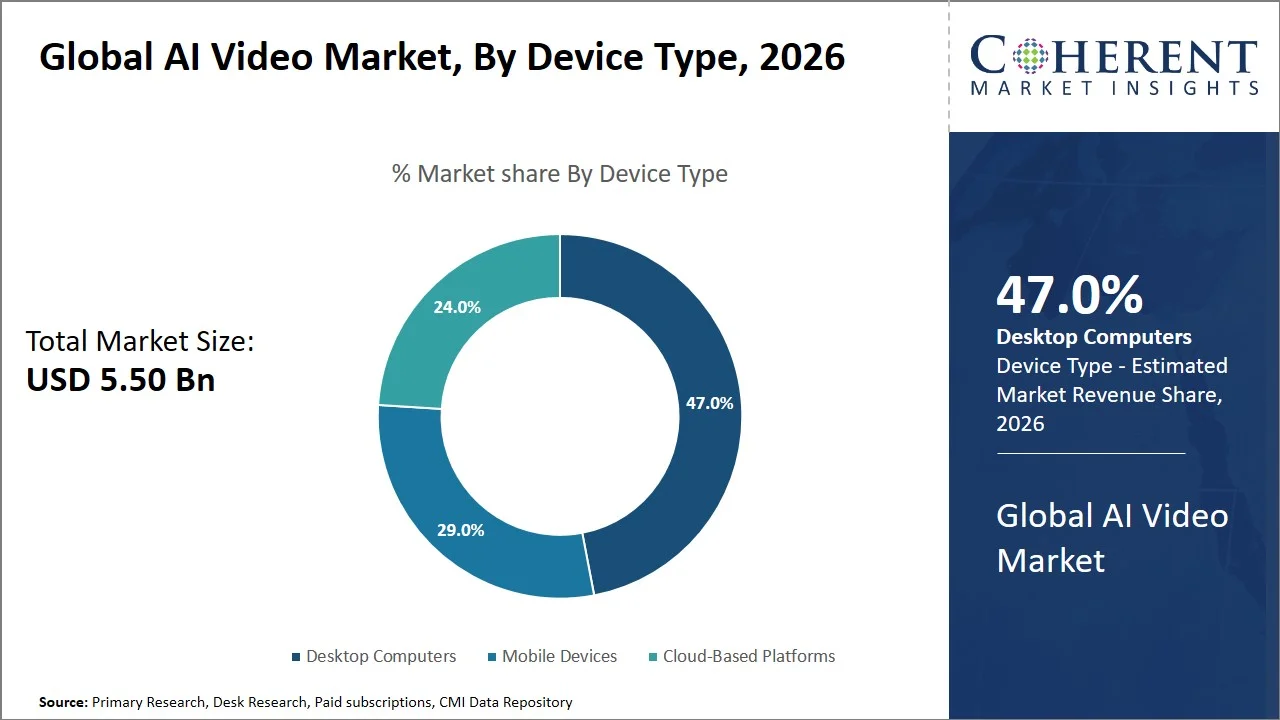
- The Desktop Computers segment is expected to account for 47.0 % of the global AI video market share in 2026. Rising demand for personalized and multilingual video content is driving the growth of the segment. On June 3, 2025, ElevenLabs launched Eleven v3 with support for more than 70 languages, multi speaker dialogue, emotional audio controls, and improved expressive speech generation.
- The Video Analysis AI segment is estimated to capture 43.0 % of the market share in 2026. Expansion of AI-powered video editing and enhancement capabilities is majorly driving the growth of the segment. On April 2, 2025, Adobe introduced major AI capabilities in Premiere Pro 25.2 at NAB 2025, including Generative Extend, Media Intelligence, and automatic caption translation in more than 27 languages.
- The Generative AI segment is estimated to capture 32.0 % of the market share in 2026. Increasing adoption of AI avatars and virtual presenters is driving the growth of the segment. On March 16, 2026, D-ID launched V4 Expressive Visual Agents, introducing digital humans designed for real time conversations connected to large language models as well as long form enterprise video.
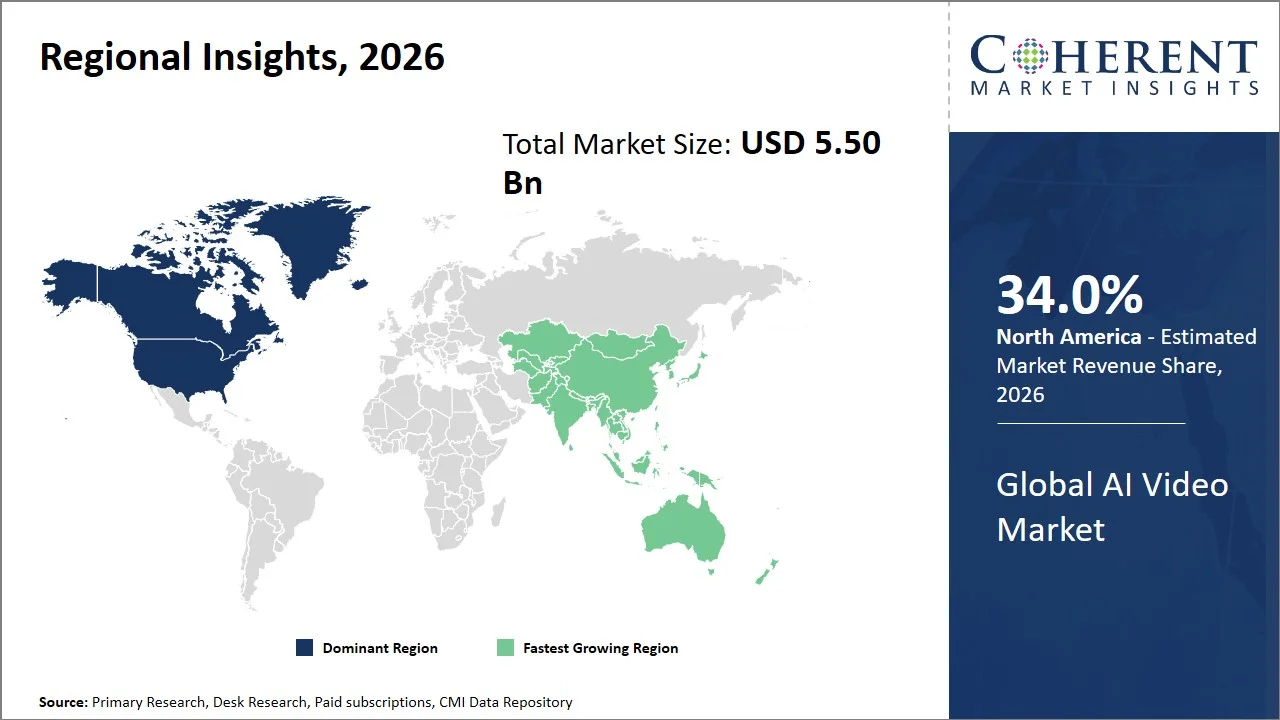
- North America is expected to dominate the AI video market in 2026 with a market share of 34.0 %. Multilingual video localization and automated dubbing in North America is driving the growth of the regional market. On April 3, 2025, Deepdub introduced Deepdub Live to enable AI dubbing in real time for live broadcasts in more than 100 languages and dialects, while trying to preserve the tone, intensity, tempo and emotional traits of the original speaker.
- Asia Pacific is expected to account for 26.0 % share in 2026. Growth in enterprise training and employee onboarding through AI avatars in Asia Pacific is driving the growth of the regional market. In June 2025, Japanese real estate firm Leopalace21 used AVITA’s AI avatar role play platform AvaTraining to train fresh graduate and early career sales employees.
Segmental Insights
Why Does Desktop Computers Dominate the Global AI Video Market?
The desktop computers segment is expected to account for 47.0% of the global AI video market share in 2026. Most mobile devices do not have the processing power, RAM and VRAM capacity, and compatibility with GPU-intensive AI video generation and editing applications that make desktop computers the preferred choice for AI video workflows, allowing users to work with high-resolution footage, run demanding generative models, work with larger video datasets, and perform complex rendering and post-production tasks more efficiently. In March 2025 NVIDIA announced its RTX PRO Blackwell series of workstation GPUs, led by the flagship RTX PRO 6000 Blackwell with 96GB of GDDR7 memory and 24,064 CUDA cores. The hardware is built for demanding AI, visual computing, rendering, and professional content creation jobs, offering the high VRAM capacity and GPU acceleration needed for more intricate AI video generation and editing on desktop workstations.
- Current Industry Events of 2026
- Market Size Estimation
- Regional Breakdown
- Competitive Landscape
- Customer Intelligence
- Segmental Analysis
- Pricing Analysis
- Key Market Drivers, Challenges & Future Trends
- Customized Insights Section
Why is Video Analysis AI the Most Preferred Offering Type?
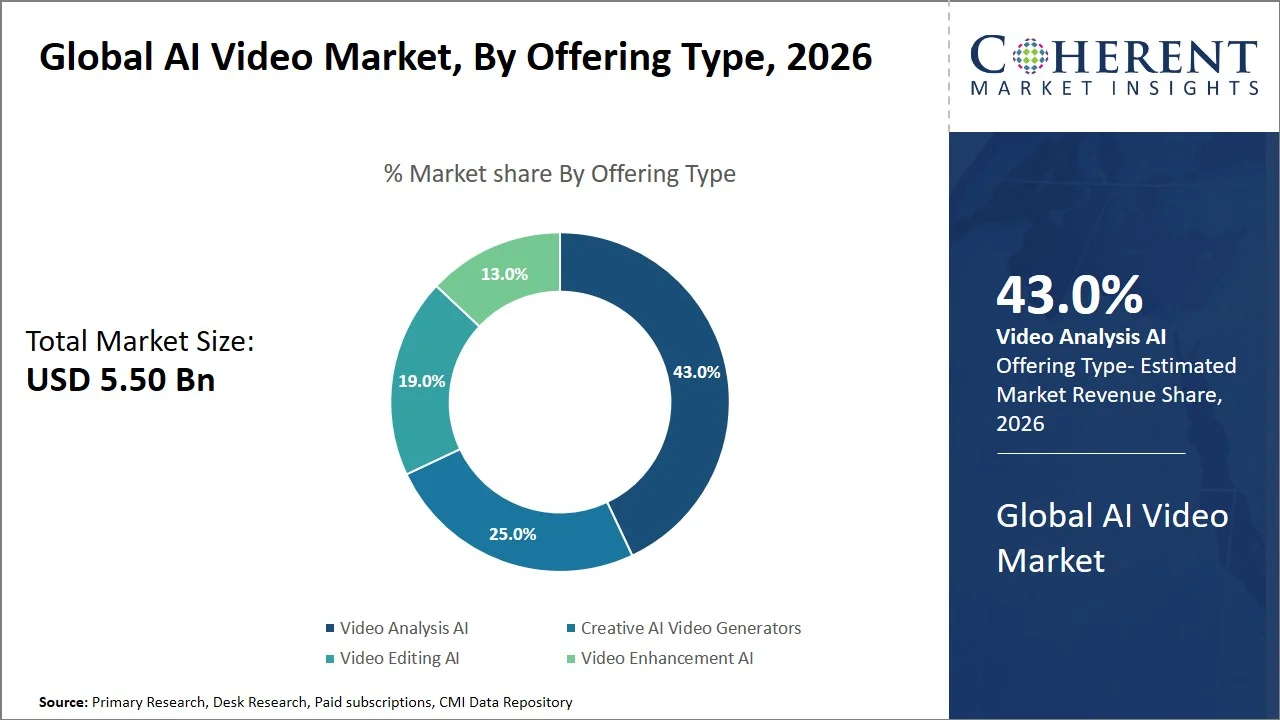
The video analysis AI segment is expected to account for 43.0% of the global AI video market share in 2026. Video Analysis AI is highly preferred because it enables organizations to automatically extract actionable information from large volumes of video through capabilities such as object detection, facial and activity recognition, scene classification, anomaly detection, and real-time event monitoring, reducing the need for continuous manual review while improving operational visibility across security, retail, transportation, media, and enterprise applications. On April 4, 2025, Motorola Solutions launched a new Pelco portfolio combining fixed, ruggedized, long range and intelligent camera systems with AI powered analytics for demanding environments such as oil and gas facilities, ports, transportation, aviation, maritime operations, and utilities.
Generative AI Dominates the Global AI Video Market
The generative AI segment is expected to account for 32.0% of the global AI video market share in 2026. Generative AI is becoming more popular because it can create whole video assets from simple text prompts, images, scripts, or reference footage, enabling businesses and creators to generate customized scenes, characters, visual effects, and marketing content without the need for extensive filming, specialized production tools, or complex manual editing workflows. On February 12, 2025, Adobe announced the launch of the Adobe Firefly Video Model, the only generative AI model that is IP-friendly and commercially safe, and the expansion of creative control in the Firefly web app which empowers anyone, at any skill level, to explore, ideate and bring their creative vision to life.
Current Events and their Impact
Current Events | Description and its Impact |
European Union - EU Artificial Intelligence Act, Article 50 Transparency Requirements |
|
China - Administrative Measures For Labeling AI Generated And Synthetic Content |
|
AI Video Market Dynamics
Market Drivers
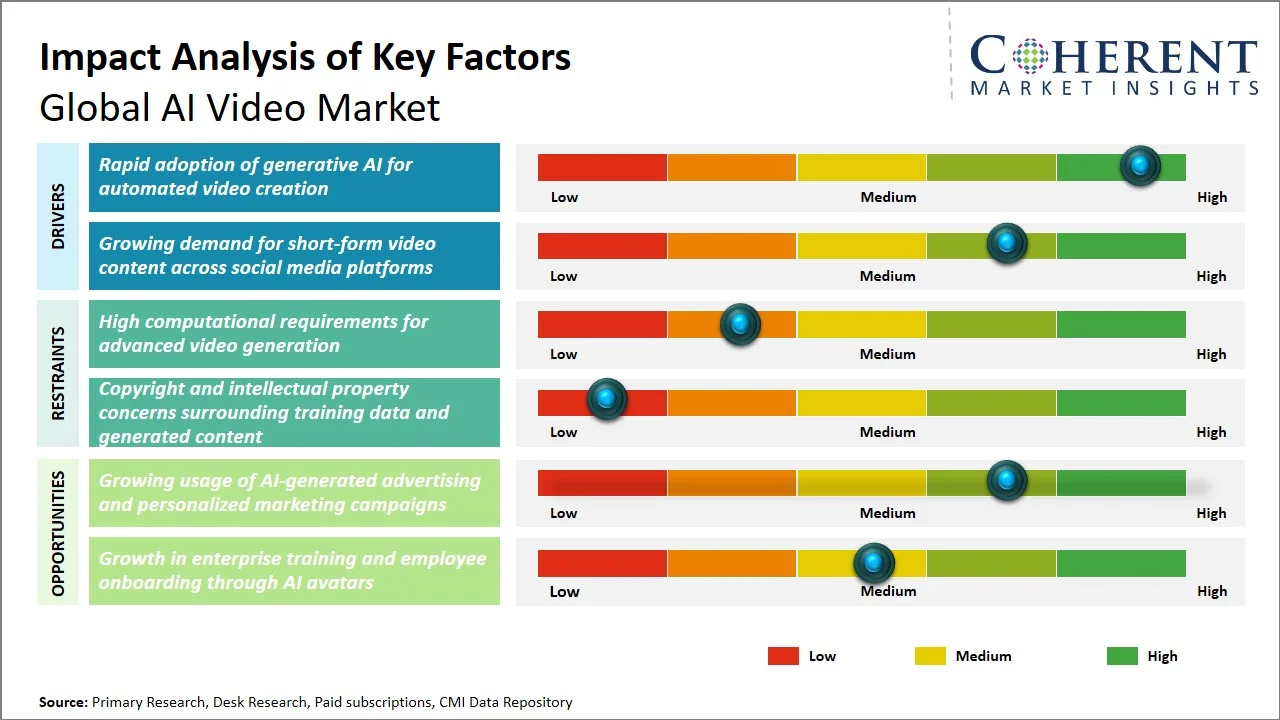
- Rapid Adoption of Generative AI for Automated Video Creation: The rapid adoption of generative AI is fueling the AI video market by allowing businesses, creators, and media houses to generate complete video content from text prompts, scripts, images, and existing footage with much less manual production work. AI tools can help automate tasks like scene generation, avatar creation, voiceovers, animation, background generation, editing, and localization so organizations can create more customized video content at scale and reduce dependence on traditional filming and post-production workflows. On April 15, 2025, Google added generative video production to Gemini, enabling Gemini Advanced users to generate high resolution eight second videos from text prompts through Veo 2. Veo 2 was connected with Whisk by Google, allowing users to animate photos into video clips, establishing a straight process from generated or existing visual assets to moving material.
- Growing Demand for Short-Form Video Content Across Social Media Platforms: As short-form video becomes popular on platforms like TikTok, Instagram Reels, YouTube Shorts, and similar services, there is a growing need for AI-powered tools that can quickly create and adjust engaging video content. Generative AI helps creators and brands convert long form content, product details, ads and written ideas into short videos with auto-generated captions, visual effects, voice-overs, music and platform specific formats, addressing the need for frequent and continuously refreshed social media content. For example, in September 2025, Meta reported that 97% of Indian respondents watch short-form videos at least once a day, and 92% said Reels is their preferred short-form video platform. That same study found that Reels resulted in around 33% higher creator engagement than other platforms surveyed, while Reels advertising had better brand recall and message association than long form video advertising, leading brands and creators to invest more in brief form content.
Emerging Trends
- Expansion of Text to Video and Image to Video Generation: AI video platforms are increasingly providing the ability to convert written prompts, static images, product concepts, and storyboards into dynamic video sequences, reducing production requirements and supporting faster creation of marketing, entertainment, educational and social media content.
- Growing Adoption of AI Avatars and Digital Humans: Companies are increasingly using AI-generated presenters, virtual spokespersons, and virtual humans to train, engage customers, demonstrate products, and create localized content. These applications are being scaled with multilingual speech generation and automated lip sync.
- Integration of AI Video with Professional Creative Workflows: AI capabilities are increasingly being built into video editing, visual effects, post-production and content management software, enabling creators to automate tasks such as object removal, background generation, video enhancement, scene extension, dubbing, captioning and footage search, while retaining greater creative control.
- Rise of Personalized and Interactive AI Video: AI video platforms are evolving to provide dynamically generated material customized for individual viewers, languages, locations, preferences and customer profiles, as well as the emergence of interactive AI characters and real-time video generation, creating new opportunities in advertising, e-learning, gaming, virtual commerce, and consumer engagement.
Regional Insights
Why is North America a Strong Market for AI Video?
North America is expected to account for a market share of 34.0% in 2026. The region is being driven by the rapid integration of AI video into professional media production, advertising, and enterprise creative workflows, particularly in the U.S. and Canada, where companies are moving beyond basic text-to-video experimentation toward production-grade generation and editing. Runway introduced Gen-4 in 2025 with consistent characters, locations, objects, and controllable visual styles, followed by Act-Two for performance-driven character animation and Aleph for video transformation and editing, while Hollywood studios are increasingly testing AI for synthetic actors, real-time backgrounds, visual effects, and production workflows, with Netflix, Imagine Entertainment, and emerging AI-native studios such as Promise and Obsidian incorporating the technology into filmmaking. The region is, therefore, developing demand for AI video not only from creators but also from film studios, advertising agencies, streaming companies, and enterprise marketing teams seeking controllable, production-ready outputs
Why Does Asia Pacific AI Video Market Exhibit High Growth?
Asia Pacific is expected to register the fastest growth with a CAGR of 29.4% over the forecast period. Asia Pacific is projected to account for 26.0% of the global AI video market in 2026. Asia Pacific is seeing particularly strong AI video expansion because the region combines large digital-content audiences, highly active creator economies, localized AI development, and government-supported AI infrastructure, creating several distinct adoption pathways rather than a single use case. China is producing globally competitive video-generation models, Japan is applying AI to advertising and anime production, South Korea is connecting video AI with entertainment and media platforms, while India is building localized AI infrastructure and multilingual applications like Kuaishou’s Kling AI surpassed 22 million global users within 10 months of launch and its Kling AI 2.0 model was released globally in April 2025, while its annualized revenue run rate exceeded USD 100 million by March 2025. These advancements are reinforcing the region’s role as a major hub for localized, mobile-oriented, entertainment-driven, and commercially deployable AI video technologies.
Global AI Video Market Outlook for Key Countries
Why is U.S. Emerging as a Major Hub in the AI Video Market?
The U.S. is being propelled by the convergence of generative AI with Hollywood's established visual-effects ecosystem and the country's concentration of leading AI model developers, cloud providers, and creative-software companies. Runway’s Gen-4 offers image-to-video production with 5- and 10-second outputs, 24-fps generation, numerous aspect ratios, character consistency, and reference-based control, while its 2025 product expansion includes Act-Two and Aleph for performance capture and AI-assisted video editing. Hollywood, too, is headed for AI-native production: Promise is using AI-generated backgrounds and synthetic characters, and Netflix and Imagine are said to be experimenting with AI on hundreds of movies. Higgsfield, a U.S. focused AI video firm, launched in 2025, had more than 30 million users in 238 countries by August 2026 and raised USD 400 million in additional funding, showing the rapid commercialization of AI video for advertising and corporate content development.
Is China the Next Growth Engine for the AI Video Market?
The growing commercialization of domestic video foundation models and the potential of huge consumer internet platforms to deliver AI-generated material directly to audiences of massive digital scale are supporting China’s AI video business. Kuaishou’s Kling AI has reached over 22 million global users in 10 months, and launched Kling AI 2.0 in April 2025. Kling 1.6 Pro also achieved the highest score in the Image to Video category of an Artificial Analysis benchmark cited by Kuaishou. Kuaishou subsequently reported an annualized revenue run rate above USD 100 million only 10 months after launch, demonstrating that Chinese developers are moving AI video from experimental technology toward subscription based commercial services. China's broader ecosystem also includes models such as Hailuo and Baidu's MuseSteamer, supporting applications across commercial video production, advertising, entertainment, and social media content.
Japan AI Video Market Analysis and Trends
The demand for AI video is being driven by Japan's strong anime, advertising, gaming, digital entertainment, and enterprise content industries, with specific needs around character consistency, Japanese language avatars and automated animation. In May 2025, Tencent Cloud and Vector Group subsidiary Offshore unveiled AvaMo, an AI-driven avatar video generation service aimed exclusively for the Japanese market, with the companies claiming that advertising video production time and expenses may be lowered by as much as 98%. CreateAI's Animon AI was also developed in Japan in collaboration with Japanese anime producers and introduced an anime specific generation workflow aimed at professional directors and individual creators. NTT also developed a 4K capable AI inference LSI for real time video processing, including drone-based infrastructure inspection, demonstrating that Japanese demand extends beyond creative generation into high resolution video intelligence and edge processing.
South Korea AI Video Market Analysis and Trends
South Korea is being driven by the intersection of AI video with its globally influential K pop, Korean drama, gaming, animation, advertising, and digital media industries, while domestic technology companies are developing specialized production infrastructure. Naver announced in July 2025 that it would introduce AI powered video technologies and XR content platforms as part of an in house live broadcast media ecosystem. Naver-backed Cinamon has raised USD 8.5 million to build CINEV, an AI platform for 3D animation and video generation, exhibiting investor interest in locally generated creative generation software. CJ also announced Millstone CUE, an AI video solution that automatically detects and blurs persons, brand logos and filming equipment, and supports video search, editing and content development in 2025. South Korea’s projected expansion of AI computing infrastructure is further increasing the computational power of key digital and media organizations.
India AI Video Market Analysis and Trends
The growth of AI videos in India is driven mostly by the need for multilingual content, a burgeoning digital artist ecosystem and homegrown AI infrastructure to support Indian language use cases. In April 2025, Sarvam was selected by the IndiaAI Mission to construct a sovereign large language model with dedicated computer resources and support for Indian languages, providing a vital basis for applications in speech, multimedia and localized content. AI video is particularly relevant to India's advertising, education, e learning, social media, and regional language content sectors because the same underlying material can increasingly be adapted into multiple Indian languages and formats. Emerging Indian AI video tools are also combining script generation, video creation, Indian language voiceovers, synchronized captions, and automated editing into integrated workflows for YouTube, Instagram, and other digital platforms. This combination of linguistic diversity, mobile first content consumption, and domestic AI infrastructure provides India with a distinctly localization driven growth pathway.
Global AI Video Market - Video Generation Resolution Preference (2025)
Video Generation Resolution | Preference Share |
HD, 720p–1080p | 61% |
2K | 24% |
4K | 15% |
Global AI Video Market - AI Generated Content Disclosure Requirements by Country/Region (2025)
Country / Region | AI Generated Video Disclosure Requirement | Disclosure Mechanism | Regulatory Status |
China | Mandatory labeling of AI generated and synthetic content | Explicit visible labels and implicit technical or metadata labels | Effective from September 1, 2025 |
European Union | Disclosure required for AI generated or manipulated deepfake video | Machine readable marking and disclosure to users | EU AI Act adopted, with Article 50 transparency obligations applying from August 2026 |
United States | No single nationwide requirement for all AI generated video, with state level requirements | Varies by state and application | State based framework |
United Kingdom | Transparency obligations developing through AI governance and synthetic media policies | Disclosure and provenance mechanisms depending on application | Evolving regulatory framework |
India | Proposed rules would require clear labeling of AI generated content | Visible markers, metadata and user declarations | Proposed framework in 2025 |
Japan | Government guidelines emphasize transparency and responsible AI use rather than a comprehensive mandatory AI video labeling law | Voluntary disclosure and provenance practices | Predominantly guideline based |
South Korea | AI generated content labeling requirements introduced for synthetic media | Visible labeling and identification of AI generated content | Regulatory requirements developing |
Australia | AI transparency and synthetic media safeguards developing through voluntary and sector specific frameworks | Disclosure and provenance depending on application | Primarily voluntary and sector specific in 2025 |
Canada | No comprehensive federal AI generated video labeling requirement in force in 2025 | Requirements depend on privacy, consumer protection and proposed AI legislation | Developing regulatory framework |
Singapore | Model AI Governance Framework and AI Verify promote transparency and responsible AI deployment | Voluntary disclosure, documentation and provenance practices | Predominantly voluntary in 2025 |
How is Growing Usage of AI-Generated Advertising and Personalized Marketing Campaigns Creating New Growth Opportunities in the AI Video Market?
Growing usage of AI generated advertising is creating a new opportunity for AI video platforms by allowing brands to move from producing a limited number of campaign creatives to generating large volumes of localized and audience specific video variations, such as changing products, messaging, language, imagery, offers, and formats for different customer groups and advertising channels. Launched by Adobe in 2025, GenStudio adds AI to create video and display advertising on Amazon Ads, Google Campaign Manager 360, LinkedIn and Meta. Its marketing solutions are used by Coca Cola, Dentsu, Estée Lauder and Publicis Groupe among others. Coca Cola has also used generative AI as part of its customization strategy across more than 200 million consumer profiles, while its Project Fizzion was aimed to speed up production of on-brand creative assets by up to 10 times. This evolution is fueling the need for AI video platforms capable of creating a vast number of brand-aligned creatives, quickly experimenting with variations, and customizing video ads for distinct audience segments, opening doors in performance marketing, local campaigns, ecommerce marketing, and automated creative optimization.
On January 1, 2024, Omneky, the Gen AI command center for smarter digital advertising, announced the launch of Smart Ads, a breakthrough new feature that will change the way marketers produce and optimize advertising creatives. Smart Ads uses artificial intelligence to automatically create high-performing, on-brand commercials.
Market Players, Key Development, and Competitive Landscape
Key Developments
- On May 4, 2026, HeyGen introduced an integration with Canva that allows users to create AI avatar videos directly within Canva by selecting an avatar, entering a script, and generating a talking video without leaving the design environment.
- On January 15 2025, Luma Labs launched Ray2, an advanced video generation model, built on Luma's new multi-modal architecture with 10 times the compute power of Ray1. This large-scale video generative model creates photorealistic visuals with natural, coherent motion and has a strong understanding of text instructions.
Competitive Landscape
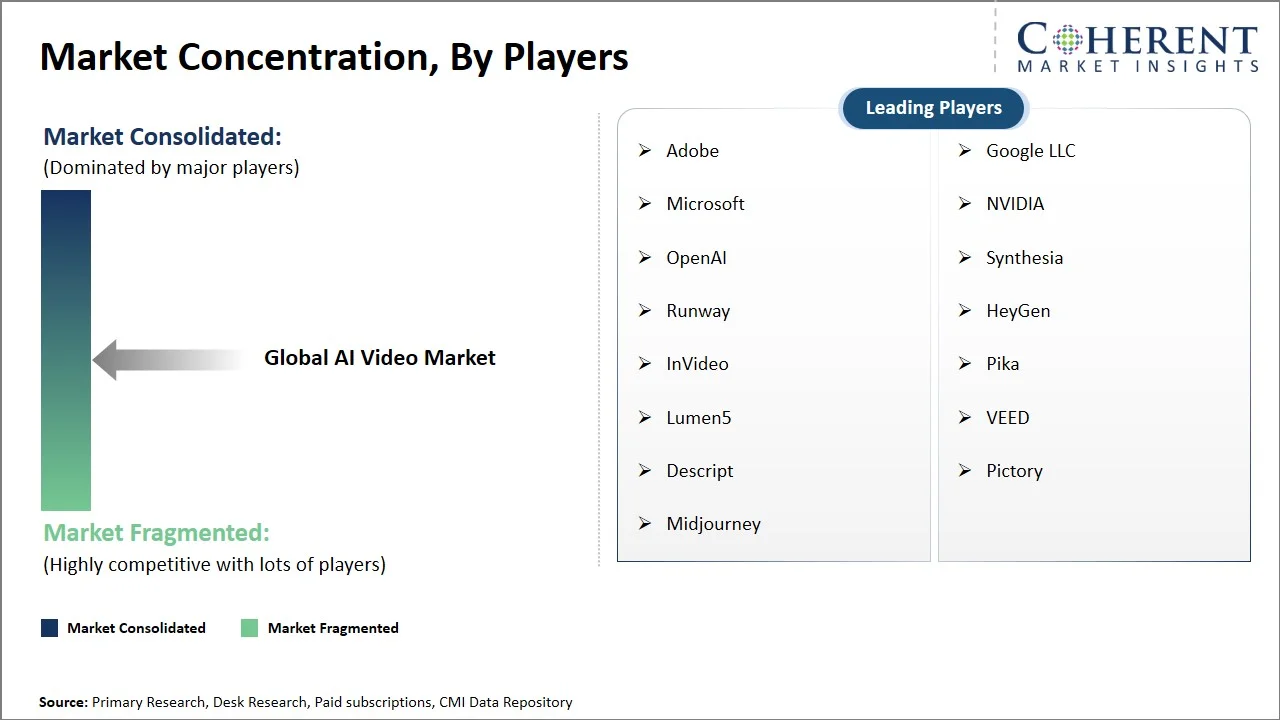
The competitive landscape is led by technology and creative software companies that are differentiating through model quality, controllability, workflow integration, and commercialization rather than basic text to video generation alone. Adobe Firefly Video Model was released in 2025 and was positioned on commercially safe generation and integration with Premiere Pro. The focus was on extending, correcting and enhancing professional footage rather than replacing the full editing workflow. Veo and Flow have been focused on cinematic production, with Flow incorporating Veo, Imagen, and Gemini, before adding more precise editing, narrative control, and audio capabilities. By October 2025, Google said Flow had made more than 275 million videos. Kuaishou Technology has pursued rapid model iteration and direct monetization through Kling AI, which exceeded 22 million global users within 10 months of launch, reached an annualized revenue run rate of USD 100 million in March 2025, and subsequently introduced Kling Video O1, Kling Video 2.6 with simultaneous audio-visual generation, and Kling Digital Human 2.0. Runway is concentrating on professional filmmaking and controllable production workflows, working with studios including Lionsgate and AMC Networks while developing increasingly sophisticated reference-based generation and video editing capabilities.
Market Report Scope
AI Video Market Report Coverage
| Report Coverage | Details | ||
|---|---|---|---|
| Base Year: | 2025 | Market Size in 2026: | USD 5.50 Bn |
| Historical Data for: | 2020 To 2024 | Forecast Period: | 2026 To 2033 |
| Forecast Period 2026 to 2033 CAGR: | 27% | 2033 Value Projection: | USD 42 Bn |
| Geographies covered: |
| ||
| Segments covered: |
| ||
| Companies covered: | Adobe, Google LLC, Microsoft, NVIDIA, OpenAI, Synthesia, Runway, HeyGen, InVideo, Pika, Lumen5, VEED, Descript, Pictory, Midjourney | ||
| Growth Drivers: |
| ||
| Restraints & Challenges: |
| ||
Analyst Opinion (Expert Opinion)
- The AI video industry is likely to move from short isolated AI generated clips toward integrated video production systems capable of understanding scripts, maintaining character and scene continuity, generating synchronized audio, editing footage, and controlling multiple shots within a single workflow. The introduction of Kling Omni as a unified multimodal framework and Google's continued expansion of Flow toward editing and narrative control indicate that competitive advantage is increasingly shifting from individual generation quality toward end-to-end creative intelligence.
- The strongest opportunities are expected to emerge in professional text to video and image to video applications, AI assisted advertising, entertainment production, digital humans, and localized commercial content, with the U S remaining particularly important for Hollywood and enterprise creative workflows while China and the broader Asia Pacific region offer substantial opportunities for high volume consumer content and localized video generation. AI video providers that can combine long duration generation, identity consistency, multilingual audio, precise editing, and brand controlled outputs are likely to capture higher value use cases than platforms focused only on short experimental clips.
- Players should prioritize proprietary multimodal models, lower inference costs, stronger temporal consistency, controllable characters and objects, and direct integration with established editing and marketing ecosystems rather than competing solely on visual realism. Commercial trust will also become an important differentiator, making provenance, content credentials, consent controls, copyright compliant training data, and reliable AI generated content identification important capabilities alongside model performance, while partnerships with studios, advertising agencies, cloud providers, and enterprise software platforms can provide access to recurring professional workloads.
Speak to the analyst
Want personalized insights?
Take the findings above to one of our principal consultants, or have the report rebuilt around the segments, geographies and competitors you actually track.
Market Segmentation
- Device Type Insights (Revenue, USD Billion, 2021 - 2033)
- Desktop Computers
- Mobile Devices
- Cloud-Based Platforms
- Offering Type Insights (Revenue, USD Billion, 2021 - 2033)
- Video Analysis AI
- Creative AI Video Generators
- Video Editing AI
- Video Enhancement AI
- Technology Type Insights (Revenue, USD Billion, 2021 - 2033)
- Generative AI
- Machine Learning
- Deep Learning
- Computer Vision
- Natural Language Processing
- Neural Networks
- Diffusion Models
- Transformer-Based Models
- Video Generation Type Insights (Revenue, USD Billion, 2021 - 2033)
- Text to Video
- Image to Video
- Video to Video
- Avatar-Based Video Generation
- Script to Video
- Application Insights (Revenue, USD Billion, 2021 - 2033)
- Marketing and Advertising
- Media and Entertainment
- Education and E-Learning
- Enterprise Communication
- Social Media and Content Creation
- Surveillance and Security
- Retail and E-Commerce
- Other
- Regional Insights (Revenue, USD Billion, 2021 - 2033)
- North America
- U.S.
- Canada
- Latin America
- Brazil
- Argentina
- Mexico
- Rest of Latin America
- Europe
- Germany
- U.K.
- Spain
- France
- Italy
- Russia
- Rest of Europe
- Asia Pacific
- China
- India
- Japan
- Australia
- South Korea
- ASEAN
- Rest of Asia Pacific
- Middle East
- GCC Countries
- Israel
- Rest of Middle East
- Africa
- South Africa
- North Africa
- Central Africa
- North America
- Key Players Insights
- Adobe
- Google LLC
- Microsoft
- NVIDIA
- OpenAI
- Synthesia
- Runway
- HeyGen
- InVideo
- Pika
- Lumen5
- VEED
- Descript
- Pictory
- Midjourney
Sources
Primary Research Interviews
- Product Managers and AI Video Specialists
- Generative AI and Video Product Specialists
Journals
- Computer Vision and Image Understanding
- International Journal of Computer Vision
- Artificial Intelligence Review
Associations
- International Association of Broadcasting Manufacturers
- European Broadcasting Union
Public Domain Sources
- U.S. National Institute of Standards and Technology
- European Union Agency for Cybersecurity
- U.S. Federal Trade Commission
Proprietary Elements
- CMI Data Analytics Tool
- Proprietary CMI Existing Repository of Information for the Last 10 Years
Get access to 250+ pages report
Every segment, forecast, competitor profile and data table behind the analysis above — available for instant download.
- ESOMAR Member
- ISO 9001:2015 Certified
- D-U-N-S Registered
- GDPR & CCPA Compliant
Missing comfort of reading report in your local language? Find your preferred language:
Transform your Strategy with Exclusive Trending Reports
Frequently Asked Questions
The global AI video market is expected to stand at USD 5.50 Bn in 2026 and is expected to reach USD 42 Bn by 2033.
The CAGR of the global AI video market is projected to be 27% from 2026 to 2033.
Generative AI enables users to create video sequences from text prompts, images, scripts, and reference footage without requiring conventional production processes.
AI enables advertisers to automatically generate multiple versions of campaigns with different languages, messages, visuals, products, and audience specific content.
Film and entertainment companies are applying AI to visual effects, scene generation, character animation, background creation, dubbing, and post production.
AI avatars allow organizations to create virtual presenters for employee training, customer communication, advertising, product demonstrations, and multilingual content.
AI tools allow creators to transform scripts, long form footage, images, and concepts into short form videos with automated editing, captions, voiceovers, and visual effects.