

Global Virtual Humans Market Size and Forecast – 2026 to 2033
Coherent Market Insights estimates that the global virtual humans market is expected to reach USD 5.50 Bn in 2026 and will expand to USD 14 Bn by 2033, registering a CAGR of 14% between 2026 and 2033.
Key Takeaways of the Virtual Humans Market
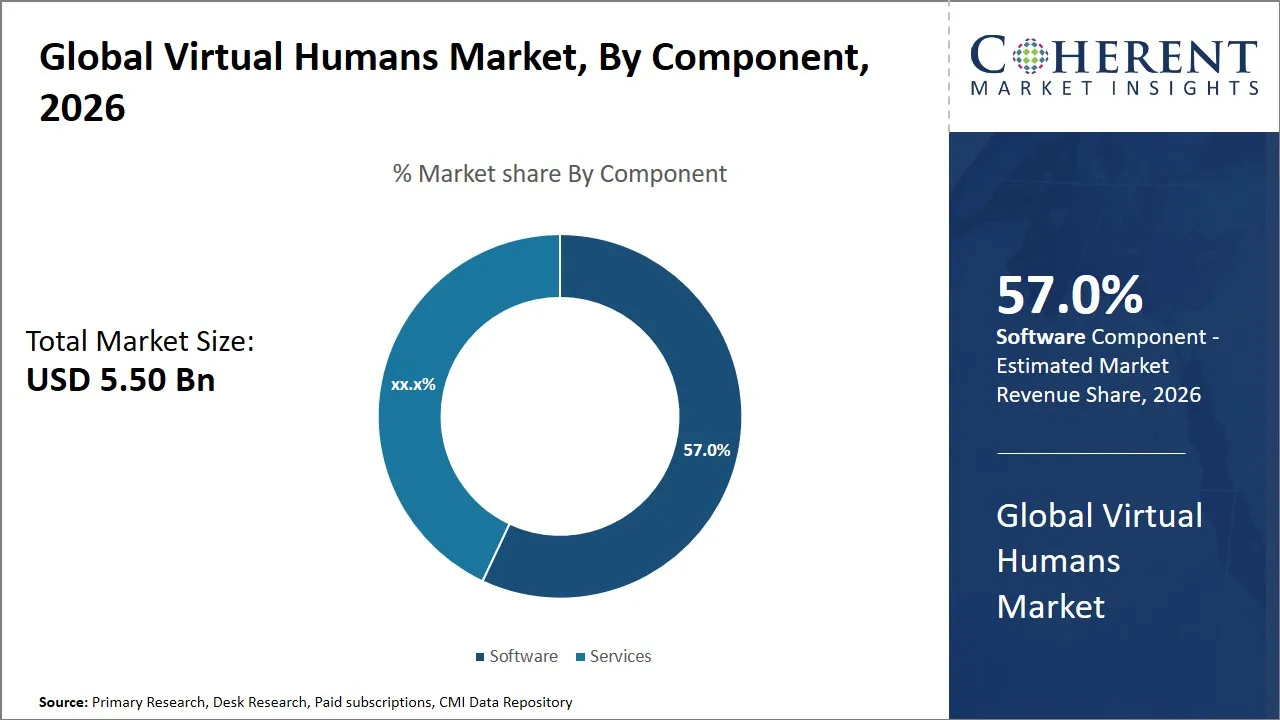
- The software segment is expected to account for 57% of the virtual humans market share in 2026.
- The natural language processing segment is estimated to hold 36% of the market share in 2026.
- The customer support and chatbots segment is projected to capture 33% share in 2026.
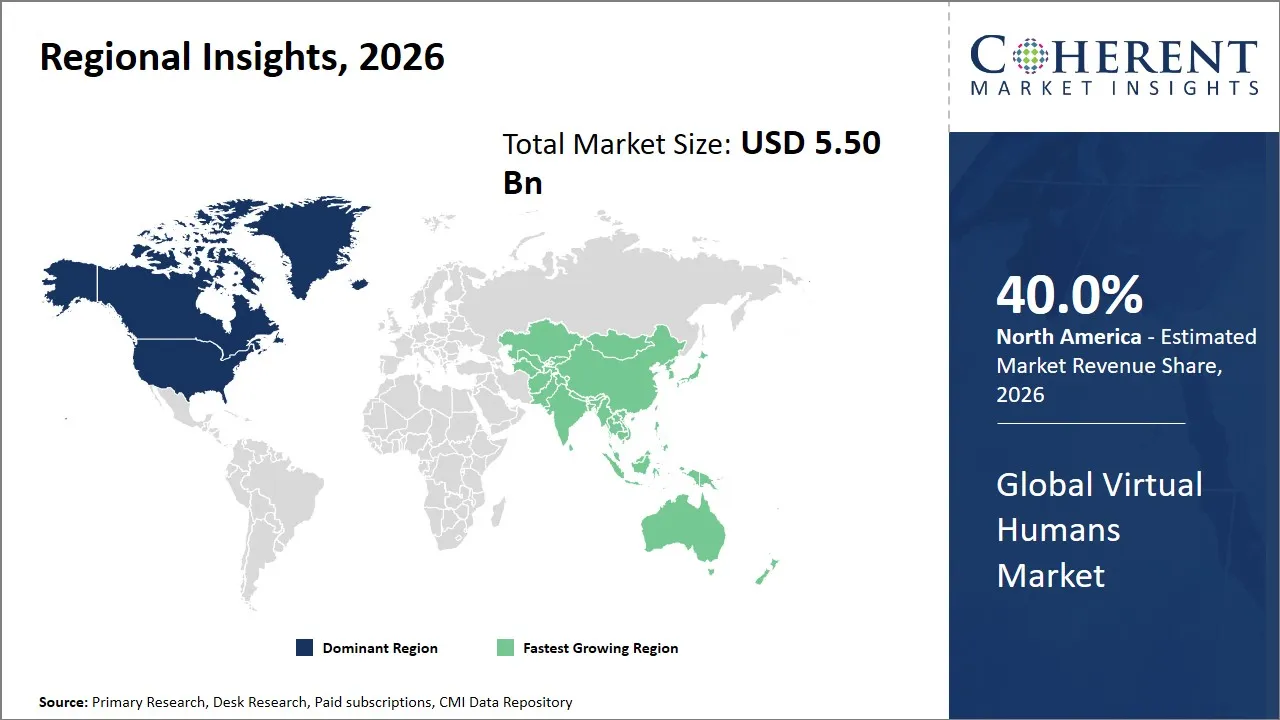
- North America will dominate the virtual humans market in 2026 with an estimated 40%
- Asia Pacific will hold 24% share in 2026 and is expected to record the fastest growth over the forecast period.
Currents Events and Its Impacts
Current Events | Description and its Impact |
UneeQ Platform Launch |
|
Segmental Insights
- Current Industry Events of 2026
- Market Size Estimation
- Regional Breakdown
- Competitive Landscape
- Customer Intelligence
- Segmental Analysis
- Pricing Analysis
- Key Market Drivers, Challenges & Future Trends
- Customized Insights Section
Why Does the Software Segment Dominate the Global Virtual Humans Market in 2026?
The software segment is expected to hold 57.0% of the global virtual humans market share in 2026. Growth stems from how it underpins the creation, management, and refinement of digital personas. Driving such capabilities are applications built with artificial intelligence rules, screen structures, connection frameworks, together with tools for animated visuals. Rather than depending on support services for installation or maintenance, the underlying system allows high-level operations: recognizing spoken words, interpreting gestures, expressing emotional responses. What sets this apart lies here - performance shaped by internal smarts, not outside help.
For instance, on October 8, 2025, Gnani.ai, a pioneer in voice-first Agentic AI platforms, unveiled a self-cloned Digital Human at Global Fintech Fest 2025. The avatar is created from a single approved source video and a short voice reference and is built on Gnani HumanOS.
Natural Language Processing Segment Dominates the Global Virtual Humans Market
The natural language processing segment is expected to account for 36.0% of the market share in 2026. Primarily, advancement occurs due to closing the distance in interaction between people and computers by interpreting and producing spoken expression. Owing to this, widespread use emerges when responses feel fluid, responsive, and shaped by circumstance qualities, vital in roles like assisting customers or aiding medical settings.
Why is Customer Support and Chatbots the Most Widespread Application in the Virtual Humans Market?
The customer support and chatbots segment is projected to capture 33.0% of the global virtual humans market share in 2026. Fueled by the need for improved support at stable costs, businesses explore fresh approaches. Available nonstop, responding promptly while adapting to individual needs, digital assistants deliver steady interactions in varied sectors. From banks to stores, even telecom providers find these digital assistants effective due to their reliability under constant demand.
AI Trust & Safety/Regulation Risk Index
Category | Metric | Approx. Value |
AI Trust & Safety - Public Trust Metrics | % People willing to trust AI | 46% |
% People wary of AI systems | 61% | |
% People perceiving cybersecurity as top AI risk | 84% | |
AI Trust & Safety - Public Concern Metrics | % Concern about AI replacing jobs | 60% |
% Concern about AI bias | 47% | |
% Concern about AI privacy invasion | 52% |
Regional Insights
North America Virtual Humans Market Analysis and Trends
The North America region is projected to lead the market with a 40% share in 2026. A surge unfolds where technology thrives alongside dominant market figures. From research centers skilled in artificial intelligence, movement forward grows stronger due to continuous financial support alongside a foundation built on responsive digital platforms. Change occurs when country-level plans synchronize with advancements in smart technologies and widespread updates within industries. Within North America, firms like Epic Games apply engine capabilities to shape lifelike avatars, while entities such as Synthesia advance methods for synthetic visual production. Still, ties between universities and companies push new tech faster toward public use. On top of that, major media firms combined with buyers who want deep engagement help keep North America ahead in virtual human development.
For instance, on November 18, 2025, UneeQ, the leader in digital human technology, announced the launch of its Immersive Training Platform, an advancement and evolution of its popular Sales Trainer solution, and built on the company’s Digital Human Operating System.
Asia Pacific Virtual Humans Market Analysis and Trends
The Asia Pacific region is expected to exhibit the fastest growth in the market contributing 24% share in 2026. The growth is due to its rapidly expanding digital economies, increasing smartphone penetration, and vibrant gaming and entertainment sectors. Momentum spreads through parts of Asia Pacific, shaped by targeted investment in artificial intelligence. Driven by national strategies, countries like China advance novel applications using digital personas - seen now inside education software, e-commerce sites, and connected messaging networks. A surge in digital shopping creates need: virtual figures guide users, respond to inquiries, operate without pause. Corporate support arrives notably from firms including Tencent and NetEase, bringing realistic avatars into dynamic environments; at the same time, Naver leads comparable efforts in South Korea. Forward movement strengthens - not just through technology, but through shared insights, cooperative work, silent exchanges across borders. Where lines fade, understanding moves, pushing change ahead. Not just busy, this area appears built to grow further.
Global Virtual Humans Market Outlook for Key Countries
Is U.S. the Next Growth Engine for the Virtual Humans Market?
Across U.S., digital beings appear more often because tech firms, new ventures, and academic labs cluster together. Progress at organizations like Meta Platforms and NVIDIA pushes these artificial characters into VR spaces, online services, and adaptive games. Because structures exist that support development - while rules encourage experimentation - ideas become available to people faster than before. These tools move quickly from concept to use. Seen regularly in movies, live broadcasts, or commercial material, artificial personas fulfill functions formerly managed only by individuals - altering interactions while not fully displacing human presence.
Why is China Emerging as a Major Hub in the Virtual Humans Market?
Backed strongly by state policies, China's virtual human sector benefits from widespread public openness to interactive technologies. Firms like Tencent and Baidu test new limits, digital likenesses emerge, virtual artists perform, customer assistance runs without human input. At the national level, focus centers on artificial intelligence; policy goals set forth in "Made in China 2025" guide investment and speed up progress. Because so many people are already online, integration moves fast across shopping sites, education apps, media experiences. Where availability joins trial efforts, change builds pace unexpectedly.
Japan Virtual Humans Market Analysis and Trends
Further along in creating digital humans, Japan uses its history of animation to build realistic virtual characters. Progress emerges when engineering ability combines with societal acceptance of make-believe beings as partners. Companies like Sony push forward by designing avatars able to respond across multiple platforms. Supported by corporate energy, government funding for artificial intelligence strengthens continuous advancement. Familiarity with fictional personalities within culture enables deeper integration over time compared to other regions.
South Korea Virtual Humans Market Analysis and Trends
Behind South Korea’s economic motion lies advanced ICT infrastructure, paired with strong digital content creation. Supported by national strategy, artificial intelligence grows through deliberate public investment. Companies such as Naver and Samsung dedicate extensive effort to crafting realistic digital figures, enhancing service and media experiences. A culture shaped by immersive gaming eases integration of avatar-driven interaction. Collaboration between tech innovators and studios opens fresh directions - progress advances without pause.
India Virtual Humans Market Analysis and Trends
A surge in young users drives India's growing interest in virtual humans. Mobile access spreads quickly across regions, enabling broader engagement with digital tools. Literacy in online environments rises steadily among everyday citizens. Support arrives through national efforts such as Digital India, which encourages advancements in artificial intelligence. Services powered by smart systems gain ground in public and private institutions. Some companies focus on conversation-driven tools, whereas startups such as Chingari test virtual personas. Movement in this space grows quietly but steadily. Education systems begin using responsive assistants designed for local dialects. Call centers employ responsive avatars that reflect local customs. Partnerships form between domestic innovators and overseas engineers. Knowledge transfer occurs more freely due to cross-border collaborations. Growth continues as expertise builds within homegrown teams.
Market Players, Key Development, and Competitive Intelligence
Key Developments
- On June 5, 2024, UneeQ, a pioneer in digital human solutions, announced a collaboration with NVIDIA to integrate UneeQ’s cutting-edge digital human solutions with NVIDIA ACE, underscoring the company’s commitment to pushing the boundaries of technology.
- On June 2, 2024, NVIDIA announced the general availability of NVIDIA ACE generative AI microservices to accelerate the next wave of digital humans, as well as new generative AI breakthroughs coming soon to the platform.
Top Strategies Followed by Global Virtual Humans Market Players
Player Type | Strategic Focus | Example |
Established Market Leaders | Kaltura Acquisition | On November, 10, 2025, Kaltura, Inc, the AI Video Experience Cloud, announced the signing of a definitive agreement to acquire eSelf.ai, a multimodal AI lab developing technology for agentic interactions with live avatars. |
Mid-Level Players | Platform Launch | On August 21, 2025, AnyMind Group announced the launch of AnyLive for Creators, enabling influencers and content creators (collectively creators) to generate their own AI avatars. |
Small-Scale Players | Fund Raising Completion | On March 12, 2025, AvatarOS announced a USD 7 million seed investment led by venture capital firm M13. |
Market Report Scope
Virtual Humans Market Report Coverage
| Report Coverage | Details | ||
|---|---|---|---|
| Base Year: | 2025 | Market Size in 2026: | USD 5.50 Bn |
| Historical Data for: | 2020 To 2024 | Forecast Period: | 2026 To 2033 |
| Forecast Period 2026 to 2033 CAGR: | 14% | 2033 Value Projection: | USD 14 Bn |
| Geographies covered: |
| ||
| Segments covered: |
| ||
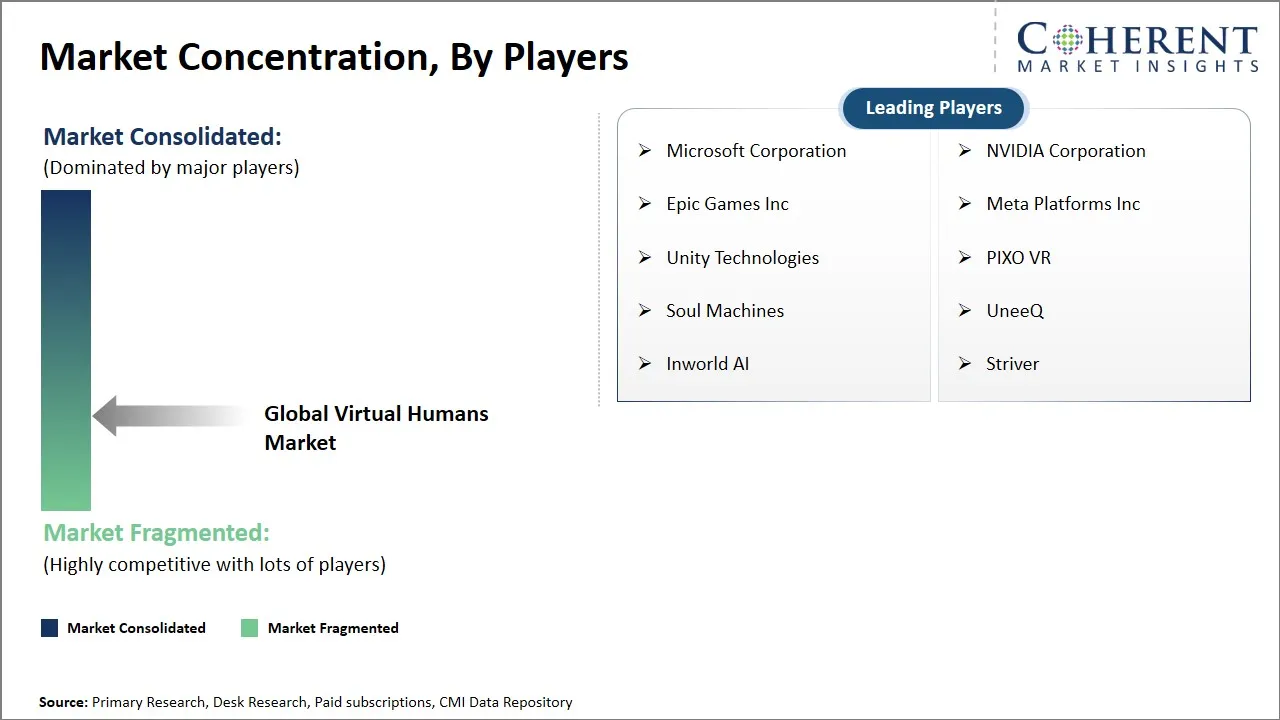
| Companies covered: | Microsoft Corporation, NVIDIA Corporation, Epic Games Inc, Meta Platforms Inc, Unity Technologies, PIXO VR, Soul Machines, UneeQ, Inworld AI, and Striver | ||
| Growth Drivers: |
| ||
| Restraints & Challenges: |
| ||
Global Virtual Humans Market Dynamics
Global Virtual Humans Market Driver - Increasing Demand for Engaging and Realistic Avatars
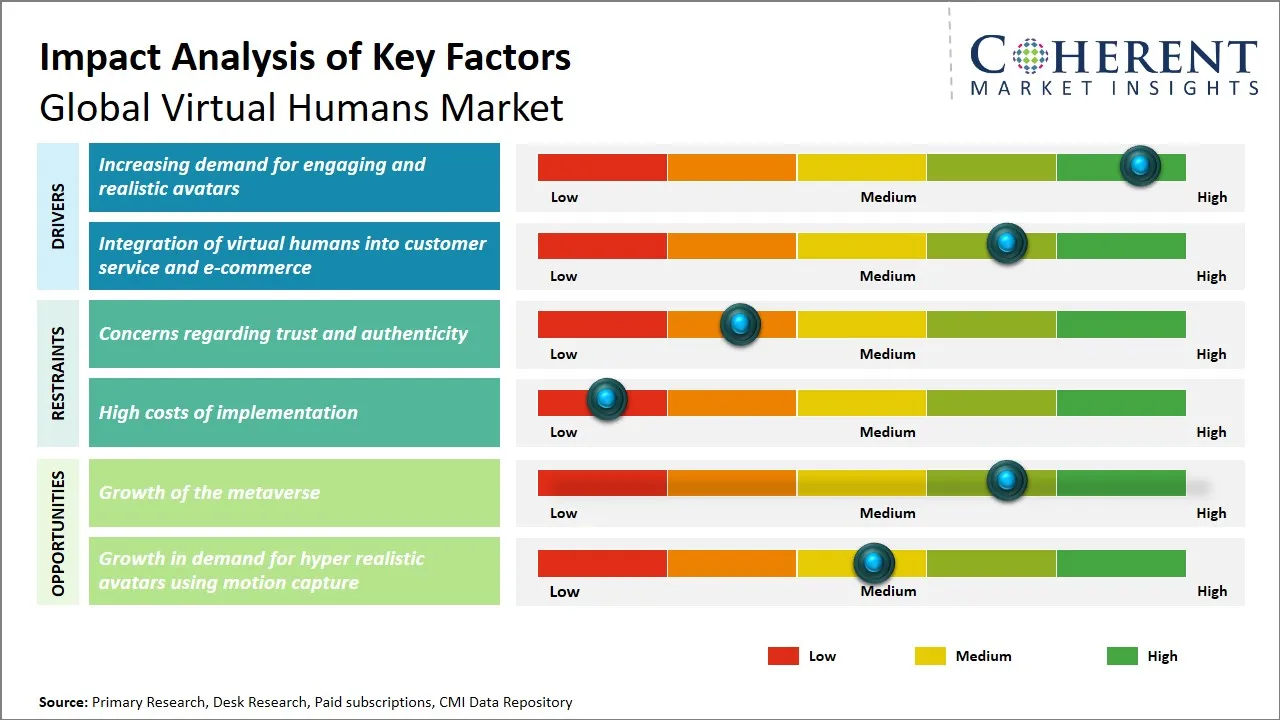
The rising need for more engaging and realistic avatars is becoming a pivotal factor driving the adoption of virtual humans across various industries. With shifts in how people engage online, there is growing interest in digital representations that reflect real human emotion and gesture, prompting creators to focus on realism. Across fields like health care, learning platforms, support systems, play environments, and media spaces, these simulated figures act as communicative interfaces offering tailored dialogue. Driven by progress in pattern recognition, visual rendering methods, and voice & speech recognition tools, synthetic characters now show subtle eye movements, dynamic intonation, and context-aware motion. Conversations with them begin to resemble actual exchanges.
For example, on January 6, 2025, Razer unveiled Project AVA, a desktop-sized holographic AI avatar that interacts with users in real time, complete with facial expressions, eye tracking, lip sync, and personalization.
Global Virtual Humans Market Opportunity - Growth of the Metaverse
Emerging digital spaces are reshaping how virtual identities function worldwide. Within these realms, artificial figures, sometimes called digital likenesses or intelligent assistants, play increasingly central roles. Driven by widespread usage of simulated environments, interaction depends on responsive, human-like entities capable of conversation and expression. Progress in machine learning, speech interpretation, and visual recognition allows such characters to act with awareness, display nuanced reactions, while operating instantly. Growth in these technologies supports deeper integration across online play, shopping, communication, and media platforms.
Analyst Opinion (Expert Opinion)
- Accelerated expansion now marks the global market for virtual humans, fueled by advances merging artificial intelligence with live visual processing. Immersive digital settings in games, online communities, and business tools contribute heavily to this shift. Lifelike representations capable of emotional reaction are seeing greater need - not just in media but also support roles, learning systems, medical uses, and skill development. Progress revealed by firms such as NVIDIA through its Avatar Cloud Engine, Razer's initiative called AVA, and Gnani.ai’s HumanOS platform shows movement toward realism, responsiveness, smoother interaction across services, and stronger user connection.
- Although giants such as Meta and Microsoft prioritize foundational systems and artificial intelligence exploration, smaller entities including UneeQ, Avataros, and Anymind concentrate on skill-building simulations, influencer dynamics, or emotionally responsive avatars. One outcome experts foresee: rising demand for lifelike detail, custom experiences, and seamless connectivity across platforms may sustain uptake - virtual individuals could become standard within evolving AI and shared digital spaces long before 2035 ends.
Speak to the analyst
Want personalized insights?
Take the findings above to one of our principal consultants, or have the report rebuilt around the segments, geographies and competitors you actually track.
Market Segmentation
- Component Insights (Revenue, USD Bn, 2021 - 2033)
- Software
- Services
- Technology Insights (Revenue, USD Bn, 2021 - 2033)
- Natural Language Processing
- Computer Vision
- Machine Learning and Deep Learning
- 3D Graphics and Rendering
- Others
- Application Insights (Revenue, USD Bn, 2021 - 2033)
- Customer Support and Chatbots
- Virtual Influencers and Brand Ambassadors
- Healthcare Assistants
- Education and Training
- Entertainment and Gaming
- Others
- Regional Insights (Revenue, USD Bn, 2021 - 2033)
- North America
- U.S.
- Canada
- Latin America
- Brazil
- Argentina
- Mexico
- Rest of Latin America
- Europe
- Germany
- U.K.
- Spain
- France
- Italy
- Russia
- Rest of Europe
- Asia Pacific
- China
- India
- Japan
- Australia
- South Korea
- ASEAN
- Rest of Asia Pacific
- Middle East
- GCC Countries
- Israel
- Rest of Middle East
- Africa
- South Africa
- North Africa
- Central Africa
- North America
- Key Players Insights
- Microsoft Corporation
- NVIDIA Corporation
- Epic Games Inc
- Meta Platforms Inc
- Unity Technologies
- PIXO VR
- Soul Machines
- UneeQ
- Inworld AI
- Striver
Sources
Primary Research Interviews
- Virtual Human Technology Developers and Software Engineers
- AI and Machine Learning Solution Providers
- Entertainment and Gaming Industry Executives
- Digital Marketing and Advertising Agency Leaders
Magazines
- VR World Magazine
- AI Magazine
- Computer Graphics World
- Digital Entertainment Magazine
- Animation World Network Magazine
Journals
- IEEE Computer Graphics and Applications Journal
- Journal of Virtual Reality and Broadcasting
- Computers & Graphics Journal
Newspapers
- TechCrunch
- VentureBeat
- The Information Technology Business News
- Digital Trends
- Wired Technology News
Associations
- Virtual Reality Industry Forum (VRIF)
- International Association of Virtual Reality Technologies
- Computer Graphics Society (CGS)
- Entertainment Software Association (ESA)
- Digital Marketing Association
Public Domain Sources
- U.S. Patent and Trademark Office (USPTO)
- European Patent Office (EPO)
- World Intellectual Property Organization (WIPO)
- Government Technology Research Reports
- Academic Institution Research Publications
Proprietary Elements
- CMI Data Analytics Tool
- Proprietary CMI Existing Repository of information for last 8 years
Get access to 250+ pages report
Every segment, forecast, competitor profile and data table behind the analysis above — available for instant download.
- ESOMAR Member
- ISO 9001:2015 Certified
- D-U-N-S Registered
- GDPR & CCPA Compliant
Missing comfort of reading report in your local language? Find your preferred language:
Transform your Strategy with Exclusive Trending Reports
Frequently Asked Questions
The global virtual humans market stood at USD 5.50 Bn in 2026 and is expected to reach USD 14 Bn by 2033.
The CAGR of global virtual humans market is projected to be 14% from 2026 to 2033.
Increasing demand for engaging and realistic avatars and integration of virtual humans into customer service and e-commerce are the major factors driving the growth of the global virtual humans market.
Concerns regarding trust and authenticity and high costs of implementation are the major factors hampering the growth of the global virtual humans market.
In terms of component, software is estimated to dominate the market revenue share in 2026.
AI enables realistic speech, facial expressions, emotional responses, and decision-making for lifelike digital avatars.
North America is expected to lead the global virtual humans market in 2026.