

Global Air Quality Control Systems Market Size and Forecast – 2026 To 2033
The global air quality control systems market is expected to grow from USD 91 Bn in 2026 to USD 140 Bn by 2033, registering a compound annual growth rate (CAGR) of 6% from 2026 to 2033. The global air quality control systems market is driven by increasing health concerns caused by air pollution, and the need to mitigate them. On March 7, 2025, Atmotube published educational resources promoting the use of low-cost air quality sensors for community pollution monitoring. The initiative focused on helping citizens understand particulate matter (PM) and VOC exposure, reflecting rising consumer interest in personal air quality monitoring. (Source: Atmotube)
Key Takeaways of the Global Air Quality Control Systems Market
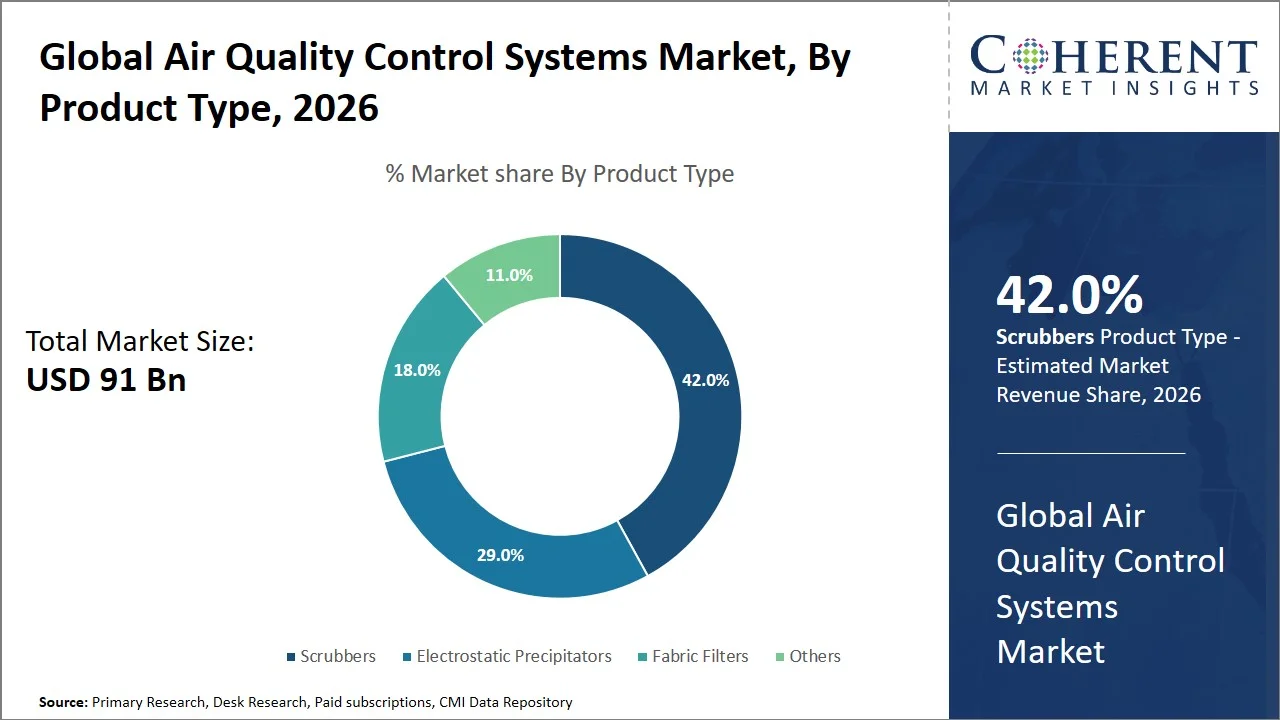
- The scrubbers segment is expected to account for 42.0 % of the global air quality control systems market share in 2026. Growing adoption of smart air monitoring & IoT-based control systems is a key factor driving the growth of the segment. On June 9, 2025, Ultrahuman introduced Ultrahuman Home, a smart environmental monitoring platform that continuously tracks indoor air quality, particulate matter, carbon dioxide, temperature, humidity, and noise levels. (Source: HLTH)
- The power generation segment is estimated to capture 35.0 % of the market share in 2026. Consistent growth in power generation and heavy industries is primarily driving the growth of the segment. On October 31, 2025, MEIL Energy Private Limited acquired a 250 MW lignite-based power plant in Neyveli, Tamil Nadu in India. This acquisition marks a major milestone in MEIL Group’s transformation, from being one of India’s largest and most diversified EPC powerhouses, to becoming an integrated developer, owner, and operator of core infrastructure assets. (Source: Meil Energy Private Limited)
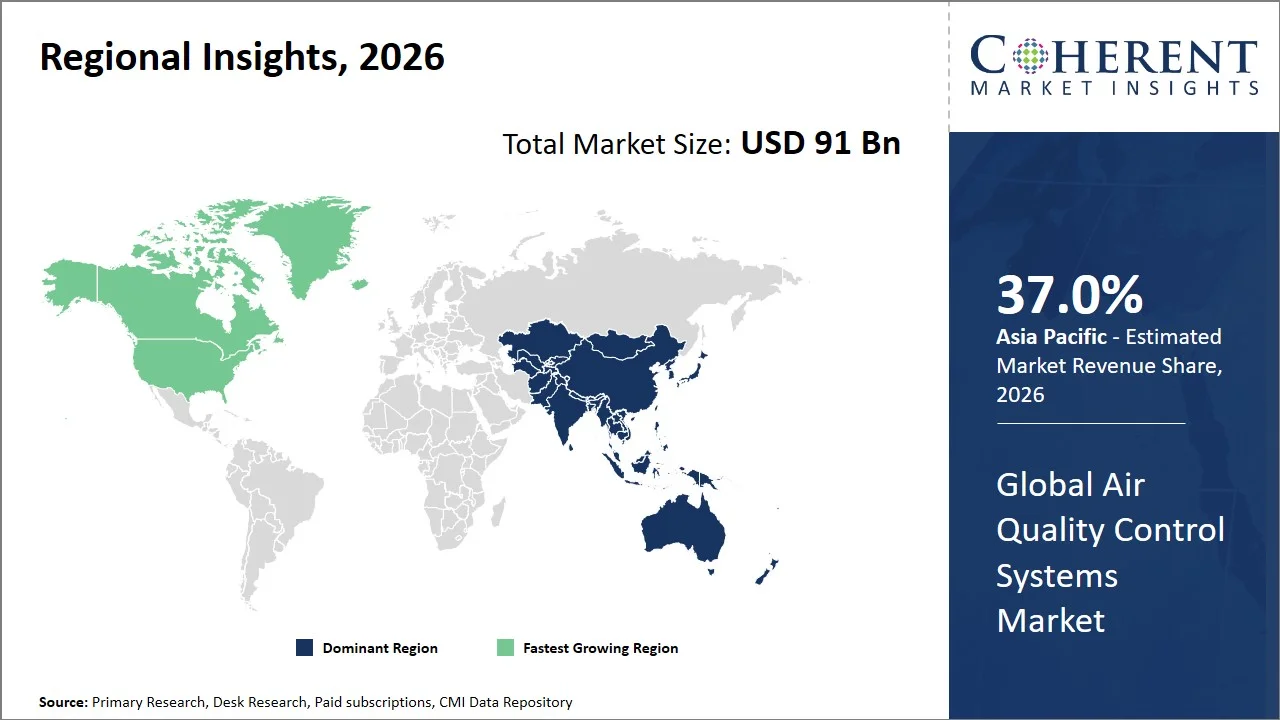
- Asia Pacific is expected to dominate the air quality control systems market in 2026 with a market share of 37.0 %. Rapid urbanization and infrastructure growth in the region is driving the growth of the air quality control systems market in Asia Pacific. In June, 2025, Keppel entered into a Strategic Partnership Agreement with the Asian Infrastructure Investment Bank (AIIB), reinforcing its position as a global asset manager and operator, and trusted partner for infrastructure in Asia Pacific. The agreement, signed on the sidelines of AIIB’s milestone 10th Annual Meeting in Beijing, sets the stage to mobilize up to USD 1.5 billion for sustainable infrastructure projects across Asia Pacific over the next five years. (Source: Keppel)
- North America is expected to account for 22.0 % share in 2026 and is projected to record the fastest growth over the forecast period. Growing integration of air quality monitoring systems with IoT, cloud monitoring, and predictive analytics in North America is expected to drive the growth of the regional market. On April 23, 2026, Clarity announced that Chicago, Philadelphia, and Washington, D.C. in the U.S. are scaling citywide air quality sensor networks to provide real-time, neighborhood-level data, using lessons from past efforts and community input to improve coverage, accessibility, and public health insights. (Source: Clarity)
- AI & IoT-enabled smart air monitoring systems: Air quality control systems are increasingly integrated with IoT devices and sensors and AI-based analytics to provide real-time monitoring, predictive maintenance and automatic emission control. The change is making industries more efficient, lowering the amount of time they are shut down, and allowing them to respond immediately to increases in pollution.
- Shift toward carbon capture and hybrid filtration technologies: Traditional filtration systems are evolving into hybrid solutions that combine particulate capture with carbon capture, NOx/SOx reduction and chemical cleaning. This is driven by climate rules that aim for net-zero emissions and worldwide decarbonization ambitions.
Segmental Insights
Why Does Scrubbers Dominate the Global Air Quality Control Systems Market?
The scrubbers segment is expected to account for 42.0% of the global air quality control systems market share in 2026. Many hazardous gases and particulate matter such as sulfur dioxide (SO2), nitrogen oxides (NOx), acid gases and fine dust can be successfully removed using very simple wet or dry chemical scrubbers. Their capacity to handle many pollutants at once makes them very desirable in sectors such as power generation, chemicals and manufacturing, where emission profiles are complicated and regulatory compliance is rigorous.
On March 26, 2025, Value Maritime completed installation of its 15-MW Filtree Exhaust Gas Cleaning System (EGCS) on the tanker Nexus Victoria owned by Mitsui O.S.K. Lines (MOL). The scrubber removes sulfur compounds and ultrafine particulate matter while simultaneously capturing up to 10% of CO₂ emissions, demonstrating how modern scrubbers are evolving into multi-pollutant control platforms. (Source: Carbon Herald)
- Current Industry Events of 2026
- Market Size Estimation
- Regional Breakdown
- Competitive Landscape
- Customer Intelligence
- Segmental Analysis
- Pricing Analysis
- Key Market Drivers, Challenges & Future Trends
- Customized Insights Section
Why is Power Generation the Most Widespread Application?
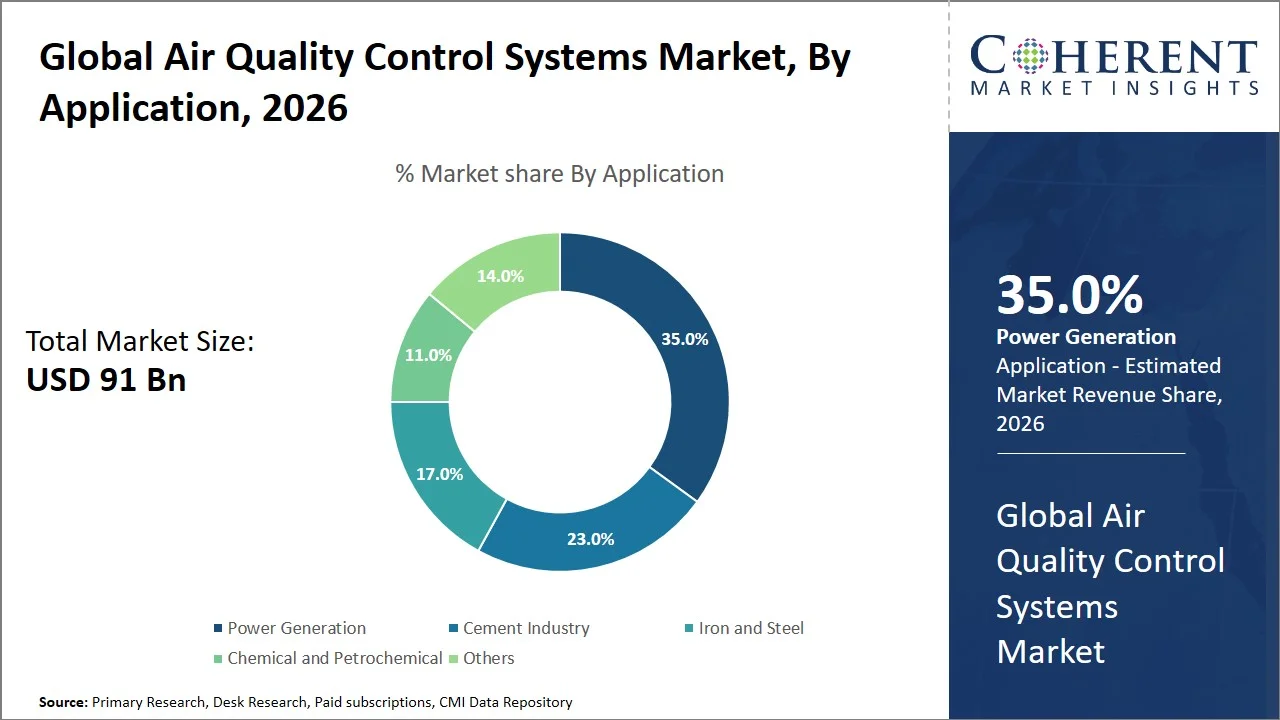
The power generation segment is expected to account for 35.0% of the global air quality control systems market share in 2026. Thermal power plants, particularly coal- and oil-fired, are major sources of sulfur dioxide (SO2), nitrogen oxides (NOx), particulate matter, and mercury emissions due to their steady-state operations, making them the prime target of air quality control systems to comply with stringent environmental emission standards.
On November 19, 2025, NTPC commissioned the FGD system at its Mouda thermal power station in Maharashtra, enabling removal of sulfur dioxide (SO₂) from coal combustion exhaust gases. The project was highlighted because visible emissions were significantly reduced, and gypsum generated from the scrubber process is being supplied to cement manufacturers. (Source: Times of India)
Currents Events and their Impact
Current Events | Description and its Impact |
Clean Air Act (US - EPA) |
|
EU Industrial Emissions Directive (IED 2010/75/EU) |
|
(Source: Environmental Protection Agency , European Union)
Air Quality Control Systems Market Dynamics
Market Drivers
Strict environmental regulations (EPA, EU directives, India CPCB norms)
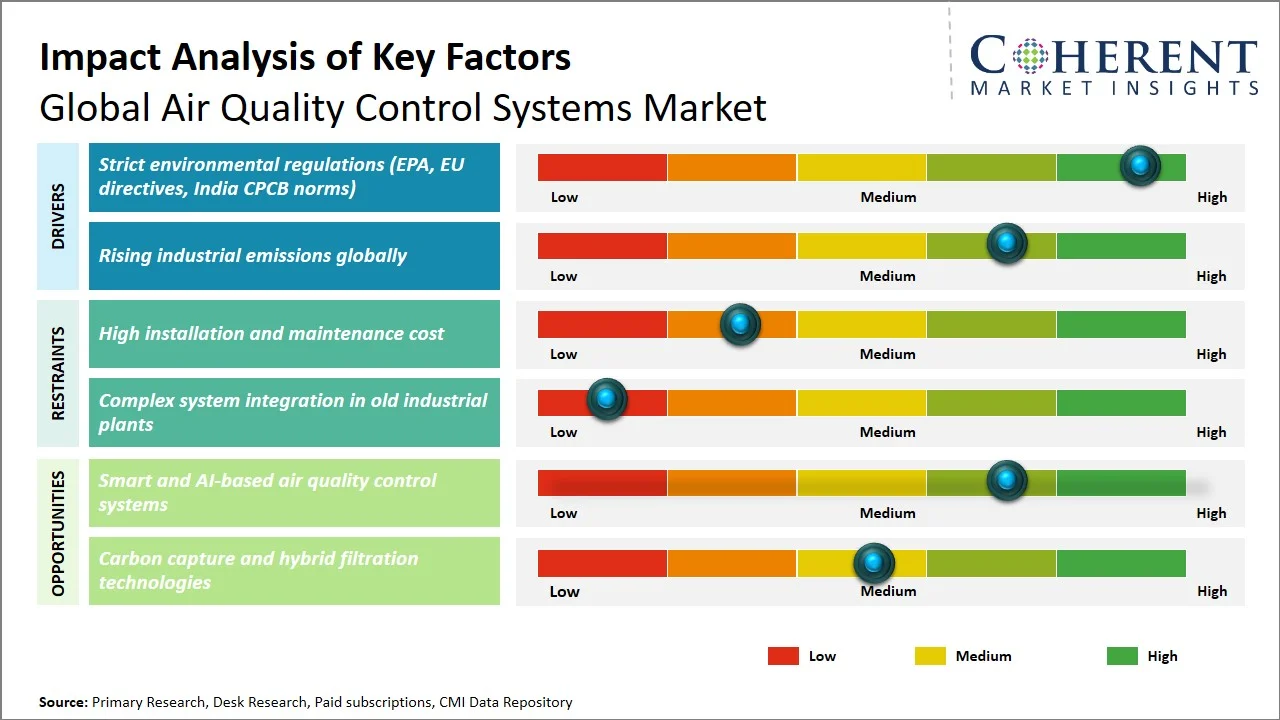
The air quality control systems market is a key driver of the Environmental Protection Agency (EPA), European Union industry guidelines and India’s Central Pollution Control Board (CPCB). The restrictions place strict limitations on the industrial emissions of pollutants including SO2, NOx, particulate matter and dangerous gases and force industries like power, cement, steel and chemicals to implement sophisticated pollution control equipment. The steady tightening of air quality regulations, together with required compliance reporting and penalties for non-compliance, has led to a large increase in the installation of scrubbers, electrostatic precipitators and other emission control devices around the world.
On June 11, 2025, the U.S. Environmental Protection Agency (EPA) initiated a major review of greenhouse-gas and air-pollution regulations for fossil-fuel power plants under the Clean Air Act. The proposal triggered compliance assessments across utilities and industrial operators, reinforcing the importance of emission-monitoring, scrubber, and pollution-control technologies even as companies evaluated potential regulatory changes. (Source: Environmental Protection Agency)
Rising industrial emissions globally
One of the major factors driving the air quality control systems market growth is the growing industrial emissions worldwide. The fast-growing industries such as power generation, manufacturing, chemicals, cement, and steel production are releasing harmful pollutants into the atmosphere. Increased urbanization and infrastructure development, especially in emerging nations, have resulted in higher energy demand and industrial output, which, in turn, have led to increasing emissions of particulate matter, sulfur oxides, nitrogen oxides and volatile organic compounds. The growing pollution load has produced an urgent need for sophisticated air pollution control systems to meet regulatory requirements, safeguard the public’s health and minimize damage on the environment.
On April 10, 2025, China expanded its national emissions trading system (ETS) to include the steel, cement, and aluminum smelting sectors, bringing more than 1,300–1,500 additional high-emitting industrial facilities under emissions regulation. The move reflects the scale of industrial emissions from these sectors and the government's effort to control growing pollution from heavy manufacturing. (Source: International Carbon Action Partnership)
Emerging Trends
- Rapid adoption in emerging economies with industrial expansion: Countries in Asia Pacific, including India, China, Vietnam, and Indonesia are witnessing strong adoption due to fast industrialization and growing pollution levels. Governments are seeking to tighten emission limits and driving industry to either upgrade or construct innovative air pollution control systems.
- Retrofit and modernization of aging industrial infrastructure: Several industrial sectors in North America and Europe are not establishing new manufacturing facilities but are upgrading existing facilities with modern air control systems such as advanced electrostatic precipitators and high-efficiency scrubbers to meet the revised environmental standards.
Regional Insights
Why is Asia Pacific a Strong Market for Air Quality Control Systems?
Asia Pacific is expected to account for a market share of 37.0% in 2026. Coal intensive power production and large scale industrial clusters are major drivers for the air quality control systems market in Asia Pacific, especially in China and India where emissions from steel, cement and chemical industry still remain high. For instance, China’s ultra-low emission retrofits in coal-fired power plants, and India’s installation of flue gas desulfurization (FGD) systems in NTPC plants have tremendously raised the demand for scrubbers and ESP systems. Japan and South Korea also contribute through advanced semiconductor and car production facilities that require high-precision air filtering systems. On February 18, 2026, ERG and Neev Fluidex launched the ERG Neev joint venture to supply air pollution control and odor-control systems throughout India and Asia Pacific. The partnership focuses on scrubbers, VOC treatment systems, carbon filtration, and industrial air pollution control technologies for the wastewater, pharmaceutical, chemical, and energy sectors. (Source: H2O Global News)
Why Does the North America Air Quality Control Systems Market Exhibit High Growth?
North America is projected to account for 22.0% of the global air quality control systems market and is expected to register the fastest growth. Demand in North America is fueled by tight EPA compliance mandates, especially the Clean Air Act, driving renovations at older coal and gas power facilities. For example, U.S. utilities in states such as Ohio and West Virginia have implemented wet scrubbers and selective catalytic reduction (SCR) systems to meet SO2 and NOx regulations. Oil sands operations in Alberta, Canada also implement complex emission control systems to mitigate the high levels of sulfur and particle emissions associated with extraction and processing activities. On November 10, 2025, the government of Canada allocated USD 186 million in 2025 budget funding to support emissions reduction and clean-air initiatives for SMEs and industrial operators. This funding is indirectly increasing the adoption of industrial scrubbers, filtration systems, and emission-control upgrades across Canadian manufacturing facilities. (Source: Government of Canada)
Global Air Quality Control Systems Market Outlook for Key Countries
Why is China Emerging as a Major Hub in the Air Quality Control Systems Market?
China is the major demand driver because to rigorous industrial emission reduction programs such as Blue Sky Protection Campaign that required steel hubs such as Hebei and Tangshan to construct high efficiency desulfurization and dust collecting systems. The large coal-fired power stations of businesses such as Huaneng Group have installed ultra-low emissions retrofits with the combination of ESPs, bag filters and wet scrubbers. The demand for replacement of advanced air quality control systems has also been significantly augmented due to the migration of industry and closing down of outdated facilities.
Is the U.S. the Next Growth Engine for the Air Quality Control Systems Market?
Retrofits are a major part of the U.S. air quality control systems market, with utilities and heavy industries rebuilding outdated infrastructure to meet EPA emission rules, particularly for mercury and NOx management. For example, Midwestern coal plants have installed SCR systems and activated carbon injection units to comply with harmful emission limitations. The refining industry in the Gulf Coast also has complex scrubber systems to manage sulfur compounds from petroleum processing.
Germany Air Quality Control Systems Market Analysis and Trends
The Germany air quality control systems market is driven by compliance with strict EU Industrial Emissions Directive and a strong chemical and automotive industrial base. Industrial sites such as BASF’s plant at Ludwigshafen use integrated air pollution control systems – thermal oxidizers and scrubbers – to regulate VOC and chemical emissions. Germany’s waste-to-energy plants also have state-of-the-art flue gas cleaning technologies that guarantee compliance with stringent dioxin and particle emissions requirements.
India Air Quality Control Systems Market Analysis and Trends
The India air quality control systems market is growing fast as Central Pollution Control Board enforces and cities manage pollution under National Clean Air Program, with large take-up from power and cement sectors. For instance, NTPC’s coal-based thermal plants have deployed large-scale flue gas desulfurization equipment, while cement makers such as UltraTech Cement are deploying bag filters and hybrid dust collectors across kilns. “The industrial clusters in states such as Delhi-NCR and Maharashtra are increasingly adopting continuous emission monitoring systems (CEMS) for compliance reporting.
Global Air Quality Control Systems Market - Air Filtration System Replacement Cycles
System/Filter Type | Application Area | Typical Replacement Cycle | Key Drivers Affecting Lifespan |
Fiberglass / Panel Filters | Basic HVAC, low-load commercial systems | 30–90 days | Dust load, occupancy, outdoor pollution |
Pleated HVAC Filters (MERV 8–13) | Commercial buildings, light industry | 3–6 months | Pollen, PM2.5 levels, system runtime |
High-MERV / HEPA Filters | Hospitals, cleanrooms, pharma, electronics | 6–12 months (up to 24 months in controlled environments) | Sterility requirements, pressure drop limits |
Bag Filters | Commercial HVAC & industrial air handling units | 6–12 months typical | Dust concentration, pre-filtration efficiency |
Industrial Dust Collector Cartridges | Cement, steel, mining, manufacturing | 6–24 months | Abrasive dust, operating hours, pulse-jet efficiency |
Baghouse Filter Bags | Power plants, cement kilns, steel plants | 6 months – 3 years | Dust chemistry, temperature, humidity, cleaning cycles |
Activated Carbon Filters | VOC control, chemical, pharma, odor control | 3–12 months | Gas concentration, adsorption saturation |
HEPA Filters (Industrial Grade) | Power plants, nuclear, high-end industrial AQMS | 12–18 months | Particle loading, airflow resistance, compliance standards |
Electrostatic Precipitator Components | Power generation, steel, cement | 2–5 years (electrode/plate maintenance cycles) | Dust resistivity, voltage load, flue gas composition |
Scrubber Packing Media / Nozzles | Chemical plants, refineries, power plants | 1–3 years | Corrosion, scaling, chemical exposure |
How are Smart and AI-Based Air Quality Control Systems Creating New Growth Opportunities in the Air Quality Control Systems Market?
Smart and AI-based air quality control systems are offering new business potential through shifting traditional pollution control from reactive operation to predictive and automated management. Today, industries are utilizing AI-powered analytics and IoT-enabled sensors to track emissions in real-time, improve filter performance and forecast equipment failures before they happen, minimizing downtime and maintenance costs. For example, power plants and cement manufacturers are using intelligent flue gas monitoring systems that automatically tune the scrubber or ESP efficiency to emissions, maintaining compliance with regulations at all times. It is also allowing remote monitoring and centralized control of many industrial sites, making modern air quality systems more scalable and desirable for major industrial operators. On September 30, 2025, Resideo Technologies launched its new Honeywell Home Whole Home Dehumidifier. The company’s most advanced indoor air quality (IAQ) product offers unsurpassed installation efficiencies and elevates expectations for the dehumidification category. (Source: Resideo)
Market Players, Key Development, and Competitive Intelligence
Key Developments
- On June 1, 2026, CECO Environmental Corp announced the completion of its previously announced strategic combination with Thermon Group Holdings, Inc., a diversified industrial technology company and a global leader in industrial process heating solutions.
- On October 31, 2025, Dürr CTS, a global technology leader in air pollution control and noise abatement, officially started operations as an independent company effective November 1, 2025. Formerly the Clean Technology Systems (CTS) division of the Dürr Group, the company now enters a new phase focused on advancing environmental technologies and leading sustainable growth in industrial production.
Competitive Landscape
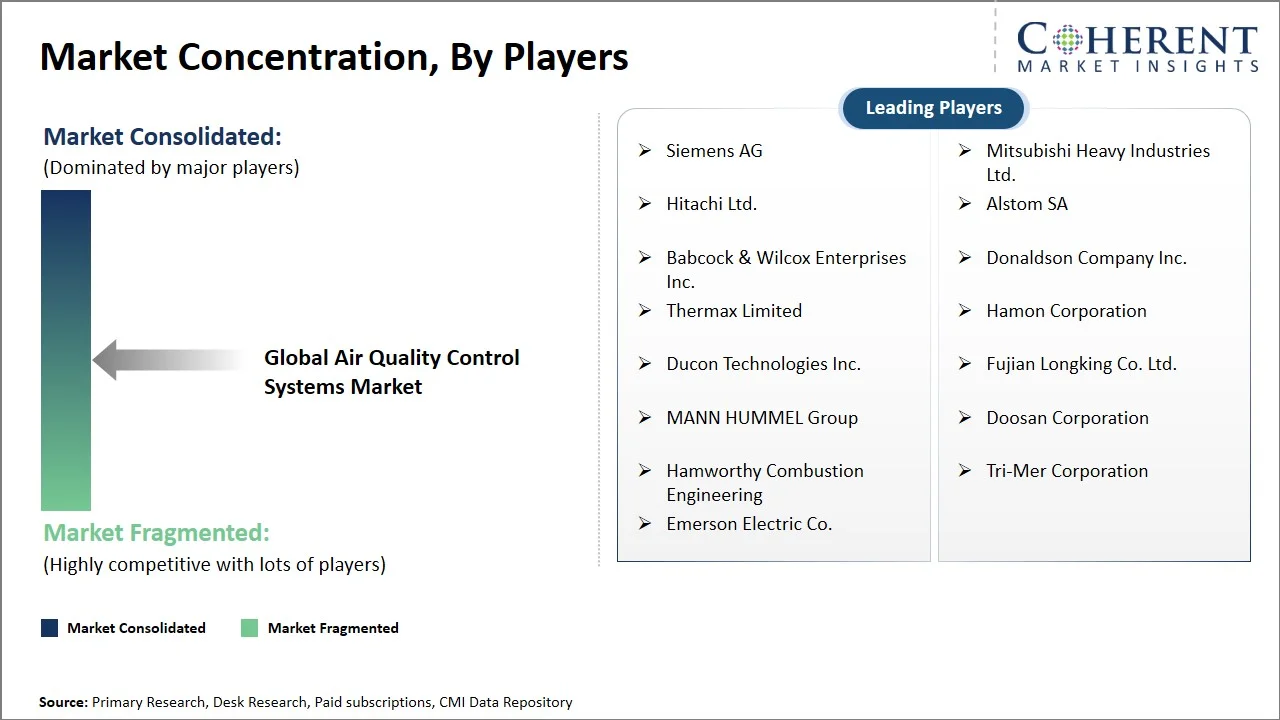
The worldwide air quality control systems market is marked by the presence of major multinational engineering and environmental technology businesses and specialized regional competitors. Some of the players operating in the market include Siemens AG, Mitsubishi Heavy Industries, Babcock & Wilcox Enterprises, Donaldson Company, and Thermax. These companies provide integrated solutions that combine scrubbers, electrostatic precipitators and digital monitoring systems. Industry contracts on a big scale are very consolidated. Retrofit and localized installation projects generally include regional players. Price is not the only driving factor and competition is fierce, driven by technical innovation, regulatory compliance expertise and long-term service contracts.
Market Report Scope
Air Quality Control Systems Market Report Coverage
| Report Coverage | Details | ||
|---|---|---|---|
| Base Year: | 2025 | Market Size in 2026: | USD 91 Bn |
| Historical Data for: | 2020 To 2024 | Forecast Period: | 2026 To 2033 |
| Forecast Period 2026 to 2033 CAGR: | 6% | 2033 Value Projection: | USD 140 Bn |
| Geographies covered: |
| ||
| Segments covered: |
| ||
| Companies covered: | Siemens AG, Mitsubishi Heavy Industries Ltd., Hitachi Ltd., Alstom SA, Babcock & Wilcox Enterprises Inc., Donaldson Company Inc., Thermax Limited, Hamon Corporation, Ducon Technologies Inc., Fujian Longking Co. Ltd., MANN HUMMEL Group, Doosan Corporation, Hamworthy Combustion Engineering, Tri-Mer Corporation, and Emerson Electric Co. | ||
| Growth Drivers: |
| ||
| Restraints & Challenges: |
| ||
Analyst Opinion (Expert Opinion)
- Market growth is largely seen as being underpinned by growing regulatory enforcement and faster industry decarbonization activities across key economies. There is a strong demand for retrofit solutions, especially in aged power generation and heavy manufacturing facilities. The trend toward digitalization and predictive maintenance is increasingly recognized as a major driver for changing the operational efficiency and lifecycle management of air pollution control systems. Moreover, increased investment in emission reduction technologies is being considered as a key prerequisite to achieve long-term sustainability goals.
- The market is predicted to grow steadily, as more stringent worldwide emission rules are enforced in a range of industrial sectors. Potential areas of growth include integration of carbon capture, AI-enabled smart monitoring systems and hybrid filtration technologies for multi-pollutant removal. Emerging economies are predicted to witness significant growth as fast industrialization and urbanization are expected to raise the demand for better air quality infrastructure. Furthermore, greater use of green hydrogen, shift to renewable energy, and net-zero promises are anticipated to revolutionize the design and deployment of next-generation air pollution control systems.
Speak to the analyst
Want personalized insights?
Take the findings above to one of our principal consultants, or have the report rebuilt around the segments, geographies and competitors you actually track.
Market Segmentation
- Product Type Insights (Revenue, USD Billion, 2021 - 2033)
- Scrubbers
- Electrostatic Precipitators
- Fabric Filters
- Others
- Application Insights (Revenue, USD Billion, 2021 - 2033)
- Power Generation
- Cement Industry
- Iron and Steel
- Chemical and Petrochemical
- Others
- Regional Insights (Revenue, USD Billion, 2021 - 2033)
- North America
- U.S.
- Canada
- Latin America
- Brazil
- Argentina
- Mexico
- Rest of Latin America
- Europe
- Germany
- U.K.
- Spain
- France
- Italy
- Russia
- Rest of Europe
- Asia Pacific
- China
- India
- Japan
- Australia
- South Korea
- ASEAN
- Rest of Asia Pacific
- Middle East
- GCC Countries
- Israel
- Rest of Middle East
- Africa
- South Africa
- North Africa
- Central Africa
- North America
- Key Players Insights
- Siemens AG
- Mitsubishi Heavy Industries Ltd.
- Hitachi Ltd.
- Alstom SA
- Babcock & Wilcox Enterprises Inc.
- Donaldson Company Inc.
- Thermax Limited
- Hamon Corporation
- Ducon Technologies Inc.
- Fujian Longking Co. Ltd.
- MANN HUMMEL Group
- Doosan Corporation
- Hamworthy Combustion Engineering
- Tri-Mer Corporation
- Emerson Electric Co.
Sources
Primary Research Interviews
- Air Quality Control Systems Manufacturers and Suppliers
- Environmental Compliance Officers and Regulatory Experts
- Industrial Plant Managers and Facility Engineers
- Environmental Consulting Firms and Technical Specialists
Magazines
- Environmental Science & Technology Magazine
- Pollution Engineering Magazine
- Air & Waste Management Magazine
- Industrial Environmental Management Magazine
Journals
- Journal of Environmental Management
- Atmospheric Environment Journal
- Environmental Science & Policy Journal
Associations
- Air & Waste Management Association (A&WMA)
- International Association of Environmental Managers (IAEM)
- Environmental Industry Associations (EIA)
- National Association of Clean Air Agencies (NACAA)
Public Domain Sources
- Environmental Protection Agency (EPA) Reports and Publications
- United Nations Environment Programme (UNEP) Publications
- World Bank Environmental Data and Reports
- OECD Environmental Statistics and Reports
Proprietary Elements
- CMI Data Analytics Tool
- Proprietary CMI Existing Repository of information for last 10 years
Get access to 250+ pages report
Every segment, forecast, competitor profile and data table behind the analysis above — available for instant download.
- ESOMAR Member
- ISO 9001:2015 Certified
- D-U-N-S Registered
- GDPR & CCPA Compliant
Missing comfort of reading report in your local language? Find your preferred language:
Transform your Strategy with Exclusive Trending Reports
Frequently Asked Questions
The global air quality control systems market is expected to stand at USD 91 Bn in 2026 and is expected to reach USD 140 Bn by 2033.
The CAGR of the global air quality control systems market is projected to be 6% from 2026 to 2033.
Growing adoption of AI, machine learning, and analytics initiatives and rising volume of enterprise data from cloud, IoT, and digital channels are the major factors driving the growth of the global air quality control systems market.
High installation and maintenance cost and complex system integration in old industrial plants are the major factors hampering the growth of the global air quality control systems market.
In terms of product type, the scrubbers segment is estimated to dominate the market revenue share in 2026.
It forces industries to adopt emission control systems to meet air quality standards.
It removes fine particulate matter from industrial exhaust using electrical charges.