

Asia Pacific Fire Doors Market Size and Forecast: 2026-2033
The Asia Pacific Fire Doors Market is expected to grow from USD 4.89 Bn in 2026 to USD 8.43 Bn by 2033, registering a compound annual growth rate (CAGR) of 8.1% from 2026 to 2033. Globally, rapid urbanization and infrastructure expansion continue to strengthen the market growth. According to Asian Development Bank (ADB), developing Asia is expected to maintain robust economic growth, with South Asia projected to grow by 6.5% in 2025, supporting investments in commercial buildings, hospitals, airports, data centers, and smart city infrastructure where fire-rated doors are mandatory. (Source: Reuters)
In Asia Pacific, retrofit-driven fire safety upgrades are emerging as a major driver, especially in urban centers where a significant share of commercial buildings (estimated 25–35% in major cities) require fire compliance upgrades or replacement of non-compliant doors. This creates a recurring replacement cycle for fire doors, directly boosting the market growth.
Key Takeaways of the Asia Pacific Fire Doors Market
- Metal is projected to hold 32.1 % of the Asia Pacific fire doors market share in 2026, making it the dominant material segment. Steel fire doors dominate especially in China, India, and Japan, where large-scale industrialization, metro rail expansion, and high-rise commercial construction require high fire-resistance performance. Their dominance is driven by superior durability, ability to withstand fire exposure up to 120 minutes, and strict compliance with building codes such as India’s NBC 2016, China’s GB fire safety standards, and Japan’s Building Standard Law. In countries like China, massive manufacturing zones and urban infrastructure projects heavily prefer steel fire doors for warehouses, factories, airports, and commercial towers due to their strength, low maintenance, and long lifecycle. For instance, China’s expanding airport and industrial infrastructure projects increasingly deploy UL-certified oversized steel fire doors for large commercial and industrial openings to enhance fire compartmentalization and evacuation safety. Manufacturers such as Shanghai Xunzhong Industry Co., Ltd. have supplied oversized steel fire doors for industrial plants, warehouses, and airport-related facilities, with fire ratings extending up to three hours and customized door sizes reaching 9×10 feet for large-scale infrastructure applications.
- Hinged fire doors are projected to account for approximately 21.6 % of the Asia Pacific fire doors market share in 2026, making them the leading product type segment. Hinged fire doors dominate particularly in India, China, Singapore, and South Korea, where building codes mandate their installation in staircases, corridors, and emergency exits of residential and commercial buildings. Their leadership is mainly due to cost efficiency, ease of installation, and compatibility with both new construction and retrofit projects. For instance, India’s high-rise residential towers under urban development programs such as Smart Cities Mission widely use hinged steel fire doors in lift lobbies and escape routes, while Singapore’s strict BCA regulations require certified hinged fire doors in almost all residential condominiums and public buildings for safe evacuation compliance.
- The residential segment is projected to hold 41.6 % of the Asia Pacific fire doors market share in 2026, making it the dominant application. This dominance is primarily driven by China and India, which are experiencing massive high-rise residential construction due to rapid urban population growth and government housing initiatives. China’s urban redevelopment programs, covering millions of older housing units, and India’s “Housing for All” initiative are significantly increasing the demand for fire-rated doors in apartment buildings, gated communities, and mixed-use residential towers. (Source: unhabitat.org)
- Fire Safety Compliance Acceleration: Stringent fire safety regulations and updated building codes across Asia Pacific are increasing the adoption of certified fire-rated doors in residential, commercial, and industrial buildings. Governments in countries such as China, India, Japan, and Australia are emphasizing mandatory fire protection measures to reduce fire-related risks and improve occupant safety.
- Smart & Sustainable Product Innovation: Technological advancements in IoT-enabled fire doors, fire-resistant composite, insulated steel doors, and eco-friendly materials are reshaping the Asia Pacific Fire Doors Market. Manufacturers are focusing on lightweight, durable, thermally efficient, and aesthetically integrated fire door solutions to support smart space development and green building certification initiatives.
Segmental Insights
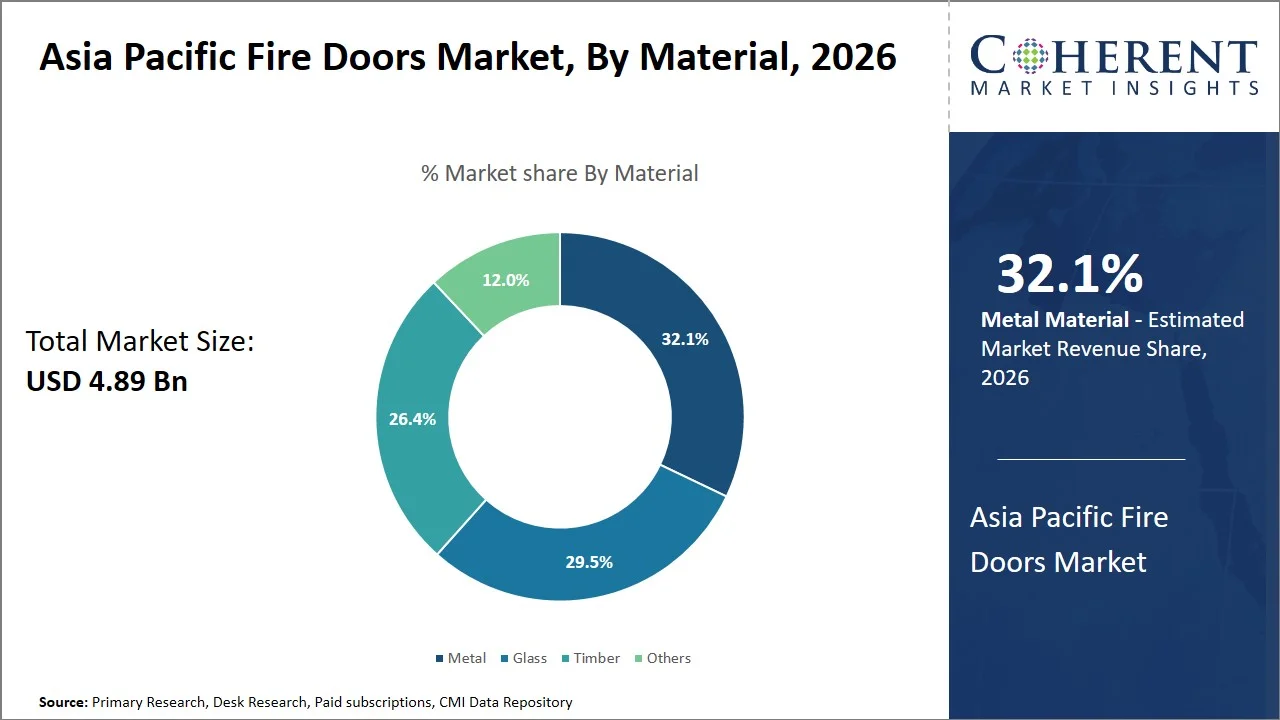
Why Does Metal Dominate the Asia Pacific Fire Doors Market ?
Metal is expected to hold the 32.1% share of the Asia Pacific fire doors market in 2026 as it offers excellent resistance to fire and high structural strength, with long service life and a compliance to strict fire safety regulations. Steel doors can resist very high temperatures for a long time, and can be designed to offer greater compartmentation in the event of a fire than is possible with a standard wooden door. They possess strong anti-corrosion, anti-impact, smoke-proof and anti-environmental characteristics, which is quite suitable for all kinds of industrial plants, commercial buildings, transport hubs, hospitals, warehouse, and high-rise buildings in the Asia Pacific region.
For example, the National Building Code (NBC) of India and the GB fire safety codes of China specify the need for fire-rated steel doors in industrial corridors, escape stairs, electrical rooms and commercial high-rise buildings. In much the same way, in Southeast Asia, the need for increased fire resistance of 60-120 minutes is driving the use of metal fire doors in airport modernization projects, while in India, metro rail projects are driving the market for metal fire doors. Overall, all these factors drive metal to be the largest segment within the Asia Pacific fire doors market.
- Current Industry Events of 2026
- Market Size Estimation
- Regional Breakdown
- Competitive Landscape
- Customer Intelligence
- Segmental Analysis
- Pricing Analysis
- Key Market Drivers, Challenges & Future Trends
- Customized Insights Section
Why are Hinged Fire Doors the Most Preferred Product Type?
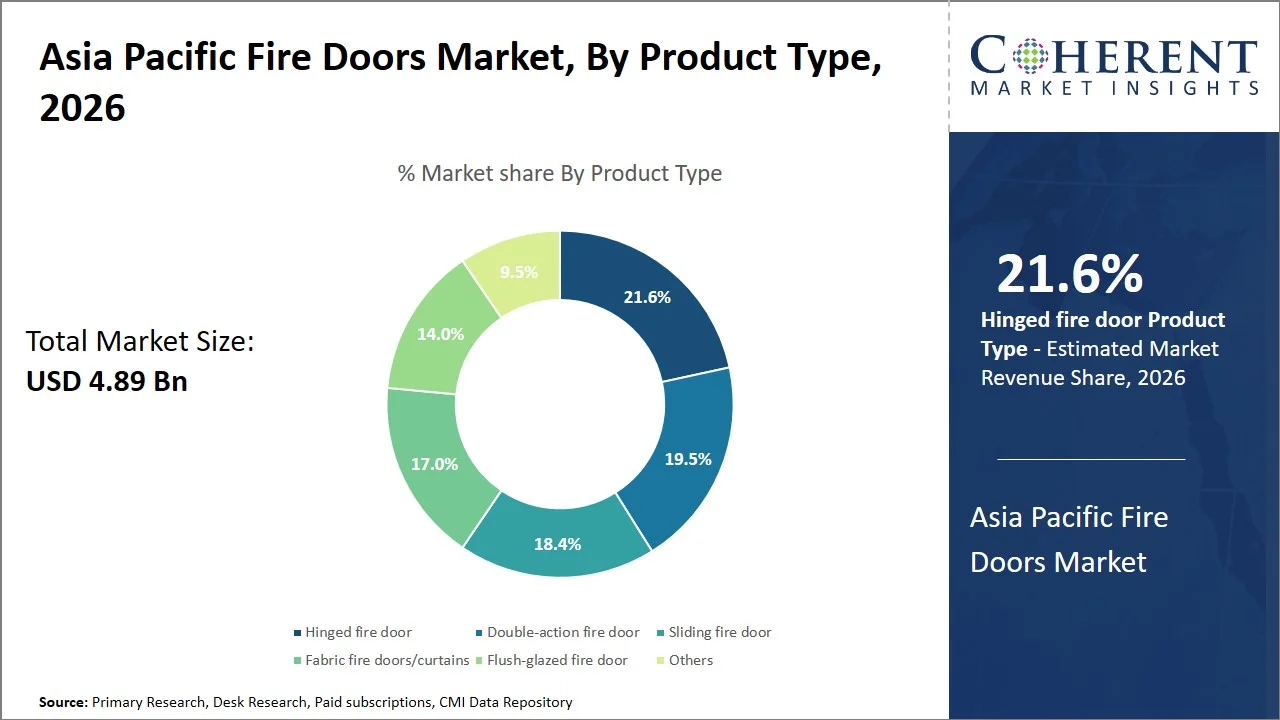
Hinged fire doors are expected to dominate the market in 2026 with a 21.6% share in the Asia Pacific fire doors market due to their cost effectiveness, ease of installation, and their wide application in residential, commercial and industrial buildings. These doors offer effective fire compartmentalization and are easily fit in new construction or retrofitting. Their flexibility with different locking systems, panic hardware, smoke seals and automation systems also aid in their overall adoption.
In India, in high rise residential and commercial projects, hinged steel fire doors are installed typically in stairwell enclosures and lift lobby according to the NBC 2016 fire safety norms.
For instance, Acodor, an India-based fire-rated door manufacturer, offers hinged steel fire doors certified under IS:3614 and BS:476 standards for high-rise residential, commercial, and industrial applications. The company specifically highlights NBC 2016-compliant fire doors for staircase enclosures, lift lobbies, and compartmentation areas in high-rise buildings. (Source: Acodor)
Residential Segment Dominates the Asia Pacific Fire Doors Market
The residential segment is expected to account for 41.6% of the Asia Pacific fire doors market in 2026, driven by rapid urbanization, population growth, and the expansion of high-rise residential construction across emerging economies such as China, India, Indonesia, Vietnam, and the Philippines. The increasing enforcement of stringent fire safety regulations for apartment complexes and housing societies is further accelerating the adoption of certified fire-rated doors in residential buildings.
Governments and municipal authorities across major Asian cities are strengthening fire safety compliance norms following multiple high-rise fire incidents. In India, the National Building Code (NBC) 2016 mandates the installation of certified fire-rated doors in staircase enclosures, lift lobbies, and emergency escape routes for buildings exceeding 15 meters in height. Similar regulatory tightening has been observed in cities such as Mumbai, Shanghai, Seoul, Jakarta, and Manila, where authorities are emphasizing compartmentalization and evacuation safety standards in residential towers.
For instance, following several fatal high-rise fire incidents in Mumbai, authorities significantly intensified fire safety inspections and compliance enforcement across residential and commercial buildings. According to a report by The Times of India, inspections conducted across 193 buildings revealed that nearly 60% violated fire safety norms, including non-functional fire alarms, sprinklers, and unsafe evacuation systems. (Source: The Times of India)
Currents Events and their Impact
Current Events | Description and its Impact |
Stricter Fire Safety Regulations Across Asia-Pacific |
|
Rapid Urbanization and Mega Infrastructure Development |
|
Asia Pacific Fire Doors Market Dynamics
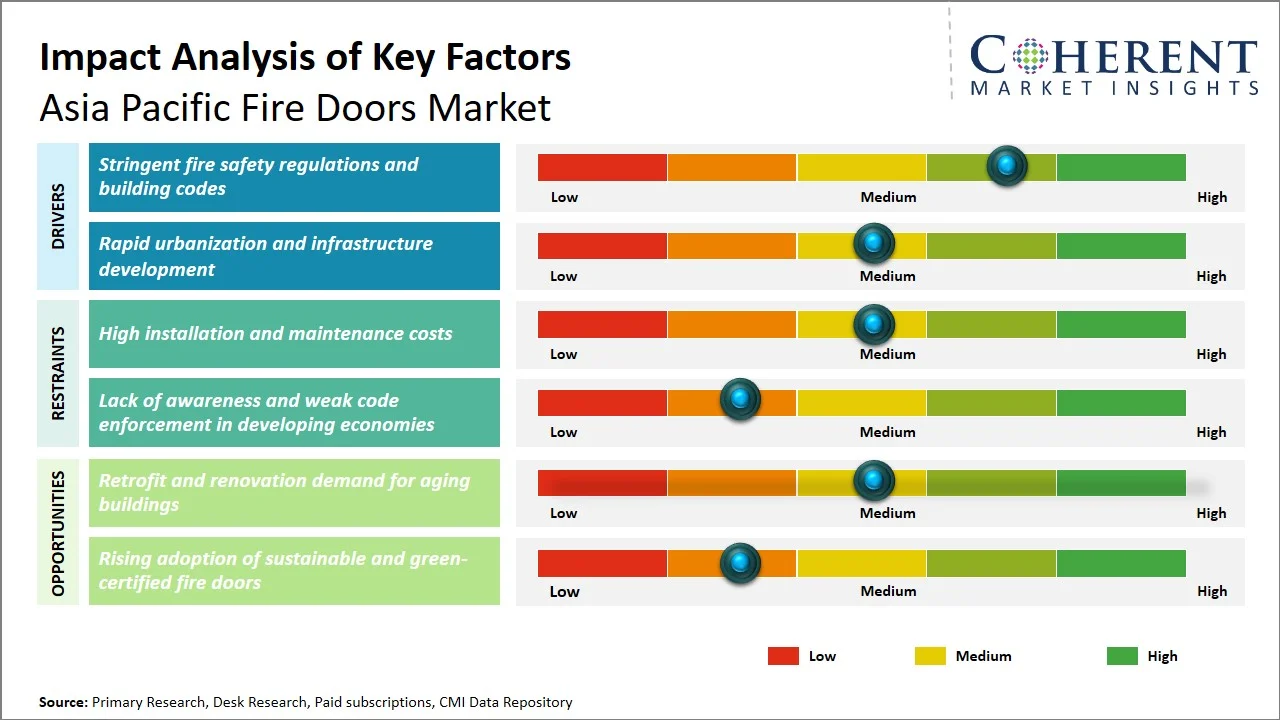
Market Drivers
- Stringent Fire Safety Regulations and Building Codes: Growing emphasis on implementing stringent fire safety regulations by governments and regulatory authorities has been driving the Asia Pacific fire doors market growth. The rising number of fire incidences in commercial and residential buildings has led to the strengthening of building safety standards in countries like China, India, Japan, Singapore, South Korea, and Australia. There is also a new issue of smoke and the spread of flames during an emergency, and fire doors are now being required in hospitals, airports, educational buildings, industrial premises, shopping malls, hotels, and high-rise residential buildings. For example, the National Building Code (NBC) and Fire & Life Safety Guidelines mandate the installation of certified fire-rated doors in staircases, corridors, and escape routes for buildings exceeding 15 meters in height in India (Source: Acodor). Similarly, China’s GB Fire Protection Standards require certified fire compartmentation systems, including fire-resistant door assemblies, in industrial and commercial buildings to limit fire and smoke spread. In Singapore, fire-resistant door assemblies are tested and certified according to the BS EN 1634-1 standard, which specifies fire resistance and smoke control testing procedures for door and shutter assemblies. (Source: webstore.ansi.org)
- Rapid Urbanization and Infrastructure Development: Asia Pacific's rapid urbanization and large-scale infrastructure development are driving the demand for fire doors at an increased rate. The region is seeing a surge in the development of residential complexes, commercial buildings, airports, metro rail systems, industrial facilities, hospitals, data centers and smart city projects that demand state-of-the-art fire safety systems and certified fire-rated doors. Increasing migration toward urban areas is putting pressure on governments to develop modern infrastructure with enhanced safety compliance. Therefore, fire doors are becoming a critical element in high-rise buildings, industrial plants, shopping malls, hotels and public infrastructure projects to stop the spread of fire and smoke in the event of an emergency. The UN Department of Economic and Social Affairs (UN DESA) reports that almost 40 million people join Asia's urban population each year, driving the need for massive developments of commercial and residential buildings throughout the region. As per the projections, the number of megacities will reach 37 by 2050, with some cities like Kuala Lumpur (Malaysia) and Hajipur (India) moving past the 10-million threshold. (Source: United Nations)
Emerging Trends
- Smart Fire Protection Integration: Technologically advanced fire doors with integrated fire sensors, automated closers, smoke detectors, and building management systems are becoming a common feature of smart and integrated fire door systems, which are being developed by manufacturers. They are becoming increasingly popular in airports, smart buildings, hospitals, data centers and commercial infrastructure projects in China, Japan, Singapore and South Korea, helping to enhance emergency responses, provide real-time monitoring, and generate more value for projects.
- Emerging Trend for Sustainable and Aesthetic Fire Doors: Fire doors are transitioning from just a safety product to an environment-friendly and aesthetic product. There is increased demand for fire rated glass doors, designer steel doors, recyclable materials, low-emission coatings and low maintenance compound doors that meet LEED and green building codes. Commercial buildings, luxury hotels and modern office spaces are increasingly using aesthetically pleasing fire-resistant doors without sacrificing safety standards
Aging Infrastructure Modernization & Fire Safety Compliance Risks
Country
| Share of Aging Buildings (>25 yrs) | High-Risk Fire Safety Stock | Key Driver |
Japan | 55–65% | Very High | Earthquake + aging infrastructure |
China | 35–45% | High | Old urban housing + code upgrades |
India | 25–35% | High | Rapid urbanization + legacy buildings |
How are growing retrofit and renovation activities creating new growth opportunities in the Asia Pacific fire doors market?
The Asia Pacific fire doors market is in the process of retrofitting and upgrading the aging infrastructure. Therefore, many older buildings in countries, like Japan, China, India, Australia and South Korea were built before the modern safety standard for fire became a requirement. Governments and building owners are more and more upgrading these facilities, in order to meet new fire protection standards. The fire safety modernization programs for hospitals, hotels, educational institutions, airports, commercial complexes, and residential towers are considering the replacement of the traditional door with certified fire-rated doors.
In total, in the first 10 months of 2025, China has begun renovation works in 25,100 old urban residential communities aimed at improving livable cities.
Market Players, Key Development, and Competitive Intelligence
Key Developments
- In April 2025, ASSA ABLOY acquired Door System, a Denmark-based manufacturer of fire-rated doors. Door System serves the pharmaceutical, food, and retail industries. This acquisition strengthens ASSA ABLOY's fire door offerings. It also enhances its presence in the Asia Pacific region. The expansion is managed through its EMEIA division.
- In February 2025, Allegion completed the acquisition of Lemaar, an Australian door hardware company. Lemaar specializes in door entry systems and digital locks. The acquisition complements Allegion’s fire door and access solutions. It reinforces Allegion’s market position in the region. This move aligns with Allegion’s growth strategy.
- In January 2025, Dormakaba introduced EasyAssist Pro, a low-energy door assistant for fire-rated doors, at BAU 2025. It enhances barrier-free access while adhering to fire safety standards. The product is ideal for offices, schools, and healthcare facilities. EasyAssist Pro aims to improve accessibility and safety. The launch highlights Dormakaba’s commitment to innovation in fire door solutions.
Competitive Landscape
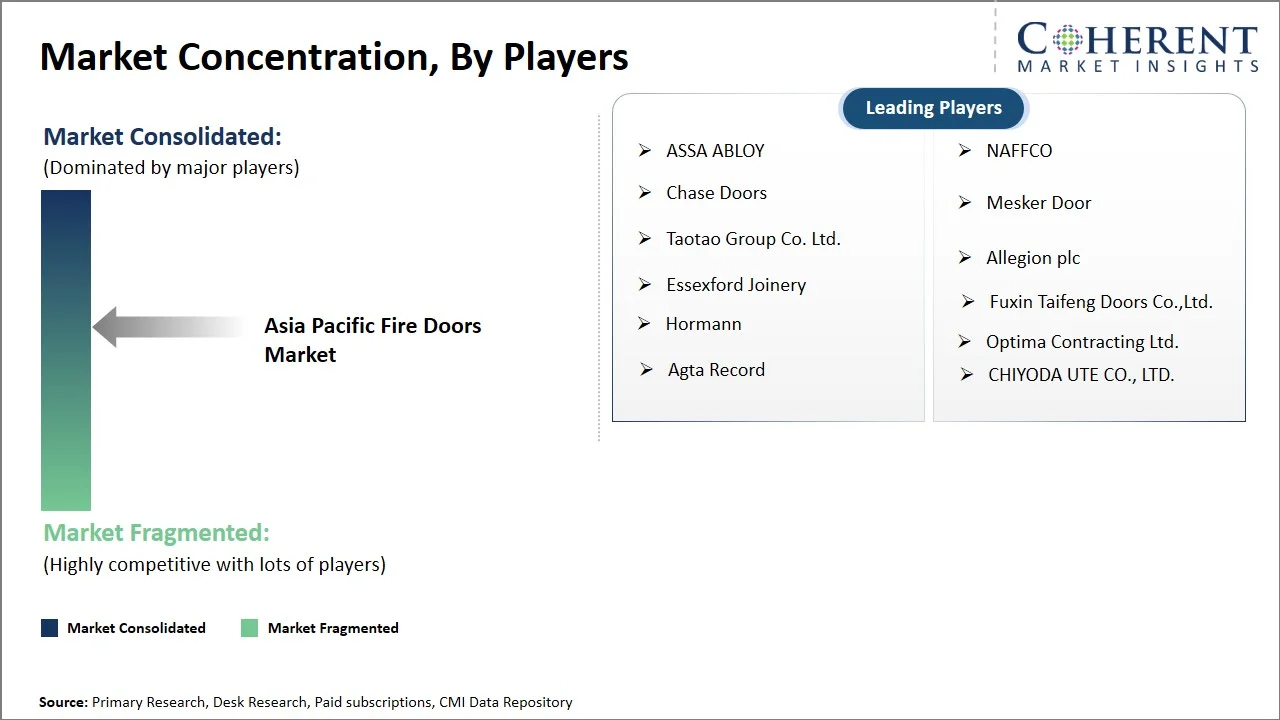
Asia Pacific Fire Doors Market is moderately fragmented and competitive owing to the strict fire safety regulations, fast pace of urban infrastructure development and the rising trend of use of certified fire-rated building materials. The international players are more prevalent in high value commercial and institutional projects, whilst regional and local players are also being successful in cost and customization for residential and medium value markets. The key focus areas are:
- Compliance-driven product innovation and product certification leadership.
- The diversification of products and installation of smart/fire-integrated solutions.
- Capable of forming strategic partnerships, acquisition deals, and region expansion
Market Report Scope
Asia Pacific Fire Doors Market Report Coverage
| Report Coverage | Details | ||
|---|---|---|---|
| Base Year: | 2025 | Market Size in 2026: | USD 4.89 Bn |
| Historical Data for: | 2020 To 2024 | Forecast Period: | 2026 To 2033 |
| Forecast Period 2026 to 2033 CAGR: | 8.1% | 2033 Value Projection: | USD 8.43 Bn |
| Segments covered: |
| ||
| Companies covered: | ASSA ABLOY, Chase Doors, Taotao Group Co. Ltd., Essexford Joinery, Hormann, Agta Record, NAFFCO, Mesker Door, Allegion plc, Fuxin Taifeng Doors Co.,Ltd., Optima Contracting Ltd., and CHIYODA UTE CO., LTD. | ||
| Growth Drivers: |
| ||
| Restraints & Challenges: |
| ||
Analyst Opinion (Expert Opinion)
- Asia Pacific fire doors market is moving from compliance driven selling to specification driven building safety integration. A combination of tougher fire safety regulations, fast urbanization and an increased use of certified passive fire protection in commercial and high-rise, residential buildings will influence the future development of the industry. Fire doors will become more than just a regulatory checkbox item and become a part of building envelope safety systems. Long term demand will be more related to new build institutionalization rather than replacement cycles, particularly in high-rise residential, healthcare, data centers, and commercial infrastructure building types where fire containment requirements increase with time.
- Maximum opportunity will focus on high-rise residential, commercial towers and critical infrastructure projects in India, Vietnam, Indonesia, and Tier-2/3 cities in China. The opportunity is most structurally underpenetrated with the rapid growth in residential towers in the metros and tier-2 cities in India, along with the government's push for mass housing. Vietnam and Indonesia are fast becoming manufacturing and urban housing hot spots, with the industrial parks and logistics facilities growing by leaps and bounds, as well as prefabricated construction projects. The incremental opportunity has changed from large cities towards smaller cities where retrofitting and building fire compliance upgrading of the commercial building is progressing faster in China.
Speak to the analyst
Want personalized insights?
Take the findings above to one of our principal consultants, or have the report rebuilt around the segments, geographies and competitors you actually track.
Market Segmentation
- Material Insights (Revenue, USD Bn, 2021 - 2033)
- Metal
- Glass
- Timber
- Others
- Product Type Insights (Revenue, USD Bn, 2021 - 2033)
- Hinged fire door
- Double-action fire door
- Sliding fire door
- Fabric fire doors/curtains
- Flush-glazed fire door
- Others
- Application Insights (Revenue, USD Bn, 2021 - 2033)
- Residential
- Commercial
- Industrial
- Distribution Channel Insights (Revenue, USD Bn, 2021 - 2033)
- Online Channels
- Offline Channels
- Key Players Insights
- ASSA ABLOY
- Chase Doors
- Taotao Group Co. Ltd.
- Essexford Joinery
- Hörmann
- Agta Record
- NAFFCO
- Mesker Door
- Allegion plc
- Fuxin Taifeng Doors Co.,Ltd.
- Optima Contracting Ltd.
- CHIYODA UTE CO., LTD.
Sources
Primary Research Interviews
- Fire door manufacturer (ASSA ABLOY, Allegion, Hörmann representative)
- Supply Chain Director of building security/safety materials producer
- Fire protection specialist (fire-rated door systems expert)
- Sustainability Officer of building safety certification authority
- C-suite executives from fire door manufacturers (C-suite, procurement leads, technical specialists)
Stakeholders
- Manufacturers of fire doors and fire-rated barriers (e.g., ASSA ABLOY, Allegion Plc, Hörmann)
- End-use Sectors:
- Residential Construction Builders (e.g., Lennar Asia Pacific affiliates, local residential developers in China/India)
- Commercial Building Developers (e.g., Prologis Asia Pacific, Brookfield Properties, smart city developers)
- Industrial Facility Developers (manufacturing plants, IT facilities, warehouses
- Government & Critical Infrastructure (hospitals, schools, transit hubs, government buildings)
- Retail and Shopping Mall Developers
- Healthcare Facility Constructors
- Regulatory & Certification Bodies:
- ICC (International Code Council) – International Building Code (IBC)
- NFPA (National Fire Protection Association) – NFPA 80, NFPA 101
- International Organization for Standardization (ISO) – ISO 3008, ISO 834
- China Ministry of Emergency Management – GB standards, Fire Protection Law (2021 Amendment)
- E-commerce Platforms:
- Home Depot Asia Pacific
- Alibaba.com (B2B fire door procurement)
- IndiaMART (Indian building materials)
- Technology Integration Players: Innovators in smart fire doors with IoT sensors (Siemens, ASSA ABLOY SMARTec, Chinsun Fire Doors), Advanced insulation/smart envelope companies (Owens Corning, BASF)
Databases
- UN Comtrade Database (HS Code 360 for doors/frames, HS Code 4418 for wood doors, HS Code 7308 for steel doors)
- China Customs Statistics (fire door import/export data)
- India Export Import (EXIM) Database – fire safety equipment trade
- USGS Construction Materials Reports (building safety products)
Magazines
- Professional Roofing Magazine – Building envelope fire safety
- Walls & Ceilings – Fire door innovations in cladding systems
- Building Enclosure – Fire-rated barriers in construction
- Fire Fighting & Safety Magazine (Asia Pacific edition)
- Professional Builder – Residential fire door applications
- Security Asia – Fire security integration
Journals
- Journal of Building Engineering – Durability of fire-rated doors
- Building and Environment – Fire safety efficiency of building barriers
- Construction and Building Materials – Fire resistance testing and permeability
- Fire Technology – Springler publication on fire door performance
Newspapers
- The Wall Street Journal – Construction demand for fire safety materials
- Business Standard (India) – Growth in housing and fire door regulations
- South China Morning Post – China fire safety construction requirements
- Construction Dive – Supply chain for fire protection systems
Associations
- National Fire Protection Association (NFPA)
- Building Enclosure Technology and Environment Council (BETEC)
- Sealant, Waterproofing & Restoration Institute (SWRI)
- Fire Safety Association of India (FSAI)
Public Domain Sources
- EPA – Guidelines for building product VOCs and fire safety materials
- International Code Council (ICC) – Standards for fire barriers
- US Department of Energy – Energy-efficient envelope guidelines (including fire-rated)
- OECD – Sustainable construction materials trade reports
- China Ministry of Emergency Management – Fire Protection Law documentation
Proprietary Elements
- CMI Data Analytics Tool
- Proprietary CMI Existing Repository of information for last 10 years.
Get access to 250+ pages report
Every segment, forecast, competitor profile and data table behind the analysis above — available for instant download.
- ESOMAR Member
- ISO 9001:2015 Certified
- D-U-N-S Registered
- GDPR & CCPA Compliant
Missing comfort of reading report in your local language? Find your preferred language:
Transform your Strategy with Exclusive Trending Reports
Frequently Asked Questions
The Asia Pacific fire doors market is estimated to be valued at USD 4.89 Bn in 2026 and is expected to reach USD 8.43 Bn by 2033.
The CAGR of Asia Pacific fire doors market is projected to be 8.1% from 2026 to 2033.
Stringent fire safety regulations and building codes, rapid urbanization and infrastructure development are the major factors driving the growth of the Asia Pacific fire doors market.
High installation and maintenance costs and lack of awareness and weak code enforcement in developing economies are the major factors hampering the growth of the Asia Pacific fire doors market.
In terms of material, metal is estimated to dominate the market revenue share in 2026.
ASSA ABLOY, Chase Doors, Taotao Group Co. Ltd., Essexford Joinery, Hormann, Agta Record, NAFFCO, Mesker Door, Allegion plc, Fuxin Taifeng Doors Co.,Ltd., Optima Contracting Ltd., and CHIYODA UTE CO., LTD. are the major players.