

Asia Pacific Ube Market Size and Forecast – 2026 To 2033
The Asia Pacific Ube Market is estimated to be valued at USD 230.0 Mn in 2026 and is expected to reach USD 352.7 Mn by 2033, exhibiting a compound annual growth rate (CAGR) of 6.3% from 2026 to 2033. Ube, pronounced “oo-beh,” is a vibrant purple yam native to the Philippines, widely recognized for its natural violet color, earthy aroma, and slightly sweet, nutty, vanilla-pistachio flavor.
The market growth is supported by strong cultural consumption in the Philippines, rising adoption of ube in bakery and dessert applications, and increasing use of processed ube forms such as powder, puree, extract, and jam across foodservice and packaged food manufacturing. The ingredient is gaining wider commercial relevance across Southeast Asia, Japan, South Korea, China, Australia, and premium café markets, where visually appealing and culturally inspired flavors are increasingly used to differentiate menus and packaged products. In Australia, Soulte Café offers a dedicated ube drinks range, including Ube Iced Latte, Ube Iced Matcha, Ube Latte, Iced Ube, and Ube Hot Chocolate. The café positions the range around vibrant purple color, sweet nutty notes, and seasonal beverage innovation, supporting the growing use of ube in premium café menus across Asia Pacific. (Source: Soul te Ube)
Key Takeaways of the Asia Pacific Ube Market
- Ube powder is projected to account for 30.4 % of the Asia Pacific ube market in 2026, supported by its shelf stability, ease of transportation, and suitability for bakery, beverage, frozen dessert, confectionery, and ready-to-eat dessert manufacturing. In the Philippines, the Department of Agriculture’s Ubi Production Guide states that ube powder is used as a basic ingredient in puto, bibingka, ice candy, macaroons, cake, flan, pastillas, polvoron, ice cream, doughnut, and empanada, confirming its broad usage across bakery and dessert applications. (Source: Agricultural Communication (AGCOM) Section)
- Bakery products are expected to hold 32.1 % share of the Asia Pacific ube market in 2026, as ube is widely used in cakes, pastries, breads, rolls, doughnuts, puto, bibingka, and other Filipino-inspired bakery products. Rebisco, a Philippines-based food manufacturer, offers Cupp Keyk Coco Ube, a packaged ube-flavored cake product under its cakes, donuts, breads, and brownies portfolio. This supports the use of ube in commercially manufactured bakery products in Asia Pacific. (Source: Rebisco)
- Food manufacturers are projected to account for 38.7 % of the market share in 2026, driven by the growing use of processed ube forms such as powder, puree, halaya, and extracts in packaged foods, ice cream, baked goods, confectionery, specialty beverages, and ready-to-eat desserts.
- Premium Café Adoption: Premium cafés and dessert chains are increasingly introducing ube-based beverages and desserts, leveraging its visual appeal and cultural relevance to attract younger, experience-driven consumers across Southeast Asia, Japan, and Australia.
- Processed Ube Innovation: There is rising innovation in shelf-stable ube formats such as powdered blends, puree, halaya, and extracts which enables manufacturers to develop new products, extend shelf life, standardize quality, and expand exports across Asia Pacific.
Segmental Insights
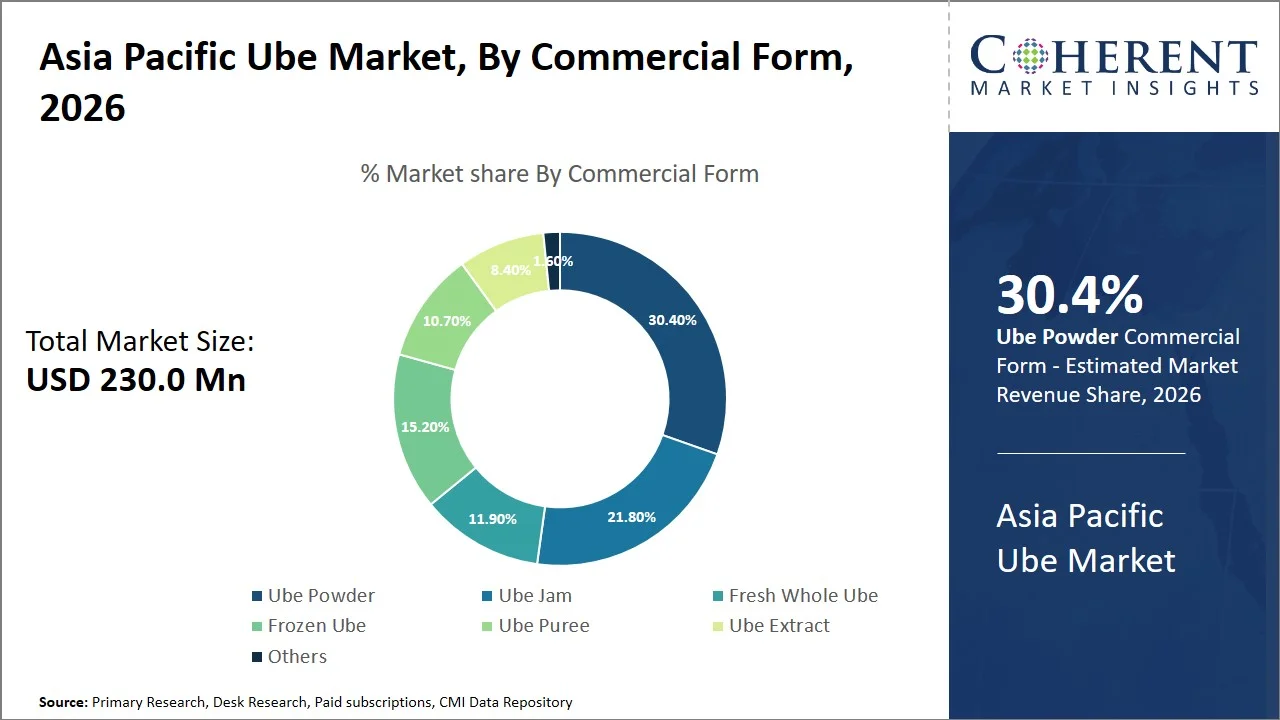
Why Does Ube Powder Dominate the Asia Pacific Ube Market?
Ube powder is estimated to dominate the Asia Pacific ube market and hold 30.4% share in 2026 due to its strong commercial utility across industrial and foodservice applications. Compared with fresh whole ube, the powder form has a longer shelf life, lower spoilage risk, and easier handling during storage, transport, and export. These advantages make it suitable for bakeries, dessert manufacturers, beverage formulators, ice cream producers, and ingredient distributors. Capacity-building programs in ube cultivation are also helping improve raw material availability, which is critical for scaling ube powder production and supporting export growth.
For instance, in the Philippines, the Agricultural Training Institute (ATI), under the Department of Agriculture, conducted a three-day “Training Course on Ube Production” from August 16–18, 2023, at ATI-RTC 02 in Malasin, San Mateo, Isabela. The training was organized for farmer-leaders in collaboration with the Department of Agriculture Regional Field Office 02 and the Bureau of Plant Industry. The Philippine Department of Trade and Industry (DTI) identified export potential for ube powder but highlighted limited raw material supply as a key challenge, which is why production-focused training was conducted to support stronger supply for processed ube products. (Source: Agricultural Training Institute (ATI))
- Current Industry Events of 2026
- Market Size Estimation
- Regional Breakdown
- Competitive Landscape
- Customer Intelligence
- Segmental Analysis
- Pricing Analysis
- Key Market Drivers, Challenges & Future Trends
- Customized Insights Section
Why Do Bakery Products Dominate the Asia Pacific Ube Market?
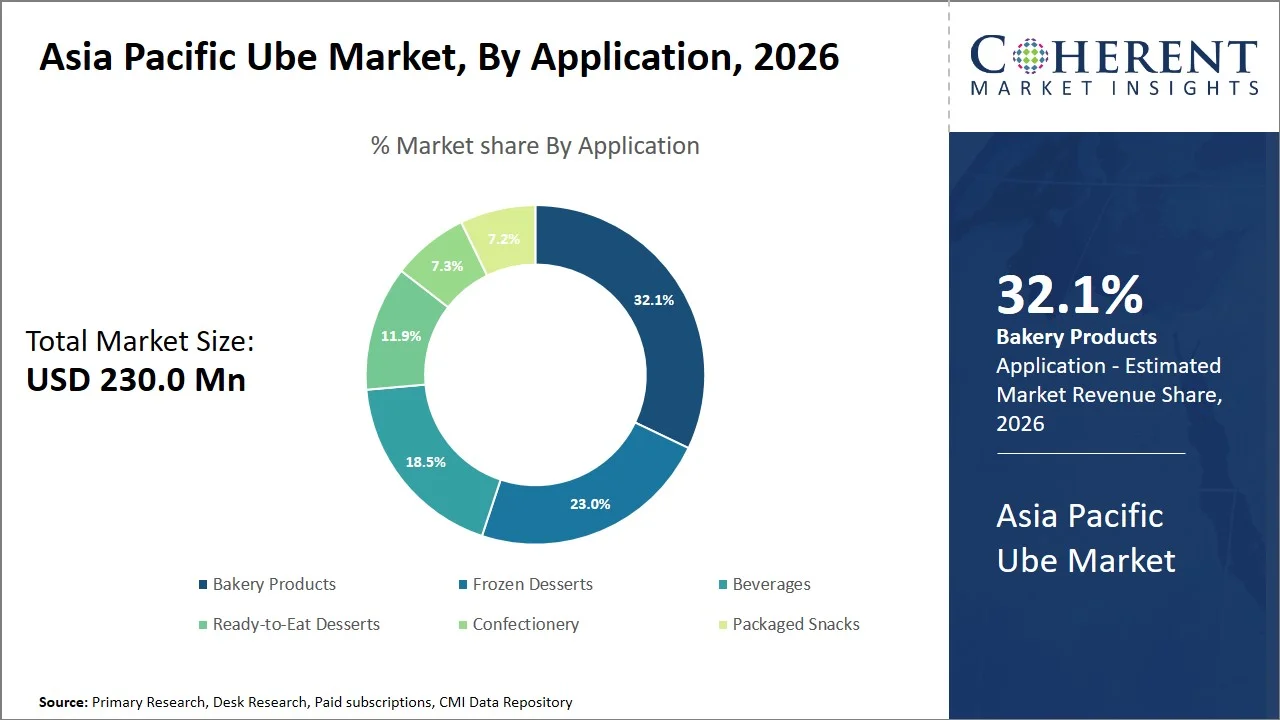
The bakery products segment is expected to occupy 32.1% market share and is likely to continue to be the highest demand segment for the Asia Pacific ube market as the ingredient is well-known for its use in Filipino desserts and bakery products. Ube is popular in cakes, pastries, rolls, sweet breads and local bakery products like puto, bibingka and ube cheese pandesal.
The segment is also bolstered by the latest bakery and café innovations. The bakery products are visually appealing due to their natural purple color and have a sweet, nutty and vanilla-like taste which is suitable for premium positioning. Bakery products using ube are likely to have a strong commercial momentum as regional consumers are seeking for culturally inspired products and one that is visually different. For example, Red Ribbon Bakeshop, a Philippines-origin bakery brand that offers multiple ube-based bakery products such as Ube Flan Cake, Ube Overload Cake, Ube Mamon, and Ube Ensaimada. Its Ube Flan Cake is described as a rich, moist ube chiffon cake topped with creamy leche flan, while the Ube Overload Cake uses real Philippine ube halaya in layered ube chiffon cake. This shows how established bakery players are using ube’s purple color, Filipino dessert identity, and sweet flavor profile to develop premium cake and pastry products. (Source: Red Ribbon Bakeshop)
Why Do Food Manufacturers Lead the Buyer Type Segment?
The food manufacturers segment is expected to contribute 38.7% of the market share in 2026 since processed ube forms are commonly used as ingredients in packaged desserts, ice cream, bakery mixes, confections, snacks, spreads and specialty beverages. Ube powder, puree, extracts and jam are preferred by manufacturers due to its ability to achieve batch consistency, formulation flexibility and year-round production.
The segment is also gaining traction in the international market, with its applications in ice creating, bakery products, confectionery, specialty drinks and ready-to-eat desserts. This boosts the ability of food manufacturers to make the most of ube as a traditional crop and transform it into a processed food ingredient of greater value. The food manufacturers segment is supported by Philippine companies already using ube in mass-market products. Selecta Philippines offers Super Thick Ube Royale Ice Cream, made with authentic Kinampay ube flavor, showing ube’s use in frozen dessert manufacturing. Gardenia Philippines sells Double Delights Ube & Cheese Loaf, a packaged bakery product combining ube and cheese for visual and taste differentiation. Lemon Square also offers Inipit Ube Keso, showing ube’s use in packaged snack cakes. These examples confirm that food manufacturers are converting ube into scalable products across ice cream, bakery, and ready-to-eat dessert categories. (Source: Gardenia Bakeries (Philippines), Inc., Lemon Square)
Currents Events and their Impact
Current Events | Description and its Impact |
Japan’s Import Compliance Requirements for Food Ingredients |
|
ASEAN Food Safety Harmonization Initiatives |
|
South Korea Strengthens Import Quarantine and Traceability Requirements |
|
Singapore’s Mandatory Nutrition Labelling Enhancement Regulations |
|
(Sources: Singapore Food Agency, Ministry of Health, Labour and Welfare, The ASEAN Food Safety Regulatory Framework (AFSRF))
Key Macro and Micro Economic Factors Impacting the Asia Pacific Ube Market
Factor | Description and Impact |
Export Growth | The Philippines’ ube exports reaching USD 3.06 Mn in 2025 reflects the growing international demand for processed ube products. This macroeconomic trend strengthens the Asia Pacific market by expanding trade flows, improving regional visibility, and encouraging investment in standardized ube production for export markets. |
Government-Led Export Promotion and Value Chain Support | DTI-led initiatives in the Philippines, including training programs, product development, packaging guidance, and export promotion, improve farm-to-export linkages and quality standards. This enhances the competitiveness of ube suppliers in Asia Pacific markets such as Japan, South Korea, and Singapore. |
Café and Foodservice Innovation | Starbucks Asia’s launch of the Crunchy Ube Oatmilk Macchiato in June 2025 exemplifies how ube adoption in premium café beverages is creating B2B and B2C demand. This microeconomic factor drives manufacturers to supply ready-to-use ube powders, syrups, and puree for foodservice applications. |
Regional Market Adoption Trends | Rising consumer demand for culturally inspired, visually distinct, and clean-label ingredients in Asia Pacific drives both domestic and international growth. Countries such as Japan, South Korea, Singapore, and Australia are high-value adoption markets due to café culture, premium dessert consumption, and interest in innovative bakery and beverage applications. |
Processed Product Availability and Standardization | Expansion of ube processing facilities, powder, puree, halaya, and extract formats in the Philippines improves supply-side readiness for regional manufacturers. This allows food producers to maintain batch consistency, scale production, and develop export-ready products across bakery, dessert, and beverage categories. |
Asia Pacific Ube Market Dynamics
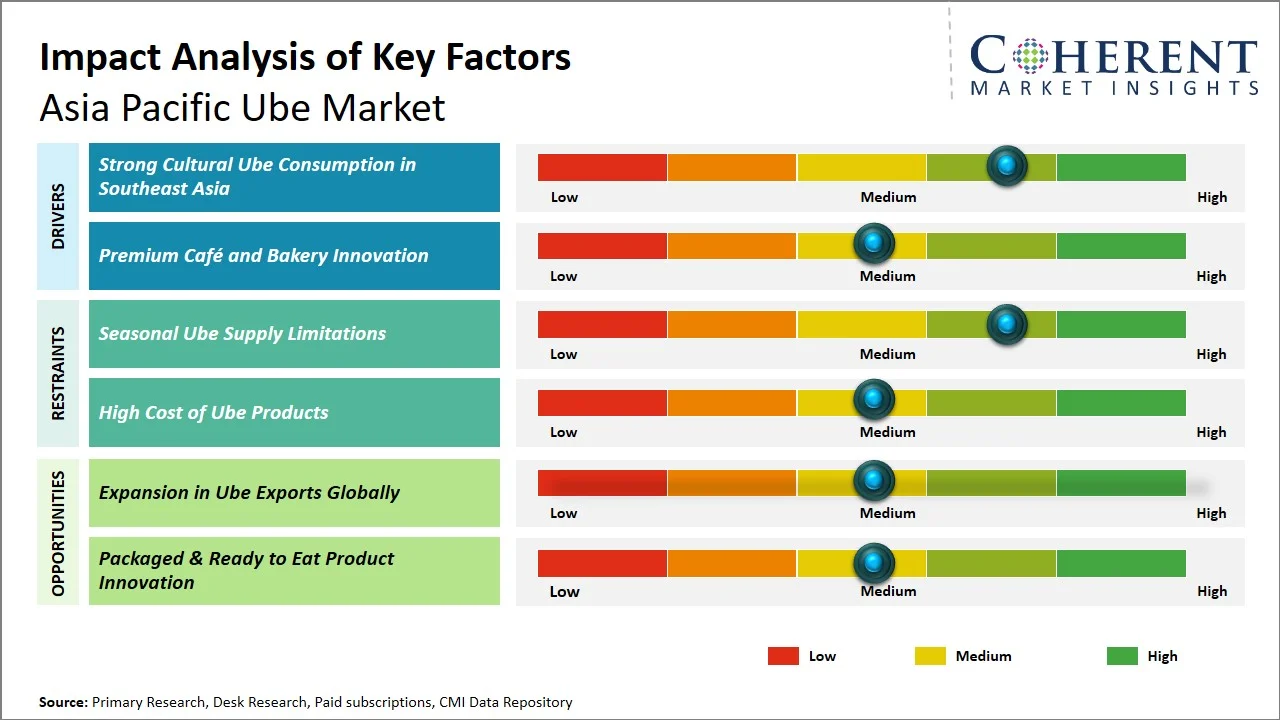
Market Drivers
- Strong Cultural Ube Consumption in Southeast Asia: Ube has strong cultural relevance in the Philippines and wider Southeast Asia, where it is widely consumed in traditional and festive desserts such as ube halaya, halo-halo, cakes, pastries, puto, ice cream, and ube cheese pandesal. This established consumption base supports repeat household demand and creates a strong foundation for commercial bakery and dessert innovation. For instance, the Philippine Information Agency (PIA) profiled Purpleyam Homemade Cakes and Pastries, a Philippines-based bakery business that opened its first outlet in 2013 specifically for customers to order and claim ube cakes. The report notes that the bakery’s ube cakes gained strong recognition and demand expanded to other Philippine cities such as Cebu, Cagayan de Oro, Iligan, and Dipolog. This supports the view that ube-based bakery products have strong commercial momentum, driven by their Filipino dessert identity, visually distinct purple appearance, and suitability for premium cake and pastry formats. (Source: The Philippine Information Agency)
- Premium Café and Bakery Innovation: Ube is increasingly being used by cafés, bakeries, dessert chains, and foodservice brands to develop premium cakes, pastries, ice creams, beverages, dessert fillings, and seasonal menu items. Its natural purple color, sweet-nutty flavor, and strong Filipino identity help brands create visually appealing, differentiated products with premium pricing potential. For example, Conti’s Bakeshop & Restaurant, a Philippines-based bakery and café chain, offers premium ube-based products such as Ube Custard, made with ube sponge cake, real purple yam, and creamy custard layers, and Ube Custard Snow, made with real ube halaya, leche flan, classic halo-halo toppings, frozen milk snow, and creamy ube sauce. This shows how established foodservice and bakery brands in Asia Pacific are using ube in premium cakes and chilled dessert formats, leveraging its natural purple color, Filipino flavor identity, and dessert compatibility to create differentiated menu offerings. (Source: Conti's Specialty Foods, Inc.)
Emerging Trends
- Ube as a Natural Food Color Ingredient: Ube is gaining importance as a naturally colorful ingredient because its strong purple shade helps food brands reduce dependence on artificial colors while improving product visibility in bakery, beverages, desserts, and frozen products. Its color appeal is especially useful in cakes, pastries, ice cream, milk tea, dessert toppings, fillings, and packaged sweets, where visual differentiation strongly influences consumer trial.
- Rising Use of Ube in Premium Bakery and Dessert Products: Ube is moving beyond traditional Filipino desserts into premium café, bakery, and dessert formats across Asia Pacific. Its sweet, nutty, vanilla-like flavor and natural purple color allow cafés and foodservice brands to create premium, fusion, and social-media-friendly products such as ube cakes, pastries, ice cream, halo-halo, milk tea, rolls, and seasonal desserts.
- Growth in Shelf-stable Ube Formats: Powder, puree, halaya, flakes, chips, and extracts are becoming more important because they are easier to store, standardize, transport, and export than fresh ube. These formats help manufacturers maintain consistent color, taste, texture, and dosage in industrial recipes, making ube more suitable for bakeries, frozen dessert producers, beverage formulators, and ingredient distributors.
How can food-processing infrastructure create scalable ube product opportunities in Asia Pacific?
The Asia Pacific ube market can benefit from government-backed food innovation infrastructure that helps MSMEs turn ube into scalable commercial products like powder, snacks, bakery fillings, instant mixes, frozen desserts, and shelf-stable ingredients. This creates opportunities for small processors to supply bakeries, cafés, hotels, supermarkets, and foodservice brands with standardized ube formats. Access to drying, vacuum frying, spray drying, retort packaging, freeze drying, food testing, packaging design, and labeling support can reduce product development barriers and improve market readiness. For instance, DOST-STII reported that DOST established its Food Processing Innovation Center in Davao to help MSMEs develop value-added agricultural food products. The facility included spray drying for better powder quality, water retort for shelf-stable food, freeze drying, vacuum packaging, and packaging/labeling support, directly supporting processed root crop and ingredient innovation. (Source: Department of Science and Technology)
Market Players, Key Development, and Competitive Intelligence
Key Developments
- In June 2025, Starbucks Asia launched the Crunchy Ube Oatmilk Macchiato across select Asia Pacific markets as part of its summer beverage lineup. The drink combined purple ube, oatmilk, espresso, and crunchy pecan crumbs, highlighting ube’s growing role in premium café beverages and seasonal menu innovation across the region.
- In June 2025, The Coffee Bean & Tea Leaf launched a seasonal Ube Coconut beverage lineup, including variants such as Ube Coconut Affogato Ice Blended Drink, Iced Ube Coconut Cream Vanilla Latte with Boba, and Iced Ube Coconut Cream Matcha Latte. This launch shows how ube is being paired with tropical flavors and café-style formats to strengthen its appeal in the specialty beverage segment.
Competitive Landscape
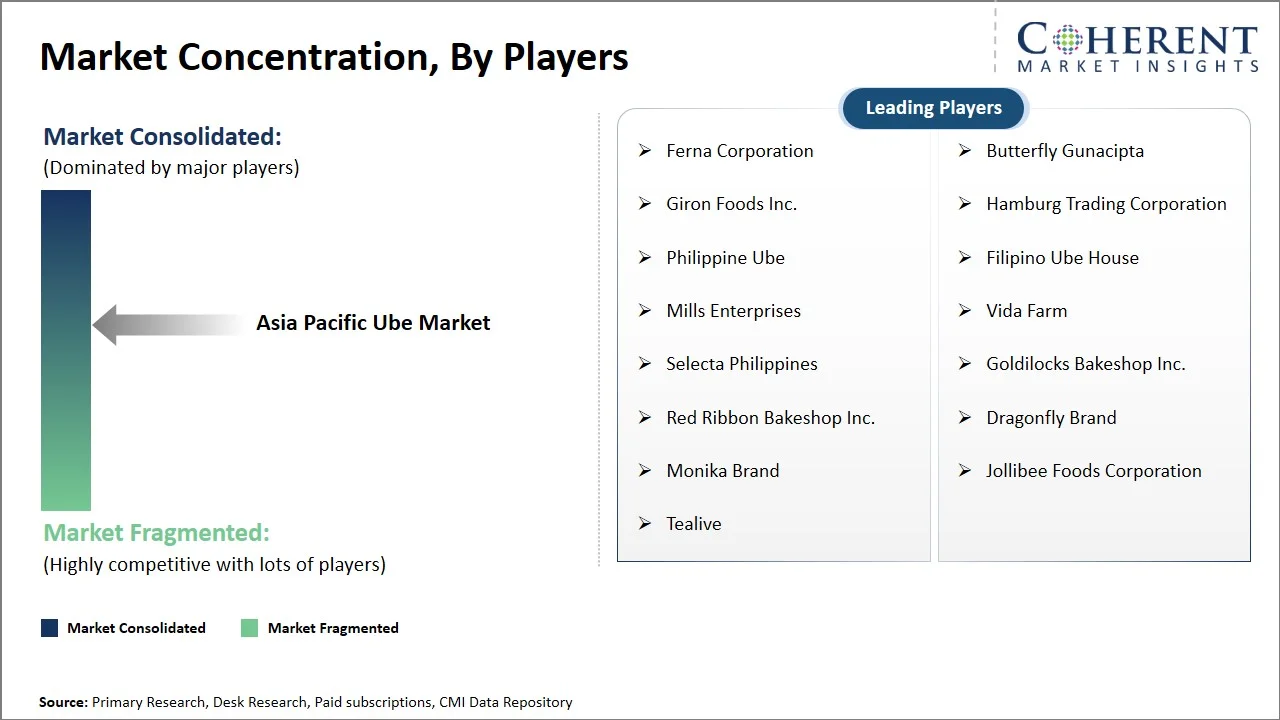
The Asia Pacific ube market is moderately fragmented and strongly origin-led, with the Philippines acting as the core supply and cultural hub, while Japan, South Korea, Singapore, Australia, and urban Southeast Asian markets are emerging as high-value consumption and innovation markets. Competition is mainly shaped by ube farmers, MSME processors, ingredient suppliers, exporters, bakery chains, dessert cafés, ice cream brands, and foodservice distributors. Local Philippine processors compete through authentic ube sourcing, powder and halaya production, and export readiness, while regional food brands focus on premium desserts, café beverages, frozen products, and packaged bakery innovations. As ube shifts from a traditional Filipino ingredient to a premium Asian flavor, companies are differentiating through product consistency, clean-label positioning, natural purple color, shelf-stable formats, and regional dessert applications.
Focus areas are:
- Processed Format Expansion: Ube powder, paste, puree, halaya, flakes, and extracts are gaining traction for bakery, ice cream, beverages, confectionery, and foodservice use.
- Premium Product Diversification: Brands are expanding ube into cakes, pastries, sweet breads, milk tea, ice cream, frozen desserts, cookies, fillings, and packaged snacks.
- Origin-Based Differentiation: Philippine-sourced ube supports authenticity, cultural heritage, natural flavor, and premium Asian dessert positioning.
- Export and Foodservice Growth: Exporters and ingredient suppliers are targeting cafés, bakeries, dessert chains, and manufacturers seeking standardized ube ingredients.
- Quality and Certification Focus: GMP, HACCP, Halal, export compliance, and consistent processing are becoming important for institutional and international buyers.
Market Report Scope
Asia Pacific Ube Market Report Coverage
| Report Coverage | Details | ||
|---|---|---|---|
| Base Year: | 2025 | Market Size in 2026: | USD 230.0 Mn |
| Historical Data for: | 2020 To 2024 | Forecast Period: | 2026 To 2033 |
| Forecast Period 2026 to 2033 CAGR: | 6.3% | 2033 Value Projection: | USD 352.7 Mn |
| Segments covered: |
| ||
| Companies covered: | Ferna Corporation, Butterfly Gunacipta, Giron Foods Inc., Hamburg Trading Corporation, Philippine Ube, Filipino Ube House, Mills Enterprises, Vida Farm, Selecta Philippines, Goldilocks Bakeshop Inc., Red Ribbon Bakeshop Inc., Dragonfly Brand, Monika Brand, Jollibee Foods Corporation, and Tealive | ||
| Growth Drivers: |
| ||
| Restraints & Challenges: |
| ||
Analyst Opinion (Expert Opinion)
- The Asia Pacific ube market is moving from a culturally rooted niche ingredient toward a commercially scalable flavor and color platform. The next phase of growth will not depend only on traditional Filipino consumption, but on how effectively processors can convert ube into standardized, shelf-stable formats that meet the requirements of cafés, bakeries, ice cream makers, beverage chains, and packaged food companies. Ube powder and paste are likely to become the most strategic formats, as they solve key barriers around seasonality, spoilage, formulation consistency, and export handling. However, suppliers that fail to maintain color intensity, authentic flavor, and food-safety compliance may lose ground to purple sweet potato, taro, and synthetic flavor/color alternatives.
- The strongest commercial upside is expected from B2B ingredient supply rather than only finished ube desserts. Manufacturers that can position ube as a premium, clean-label, Filipino-origin ingredient for bakery mixes, frozen desserts, milk tea bases, dessert fillings, and café beverages are likely to capture higher margins. Japan, South Korea, Singapore, Australia, and urban India may act as higher-value adoption markets, while the Philippines will remain the key cultural and supply anchor. Companies should prioritize export-ready ube powder, certified processing, and partnerships with bakery chains, ice cream brands, and beverage operators, as these channels offer faster scalability than traditional retail-only ube products.
Speak to the analyst
Want personalized insights?
Take the findings above to one of our principal consultants, or have the report rebuilt around the segments, geographies and competitors you actually track.
Market Segmentation
- Commercial Form Insights (Revenue, USD Mn, 2021 - 2033)
- Ube Powder
- Ube Jam
- Fresh Whole Ube
- Frozen Ube
- Ube Puree
- Ube Extract
- Others
- Application Insights (Revenue, USD Mn, 2021 - 2033)
- Bakery Products
- Confectionery
- Frozen Desserts
- Beverages
- Packaged Snacks
- Ready to Eat Desserts
- Buyer Type Insights (Revenue, USD Mn, 2021 - 2033)
- Food Manufacturers
- Beverage Manufacturers
- Foodservice Operators
- Retail Consumers
- Ingredient Distributors
- Distribution Channel Insights (Revenue, USD Mn, 2021 - 2033)
- Direct Sales
- Indirect (Via Distributor)
- Key Players Insights
- Ferna Corporation
- Butterfly Gunacipta
- Giron Foods Inc.
- Hamburg Trading Corporation
- Philippine Ube
- Filipino Ube House
- Mills Enterprises
- Vida Farm
- Selecta Philippines
- Goldilocks Bakeshop Inc.
- Red Ribbon Bakeshop Inc.
- Dragonfly Brand
- Monika Brand
- Jollibee Foods Corporation
- Tealive
Sources
Primary Research Interviews
- Ube growers and farmer cooperatives
- Ube powder, puree, paste, halaya, and extract manufacturers
- Bakery product manufacturers and frozen dessert producers
- Beverage brands, café chains, and foodservice operators
- Importers, exporters, and specialty Asian food distributors
- Retail buyers from supermarkets, Asian grocery chains, and online grocery platforms
Magazines / Trade Publications
- Food Business News
- Food Navigator
- Bakery and Snacks
- Prepared Foods Magazine
- QSR Magazine
- Specialty Food Magazine
- Philippine Food and Beverage Industry publications
Journals
- Journal of Food Science and Technology
- Food Chemistry
- International Journal of Food Science
- Journal of Root Crops
- Philippine Journal of Crop Science
- Foods Journal
- Journal of Agriculture and Food Research
Associations
- Philippine Department of Trade and Industry
- Philippine Department of Agriculture
- Philippine Coconut Authority and regional agricultural offices, where relevant
- Philippine Root Crop Research and Training Center
- Specialty Food Association
- International Dairy Foods Association
- American Bakers Association
- International Foodservice Distributors Association
Public Domain Sources
- Philippine Statistics Authority
- Philippine Department of Trade and Industry export updates
- Philippine Information Agency
- Department of Agriculture, Philippines
- Bureau of Plant Industry, Philippines
- UN Comtrade Database
- FAOSTAT
- USDA Foreign Agricultural Service
- Company press releases, newsroom updates, & product portfolios
- Retail and foodservice menu listings
Proprietary Elements
- CMI Data Analytics Tool
- Proprietary CMI Existing Repository of information for last 10 years
Get access to 250+ pages report
Every segment, forecast, competitor profile and data table behind the analysis above — available for instant download.
- ESOMAR Member
- ISO 9001:2015 Certified
- D-U-N-S Registered
- GDPR & CCPA Compliant
Missing comfort of reading report in your local language? Find your preferred language:
Transform your Strategy with Exclusive Trending Reports
Frequently Asked Questions
Market size of the Asia Pacific ube market is projected to be US$ 230.0 Mn in 2026 and US$ 352.7 Mn in 2033.
The CAGR of the Asia Pacific UBE Market is projected to be 6.3% from 2026 to 2033.
Ube powder product type is expected to dominate the Asia Pacific ube market in 2026.
Cultural demand in Philippines & SEA and cafe & bakery adoption via social media are the major factors driving the growth of the Asia Pacific UBE market.
Seasonal Ube supply limitations and high cost of Ube products are the major factors hampering the growth of the Asia Pacific UBE Market.
In terms of commercial form, ube powder is estimated to dominate the market revenue share in 2026.
Ferna Corporation, Butterfly Gunacipta, Giron Foods Inc., Hamburg Trading Corporation, Philippine Ube, Filipino Ube House, Mills Enterprises, Vida Farm, Selecta Philippines, Goldilocks Bakeshop Inc., Red Ribbon Bakeshop Inc., Dragonfly Brand, Monika Brand, Jollibee Foods Corporation, and Tealive are the major players.