

Middle East Coconut Products Market Size and Share Analysis - 2026 To 2033
The Middle East coconut products market size is expected to rise from USD 1,248.1 Mn in 2026 to USD 2,184.2 Mn in 2033, growing at a compound annual growth rate (CAGR) of 7.9% during the forecast period (2026-2033). Such growth in the market can be attributed mainly to an increasing preference among consumers for organic food products, higher consumption of beverages and processed foods that use coconut products, and growing application in the cosmetics industry.
Key Takeaways from the Middle East Coconut Products Market Report
- Coconut Oil is expected to remain the dominant segment with an estimated share of 45% in 2026, driven by its extensive use in food processing, bakery applications, and cosmetics & personal care formulations. The Food and Agricultural Organization states that coconut oil ranks among the top of the most traded tropical vegetable oils in the world and enjoys heavy usage due to its functional stability and long shelf life in the processed foods and cosmetics industry.
Segmental Insights
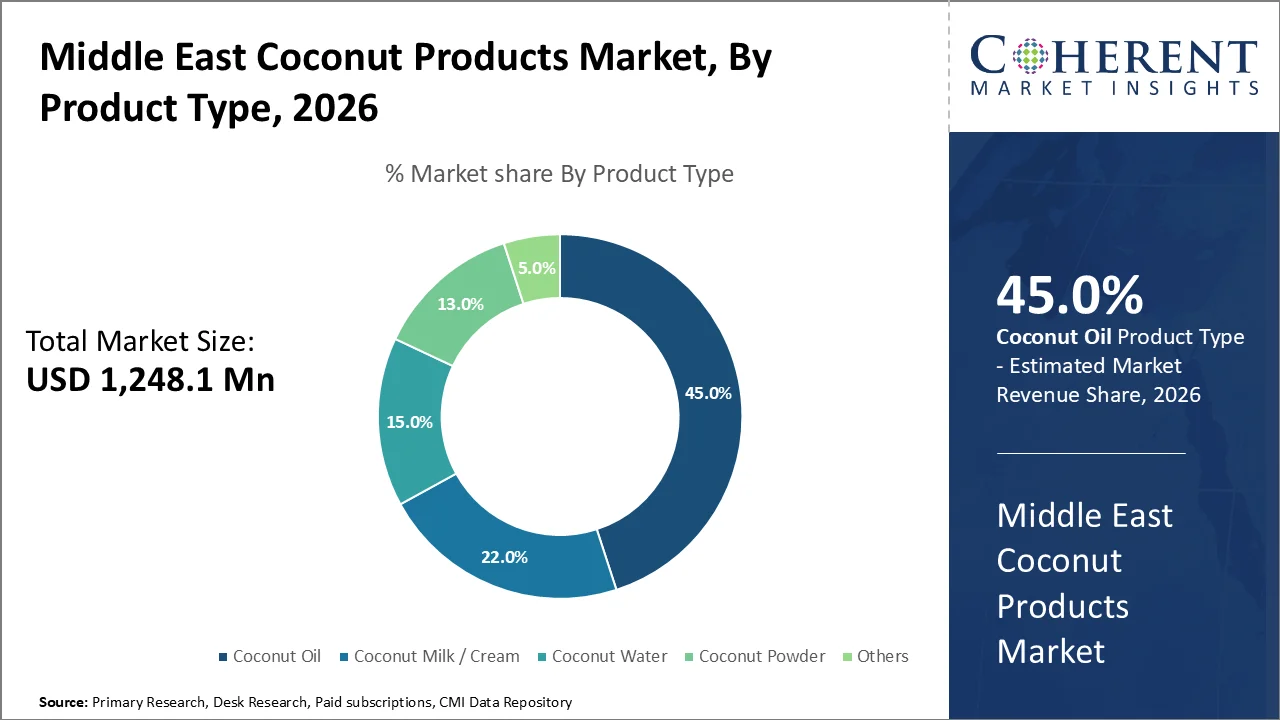
Why is Coconut Oil Acquiring the Largest Market Share in the Middle East Coconut Products Market?
Coconut oil is expected to hold the largest market share in the Middle East coconut products market in 2026, estimated to comprise almost 45% of the overall market share. The major factor responsible for this dominance is the wide application scope of coconut oil in food processing, baking, confectionery production, and cosmetics & personal care preparations.
Increased consumption of clean-label and vegetarian ingredients has further cemented the significance of coconut oil in the region. Coconut oil is extensively used as an alternative to hydrogenated oils and animal ingredients in packaged food products, along with being one of the most common base oils in skin care and hair care formulations.
The International Coconut Community (ICC) notes that coconut oil demand remains structurally strong, driven by health-conscious consumption trends and expansion of natural ingredient-based cosmetics.
- Current Industry Events of 2026
- Market Size Estimation
- Regional Breakdown
- Competitive Landscape
- Customer Intelligence
- Segmental Analysis
- Pricing Analysis
- Key Market Drivers, Challenges & Future Trends
- Customized Insights Section
Market Drivers
Rising Demand for Plant-Based and Functional Foods is Driving the Middle East Coconut Products Market
The increasing trend towards consumption of plant-based and natural label foods in the region has caused an increase in the demand for coconut products. Products such as coconut milk, coconut oil, and coconut water are increasingly being used as alternative sources of dairy in beverages, bakery, and confectionery.
As per GFI, the plant-based foods market in the MENA region is growing at a fast pace, with the double-digit annual growth rate surpassing 10%, as a result of the increasing health awareness and lactose intolerance issues among consumers.
Increasing Demand from Food Processing and Bakery Industry is Fueling Market Growth
Coconut oil and coconut milk are used extensively in various food products and bakery items because of their ability to preserve and enhance the flavors of products. Expansion in the field of food processing industries in GCC nations is leading to increased usage of coconut products.
Based on USDA FAS, there has been continued growth in food processing and consumption of packaged foods in the Gulf region, as processed food imports increase at the rate of 6–8% each year in major GCC nations because of urbanization and change in lifestyles.
Current Events and Their Impact on the Middle East Coconut Products Market
Current Event | Description and its Impact |
Rising Inflation and Food Price Volatility in Import-Dependent Gulf Economies. |
|
Global Supply Chain Disruptions in Edible Oil and Tropical Commodity Trade |
|
Middle East Coconut Products Market Trends
- Rising demand for coconut water & plant-based drinks driven by health-conscious consumers in UAE & Saudi Arabia; coconut water market growing ~8–12% CAGR in region.
- Higher use in food processing (bakery, confectionery, RTE foods) supported by expanding GCC packaged food industry and tourism-led consumption growth.
- Strong growth in coconut-based cosmetics & personal care (~5–7% CAGR) due to demand for natural, chemical-free skincare products.
- Heavy import dependence from Asia-Pacific suppliers (Indonesia, Philippines, India) as Middle East has negligible coconut cultivation; UAE acts as a key re-export hub.
- Health & wellness shift boosting dairy alternatives (coconut milk, vegan products) supported by rising diabetes & obesity concerns in GCC populations.
Middle East Coconut Products Market Outlook for Key Countries
UAE Coconut Products Analysis Market Trends
The UAE coconut products market has been experiencing consistent growth due to high levels of demand coming from the food & beverages sector, the hospitality industry, and cosmetics. Since the UAE is one of the biggest importers in the Middle East, there is very high reliance on the importation of coconut oil, coconut milk, and coconut water from Southeast Asia.
The UAE imports more than 85 to 90% of its requirement for foods consumed, which includes edible oils, as well as tropical products such as coconut oil, coconut milk, and coconut water. This reliance justifies the sustained growth in the importation of coconuts.
Dubai’s position as a global trade and re-export hub further enhances coconut product distribution across the GCC region, making it one of the most important demand centers for coconut-based ingredients in the Middle East market.
Saudi Arabia Coconut Products Analysis Market Trends
The Saudi Arabia market for coconut products is witnessing tremendous growth due to increasing consumption of natural ingredients in food along with the production of processed foods in line with the Vision 2030 policy to diversify the food portfolio. Coconut oil and coconut milk have started being used in bakery items, confectionery, and ready-to-eat foods.
Food products constitute a sizeable portion of the goods that Saudi Arabia needs to import since more than 80% of all the consumed food items are imports including edible oils, plant milk, and tropical foods such as coconut oil and milk.
Additionally, Saudi Arabia’s large-scale food import dependency ensures consistent demand for coconut derivatives, making it one of the fastest-growing markets for coconut-based ingredients in the region.
Who are the Major Companies in Middle East Coconut Products Industry
Some of the major key players in Middle East Coconut Products are Thai Coconut Public Company Ltd., Vita Coco (All Market Inc.), Coco Veda Natural Products Inc., The Coconut Company Ltd., Merit Food Products Co., Ltd., Thai Agri Foods Public Company Ltd., Linaco, Marico Ltd., Hero Nature Products Pvt Ltd., Chef’s Choice Foods Manufacturer Co. Ltd.
Key News
- In March 2026, Marico Ltd. expanded its coconut-based personal care portfolio by strengthening its Parachute coconut oil-derived product range, introducing coconut-infused formulations in the haircare segment, further extending coconut applications beyond edible oils into cosmetics and personal care industries.
- In September 2025, Thai Coconut Public Company Ltd. strengthened its sustainability initiatives by enhancing eco-friendly coconut processing and certified supply chain practices for coconut milk, cream, and coconut oil products, supporting premium export growth to international markets.
Market Report Scope
Middle East Coconut Products Market Report Coverage
| Report Coverage | Details | ||
|---|---|---|---|
| Base Year: | 2025 | Market Size in 2026: | USD 1,248.1 Mn |
| Historical Data for: | 2020 To 2024 | Forecast Period: | 2026 To 2033 |
| Forecast Period 2026 to 2033 CAGR: | 7.9% | 2033 Value Projection: | USD 2,184.2 Mn |
| Geographies covered: | Saudi Arabia, UAE, Oman, Bahrain, Kuwait, Qatar, Israel, and Rest of Middle East | ||
| Segments covered: |
| ||
| Companies covered: | Thai Coconut Public Company Ltd., Vita Coco (All Market Inc.), Coco Veda Natural Products Inc., The Coconut Company Ltd., Merit Food Products Co., Ltd., Thai Agri Foods Public Company Ltd., Linaco, Marico Ltd., Hero Nature Products Pvt Ltd., Chef’s Choice Foods Manufacturer Co. Ltd. | ||
| Growth Drivers: |
| ||
| Restraints & Challenges: |
| ||
Analyst Opinion
- The Middle East coconut products market depends highly on imports, as there are hardly any local coconuts grown in the Middle East countries. In this way, the market is vulnerable to international supply fluctuations and price fluctuations.
- Coconut oil is still the preferred choice for consumption, owing to its excellent position within food processing, bakery, and personal care products where it plays an important functional role, as opposed to being an optional one.
- The shift toward plant-based diets and clean-label ingredients is no longer considered a fad but an enduring pattern of consumer behavior in GCC nations, whereby coconut-based alternatives are taking the place of dairy and hydrogenated oils in packaged food and cosmetics.
- Rapid growth in the cosmetics and personal care sectors, especially in the UAE and Saudi Arabia, is rapidly creating an increased requirement for virgin and organic coconut oil, making it a lucrative sector of the overall market.
- However, the market is extremely susceptible to the supply cycles of coconuts worldwide, where their production largely occurs in Southeast Asia. This means that any change in weather and any limitations on exports have a direct influence on pricing and supply in the Middle East.
Speak to the analyst
Want personalized insights?
Take the findings above to one of our principal consultants, or have the report rebuilt around the segments, geographies and competitors you actually track.
Market Segmentation
- By Product Type (Revenue, USD Mn, 2021-2033)
- Coconut Powder
- Coconut Water
- Coconut Milk/ Cream
- Coconut Oil
- Others
- Region Insights (Revenue, USD Mn, 2021 - 2033)
- Saudi Arabia
- UAE
- Oman
- Bahrain
- Kuwait
- Qatar
- Israel
- Rest of Middle East
Sources
Primary Research interviews
- Interviews with food industry experts, FMCG product managers, coconut product importers, distributors, retail buyers, cosmetics and personal care manufacturers, and HoReCa (hotel, restaurant, catering) procurement managers
Databases
- International Trade Centre (ITC) Trade Map import-export database
- UN Comtrade international trade statistics database
- FAOSTAT agricultural commodities database (coconut, vegetable oils)
- World Bank commodity and macroeconomic databases
- GCC trade and customs import data portals
Magazines
- Food Business Middle East magazine
- Food Navigator Asia & Middle East coverage
- Global Food Industry and FMCG trade publications
- Cosmetics & Personal Care industry magazines (natural ingredients focus)
Journals
- Journal of Food Science and Technology
- International Journal of Food Sciences and Nutrition
- Journal of Tropical Agriculture and Food Systems
- Sustainability journals covering agricultural supply chains
Newspapers
- Gulf News (UAE)
- Arab News (Saudi Arabia)
- Financial Times (global food commodity coverage)
- Reuters commodity and agriculture news
Associations
- International Coconut Community (ICC)
- Food and Agriculture Organization (FAO)
- Gulf Cooperation Council (GCC Standardization Organization – GSO)
- World Trade Organization (WTO)
- ASEAN Coconut Industry associations (supply-side reference)
Public Domain sources
- FAO Markets and Trade Division reports
- FAOSTAT official database
- World Bank Global Economic Prospects reports
- UNCTAD maritime trade and logistics reports
- National import/export statistics from GCC ministries of trade
- Public company annual reports and investor presentations (FMCG and coconut processors)
Proprietary Elements
- CMI Data Analytics Tool
- CMI proprietary repository of coconut and FMCG market intelligence (last 8 years historical dataset)
Get access to 250+ pages report
Every segment, forecast, competitor profile and data table behind the analysis above — available for instant download.
- ESOMAR Member
- ISO 9001:2015 Certified
- D-U-N-S Registered
- GDPR & CCPA Compliant
Missing comfort of reading report in your local language? Find your preferred language:
Transform your Strategy with Exclusive Trending Reports
Frequently Asked Questions
The Middle East coconut products market is estimated to be valued at USD 1,248.1 Mn in 2026.
The Middle East coconut products market value is expected to reach USD 2,184.2 Mn by 2033.
The market is projected to grow at a CAGR of 7.9% from 2026 to 2033.
Major growth drivers include rising demand for plant-based and dairy-free food products, increasing use of coconut oil in food processing and bakery applications, and expanding applications in cosmetics and personal care industries.
The coconut oil segment dominates the market with around 45% share in 2026, driven by its widespread use in food processing, bakery, confectionery, and personal care formulations.
Some major companies in the market include Thai Coconut Public Company Ltd., Vita Coco (All Market Inc.), Coco Veda Natural Products Inc., The Coconut Company Ltd., Merit Food Products Co., Ltd., Thai Agri Foods Public Company Ltd., Linaco, Marico Ltd., Hero Nature Products Pvt Ltd., and Chef’s Choice Foods Manufacturer Co. Ltd.
The market demand is primarily driven by GCC countries such as UAE and Saudi Arabia, supported by strong import dependency and growing consumption of plant-based and processed food products.