

Baltic and Nordic Underground Chambers Market Size and Forecast – 2026-2033
The Baltic and Nordic underground chambers market is estimated to be valued at USD 389.5 Mn in 2026 and is expected to reach USD 562.8 Mn by 2033, exhibiting a compound annual growth rate (CAGR) of 5.4% from 2026 to 2033.
Key Takeaways of the Baltic and Nordic Underground Chambers Market
- The concrete segment leads the market holding an estimated share of 39.0 % in 2026.
- The sewer chambers segment dominates with a share of 36.4 % in 2026.
- The local government authorities segment leads the market holding an estimated share of 32.0 % in 2026.
Market Overview
The market is seeing the growing adoption of advanced construction technologies and sustainable practices for minimizing environmental impact. Also, the rising demand for underground spaces for data centers, secure storage, and energy facilities is propelling market expansion. Governments in the region are also putting in place supportive policies and incentives, adding to market growth and fostering innovation in design and functionality of underground chambers.
Current Events and Its Impact
Current Events | Description and its Impact |
Geopolitical and Trade Developments |
|
Economic and Industrial Trends |
|
Segmental Insights
- Current Industry Events of 2026
- Market Size Estimation
- Regional Breakdown
- Competitive Landscape
- Customer Intelligence
- Segmental Analysis
- Pricing Analysis
- Key Market Drivers, Challenges & Future Trends
- Customized Insights Section
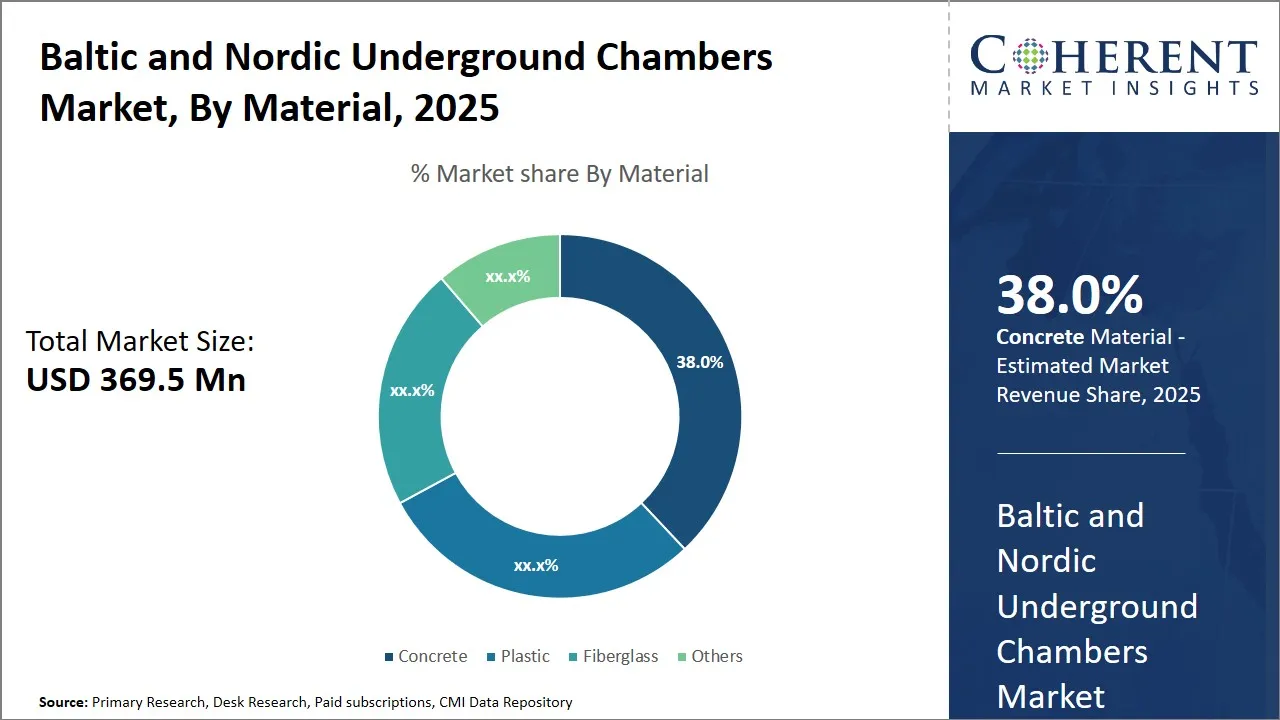
Baltic and Nordic Underground Chambers Market Insights, By Material – Concrete Lead Because of Durability and Cost-efficiency
The concrete segment is projected to account for 39.0% of the Baltic and Nordic underground chambers market share in 2026 because of its durability and cost-efficiency in challenging underground environments. Concrete is a preferred choice for underground chambers in this region because it gives structural integrity against external loads like soil pressure and vehicular traffic. The Baltic and Nordic regions see harsh climatic conditions like freezing temperatures and seasonal moisture variations, making concrete’s resistance to weathering and frost very useful. Skanska AB, one of the largest Nordic construction firms, used reinforced precast concrete underground chambers for the Stockholm Royal Seaport District infrastructure project.
Additionally, concrete is often more cost-effective than advanced synthetic materials like fiberglass or plastic when considering life-cycle costs, as it demands less frequent maintenance and replacement. Environmental sustainability also plays a big role because concrete materials can be sourced locally in the Baltic and Nordic countries, reducing transportation emissions and supporting regional economies. Concrete can easily be integrated with existing underground utility networks without any risk of corrosion or degradation adding to its preference. These factors collectively drive the robust adoption of concrete in underground chamber applications throughout the region.
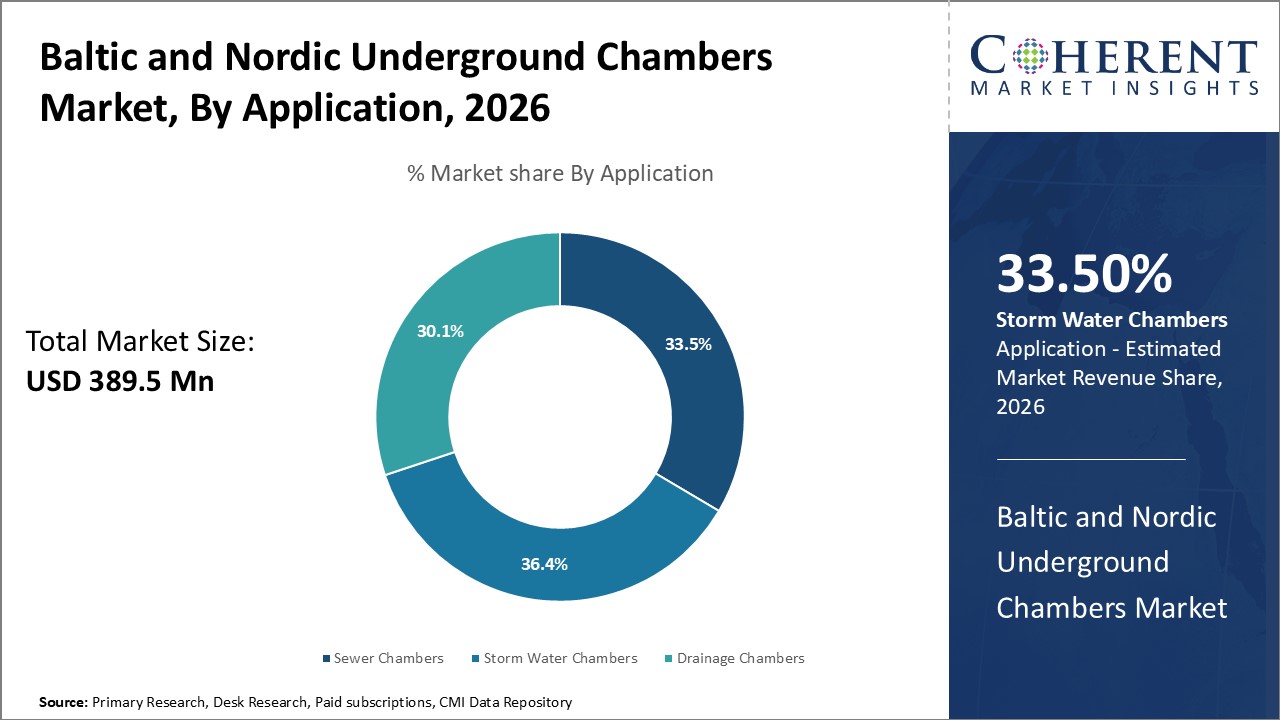
Baltic and Nordic Underground Chambers Market Insights, By Application – Sewer Chambers Lead Driven by Increasing Urbanization and Stringent Sanitation Norms
The sewer chambers segment is expected to capture 36.4% of the market share in 2026, because of the growing need for efficient wastewater management systems amid rapid urbanization and increasingly stringent environmental regulations. In urban centers throughout the Baltic and Nordic countries, aging sewer infrastructure requires upgrading to meet higher population densities and evolving sanitation standards. Sewer chambers act as nodes in these systems, allowing inspection, maintenance, and flow regulation, making them indispensable components of modern sewer networks.
The focus on environmental protection in the region has added to the investment in sewerage systems made to minimize contamination and untreated discharge into water bodies. Sewer chambers are the access points for regulating and routing sewage, very important to preventing blockages and ensuring smooth operation of wastewater conveyance networks. With governments prioritizing sustainable urban development agendas, there is a clear focus on integrating advanced and reliable underground sewer systems capable of handling variable flow loads and reducing untreated runoff.
In 2023, The Tallinn Water Utility launched a big sewerage network modernization program for replacing aging pipelines and chambers in the Estonian capital. The project includes installation of new precast concrete sewer inspection chambers and flow regulation nodes made by Wavin Baltic and Uponor Infra, made for the city’s high groundwater levels and urban expansion needs.
Also, technological advancements in sewer chamber design, like improved sealing materials and structural resilience, help withstand the pressures of increased sewage volumes and prevent infiltration that can affect water quality. Public health concerns also advocate for better sewage management, making sewer chambers a very important segment in the underground chambers market. These drivers collectively underscore why sewer chambers dominate application-wise in the Baltic and Nordic regions.
Baltic and Nordic Underground Chambers Market Insights, By End Users - Local Government Authorities Drive Demand Through Infrastructure Development and Regulatory Compliance
The local government authorities segment is projected to hold 33.0% in 2026, because they are the key stakeholders for urban infrastructure development and regulatory enforcement. These governmental bodies see the planning, funding, and maintenance of essential public utilities such as sewage, stormwater drainage, and municipal water systems, which heavily rely on underground chambers.
The growing focus on improving public infrastructure to support population growth and economic expansion in the region pushes local governments to invest highly in durable and effective underground chamber solutions. These authorities also see strict environmental and safety regulations that make necessary the installation and upkeep of compliant underground chambers to mitigate flooding, pollution, and other urban risks.
Also, decentralized governance models seen in the Baltic and Nordic countries allow local agencies to make infrastructure projects as per community-specific needs, making steady demand for underground chambers in diverse municipal applications. Public sector funding programs often support upgrades and new installations of chambers designed to enhance urban resilience against climate impacts such as increased rainfall and storm surges.
Local governments also join hands with private contractors and engineering firms to use advanced chamber materials and designs made for sustainability goals. Their pivotal role in policy implementation and asset management makes local government authorities the primary end users catalyzing growth and innovation in the underground chambers market throughout the Baltic and Nordic regions.
Pricing Analysis of the Baltic and Nordic Underground Chambers Market
Item (typical product) | Typical size/unit | Unit price (USD) | Price range (Low — High, USD) |
Precast concrete manhole ring (1500 mm) | DN1500 ring | USD 343.66 | USD 309.29 — USD 412.39 |
Aquacell/attenuation crate unit (Osma) | 1000 × 500 × 400 mm (≈0.2 m³) | USD 154.99 | USD 123.99 — USD 201.49 |
Stormwater attenuation crates (Graf-type) | per m³ (modular system) | USD 393.39 | USD 275.36 — USD 590.09 |
Plastic inspection chamber (PP) | 315 mm internal diameter unit | USD 60.00 | USD 10.00 — USD 150.00 |
GRP chamber/sump | 1.5 m diameter (variable depth) | USD 1,213.00 | USD 727.76 — USD 1,940.69 |
Precast complete manhole system (sealed) | 1200 mm complete system (base + rings + slab + cover) | USD 1,617.24 | USD 1,374.65 — USD 2,102.41 |
Large precast concrete chamber | ~2–4 m³ (DN2000 approx.) | USD 2,021.55 | USD 1,617.24 — USD 3,032.32 |
Custom engineered underground vault (data-centre/pump station) | Bespoke large unit | USD 200,000.00 | USD 50,000.00 — USD 1,000,000.00 |
Installation cost — precast manhole (per unit) | Labor + plant + backfill (urban) | USD 1,078.16 | USD 754.71 — USD 1,725.06 |
Installation cost — attenuation crates | Excavation, bedding, backfill (per m³) | USD 202.15 | USD 121.29 — USD 404.30 |
Meter chamber VC frame & cover (MCON price list) | 3-piece unit | USD 5,567.00 | USD 5,010.30 — USD 6,123.70 |
Market Players, Key Development, and Competitive Intelligence
Key Developments
- In June 2025, Wavin, a global leader in water management and building solutions, launched the next-generation Tegra 600 LC (Low Carbon) inspection chamber.
- In May 2025, Commissioner for Energy and Housing Mr. Dan Jørgensen and energy ministers of the Baltic Energy Market Interconnection Plan (BEMIP) High-Level Group signed a new Memorandum of Understanding (MoU). The parties pledged to work closely together in investing in and completing infrastructure projects and interconnections in the region.
- In January 2025, NATO launched a new military activity to strengthen the protection of critical infrastructure. “Baltic Sentry” will enhance NATO’s military presence in the Baltic Sea and improve Allies’ ability to respond to destabilizing acts.
- In February 2024, the City of Espoo became the first in Finland to introduce Uponor’s Vortex stormwater separation chamber at the Ylämaansola construction site.
Top Strategies Followed by Baltic and Nordic Underground Chambers Market Players
- Established players dominate the market through substantial investments in research and development (R&D), striving to innovate high-performance products that meet the evolving demands of customers across various industries.
- Uponor Infra actively invests in R&D for sustainable stormwater and underground chamber systems. It developed Uponor IQ Stormwater and Vortex separation chambers, used in cities like Espoo, Finland and Norrköping, Sweden.
- Mid-level players in the Baltic and Nordic underground chambers market use a different approach, focusing on delivering cost-effective solutions that give a balance between quality and affordability.
- TeraPlast Group (Romania) – Expanded polymer pipe and chamber production by acquiring Wavin Hungary’s assets (2024). This move enhances cost-efficient regional manufacturing and distribution to Baltic and Central European markets, lowering logistics and import costs.
- Small-scale players make their niche in the Baltic and Nordic underground chambers market by focusing on specialized features and highly innovative product offerings.
- Kilen Baltic specializes in custom precast and reinforced concrete chambers made for local environmental and geotechnical conditions.
Market Report Scope
Baltic and Nordic Underground Chambers Market Report Coverage
| Report Coverage | Details | ||
|---|---|---|---|
| Base Year: | 2025 | Market Size in 2026: | USD 389.5 Mn |
| Historical Data for: | 2020 To 2024 | Forecast Period: | 2026 To 2033 |
| Forecast Period 2026 to 2033 CAGR: | 5.4% | 2033 Value Projection: | USD 562.8 Mn |
| Segments covered: |
| ||
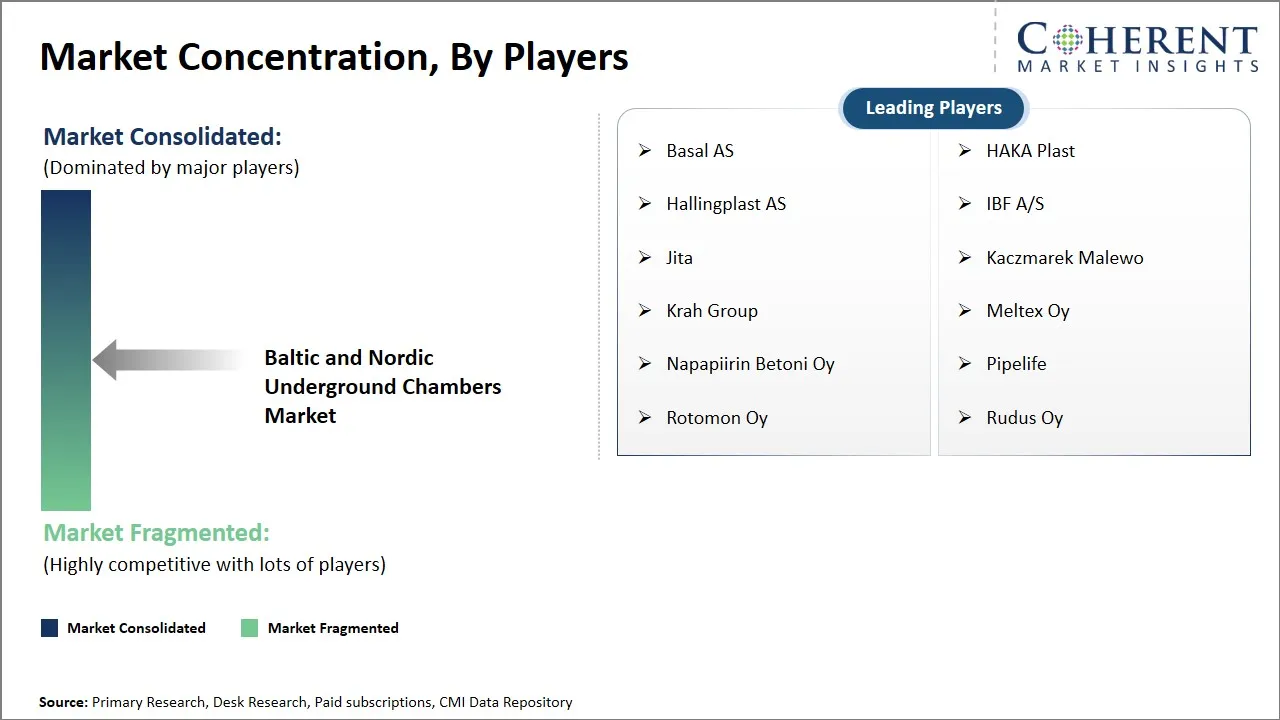
| Companies covered: | Basal AS, HAKA Plast, Hallingplast AS, IBF A/S, Jita, Kaczmarek Malewo, Krah Group, Meltex Oy, Napapiirin Betoni Oy, Pipelife, Rotomon Oy, and Rudus Oy | ||
| Growth Drivers: | Increasing investment in climate-resilient stormwater management & SuDS Offsite prefabrication trend | ||
| Restraints & Challenges: |
| ||
Market Dynamics
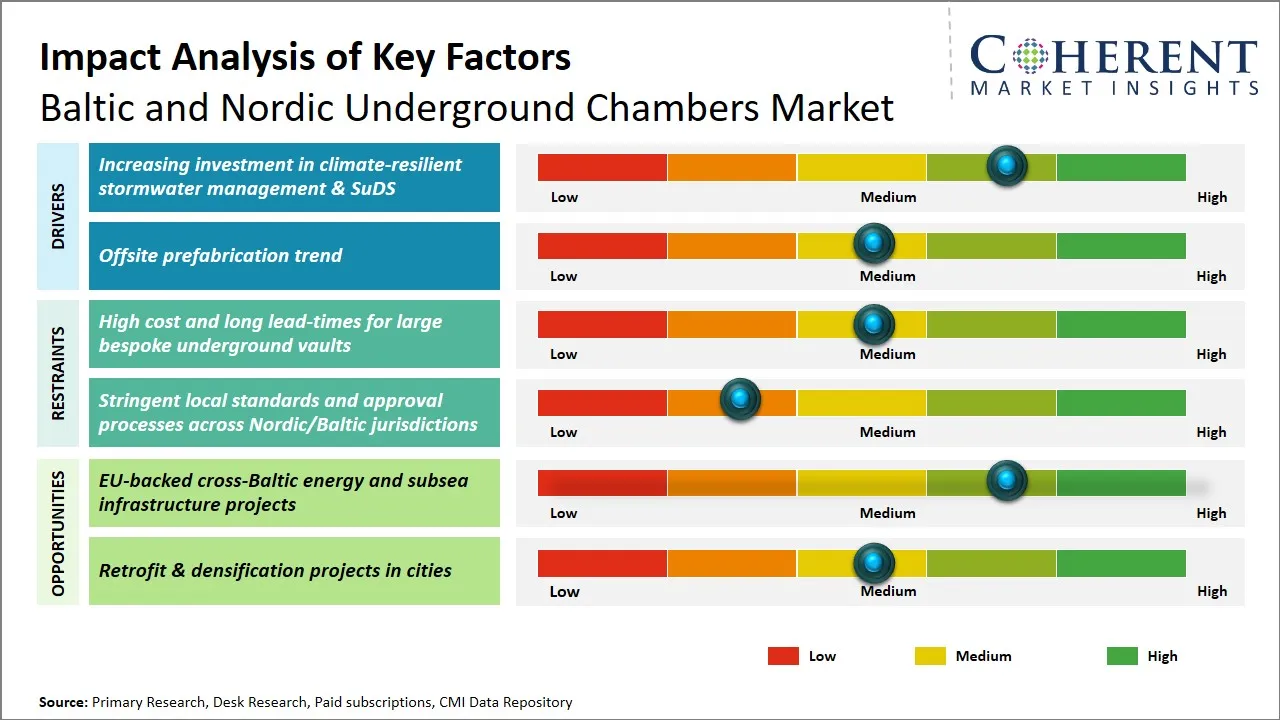
Baltic and Nordic Underground Chamber Market Driver – Increasing Investment in Climate-Resilient Stormwater Management & SuDs
The Baltic and Nordic regions are witnessing a significant uptick in investments focused on climate-resilient stormwater management solutions, driven by the urgent need to mitigate the adverse effects of increasingly unpredictable weather patterns and rising precipitation levels. Urban centers and infrastructure projects are focusing on Sustainable Drainage Systems (SuDS) and underground chambers as important components in managing runoff efficiently, reducing flood risks, and improving water quality. These regions’ proactive approach to environmental protection and adherence to strict regulatory frameworks pushes public and private sector stakeholders to move huge resources towards innovative underground water retention and infiltration systems.
Also, as urbanization grows, adding underground chambers to stormwater infrastructure becomes a practical solution to optimize limited space while improving resilience against climate change impacts. The focus on long-term sustainability, and growing environmental awareness in municipalities and developers, makes a lot of demand for advanced underground chamber technologies made for climate adaptation in the Baltic and Nordic markets.
Baltic and Nordic Underground Chamber Market Opportunity – EU-Backed Cross-Baltic Energy and Subsea Infrastructure Projects
The Baltic and Nordic underground chambers market will benefit a lot from the rise in EU-backed cross-Baltic energy and subsea infrastructure projects for improving regional energy security and integration. With the European Union's strategic focus on sustainable energy transition and reducing dependence on external energy sources, there is considerable investment in developing interconnected power grid systems, gas pipelines, and data transmission cables across the Baltic Sea region. These infrastructure projects require extensive underground chambers for housing critical equipment such as transformers, valves, switchgears, and fiber optic networks, creating a substantial demand for advanced, durable, and secure underground solutions.
Additionally, the subsea tunnels and chambers facilitate maintenance access and provide protective habitats for essential infrastructure against harsh marine and geological conditions. The growing emphasis on offshore wind energy further amplifies the need for subsea cable tunnels linking power generation sites to onshore grids, thereby fueling demand in this niche market segment. This opportunity allows companies operating in underground chambers to capitalize on the EU’s Green Deal initiatives, funding mechanisms, and cross-border collaboration frameworks that prioritize energy resilience and technological innovation.
Analyst Opinion (Expert Opinion)
- The region’s growing emphasis on climate resilience and flood mitigation is significantly boosting demand for underground stormwater detention and infiltration chambers. Nordic countries like Sweden and Finland are upgrading urban drainage networks to manage extreme rainfall events, while Baltic nations are aligning infrastructure with EU water management directives. This segment remains the primary growth driver, accounting for the largest share of underground chamber installations.
- Rapid digitalization and EU-backed broadband and 5G expansion initiatives across Estonia, Latvia, and Lithuania are driving demand for polymer-based access and inspection chambers. Telecom operators and utility providers increasingly prefer lightweight, modular plastic or composite chambers for faster deployment and reduced maintenance. This use-case is emerging as the fastest-growing demand segment in the market.
- Beyond civil infrastructure, industries such as energy, manufacturing, and defense are investing in custom-engineered underground vaults and chambers for cable management, pump stations, and critical equipment housing. With growing focus on subsea infrastructure security and energy transition projects (like the Baltic Energy Market Interconnection Plan), demand for specialized, reinforced, and corrosion-resistant chambers is rising, offering lucrative opportunities for high-margin suppliers.
Speak to the analyst
Want personalized insights?
Take the findings above to one of our principal consultants, or have the report rebuilt around the segments, geographies and competitors you actually track.
Market Segmentation
- Material Insights (Revenue, USD Mn, 2021 - 2033)
- Concrete
- Plastic
- Fiberglass
- Others
- Application Insights (Revenue, USD Mn, 2021 - 2033)
- Sewer Chambers
- Storm Water Chambers
- Drainage Chambers
- End User Insights (Revenue, USD Mn, 2021 - 2033)
- Local Government Authorities
- Business
- Residential
- Industrial
- Commercial
- Energy Sector
- Mining Sector
- Paper Industry
- Chemical Industry
- Others
- Key Players Insights
- Basal AS
- HAKA Plast
- Hallingplast AS
- IBF A/S
- Jita
- Kaczmarek Malewo
- Krah Group
- Meltex Oy
- Napapiirin Betoni Oy
- Pipelife
- Rotomon Oy
- Rudus Oy
Sources
Primary Research Interviews
Stakeholders
- Civil Infrastructure Contractors and Drainage Engineers
- Underground Chamber Manufacturers and Suppliers
- Utility and Telecom Project Planners involved in subterranean infrastructure networks
- Municipal Water Authorities and Environmental Engineering Departments in Finland, Sweden, Estonia, Latvia, and Lithuania
- Energy Project Developers and Cable Infrastructure Consultants (focusing on underground and subsea power corridors)
- Urban Resilience and Climate Adaptation Experts (focusing on stormwater and flood control systems)
Databases
- Nordic Construction Data Portal (NCDP)
- Baltic Infrastructure Statistics Bureau (BISB)
- European Water Management Observatory (EWMO)
- OECD Infrastructure Outlook Database
- Construction Global
- Eurostat
Magazines
- Nordic Construction Review
- Infrastructure Today (Europe Edition)
- Smart City Scandinavia Magazine
- Building Design + Construction (BD+C)
- Sustainable Drainage & Water Management Magazine (SDWM Europe)
Journals
- Journal of Underground Infrastructure & Geotechnical Systems (JUIGS)
- Construction and Building Materials Journal
- Automation in Construction Journal
- Journal of Civil Engineering and Urban Systems
- Journal of Building Engineering
Newspapers
- The Construction Index (U.K.)
- Construction Week Online
- The Baltic Times (Latvia)
- Nordic Daily News (Sweden)
- The Guardian (U.K.)
- The Economic Times (India)
Associations
- Nordic Water and Wastewater Association (NWWA)
- European Underground Infrastructure Association (EUIA)
- Scandinavian Civil Contractors Federation (SCCF)
- The Concrete Society (U.K.)
- American Concrete Institute (ACI)
- International Water Association (IWA)
Public Domain Sources
- EUROSTAT
- World Bank Open Data
- United Nations Economic Commission for Europe (UNECE)
- European Commission – DG Environment Reports
- Baltic Development Forum Reports
- ResearchGate (Open Access Publications)
Proprietary Elements
- CMI Data Analytics Tool, Proprietary CMI Existing Repository of information for last 8 years
Get access to 250+ pages report
Every segment, forecast, competitor profile and data table behind the analysis above — available for instant download.
- ESOMAR Member
- ISO 9001:2015 Certified
- D-U-N-S Registered
- GDPR & CCPA Compliant
Missing comfort of reading report in your local language? Find your preferred language:
Transform your Strategy with Exclusive Trending Reports
Frequently Asked Questions
The Baltic and Nordic underground chambers market is estimated to be valued at USD 389.5 million in 2026 and is expected to reach USD 562.8 million by 2033.
The CAGR of the Baltic and Nordic underground chambers market is projected to be 5.4% from 2026 to 2033.
Increasing investment in climate-resilient stormwater management & SuDS and offsite prefabrication trend are the major factors driving the growth of the Baltic and Nordic underground chambers market.
High cost and long lead-times for large bespoke underground vaults and stringent local standards and approval processes across Nordic/Baltic jurisdictions are the major factors hampering the growth of the Baltic and Nordic underground chambers market.
In terms of material, the concrete segment is estimated to dominate the market revenue share in 2026.
They are primarily used for stormwater management, wastewater inspection, telecom access, and underground utility protection.
Municipal infrastructure, utilities, telecom, and industrial sectors account for most installations.