

Global Base Station Antenna Market Size and Forecast – 2026 To 2033
The global base station antenna market is expected to grow from USD 11 Bn in 2026 to USD 19 Bn by 2033, registering a compound annual growth rate (CAGR) of 9% from 2026 to 2033. The global base station antenna market is driven by growing expansion of private 5G and industrial wireless networks. On April 1, 2026, Siemens announced that it is bringing its industrial-grade private 5G infrastructure to the U.S. and seven additional countries. The expansion is enabled by two new radio units covering the 3.8–4.2 GHz band and the U.S.-specific CBRS band, bringing the solution to a total of 15 countries across Europe and the Americas. (Source: Siemens)
Key Takeaways of the Global Base Station Antenna Market
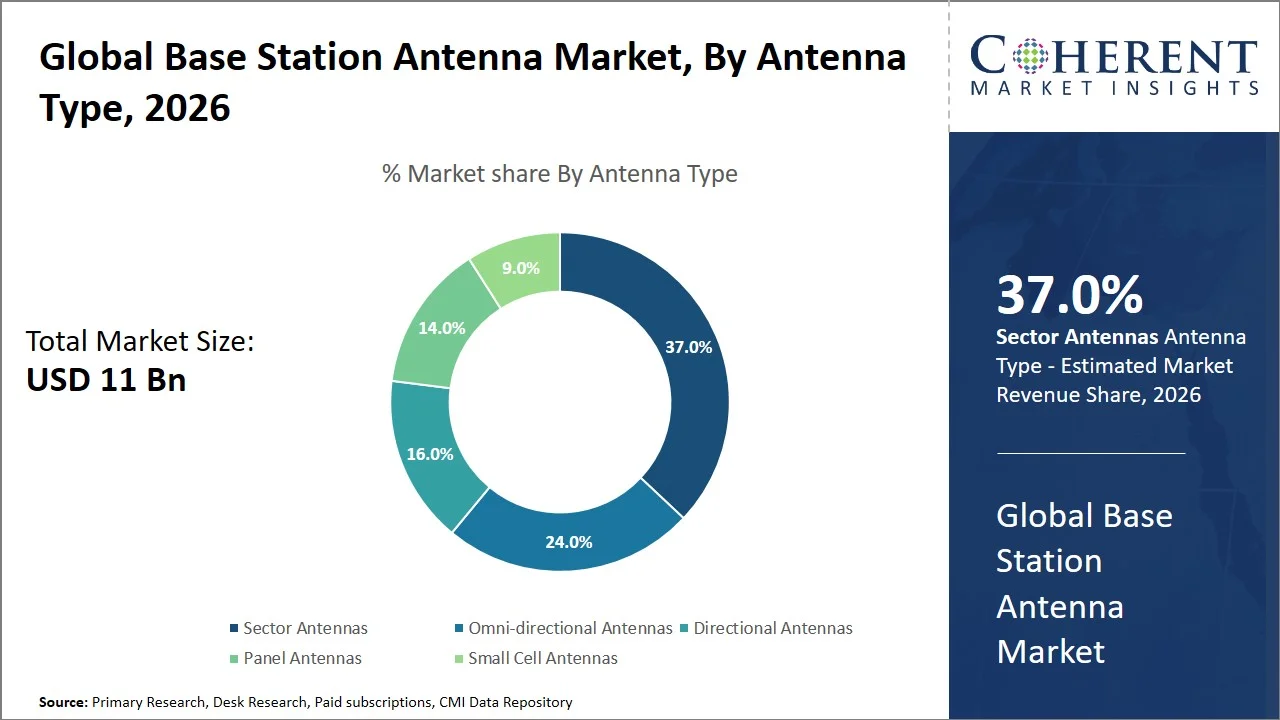
- The sector antennas segment is expected to account for 37.0 % of the global base station antenna market share in 2026. Increasing investments in telecom infrastructure modernization is driving the growth of the segment. On November 17, 2025, Nokia announced that it has been awarded a significant new three-year deal by Telecom Italia (TIM) to expand and modernize the coverage and capacity of its 5G network. (Source: Nokia)
- The 4G/LTE segment is estimated to capture 34.0 % of the market share in 2026. Rising demand for enhanced rural broadband connectivity is a major factor driving the growth of the segment. On June 10, 2026, BSNL formally inaugurated the nationwide 4G deployment based on indigenously produced technology in India, expanding coverage to tens of thousands of additional locations and bringing connectivity to underdeveloped regions.
- The mobile communication segment is estimated to capture 32.0 % of the market share in 2026. Growing mobile data traffic driven by video streaming and AI applications is driving the growth of the segment. On June 23, 2026, Nokia announced multiple upgrades to its autonomous networks portfolio, introducing a comprehensive set of agentic AI capabilities designed to help telecommunication providers simplify operations, improve network performance, and respond more effectively to increasingly complex and dynamic traffic demands.
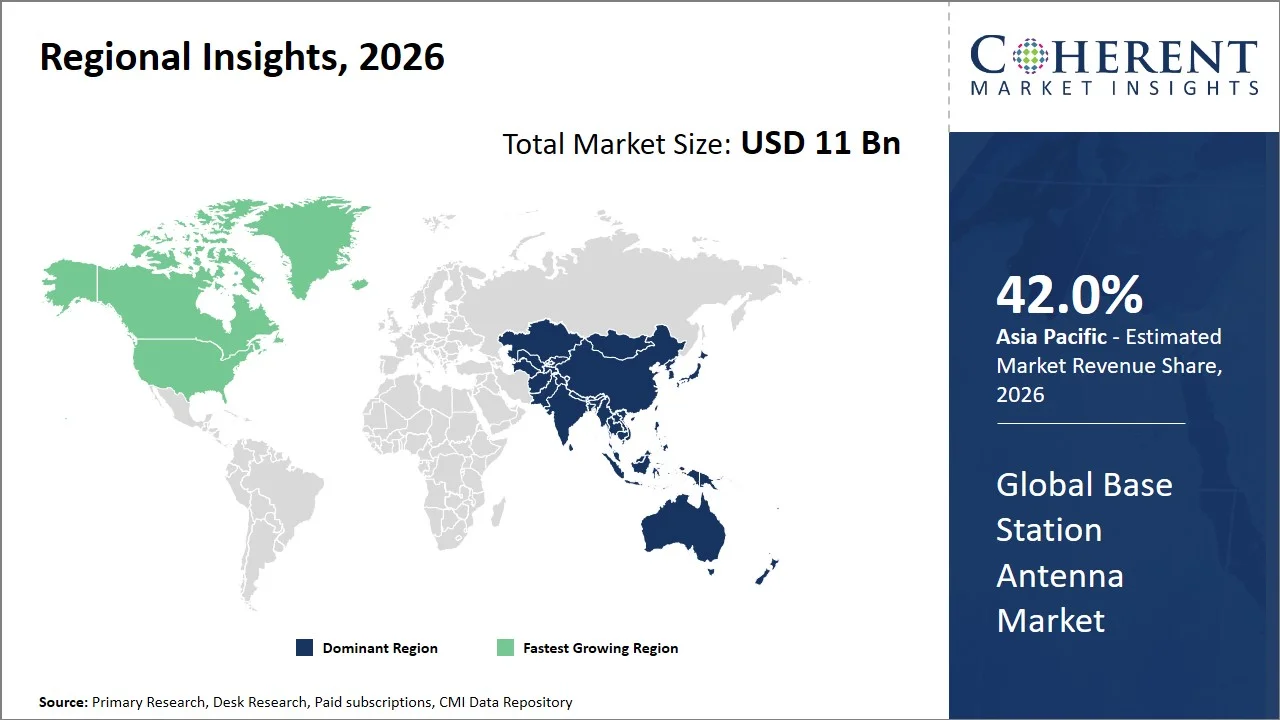
- Asia Pacific is expected to dominate the base station antenna market in 2026 with a market share of 42.0 %. Growing telecom investments across Asia Pacific is driving the growth of the regional market. On February 19, 2025, Telstra and Ericsson launched Australia’s first programmable 5G Advanced networks. The investment comprises Open RAN-ready gear, Massive MIMO radios, AI-driven network automation and capacity increases to enable future digital services and enterprise applications.
- North America is expected to account for 24.0 % share in 2026 and is projected to record the fastest growth over the forecast period. Expansion of mmWave-based fixed wireless access (FWA) in North America is driving the growth of the regional market. On September 29, 2025, Aviat Networks, Inc. announced a partnership with Intracom Telecom to deliver Fixed Wireless Access (FWA) technology that leverages the high-capacity 28 and 39 GHz millimeter wave (mmWave) bands, conforming to FCC requirements for mmWave bands intended for 5G use. (Source: Aviat Networks)
- Rapid Adoption of Massive MIMO and Active Antenna Systems (AAS): Telecom operators are rolling out Massive Multiple Input Multiple Output and Active Antenna Systems at a fast pace to improve spectral efficiency, network capacity and coverage. These sophisticated antennas are enabling multi-user beamforming and are becoming a cornerstone in 5G infrastructure expansion, particularly in highly populated urban regions.
- Growing Integration of AI-Enabled Beamforming Technologies: Base station antennae now include artificial intelligence and machine learning to improve beam steering, traffic management, and network performance in real time. Operators can utilize AI-driven antennas to reduce energy usage and to improve user experience and network dependability.
Segmental Insights
Why Do Sector Antennas Dominate the Global Base Station Antenna Market?
The sector antennas segment is expected to account for 37.0% of the global base station antenna market share in 2026. Sector antennas are more common as the antenna separates the cellular site into numerous sectors (usually 3 sectors of 120 degrees each) to provide extremely efficient coverage. This allows operators to maximize network capacity and spectrum use within a given coverage region. The sectorized architecture reduces interference and enhances signal quality and user densities and is thus well suited for modern 4G and 5G networks where increasing data traffic and capacity demands necessitate enhanced radio performance and cost-effective network growth. On February 14, 2026, MTN, in collaboration with Huawei, successfully completed the world’s first large-scale deployment of the Alpha Antenna in Ghana. This milestone represents a substantial enhancement in network performance, with the transition to intelligent and AI-driven innovation establishing a new benchmark for the evolution toward autonomous driving networks in Africa and globally.
- Current Industry Events of 2026
- Market Size Estimation
- Regional Breakdown
- Competitive Landscape
- Customer Intelligence
- Segmental Analysis
- Pricing Analysis
- Key Market Drivers, Challenges & Future Trends
- Customized Insights Section
Why is 4G/LTE the Most Preferred Technology Type?
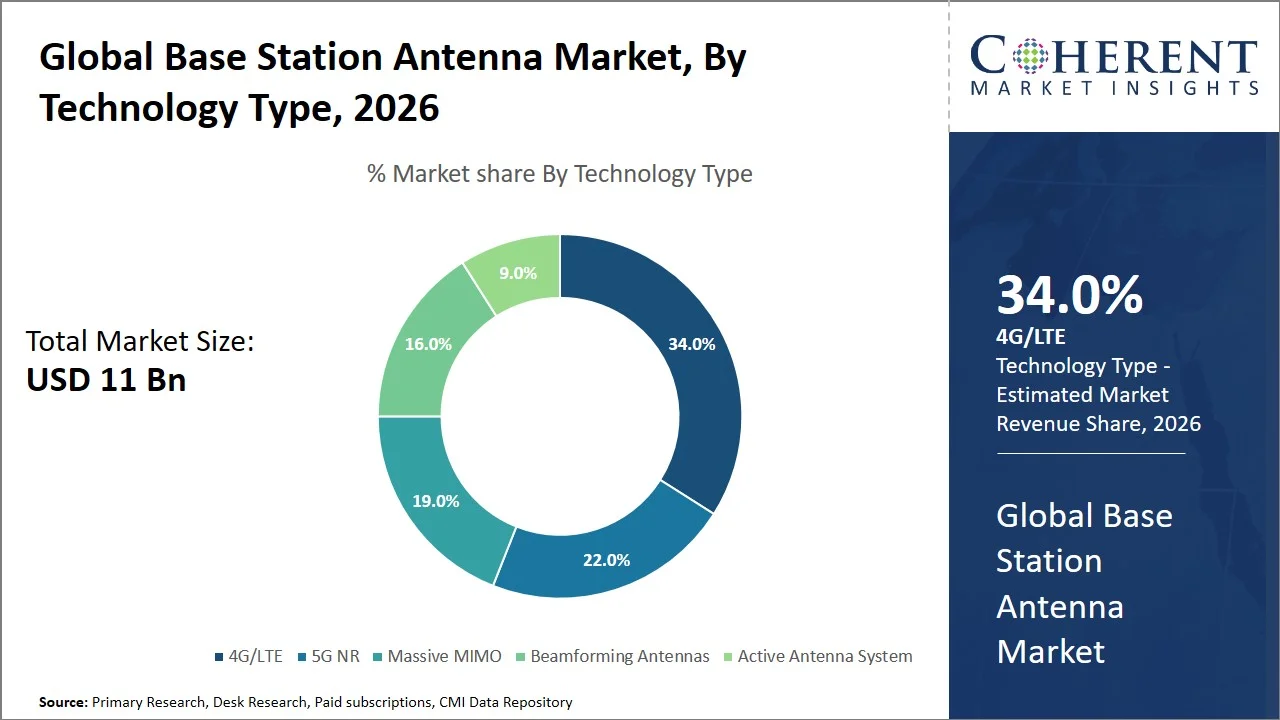
The 4G/LTE segment is expected to account for 34.0% of the global base station antenna market share in 2026. The widespread adoption of 4G/LTE can be attributed to its extensive global infrastructure footprint and highly mature ecosystem, which provide operators with a reliable, scalable, and cost-effective platform for delivering mobile broadband services. Over the past decade, telecoms carriers have poured billions into 4G/LTE networks, resulting in extensive coverage, proven durability and great compatibility with billions of connected devices throughout the world. The infrastructure allows operators to provide high-speed mobile broadband services at low cost while accommodating the growth in data traffic, making 4G/LTE a feasible and economically viable technology for both developed and emerging economies. On September, 27, 2025, BSNL unveiled its pan-India indigenous 4G network and commissioned around 97,500 4G towers built with a domestically created telecom technology stack.
Mobile Communication Dominates the Global Base Station Antenna Market
The mobile communication segment is expected to account for 32.0% of the global base station antenna market share in 2026. The healthy state of mobile communication can be attributed to the increasing use of smartphones and the growing amount of mobile data consumed globally. The growing use of mobile networks by consumers for video streaming, social media, cloud applications, online gaming and digital services continues to drive the demand for high-capacity and dependable wireless connectivity. With the growing volume of traffic and the need for better user experience, telecom providers are expanding and upgrading their networks. Investments in base station antennas for mobile communication applications are also witnessing considerable increase. On June 9, 2025, Ericsson announced that it has been awarded a multi-year NOC Managed Services (MS) contract by Bharti Airtel. Under this agreement, Ericsson will enable intent-based operations, powered by its centralized Network Operations Center (NOC), to manage Airtel services across 4G, 5G NSA, 5G SA, Fixed Wireless Access (FWA), Private Networks, and Network Slicing.
Currents Events and their Impact
Current Events | Description and its Impact |
India's Telecommunications (Framework to Notify Standards, Conformity Assessment and Certification) Rules, 2025 |
|
Canada’s Bill C-8 Cybersecurity Legislation (2026) |
|
Base Station Antenna Market Dynamics
Market Drivers
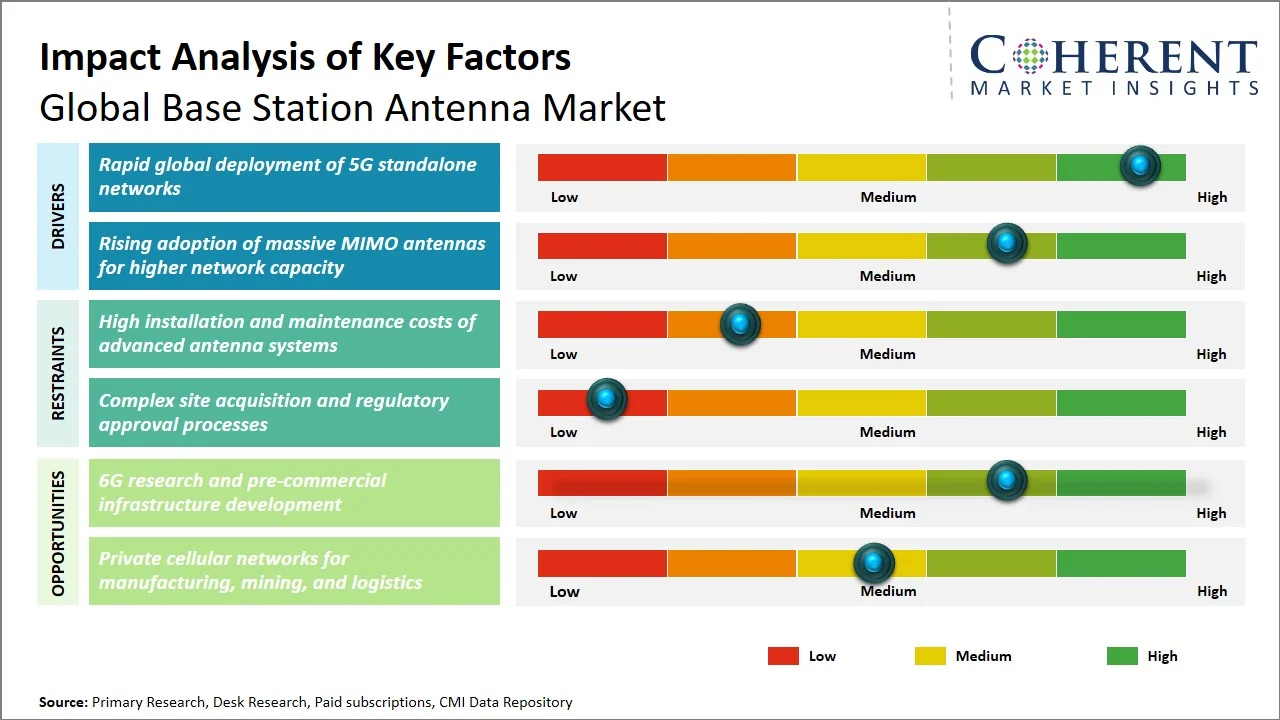
Rapid global deployment of 5G standalone networks
5G standalone (SA) networks are being rolled out rapidly around the world and this is a major driver of demand for enhanced base station antennas as operators shift from non-standalone architectures to completely independent 5G core networks. Unlike previous deployments that leveraged existing 4G infrastructure, 5G SA networks would require significant modifications to radio access equipment such as massive MIMO, beamforming and active antenna systems to enable higher speed, extremely low latency and improved network capacity. With telecom providers across North America, Europe, Asia Pacific and the Middle East accelerating nationwide 5G rollouts to support emerging applications such as industrial automation, autonomous systems and smart cities, investments in next-generation base station antenna infrastructure continue to grow.
On March 10, 2026, AT&T announced an investment and spend of more than USD 250 billion in the future of U.S. advanced connectivity, building the high-speed networks and resilience required for the next era of innovation and economic growth. (Source: AT&T)
Rising adoption of Massive MIMO antennas for higher network capacity
The growing deployment of Massive MIMO antennas is a key growth factor for the base station antenna market as telecom operators aim to expand network capacity and improve spectral efficiency amid the ever-increasing mobile data traffic. Massive MIMO technology employs huge number of antenna elements to serve numerous users concurrently by employing advanced beamforming techniques thus increasing throughput, coverage and network congestion. As 5G deployments grow globally and demand for high-bandwidth applications like video streaming, cloud services and industrial connectivity increases, operators are increasingly leaning toward investing in Massive MIMO-enabled base stations to get the most out of their network and support more connected devices.
On May 14, 2025, Vi (Vodafone Idea) announced the launch of 5G services in Delhi NCR, India in partnership with Ericsson. Vi has deployed Ericsson’s high-performing Massive MIMO radios to launch its 5G service in the capital city.
Emerging Trends
- Expansion of Open RAN (O-RAN) Compatible Antenna Solutions: The move by operators to Open RAN designs is seeing a rise in demand for interoperable, vendor-neutral antenna solutions. Operators are rapidly using O-RAN-compliant infrastructure to decrease costs of deployment, increase network flexibility and avoid vendor lock-in.
- Increasing Deployment of High-Frequency and Multi-Band Antennas: As mobile operators roll out 5G services and gear up for future 6G networks, the requirement for antennas that can operate on various frequency bands like sub-6 GHz and millimeter-wave spectrum is increasing. Multi-band antenna technologies provide more network capacity, using less tower space and reducing deployment complexity.
Regional Insights
Why is Asia Pacific a Strong Market for Base Station Antennas?
Asia Pacific is expected to account for a market share of 42.0% in 2026. The Asia Pacific region leads in base station antenna deployment, with major investments in 5G infrastructure in China, India, Japan and South Korea. Across the region, telecom operators are increasingly deploying Massive MIMO and active antenna systems to serve high mobile data demand and dense urban populations. Still, Chinese operators are expanding 5G-Advanced networks and India’s major operators are densifying networks swiftly with more macro and small-cell sites to boost coverage and capacity in metropolitan and semi-urban areas.
Moreover, growing investments in the expansion of network infrastructure is further driving the growth of the regional market. On March 30, 2026, Bharti Airtel announced an investment of USD 1 Billion by Alpha Wave Global, Carlyle and Anchorage Capital, through their affiliates, in Nxtra Data Limited, a subsidiary of Bharti Airtel engaged in the data center business, to expand its network across India and accelerate growth.
Why Does the North America Base Station Antenna Market Exhibit High Growth?
North America is projected to account for 24.0% of the global base station antenna market and is expected to register the fastest growth. North America is witnessing a broad densification of 5G networks and increased usage of improved antenna technologies for both public and private wireless networks. Major operators are adding multi-band and beamforming antennas to increase network performance in cities, stadiums, airports and industrial locations. In the U.S., operators such as Verizon and AT&T are continuing to roll out fixed wireless access services, which is maintaining the demand for high-capacity base station antennas that are able to handle higher traffic loads and wider coverage needs. In October 2025, Verizon announced plans to acquire wireless internet company Starry, which offers gigabit Internet on millimeter-wave technology in dense urban areas. The acquisition is aimed at expanding Verizon’s fixed wireless broadband capabilities and leveraging its large mmWave spectrum assets to serve apartments, condominiums and other multi-dwelling units across North America.
Global Base Station Antenna Market Outlook for Key Countries
Why is China Emerging as a Major Hub in the Base Station Antenna Market?
China is the most active country in base station antenna deployment, due to the ongoing expansion of 5G and growing 5G-Advanced infrastructure. Chinese vendors, such as Huawei and ZTE, are offering sophisticated Massive MIMO antennas to meet the needs of high-capacity applications such as smart manufacturing, industrial automation and intelligent transportation systems. Chinese telecom carriers are also incorporating AI-enhanced network optimization and superior beamforming capabilities, driving the demand for sophisticated active antenna systems in both urban and industrial contexts.
Is the U.S. the Next Growth Engine for the Base Station Antenna Market?
The U.S. continues to expand its base station antenna market through continuing 5G upgrading efforts and expanding private network deployments. Telecom operators are looking for ways to enhance network efficiency with the arrival of multi-band antennas that can support low, mid and high-band spectrum at the same time. In addition, the growth of private wireless networks in industrial plants, logistics centers, ports and energy facilities is creating further need for advanced base station antenna infrastructure intended for high reliability and low-latency communication.
Japan Base Station Antenna Market Analysis and Trends
Driving the industry in Japan are continued investments in sophisticated wireless technologies and preparedness for future 6G networks. Operators like KDDI are launching small, energy-saving antenna systems and upgrading current 5G infrastructure with improved beamforming and Massive MIMO capabilities. Japanese telecom companies are also involved in Open RAN activities, promoting interoperable antenna solutions that can function in multi-vendor network environments while meeting high-performance connectivity needs.
India Base Station Antenna Market Analysis and Trends
Operators are expanding their 5G coverage across major cities, industrial corridors and rural areas, leading to a significant surge in base station antennas deployment in India. Reliance Jio and Bharti Airtel are already rolling out massive MIMO-based antenna systems to increase network capacity and improve service quality for a vast and increasing mobile subscriber base. Growing acceptance of fixed wireless access and enterprise connectivity solutions and government backing for telecom infrastructure development are driving the installation of improved base station antennas across the country.
South Korea Base Station Antenna Market Analysis and Trends
South Korea has one of the most advanced wireless ecosystems with operators focusing on enhancing network quality by deploying high performance antenna systems. The country’s early deployment of 5G has prompted continual upgrades of Massive MIMO and active antenna technology, particularly in high-density metropolitan areas. South Korean vendors such as Samsung Electronics are also investing in next generation antenna innovations to support immersive digital services, autonomous mobility applications and future 6G research programs, further strengthening demand for advanced base station antennas.
Global Base Station Antenna Market - Base Station Antennas Installed Annually (2026)
Region | Annual Base Station Antennas Installed (Million Units) |
Asia Pacific | 12.8 |
North America | 4.6 |
Europe | 4.3 |
Latin America | 2.5 |
Africa | 2.0 |
Middle East | 2.4 |
How is 6G Research and Pre-Commercial Infrastructure Development Creating New Growth Opportunities in the Base Station Antenna Market?
The base station antenna market is expected to witness significant growth opportunities due to increased research on 6G and development of pre-commercial infrastructure, driven by growing demand for next-generation antenna technologies supporting ultra-high frequencies, intelligent beamforming, integrated sensing and communication functions, and extremely high data transmission rates. In countries such as Japan, South Korea, China, the U.S. and members of the European Union governments, research institutions and telecom companies are investing in 6G testbeds and pilot networks, which require the development and deployment of advanced antenna architectures beyond current 5G capabilities. Such efforts are prompting antenna manufacturers to innovate in areas such as terahertz-frequency antennas, reconfigurable intelligent surfaces and AI-enabled antenna systems, generating new revenue streams and long-term commercialization opportunities as the telecommunications industry prepares for future generations of wireless networks. On November 17, 2025, NTT DOCOMO, INC. announced that it has successfully conducted the world’s first outdoor demonstration using real-time transceiver systems with AI-powered wireless technology for sixth-generation (6G) mobile communications.
Market Players, Key Development, and Competitive Intelligence
Key Developments
- On March 1, 2026, Huawei unveiled a full suite of U6GHz products and solutions designed to fully unleash the potential of 5G-A and enable a smooth evolution towards 6G. This suite provides the large capacity, low latency, and premium user experience required for the emerging mobile AI era.
- On June 18, 2025, Ericsson announced the launch of two high-performance antennas, the Antenna 1005 and Antenna 1006, designed to meet the specific needs of Public Protection and Disaster Relief (PPDR) networks, providing secure and reliable coverage where it's needed most.
Competitive Landscape
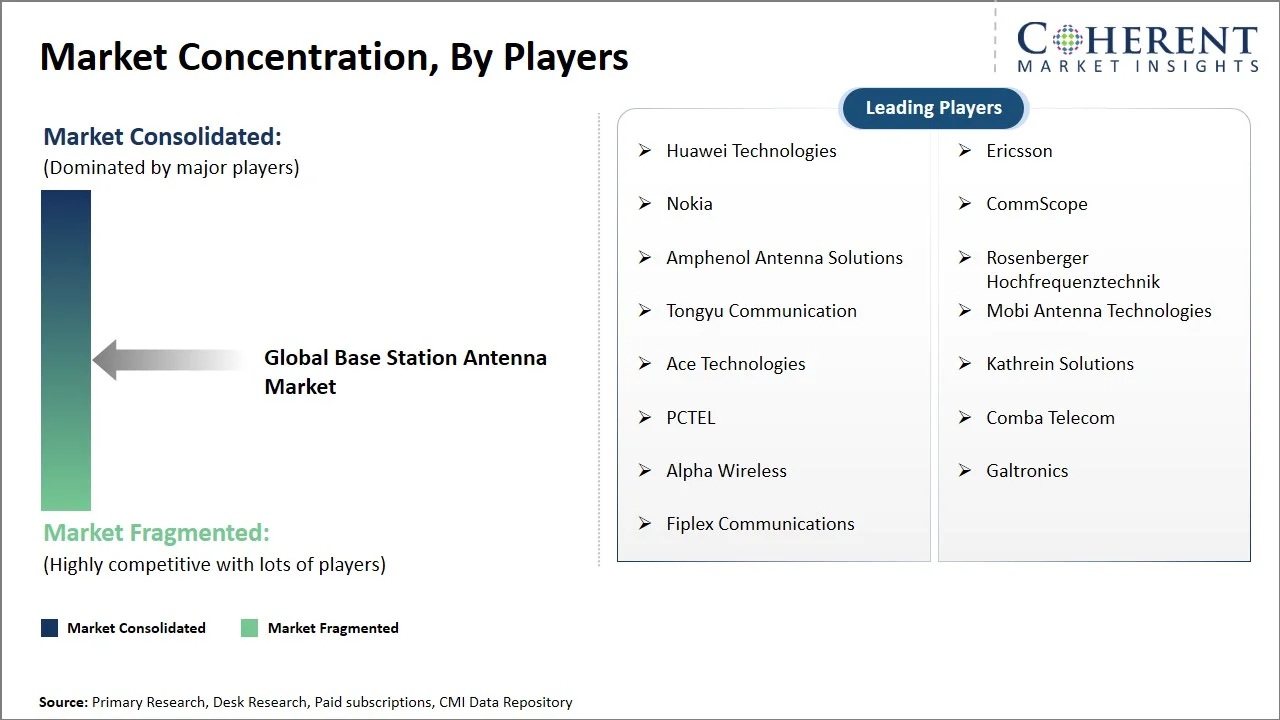
The global base station antenna industry is very competitive, with a number of established telecommunication equipment manufacturers and specialized antenna providers competing for market share. Companies like as Huawei, Ericsson, Nokia, CommScope, Amphenol Antenna Solutions, Tongyu Communication and Comba Telecom are focused on product innovation, Massive MIMO technologies, active antenna systems and multi-band antenna solutions to increase their market positions. Telecom operators, investments in Open RAN-compatible devices, and the growth of manufacturing capabilities are being rapidly embraced to fulfill the growing demand for advanced 5G and eventual 6G network infrastructure.
Market Report Scope
Base Station Antenna Market Report Coverage
| Report Coverage | Details | ||
|---|---|---|---|
| Base Year: | 2025 | Market Size in 2026: | USD 11 Bn |
| Historical Data for: | 2020 To 2024 | Forecast Period: | 2026 To 2033 |
| Forecast Period 2026 to 2033 CAGR: | 9% | 2033 Value Projection: | USD 19 Bn |
| Geographies covered: |
| ||
| Segments covered: |
| ||
| Companies covered: | Huawei Technologies, Ericsson, Nokia, CommScope, Amphenol Antenna Solutions, Rosenberger Hochfrequenztechnik, Tongyu Communication, Mobi Antenna Technologies, Ace Technologies, Kathrein Solutions, PCTEL, Comba Telecom, Alpha Wireless, Galtronics, and Fiplex Communications | ||
| Growth Drivers: |
| ||
| Restraints & Challenges: |
| ||
Analyst Opinion (Expert Opinion)
- The base station antenna market is significantly supported by the ongoing growth of 5G networks, increased mobile data usage and continued expenditures in modernizing telecommunications infrastructure. Deployment costs and regulatory requirements are likely to be manageable, with significant opportunities coming from the adoption of Massive MIMO, AI-enabled beamforming, private wireless networks and Open RAN architectures. Network operators continue to focus on capacity expansion and connection upgrades, therefore Long-term growth prospects are viewed positively.
- Ongoing technological advancements across the telecom sector as operators accelerate 5G-Advanced network deployments and prepare infrastructure for future 6G commercialization. Investment is expected to rise in intelligent antenna systems, energy-efficient network infrastructure, terahertz frequency range research and enhanced beamforming technologies to enable applications such as autonomous mobility, industrial automation, augmented reality and smart cities. As wireless communication requirements continue to grow, there are significant possibilities expected to be generated for antenna manufacturers that can supply high-performance, scalable and future-ready solutions.
Speak to the analyst
Want personalized insights?
Take the findings above to one of our principal consultants, or have the report rebuilt around the segments, geographies and competitors you actually track.
Market Segmentation
- Antenna Type Insights (Revenue, USD Billion, 2021 - 2033)
- Sector Antennas
- Omni-directional Antennas
- Directional Antennas
- Panel Antennas
- Small Cell Antennas
- Technology Type Insights (Revenue, USD Billion, 2021 - 2033)
- 4G/LTE
- 5G NR
- Massive MIMO
- Beamforming Antennas
- Active Antenna System
- Application Insights (Revenue, USD Billion, 2021 - 2033)
- Mobile Communication
- Fixed Wireless Access (FWA)
- Private Networks
- Government and Defense
- Industrial Connectivity
- Regional Insights (Revenue, USD Billion, 2021 - 2033)
- North America
- U.S.
- Canada
- Latin America
- Brazil
- Argentina
- Mexico
- Rest of Latin America
- Europe
- Germany
- U.K.
- Spain
- France
- Italy
- Russia
- Rest of Europe
- Asia Pacific
- China
- India
- Japan
- Australia
- South Korea
- ASEAN
- Rest of Asia Pacific
- Middle East
- GCC Countries
- Israel
- Rest of Middle East
- Africa
- South Africa
- North Africa
- Central Africa
- North America
- Key Players Insights
- Huawei Technologies
- Ericsson
- Nokia
- CommScope
- Amphenol Antenna Solutions
- Rosenberger Hochfrequenztechnik
- Tongyu Communication
- Mobi Antenna Technologies
- Ace Technologies
- Kathrein Solutions
- PCTEL
- Comba Telecom
- Alpha Wireless
- Galtronics
- Fiplex Communications
Sources
Primary Research Interviews
- Antenna Manufacturers & Suppliers
- Telecom Network Operators & Service Providers
- Infrastructure Equipment Vendors
- Regulatory & Standards Body Representatives
Magazines
- IEEE Spectrum
- RCR Wireless News Magazine
- Microwave Journal
- Mobile Communications International
Journals
- IEEE Transactions on Antennas and Propagation
- Journal of Electromagnetic Waves and Applications
- International Journal of Antennas and Propagation
Associations
- Global System for Mobile Communications Association (GSMA)
- Telecommunications Industry Association (TIA)
- European Telecommunications Standards Institute (ETSI)
Public Domain Sources
- International Telecommunication Union (ITU) Reports & Publications
- Federal Communications Commission (FCC) Public Filings
- 3GPP (3rd Generation Partnership Project) Technical Specifications
- World Bank ICT Development Reports
Proprietary Elements
- CMI Data Analytics Tool
- Proprietary CMI Existing Repository of Information for Last 10 Years
Get access to 250+ pages report
Every segment, forecast, competitor profile and data table behind the analysis above — available for instant download.
- ESOMAR Member
- ISO 9001:2015 Certified
- D-U-N-S Registered
- GDPR & CCPA Compliant
Missing comfort of reading report in your local language? Find your preferred language:
Transform your Strategy with Exclusive Trending Reports
Frequently Asked Questions
The global base station antenna market is expected to stand at USD 11 Bn in 2026 and is expected to reach USD 19 Bn by 2033.
The CAGR of the global base station antenna market is projected to be 9% from 2026 to 2033.
Rapid global deployment of 5G standalone networks and rising adoption of Massive MIMO antennas for higher network capacity are the major factors driving the growth of the global base station antenna market.
High installation and maintenance costs of advanced antenna systems and complex site acquisition and regulatory approval processes are the major factors hampering the growth of the global base station antenna market.
In terms of antenna type, the sector antennas segment is estimated to dominate the market revenue share in 2026.
They enable high-speed broadband connectivity without requiring physical fiber connections to end users.
Open RAN promotes interoperable network equipment, increasing the demand for vendor-neutral antenna solutions.