

Global Betel Nuts Market Size and Forecast – 2026 To 2033
The Global Betel Nuts Market is estimated to be valued at USD 11.77 Bn in 2026 and is expected to reach USD 13.71 Bn by 2033, exhibiting a compound annual growth rate (CAGR) of 2.2% from 2026 to 2033. This steady expansion reflects the continued use of betel nuts in traditional chewing, betel quid, pan masala, mouth fresheners, ceremonies, and social customs, particularly across Asia Pacific.
The market is also supported by established cultivation, processing, wholesale trading, and export networks connecting producing countries with regional and diaspora consumers. According to the Agricultural and Processed Food Products Export Development Authority (APEDA), in FY 2024–25, India exported 2,396.26 metric tons of areca nuts valued at USD 12.55 million, with the UAE, Malaysia, Sri Lanka, Maldives, Bhutan, and the U.K. among the principal destinations, demonstrating sustained cross-border commercial demand.
Key Takeaways of the Global Betel Nuts Market
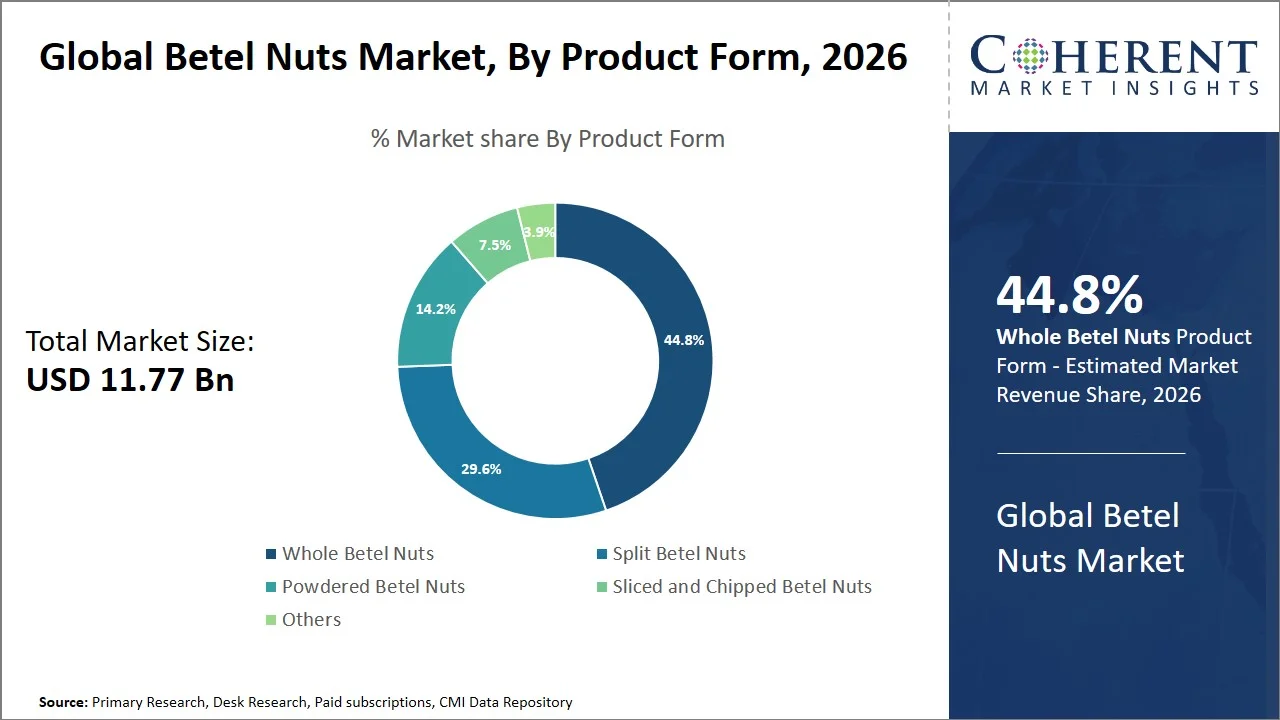
- Whole betel nuts are expected to hold 44.8 % of the global betel nuts market share in 2026 because they preserve downstream flexibility: processors can grade, split, slice, flavor, or mill them according to buyer specifications. In February 2026, India’s DGFT launched TRACE compliance support and listed fresh or dried areca nuts under eligible tariff lines, strengthening formal export readiness.
- Sun dried segment is expected to account for 45.7 % of the market share in 2026 because the method requires limited fixed investment, fits dispersed farm production, and produces durable lots suited to grading and bulk trading. In July 2026, ICAR-CPCRI’s official arecanut operations calendar instructed growers to continue harvesting and drying ripe nuts, followed by dehusking and grading.
- Betel quid and direct chewing is expected to represent 61.8 % of the market share in 2026 because consumption remains embedded in household routines, hospitality, ceremonies, and established retail purchasing across major producing countries. In October 2024, IARC reported that areca nut is consumed in betel quid or alone and documented extensive use, while underscoring material public-health and regulatory risks.
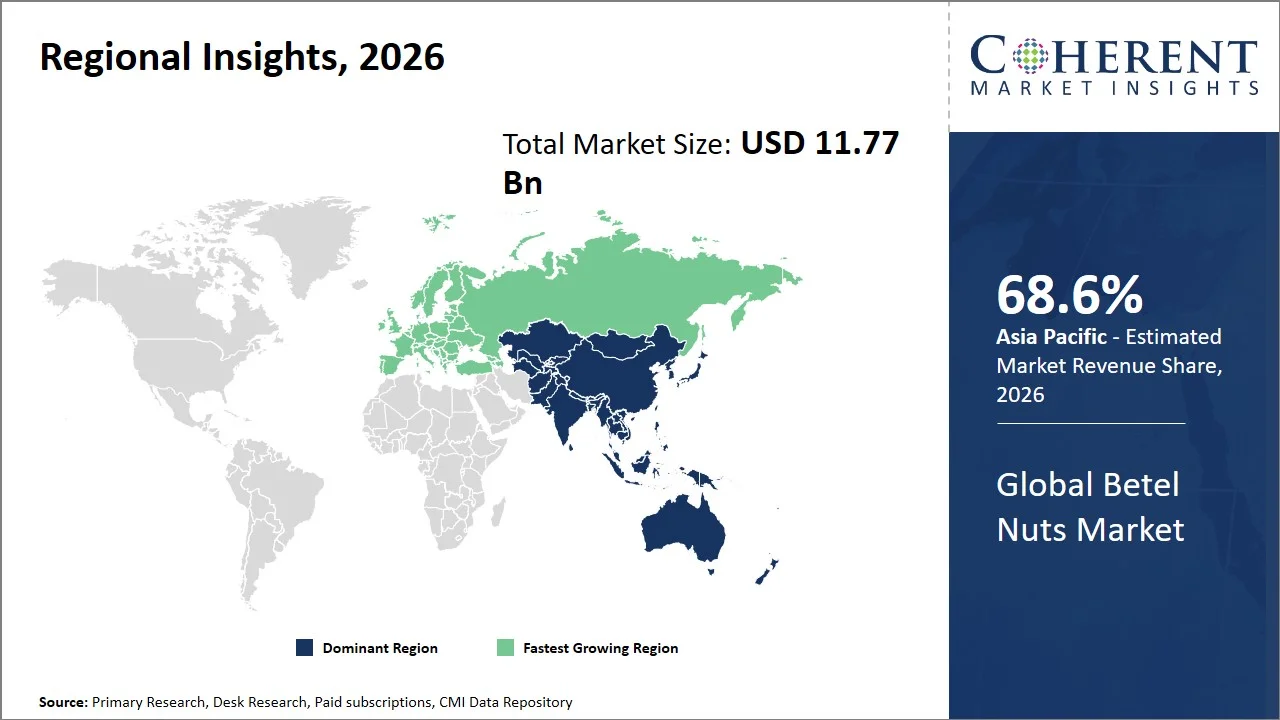
- Asia Pacific is expected to command 68.6 % of the global betel nuts market share in 2026 because cultivation, primary processing, wholesale aggregation, and end-use consumption are concentrated within the same regional value chain. In January 2025, India’s Directorate of Arecanut and Spices Development retained two multi-year arecanut projects covering health evidence and large-scale leaf-spot management demonstrations, reinforcing institutional support around production continuity.
- Europe is expected to hold 12.8 % of the market share in 2026 and emerge as the fastest-growing region as importers professionalize ethnic retail, online fulfillment, brand protection, and compliance documentation for South Asian consumer products. In January 2026, the UK Intellectual Property Office published Som Fragrances’ trademark application covering processed and scented betel nuts and pan masala, signaling structured commercial positioning.
- Quality Standardization and Traceability: The market is shifting from loosely specified commodity lots toward graded, moisture-controlled, origin-documented supply. This raises the strategic value of testing, batch identification, hygienic drying, and supplier qualification. Businesses that can demonstrate consistent nut size, curing quality, contamination controls, and dependable documentation should gain stronger processor relationships, reduce shipment disputes, and defend margins against undifferentiated traders.
- Health-Responsive Portfolio Repositioning: Public-health scrutiny is reshaping product strategy across chewing-oriented categories. Producers and brands will need clearer ingredient disclosure, responsible warnings, stronger legal review, and strict separation of tobacco-containing and tobacco-free offerings without implying that areca nut is risk-free. Investment may increasingly move toward controlled packaging, compliant specialty retail, and non-chewing extract or industrial applications that diversify exposure to traditional consumption channels.
Segmental Insights
Why Do Whole Betel Nuts Dominate the Global Betel Nuts Market?
Whole betel nuts are expected to lead the product form category, holding 44.8% of the market share in 2026. This is because they preserve maximum commercial optionality after procurement. Traders can inspect maturity, kernel integrity, color, and external defects before grading, while processors can later split, slice, chip, roast, flavor, or mill the same inventory according to customer orders. This reduces the risk of committing stock prematurely to a narrower format and supports wholesale trading, export handling, ceremonial use, and processor procurement. Whole nuts also tolerate repeated sorting and standardized bagging more effectively than fragmented material, helping suppliers serve buyers with different specifications from one raw-material pool. In January 2026, ICAR-CPCRI (Indian Council of Agricultural Research - Central Plantation Crops Research Institute) highlighted its Shatamangala arecanut variety, developed for both tender-nut processing and dry-kernel production, reinforcing the commercial importance of versatile whole-nut raw material in downstream value addition.
- Current Industry Events of 2026
- Market Size Estimation
- Regional Breakdown
- Competitive Landscape
- Customer Intelligence
- Segmental Analysis
- Pricing Analysis
- Key Market Drivers, Challenges & Future Trends
- Customized Insights Section
Why Does Sun Dried Represent the Largest Processing Type in the Global Betel Nuts Market?
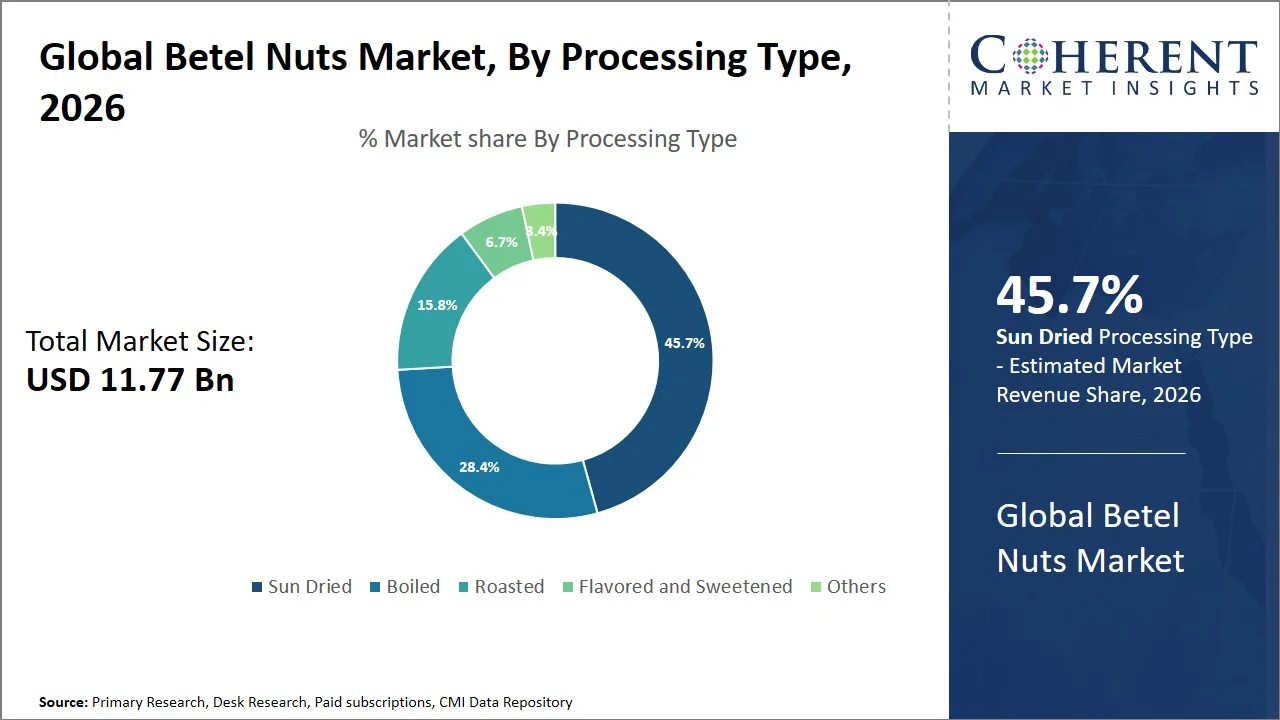
Sun dried segment is expected to represent the largest processing type category and account for 45.7% of the market share in 2026. This is because the method aligns with the economics of smallholder production and decentralized rural aggregation. Producers can cure harvested nuts without continuous fuel expenditure or large industrial equipment, while reduced moisture supports longer storage, lower transport weight, and year-round release of seasonal inventories. The resulting hard, stable kernels are suited to grading, dehusking, cutting, wholesale storage, and subsequent formulation by pan masala and mouth-freshener processors. Commercially, sun drying allows farmers and local processors to retain more post-harvest value before selling to larger traders. In August 2025, researchers published a screw-blade dehusking machine for dry areca nuts that achieved mechanized husk removal, showing how equipment development is improving downstream handling efficiency for established dried-nut supply chains.
Why Does Betel Quid and Direct Chewing Dominate the Application Category of the Global Betel Nuts Market?
Betel quid and direct chewing are expected to dominate the application category, holding 61.8% of the market share in 2026. This is because they generate frequent, consumption-led purchases rather than irregular industrial orders. Users can select whole, split, or chipped nuts and combine them with betel leaf, lime, spices, or other locally preferred ingredients, enabling strong adaptation to household customs and community-specific taste profiles. Demand is supported by paan shops, traditional markets, neighborhood retailers, ceremonies, and social sharing, giving the application a distribution reach that specialized extracts and medicinal uses cannot match. The segment also accommodates multiple price tiers, from loose commodity nuts to prepared quids. In October 2025, a multicenter study of adult Indian betel-quid users reported that two-thirds consumed betel quid daily, demonstrating the purchase frequency and habitual consumption underpinning this application’s commercial scale.
Global Betel Nuts Market Dynamics
Key Market Drivers
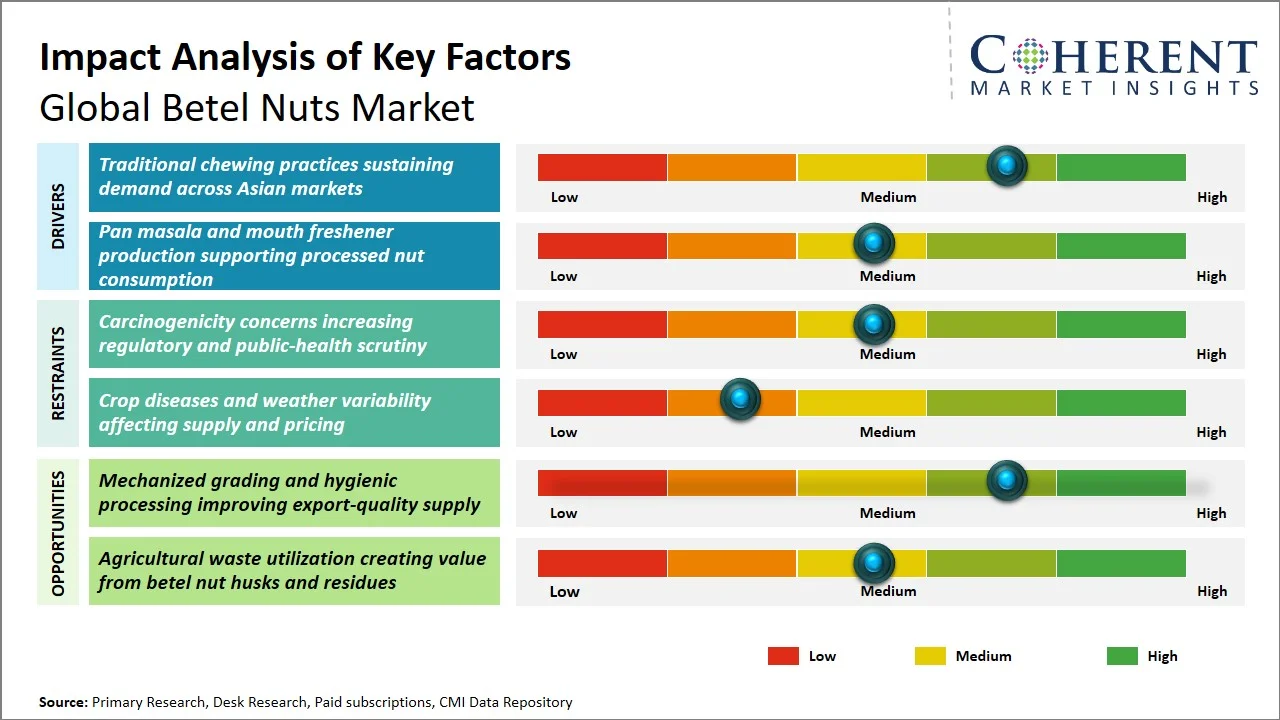
- Culturally embedded chewing practices sustain recurring consumption: Traditional chewing practices provide the global betel nuts market with a durable consumption base because purchases are linked to social hospitality, religious observance, ceremonial exchange, and habitual betel-quid preparation rather than occasional snacking. This creates recurring demand for growers, village aggregators, wholesalers, and processors supplying whole, split, and dried nuts. The commercial value lies in the frequency and cultural embeddedness of consumption, which protects core volumes even when branded formats or retail channels change. Producers that maintain regional preferences for maturity, taste, and curing are better positioned to secure repeat buyers and stable trader relationships. In August 2025, India’s Ministry of Agriculture and Farmers’ Welfare convened a high-level meeting on areca-nut development, crop disease losses, research, illegal imports, and farmer protection, demonstrating the crop’s continuing economic importance within major consuming communities.
- Pan masala and mouth-freshener manufacturing supports processed-nut procurement: Pan masala and mouth-freshener manufacturing converts betel nuts from a seasonal agricultural commodity into a continuously procured formulation input. Processors require calibrated grades for cutting, roasting, flavor absorption, blending, and pouch filling, creating demand for consistent moisture, color, texture, and particle size. These benefits organized suppliers, grading units, contract processors, flavor houses, packaging vendors, and distributors serving high-frequency general-trade outlets nationally at scale. The segment’s strategic importance comes from its ability to generate higher realization per kilogram than undifferentiated bulk sales while supporting product variation across price points. In April 2025, DS Group reported that mouth fresheners contributed 38% of its fiscal-year revenue, demonstrating the commercial scale of organized categories in which processed betel nuts and other carefully prepared formulation inputs are procured.
Emerging Market Trends
- Specification-Based Procurement is Replacing Loose-Lot Trading: Buyers increasingly require defined standards for nut size, moisture, maturity, curing, defects, contamination, and origin. Exporters and processors with grading, testing, hygienic storage, and batch documentation can reduce rejection and blending losses while securing longer contracts and premium pricing. Small traders lacking quality-control capabilities may face growing pressure.
- Health Scrutiny is Reshaping Product and Channel Strategies: Regulatory and public-health concerns are driving tobacco-free positioning, clearer labeling, smaller portions, sealed packaging, and controlled formulations. Organized retailers and digital platforms may increasingly favor compliant branded products over informal offerings. Manufacturers will need stronger legal review, tamper-evident packaging, consistent recipes, and disciplined merchandising to avoid delisting, enforcement, and reputational risks.
Current Events and their Impact
Current Event | Description and Its Impact |
DGFT Amends Areca-Nut Import Policy Conditions – October 2025 |
|
FSSAI Rejects Non-Compliant Whole Areca-Nut Consignment – February 2024 |
|
Regional Insights
Why Does Asia Pacific Dominate the Global Betel Nuts Market?
Asia Pacific is expected to account for 68.6% of the global betel nuts market in 2026, reflecting the region’s combined strength in betel nut’s cultivation, primary processing, wholesale aggregation, and traditional consumption. India, Indonesia, and Bangladesh support an integrated value chain in which whole, split, boiled, and sun-dried nuts move through established commodity networks to processors and direct-chewing channels. The region also benefits from climate suitability, experienced farm labor, dense rural trading systems, and proximity between major suppliers and end users, reducing procurement complexity. In November 2025, Indonesia’s Bapeltan Jambi reported the export of 36 tons of pinang from Jambi to Bangladesh. The shipment, handled by PT Export Tani Nusantara through Talang Duku Port, involved coordination among government authorities, farmers, agricultural quarantine, customs, and port stakeholders, demonstrating the established trade infrastructure supporting Jambi’s agricultural exports.
Why is Europe Emerging as the Fastest-Growing Region in the Global Betel Nuts Market?
Europe is expected to represent 12.8% of the global betel nuts market in 2026 and emerge as the fastest-growing region, although expansion will occur from a comparatively smaller commercial base. Growth is supported by diaspora-linked specialty retail, broader online availability, importer-led product assortment, and interest in packaged whole, split, and flavored formats. Commercial gains will favor suppliers able to provide reliable origin records, ingredient declarations, hygienic processing, and consistent batch quality, as European market access is compliance-intensive. In January 2024, the European Commission’s report on EU agri-food fraud suspicions recorded an areca-nut entry originating in India and notified within the European Union. The case highlights that future expansion will depend not only on consumer access but also on traceability, documentation, and disciplined importer controls, creating an advantage for professionally managed supply chains.
Global Betel Nuts Market Outlook for Key Countries
Why is Indonesia a Key Market for the Global Betel Nuts Market?
Indonesia is a key country in the global betel nuts market because it combines a substantial primary-supply base with export-oriented trading capabilities. Production clusters, particularly across Sumatra, enable aggregators to procure whole and sun-dried nuts from dispersed growers and consolidate them for grading, bagging, and overseas shipment. This structure supports competitive sourcing for processors seeking bulk raw material rather than finished consumer products. Indonesia’s strategic relevance also lies in its ability to serve multiple Asian destination markets and adjust export volumes according to crop availability and buyer specifications. In June 2026, Indonesia’s Ministry of Agriculture reported that primary pinang exports totaled 52,771 tons during January–April 2026, including 17,293 tons in April. The data confirms that Indonesia remains an active high-volume trade origin, making exporter reliability, moisture management, and consistent quality grading central competitive factors.
Why is Bangladesh Important in the Global Betel Nuts Market?
Bangladesh is important in the global betel nuts market because domestic cultivation and direct consumption are closely connected through village markets, district wholesalers, and urban trading centers. Betel nut functions as a long-duration cash crop for small and medium growers, while established household and ceremonial usage sustains recurring local purchases. Supply from betel producing districts can therefore serve local demand before moving to other parts of the country, limiting dependence on a single end-use channel. Attractive farm economics also encourage orchard maintenance and gradual acreage expansion where climatic conditions are favorable. In October 2025, Bangladesh Sangbad Sangstha reported that Lakshmipur had about 7,360 hectares under betel-nut gardens and targeted roughly 20,500 metric tons of output, with the district agriculture department valuing production at around Taka 1,000 crore. This production-commercialization link strengthens Bangladesh’s market depth.
Why Does Kenya Support Growth in the Global Betel Nuts Market?
Kenya supports selective growth in the global betel nuts market primarily as an import, distribution, and regional trade market rather than as a leading production center. Specialty wholesalers can aggregate demand from culturally aligned consumer groups and supply permitted products through formal retail and commodity channels. Kenya’s location within the East African Community also gives importers access to a broader regional customer base, making customs classification, landed-cost control, and distributor reach more important than plantation scale. The KRA-hosted East African Community provisional tariff-concession schedule for the African Continental Free Trade Area explicitly lists areca nuts as a classified product and sets out a staged tariff pathway. This formal treatment provides traders with a clearer framework for cross-border costing and sourcing. Growth prospects will remain niche and compliance-sensitive, favoring transparent importers that can document origin, product form, labeling, and lawful distribution.
Why is India a Strategic Country in the Global Betel Nuts Market?
India is a strategic country in the global betel nuts market because it combines large-scale cultivation, entrenched direct-chewing traditions, extensive pan and mouth-freshener processing, and one of the market’s deepest wholesale networks. Demand spans whole nuts for ceremonies and household use, split and sliced material for processors, and graded inputs for branded products. Diverse producing belts also allow buyers to source multiple qualities and processing types, although crop variability and informal trading can affect consistency. Investment in localized processing can improve farmer realization, reduce raw-material movement, and support standardized output. In January 2026, the Government of Mizoram announced the inauguration of SSB Agro’s arecanut processing unit at Buhchangphai, supported by a procurement and supply arrangement with the Mizoram Agriculture Marketing Cooperative Society. The development demonstrates India’s shift toward organized aggregation, local value addition, and stronger producer-to-processor linkages.
Why is the UAE an Important Growth Market for the Global Betel Nuts Market?
The UAE is an important growth market for the global betel nuts market because its commercial relevance is centered on import logistics, specialty distribution, and access to wider Gulf consumer networks. Domestic agricultural production is limited, so opportunity depends on efficient sourcing from South and Southeast Asia, compliant customs clearance, and distributor relationships serving permitted ethnic-food and traditional-product channels. The market is best suited to clearly labeled, traceable, packaged products rather than loosely documented commodity flows. The UAE’s official unified customs tariff classifies areca nuts under HS code 08028000 and applies a 5% customs duty. This explicit classification gives importers a defined basis for landed-cost calculations and supplier negotiations. Future positioning will favor businesses that combine reliable documentation, controlled packaging, and regulatory review with inventory models capable of serving relatively concentrated, demand-specific customer segments across the Emirates and neighboring Gulf markets.
Technology Adoption Landscape in the Global Betel Nuts Market
Technology | Adoption Level | Key Application Area | Business Impact |
Mechanized Dehusking and Calibrated Cutting | Medium | Removal of husks and production of split, sliced, or chipped nuts | Reduces manual handling, increases processing throughput, limits kernel breakage, and improves dimensional consistency for downstream processors. |
Controlled Hot-Air and Hybrid Solar Drying | Medium | Moisture reduction and curing of harvested nuts | Provides more dependable drying during humid or rainy conditions, reduces mold exposure, and supports predictable moisture specifications. |
Optical Sorting and Machine-Vision Grading | Low | Segregation by color, size, surface defects, and foreign matter | Improves grading repeatability, lowers dependence on subjective manual inspection, and enables premium pricing for uniform batches. |
Digital Moisture and Water-Activity Testing | Medium | Procurement inspection, warehouse monitoring, and batch release | Identifies spoilage risk before storage or shipment, reduces disputes between buyers and sellers, and supports documented quality assurance. |
Chromatographic and Microbial Testing Systems | Medium | Analysis of alkaloids, residues, contaminants, mold, and microbial quality | Strengthens regulatory compliance, reduces shipment-rejection risk, and allows processors to supply customers with tighter technical specifications. |
Vacuum and Nitrogen-Flush Barrier Packaging | Medium | Packaging of sliced, roasted, flavored, and retail-format betel nuts | Limits moisture uptake and aroma loss, extends usable shelf life, supports smaller pack sizes, and improves product consistency across distribution channels. |
How are Specification-Controlled Non-Chewing Extracts Creating New Growth Opportunities in the Global Betel Nuts Market?
An underdeveloped opportunity lies in converting lower-visual-grade but safe, traceable nuts and processing side streams into specification-controlled extracts for permitted non-chewing industrial uses. Potential customers include natural-color developers, tannin users, specialty chemical formulators, research suppliers, and selected personal-care manufacturers seeking plant-derived functional inputs. The opportunity matters because it can diversify revenue away from direct chewing applications and create value from material that lacks premium appearance but still meets chemical and contaminant requirements. Commercial capture will require selective extraction, arecoline profiling and reduction where technically necessary, solvent-recovery systems, validated analytical methods, and customer-specific performance testing. Suppliers should avoid broad wellness claims and instead sell against measurable parameters such as tannin content, color strength, purity, and process compatibility. Established processors with dependable feedstock and quality laboratories are likely to hold an advantage, although specialist extraction companies can enter through toll processing and application partnerships. Success will depend on regulatory classification, safe handling, effluent management, and the ability to deliver consistent batches at industrial scale.
Market Players, Key Development, and Competitive Landscape

Key Developments
- In January 2026, SSB Agro inaugurated an areca-nut processing unit at Buhchangphai in Mizoram, India and established a procurement arrangement with the Mizoram Areca Nut Marketing Cooperative Society. This is important for the global betel nuts market because it expands local value addition, provides a more structured farmer-offtake route, and reduces dependence on selling unprocessed nuts through distant intermediaries.
- In January 2026, CAMPCO participated in Gulfood Dubai as part of India’s agricultural and food-export delegation. This is important for the global betel nuts market because international trade exhibitions provide cooperative suppliers with access to importers, distributors, private-label customers, and institutional buyers, supporting export-market diversification and commercial positioning for processed areca-nut products.
- In June 2024, Aayush Wellness launched a tobacco-free and supari-free herbal alternative designed to reproduce familiar pan-masala and gutka sensory characteristics. This is important for the global betel nuts market because it represents direct substitution pressure on areca-based chewing formats and may compel established processors to reassess product portfolios, consumer-retention strategies, regulatory exposure, and investment in differentiated mouth-freshener offerings.
Competitive Landscape
The global betel nuts market is fragmented across cultivation, village aggregation, and commodity trading, while greater organization is visible among cooperatives, export houses, large processors, and branded chewing-product manufacturers. Competition is not determined by farm-gate pricing alone. Industrial buyers also assess maturity, moisture consistency, curing quality, defect levels, supply continuity, processing flexibility, and contaminant-control documentation. Regional traders retain influence through farmer relationships and rapid working-capital deployment, whereas specialist processors create differentiation through grading, cutting, roasting, flavoring, packaging, and private-label execution. Regulatory exposure increasingly favors participants capable of demonstrating traceable procurement and legal channel compliance.
Key focus areas include
- Raw-material quality: Consistent maturity, kernel integrity, color, and moisture levels reduce processing losses and strengthen buyer retention.
- Procurement reach: Direct farmer and cooperative relationships improve seasonal access and reduce dependence on multiple intermediary layers.
- Working-capital capability: Traders that can purchase and store harvest volumes promptly have greater negotiating power during seasonal supply peaks.
- Processing customization: Flexible cutting, roasting, flavoring, and blending capabilities help suppliers meet processor- and market-specific requirements.
- Quality assurance: Laboratory testing, batch records, hygienic storage, and documented inspections support entry into regulated and premium channels.
- Distribution coverage: Wholesale relationships, processor contracts, retail availability, and export partners determine how efficiently products reach fragmented demand centers.
- Supply and pricing resilience: Geographic diversification, inventory planning, and disciplined contracting reduce exposure to weather, enforcement actions, and seasonal price volatility.
Market Report Scope
Betel Nuts Market Report Coverage
| Report Coverage | Details | ||
|---|---|---|---|
| Base Year: | 2025 | Market Size in 2026: | USD 11.77 Bn |
| Historical Data for: | 2020 To 2024 | Forecast Period: | 2026 To 2033 |
| Forecast Period 2026 to 2033 CAGR: | 2.2% | 2033 Value Projection: | USD 13.71 Bn |
| Geographies covered: |
| ||
| Segments covered: |
| ||
| Companies covered: | PT Vale Agrovia Nusantara, Rezeki Mandiri Global, Areca Indonesia, PT Cool Man Global, Alma Areca, PT Jexprom Sejahtera Indonesia, PT Ruby Privatindo, ASNAFF Group, Darshan Enterprise, AKM Traders, Lingappa and Co, Kanaiya Enterprise, Triveni Betel Nut Industries, Yiwu Yulight Import and Export, and Mongla Exim Industries | ||
| Growth Drivers: |
| ||
| Restraints & Challenges: |
| ||
Analyst Opinion (Expert Opinion)
- The global betel nuts market leadership is likely to shift from control of commodity volume toward control of verified product specifications. Successful suppliers will increasingly sell procurement assurance, moisture management, processing consistency, testing documentation, and customized grades as an integrated solution. This transition should expand the margin gap between undifferentiated traders and processors capable of delivering repeatable performance to branded and export customers.
- The most consequential disruption may be a structural separation between documented, legally marketed tobacco-free products and informal chewing mixtures with uncertain composition. As retailers, digital platforms, payment providers, and regulators impose stronger product-verification requirements, businesses dependent on ambiguous labeling or mixed-product distribution could lose market access. Participants with controlled recipes, traceable inputs, and defensible channel practices will be better positioned.
- The global betel nuts market participants should prioritize moisture-controlled drying, contaminant testing, flexible cutting and roasting, supplier traceability, and diversified offtake arrangements. Partnerships with cooperatives, accredited laboratories, compliant importers, and regional distributors can create more defensible supply networks. Companies should avoid excessive investment in poorly differentiated flavored chewing products or unsupported health positioning, as regulatory scrutiny, substitute products, and raw-material price volatility may weaken returns.
Speak to the analyst
Want personalized insights?
Take the findings above to one of our principal consultants, or have the report rebuilt around the segments, geographies and competitors you actually track.
Market Segmentation
- Product Form Insights (Revenue, USD Bn, 2021 - 2033)
- Whole Betel Nuts
- Split Betel Nuts
- Powdered Betel Nuts
- Sliced and Chipped Betel Nuts
- Others
- Processing Type Insights (Revenue, USD Bn, 2021 - 2033)
- Sun Dried
- Boiled
- Roasted
- Flavored and Sweetened
- Others
- Application Insights (Revenue, USD Bn, 2021 - 2033)
- Betel Quid and Direct Chewing
- Pan Masala and Mouth Fresheners
- Traditional Medicine
- Extracts and Industrial Applications
- Others
- Distribution Channel Insights (Revenue, USD Bn, 2021 - 2033)
- Wholesale and Commodity Traders
- Direct Sales to Processors
- Retail Stores
- Online Sales
- Others
- Regional Insights (Revenue, USD Bn, 2021 - 2033)
- North America
- U.S.
- Canada
- Latin America
- Brazil
- Argentina
- Mexico
- Rest of Latin America
- Europe
- Germany
- U.K.
- Spain
- France
- Italy
- Russia
- Rest of Europe
- Asia Pacific
- China
- India
- Japan
- Australia
- South Korea
- ASEAN
- Rest of Asia Pacific
- Middle East
- GCC Countries
- Israel
- Rest of Middle East
- Africa
- South Africa
- North Africa
- Central Africa
- North America
- Key Players Insights
- PT Vale Agrovia Nusantara
- Rezeki Mandiri Global
- Areca Indonesia
- PT Cool Man Global
- Alma Areca
- PT Jexprom Sejahtera Indonesia
- PT Ruby Privatindo
- ASNAFF Group
- Darshan Enterprise
- AKM Traders
- Lingappa and Co
- Kanaiya Enterprise
- Triveni Betel Nut Industries
- Yiwu Yulight Import and Export
- Mongla Exim Industries
Sources
Primary Research Interviews
- Betel nut growers, cooperatives, processors, traders, exporters, importers, distributors, and branded product manufacturers
- Procurement, production, quality, regulatory, logistics, marketing, and sales executives
Stakeholders
- Whole, split, sliced, powdered, dried, boiled, roasted, and flavored betel nut processors
- Pan masala, supari, betel quid, mouth-freshener, herbal medicine, and extract manufacturers
- Wholesalers, paan shops, traditional retailers, supermarkets, online platforms, packaging suppliers, laboratories, and logistics providers
End-use Sectors
- Betel quid and direct chewing
- Pan masala, flavored supari, and mouth fresheners
- Traditional medicine, botanical extracts, tannins, and industrial applications
- Household, ceremonial, religious, hospitality, and retail consumption
Regulatory and Government Bodies
- FSSAI, DGFT, APEDA, Indian Customs, Ministry of Agriculture and ICAR-CPCRI
- Bangladesh Food Safety Authority, Indonesia BPOM, Sri Lanka Customs, Kenya Bureau of Standards, and UAE food authorities
- European Commission, UK FSA, WHO, and IARC
Databases
- UN Comtrade, ITC Trade Map, WTO Statistics, FAOSTAT, World Bank, and Eurostat
- India DGCI&S, APEDA AgriExchange, national customs databases, company filings, auction prices, retail listings, and trade databases
Journals and Industry Publications
- Journal of Plantation Crops, Indian Journal of Agricultural Sciences, Food Chemistry, Food Control, Oral Diseases, Tobacco Control, and International Journal of Cancer
Associations and Cooperatives
- CAMPCO, farmer producer organizations, areca-nut grower cooperatives, commodity trader associations, FIEO, agricultural universities, and food-processing associations
Public Domain Sources
- Government production, cultivation, yield, price, import, export, customs, and food-safety records
- Company reports, cooperative publications, product catalogues, labels, certifications, processing specifications, and press releases
- Wholesale markets, traditional retailers, supermarkets, distributors, and online marketplace listings
Proprietary Elements
- CMI Data Analytics Tool, Proprietary CMI Existing Repository of information for last 10 years.
Get access to 250+ pages report
Every segment, forecast, competitor profile and data table behind the analysis above — available for instant download.
- ESOMAR Member
- ISO 9001:2015 Certified
- D-U-N-S Registered
- GDPR & CCPA Compliant
Missing comfort of reading report in your local language? Find your preferred language:
Transform your Strategy with Exclusive Trending Reports
Frequently Asked Questions
The CAGR of the global betel nuts market is projected to be 2.2% from 2026 to 2033.
The global betel nuts market is estimated to be valued at USD 11.77 billion in 2026 and is expected to reach USD 13.71 billion by 2033.
Sun-dried betel nuts are the leading processing type due to their longer shelf life, lower processing costs, and suitability for wholesale trading and downstream processing.
Betel quid and direct chewing generate the highest demand, supported by established cultural, ceremonial, and habitual consumption across major Asian markets.
Wholesale and commodity traders represent the most prominent distribution channel, connecting farmers and processors with manufacturers, exporters, retailers, and regional buyers.
Traditional chewing practices sustaining demand across Asian markets and pan masala and mouth freshener production supporting processed nut consumption are the major factors driving the growth of the global betel nuts market.
Carcinogenicity concerns increasing regulatory and public-health scrutiny and crop diseases and weather variability affecting supply and pricing are the major factors hampering the growth of the global betel nuts market.