

Vegetable Seed Market Size and Forecast
The Global Vegetable Seed Market is estimated to be valued at USD 8,768.2 Mn in 2026 and is expected to reach USD 12,337.8 Mn by 2033, exhibiting a compound annual growth rate (CAGR) of 5.0% from 2026 to 2033.
Key Takeaways
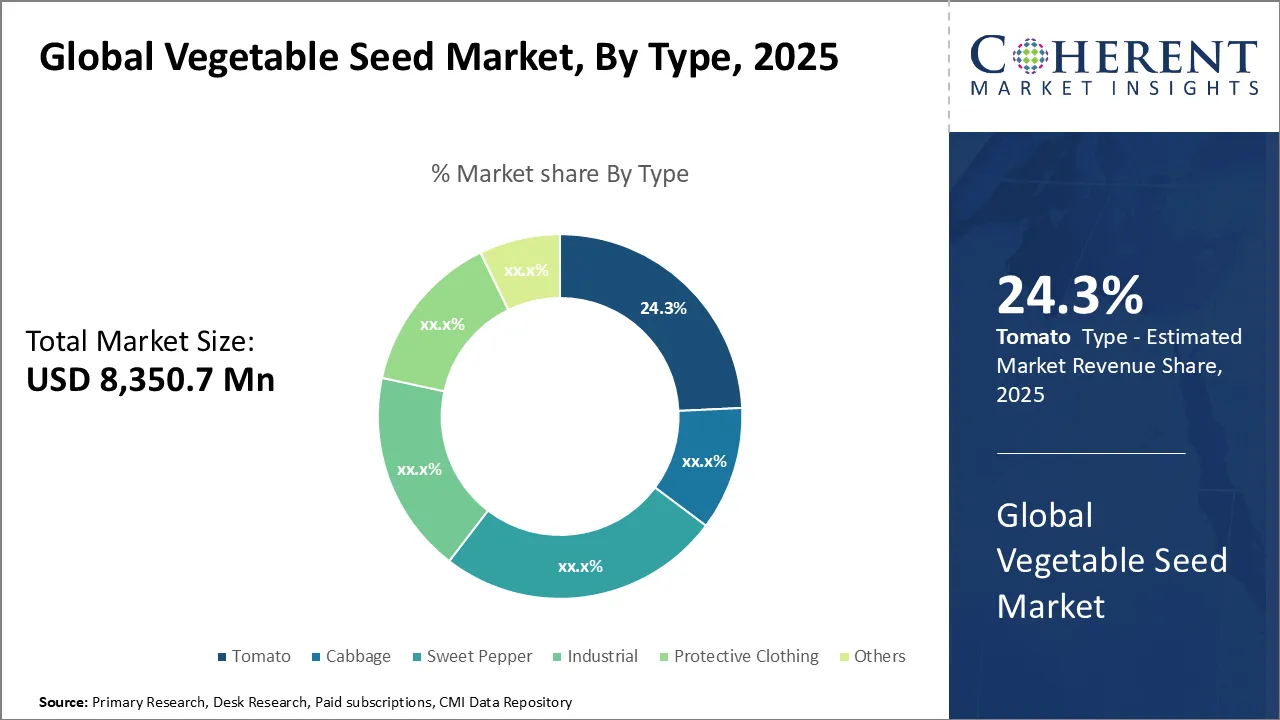
- Based on Type, Tomato acquired the prominent share of 25.3% in 2026 as tomato is widely grown and consumed crop worldwide.
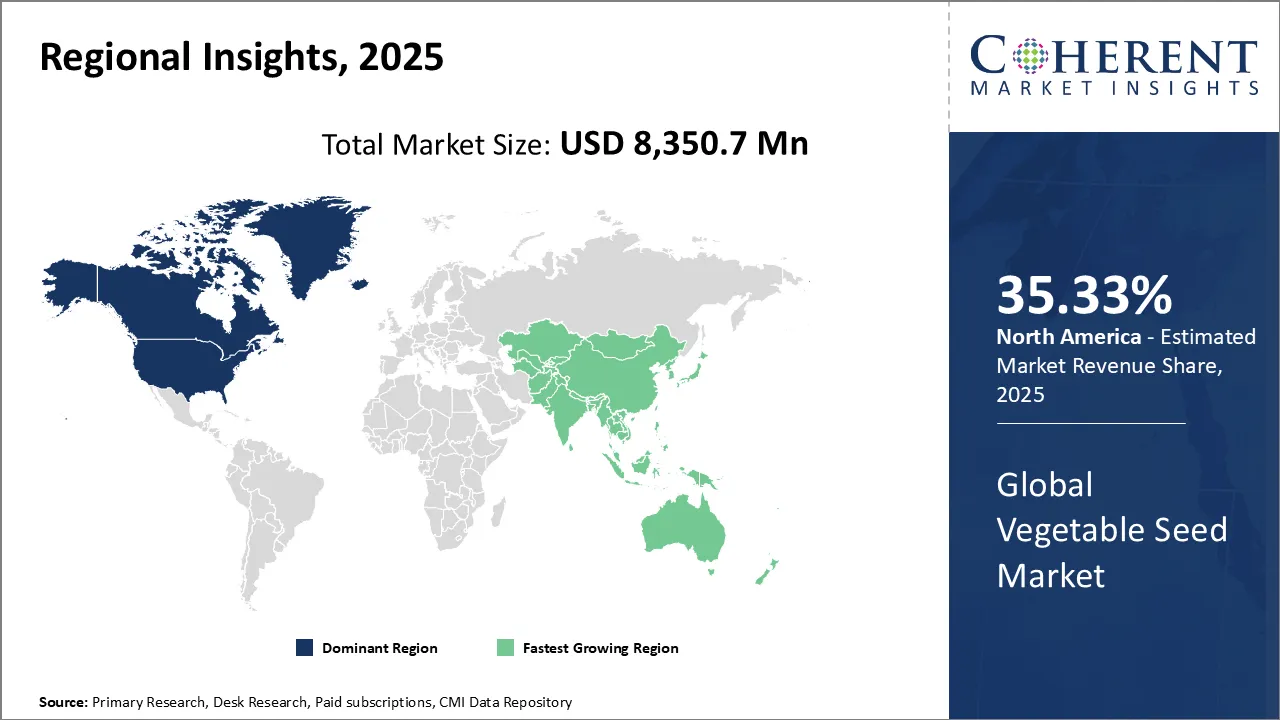
- Based on Region, North America led the overall vegetable seed market growth with a share of 35.33% owing to the growing demand for high-yielding, hybrid, and disease-resistant varieties of vegetables in the region.
Market Overview
The growing investment by private sector for vegetable seed market coupled with the increasing demand for fresh vegetables are key factor propelling market growth. Moreover, advancement in the vegetable seed technology and availability of more variety in crop are other key factors propelling market growth. Furthermore, favorable government policies are further anticipated to augment the vegetable seed market growth.
Current Events and their Impact on the Vegetable Seed Market
Current Events | Description and its impact |
Geopolitical Trade Realignments
|
|
Organic Policy & Consumer Trends
|
|
Government Initiatives
According to an article published by National Food Security Mission (NFSM): Under this mission, the government provides financial assistance for the production and distribution of high-yielding varieties (HYV) and hybrid seeds. For instance, a subsidy of ₹50 per kg or 50% of the cost (whichever is less) is provided for pulses and oilseeds.
- Current Industry Events of 2026
- Market Size Estimation
- Regional Breakdown
- Competitive Landscape
- Customer Intelligence
- Segmental Analysis
- Pricing Analysis
- Key Market Drivers, Challenges & Future Trends
- Customized Insights Section
End-user Feedback and Unmet Needs in the Vegetable Seed Market
End-user Feedback and Unmet Needs
- High Seed Costs: The expense of hybrid seeds, especially F1 generation varieties, is a major concern. These seeds often require repurchase each season, as seeds from the previous harvest may not retain the desired traits, leading to increased costs for farmers.
- Quality and Availability: Farmers frequently encounter issues with seed quality, including low germination rates and the presence of spurious seeds. Additionally, the timely availability of quality seeds remains a persistent problem, affecting planting schedules and crop yields.
- Market Information and Access: In regions like Bangladesh, farmers face challenges due to a lack of market information, inadequate infrastructure, and the presence of intermediaries who often control pricing and distribution, leaving farmers with limited bargaining power.
Pricing Analysis
- Increased Costs: The cost of commercial seed packets has risen significantly. For instance, a pack that previously cost $1.78 now retails for $2.19, marking a 23% increase over two years.
- Environmental Conditions: Adverse weather events, such as heavy rains and extreme temperatures, have impacted crop yields, leading to higher prices for both seeds and produce.
Segmental Insights
Vegetable Seed Market Insights, by Type
Tomato contributes the highest share of the market owing to wide utilization and consumption crop worldwide
Tomato segment has seen significant adoption in the global vegetable seed market with an estimated share of 25.3% in 2026 due to its extensive use worldwide. Tomatoes, in particular, dominate within this category, driven by their widespread culinary use and high seed replacement rates. This dominance is further bolstered by advancements in hybrid seed development, enhancing yield potential, disease resistance, and adaptability to diverse climatic conditions.
The shift towards greenhouse and hydroponic farming methods has increased the demand for specialized tomato seeds. Controlling environmental variables, crops grow faster and healthier, leading to higher yields and improved quality. For instance, according to an article published by the ICARDA, in the UAE, hydroponic tomato yields increased by 192% compared to traditional soil-based methods. These systems optimize the use of water and nutrients, reducing waste and conserving resources. These factors are further positively influencing the vegetable seed market share.
Regional Insights
North America Vegetable Seed Market Trends
North America has established itself as the dominant region in the global vegetable seed market. Owing to the growing demand for high-yielding, hybrid, and disease-resistant varieties of vegetables in the region. Furthermore, this dominance is attributed to the superior characteristics of hybrid seeds, such as enhanced yield, uniformity, improved color, and increased disease resistance. Crops like cucumber, gherkin, cauliflower, broccoli, and tomato are significant contributors to this segment. For instance, according to the recently released Census of Agriculture, 69,452 farms reported the harvest of Vegetables. Despite the drop in total vegetable farms and processing farm acres, from 2017 to 2022 real (inflation-adjusted) sales of vegetables (including seeds and transplants) per operation increased by 82 percent from about USD 280,000 to over USD 500,000.
Asia Pacific Vegetable Seed Market Trends
Asia pacific is also expected to witness fastest growth in the global market over the forecast period owing to the high consumption of fresh vegetables in countries like China and India. According to the Coherent Market Insights analysis, the seed market in China is the second-largest in the world, after the United States, and accounts for 21% of the global market share. A total of 6,665 new vegetable varieties were registered by the vegetable seed companies in China. The country requires almost 400,000 metric tons of vegetable seeds annually to fulfill its vegetable requirements. Apart from this, the growing technological innovations across India is also propelling the vegetable seed market demand in Asia Pacific region. In March 2024, Syngenta Vegetable Seeds opened a state-of-the-art Seed Health Lab in Hyderabad, India — the country’s first dedicated facility of its kind. This advanced lab enhances Syngenta’s quality control efforts and will support growers in India, the Asia Pacific region, and beyond.
United States Vegetable Seed Market
The growth of the market in United States is driven by its extensive vegetable cultivation areas, particularly in states like California, Florida, and Arizona, which benefit from favorable climatic conditions and advanced agricultural practices. The U.S. market is characterized by a strong preference for hybrid seeds, particularly in protected cultivation environments, and is supported by a robust agricultural infrastructure and a well-established distribution network. According to WITS, United States imports of Vegetable seed, of a kind used for sowing was $370,995.77K and quantity 11,751,400Kg. United States imported Vegetable seed, of a kind used for sowing.
China Vegetable Seed Market Trends
The country's leadership is underpinned by its vast agricultural land, favorable climatic conditions, and robust research and development capabilities. China's vegetable seed industry benefits from strong government support and increasing private sector participation, driving innovations in hybrid seed varieties and protected cultivation techniques. The adoption of hybrid seeds, particularly in crops like tomatoes, cucumbers, and gherkins, has been a key factor in enhancing yield and disease resistance. According to a report by China's organic agriculture and food sector, China is also the leading producer of organic oilseeds, with 506,000 ha of farmland dedicated to this purpose.
Market Report Scope
Vegetable Seed Market Report Coverage
| Report Coverage | Details | ||
|---|---|---|---|
| Base Year: | 2025 | Market Size in 2026: | USD 8,768.2 Mn |
| Historical Data for: | 2020 To 2024 | Forecast Period: | 2026 To 2033 |
| Forecast Period 2026 to 2033 CAGR: | 5.0% | 2033 Value Projection: | USD 12,337.8 Mn |
| Geographies covered: |
| ||
| Segments covered: |
| ||
| Companies covered: | Bayer CropScience AG, Groupe Limagrain, Syngenta AG, BASF SE (Nunhems BV), Rijk Zwaan Zaadteelt En Zaadhandel BV, Sakata Seed Corporation, UPL Limited (Advanta Seeds International), Takii & Co. Limited, East-West Seed International Ltd, Enza Zaden BV, Bejo Zaden BV, and Namdhari Seeds | ||
| Growth Drivers: |
| ||
| Restraints & Challenges: |
| ||
Vegetable Seed Market Trend
Government support for vegetable seed market
Government policies and regulations that include the export and import duties imposed on seeds in the Southeast Asian countries showed a positive impact on the seed market. Governments worldwide play a pivotal role in shaping the vegetable seed market through policies, subsidies, and international collaborations aimed at enhancing seed quality, ensuring food security, and promoting sustainable agricultural practices. For example, in November 2024, a project in Rwanda has shown how farmers can produce more from crops simply by using modern and higher quality varieties of seeds. In one case, farmers were able to grow up to 10 times as many carrots on the same plot of land by swapping old seeds for new, more suitable versions. The “seed resilience” project, launched in 2023, also aims to help farmers make better use of natural resources and help feed a rising global population, further accelerating the vegetable seed market growth.
Advancements in Seed Technology
Technological innovations in seed development have significantly improved crop productivity and resilience. The development of genetically modified (GM) seeds, hybrid seeds, and bio-engineered vegetable seeds has enhanced traits such as disease resistance, yield potential, and adaptability to various climatic conditions. These advancements enable farmers to produce more robust and high-yielding crops, meeting the increasing global food demand. Additionally, the adoption of precision farming techniques, including GPS-guided planting and variable-rate application of fertilizers and pesticides, has further optimized vegetable production, contributing to the expansion of the vegetable seed market.
The integration of sensor technologies into seeds has led to the emergence of "smart seeds." These seeds are embedded with tiny sensors that monitor environmental conditions such as soil moisture and temperature. This data allows farmers to make informed decisions regarding irrigation, fertilization, and pest control, optimizing resource use and enhancing crop health. Additionally, the adoption of digital tools like drones and satellite imaging provides real-time insights into crop health and soil conditions, further aiding in precision agriculture.
Vegetable Seed Market Opportunities: Increasing Investment from the Private Sector
Increasing investment from the private sector in vegetable seed market is expected to serve major growth opportunities. Spending from the private sector is important to improve the resources and expertise in the vegetable seed breeding programs across the globe. These investments can increase the research and development activities that can meet the changing demands of farmers and consumers for types of vegetables produced. Moreover, the availability of more varieties in crop can present more opportunities for farmers in the domestic and international market. For instance, according to the World Bank’s Strategic Approach to Global Food Security in 2025, the largest financer of agriculture and food in developing countries, having invested USD 22.3 billion in lending over the past five years. The Bank has committed to providing USD 9 billion annually for agri-finance and agribusiness by 2030, aiming to connect unbanked farmers to global value chains and create jobs in emerging markets.
Vegetable Seed Market News
- In May 2025, Syngenta Vegetable Seeds and Tropic launch Strategic Collaboration Leveraging Tropic’s GEiGS® Technology to Tackle Disease Resistance in Key Commercial Crops.
- In May 2025, BASF Egypt launched commercial operations of Nunhems vegetable seed varieties. With more than 2,000 specialists, it is present in all major vegetable production areas around the globe and dedicated to developing market and consumer-oriented varieties and concepts.
- In 2025, Johnny’s selected seeds introduced the newest innovation in salad mix production and a superior hydroponic lettuce, Salanova® Lettuce Seeds offers versatility, efficiency, and high value. Harvested as fully mature heads, the flavor and texture have more time to develop than traditional baby-leaf lettuces.
- In May 2025, Bayer introduced, Seminis® Brassica/Leafy Field Days Highlights Innovation and Solutions. This event brought together partners in the vegetable production industry, including dealers, growers, packers and shippers, as well as retailers and food service professionals.
Analyst Opinion (Expert Opinion)
- The vegetable seed market is undergoing a significant transformation, primarily driven by technological advancements.
- The integration of advanced technologies is revolutionizing seed quality assessment. For instance, a novel computer vision-based system utilizing Generative Adversarial Networks (GANs) and Active Learning has achieved accuracies of up to 91.6% in testing the physical purity of seed samples. This innovation addresses challenges in manual seed quality testing, offering a more efficient and scalable solution for the industry.
- Disease-resistant vegetable seeds are gaining momentum as farmers prioritize crop protection against viruses, fungi, and bacterial infections. The increasing prevalence of plant diseases, such as downy mildew in lettuce and late blight in potatoes, has spurred demand for resistant seed varieties. Companies like Bejo Zaden and Sakata Seed Corporation have focused on developing seeds that are resistant to common diseases, reflecting the industry's response to evolving agricultural challenges.
- In India, anthracnose disease alone is responsible for annual losses exceeding $490 million in chili pepper production. Such significant economic repercussions underscore the necessity for developing and adopting disease-resistant seed varieties.
Speak to the analyst
Want personalized insights?
Take the findings above to one of our principal consultants, or have the report rebuilt around the segments, geographies and competitors you actually track.
Market Segmentation
- Type Insights (Revenue, USD Mn, 2021 - 2033)
- Tomato
- Cabbage
- Sweet Pepper
- Lettuce
- Watermelon
- Onion
- Melon
- Chinese cabbage
- Hot Pepper
- Carrot
- Sweet Corn
- Eggplant
- Okra
- Regional Insights (Revenue, USD Mn, 2021 - 2033)
- North America
- U.S.
- Canada
- Latin America
- Brazil
- Argentina
- Mexico
- Rest of Latin America
- Europe
- Germany
- U.K.
- Spain
- France
- Italy
- Russia
- Rest of Europe
- Asia Pacific
- China
- India
- Japan
- Australia
- South Korea
- ASEAN
- Rest of Asia Pacific
- Middle East
- GCC Countries
- Israel
- Rest of Middle East
- Africa
- South Africa
- North Africa
- Central Africa
- North America
- Key Players Insights (Revenue, USD Mn, 2021 - 2033)
- Bayer CropScience AG
- Groupe Limagrain
- Syngenta AG
- BASF SE (Nunhems BV)
- Rijk Zwaan Zaadteelt En Zaadhandel BV
- Sakata Seed Corporation
- UPL Limited (Advanta Seeds International)
- Takii & Co. Limited
- East-West Seed International Ltd.
- Enza Zaden BV
- Bejo Zaden BV
- Namdhari Seeds
Sources
Primary Research Interviews from the following stakeholders
Stakeholders
- Engaged with over 52,000 farmers across six districts, addressing issues like crop damage by nilgai, water shortages, pest control, market access, and lack of quality seeds.
- Conducts extensive research and development on vegetable crops, collaborating with global partners to enhance vegetable production and consumption.
Databases
- International Seed Testing Association (ISTA)
- Agricultural Research Service (ARS) Seed Lab
Magazines
- The New Yorker
- Modern Farmer
Journals
- Folia Horticulturae
- The Plant Journal
Newspapers
- Reuters
- The Wall Street Journal (WSJ)
Associations
- Freshfel Europe
- Seed Savers Exchange
Public Domain Sources
- Seed Savers Exchange
- World Vegetable Center
Proprietary Elements
- CMI Data Analytics Tool, and Proprietary CMI Existing Repository of information for last 8 years
*Definition: The global vegetable seed market encompasses the production, distribution, and sale of seeds used to cultivate a wide variety of vegetables, including leafy greens, root vegetables, and legumes. Driven by factors such as rising global demand for nutritious food, advancements in seed technology, and the adoption of sustainable farming practices, the market is experiencing significant growth.
Get access to 250+ pages report
Every segment, forecast, competitor profile and data table behind the analysis above — available for instant download.
- ESOMAR Member
- ISO 9001:2015 Certified
- D-U-N-S Registered
- GDPR & CCPA Compliant
Missing comfort of reading report in your local language? Find your preferred language:
Transform your Strategy with Exclusive Trending Reports
Frequently Asked Questions
The Vegetable Seed Market is estimated to be valued at USD 8,768.2 Mn in 2026, and is expected to reach USD 12,337.8 Mn by 2033.
The CAGR of the Vegetable Seed Market is projected to be 5.0% from 2026 to 2033.
Government support and increasing innovation in seed technology are fuelling the market.
The Others segment is the leading component segment in the market.
High seed upfront cost is the major factors restraining the market.
Bayer CropScience AG, Groupe Limagrain, Syngenta AG, BASF SE (Nunhems BV), Rijk Zwaan Zaadteelt En Zaadhandel BV, Sakata Seed Corporation, UPL Limited (Advanta Seeds International), Takii & Co. Limited, East-West Seed International Ltd, Enza Zaden BV, Bejo Zaden BV, and Namdhari Seeds.