

Global Blood Meal Market Size and Forecast – 2026 To 2033
The Global Blood Meal Market is estimated to be valued at USD 2,733.4 Mn in 2026 and is expected to reach USD 4,332.1 Mn by 2033 exhibiting a compound annual growth rate (CAGR) of 6.80% from 2026 to 2033 This growth is attributable to the growing demand for organic fertilizers, growing awareness about sustainable agriculture and the expansion of the livestock industry, among others, which are contributing to the use of blood meal as an efficient nutrient source worldwide.
Blood meal is gaining traction as both a high-protein animal feed ingredient and a concentrated organic nitrogen fertilizer. In March 2026, the Canadian Food Inspection Agency listed blood meal as collected blood from slaughtered birds or mammals, dried and ground, containing at least 12% nitrogen, reinforcing its relevance as a regulated fertilizer input. (Source: Canadian Food Inspection Agency)
Key Takeaways of the Global Blood Meal Market
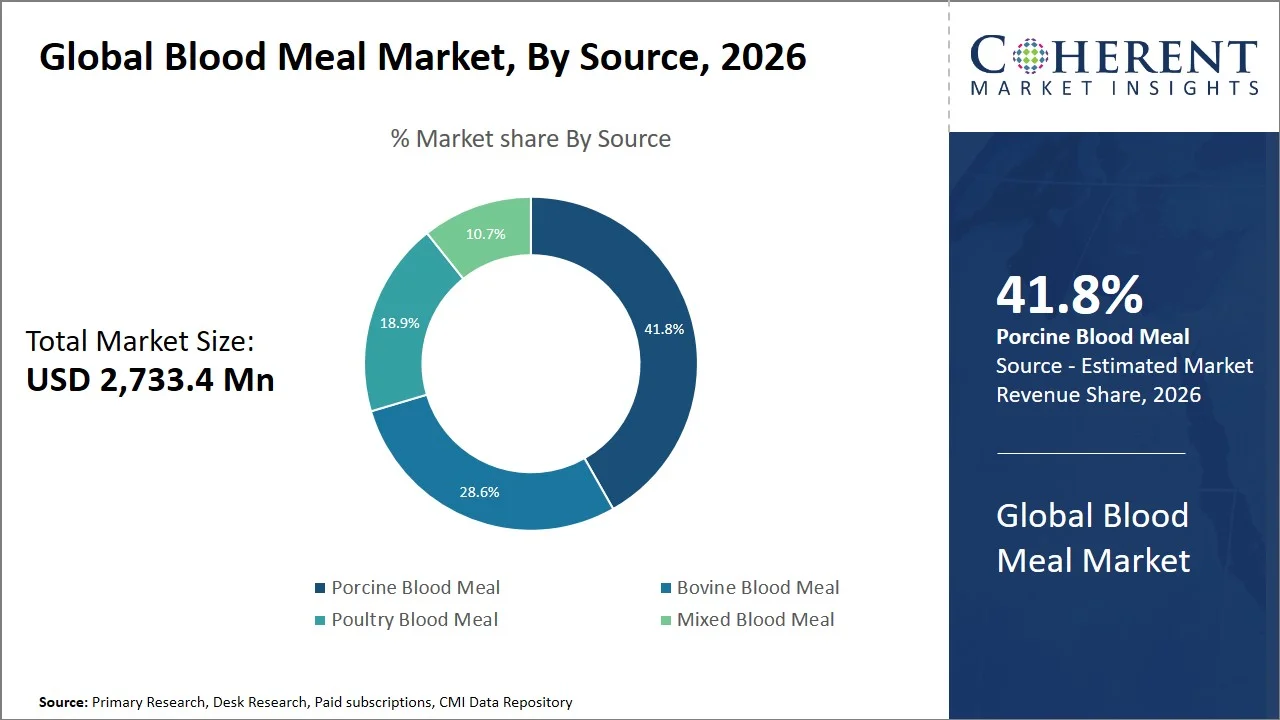
- Porcine blood meal is expected to dominate the source segment with 41.8% of the market share in 2026, supported by its strong availability from organized pork processing and suitability in high-protein feed formulations. In April 2026, USDA NASS reported U.S. commercial hog slaughter at 128 Mn head in 2025, indicating a large raw-material base for porcine-derived by-products.
- Spray dried blood meal is expected to hold 56.4% of the market share in 2026, as controlled drying improves protein preservation, handling consistency, and suitability for commercial feed mills. In July 2025, Springer Nature published a review highlighting blood meal and spray-dried blood cells as viable alternative protein sources in dairy diets.
- Animal feed is expected to lead the application segment with 54.7% of the market share in 2026, as blood meal remains a cost-effective amino-acid-rich ingredient for swine, poultry, and ruminant diets. In April 2026, Alltech reported global feed production reached 1.44 billion metric tons in 2025, reinforcing the scale of demand for protein feed ingredients.
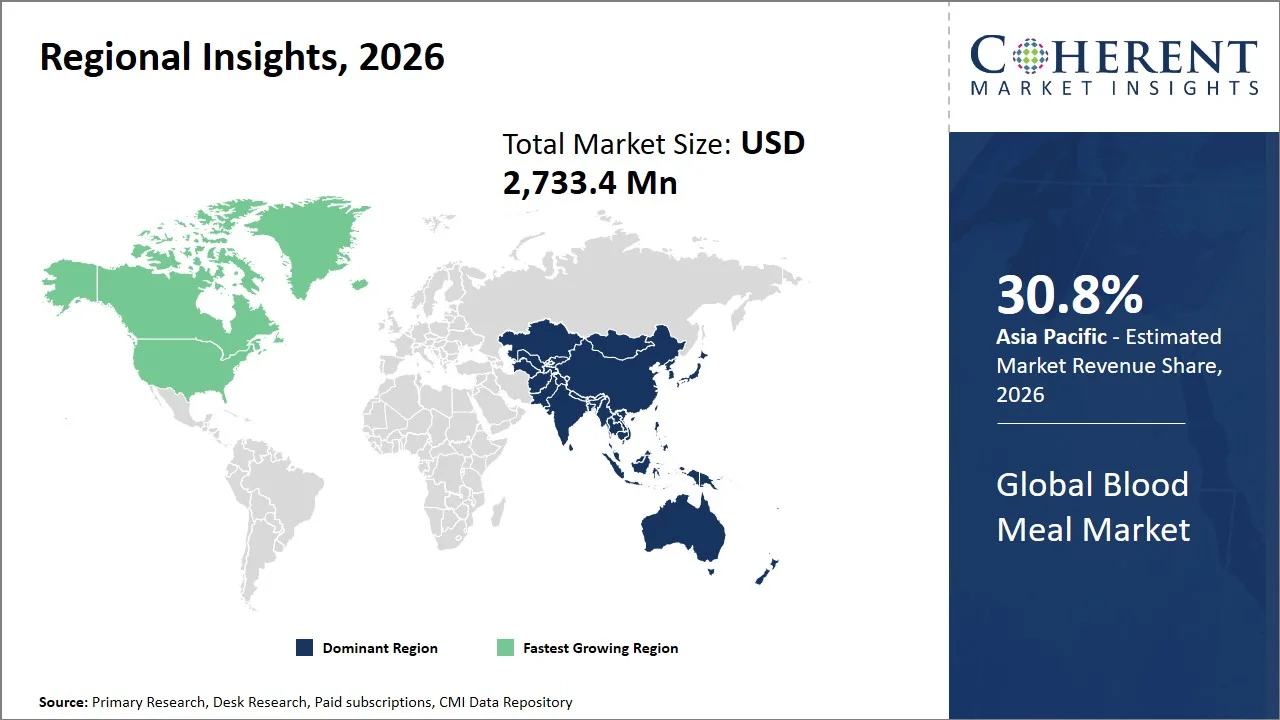
- Asia Pacific is expected to dominate the global blood meal market with 30.8% share in 2026, supported by large livestock populations, expanding feed manufacturing, and strong animal protein consumption. In July 2025, OECD-FAO projected that 55% of global meat production growth through 2034 will occur in Asia, led by poultry and pork recovery.
- North America is expected to account for 28.4% of the market share in 2026 and remain the fastest-growing region, backed by advanced feed manufacturing, strong rendering infrastructure, and higher adoption of specialty animal nutrition ingredients. In September 2025, ADM and Alltech announced a North American animal feed joint venture, combining major U.S. and Canadian feed mill assets.
- Circular Protein Valorization: Blood meal is gaining strategic relevance as feed producers and renderers convert slaughter by-products into high-value protein ingredients. This supports lower waste, better raw-material utilization, and improved feed cost management. Companies with integrated slaughtering, rendering, and feed distribution capabilities are better positioned to capture margins across the animal protein value chain.
- Quality-Controlled Feed Ingredient Positioning: The market is shifting from basic by-product trading toward standardized, traceable, and nutritionally consistent feed ingredients. Buyers increasingly prioritize digestibility, pathogen control, moisture stability, and amino-acid consistency. This favors suppliers investing in controlled drying, quality certification, and reliable sourcing systems to meet commercial feed mill specifications.
Segmental Insights
Why Does Porcine Blood Meal Dominate the Global Blood Meal Market?
Porcine blood meal is expected to dominate the source segment with 41.8% of the market share in 2026, supported by its strong linkage with organized pork processing and its relevance in monogastric feed formulations. The segment benefits from consistent raw blood availability from commercial pig slaughter facilities, better source segregation compared to mixed blood meal, and strong use in swine and poultry rations where high-protein, lysine-rich ingredients are required at controlled inclusion levels. Demand is particularly strong among feed mills serving piglet, grower, and finisher diets, where formulators seek compact protein sources that can reduce dependence on bulkier plant proteins. On the supply side, pork processors and renderers can convert slaughter by-products into standardized feed ingredients, improving value recovery. In March 2026, Eurostat forecast EU pig production to rise to 61.2 million head in Q4 2026, strengthening porcine by-product availability. (Source: Eurostat)
- Current Industry Events of 2026
- Market Size Estimation
- Regional Breakdown
- Competitive Landscape
- Customer Intelligence
- Segmental Analysis
- Pricing Analysis
- Key Market Drivers, Challenges & Future Trends
- Customized Insights Section
Why Does Spray Dried Blood Meal Represent the Largest Process Segment in the Global Blood Meal Market?
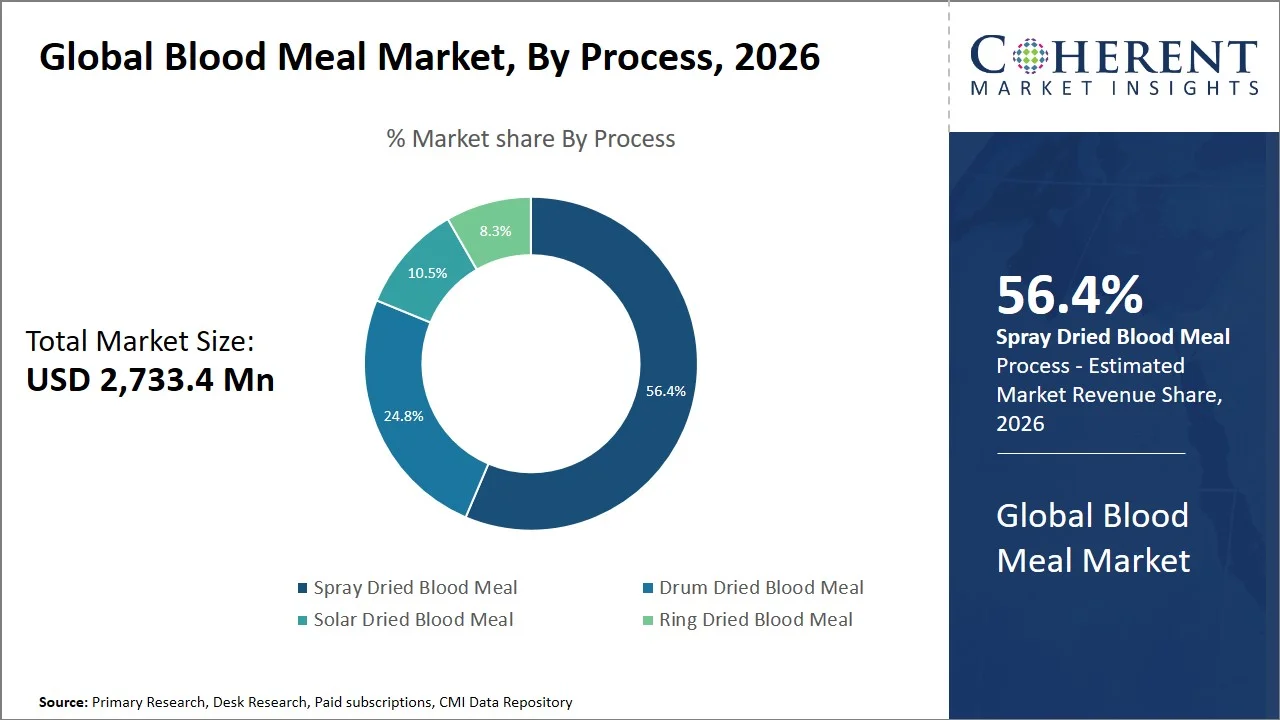
Spray dried blood meal is expected to represent the largest process segment with 56.4% of the market share in 2026, as feed manufacturers prefer drying systems that deliver better protein functionality, uniform particle quality, and lower moisture variability. Compared with conventional drying methods, spray drying supports faster dehydration, improved handling characteristics, and stronger suitability for precision feed formulation. This is important for commercial feed mills that require consistent nutrient profiles, stable bulk density, and predictable mixing performance across swine, poultry, aquaculture, and pet nutrition applications. The segment also benefits from its compatibility with large-scale rendering and blood fractionation systems, where quality-controlled drying helps preserve nutritional value and reduce product inconsistency. In December 2025, Frontiers in Veterinary Science published research showing that spray-dried plasma in nursery pig diets supported gut health, reduced gastrointestinal interventions, and improved later-stage performance indicators. (Source: Frontiers in Veterinary Science)
Why Does Animal Feed Dominate the Global Blood Meal Market?
Animal feed is expected to dominate the application segment with 54.7% of the market share in 2026, as blood meal is mainly positioned as a concentrated protein and amino acid ingredient for livestock nutrition rather than a fertilizer or specialty input. Feed mills use it where ration density, protein balancing, and ingredient cost efficiency are critical, especially in swine, poultry, and ruminant formulations. Demand-side strength comes from the need to support animal weight gain, feed conversion, and protein adequacy without increasing formulation bulk. Supply-side adoption is supported by rendering networks that convert slaughterhouse blood into storable, transportable feed-grade material, creating a steady bridge between meat processing and compound feed production. In January 2025, the U.S. Food & Drug Administration finalized Guidance for Industry #294 on Animal Food Ingredient Consultation, providing an additional pathway for firms developing animal food ingredients. (Source: U.S. Food & Drug Administration)
Global Blood Meal Market Dynamics
Key Market Drivers
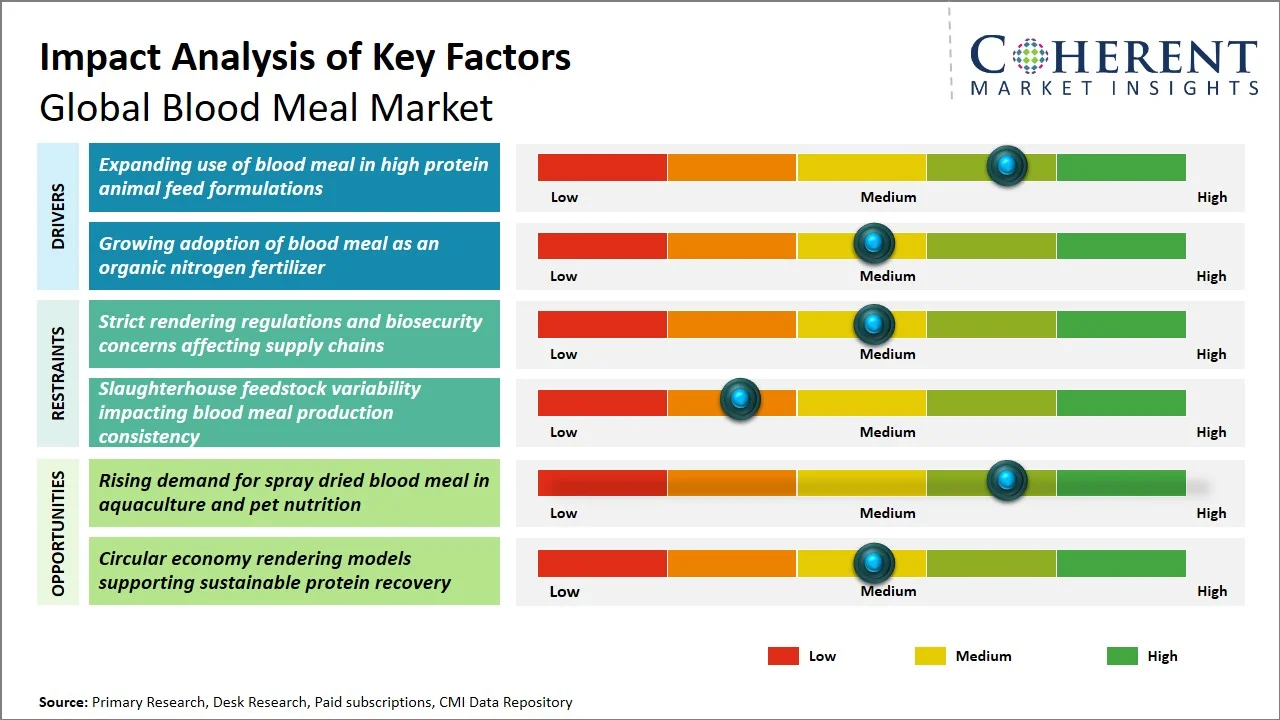
Expanding Use of Blood Meal in High-Protein Animal Feed Formulations
Blood meal is gaining stronger commercial relevance as feed producers seek concentrated protein ingredients that improve amino acid density without increasing formulation bulk. Its role is particularly important in swine, poultry, aquaculture, and specialty feed where crude protein consistency, moisture control, and origin-specific labelling matter. Adoption is also supported by defined feed-grade specifications, which help buyers assess quality, processing method, and label compliance. In June 2026, the Canadian Food Inspection Agency updated its Canadian Feed Ingredients Table, listing animal blood meal, flash/ring dehydrated blood meal, spray-dehydrated animal blood, and spray-dried animal blood cells with labelling guarantees for protein, moisture, ash, and sodium. (Source: Government of Canada)
Growing Adoption of Blood Meal as an Organic Nitrogen Fertilizer
It is increasingly being positioned as a high-value, animal-based organic nitrogen input, driven by growers’ shift toward quick-acting solutions for vegetable, horticulture, nursery crop, and other high-value organic farming systems. is popular for its ability to deliver a high concentration of nitrogen for application, the ability to be used in soil amendment programs, and for its use in blends where the formulators desire greater nitrogen release than is available from compost. This will generate extra revenue on top of feed, further diversifying the revenue for the renderers and processors. Blood meal was listed as a public product in OMRI's public product listing in June 2026 with an “Allowed” status for crop fertilizers and soil amendments, thus continuing to be commercially accepted in organic crop input channels.
Emerging Market Trends
Shift Toward Segregated, Species-Specific Blood Meal Grades
The market is transitioning towards species specific grades of blood meal, including porcine, bovine, poultry, and application specific grades, from one of the undifferentiated mixed blood meal. With the benefits of better ration formulation, customer assurance, export documentation, and adherence to species-specific feed regulations, feed manufacturers are increasingly opting for sourcing clear feeds. This trend is an advantage to suppliers that have strong connections with slaughter houses, traceable collection systems and have separate slaughter lines. It also offers high quality placement for porcine and spray-dried levels in specialized swine, aquaculture and pet nutrition applications. During the forecast period, buyers will reward suppliers who can offer reliable certificates of analysis, consistent nutrient guarantees and origin-based product differentiation besides being low-cost bulk protein meal suppliers.
Integration of Rendering By-Products into Circular Agriculture Models
Blood meal is now being considered as a by-product of farming that can be used as protein for feed and organic fertilizer in the farming system instead of being treated as a low-value waste. This trend solidifies the business incentive for integrated meat processor, renderer, feed ingredient supplier and fertilizer blender. It also alleviates pressure on companies with regard to waste disposal, generates new revenue streams, and contributes to sustainability positioning with customers. It is beneficial in feed for protein efficiency and in crop nutrition for the recovery of organic nitrogen. This generates a dual market opportunity for processors to maximize margins by supplying product to animal feeds, aquaculture feeds, pet food, or fertilizer based on quality, regulation and pricing.
Current Events and their Impact
Current Events | Description and its Impact |
April 2025 – European Commission PAFF Committee Technical Specifications for Animal By-Product Establishments |
|
February 2026 – CFIA Amendment to BSE Import Policy for Bovine By-Products |
|
June 2026 – USDA APHIS Animal Product Import Requirements Update |
|
Regional Insights
Why Does Asia Pacific Dominate the Global Blood Meal Market?
Asia Pacific is expected to dominate the global blood meal market with 30.8% share in 2026, supported by its large livestock base, expanding aquaculture sector, and high dependence on cost-efficient protein feed ingredients. The region’s swine, poultry, and fish farming industries create steady demand for amino acid-rich inputs that can improve feed density and formulation efficiency. Blood meal also benefits from the region’s strong slaughtering ecosystem, where animal by-products can be converted into feed and fertilizer-grade materials. In fertilizer applications, smallholder farming and organic nutrient demand further support regional consumption. In March 2026, Food and Agriculture Organization(FAO) Asia Pacific highlighted that livestock systems across the region are under pressure from rising demand for animal-source foods, reinforcing the need for efficient feed and by-product utilization. (Source: FAO)
Why is North America Emerging as the Fastest-Growing Region in the Global Blood Meal Market?
North America is expected to be the fastest-growing region with 28.4% share in 2026, driven by advanced rendering infrastructure, large-scale feed manufacturing, strong regulatory discipline, and increasing use of circular feed ingredients. The region has well-established slaughterhouse and rendering networks that support reliable collection, processing, and quality assurance for animal-derived protein meals. Blood meal adoption is also supported by commercial livestock, poultry, aquaculture, and pet nutrition sectors where feed mills require standardized ingredients with consistent nutrient profiles. The organic fertilizer channel provides an additional growth route, especially for specialty crop and horticulture applications. In 2025, the North American Renderers Association (NARA) reported that U.S. livestock, poultry, and aquaculture consumed 283.6 million tons of feed, with circular ingredients accounting for 37% of total feed consumption. (Source: North American Renderers Association)
Blood Meal Market Outlook for Key Countries
Why is the U.S. a Key Market for the Global Blood Meal Market?
The U.S. is a key market for blood meal due to its large animal feed manufacturing base, mature rendering industry, and strong demand from livestock, poultry, aquaculture, pet food, and organic fertilizer users. Blood meal benefits from the country’s integrated meat processing and by-product recovery ecosystem, which supports stable supply and consistent feed-grade material availability. U.S. feed manufacturers also place strong emphasis on nutrient consistency, traceability, pathogen control, and documentation, creating demand for higher-quality processed blood meal. The country is also important for value-added applications, including premium pet nutrition and soil amendment products. In September 2025, AFIA reported that the U.S. animal food industry had a US$ 267.1 billion economic footprint, showing the scale of downstream demand for feed ingredients.
Why is India Important in the Global Blood Meal Market?
India is important in the global blood meal market because of its expanding animal husbandry sector, rising commercial poultry output, and increasing need for economical feed protein sources. The country’s livestock economy creates demand for feed ingredients that can support poultry, dairy, aquaculture, and swine productivity while keeping formulation costs manageable. Blood meal can also support organic and specialty crop nutrition, particularly where farmers seek concentrated nitrogen inputs. India’s large poultry and meat production base provides a potential raw material pool for rendering and by-product valorization, although quality control, segregation, and regulatory compliance remain essential for broader adoption. In November 2025, India’s Press Information Bureau (PIB) reported 2024–25 meat production of 10.50 million tons, with poultry contributing 5.18 million tons.
Why Does China Support Growth in the Global Blood Meal Market?
China supports growth in the blood meal market through its massive swine and poultry industries, large feed manufacturing ecosystem, and strategic focus on reducing dependence on imported protein ingredients. Blood meal is relevant where feed producers need dense animal-origin protein inputs for swine, poultry, and aquaculture diets, especially when soybean meal prices are volatile. The country’s scale creates opportunities for differentiated feed ingredients, but buyers are increasingly sensitive to feed cost, digestibility, disease risk, and regulatory control. China’s push toward alternative protein sources also makes locally available rendered meals commercially relevant. In April 2026, Reuters reported that China was accelerating livestock feed diversification, with feed accounting for around 70% of pig rearing costs and fermented feed adoption rising in industrial feed.
Why is Germany a Strategic Country in the Global Blood Meal Market?
Germany is a strategic country for blood meal due to its advanced feed safety systems, structured livestock sector, and strong emphasis on regulated animal by-product handling. The country’s relevance is linked more to quality, compliance, and premium feed-grade standards than only volume growth. German feed buyers and processors typically require strong documentation, traceability, and hygienic processing, making the market attractive for suppliers offering standardized blood meal grades. The country’s pork and cattle sectors also provide a stable base for rendered animal protein demand, although structural consolidation is reshaping supply chains. In June 2026, Destatis reported that Germany had around 21.0 million pigs and 10.4 million cattle as of May 2026, while the trend toward larger pig farms continued.
Why is Brazil an Important Growth Market for Blood Meal?
Brazil is an important growth market for blood meal because of its large poultry, swine, beef, aquaculture, and pet food sectors, all of which create demand for protein-rich feed ingredients and by-product valorization. The country’s strong animal protein industry supports a wide raw material base for rendering, while its export-oriented meat sector encourages feed efficiency and cost control. Blood meal can gain traction in poultry and swine feed where nutrient density and pricing are critical, and in organic fertilizer channels where concentrated nitrogen inputs are valued. Brazil also benefits from strong regional distribution across Latin America. In April 2026, Sindirações estimates cited by Food & Agribusiness projected Brazil’s animal feed production to reach 97.3 million tons in 2026, up 3.3% from the previous year.
Technology Adoption Landscape in the Global Blood Meal Market
Technology | Adoption Level | Key Application Area | Business Impact |
Spray drying | High | Feed-grade blood meal and blood plasma products | Improves protein quality, moisture control, shelf stability, and suitability for premium feed formulations. |
Centrifugation-based blood fractionation | Medium | Separation of plasma and red blood cells | Enables value-added products such as plasma, hemoglobin-rich fractions, and species-specific feed ingredients. |
Flash and ring drying | Medium | Bulk blood meal production | Supports faster dehydration, scalable production, and improved operational throughput for rendering plants. |
Heat treatment and sterilization systems | High | Pathogen control and feed safety | Helps meet feed safety requirements, reduces microbial risk, and improves market access for regulated buyers. |
Grinding, sieving, and particle-size control | High | Finished blood meal standardization | Improves blending performance in compound feed and fertilizer mixes while reducing formulation variability. |
Batch traceability and quality testing systems | Medium | Compliance, export, and customer assurance | Strengthens documentation, certificate-of-analysis reliability, and differentiation for premium-grade suppliers. |
How are Precision Feed Formulation and Organic Nitrogen Inputs Creating New Growth Opportunities in the Global Blood Meal Market?
Precision nutrition and organic crop input demand are creating a stronger growth pathway for blood meal suppliers. In animal feed, formulators are increasingly looking for compact protein ingredients that help balance amino acid profiles, improve ration density, and support species-specific feed performance. This opens opportunities for higher-grade, source-segregated, and process-controlled blood meal products rather than commodity-grade material alone. In crop nutrition, blood meal can serve organic growers and specialty fertilizer blenders that require concentrated nitrogen inputs for vegetables, horticulture, and controlled-environment agriculture. The opportunity is commercially important because it allows processors to serve both feed and fertilizer markets, reducing dependence on a single end-use category. Suppliers that invest in quality testing, traceability, moisture control, and grade differentiation can command stronger margins, improve export readiness, and position blood meal as a value-added circular protein and nitrogen product.
Market Players, Key Development, and Competitive Intelligence
Key Developments
- In May 2026, Royal Agrifirm Group completed the acquisition of Hamlet Protein, a specialist in high-value protein ingredients for young animal nutrition. The transaction strengthens Agrifirm’s specialty nutrition business and reflects increasing competition in premium feed protein ingredients. For the blood meal market, this signals stronger buyer focus on digestibility, early-life nutrition, protein quality, and science-backed feed formulations.
- In April 2026, Darling Ingredients reported strong first-quarter 2026 performance, with total net sales increasing to USD 1.6 billion from USD 1.4 billion in the prior-year period. The company also highlighted stronger core ingredients performance, indicating continued commercial strength in rendering-based ingredient platforms. This supports the blood meal market by reinforcing investment capacity in animal by-product collection, processing, and specialty feed ingredient supply chains.
- In November 2025, Cargill Animal Nutrition & Health completed a major expansion of its Engerwitzdorf, Austria facility, increasing micronutrition production capacity by 50% to 30,000 metric tons annually. This development reflects rising demand for advanced animal nutrition solutions and supports the broader feed ingredient market, where blood meal competes as a high-protein input for livestock and aquaculture formulations.
Competitive Landscape
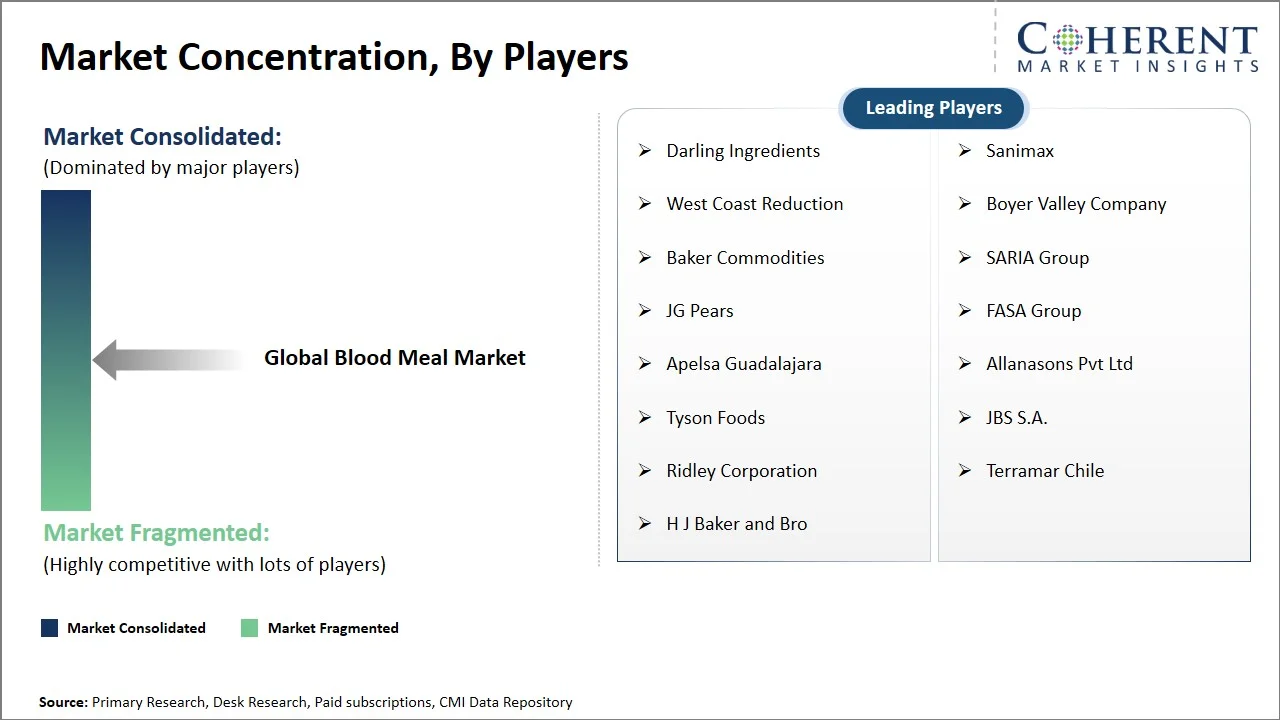
The global blood meal market is moderately fragmented, with competition shaped by rendering capacity, slaughterhouse access, processing quality, feed-grade compliance, and distribution reach. Large integrated renderers have an advantage in raw-material security and quality control, while regional processors compete through price, local feed mill relationships, and flexible supply.
Key focus areas include:
- Product quality and differentiation through source-specific porcine, bovine, poultry, and mixed grades
- Technology adoption focused on spray drying, fractionation, sterilization, and moisture control
- Pricing competitiveness linked to raw blood availability, energy cost, and transport economics
- Supply reliability through slaughterhouse integration and long-term raw material procurement
- Certifications, feed safety systems, and quality-control documentation for regulated buyers
- Product format differentiation by protein level, moisture, particle size, digestibility, and grade
- Strong B2B distribution through feed mills, fertilizer blenders, traders, and ingredient suppliers
- Sustainable and circular-economy positioning for by-product valorization and organic fertilizer channels
Market Report Scope
Blood Meal Market Report Coverage
| Report Coverage | Details | ||
|---|---|---|---|
| Base Year: | 2025 | Market Size in 2026: | USD 2,733.4 Mn |
| Historical Data for: | 2020 To 2024 | Forecast Period: | 2026 To 2033 |
| Forecast Period 2026 to 2033 CAGR: | 6.80% | 2033 Value Projection: | USD 4,332.1 Mn |
| Geographies covered: |
| ||
| Segments covered: |
| ||
| Companies covered: | Darling Ingredients, Sanimax, West Coast Reduction, Boyer Valley Company, Baker Commodities, SARIA Group, JG Pears, FASA Group, Apelsa Guadalajara, Allanasons Pvt Ltd, Tyson Foods, JBS S.A., Ridley Corporation, Terramar Chile, and H J Baker and Bro | ||
| Growth Drivers: |
| ||
| Restraints & Challenges: |
| ||
Analyst Opinion (Expert Opinion)
- The global blood meal market is expected to maintain a positive outlook as feed manufacturers and fertilizer blenders continue to value concentrated protein and organic nitrogen inputs. The strongest growth pockets are likely to emerge in spray-dried blood meal, porcine blood meal, animal feed, aquaculture feed, and organic fertilizer applications.
- Asia Pacific should remain commercially important due to scale of livestock and aquaculture consumption, while North America offers attractive growth through advanced rendering infrastructure, regulated feed systems, and demand for higher-quality animal nutrition inputs.
- Key risks include disease-related trade restrictions, feed safety compliance, odor and handling concerns, raw material variability, and competition from soybean meal, fishmeal, synthetic amino acids, and other protein alternatives. Suppliers should focus on source traceability, process-controlled drying, consistent protein guarantees, and value-added grades to defend margins.
- Companies that build strong relationships with slaughterhouses, feed mills, pet food manufacturers, and organic fertilizer blenders will be better positioned to capture premium demand. Competitive advantage will increasingly depend on compliance readiness, product consistency, application-specific grades, and the ability to serve both feed and crop nutrition channels.
Speak to the analyst
Want personalized insights?
Take the findings above to one of our principal consultants, or have the report rebuilt around the segments, geographies and competitors you actually track.
Market Segmentation
- Source Insights (Revenue, USD Mn, 2021 - 2033)
- Porcine Blood Meal
- Bovine Blood Meal
- Poultry Blood Meal
- Mixed Blood Meal
- Process Insights (Revenue, USD Mn, 2021 - 2033)
- Spray Dried Blood Meal
- Drum Dried Blood Meal
- Solar Dried Blood Meal
- Ring Dried Blood Meal
- Application Insights (Revenue, USD Mn, 2021 - 2033)
- Animal Feed
- Aquaculture Feed
- Organic Fertilizer
- Pet Food
- Others
- End User Insights (Revenue, USD Mn, 2021 - 2033)
- Swine Feed
- Poultry Feed
- Aquaculture
- Ruminant Feed
- Crop Nutrition
- Pet Nutrition
- Sales Channel Insights (Revenue, USD Mn, 2021 - 2033)
- Direct Sales
- Distributors and Traders
- Feed Ingredient Suppliers
- Online and Others
- Regional Insights (Revenue, USD Mn, 2021 - 2033)
- North America
- U.S.
- Canada
- Latin America
- Brazil
- Argentina
- Mexico
- Rest of Latin America
- Europe
- Germany
- U.K.
- Spain
- France
- Italy
- Russia
- Rest of Europe
- Asia Pacific
- China
- India
- Japan
- Australia
- South Korea
- ASEAN
- Rest of Asia Pacific
- Middle East
- GCC Countries
- Israel
- Rest of Middle East
- Africa
- South Africa
- North Africa
- Central Africa
- North America
Source
Primary Research Interviews
- Blood meal manufacturers and animal blood protein processors
- Rendering companies and slaughterhouse by-product processing companies
- Meat processors and poultry, swine, bovine slaughterhouse operators
- Animal feed manufacturers using blood meal in swine, poultry, ruminant, and aquaculture feed
- Organic fertilizer manufacturers and soil amendment formulators using blood meal as nitrogen input
- Pet food and aquafeed ingredient procurement managers
- Feed ingredient distributors, traders, importers, and exporters
- Spray drying, ring drying, drum drying, and rendering equipment suppliers
- Feed safety consultants, veterinary nutritionists, rendering plant operators, and regulatory experts
Stakeholders
- Blood meal and rendered protein ingredient producers: Darling Ingredients, Sanimax, West Coast Reduction, Baker Commodities, Boyer Valley Company, SARIA Group, JG Pears, FASA Group, Apelsa Guadalajara, Allanasons Pvt Ltd, Terramar Chile, H J Baker and Bro
- Integrated meat and poultry processors: Tyson Foods, JBS S.A., Smithfield Foods, Cargill Meat Solutions, BRF S.A., Minerva Foods, Marfrig Global Foods
- Feed and animal nutrition companies: Cargill Animal Nutrition, ADM Animal Nutrition, Royal Agrifirm Group, De Heus, Nutreco, Ridley Corporation, Alltech, ForFarmers
- End-use sectors: Swine feed, poultry feed, aquaculture feed, ruminant feed, pet nutrition, organic fertilizer, crop nutrition, specialty soil amendments
- Supporting ecosystem: Slaughterhouses, rendering plants, feed mills, fertilizer blenders, ingredient traders, logistics providers, quality testing laboratories, veterinary nutrition consultants
- Regulatory and certification bodies: FDA, USDA, USDA APHIS, AAFCO, CFIA, European Commission, EFSA, FSSAI, FAO, OMRI
Databases
- FDA Animal Food Ingredient Consultation Inventory – animal food ingredient consultation and safety pathway data.
- AAFCO Official Publication / ingredient definitions – feed ingredient definitions, label standards, and animal feed terminology.
- CFIA Canadian Feed Ingredients Table – blood meal, spray-dried animal blood, blood plasma, and animal blood cells ingredient descriptions.
- USDA NASS Livestock Slaughter Annual Summary – livestock slaughter, red meat production, and slaughter plant data.
- FAOSTAT – livestock, meat production, agricultural production, and country-level raw material availability data.
- Eurostat Livestock and Meat Statistics – Europe livestock population, meat production, and country-level livestock data.
- UN Comtrade Database – import/export data for animal by-products, blood fractions, protein substances, and feed-related products.
- ITC Trade Map – trade flow analysis for rendered protein ingredients, animal by-products, feed ingredients, and fertilizer inputs.
Magazines / Industry Publications
- FeedNavigator
- Feed Strategy
- Feed & Grain
- All About Feed
- Petfood Industry
- Aquafeed.com
- World Grain
- Meat + Poultry
- Poultry World
- Rendering industry publications
- Food & Agribusiness World
- Agri-Pulse
Journals
- Animal Feed Science and Technology
- Journal of Animal Science
- Poultry Science
- Aquaculture Nutrition
- Frontiers in Veterinary Science
- Animals
- Journal of Cleaner Production
- Applied Animal Science
- Veterinary Sciences
- Meat Science
- Waste Management
- Sustainability
Newspapers / Credible News Sources
- Bloomberg – agribusiness, meat processing, feed cost, and animal protein market trends
- Financial Times – food supply chain, agriculture, and commodity market coverage
- The Wall Street Journal – livestock, meat processing, and feed industry business updates
- The Hindu BusinessLine – India livestock, poultry, fertilizer, and feed sector updates
- AgFunderNews – agrifood technology, sustainable agriculture, and alternative protein investment updates
Associations
- North American Renderers Association – rendering, animal by-products, rendered protein meals, animal nutrition, and fertilizer applications.
- American Feed Industry Association – animal feed industry, feed ingredient regulation, and U.S. feed business insights.
- International Feed Industry Federation – global compound feed production and feed industry statistics.
- European Fat Processors and Renderers Association
- Pet Food Institute
- European Pet Food Industry Federation
- Global Aquaculture Alliance
- International Fertilizer Association
- Organic Materials Review Institute
Public Domain Sources
- USDA – livestock production, slaughter, meat processing, feed, and agricultural statistics
- USDA APHIS – animal-origin product import/export, sanitary, and biosecurity requirements
- FDA – animal food ingredient consultations and feed safety guidance
- AAFCO – feed ingredient definitions and label standards
- CFIA – livestock feed ingredient tables and animal by-product import/export policy
- European Commission – animal by-products, feed rules, and organic fertilizer regulation
- EFSA – feed safety, animal by-product, and risk assessment opinions
- FAO – livestock production, feed, food security, and animal-source raw material data
- Eurostat – European livestock and meat production statistics
- OMRI – organic input status for blood meal in crop fertilizers and soil amendments
- FSSAI – food/feed-related regulatory references in India, where applicable
Proprietary Elements
- CMI Data Analytics Tool
- Proprietary CMI Existing Repository of information for last 10 years
Get access to 250+ pages report
Every segment, forecast, competitor profile and data table behind the analysis above — available for instant download.
- ESOMAR Member
- ISO 9001:2015 Certified
- D-U-N-S Registered
- GDPR & CCPA Compliant
Missing comfort of reading report in your local language? Find your preferred language:
Transform your Strategy with Exclusive Trending Reports
Frequently Asked Questions
The CAGR of the global blood meal market is projected to be 6.80% from 2026 to 2033.
The global blood meal market is estimated to be valued at USD 2,733.4 Mn in 2026 and is expected to reach USD 4,332.1 Mn by 2033.
Expanding use of blood meal in high protein animal feed formulations and growing adoption of blood meal as an organic nitrogen fertilizer are the major factors driving the growth of the global blood meal market
Strict rendering regulations and biosecurity concerns affecting supply chains and slaughterhouse feedstock variability impacting blood meal production consistency are the major factors hampering the growth of the global blood meal market.
Spray dried blood meal is expected to dominate the market in 2026, as this process helps preserve protein quality, improves digestibility, and provides better consistency for commercial feed manufacturers.
Blood meal is gaining demand as an organic fertilizer because it is a rich nitrogen source and supports soil fertility, plant growth, and sustainable farming practices. Its use is increasing among organic growers and specialty crop producers.
In terms of source, porcine blood meal is estimated to dominate the market revenue share in 2026.