

Brachytherapy Afterloaders Market Size and Forecast – 2026 to 2033
The Brachytherapy Afterloaders Market is anticipated to grow at a CAGR of 5.4% with USD 1.8 Bn share in 2026 and is expected to reach USD 3.2 Bn in 2033. The rising cancer burden, wider adoption of targeted radiation therapy, and increasing preference for minimally invasive treatments are driving demand in the Brachytherapy Afterloaders Market. Cancer remains a leading cause of death globally, accounting for nearly 10 million deaths in 2024, or approximately one in six deaths worldwide.
Key Takeaways
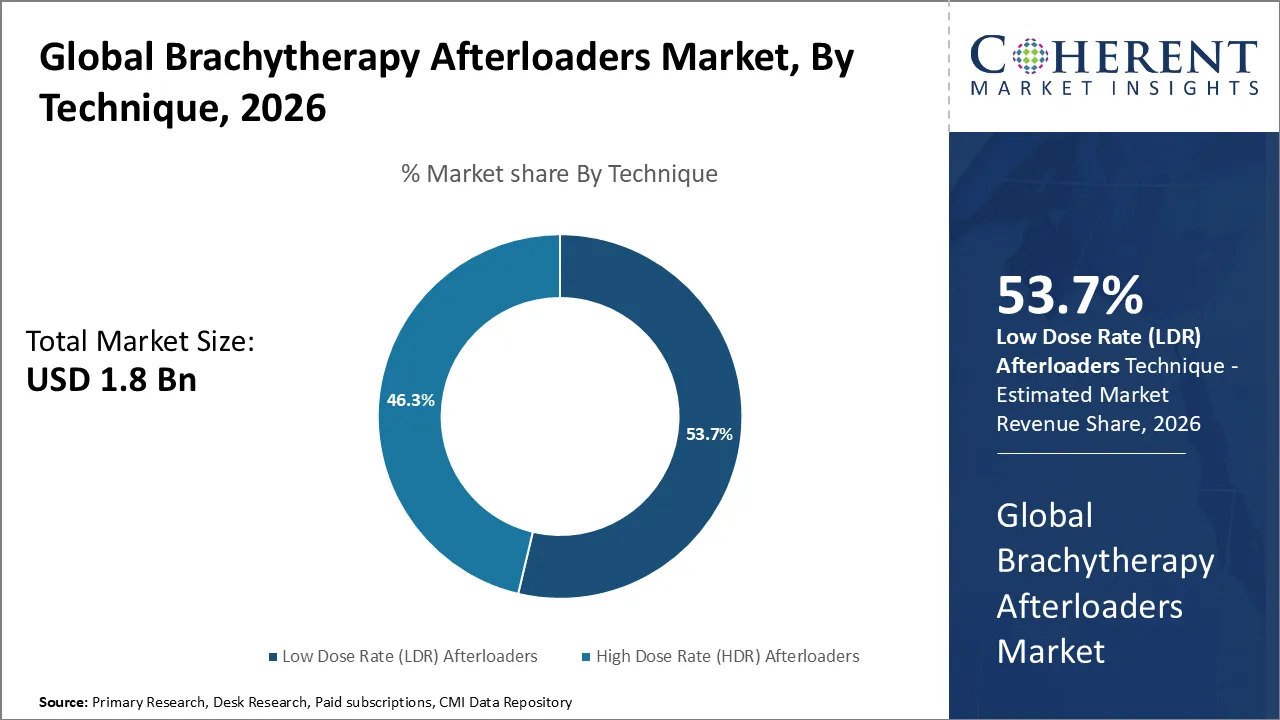
- Low Dose Rate (LDR) Afterloader hold the largest market share of 53.7% in 2026 owing to the growing prevalence of cancer. In 2025, an estimated 2,041,910 new cancer cases will be diagnosed in the United States, with approximately 618,120 cancer-related deaths expected.
- Prostate Cancer expected to hold largest market share of 38.9% in 2026 owing to its growing geriatric male population. In India, males aged 60 and above account for approximately 42% of the elderly population, with the total number of senior citizens projected to reach 319 million by 2050.
- North America is expected to acquire the dominant share of 42.3% in 2026 owing to the established use of brachytherapy across multiple cancers.
Current Events and Their Impact on the Brachytherapy Afterloaders Market
Current Event | Description and its Impact |
U.S. Medicare CY2026 OPPS/ASC Payment Update |
|
India: AERB Regulatory Requirements for Remote Afterloading Brachytherapy |
|
Segmental Insights
- Current Industry Events of 2026
- Market Size Estimation
- Regional Breakdown
- Competitive Landscape
- Customer Intelligence
- Segmental Analysis
- Pricing Analysis
- Key Market Drivers, Challenges & Future Trends
- Customized Insights Section
Why is Low Dose Rate (LDR) Afterloader Acquiring the Largest Market Share?
Low Dose Rate (LDR) Afterloader hold the largest market share of 53.7% in 2026. LDR afterloaders benefit from the established use of LDR brachytherapy for localized cancers, particularly prostate cancer, where clinicians use permanent radioactive seed implantation for appropriately selected patients. An estimated 333,830 new cases of prostate cancer are expected to be diagnosed in the United States in 2026. Healthcare providers increasingly use localized radiation delivery, while advances in ultrasound-guided treatment planning and growing clinical expertise improve treatment precision and adoption. The convenience of completing treatment through a single implant also supports demand. Furthermore, clinicians continue to use established radionuclides such as iodine-125, palladium-103, and cesium-131, sustaining demand for LDR treatment systems.
Which Application segment dominates the market?
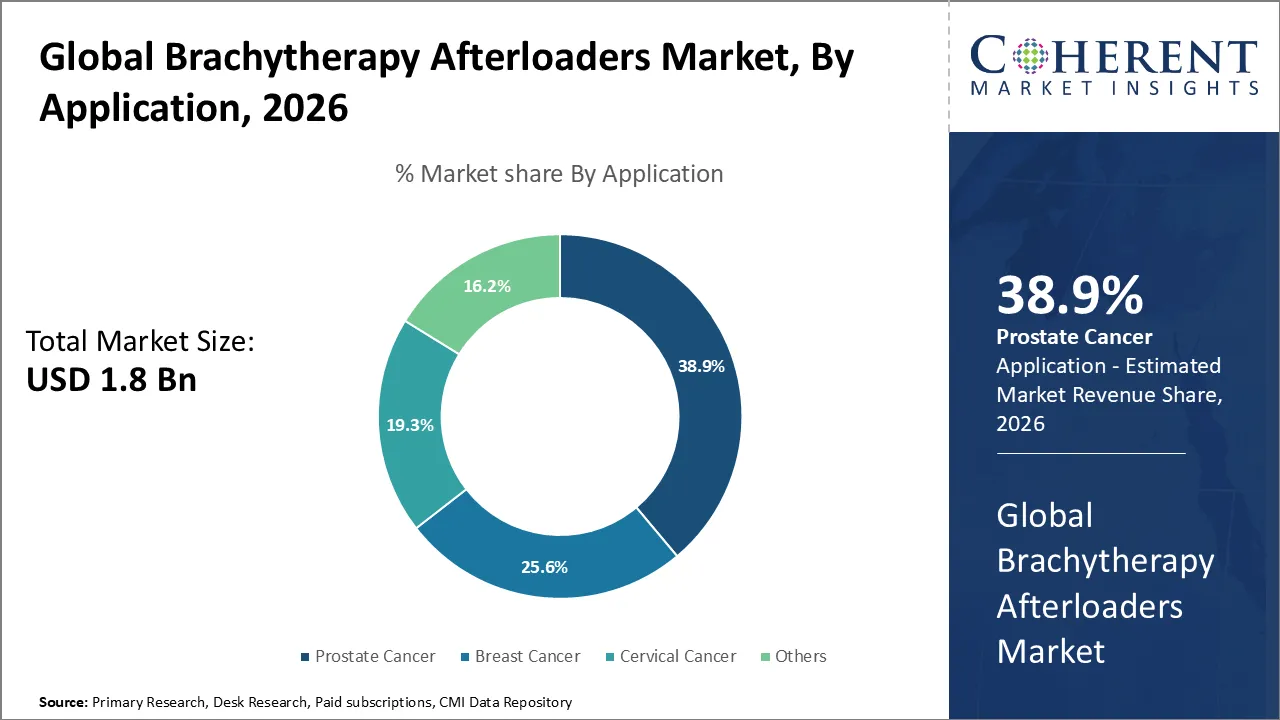
Prostate Cancer expected to hold largest market share of 38.9% in 2026. Prostate cancer supports demand for brachytherapy afterloaders because clinicians widely use brachytherapy to treat appropriately selected patients with localized disease. Increasing prostate cancer diagnoses, especially among older men, expand the pool of patients eligible for radiation-based therapies. Clinicians use brachytherapy to deliver radiation directly to or near the prostate, enabling targeted treatment. Improvements in imaging, treatment planning, and implantation techniques enhance procedural precision, while expanding clinical expertise and continued adoption of LDR and HDR techniques strengthen demand for specialized afterloading systems. The hospital’s Colney Centre used the advanced Varian Bravos afterloader system to deliver brachytherapy for selected gynaecological and prostate cancers.
Brachytherapy Afterloaders Market Trends
- Rising adoption of image-guided brachytherapy improves treatment precision, supports accurate applicator positioning, and enables more targeted radiation delivery while limiting exposure to surrounding healthy tissue. The continued use of brachytherapy in cervical and other cancers supports demand for systems that can integrate with modern imaging and treatment-planning workflows. WHO reports that approximately 660,000 women were diagnosed with cervical cancer and about 350,000 died from the disease globally in 2022, highlighting the continuing need for effective treatment infrastructure.
- Growing preference for minimally invasive and organ-preserving cancer treatments supports the use of brachytherapy, particularly for prostate, cervical, breast, and gynecological cancers. In the U.S., the American Cancer Society estimates 333,830 new prostate cancer cases in 2026, making prostate cancer one of the major potential application areas for brachytherapy services.
- Government-supported cancer programs and reimbursement policies can influence providers' ability to maintain and expand brachytherapy services. In the U.S., CMS's CY2026 Hospital Outpatient Prospective Payment System (OPPS) increased applicable hospital outpatient payment rates by 2.6%. CMS also continues to list brachytherapy sources as separately payable under OPPS, with payment based on applicable OPPS rates when available.
Regional Insights
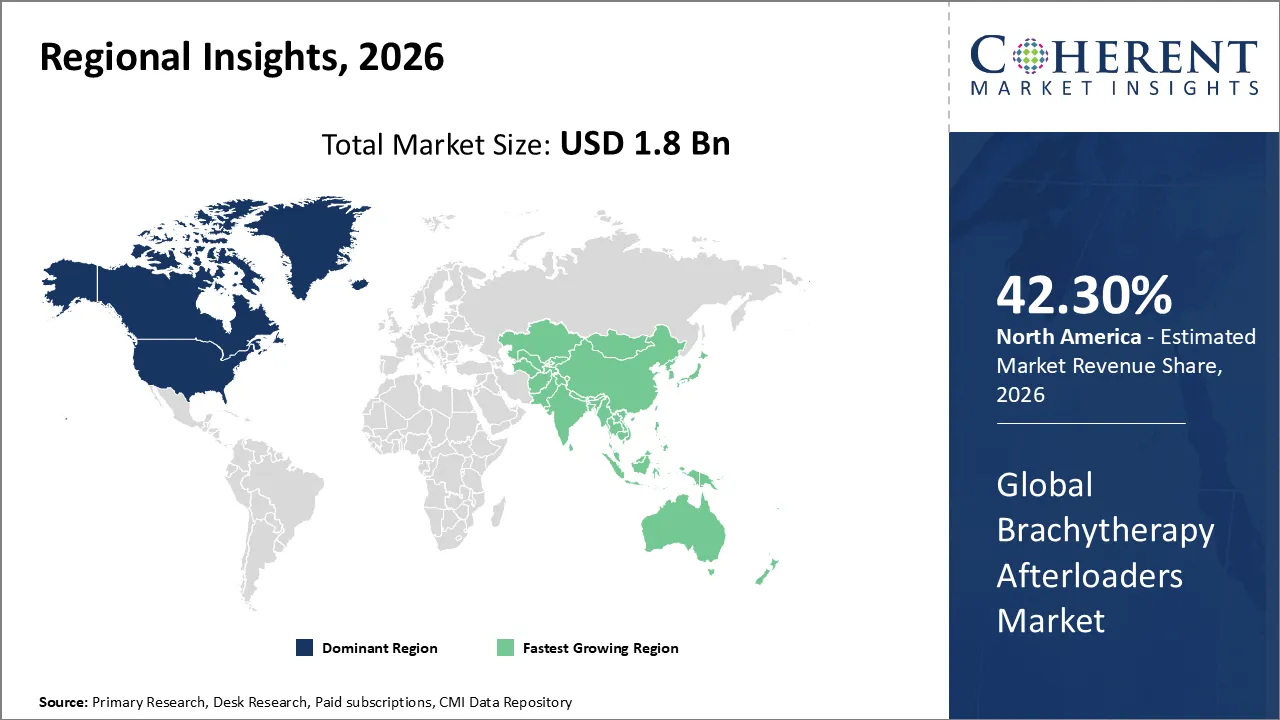
North America dominates owing to strong technology adoption and replacement demand
North America is expected to acquire the dominant share of 42.30% in 2026. Advanced radiation oncology infrastructure and specialized cancer centers strengthen the Brachytherapy Afterloaders Market across North America. Healthcare providers increasingly adopt image-guided treatment technologies to improve precision and treatment outcomes. The region’s substantial patient population with prostate, cervical, breast, and other cancers continues to generate demand for brachytherapy services. Furthermore, increasing investments in precision radiation therapy and oncology facility modernization encourage providers across the United States and Canada to adopt advanced brachytherapy systems. Radiation oncology company Varian Medical Systems introduced Bravos, a new high-dose-rate (HDR) brachytherapy afterloader. The company unveiled the system at the American Society for Radiation Oncology (ASTRO) meeting after five years of clinical research and development.
Asia Pacific Brachytherapy Afterloaders Market Trends
The Asia Pacific brachytherapy afterloaders market is growing as the region faces a rising cancer burden and expands its radiotherapy infrastructure. Healthcare providers in China, India, Japan, and South Korea are increasing investments in oncology care and adopting high-dose-rate brachytherapy, image-guided treatment, and minimally invasive radiation techniques. Governments are also modernizing healthcare systems and developing specialized cancer centers. The government plans to establish Day Care Cancer Centres in all district hospitals within three years, with 200 centres scheduled to be established in 2025–26. Improved access to radiation oncology professionals and greater awareness of localized cancer treatments further encourage healthcare facilities to adopt advanced brachytherapy afterloader systems across the region.
United States Brachytherapy Afterloaders Market Trends
The U.S. brachytherapy afterloaders market benefits from the country’s significant cancer burden and growing need for precise, targeted radiation therapy. Healthcare providers increasingly use brachytherapy to treat prostate, breast, cervical, head and neck, and other cancers, driving demand for advanced afterloading systems. The expanding use of high-dose-rate procedures, which provide temporary radiation delivery and shorter treatment sessions, further supports adoption. In addition, improvements in treatment planning, imaging integration, automation, and healthcare infrastructure encourage more radiation oncology centers to adopt these technologies. The IAEA developed a brachytherapy dosimetry methodology that underpins a new audit service from its Dosimetry Laboratory. Results from the Agency’s multicentre pilot study will help improve the safety and effectiveness of high-dose-rate brachytherapy treatments, particularly for cancer patients in resource-constrained settings.
Japan Brachytherapy Afterloaders Market Trends
Japan’s brachytherapy afterloaders market benefits from its aging population and rising need for precise, localized cancer treatments, including therapies for cervical, prostate, breast, and other cancers. Cancer is the leading cause of death in Japan, accounting for approximately 23.8% of all deaths. Healthcare providers across Japan operate an established network of brachytherapy centers and increasingly use image-guided techniques, creating demand for advanced afterloading systems. The growing adoption of high-dose-rate brachytherapy, enhanced treatment-planning technologies, and sophisticated imaging solutions further drives market development. Japan’s strong healthcare infrastructure and continuous technological advancements also encourage radiation oncology facilities to upgrade their equipment.
Who are the Major Companies in Brachytherapy Afterloaders Industry
Some of the major key players in Brachytherapy Afterloaders are Elekta, Eckert & Zieglar BEBIG, and Varian Medical Systems, Inc.
Key News
- In November 2023, Elekta secured an approximately $40 million order for its oncology portfolio, including Unity MR-Linacs, Gamma Knife systems, Versa HD accelerators, Flexitron brachytherapy afterloaders, and Elekta One software.
Brachytherapy Afterloaders Market Report Coverage
Report Coverage | Details | ||
Base Year: | 2025 | Market Size in 2026: | USD 1.8 Bn |
Historical Data for: | 2020 to 2024 | Forecast Period: | 2026 to 2033 |
Forecast Period 2026 to 2033 CAGR: | 5.4% | 2033 Value Projection: | USD 3.2 Bn |
Geographies covered: |
| ||
Segments covered: |
| ||
Companies covered: | Elekta, Eckert & Zieglar BEBIG, and Varian Medical Systems, Inc. | ||
Analyst Opinion
- Brachytherapy afterloaders are being supported by clinical necessity, not simply equipment replacement. In a U.S. SEER analysis of 8,500 women with stage IB2–IVA cervical cancer treated with external-beam radiotherapy, brachytherapy use reached 76% during 2018–2020, while matched patients receiving brachytherapy recorded 64.0% overall survival versus 51.4% without it. These outcomes reinforce the clinical importance of HDR afterloading systems, particularly for gynecologic oncology.
- The strongest opportunity lies in HDR and image-guided workflows. A 2022 nationwide Japanese survey covering 177 brachytherapy establishments found that 71% of institutions had implemented image-guided brachytherapy, while gynecologic intracavitary treatment accounted for 3,719 patients in 2021. This indicates that providers increasingly value afterloaders that integrate accurately with imaging and treatment-planning platforms rather than relying on standalone radiation delivery.
- However, the market faces a capacity problem that technology alone cannot solve. U.S. data identified 564 facilities providing brachytherapy in 2018, yet only 149 of 306 hospital referral regions had access, leaving approximately 75.3 million people outside a referral region with brachytherapy access. We therefore view geographic availability and specialist capacity as critical determinants of afterloader adoption, with replacement demand likely strongest at established high-volume centers.
- Safety and reliability will increasingly determine purchasing decisions. FDA adverse-event data recorded 372 HDR-brachytherapy events from 1993–2019, with 48.9% attributed to device malfunction and 11% requiring afterloader repair. For manufacturers, this makes automated source positioning, applicator reliability, quality assurance, and system uptime commercially important differentiators—not secondary technical features.
Speak to the analyst
Want personalized insights?
Take the findings above to one of our principal consultants, or have the report rebuilt around the segments, geographies and competitors you actually track.
Market Segmentation
- By Technique (Revenue, USD Bn, 2021-2033)
- Low Dose Rate (LDR) Afterloaders
- High Dose Rate (HDR) Afterloaders
- By Application (Revenue, USD Bn, 2021-2033)
- Prostate Cancer
- Breast Cancer
- Cervical Cancer
- Others
- By Region (Revenue, USD Bn, 2021-2033)
- North America
- U.S.
- Canada
- Latin America
- Brazil
- Mexico
- Argentina
- Rest of Latin America
- Europe
- Germany
- U.K.
- France
- Italy
- Spain
- Russia
- Rest of Europe
- Asia Pacific
- China
- India
- Japan
- Australia
- South Korea
- ASEAN
- Rest of Asia Pacific
- Middle East
- GCC
- Israel
- Rest of Middle East
- Africa
- South Africa
- Central Africa
- North Africa
- North America
- Key Players
- Elekta
- Eckert & Zieglar BEBIG
- Varian Medical Systems, Inc.
Sources
Primary Research interviews
- Radiation oncologists specializing in HDR and LDR brachytherapy
- Medical physicists and brachytherapy physicists
- Directors and administrators of radiation oncology departments
- Hospital procurement and biomedical engineering professionals
- Brachytherapy equipment distributors and service specialists
- Clinical experts involved in image-guided brachytherapy and treatment planning
- Regulatory and radiation-safety professionals
Databases
- U.S. Food and Drug Administration (FDA) medical device databases
- U.S. Centers for Medicare & Medicaid Services (CMS) databases
- National Cancer Institute (NCI) and SEER databases
- International Atomic Energy Agency (IAEA) DIRAC database
- PubMed/MEDLINE
- ClinicalTrials.gov
- U.S. Census Bureau
- National Center for Health Statistics (NCHS)
Magazines
- Medical Physics International
- Applied Radiation and Isotopes
- Physics Today
- Radiation Oncology News
- Oncology Times
Journals
- Medical Physics
- International Journal of Radiation Oncology, Biology, Physics
- Brachytherapy
- Radiotherapy and Oncology
- Journal of Radiation Research
- Practical Radiation Oncology
- Journal of Applied Clinical Medical Physics
- Physics in Medicine & Biology
Newspapers
- The New York Times
- The Wall Street Journal
- The Washington Post
- The Guardian
- Nikkei Asia
Associations
- American Association of Physicists in Medicine (AAPM)
- American Society for Radiation Oncology (ASTRO)
- European Society for Radiotherapy and Oncology (ESTRO)
- International Atomic Energy Agency (IAEA)
- American Brachytherapy Society (ABS)
- International Commission on Radiation Units and Measurements (ICRU)
- Radiological Society of North America (RSNA)
Public Domain sources
- U.S. Food and Drug Administration (FDA) device and radiation-emitting product information
- U.S. Nuclear Regulatory Commission (NRC) regulations and radiation-safety guidance
- U.S. Centers for Medicare & Medicaid Services (CMS) reimbursement and utilization data
- National Cancer Institute (NCI) cancer statistics and treatment information
- SEER cancer statistics
- International Atomic Energy Agency (IAEA) radiation therapy and brachytherapy resources
- World Health Organization (WHO) cancer and radiotherapy data
- National Institutes of Health (NIH) and PubMed publications
- U.S. Department of Health and Human Services (HHS) publications
- Government health and cancer registries from Japan, Canada, the European Union, China, and other covered markets
Proprietary Elements
- CMI Data Analytics Tool
- Proprietary CMI Existing Repository of information for last 10 years
Get access to 250+ pages report
Every segment, forecast, competitor profile and data table behind the analysis above — available for instant download.
- ESOMAR Member
- ISO 9001:2015 Certified
- D-U-N-S Registered
- GDPR & CCPA Compliant
Missing comfort of reading report in your local language? Find your preferred language:
Transform your Strategy with Exclusive Trending Reports
Frequently Asked Questions
The market is primarily driven by the rising cancer burden, increasing adoption of targeted radiation therapy, and demand for precise and minimally invasive cancer treatment.
Low Dose Rate (LDR) afterloaders are projected to hold the largest share in 2026.
Prostate cancer is expected to represent the leading application segment, supported by the large population of older men requiring localized radiation treatment and continued use of both LDR and HDR brachytherapy.
Clinicians use brachytherapy to deliver radiation directly to or near the prostate, enabling localized treatment.
HDR brachytherapy supports market development by enabling clinicians to deliver highly localized radiation through temporary source placement.