

Global Commercial Ovens Market Size and Forecast – 2026 To 2033
The Global Commercial Ovens Market is estimated to be valued at USD 14.70 Bn in 2026 and is expected to reach USD 22.84 Bn by 2033, exhibiting a compound annual growth rate (CAGR) of 6.50% from 2026 to 2033. Market growth is supported by expanding restaurant and bakery networks, greater commercial catering activity, and the modernization of foodservice operations in emerging economies.
Manufacturers are also introducing programmable, space-efficient, and energy-conscious ovens that help operators improve consistency, throughput, and operating costs. In February 2026, MIWE introduced the thermo-static e+ professional bakery oven, designed to deliver reproducible baking quality, improved energy efficiency, and greater production capacity within a smaller installation footprint.
Key Takeaways of the Global Commercial Ovens Market
- Convection ovens are expected to hold 28.6% of the global commercial ovens market in 2026 because uniform airflow, familiar operation, broad menu compatibility, and replacement-friendly footprints suit high-throughput kitchens without specialized workflows. In April 2026, Alto-Shaam launched Origin Multi-Cook Convection Ovens for full-load consistency, multiple timed foods, and reduced operator intervention.
- Electric segment is expected to hold 61.8% of the market share in 2026, reflecting precise temperature control, programmable operation, compatibility with connected kitchen platforms, and easier integration into facilities pursuing all-electric equipment strategies. In April 2024, Electrolux Professional introduced its new SkyLine Combi Oven range, including electric configurations with AI-based cooking-order optimization, automated cleaning, and remote performance monitoring.
- Bakeries and Confectioneries segment is expected to capture 31.7% of the market share in 2026 because ovens determine batch consistency, throughput, product uniformity, and capacity utilization across bread, pastry, and confectionery production. In May 2024, GEA introduced Bakery Plug&Play, using preassembled oven modules to shorten on-site installation and reduce production downtime for bakery operators.
- North America is expected to account for 31.2% of the market share in 2026, supported by a large installed base of restaurants, quick-service chains, institutional kitchens, recurring replacement demand, and mature dealer-service networks. In February 2025, Welbilt announced a Texas Experience Center where operators and channel partners could evaluate smart, automated, energy-efficient foodservice systems in working environments.
- Asia Pacific is expected to hold 29.8% of the market share in 2026 and remain the fastest-growing market as chain foodservice expansion, bakery modernization, hospitality investment, local product adaptation, and manufacturing localization improve commercial oven accessibility. In January 2026, RATIONAL completed a production and development site in Suzhou, China, where it began producing a combi oven designed specifically for Chinese market requirements.
Segmental Insights
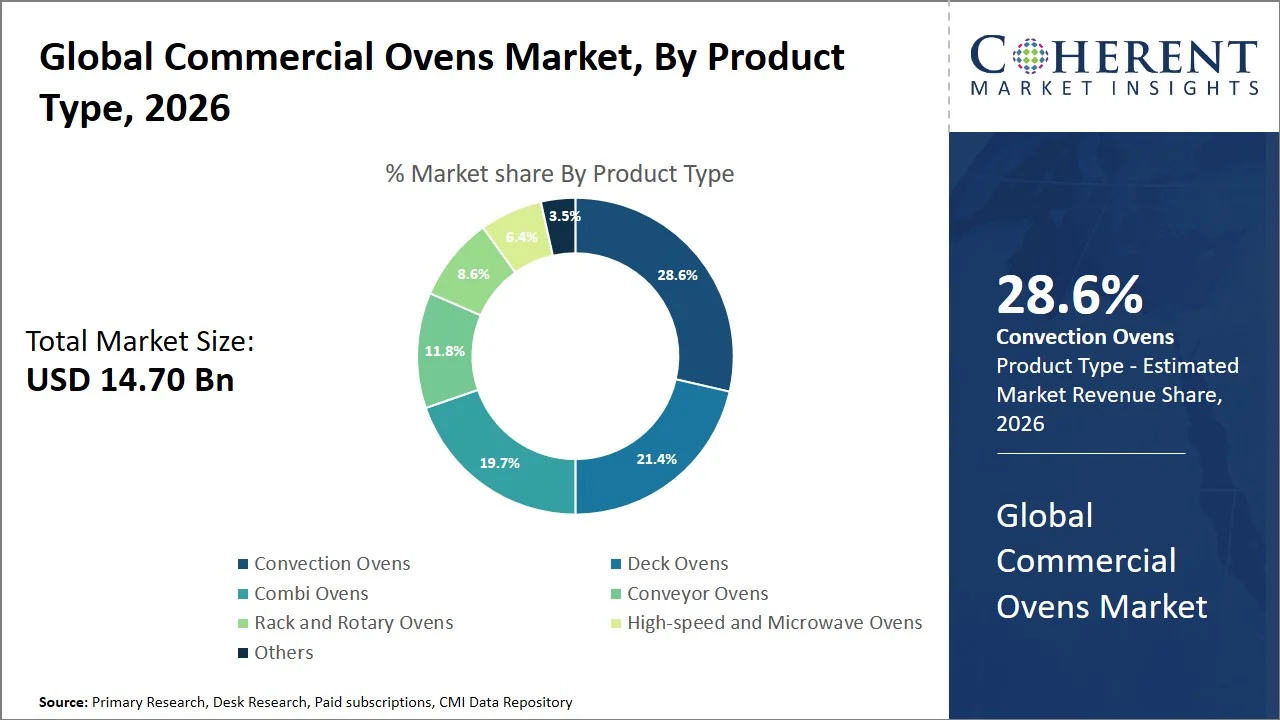
Why Do Convection Ovens Dominate the Global Commercial Ovens Market?
Convection ovens are expected to account for 28.6% of the global commercial ovens market in 2026 because forced-air circulation supports repeatable browning and temperature recovery across mixed cooking schedules. Their ability to bake, roast, reheat, and finish products makes them practical for restaurants, schools, healthcare kitchens, cafés, and retail foodservice operations that cannot justify several single-purpose appliances. Standardized cavity sizes, familiar rack formats, broad dealer availability, and established technician expertise also reduce procurement and lifecycle risk. Manufacturers can defend margins by adding programmable recipes, independent chamber control, ventless configurations, and connectivity without forcing buyers to redesign core workflows. In January 2025, Blodgett presented its electric ventless ImVection oven, which allows four chambers to operate with convection or impingement cooking, demonstrating how suppliers are extending convection technology into compact, multi-menu production environments.
- Current Industry Events of 2026
- Market Size Estimation
- Regional Breakdown
- Competitive Landscape
- Customer Intelligence
- Segmental Analysis
- Pricing Analysis
- Key Market Drivers, Challenges & Future Trends
- Customized Insights Section
Why Does Electric Represent the Largest Energy Source in the Global Commercial Ovens Market?
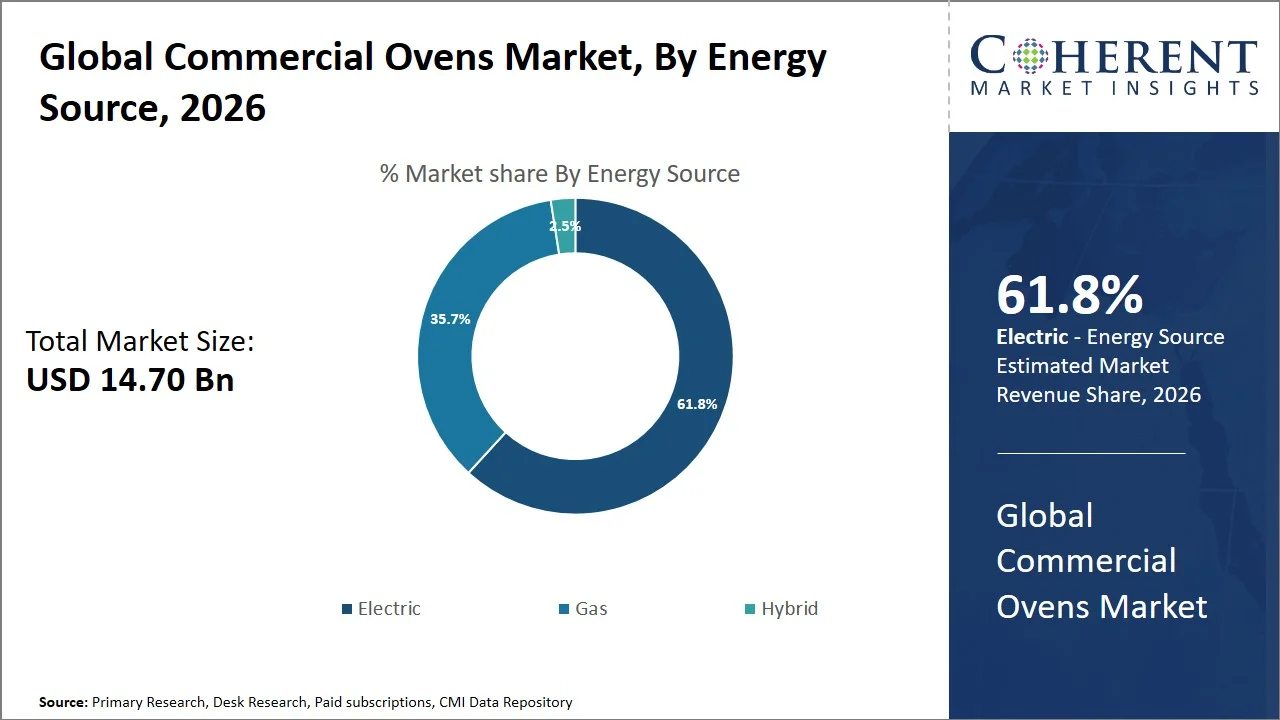
Electric segment is expected to represent 61.8% of the global commercial ovens market in 2026 as foodservice operators seek controllable heat, simplified utility planning, and equipment compatible with ventilation-constrained or gas-restricted properties. Electric heating enables accurate deck or cavity control, quick response of digital controls and easy programming of recipes and energy monitoring systems. These characteristics have meaningful applications in commercial hotels, restaurants, pizzerias, bakery and institutional kitchens which have to deal with several different batches and little skilled staff. There are also greater advantages for suppliers to standardize the products across markets instead of providing a variety of gas products for appliances. In June 2025, Moretti Forni documented the deployment of its electric Neapolis and P series ovens at Darsena del Sale, where electricity was essential for operating within a listed heritage building and independent deck temperatures supported several pizza styles. The case illustrates how site constraints and production flexibility reinforce electric oven purchasing.
Why Do Bakeries and Confectioneries Dominate the End User Segment of the Global Commercial Ovens Market?
Bakeries and confectioneries are expected to hold 31.7% of the global commercial ovens market in 2026 because oven performance directly determines crust development, moisture control, color uniformity, batch yield, and daily production capacity. Unlike kitchens where ovens support part of the menu, bakery businesses depend on continuous and precisely sequenced baking, making equipment replacement and capacity additions operationally critical. Demand spans production bakeries, pastry shops, supermarket bake-off counters, and multi-outlet chains requiring consistent results across different staff skill levels. Suppliers can create value through modular combinations, steam management, recipe storage, compact loading arrangements, and service contracts that minimize interrupted selling hours. In May 2025, WIESHEU and WACHTEL introduced the Dibas blue2 PICCOLO C baking station, combining convection and deck technologies in a modular footprint for bakery outlets. The configuration supports broader assortments while reducing space, training, and energy burdens at the point of sale.
Current Events and their Impact
Current Event | Description and Its Impact |
California Commercial Oven Efficiency Pre-Rulemaking – September 2024 |
|
European Union Cyber Resilience Act – December 2024 |
|
Global Commercial Ovens Market Dynamics
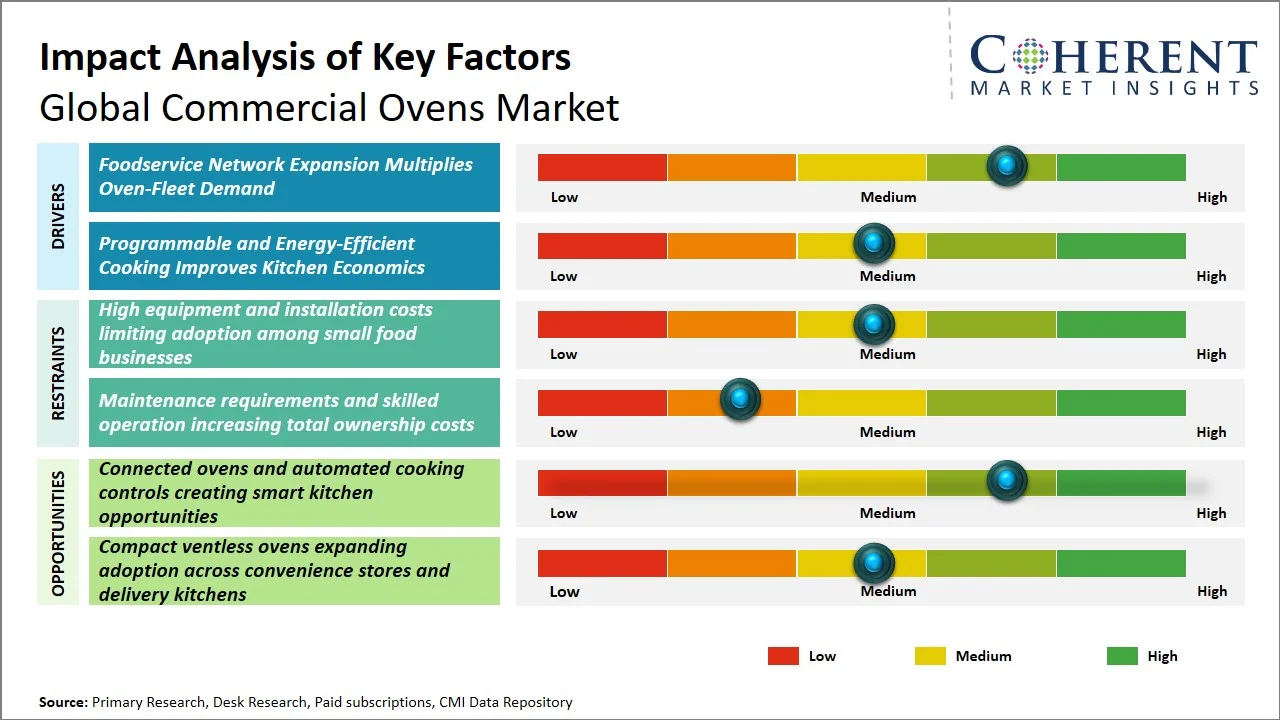
Key Market Drivers
Foodservice Network Expansion Multiplies Oven-Fleet Demand
Foodservice network expansion increases commercial oven demand through both new-unit installations and repeatable fleet specifications. Each restaurant, bakery, convenience-food outlet, hotel kitchen, or institutional site requires cooking capacity matched to menu volume, service speed, and peak-hour throughput. Multi-unit operators create particularly valuable demand because approved oven platforms are replicated across openings, while older locations generate replacement, refurbishment, and spare-parts revenue. Conveyor, deck, convection, and rapid-cook suppliers’ benefit, alongside distributors, installers, ventilation specialists, and service contractors. The commercial significance extends beyond initial equipment sales: expanding chains reward manufacturers that can deliver standardized controls, predictable lead times, national service coverage, and consistent cooking outcomes across geographically dispersed kitchens. In April 2026, Domino’s reported 233 gross store openings and 180 net additions during its first quarter, increasing its worldwide system to 22,322 stores and illustrating the equipment demand created by continuing restaurant-network expansion.
Programmable and Energy-Efficient Cooking Improves Kitchen Economics
Energy-efficient and programmable ovens convert utility and labor pressures into measurable kitchen productivity. Multi-stage recipes, automatic humidity control, independent timers, rapid heat recovery, and stored cooking programs allow operators to reproduce output with fewer manual adjustments. This reduces training complexity, overcooking, idle energy use, and production bottlenecks while improving menu consistency across shifts and locations. Hotels, supermarkets, healthcare kitchens, contract caterers, and restaurant groups gain from greater throughput per employee, whereas manufacturers and service providers benefit from premium controls, commissioning, software support, and preventive-maintenance revenue. Purchasing decisions therefore increasingly evaluate lifecycle operating cost and workflow reliability rather than acquisition price alone. In May 2024, Henny Penny documented Redner’s Markets’ use of FlexFusion combi ovens to improve food quality, efficiency, and workflow across an operation that needed equipment usable by more than 4,500 employees, demonstrating the commercial value of programmable cooking standardization.
Emerging Market Trends
Centralized Production and Distributed Finishing
Commercial food production is increasingly shifting toward central kitchens, while restaurants, hospitals, retail counters, and satellite outlets use ovens for regeneration and final preparation. This model increases demand for high-capacity production ovens and compact finishing systems with programmable recipes and moisture control. Manufacturers offering coordinated equipment, accessories, and workflow support across both locations can strengthen customer relationships and secure broader equipment contracts.
Automated Cleaning as a Lifecycle Revenue Model
Automated cleaning is becoming an important equipment-selection factor as operators seek lower labor requirements, controlled chemical use, consistent sanitation, and reduced downtime. Manufacturers can generate recurring revenue from detergents, filters, maintenance kits, and service agreements. Suppliers that combine effective cleaning performance with affordable consumables, transparent operating costs, and dependable after-sales support are likely to gain an advantage in commercial oven procurement.
Regional Insights
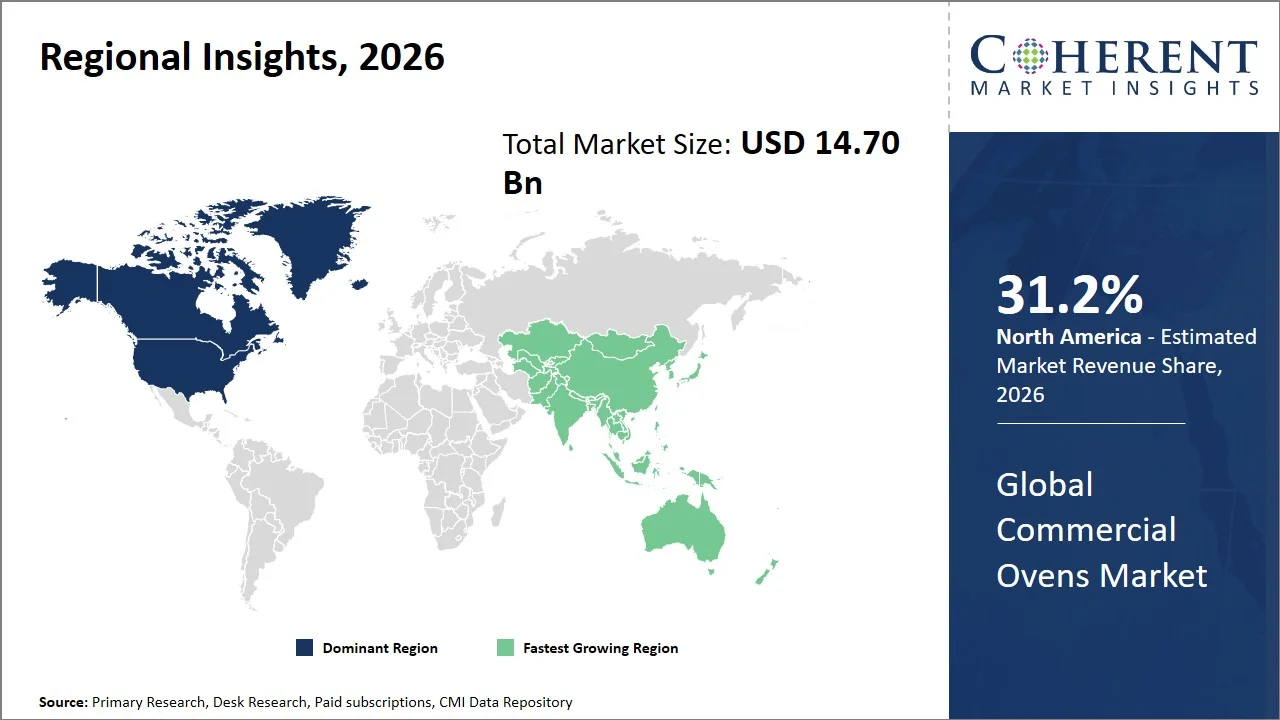
Why Does North America Dominate the Global Commercial Ovens Market?
North America is expected to lead the global commercial ovens market with a 31.2% share in 2026 because its large installed base of restaurants, quick-service chains, bakeries, hotels, schools, hospitals, and contract catering kitchens creates sustained replacement and upgrade demand. Operators increasingly prioritize programmable controls, connected monitoring, ventless configurations, energy efficiency, and dependable service coverage to manage labor constraints and protect throughput. Mature distributor networks also shorten equipment selection, installation, and maintenance cycles, supporting premium and multi-site purchases. In February 2026, Unox opened its first U.S. manufacturing facility in North Carolina, backed by a USD 20 million investment, to produce combi ovens locally, reduce customer lead times, and improve parts and service availability across North America. This localization strengthens regional supply resilience and supports faster adoption of advanced commercial cooking systems.
Why is Asia Pacific Emerging as the Fastest-Growing Region in the Commercial Ovens Market?
Asia Pacific is expected to be the fastest-growing region while accounting for 29.8% of the global commercial ovens market in 2026. Expansion of organized restaurants, bakery chains, convenience foodservice, hotels, institutional catering, and delivery-oriented kitchens is increasing demand for compact, programmable, and high-throughput ovens. Operators across the region require equipment that standardizes recipes, reduces dependence on highly skilled labor, accommodates diverse menus, and fits space-constrained urban kitchens. Local manufacturing and broader dealer coverage are also improving affordability and after-sales access. In March 2026, the government-backed AAHAR 2026 exhibition in India brought together hotels, restaurants, catering institutions, importers, distributors, and suppliers at a major South Asian business platform. Such industry ecosystems accelerate equipment demonstrations, distributor partnerships, and commercial procurement, supporting wider adoption of convection, combi, deck, and high-speed ovens.
Global Commercial Ovens Market Outlook for Key Countries
Why is the U.S. a Key Market for the Commercial Ovens Market?
The final market scope identifies the U.S. as a top-five country but does not provide a standalone 2026 country share. The U.S. remains central to commercial oven demand because it combines a very large restaurant base with substantial institutional foodservice, bakery, hospitality, convenience-store, and contract catering activity. High labor costs and persistent staffing challenges encourage operators to purchase programmable convection, combi, conveyor, and high-speed ovens that simplify training, improve batch consistency, and increase output per employee. Replacement demand is also supported by energy-efficiency targets, menu diversification, off-premises service, and multi-unit standardization. In February 2026, the National Restaurant Association projected U.S. restaurant and foodservice sales of USD 1.55 trillion and more than 100,000 additional jobs during the year. This operating scale creates a broad addressable base for both new installations and technology-led oven upgrades.
Why is India Important in the Global Commercial Ovens Market?
The final scope places India among the five key countries, although no separate 2026 country share was supplied. India supports commercial oven growth through rapid expansion of organized restaurants, bakery and confectionery outlets, hotels, catering businesses, and institutional kitchens beyond major metropolitan areas. Multi-site operators increasingly need electric convection and combi ovens that can reproduce recipes, reduce cooking supervision, improve food safety, and support broad menus within limited kitchen footprints. Domestic equipment manufacturing and competitive distributor networks also widen access among mid-sized buyers. In January 2025, the National Restaurant Association of India stated that the country’s foodservice industry was expected to reach USD 8,147.94 Mn by 2028, expanding at an 8.1% CAGR. Continued formalization of this customer base is likely to increase purchases of programmable, energy-conscious, and service-supported commercial ovens.
Why Does China Support Growth in the Commercial Ovens Market?
The final market scope lists China as a top-five country but does not assign a separate 2026 share. China’s importance reflects the combination of a vast catering economy, rapid chain expansion, dense urban delivery networks, and strong domestic manufacturing capabilities for stainless-steel foodservice equipment and electronic controls. Restaurant groups need ovens that deliver consistent cooking across thousands of locations while supporting smaller formats, lower-tier cities, and high delivery volumes. This favors connected combi, conveyor, deck, and high-speed systems with repeatable programs and efficient cleaning. In July 2026, Yum China reported opening 560 net new stores during the second quarter, lifting its network to 19,297 locations; Pizza Hut alone added 174 net new stores. Expansion at this scale creates recurring demand for standardized cooking platforms, replacement units, spare parts, and technician-supported maintenance.
Why is Germany a Strategic Country in the Commercial Ovens Market?
Germany is identified as a key country in the final scope, but a standalone 2026 market share was not provided. Its strategic importance comes from advanced commercial-kitchen engineering, strong bakery and hospitality traditions, export-oriented equipment production, and buyer emphasis on durability, hygiene, energy performance, and lifecycle cost. German manufacturers compete through precision temperature management, modular layouts, connected controls, heat recovery, and robust service models rather than low initial pricing. This strengthens Germany’s role as both a premium demand market and a technology-development center for commercial ovens. In July 2025, MKN’s new OPTIMA professional cooking line received the Red Dot Award for Product Design, recognizing its flexibility, durability, modular planning, seamless controls, and easier cleaning. The development illustrates how German suppliers use engineering and user-centered design to influence global purchasing specifications.
Why is Brazil an Important Growth Market for the Commercial Ovens Market?
Brazil is included among the five key countries in the final scope, although no individual 2026 share was supplied. The country offers growth potential through its extensive bakery, confectionery, pizzeria, restaurant, supermarket, hotel, and institutional catering base. Buyers require ovens adapted to high production volumes, varied regional menus, constrained capital budgets, and uneven service access across a large geography. Local manufacturing is therefore commercially important because it can improve product customization, financing, spare-parts availability, and technician response. In July 2025, Brazilian foodservice-equipment manufacturer Prática introduced the TORO TC deck oven at FIPAN in São Paulo, adding greater connectivity and technology for bakery and confectionery users. The launch shows how domestic suppliers are upgrading traditional baking platforms to meet demand for process control, consistency, and more efficient production.
Technology Adoption Landscape in the Global Commercial Ovens Market
Technology | Adoption Level | Key Application Area | Business Impact |
Variable-Speed Airflow with PID Temperature Control | High | Convection, rack, and multi-level baking operations | Improves temperature recovery and heat distribution, reducing variation between trays and consecutive batches. |
Closed-Loop Humidity and Steam Management | High | Combi cooking, bread production, roasting, and regeneration | Controls moisture loss, crust formation, texture, and yield while supporting repeatable multi-stage recipes. |
Multi-Stage Recipe Programming and Independent Timers | High | Chain restaurants, hotels, supermarkets, and institutional kitchens | Reduces operator dependence, simplifies training, and standardizes output across shifts and locations. |
Automatic Wash Cycles with Controlled Chemical Dosing | High | Combi ovens and high-volume catering equipment | Lowers manual cleaning requirements, supports sanitation consistency, and creates aftermarket consumable and service revenue. |
Catalytic Grease and Odor Treatment Systems | Medium | Food-to-go counters, kiosks, cafés, and constrained retail locations | Reduces dependence on conventional ventilation infrastructure, although menu limitations and local approvals can restrict deployment. |
Remote Diagnostics and Centralized Recipe Deployment | Medium | Multi-site oven fleets and managed foodservice operations | Supports faster fault identification, preventive maintenance, software updates, and centralized operational control while increasing cybersecurity obligations. |
How are Upgradeable Controls and Certified Retrofit Programs Creating New Growth Opportunities in the Global Commercial Ovens Market?
A large installed base of mechanically durable commercial ovens remains underserved by structured modernization programs. Many units retain usable chambers and frames but operate with aging controllers, inaccurate sensors, worn door seals, inefficient insulation, or obsolete communication hardware. Suppliers can capture this gap through certified upgrade packages covering digital controls, temperature calibration, door and insulation improvements, steam-system refurbishment, energy monitoring, and secure connectivity. The opportunity is relevant to independent restaurants, bakeries, hotels, schools, hospitals, and emerging-market kitchens that cannot justify full equipment replacement or prolonged installation downtime. Commercialization requires model-compatibility databases, validated retrofit procedures, trained technicians, regional parts inventories, warranty protection, and financing tied to operating savings. Established manufacturers are well positioned because they control technical documentation and original components, although specialist service companies can participate through authorized partnerships. Successful programs would create recurring aftermarket revenue, extend customer relationships, and provide a lower-cost route to improved performance. Companies should avoid unsupported universal kits and instead prioritize auditable upgrades that preserve safety certification and cooking reliability.
Market Players, Key Development, and Competitive Intelligence
Key Developments
- In March 2026, TurboChef introduced the Plexor M2, a two-chamber platform that can combine impingement, rapid-cook, or convection processes according to an operator’s menu. This is important for the global commercial ovens Market because modular process selection allows suppliers to serve broader foodservice applications without requiring customers to purchase and accommodate several separate appliances.
- In April 2025, Baxter announced the new CS500 rotating rack oven as part of ITW Food Equipment Group’s planned product showcase at the National Restaurant Association Show. This is important for the global commercial ovens market because a more accessible rack-oven offering can expand automated and uniform batch baking among independent bakeries, supermarket production departments, and growing regional bakery operations.
- In March 2025, Eloma presented a new generation of GENIUS MT and MULTIMAX floor-standing combi steamers with expanded chamber capacity, automated cleaning, improved insulation, enhanced steam functions, and additional cooking programs. This is important for the global commercial ovens market because it strengthens high-capacity solutions for institutional catering, hotels, hospitals, and production kitchens that require throughput, sanitation control, and energy retention within one platform.
Competitive Landscape
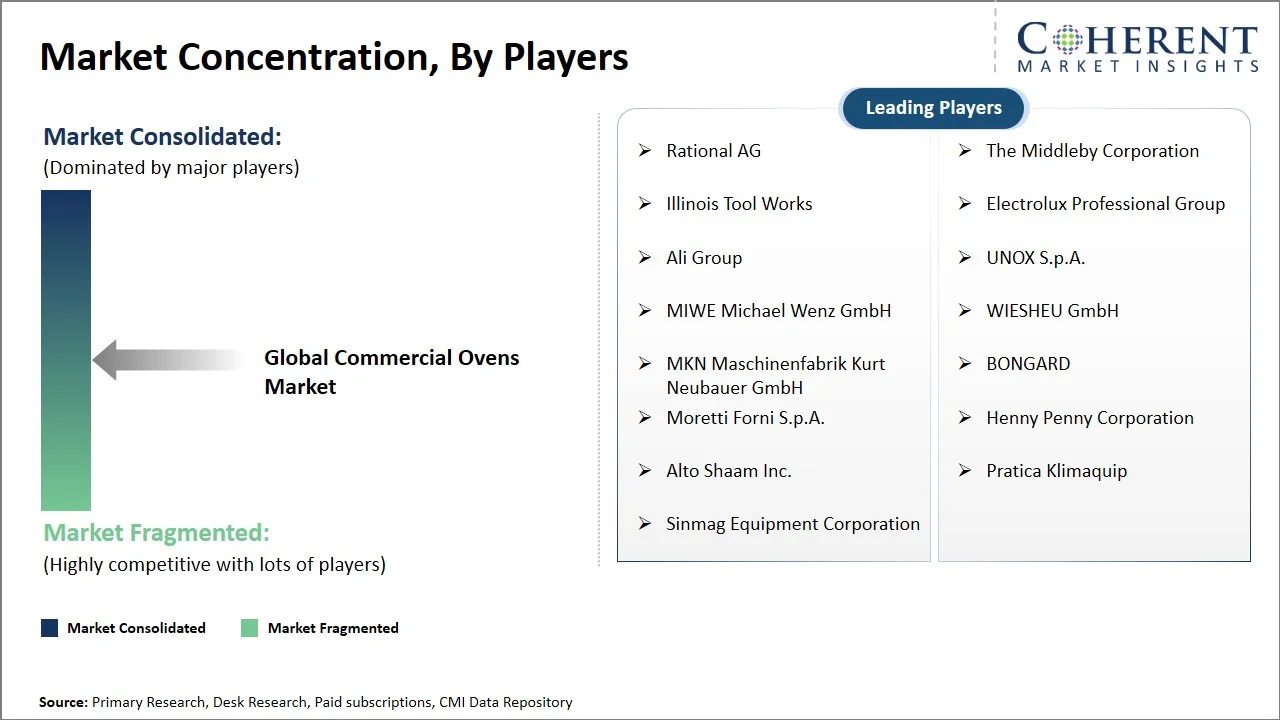
The global commercial ovens market is moderately fragmented, combining multinational foodservice-equipment groups with specialist oven manufacturers, bakery-technology providers, pizza-equipment companies, regional fabricators, and dealer-supported private-label suppliers. Global companies compete through portfolio breadth, engineering resources, multinational service arrangements, and institutional-account access. Specialists retain strong positions were application knowledge, customized chamber design, baking expertise, or menu-specific thermal performance matters more than corporate scale. Competitive advantage increasingly depends on balancing cooking performance with ownership cost, compliance readiness, product availability, installation support, and dependable maintenance.
Key focus areas include
- Thermal performance: Temperature uniformity, recovery speed, humidity accuracy, and repeatability determine product quality and usable capacity.
- Workflow specialization: Suppliers differentiate through oven configurations designed for baking, pizza production, high-speed service, roasting, regeneration, or institutional batch cooking.
- Total cost of ownership: Energy consumption, cleaning inputs, ventilation requirements, maintenance frequency, and expected equipment life increasingly influence procurement.
- Control usability: Clear interfaces, transferable cooking programs, multilingual operation, and simplified staff training strengthen chain-account acceptance.
- Compliance capability: Electrical safety, gas certification, food-contact standards, ventilation approvals, energy labeling, and cybersecurity readiness affect market access.
- Service and parts coverage: Technician availability, remote support, spare-parts inventory, and response times are decisive for customers whose revenue depends on oven uptime.
- Localized production and distribution: Regional assembly, distributor training, and market-specific configurations reduce lead times and help suppliers address local utility and menu requirements.
Market Report Scope
Commercial Ovens Market Report Coverage
| Report Coverage | Details | ||
|---|---|---|---|
| Base Year: | 2025 | Market Size in 2026: | USD 14.70 Bn |
| Historical Data for: | 2020 To 2024 | Forecast Period: | 2026 To 2033 |
| Forecast Period 2026 to 2033 CAGR: | 6.50% | 2033 Value Projection: | USD 22.84 Bn |
| Geographies covered: |
| ||
| Segments covered: |
| ||
| Companies covered: | Rational AG, The Middleby Corporation, Illinois Tool Works, Electrolux Professional Group, Ali Group, UNOX S.p.A., MIWE Michael Wenz GmbH, WIESHEU GmbH, MKN Maschinenfabrik Kurt Neubauer GmbH, BONGARD, Moretti Forni S.p.A., Henny Penny Corporation, Alto Shaam Inc., Pratica Klimaquip, and Sinmag Equipment Corporation | ||
| Growth Drivers: |
| ||
| Restraints & Challenges: |
| ||
Analyst Opinion (Expert Opinion)
- The global commercial ovens market leadership is likely to move from selling standalone ovens toward contracting for kitchen performance. Competitive offers will increasingly combine equipment selection, menu engineering, commissioning, operator training, uptime commitments, scheduled maintenance, consumables, and financing. Manufacturers that can quantify operational outcomes and remain commercially involved throughout the equipment lifecycle should gain stronger customer retention than suppliers competing primarily through specifications and initial price.
- Hardware-independent recipe portability could materially alter existing competitive boundaries. When cooking instructions, process parameters, and operating data can move securely between different equipment platforms, buyers may become less dependent on proprietary oven ecosystems. This would place pressure on manufacturers using closed controls to protect replacement sales and favor participants capable of building interoperable interfaces, governed data structures, cybersecurity safeguards, and partnerships with kitchen-management software providers.
- Manufacturers should prioritize modular electronics, compliance engineering, field-service training, critical-parts forecasting, and application support for customers where equipment downtime immediately affects food availability or revenue. Localizing high-failure service components can provide greater commercial value than duplicating entire manufacturing plants. Companies should control excessive model proliferation, which can dilute purchasing scale and complicate parts support, while protecting margins through clearly differentiated service packages rather than relying on repeated hardware discounting.
Speak to the analyst
Want personalized insights?
Take the findings above to one of our principal consultants, or have the report rebuilt around the segments, geographies and competitors you actually track.
Market Segmentation
- Product Type Insights (Revenue, USD Bn, 2021 - 2033)
- Convection Ovens
- Deck Ovens
- Combi Ovens
- Conveyor Ovens
- Rack and Rotary Ovens
- High-speed and Microwave Ovens
- Others
- Energy Source Insights (Revenue, USD Bn, 2021 - 2033)
- Electric
- Gas
- Hybrid
- End User Insights (Revenue, USD Bn, 2021 - 2033)
- Bakeries and Confectioneries
- Restaurants and Quick-service Restaurants
- Hotels and Catering Services
- Institutional Kitchens
- Retail Foodservice Outlets
- Others
- Distribution Channel Insights (Revenue, USD Bn, 2021 - 2033)
- Direct B2B Sales
- Distributors and Dealers
- Online Sales
- Specialty Equipment Retailers
- Others
- Regional Insights (Revenue, USD Bn, 2021 - 2033)
- North America
- U.S.
- Canada
- Latin America
- Brazil
- Argentina
- Mexico
- Rest of Latin America
- Europe
- Germany
- U.K.
- Spain
- France
- Italy
- Russia
- Rest of Europe
- Asia Pacific
- China
- India
- Japan
- Australia
- South Korea
- ASEAN
- Rest of Asia Pacific
- Middle East
- GCC Countries
- Israel
- Rest of Middle East
- Africa
- South Africa
- North Africa
- Central Africa
- North America
Sources
Primary Research Interviews
- Commercial oven, bakery-equipment, component, control-system, and foodservice-equipment manufacturers
- Restaurants, QSRs, bakeries, hotels, caterers, institutional kitchens, supermarkets, and cloud kitchens
- Distributors, dealers, importers, exporters, kitchen consultants, installers, and maintenance providers
- Procurement, production, engineering, quality, R&D, operations, regulatory, sales, and service executives
Stakeholders
- Oven manufacturers, heating-element and burner suppliers, stainless-steel fabricators, sensor providers, and contract manufacturers
- Restaurant chains, bakeries, hotels, catering companies, institutional kitchens, and retail foodservice operators
- Kitchen designers, equipment distributors, ventilation providers, service contractors, logistics companies, and leasing providers
End-Use Sectors
- Bakeries, confectioneries, pastry shops, and supermarket bakeries
- Restaurants, QSRs, pizzerias, cafés, and cloud kitchens
- Hotels, resorts, catering services, and banquet facilities
- Hospitals, schools, universities, corporate cafeterias, and military kitchens
- Supermarkets, convenience stores, food courts, and retail foodservice outlets
Regulatory and Government Bodies
- U.S. Department of Energy, EPA, ENERGY STAR, OSHA, and California Energy Commission
- European Commission, European Committee for Standardization, and UK regulatory authorities
- Natural Resources Canada and Standards Council of Canada
- China SAMR, Japan METI, Bureau of Indian Standards, and FSSAI
- Standards Australia and Brazil INMETRO
Databases
- UN Comtrade, ITC Trade Map, WTO, Eurostat, World Bank, OECD, and national statistics databases
- USITC DataWeb, U.S. Census Bureau, China Customs, Japan Trade Statistics, India Export Import Data Bank, and Brazil Comex Stat
- ENERGY STAR and U.S. Department of Energy equipment databases
- Espacenet, WIPO PATENTSCOPE, company filings, catalogues, price lists, patents, and shipment records
Magazines and Journals
- Foodservice Equipment Reports, Foodservice Equipment Journal, Catering Insight, and Foodservice Equipment & Supplies
- Restaurant Business, QSR Magazine, Foodservice Director, Baking Business, and Baking & Snack
- Journal of Food Engineering, Applied Thermal Engineering, Energy and Buildings, and International Journal of Hospitality Management
Associations
- North American Association of Food Equipment Manufacturers
- Foodservice Consultants Society International
- Commercial Food Equipment Service Association
- National Restaurant Association
- American Bakers Association
- European Federation of Catering Equipment Manufacturers
- Bakery Equipment Manufacturers and Allieds
- VDMA Food Processing and Packaging Machinery Association
Public Domain Sources
- Energy-efficiency standards, safety certifications, test procedures, and product-registration records
- Restaurant, bakery, hotel, catering, and institutional foodservice statistics
- Commercial cooking-equipment import and export records
- Public procurement, factory approvals, environmental clearances, and investment announcements
- Product catalogues, technical specifications, manuals, patents, annual reports, and press releases
Key Standards and Regulations
- ENERGY STAR commercial oven criteria and U.S. Department of Energy requirements
- NSF/ANSI 4, UL 197, ANSI Z83.11, CSA 1.8, and commercial-kitchen fire and ventilation codes
- EU CE marking, Low Voltage, EMC, Machinery, RoHS, REACH, and gas-appliance requirements
- UKCA, Canadian, Chinese, Japanese, Indian, Australian, and Brazilian appliance-safety requirements
- ISO 9001, ISO 14001, ISO 45001, HACCP, sanitation, food-contact, and traceability standards
Proprietary Elements
- CMI Data Analytics Tool
- Proprietary CMI Existing Repository of information for last 10 years.
Get access to 250+ pages report
Every segment, forecast, competitor profile and data table behind the analysis above — available for instant download.
- ESOMAR Member
- ISO 9001:2015 Certified
- D-U-N-S Registered
- GDPR & CCPA Compliant
Missing comfort of reading report in your local language? Find your preferred language:
Transform your Strategy with Exclusive Trending Reports
Frequently Asked Questions
The CAGR of the global commercial ovens market is projected to be 6.50% from 2026 to 2033.
The global commercial ovens market is estimated to be valued at USD 14.70 Bn in 2026 and is expected to reach USD 22.84 Bn by 2033.
Electric ovens lead the market due to precise temperature control, programmable operation, and compatibility with energy-efficient commercial kitchens.
Bakeries and confectioneries generate the highest demand because ovens are essential for consistent baking quality, production capacity, and product standardization.
Asia Pacific is expected to be the fastest-growing region, supported by expanding restaurant chains, bakery modernization, hospitality investment, and organized foodservice development.
Foodservice expansion increasing demand for high capacity commercial cooking equipment and energy efficient and programmable ovens improving kitchen productivity and consistency are the major factors driving the growth of the global commercial ovens market.
High equipment and installation costs limiting adoption among small food businesses and maintenance requirements and skilled operation increasing total ownership costs are the major factors hampering the growth of the global commercial ovens market.