

Global Cosmetic Pigments Market
Market Definition |
The global cosmetic pigments market covers colorants and effect pigments used in makeup, personal care, hair colorants, nail products, and beauty formulations. These pigments include inorganic pigments, organic pigments, natural pigments, iron oxides, titanium dioxide, mica-based pigments, lakes, toners, ultramarines, and pearlescent pigments. |
Key Statistics at a Glance
Metric | Value |
Global Market Size (2026) | USD 1,032.4 Million |
Forecast Market Size (2033) | USD 1,636.2 Million |
Growth Rate (CAGR 2026–2033) | 6.8% |
Leading Composition Segment | Inorganic Pigments (58.6% share in 2026) |
Leading Pigment Type Segment | Iron Oxides (28.4% share in 2026) |
Leading Form Segment | Powder Pigments (64.8% share in 2026) |
Dominant Region | Europe (32.4% share in 2026) |
Fastest Growing Region | Asia Pacific (29.8% share in 2026) |
Base Year | 2025 |
Forecast Period | 2026–2033 |
Key Players | Sun Chemical, Sensient Cosmetic Technologies, Merck KGaA, Sudarshan Chemical Industries, Clariant |
Global Cosmetic Pigments Market Size and Forecast - 2026-2033
The Global Cosmetic Pigments Market is estimated to be valued at USD 1,032.4 Mn in 2026 and is expected to reach USD 1,636.2 Mn by 2033, exhibiting a compound annual growth rate (CAGR) of 6.8% from 2026 to 2033. This growth is driven by rising consumer interest in innovative color cosmetics, premium makeup products, clean beauty trends, and high-performance pigments that enhance stability, texture, and visual appeal.
Additionally, the expansion of beauty markets in emerging regions, along with continuous advancements in surface-treated, pearlescent, and effect pigments, is contributing to market growth. In April 2026, ECKART introduced two advanced effect pigments and showcased new cosmetic trend concepts at in-cosmetics Global 2026 in Paris, including a durable blue effect pigment and a vibrant orange interference pigment, reflecting ongoing innovation in cosmetic color technologies.
Key Takeaways of the Global Cosmetic Pigments Market
- Inorganic pigments are expected to dominate the composition segment with 58.6 % share in 2026, supported by strong color stability, opacity, and use across foundations, sunscreens, eye cosmetics, and long-wear products. In March 2026, the U.S. FDA updated its color additives resource, reinforcing that color additives, except coal tar hair dyes, require approval before use in cosmetics.
- Iron oxides are expected to lead the pigment type segment with 28.4 % share in 2026, as they offer stable red, yellow, black, and brown tones for complexion and color cosmetics. In May 2025, Sun Chemical highlighted Timica Terra effect pigments with high iron oxide loadings, designed to deliver skin-tone radiance and coverage without milling or grinding.
- The powder pigments segment is expected to hold 64.8 % of the market share in 2026 as the powder form offers easier handling, blending flexibility, and suitability for pressed powders, loose powders, eyeshadows, blushes, and mineral makeup. In February 2026, Koel Colours introduced Sparsh TMS-treated pigments for high-performance cosmetic color solutions, supporting longer-lasting formulations and improved sensory feel.
- Europe is expected to remain the dominant region with 32.4 % share in 2026, supported by strict cosmetic safety standards, premium color cosmetics consumption, and strong formulation capabilities. In May 2025, Commission Regulation (EU) 2025/877 updated the EU Cosmetics Regulation for Carcinogenic, Mutagenic, or Reprotoxic (CMR)-classified substances, strengthening compliance requirements for cosmetic ingredient and pigment suppliers.
- Asia Pacific is expected to be the fastest-growing region with 29.8 % share in 2026, supported by expanding beauty manufacturing, K-beauty and J-beauty influence, and increasing demand for high-impact color cosmetics. In November 2025, in-cosmetics Asia drew a record 14,383 unique visitors and 700 exhibitors in Bangkok, reflecting stronger regional formulation activity.
- Current Industry Events of 2026
- Market Size Estimation
- Regional Breakdown
- Competitive Landscape
- Customer Intelligence
- Segmental Analysis
- Pricing Analysis
- Key Market Drivers, Challenges & Future Trends
- Customized Insights Section
Segmental Insights
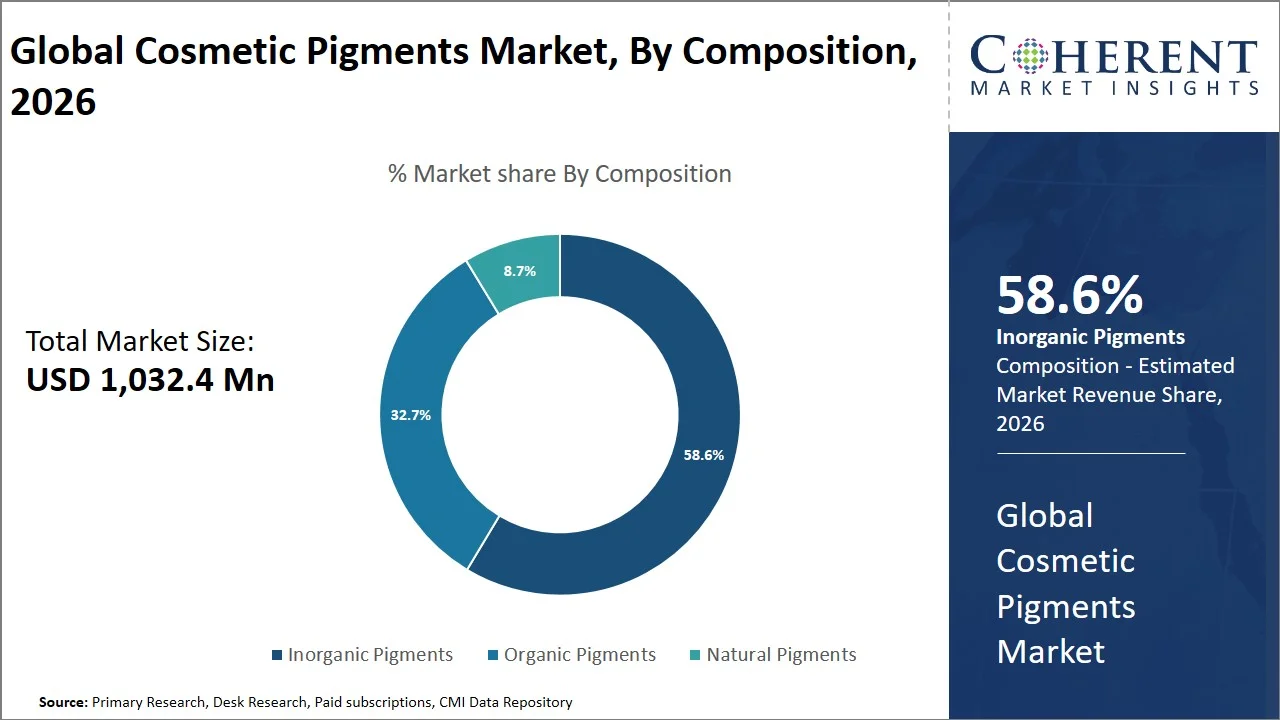
Why Do Inorganic Pigments Dominate the Global Cosmetic Pigments Market?
Inorganic pigments are expected to dominate the global cosmetic pigments market with 58.6% share in 2026, mainly because they offer strong opacity, color stability, heat resistance, lightfastness, and broad compatibility with makeup formulations. Demand is the strongest in facial makeup, eye makeup, compact powders, foundations, concealers, and sunscreens, where formulators need reliable shade performance and safe mineral-based color systems. Supply-side strength comes from established manufacturing routes for titanium dioxide, iron oxides, ultramarines, and mica-based pigment systems. These pigments also support premium and mass-market products because they deliver consistent coverage across different skin tones. In September 2025, the European Commission’s SCCS issued a request for a scientific opinion on titanium dioxide in nano and non-nano cosmetic products, reinforcing the strategic importance of safety-reviewed inorganic pigments in regulated beauty formulations.
Why Do Iron Oxides Represent the Largest Pigment Type in the Cosmetic Pigments Market?
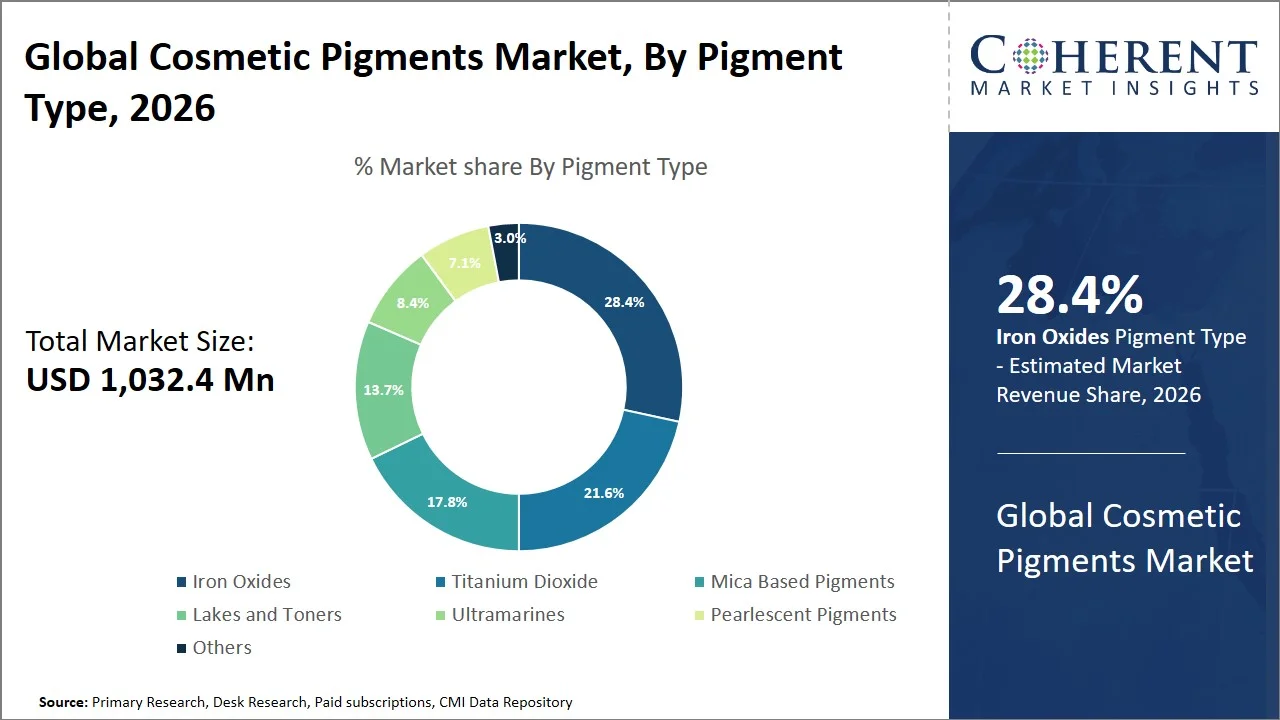
Iron oxides are expected to represent the largest pigment type with 28.4% share in 2026, supported by their essential role in natural skin-tone, brown, red, yellow, and black shade development. They are widely used in foundations, concealers, pressed powders, blushes, brow products, eyeshadows, and lip products because they provide earthy tones, strong coverage, and high formulation stability. Demand is also supported by inclusive shade ranges, where brands require precise undertone control for deeper and warmer complexions. On the supply side, high-purity and low-heavy-metal iron oxide grades are becoming important for global cosmetic compliance. In October 2024, OXERRA introduced OxPure, a new range of ultra-high purity iron oxide pigments formulated for cosmetic applications and positioned to exceed global regulatory requirements.
Why Do Powder Pigments Dominate the Cosmetic Pigments Market?
Powder pigments are expected to dominate the form segment with 64.8% share in 2026, as they are easier to blend, dose, micronize, press, and customize across large-scale cosmetic manufacturing. Their strong position is supported by broad use in pressed and loose powder formats, eyeshadows, blushes, mineral makeup, highlighters, and compact foundation products, where dry pigment handling supports shade accuracy and production efficiency. Powder formats also allow formulators to combine iron oxides, titanium dioxide, mica, lakes, and effect pigments with binders and fillers to create different textures and finishes. Supply-side adoption is strong because powder pigments support flexible batch production and lower processing complexity compared with liquid systems. In April 2025, Kobo Products showcased a pressed powder formulation at in-cosmetics Global 2025 using silane-treated pigments that create shade and disperse easily, highlighting powder pigment’s relevance in modern color cosmetics.
Global Cosmetic Pigments Market Dynamics
Market Drivers
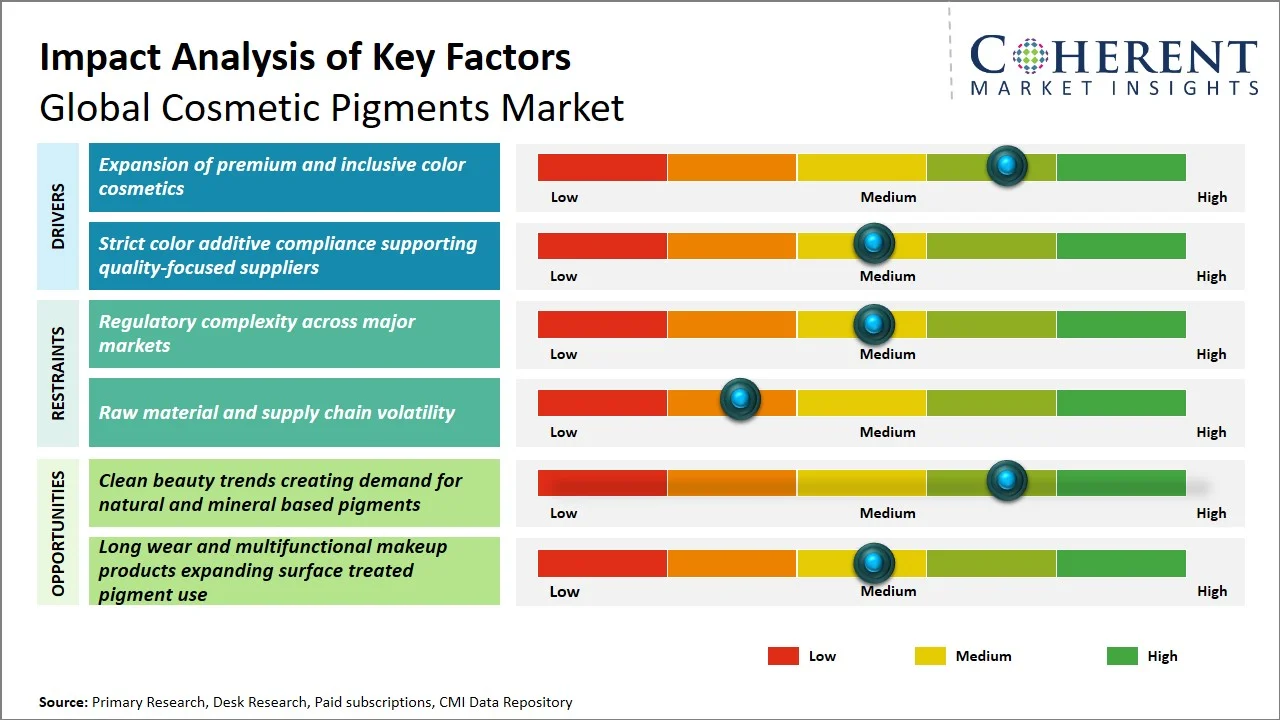
- Expansion of Premium and Inclusive Color Cosmetics: Cosmetic brands are widening shade ranges across foundations, concealers, blushes, lip products, and eye makeup, increasing the need for stable and high-purity pigments. Iron oxides, titanium dioxide, and mica-based pigments are especially important in complexion and hybrid makeup products where tone accuracy and coverage are critical. Premiumization is also encouraging suppliers to offer pigments with better dispersion, skin feel, and visual depth. In February 2026, L’Oréal reported 2025 sales of USD 50.27 billion, growth across all divisions and regions, and e-commerce passing 30% of sales, showing the scale of beauty demand and digital-led product discovery that supports color cosmetic innovation.
- Strict Color Additive Compliance Supporting Quality-Focused Suppliers: Regulatory control over cosmetic colorants is becoming a major purchasing criterion for global beauty brands. Pigment suppliers must meet purity, heavy metal, permitted-use, and batch certification requirements, particularly in the U.S. and Europe. This supports demand for documented, traceable, and regulation-ready pigment grades rather than low-cost unverified alternatives. In March 2026, the U.S. Food & Drug Administration reiterated that color additives, except coal tar hair dyes, require approval before they may be used in cosmetics, reinforcing compliance as a core market driver.
- Shift Toward Natural and Sustainable Pigment Alternatives: Beauty brands are increasingly evaluating pigment sources that reduce fossil-based inputs and improve sustainability positioning. Natural pigments remain a smaller segment, but they are gaining relevance in clean beauty, vegan cosmetics, and brands targeting environmentally conscious consumers. This is creating opportunities for algae-derived, mineral-based, and bio-based color systems. In April 2024, The Unseen Beauty partnered with Living Ink to debut Algae Black in mascara and eyeliner, positioning it as a sustainable alternative to petroleum-based black carbon pigment.
- Rising Formulation Activity Across Asia Pacific: Asia Pacific is becoming a major formulation and sourcing hub for color cosmetics, supported by K-beauty, J-beauty, indie beauty brands, and regional contract manufacturing. This increases demand for pigment dispersions, treated pigments, synthetic mica, and effect pigments that enable fast product development. Regional events and ingredient platforms are also strengthening buyer-supplier engagement
- Demand for Trend-Led Shades and High-Impact Visual Effects: Cosmetic pigments are increasingly selected not only for color but also for finish, texture, light reflection, and brand storytelling. Eye makeup, lip products, and facial makeup require pigments that can deliver matte, satin, shimmer, metallic, and pearlescent effects while remaining stable in complex formulations. This is pushing suppliers to offer curated color palettes and trend-based pigment solutions.
Top 5 Trends in the Global Cosmetic Pigments Market
- Dominance of Inorganic Pigments: Inorganic pigments are expected to remain the preferred choice for complexion and long-wear makeup due to opacity, stability, and regulatory familiarity. Their use is particularly strong in foundations, powders, concealers, and eye products where consistent shade and durability are essential.
- Growing Use of Surface-Treated Pigments: Surface treatment is becoming important for improving spread ability, skin adhesion, water resistance, and sensory feel. Treated iron oxides, titanium dioxide, and mica-based pigments help brands develop transfer-resistant and long-lasting cosmetic formulas.
- Shift Toward Ready-to-Use Pigment Dispersions: Pigment dispersions are gaining traction among contract manufacturers and indie brands that need faster formulation cycles. Pre-dispersed systems reduce processing time, improve color consistency, and lower batch-to-batch variation.
- Clean Beauty Impact on Pigment Selection: Brands are reviewing pigment origin, traceability, heavy metal limits, talc association, and sustainability claims before supplier selection. This is creating stronger demand for documented mineral pigments, natural-origin colorants, and responsibly sourced mica alternatives.
- Higher Demand for Visual Effect Pigments: Pearlescent, metallic, shimmer, and soft-focus pigments are being used to differentiate premium makeup products. Mica-based and synthetic effect pigments are gaining relevance in eye makeup, highlighters, lip products, and hybrid skincare-makeup formats.
Market Challenges
- Regulatory Complexity Across Major Markets: Cosmetic pigments must comply with different color additive lists, permitted-use conditions, purity limits, and labeling rules across the U.S., EU, China, and other countries. This increases testing, documentation, and registration costs for suppliers. Smaller pigment producers may find it difficult to meet multi-market compliance expectations, limiting their access to global beauty brands.
- Raw Material and Supply Chain Volatility: Pigments depend on mineral inputs, specialty chemicals, dispersants, mica, titanium dioxide, and iron oxide feedstocks. Any disruption in mining, energy prices, logistics, or chemical intermediates can affect pigment pricing and lead times. This creates margin pressure for formulators, especially in cost-sensitive mass-market makeup products.
- Safety Concerns Around Contaminants and Impurities: Heavy metals, asbestos concerns in talc-associated materials, and impurity limits remain important risks for cosmetic pigments. Brands increasingly require certificates of analysis, supplier audits, and third-party testing before procurement. These controls improve product safety but can slow new product launches and raise compliance costs.
Current Events and their Impact
Current Events | Description and its Impact |
U.S. FDA Color Additive Certification Fee Increase, November 2024 |
|
EU Commission Regulation 2025/877 on CMR Substances, May 2025 |
|
China NMPA Cosmetic Safety Risk Monitoring Measures, April 2025 |
|
Regional Insights
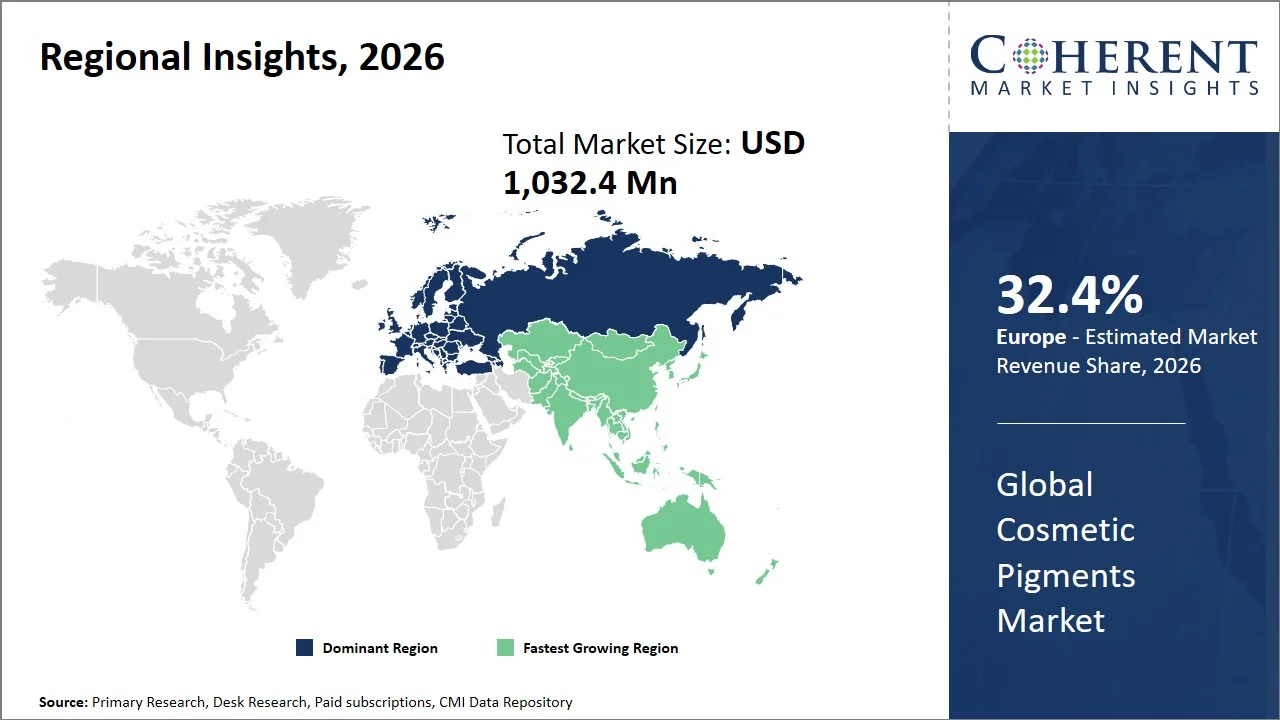
Why Does Europe Dominate the Global Cosmetic Pigments Market?
Europe is expected to dominate the global cosmetic pigments market with 32.4% share in 2026, supported by its mature beauty manufacturing base, premium color cosmetics consumption, and strict ingredient quality expectations. The region has strong demand for iron oxides, titanium dioxide, mica-based pigments, and pearlescent pigments used in facial makeup, eye makeup, lip products, and high-end formulations. European brands also place strong emphasis on pigment purity, safety documentation, responsible sourcing, and compliance with cosmetic ingredient standards. In June 2025, Cosmetics Europe reported that Europe’s cosmetics and personal care retail sales reached USD 125.64 billion, with decorative cosmetics valued at USD 15.53 billion, highlighting a large downstream base for cosmetic pigment demand.
Why is Asia Pacific Emerging as the Fastest-Growing Region in the Cosmetic Pigments Market?
Asia Pacific is expected to be the fastest-growing region with 29.8% share in 2026, driven by rapid expansion of K-beauty, J-beauty, C-beauty, and India’s fast-growing color cosmetics consumption. The region has strong formulation activity across face makeup, eye makeup, lip products, nail products, and hybrid skincare-makeup formats. Local and international brands are increasingly using treated pigments, dispersions, synthetic mica, and high-impact effect pigments to respond faster to beauty trends. In November 2025, Cosmoprof Asia 2025 in Hong Kong attracted 64,761 visitors from 140 countries and regions and 2,688 exhibitors from 46 countries and regions, confirming Asia Pacific’s growing role as a beauty innovation and sourcing hub.
Global Cosmetic Pigments Market Outlook for Key Countries
Why is the U.S. a Key Market for the Cosmetic Pigments Market?
The U.S. is expected to account for 24.5% share in 2026, making it one of the most important country markets for cosmetic pigments. Demand is supported by a large beauty retail ecosystem, strong makeup consumption, and high adoption of inclusive shade ranges across foundations, concealers, blushes, lip products, and eye cosmetics. Pigment suppliers benefit from demand for high-purity iron oxides, titanium dioxide, lakes, toners, and effect pigments that meet brand-level quality expectations. In May 2026, the Personal Care Products Council reported that the U.S. personal care products industry generated USD 495.6 billion in total economic output and supported more than 2.6 million jobs, showing the scale of the downstream market served by pigment and ingredient suppliers.
Why Does China Support Growth in the Cosmetic Pigments Market?
China is expected to hold 11.4% share in 2026, supported by its large cosmetics consumption base, strong domestic beauty brands, and advanced online beauty retail ecosystem. The country is an important demand center for facial makeup, lip products, eye makeup, and trend-driven color cosmetics that require stable pigments, dispersions, and effect finishes. China also supports pigment demand through its manufacturing clusters and fast product launch cycles. In January 2026, China’s National Bureau of Statistics reported that 2025 cosmetics retail sales reached USD 68.49 billion, rising 5.1% year-on-year, indicating sustained consumer demand for beauty products despite broader retail moderation.
Why is India Important in the Global Cosmetic Pigments Market?
India is expected to account for 5.8% share in 2026, supported by rising beauty spending, premiumization, e-commerce-led discovery, and growing adoption of makeup among younger consumers. The country is becoming important for pigments used in foundations, kajal, lipsticks, compact powders, blushes, and affordable premium color cosmetics. Hot and humid climate conditions also push brands to use pigments that support long-wear, sweat-resistant, and high-coverage formulations. In August 2025, Reuters reported that India’s luxury beauty market was expected to grow from USD 800 million in 2023 to USD 4 billion by 2035, while global brands were modifying offerings for Indian consumers, supporting demand for localized pigment and shade solutions.
Why is Japan a Strategic Country in the Cosmetic Pigments Market?
Japan is expected to hold 5.1% share in 2026, supported by its advanced cosmetics formulation culture, quality-focused consumers, and strong demand for refined textures, natural finishes, and functional makeup products. Japanese cosmetic manufacturers prioritize pigment consistency, fine particle size, safety, and sensorial performance, especially in facial makeup, powders, eye makeup, and premium color cosmetics. The country also remains relevant for export-oriented beauty innovation across Asia. In October 2024, the Japan Cosmetic Industry Association reported that Japan’s cosmetic shipments reached USD 8.03 billion in 2023, with makeup cosmetics accounting for 20.7% of shipment value, reinforcing Japan’s established base for pigment-intensive cosmetic categories.
Why is South Korea an Important Growth Market for the Cosmetic Pigments Market?
South Korea is expected to account for 3.8% share in 2026, supported by K-beauty’s global influence, fast innovation cycles, and strong demand for trend-led makeup textures and shades. The country is important for pigment suppliers because Korean brands frequently develop lightweight complexion products, cushion makeup, lip tints, eye palettes, and hybrid skincare-makeup formats. These products require pigments that deliver smooth dispersion, soft-focus effects, transparency, and long-lasting color. In November 2025, South Korea’s Ministry of Trade, Industry and Resources reported that cosmetics exports reached USD 9.42 billion as of October 2025, up 11.9% year-on-year, reflecting strong global demand for Korean beauty products.
Technology Adoption Landscape in the Global Cosmetic Pigments Market
Technology | Adoption Level | Key Application Area | Business Impact |
Surface-treated pigments | High | Foundations, concealers, powders, eye makeup | Improves spreadability, adhesion, water resistance, and long-wear performance |
High-purity iron oxide and titanium dioxide processing | High | Facial makeup, sunscreens, color cosmetics | Supports shade consistency, opacity, safety compliance, and batch reliability |
Pigment dispersion and micronization technology | High | Liquid foundations, lip products, nail products | Reduces formulation time, improves color uniformity, and lowers batch rejection |
Synthetic mica and effect pigment engineering | Medium | Highlighters, eyeshadows, nail products, premium makeup | Enables pearlescent, metallic, and shimmer effects with stronger traceability |
Encapsulated and color-changing pigment systems | Medium | Lip products, personalized makeup, novelty cosmetics | Supports product differentiation and interactive beauty formats |
Digital color matching and spectrophotometry | High | Shade development, quality control, scale-up | Improves color accuracy, reduces reformulation cycles, and supports global shade consistency |
How are Surface-Modified Pigments and Clean Beauty Formulations Driving New Opportunities in the Global Cosmetic Pigments Market?
Surface-treated pigments and clean-label formulation needs are creating strong growth opportunities in the global cosmetic pigments market. Brands are moving beyond basic color delivery and now require pigments that support better skin feel, longer wear, improved dispersion, moisture resistance, and compatibility with hybrid skincare-makeup formulas. This is commercially important because facial makeup remains the leading application area, and shade accuracy is critical for foundations, concealers, blushes, and setting powders. Suppliers that can provide treated iron oxides, titanium dioxide, mica-based pigments, and ready-to-use dispersions are better positioned to serve both premium brands and fast-moving contract manufacturers. Clean beauty is also creating demand for responsibly sourced minerals, synthetic mica alternatives, natural-origin colorants, and stronger impurity documentation. Over the forecast period, companies that combine performance, safety data, sustainability claims, and formulation support can capture higher-value opportunities across Europe, North America, and Asia Pacific.
Market Players, Key Development, and Competitive Intelligence
Key Developments
- In June 2026, Sun Chemical announced that it would introduce its latest cosmetic ingredient and effect pigment technologies at in-cosmetics Korea 2026 in Seoul. This is important for the global cosmetic pigments market because it strengthens access to high-performance, high-purity, visually impactful pigments for K-beauty and Asia-focused color cosmetics development.
- In May 2026, Sunjin Beauty Science officially opened its Indonesia subsidiary as part of its strategic expansion into Southeast Asia. This is important for the global cosmetic pigments market because Sunjin’s portfolio includes pigments and pigment dispersions, and a local Southeast Asian presence can improve customer support, regional supply, and formulation collaboration.
- In July 2025, Global New Material International acquired Merck’s Surface Solutions business after the business was transferred on July 31, 2025. The deal is relevant to the global cosmetic pigments market because Surface Solutions includes pearlescent and effect pigments used in cosmetics, strengthening GNMI’s global position in high-value visual effect materials.
- In March 2025, Sudarshan Chemical Industries Ltd. completed the acquisition of Heubach Group’s global pigment business. The deal is relevant to the global cosmetic pigments market because it created a larger global pigment platform with a wider portfolio, 19 international sites, and stronger access to Europe and the Americas.
Competitive Landscape
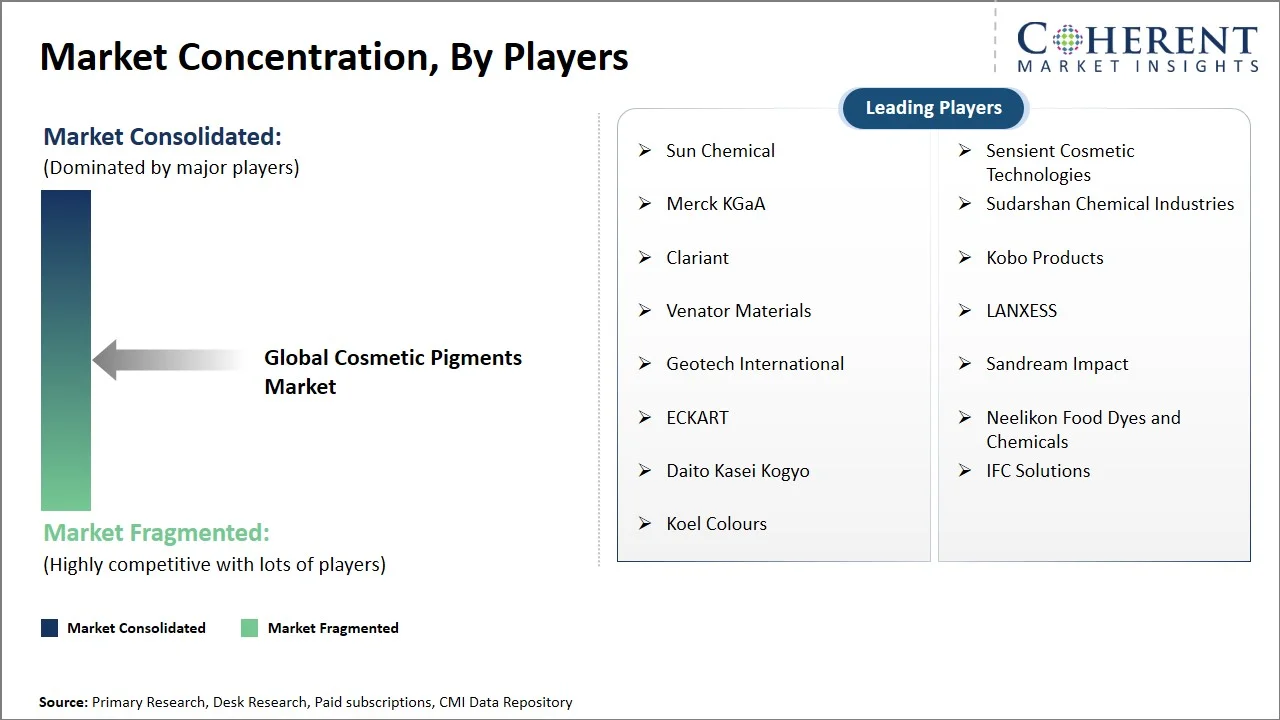
The global cosmetic pigments market is moderately fragmented, with competition between large specialty chemical companies, pigment manufacturers, cosmetic ingredient suppliers, regional colorant producers, and niche natural pigment innovators. Competition is based on purity, regulatory compliance, color consistency, formulation support, shade innovation, sustainability positioning, and supply reliability.
Key focus areas include
- Product quality and differentiation remain critical, especially for iron oxides, titanium dioxide, mica-based pigments, lakes, toners, and pearlescent grades.
- Technology adoption is focused on surface treatment, dispersion stability, micronization, and high-purity pigment processing.
- Pricing and cost competitiveness matter in mass-market makeup, while premium brands prioritize performance, traceability, and regulatory documentation.
- Capacity expansion and supply reliability are important as beauty brands reduce dependence on single-region sourcing.
- Certifications, testing, and quality control are becoming stronger differentiators for suppliers targeting the U.S., EU, and China.
- Product format differentiation is increasing across powders, dispersions, pastes, treated pigments, and customized blends.
- Partnerships with contract manufacturers and formulation labs help suppliers improve customer stickiness and shorten development cycles.
- Sustainable, synthetic mica, natural-origin, and clean-beauty pigment positioning is becoming more important for premium and indie beauty brands.
Competitive Landscape Table
Company | Headquarters | Key Market Brands | Primary Market Segment |
Sun Chemical | Parsippany, U.S. | SunPURO, Timica, Chione, SunSHINE | Cosmetic colorants, high-purity iron oxides, inorganic pigments, synthetic mica, and effect pigments |
Sensient Cosmetic Technologies | Milwaukee, U.S. | Unipure, Ariabel, Covapearl, Natpure | Organic/inorganic pigments, dyes, pearls, and natural color ingredients |
Merck KGaA | Darmstadt, Germany | Timiron, Colorona, Xirona, Ronastar | Effect pigments, pearlescent pigments, and mica-based cosmetic pigments |
Sudarshan Chemical Industries | Pune, India | Prestige, Sumicos, Sumicair, Sudacos | Organic pigments, inorganic pigments, pearlescent pigments, and effect pigments |
Clariant | Muttenz, Switzerland | Hostaperm, Novoperm, Hostatint, Colanyl | Specialty pigments and pigment preparations |
Kobo Products | South Plainfield, U.S. | KTZ Pearls, Kobopearl, Moonshine, CARESS | Surface-treated pigments, color dispersions, effect pigments, and powders |
Venator Materials | Wynyard, U.K. | HOMBITAN, UV-TITAN, TIOXIDE, Ultramarine Blue | Titanium dioxide pigments, ultramarines, inorganic pigments, and cosmetic additives |
LANXESS | Cologne, Germany | Bayferrox, Colortherm, Bayoxide | Synthetic iron oxide and inorganic pigments |
Geotech International | Haarlem, Netherlands | GEOPEARL, GEOGLITTER, GEOCOLOR | Pearlescent pigments, glitter pigments, aluminum pigments, and special effect pigments |
Sandream Impact | Fairfield, U.S. | SilikMira, SynMira, GlassMira, Olivsperse | Effect pigments, synthetic mica pigments, color dispersions, and cosmetic actives |
ECKART | Hartenstein, Germany | MIRAGE, ECOFIL, EDELSTEIN, METALURE | Metallic effect pigments, pearlescent pigments, fillers, and cosmetic effect pigments |
Neelikon Food Dyes and Chemicals | Mumbai, India | Lavanya, Neelicol, Neelicert | Cosmetic pigments, certified dyes, lakes, surface-treated pigments, and personal care colors |
Daito Kasei Kogyo | Osaka, Japan | MAKIMOUSSE, MAKISWELL, PGQ Treated Pigments, PXS Treated Pigments | Surface-treated pigments, cosmetic powders, dispersions, and functional cosmetic raw materials |
IFC Solutions | Linden, U.S. | ColorGlo, PowderBits, cosmetic color concentrates | Pearlescent cosmetic colors, pigment powders, dispersions, pastes, and custom color blends |
Koel Colours | Mumbai, India | Sparsh, Sparsh TMS | Cosmetic pigments, lakes, titanium dioxide, mica pigments, and surface-treated pigments |
Market Report Scope
Cosmetic Pigments Market Report Coverage
| Report Coverage | Details | ||
|---|---|---|---|
| Base Year: | 2025 | Market Size in 2026: | USD 1,032.4 Mn |
| Historical Data for: | 2020 To 2024 | Forecast Period: | 2026 To 2033 |
| Forecast Period 2026 to 2033 CAGR: | 6.8% | 2033 Value Projection: | USD 1,636.2 Mn |
| Geographies covered: |
| ||
| Segments covered: |
| ||
| Companies covered: | Sun Chemical, Sensient Cosmetic Technologies, Merck KGaA, Sudarshan Chemical Industries, Clariant, Kobo Products, Venator Materials, LANXESS, Geotech International, Sandream Impact, ECKART, Neelikon Food Dyes and Chemicals, Daito Kasei Kogyo, IFC Solutions, and Koel Colours | ||
| Growth Drivers: |
| ||
| Restraints & Challenges: |
| ||
Analyst Opinion (Expert Opinion)
- The global cosmetic pigments market is expected to maintain a positive outlook over the forecast period, supported by expanding color cosmetics consumption, stronger demand for complexion products, and growing use of high-performance pigment technologies. Inorganic pigments, especially iron oxides and titanium dioxide, will remain commercially important due to their stability, opacity, and broad use in facial makeup.
- The strongest growth pockets are expected in Asia Pacific, mica-based effect pigments, pigment dispersions, treated pigments, and hybrid makeup applications. Facial makeup will remain the largest application area, but eye makeup and lip products will continue to support innovation in bold colors, shimmer effects, and long-wear performance.
- Market players should focus on regulatory-ready product portfolios, strong impurity control, sustainable sourcing, and technical formulation support. Companies that can offer clean documentation, consistent shade performance, flexible formats, and faster customer development support will be better placed to win business from multinational beauty brands and contract manufacturers.
Speak to the analyst
Want personalized insights?
Take the findings above to one of our principal consultants, or have the report rebuilt around the segments, geographies and competitors you actually track.
Market Segmentation
- Composition Insights (Revenue, USD Mn, 2021 - 2033)
- Inorganic Pigments
- Organic Pigments
- Natural Pigments
- Pigment Type Insights (Revenue, USD Mn, 2021 - 2033)
- Iron Oxides
- Titanium Dioxide
- Mica Based Pigments
- Lakes and Toners
- Ultramarines
- Pearlescent Pigments
- Others
- Form Insights (Revenue, USD Mn, 2021 - 2033)
- Powder Pigments
- Pigment Dispersions
- Pigment Pastes
- Others
- Application Insights (Revenue, USD Mn, 2021 - 2033)
- Facial Makeup
- Eye Makeup
- Lip Products
- Nail Products
- Hair Colorants
- Others
- Regional Insights (Revenue, USD Mn, 2021 - 2033)
- North America
- U.S.
- Canada
- Latin America
- Brazil
- Argentina
- Mexico
- Rest of Latin America
- Europe
- Germany
- U.K.
- Spain
- France
- Italy
- Russia
- Rest of Europe
- Asia Pacific
- China
- India
- Japan
- Australia
- South Korea
- ASEAN
- Rest of Asia Pacific
- Middle East
- GCC Countries
- Israel
- Rest of Middle East
- Africa
- South Africa
- North Africa
- Central Africa
- North America
- Key Players Insights
- Sun Chemical
- Sensient Cosmetic Technologies
- Merck KGaA
- Sudarshan Chemical Industries
- Clariant
- Kobo Products
- Venator Materials
- LANXESS
- Geotech International
- Sandream Impact
- ECKART
- Neelikon Food Dyes and Chemicals
- Daito Kasei Kogyo
- IFC Solutions
- Koel Colours
Source
Primary Research Interviews
- Cosmetic pigment manufacturers producing inorganic pigments, organic pigments, natural pigments, iron oxides, titanium dioxide, mica-based pigments, lakes, toners, ultramarines, pearlescent pigments, and surface-treated pigments
- Color cosmetics and personal care manufacturers using pigments in facial makeup, eye makeup, lip products, nail products, hair colorants, powders, foundations, concealers, blushes, highlighters, and hybrid makeup formulations
- Cosmetic ingredient distributors, specialty chemical suppliers, pigment formulators, contract manufacturers, private-label cosmetic producers, and formulation consultants
- Raw material and technology suppliers covering mica, synthetic mica, titanium dioxide, iron oxides, lakes, dispersants, binders, coatings, pigment dispersions, and treated pigment systems
- Testing labs, regulatory consultants, and quality-control experts involved in color additive approval, heavy metal impurity testing, cosmetic ingredient safety, batch certification, and EU/U.S./China cosmetic compliance
Company and Industry Sources Used
- Company websites, press releases, product pages, investor updates, and formulation documents of Sun Chemical, Sensient Cosmetic Technologies, Merck KGaA, Sudarshan Chemical Industries, Clariant, Kobo Products, LANXESS, Venator Materials, Geotech International, Sandream Impact, ECKART, Neelikon Food Dyes and Chemicals, Daito Kasei Kogyo, IFC Solutions, Koel Colours, Sunjin Beauty Science, OXERRA, and L’Oréal
- Official company developments used for cosmetic pigment launches, effect pigment innovation, surface-treated pigment portfolios, regional expansion, pigment business acquisitions, and competitive landscape validation
- Industry event and association sources including in-cosmetics Global, in-cosmetics Korea, in-cosmetics Asia, Cosmoprof Asia, Cosmetics Europe, Japan Cosmetic Industry Association, and Personal Care Products Council for beauty ingredient trends, regional market validation, cosmetic demand indicators, and industry positioning
Government / Regulatory Sources Used
- U.S. Food and Drug Administration (FDA) for cosmetic color additive approval, color additive certification, permitted-use requirements, and certification fee updates
- European Commission, EUR-Lex, and Scientific Committee on Consumer Safety (SCCS) for EU Cosmetics Regulation updates, CMR substance restrictions, and titanium dioxide safety review inputs
- China National Medical Products Administration (NMPA) for cosmetic safety risk monitoring and evaluation measures affecting cosmetic ingredients and pigment compliance
- China National Bureau of Statistics for cosmetics retail sales and country-level demand validation
- South Korea Ministry of Trade, Industry and Resources for cosmetics export performance and K-beauty trade relevance
Credible News / Market Validation Sources Used
- Reuters for India beauty and premium cosmetics market validation
- Green Queen for sustainable pigment innovation and algae-derived cosmetic pigment use
- Official trade fair and industry organizer releases for Asia Pacific beauty sourcing, exhibitor participation, and ingredient innovation activity
Proprietary Elements
- CMI Data Analytics Tool, Proprietary CMI Existing Repository of information for last 10 years.
Get access to 250+ pages report
Every segment, forecast, competitor profile and data table behind the analysis above — available for instant download.
- ESOMAR Member
- ISO 9001:2015 Certified
- D-U-N-S Registered
- GDPR & CCPA Compliant
Missing comfort of reading report in your local language? Find your preferred language:
Transform your Strategy with Exclusive Trending Reports
Frequently Asked Questions
The CAGR of the global cosmetic pigments market is projected to be 6.8% from 2026 to 2033.
The global cosmetic pigments market is estimated to be valued at USD 1,032.4 million in 2026 and is expected to reach USD 1,636.2 million by 2033.
Cosmetic pigments are used to provide color, opacity, shimmer, coverage, and visual effects in makeup and personal care products.
Facial makeup is a major application area, as foundations, concealers, powders, blushes, and highlighters require stable and skin-tone-compatible pigments.
Iron oxide pigments are important because they provide natural red, yellow, brown, and black shades used widely in complexion and color cosmetics.
Mica-based pigments are used to create shimmer, pearl, satin, and soft-focus effects in eye makeup, highlighters, lip products, and premium cosmetics.
Regulations affect the market by requiring pigment safety, purity, permitted-use compliance, impurity control, and proper documentation before use in cosmetic products.