

Color Cosmetics Market Size and Trends
The Global Color Cosmetics Market is estimated to be valued at USD 92.59 Bn in 2026 and is expected to reach USD 141.06 Bn by 2033, exhibiting a compound annual growth rate (CAGR) of 6.2% from 2026 to 2033.
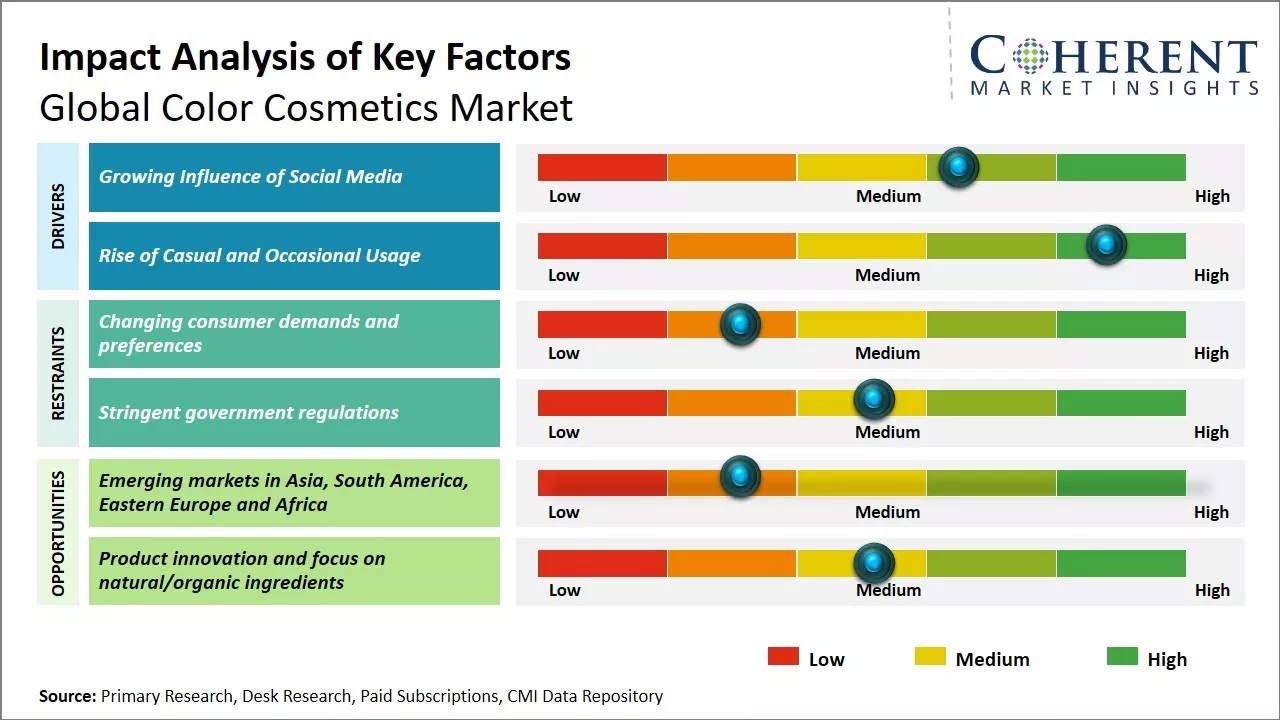
Key Takeaways
- Based on Product Type, the Face Make-Up segment is projected to capture 35.8% share of the market in 2026, driven by demand for flawless skin and hybrid skincare benefits.
- Based on Distribution Channel, the Online segment is expected to account for the largest share of the market in 2026, fueled by convenience, digital engagement, and influencer-driven shopping trends.
- Based on Region, North America is set to lead the global color cosmetics market with 41.7% share in 2026. While, Asia Pacific is projected to be the fastest growing region.
Market Overview
The color cosmetics market demand is witnessing significant growth and is expected to continue this trend during the forecast period. Rising incomes, increasing product launches catering to specific needs, and wide availability through multiple distribution channels are some key factors driving this demand. Innovation and experimentation are center stage in this industry as consumers are willing to spend more on higher-end, premium, and natural products. Manufacturers are accordingly investing in R&D to come up with new formulations, packaging, and experiential concepts. While makeup routines have become simpler owing to evolving lifestyle needs post-pandemic, the enthusiasm for self-expression through color cosmetics remains strong.
Current Events and their Impact on the Color Cosmetics Market
Current Event | Description and its Impact |
Evolving Global Regulatory Landscape |
|
Shifting Consumer Values and Behavioral Trends |
|
Role of Artificial Intelligence (AI) in Color Cosmetics Market
Artificial Intelligence (AI) is transforming the Color Cosmetics Market by enhancing personalization, product development, and customer engagement. AI-powered tools enable virtual try-ons, helping consumers visualize makeup on their skin tone before purchase, reducing returns and boosting confidence. Brands use AI to analyze consumer preferences, predict trends, and create customized formulations. Machine learning algorithms also optimize inventory, pricing, and targeted marketing campaigns, especially on social media platforms. Additionally, AI-driven chatbots and recommendation engines improve online shopping experiences, making beauty more accessible and interactive. As AI continues to evolve, it plays a pivotal role in reshaping how consumers discover, select, and use color cosmetics.
For instance, in October 2025, Maybelline New York launched SNAP, an AI-powered beauty studio that lets users virtually try on makeup products like lipsticks, foundations, and eyeshadows. This immersive experience enhances personalized shopping and digital engagement, reflecting the brand’s push toward tech-driven beauty solutions. SNAP aims to redefine how consumers explore and select color cosmetics online.
- Current Industry Events of 2026
- Market Size Estimation
- Regional Breakdown
- Competitive Landscape
- Customer Intelligence
- Segmental Analysis
- Pricing Analysis
- Key Market Drivers, Challenges & Future Trends
- Customized Insights Section
Segmental Insights
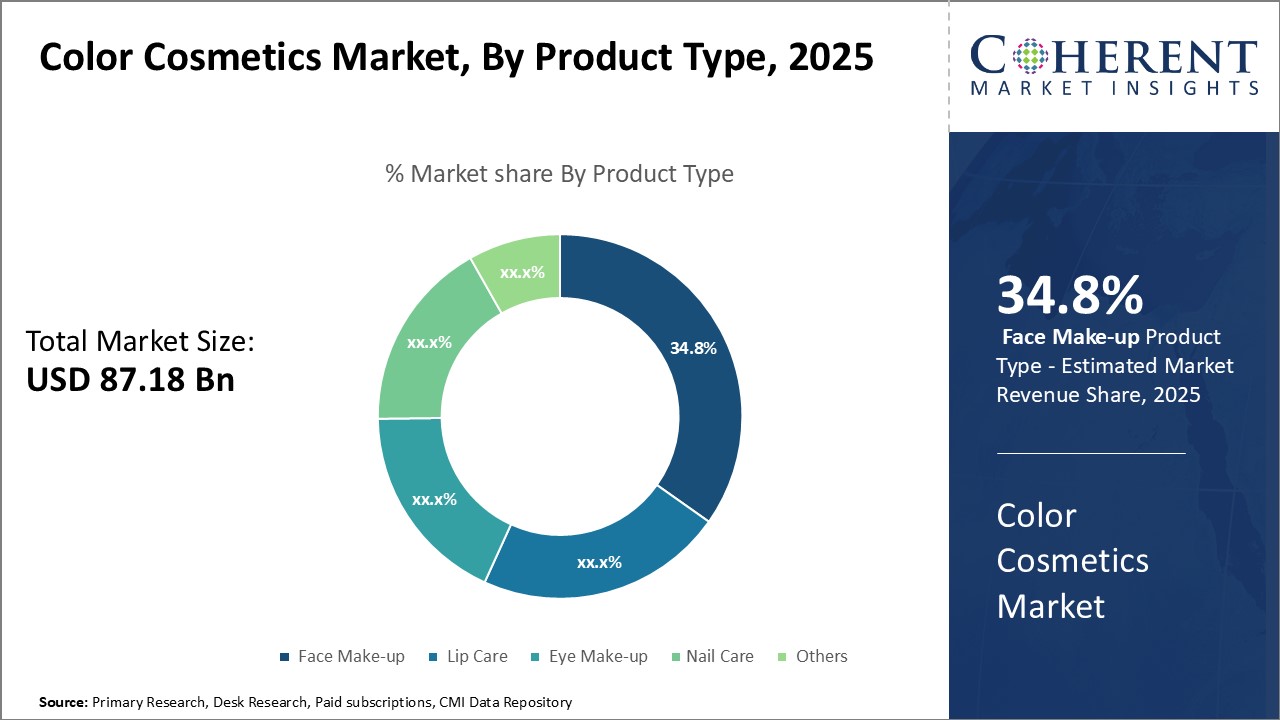
Color Cosmetics Market Insights, By Product Type: Face Make-Up Dominance Is Driven by Demand for Flawless Skin and Hybrid Skincare Benefits
In terms of product type, the Face Make-up segment is expected to contributes the 35.8% share of the market in 2026, driven by its essential role in both everyday beauty routines and professional applications. This category includes products such as foundations, concealers, primers, blushes, and highlighters, each designed to enhance skin tone, texture, and overall complexion. The surge in demand is largely attributed to the growing popularity of “no-makeup” makeup looks, which emphasize natural beauty while still requiring a base of face products.
Additionally, the rise of hybrid cosmetics products that combine skincare benefits with makeup functionality has further fueled this segment. Consumers are increasingly drawn to formulations that offer hydration, sun protection, and anti-aging properties alongside coverage. Social media influencers and beauty vloggers have also played a pivotal role in popularizing face make-up trends, encouraging experimentation and boosting product sales across global markets.
For instance, in March 2025, ASOS launched Pat McGrath Labs on its platform, enhancing its Face + Body portfolio with the iconic beauty brand. The collaboration brings a curated range of high-performance color cosmetics, including complexion, eye, and lip products, to ASOS customers globally, reinforcing the retailer’s commitment to offering premium beauty experiences to its fashion-forward audience.
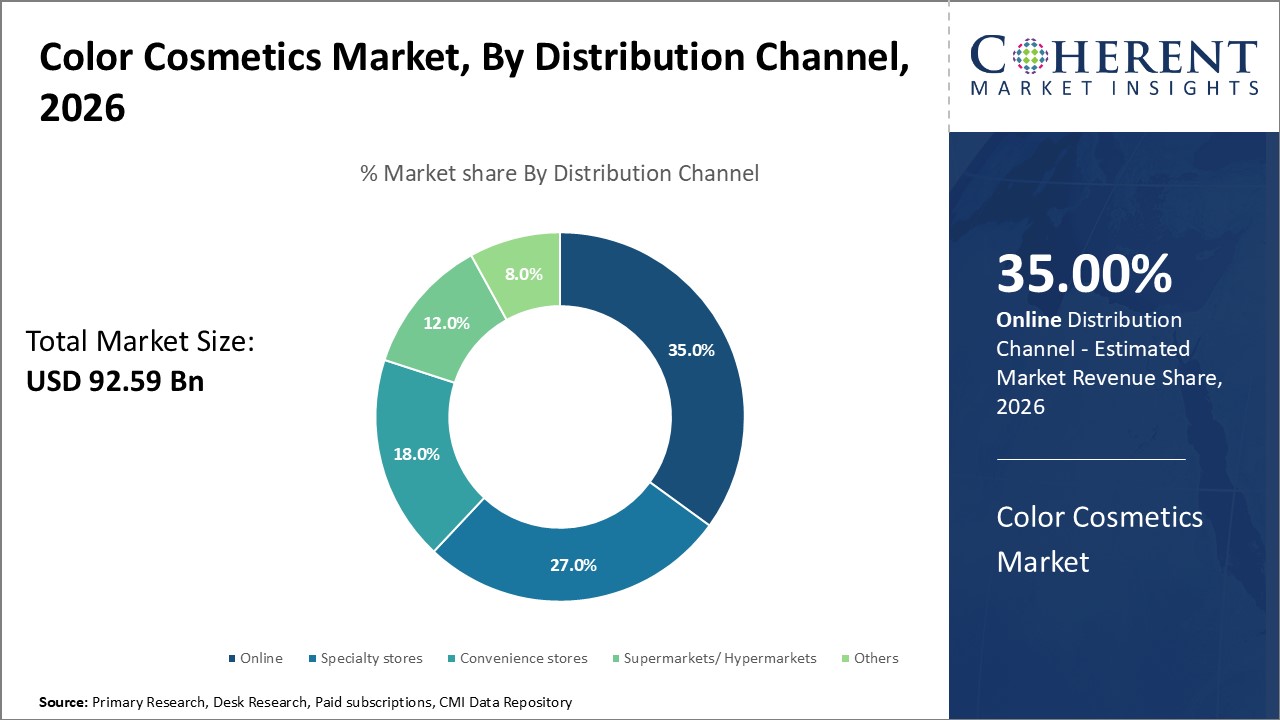
Color Cosmetics Market Insights, By Distribution Channel: Online Platforms Dominance Is Fueled by Convenience, Digital Engagement, And Influencer-Driven Shopping Trends
In terms of distribution channel, the online segment is expected to hold the largest share of the market in 2026. The shift toward e-commerce has been accelerated by changing consumer behavior, particularly among younger demographics who value convenience, variety, and digital engagement. Online platforms offer a seamless shopping experience, allowing users to browse extensive product catalogs, read reviews, compare prices, and access exclusive deals, all from the comfort of their homes.
Moreover, the integration of augmented reality (AR) tools for virtual try-ons and personalized recommendations has enhanced the online shopping experience, making it more interactive and tailored. Brands are also leveraging social commerce is selling directly through platforms like Instagram and TikTok to reach consumers where they spend most of their time. This digital-first approach not only expands market reach but also enables brands to gather real-time feedback and adapt quickly to trends.
For instance, in September 2025, rhode, the skincare brand founded by Hailey Bieber, officially launched at Sephora stores and online across the U.S. and Canada, marking its first retail expansion. Backed by e.l.f. Beauty’s $1B acquisition, rhode’s debut includes its core skincare and color cosmetics lineup, with plans to expand into the U.K. this fall.
Regional Insights
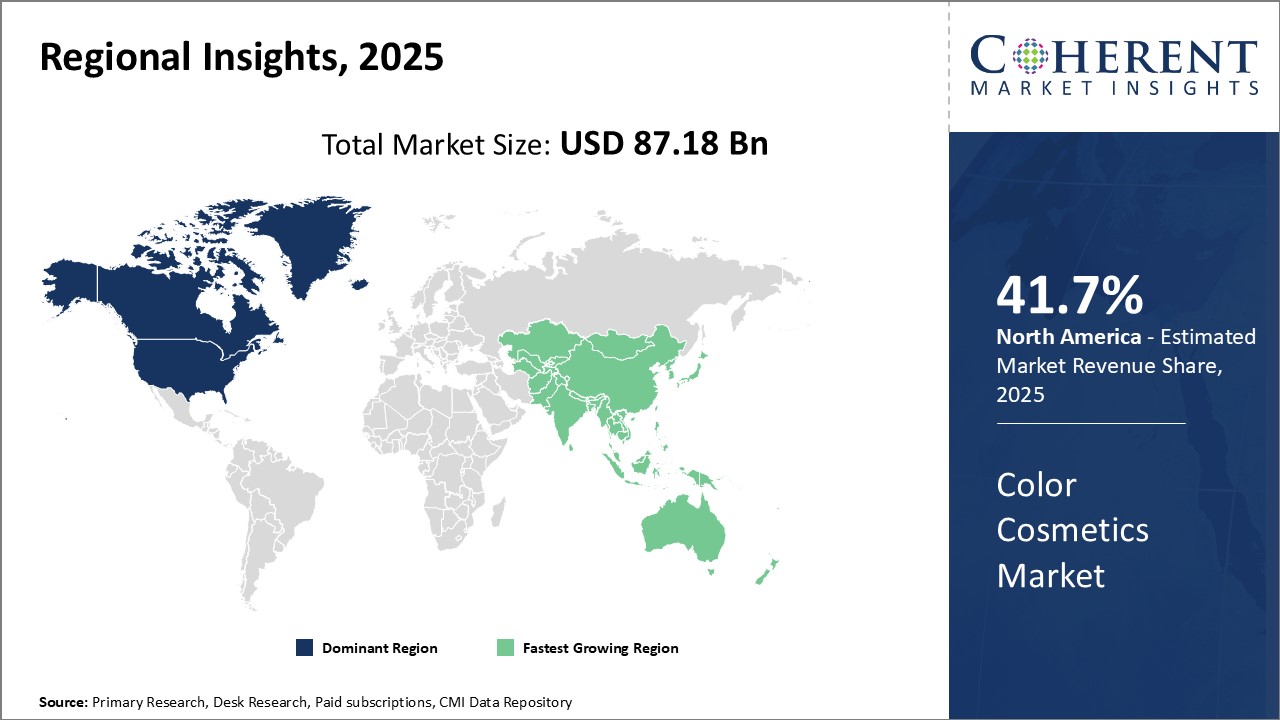
North America Color Cosmetics Market Analysis & Trends
North America has established itself as the dominant player in the global color cosmetics market over the years with 41.7% share. Being the early adopter of color cosmetics, the region enjoys a strong brand presence of all major players. America has developed a robust retail infrastructure for cosmetics products with organized retail gaining widespread popularity. This provides ample opportunities for color cosmetics brands to engage customers. Further, the region is home to some of the key innovators and product developers in the color cosmetics space. The American brands extensively focus on new product launches and customized formulations to cater to dynamic consumer demand.
For instance, in October 2026, IPSY unveiled its first Ultimate Collection in collaboration with renowned makeup artist Natasha Denona, featuring her cult-favorite eyeshadow palette and other premium color cosmetics. Available exclusively online, the curated set includes products from top brands like Saie Beauty and Milk Makeup, offering subscribers a personalized, artistry-driven beauty experience.
Asia Pacific Color Cosmetics Market Analysis & Trends
The Asia Pacific region has emerged as the fastest growing market for color cosmetics globally. In recent times, Asian markets like China, India, and Southeast Asian countries have gone through rapid urbanization and rise of nuclear families. This has boosted disposable incomes and changed lifestyles and fashion trends. More women participate in workforce and aspire for modern professional looks. The expanding middle class seeks premium international brands as a matter of prestige and status. Domestic players are also making strides to cater to this customer segment. Furthermore, the Asia Pacific region is an important sourcing base for raw materials and finished products. Brands leverage this advantage for cost optimization to drive volume sales. Countries like China have built strong manufacturing capabilities for color cosmetics and allied industries.
For instance, in November 2026, Nikko Chemicals showcased its latest color cosmetics innovations at in-cosmetics Asia 2026 in Bangkok, Thailand. The exhibit features advanced pigment dispersion technology and a foundation color-matching experience tailored to seasonal skin tones. This initiative highlights Nikko’s commitment to personalization and performance in face make-up formulations for the global beauty market.
Color Cosmetics Market Outlook Country-Wise
The U.S. Color Cosmetics Market Trends
The U.S. color cosmetics market is booming due to rising consumer demand for innovative beauty products, personalized makeup solutions, and hybrid skincare formulas. Growth is fueled by e-commerce expansion, influencer-driven trends, and increased interest in self-expression through makeup. Digital platforms offer convenience and variety, making online shopping a key driver of market demand.
For instance, in May 2026, Dow showcased its latest personal care innovations at NY SCC Suppliers’ Day 2026 in New York, spotlighting advanced film formers like DOWSIL MQ-1610 ID and MQ-1650 ID Resins. These technologies enhance long wear and water resistance in color cosmetics, reinforcing Dow’s commitment to high-performance beauty formulations tailored for modern consumer needs.
China Color Cosmetics Market Trends
China’s color cosmetics market is booming in 2026 due to rising demand for premium, innovative products, strong e-commerce growth, and the popularity of homegrown beauty brands. Consumers are increasingly drawn to high-performance makeup, personalized shades, and influencer-driven trends, making China a key driver of global beauty industry expansion.
For instance, in August 2026, Louis Vuitton entered the color cosmetics market with the launch of its La Beaute collection, debuting exclusively in China. The luxury brand’s new line includes lipsticks and other makeup products, marking a strategic expansion into beauty. This move reflects growing demand for high-end cosmetics in Asia’s fast-growing luxury market.
Market Report Scope
Color Cosmetics Market Report Coverage
| Report Coverage | Details | ||
|---|---|---|---|
| Base Year: | 2025 | Market Size in 2026: | USD 92.59 Bn |
| Historical Data for: | 2020 To 2024 | Forecast Period: | 2026 To 2033 |
| Forecast Period 2026 to 2033 CAGR: | 6.2% | 2033 Value Projection: | USD 141.06 Bn |
| Geographies covered: |
| ||
| Segments covered: |
| ||
| Companies covered: | Beiersdorf, Krylon, Estee Lauder Companies Inc., Amway, Avon Products Inc., CHANEL, CIATÉ, Coty Inc, Johnson & Johnson, KRYOLAN, L'Oréal S.A, Revlon, Inc., Shiseido Company Limited, Unilever, HCP Wellness, AG Organica, Koel Colours, FabLay, Natura & Co., and Gorgeous Cosmos Pvt.Ltd | ||
| Growth Drivers: |
| ||
| Restraints & Challenges: |
| ||
Color Cosmetics Market Driver
Growing Influence of Social Media
Social media is a major driver of global color cosmetics market share growth. Platforms like Instagram and YouTube enable direct product discovery, reviews, and tutorials, enhancing personalized shopping. Influencers promote makeup trends and limited editions, boosting impulse buys and repeat purchases. Women aged 16–24 spend over four hours daily online, relying on peer recommendations over ads. Brands use interactive content to test shades and target Gen Z and Millennials. As social media usage rises, especially among young women, influencer-driven marketing continues to expand the color cosmetics market share worldwide, outpacing traditional advertising methods and reshaping consumer engagement.
Rise of Casual and Occasional Usage
The color cosmetics market value is rising as makeup becomes part of everyday style, not just special occasions. Younger consumers now embrace colorful eyeshadows, lipsticks, and nail colors for casual outings, brunches, and social media moments. The no-makeup makeup trend and the rise of ‘one brand face’ loyalty drive repeat purchases. Millennials and Gen Z use cosmetics for self-expression and to enhance their digital presence. With beauty now integrated into daily self-care routines, the market has expanded beyond traditional events, significantly increasing usage frequency and broadening the global customer base for color cosmetics.
Color Cosmetics Market Opportunities
Emerging markets in Asia, South America, Eastern Europe and Africa
The color cosmetics market forecast highlights strong growth potential in emerging markets across Asia, South America, Eastern Europe, and Africa. Rising incomes, urbanization, and exposure to global beauty trends are fueling increased cosmetics spending in these regions. A rapidly expanding middle class is embracing makeup as part of daily self-expression. Companies are capitalizing on this momentum by launching innovative product categories and formulations tailored to diverse skin tones and cultural preferences. These new geographical areas offer untapped opportunities for brand expansion, digital engagement, and localized marketing strategies, making them key drivers in the global color cosmetics market forecast for 2025 and beyond.
Analyst Opinion (Expert Opinion)
The color cosmetics market is undergoing a decisive structural shift where agility and authenticity outweigh legacy scale. E-commerce now defines profitability, digital-first brands with direct-to-consumer models are outperforming due to control over pricing, personalization, and consumer data. Online sales already account for nearly one-third of global beauty revenues, and digital-native players continue to expand faster than traditional retail. Authenticity and sustainability have also become non-negotiable. Around 25% of Japanese consumers now factor eco-friendly claims into purchase decisions, and refillable or “clean” cosmetics are driving higher retention among younger buyers. However, superficial sustainability efforts risk backlash, as consumers increasingly demand measurable transparency and credible certifications.
Simultaneously, social media has transformed marketing from aspirational to participatory. Short-form video and influencer-led content now drive discovery and conversion, with top-performing brands rapidly iterating creative output based on engagement data. Male and gender-neutral cosmetics are another rising vector, signaling broad cultural normalization rather than niche experimentation. Innovation, therefore, extends beyond pigments to packaging design, refill logistics, and experience-driven branding.
Brands that synchronize digital commerce, verified sustainability, and platform-native storytelling will capture long-term loyalty. Those slow to pivot will face margin erosion and relevance loss in an industry now defined by credibility, creativity, and consumer intimacy.
Speak to the analyst
Want personalized insights?
Take the findings above to one of our principal consultants, or have the report rebuilt around the segments, geographies and competitors you actually track.
Recent Developments
- In October 2025, Indian beauty brand LA Pink aims to achieve ₹100 crore revenue by FY27, announcing plans to expand into the color cosmetics segment and international markets. The company will introduce new product lines and strengthen its digital presence to tap into rising global demand. This strategic move reflects growing opportunities in the beauty and personal care industry.
- In April 2025, Ananya Birla launched LOVETC, a new homegrown color cosmetics brand in India, targeting Gen Z and millennial consumers. The brand aims to offer expressive, inclusive makeup products aligned with global trends. India’s color cosmetics market is projected to reach USD 1,305.69 million by FY2032, signaling strong growth and demand in the beauty segment.
- In January 2025, Born16, a new color cosmetics brand, launched in India with a mission to empower women through inclusive beauty. The brand offers makeup products tailored to diverse Indian skin tones and aims to promote self-expression and confidence. Born16’s entry reflects the growing demand for homegrown beauty solutions in India’s expanding cosmetics market.
Market Segmentation
- Product Type Insights (Revenue, USD Bn, 2026 - 2033)
- Nail care
- Lip Care
- Eye Make-up
- Face Make-up
- Others
- Distribution Channel Insights (Revenue, USD Bn, 2026 - 2033)
- Supermarkets/ Hypermarkets
- Specialty stores
- Convenience stores
- Online
- Others
- Regional Insights (Revenue, USD Bn, 2026 - 2033)
- North America
- U.S.
- Canada
- Latin America
- Brazil
- Argentina
- Mexico
- Rest of Latin America
- Europe
- Germany
- U.K.
- Spain
- France
- Italy
- Russia
- Rest of Europe
- Asia Pacific
- China
- India
- Japan
- Australia
- South Korea
- ASEAN
- Rest of Asia Pacific
- Middle East & Africa
- GCC Countries
- Israel
- Rest of Middle East & Africa
- Key Players Insights (Revenue, USD Bn, 2021 - 2033)
- Beiersdorf
- Krylon
- Estee Lauder Companies Inc.
- Amway
- Avon Products Inc.
- CHANEL
- CIATE
- Coty Inc
- Johnson & Johnson
- KRYOLAN
- L'Oreal S.A
- Revlon, Inc.
- Shiseido Company Limited
- Unilever
- HCP Wellness
- AG Organica
- Koel Colours
- FabLay
- Natura & Co.
- Gorgeous Cosmos Pvt.Ltd
Sources
Primary Research Interviews from the following stakeholders
Stakeholders
- Interviews with brand product & formulation teams, R&D chemists, packaging engineers, contract manufacturers, pigment & raw-material suppliers, retail buyers (offline & online), beauty category managers, salon owners/chain operators, ecommerce platform category leads, hair & makeup artists, dermatologists/clinical testers, regulatory affairs managers, logistics & cold-chain providers, and procurement heads across leading global markets.
Specific stakeholders
- Product managers and R&D/formulation leads at global and regional beauty brands (e.g., Sephora, Ulta, L’Oreal regional teams, H&M Beauty, Nykaa).
- Ecommerce beauty/category leads at Amazon Beauty, Tmall/Alibaba, Nykaa, Flipkart, and Walmart.com.
- Retail operations & visual merchandising heads at department stores and retail chains (e.g., Shoppers Stop, Reliance Retail, Macy’s).
- Heads of innovation and clinical testing at dermatology clinics and independent testing labs.
- Supply-chain and procurement heads at contract manufacturers and private-label producers.
- Packaging procurement and sustainability leads at packaging converters and carton/bioplastic suppliers.
- Category and digital marketing managers at large pharmacy chains and mass-market retailers (e.g., Boots, Watsons).
- Salon group owners and professional makeup artist collectives (salon chains and pro schools).
- Influencer & creator managers at talent agencies and in-house influencer program leads at large brands.
- Ethical sourcing and compliance officers at ingredient suppliers (pigments, preservatives, natural extracts).
- Regulatory affairs specialists at cosmetics firms and national regulatory bodies.
Databases
- WTO Trade Statistics (tariff & trade flows)
- UN Comtrade Database (HS codes for cosmetics & ingredients)
- Food and Drug Administration (FDA) — Cosmetic Regulatory/Enforcement Data (U.S.)
- Central Drugs Standard Control Organization (CDSCO) / Ministry of Health records (India)
- European Commission — CosIng and trade/statistics portals (EU)
- China Customs Statistics / General Administration of Customs (China)
- Korea Customs Service Data Portal (Korea)
- Japan External Trade Organization (JETRO) and METI trade datasets (Japan)
- Bureau of Economic Analysis / U.S. trade and consumer expenditure datasets
- Eurostat (retail, trade and consumer price statistics)
- Directorate General of Commercial Intelligence and Statistics (DGCIS), India
Industry & Trade Magazines
- Cosmetics Design (Global / Europe / Asia editions)
- Beauty Packaging
- Global Cosmetic Industry (GCI) / HAPPI (Household & Personal Products Industry)
- Cosmetics Business
- Vogue Business — Beauty & Retail section
- Future Store Guide (retail tech & beauty in-store innovation)
- Wall Street Journal — Life & Style / Fashion & Beauty columns (industry reporting)
Technical journals & academic sources
- International Journal of Cosmetic Science
- Journal of Cosmetic Dermatology
- Journal of Cosmetic Science
- Skin Research and Technology
- Journal of Consumer Behaviour / Journal of Retailing and Consumer Services (consumer demand & retailing studies)
- Journal of Visual Communication and Image Representation (for colorimetry and imaging methods)
Newspapers & business press
- The Wall Street Journal — Tech & Retail/Beauty coverage
- Financial Times — Consumer Goods & Retail reports
- The Economic Times — FMCG, Retail & Beauty industry in India
- The Hindu Business Line — Consumer Tech & Retail (India)
- Nikkei Asia — Electronics, supply chain and consumer trends affecting cosmetics (e.g., packaging, manufacturing)
- South China Morning Post — Greater China market & retail coverage
Associations, standards bodies & trade groups
- Personal Care Products Council (PCPC) — U.S. industry guidance & regulatory position papers
- Cosmetics Europe — European trade association (regulatory & market insights)
- International Federation of Societies of Cosmetic Chemists (IFSCC) — technical conferences & papers
- ISO technical committees and standards relevant to cosmetics and packaging (ISO standards registry)
- Association of Southeast Asian Nations (ASEAN) Cosmetic Committee / regional regulatory working groups
- Confederation of Indian Industry (CII) — cosmetics & personal care working groups and events
- Local and national dermatology societies (clinical safety and testing guidance)
Public domain & government sources
- FDA — Cosmetic Guidance, recalls and adverse event reporting (U.S.)
- CDSCO / Ministry of Health (India) — regulatory notifications, labeling rules, import guidelines
- EU CosIng / European Commission — ingredient approvals and restrictions
- USITC / U.S. International Trade Commission — tariff and trade investigations affecting cosmetics inputs
- METI (Japan) and relevant Japanese ministries — trade & regulatory data
- National statistical offices (retail sales, CPI for cosmetics categories) — e.g., Office for National Statistics (UK), Statistics Bureau (Japan)
- RBI / Reserve Bank of India reports and trade policy circulars that impact imports/exports and retail financing
- NITI Aayog / India Investment Grid — sectoral policy and investment facilitation records
Proprietary elements
- CMI Data Analytics Tool
- Proprietary CMI Existing Repository of information for last 8 years
Get access to 250+ pages report
Every segment, forecast, competitor profile and data table behind the analysis above — available for instant download.
- ESOMAR Member
- ISO 9001:2015 Certified
- D-U-N-S Registered
- GDPR & CCPA Compliant
Missing comfort of reading report in your local language? Find your preferred language:
Transform your Strategy with Exclusive Trending Reports
Frequently Asked Questions
The Color Cosmetics Market is estimated to be valued at USD 92.59 Bn in 2026, and is expected to reach USD 141.06 Bn by 2033.
The CAGR of the Color Cosmetics Market is projected to be 6.2% from 2026 to 2033.
Growing influence of social media and rise of casual and occasional usage are the major factors driving the growth of the global color cosmetics market.
Changing consumer demands and preferences and stringent government regulations are the major factors hampering the growth of the global color cosmetics market.
In terms of Product Type, Face Make-up is estimated to dominate the market revenue share in 2026.
Beiersdorf, Krylon, Estee Lauder Companies Inc., Amway, Avon Products Inc., CHANEL, CIATÉ, Coty Inc, Johnson & Johnson, KRYOLAN, L'Oréal S.A, Revlon, Inc., Shiseido Company Limited, Unilever, HCP Wellness, AG Organica, Koel Colours, FabLay, Natura & Co., and Gorgeous Cosmos Pvt.Ltd are the major players.
North America is expected to lead the global color cosmetics market.