

Global Crane Rental Market Size and Forecast – 2026-2033
The global crane rental market is estimated to be valued at USD 59.36 Bn in 2026 and is expected to reach USD 85.78 Bn by 2033, exhibiting a compound annual growth rate (CAGR) of 5.4% from 2026 to 2033.
Key Takeaways of the Global Crane Rental Market
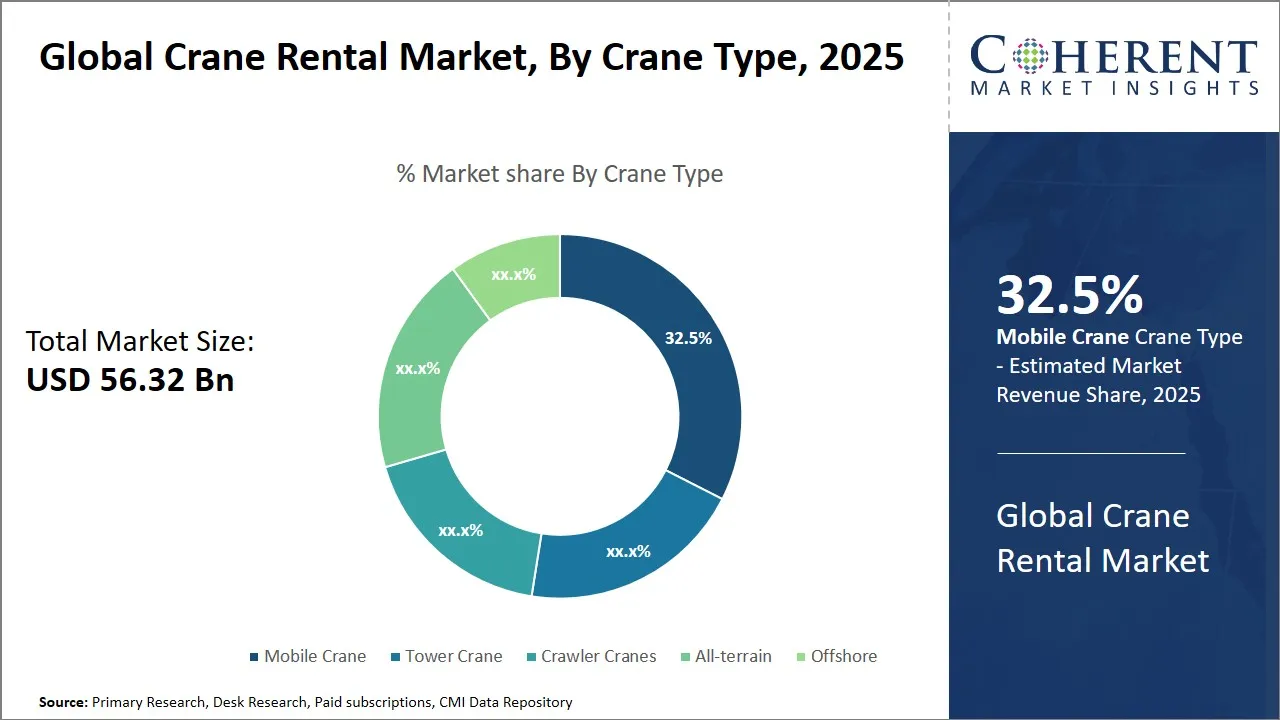
- The mobile crane segment is expected to lead the market holding a share of 33.5 % in 2026.
- The short-term rental segment is projected to dominate with a share of 56.3 % in 2026.
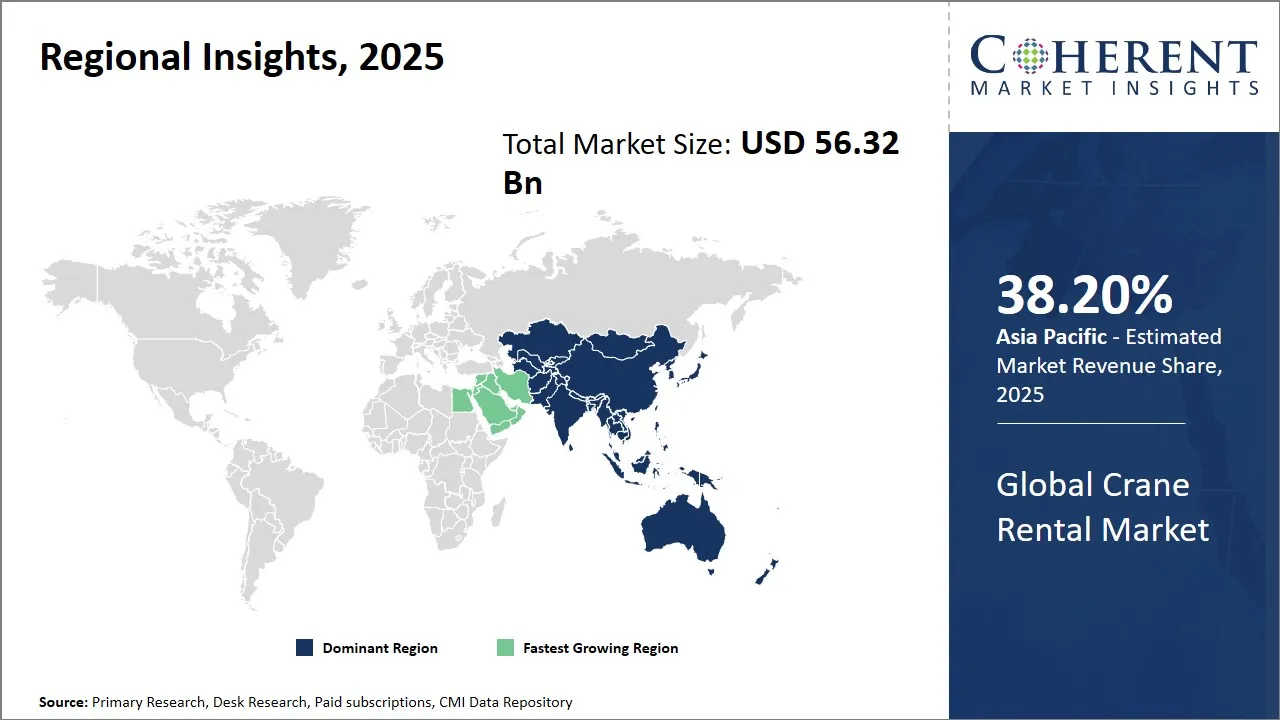
- Asia Pacific, holding an estimated share of 38. 2% in 2026, is projected to dominate the market.
- Middle East, holding an estimated share of 11. 7% in 2026, shows the fastest growth in the market.
Market Overview
The crane rental market is seeing a lot of adoption of technologically advanced cranes equipped with IoT and remote monitoring systems, enhancing operational efficiency and safety. Also, the move towards sustainable and eco-friendly construction practices is encouraging rental companies to offer energy-efficient cranes, addressing environmental concerns while optimizing cost-effectiveness for clients.
Current Events and Its Impact
Current Events | Description and its Impact |
U.S.-China trade dynamics |
|
U.S./Western infrastructure spending |
|
China property-market slowdown & rebalancing |
|
Segmental Insights
- Current Industry Events of 2026
- Market Size Estimation
- Regional Breakdown
- Competitive Landscape
- Customer Intelligence
- Segmental Analysis
- Pricing Analysis
- Key Market Drivers, Challenges & Future Trends
- Customized Insights Section
Global Crane Rental Market Insights, By Crane Type – Mobile Crane Leads Because of its Versatility and Operational Flexibility
The mobile crane segment is expected to hold a 33.5% share in 2026 which dominates the global crane rental market because of its exceptional adaptability across construction, energy, and infrastructure projects. Unlike tower or crawler cranes, mobile cranes allow easy transport, quick setup, and on-road mobility, making them suited for short-duration and multi-site operations.
Their broad lifting range and lower logistical requirements make them cost-effective for contractors working under tight deadlines or spatial constraints, particularly in urban areas. Technological improvements such as Liebherr’s LTM 1110-5.2, featuring advanced load-sensing hydraulics and EcoDrive systems, have also added to safety and efficiency, making rental demand.
Also, fast urbanization in emerging economies like India and Indonesia fuels steady usage, as mobile cranes can efficiently navigate congested city sites. Supported by ongoing infrastructure expansion, their portability, performance, and cross-sector versatility ensure sustained market leadership.
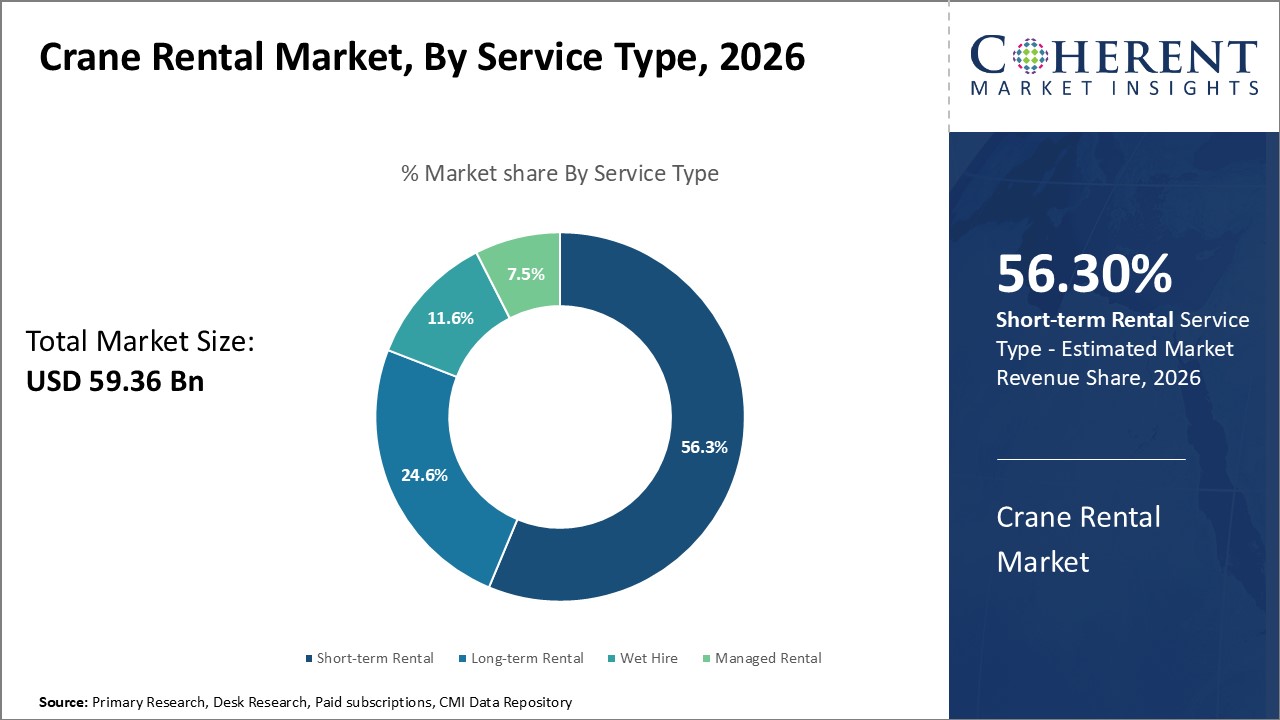
Global Crane Rental Market Insights, By Service Type – Short-term Rental Leads Because of Project-Based Demand and Cost-Efficiency
The short-term rental segment, holding 56.3% of the market share in 2026, is projected to dominate because of its alignment with project-based demand cycles. Construction and industrial projects often need cranes for limited durations, making short-term rentals a cost-efficient option.
SMEs and contractors choose this model to maintain budget flexibility while using modern, specialized cranes when needed. The growth of digital rental platforms has simplified booking and logistics, adding to adoption. For instance, Maxim Crane Works’ on-demand rental platform in the U.S. allows customers to reserve and mobilize cranes within hours, optimizing usage and response time. This segment also supports sustainability and operational agility, reducing idle equipment and encouraging resource sharing.
Regional Regulatory Framework & Safety Compliance Costs
Region | Key Safety Certification/Regulatory Requirements | Impact on Rental Cost Structure |
North America (U.S. & Canada) |
|
|
Europe (EU, U.K.) |
|
|
Asia Pacific (China, India, Japan, Southeast Asia) |
|
|
Middle East (Saudi Arabia, U.A.E., Qatar) |
|
|
Latin America (Brazil, Mexico, Chile) |
|
|
Africa (South Africa, Nigeria, Egypt) |
|
|
Pricing Analysis of the Crane Rental Market
Crane Type/Capacity | Typical Rental Rate |
Standard mobile crane (50-80 t) – North America | USD 800 – 1,500/day |
Mobile hydraulic crane (60-100 t) – U.S. | USD 1,500 – 3,000/day |
Crawler crane (200-300 t) – U.S. | USD 5,000 – 12,000/day |
All-terrain crane – U.S. | USD 2,500 – 6,000/day |
Rough terrain crane – U.S. | USD 1,200 – 2,500/day |
Standard mobile crane – Europe (e.g., U.K., Germany) | USD 900 – 1,800/day |
Mobile crane rental – Asia (e.g., India, China) | USD 600 – 1,400/day |
Small mobile crane – generic global | USD 200 – 500/day |
Technological Integration in Crane Rental Market
Region | Key Technologies Implemented | Adoption Rate of Digital Monitoring Tools & Maintenance Automation | Operational Impact/Benefits |
North America (U.S. & Canada) |
| ≈75–80% adoption among major rental fleets. |
|
Europe (EU, U.K.) |
| ≈70–75% adoption in Western Europe; 50–60% in Eastern Europe. |
|
Asia Pacific (China, India, Japan, Southeast Asia) |
| ≈45–55% adoption overall. |
|
Middle East (Saudi Arabia, U.A.E., Qatar) |
| ≈50–60% adoption, led by Tier-1 contractors and international rental firms. |
|
Latin America (Brazil, Mexico, Chile) |
| ≈30–40% adoption among mid- to large-scale rental fleets. |
|
Africa (South Africa, Nigeria, Egypt) |
| ≈20–30% adoption (mostly large foreign-operated fleets). |
|
Regional Insights
Asia Pacific Crane Rental Market Analysis and Trends
The Asia Pacific region, holding an estimated share of 38.2% in 2026, dominates the crane rental market because of fast urbanization, infrastructure expansion, and industrialization, especially across China, India, and Southeast Asia. Government initiatives pushing smart cities, transportation networks, and energy projects make a lot of demand for crane rentals, which provide cost-effectiveness and flexibility in project execution.
The market ecosystem sees a mix of global rental giants and emerging local providers like Zoomlion and XCMG that are growing their crane fleets and rental services. Trade dynamics favor this region as it is a big hub for construction equipment manufacturing, boosting availability and driving down rental costs that appeal to a broad customer base.
Middle East Crane Rental Market Analysis and Trends
The Middle East region, holding an estimated share of 11.7% in 2026, shows the fastest growth trajectory in the global crane rental market, because of large-scale infrastructure development, energy diversification, and megaproject construction. Countries such as Saudi Arabia, the U.A.E., and Qatar are leading huge initiatives under programs like Saudi Vision 2030 and U.A.E.’s National Infrastructure Strategy, which involve the development of smart cities, transportation corridors, tourism hubs, and renewable energy facilities.
The presence of regional heavy-lift specialists and partnerships with global rental operators, such as Mammoet’s collaboration on NEOM projects in Saudi Arabia and Sarens’ expansion in the Gulf region, also adds to market momentum. Competitive pricing, strong capital investments, and the growing availability of advanced equipment from global OEMs like Liebherr, Tadano, and Zoomlion are adding to expansion.
Global Crane Rental Market Outlook for Key Countries
U.S. Crane Rental Market Analysis and Trends
The U.S. maintains a strong crane rental market because of consistent infrastructure upgrades and commercial construction projects. Key players such as United Rentals and Maxim Crane Works dominate through big service networks and a diverse inventory of mobile cranes, tower cranes, and specialty equipment. The country’s advanced regulatory framework and focus on workplace safety make demand for high-quality, well-maintained rental cranes. Moreover, national policies encouraging renewable energy and transportation infrastructure add to market activity.
China Crane Rental Market Analysis and Trends
China continues to lead Asia Pacific crane rental market growth because of large-scale urban developments, industrial parks, and transportation initiatives like high-speed railways. Local manufacturers such as Zoomlion and Sany supply equipment for sale and also operate significant rental fleets that cater to different sectors. Government policies prioritizing infrastructure investments and construction modernization make demand. Also, the use of smart technologies into cranes and rental logistics enhances service efficiency and operational reliability.
India Crane Rental Market Analysis and Trends
India crane rental market is expanding rapidly due to booming infrastructure projects, including highways, metro rail systems, and commercial real estate. Local and international rental firms, including L&T Construction and Tata Projects, use the country’s construction boom to offer flexible crane rental solutions. Government initiatives like “Make in India” and public-private partnerships add to modernization within the industry. Also, growing adoption of asset management technologies and safety standards promotes market maturity.
Germany Crane Rental Market Analysis and Trends
Germany continues to lead the Europe crane rental market because of its advanced construction technology and extensive industrial base. Firms such as Liebherr, an established crane manufacturer and rental service provider, play a central role in offering high-precision cranes for various applications. Environmental regulations and government incentives for green infrastructure projects add to rental equipment demand. The presence of a diversified construction sector, including automotive and manufacturing industries, creates consistent growth in crane rentals.
Brazil Crane Rental Market Analysis and Trends
Brazil crane rental market shows the country’s infrastructure redevelopment and energy sector investments, especially in oil & gas and renewable energy. Local rental companies and multinational operators like Randon and CTT Equipamentos add to market development by growing fleet offerings and enhancing service capabilities. Government policies focusing on infrastructure modernization and recovery from economic challenges underpin growing demand. Also, Brazil’s participation in international trade agreements facilitates access to advanced crane technologies and equipment.
Market Players, Key Development, and Competitive Intelligence
Key Developments
- In June 2025, Konecranes announced that it will supply an integrated crane system to Impeccable Vintage Properties (IVP), a subsidiary of Khazanah Nasional Berhad responsible for infrastructure development at Subang Airport in Malaysia. The system, which was ordered in 2024, will be installed in Hangar 3 at the IVP Complex within the airport later this year or in early 2026.
- In April 2025, Liebherr presented the lightest 3-axle all-terrain crane on the market at Bauma. Despite the lightweight design of the LTM 1055-3.3, it offers high lifting capacities with its 40-metre telescopic boom, especially for medium and large radii.
- In April 2025, Manitowoc introduced several new products and expanded aftermarket services at Bauma 2025, including hybrid-electric cranes, advanced digital tools, and an expanded suite of lifecycle services.
- In January 2025, Tadano completed the acquisition of Manitex International. Manitex is now a wholly owned subsidiary of Tadano Ltd., and, as a result, Manitex shares are no longer listed on Nasdaq.
Top Strategies Followed by Crane Rental Market Players
- Established market leaders invest a lot in research and development to drive innovation and deliver high-performance, reliable crane products that meet evolving industry demands.
- Liebherr Group (Germany) invested in developing battery-electric mobile cranes (LTM 1110-5.2) and advanced LiDAT SmartApp telematics for predictive maintenance and performance optimization.
- Mid-level players in the crane rental market use a different approach that centers around cost-effective solutions made to strike a balance between quality and affordability.
- Action Construction Equipment (ACE, India) focuses on providing value-based rental cranes and localized service support to SMEs in India’s tier-2 cities.
- Small-scale players make their market niche by concentrating on specialized features or innovative products that differentiate them from broader market competitors.
- Sanghvi Movers (India) targets specialized lifting solutions for wind turbine installation, building expertise in renewable energy project rentals to stand out from generalist operators.
Market Report Scope
Crane Rental Market Report Coverage
| Report Coverage | Details | ||
|---|---|---|---|
| Base Year: | 2025 | Market Size in 2026: | USD 59.36 Bn |
| Historical Data for: | 2020 To 2024 | Forecast Period: | 2026 To 2033 |
| Forecast Period 2026 to 2033 CAGR: | 5.4% | 2033 Value Projection: | USD 85.78 Bn |
| Geographies covered: |
| ||
| Segments covered: |
| ||
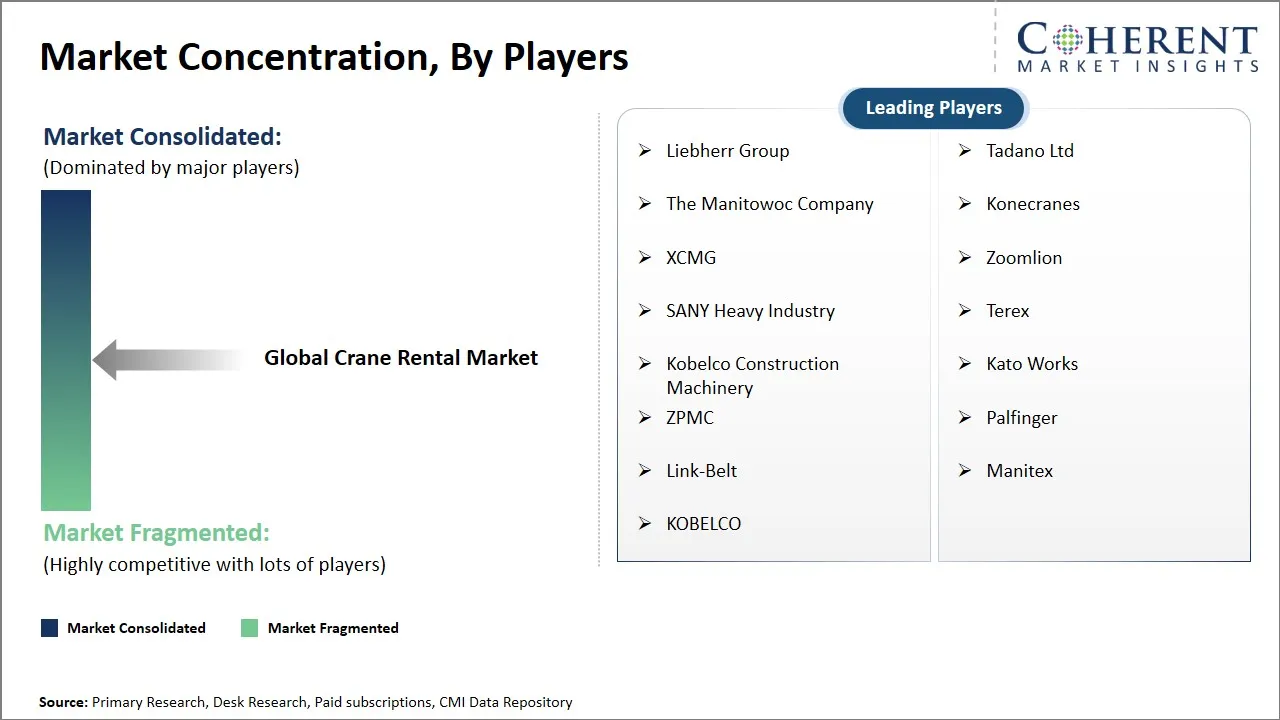
| Companies covered: | Liebherr Group, Tadano Ltd, The Manitowoc Company, Konecranes, XCMG, Zoomlion, SANY Heavy Industry, Terex, Kobelco Construction Machinery, Kato Works, ZPMC, Palfinger, Link-Belt, Manitex, and KOBELCO | ||
| Growth Drivers: |
| ||
| Restraints & Challenges: |
| ||
Market Dynamics
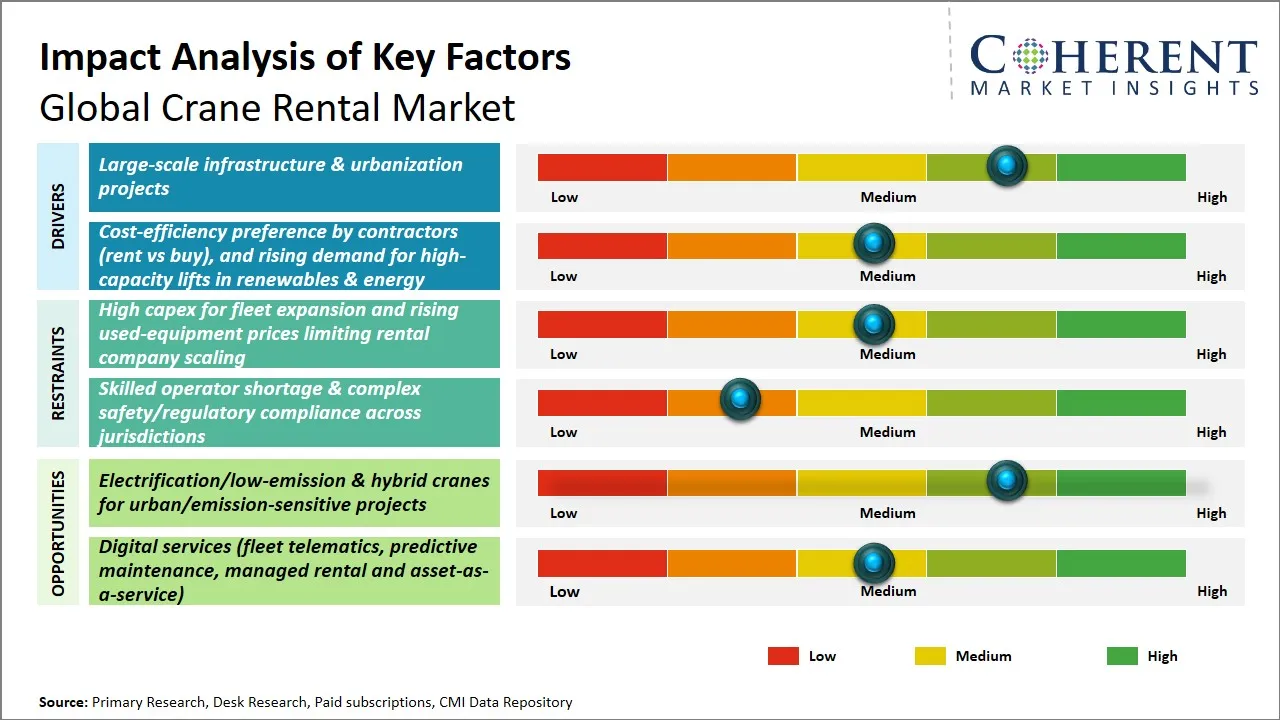
Global Crane Rental Market Driver – Large-Scale Infrastructure & Urbanization Projects
The surge in megaprojects and rapid urbanization worldwide is a major growth driver for the crane rental market. Growing investments in transportation, energy, and smart city infrastructure demand versatile lifting solutions without long-term capital commitments. Cranes play a big role in executing large-scale developments efficiently, especially in space-constrained urban sites.
In India, projects under the Bharatmala Pariyojana and Smart Cities Mission have boosted short-term crane rentals a lot for bridge and metro construction. Similarly, Saudi Arabia’s NEOM and The Line projects are making large-scale demand for heavy-lift and tower cranes to support complex, vertical construction.
Global Crane Rental Market Opportunity – Electrification and Hybrid Cranes for Urban and Emission-Sensitive Projects
The growing push toward sustainable and low-emission construction is making new opportunities for electric and hybrid cranes. These models reduce carbon output and noise, aligning with urban emission norms and green infrastructure goals. Rental firms using eco-friendly fleets gain a competitive edge in environmentally regulated zones.
Liebherr launched its LTM 1110-5.2 hybrid mobile crane, offering reduced emissions for urban construction sites. Sarens used battery-electric cranes in the Netherlands to meet strict EU environmental standards, showcasing how rental fleets are adapting to green project demands.
Analyst Opinion (Expert Opinion)
- The crane rental industry is caught between increasing safety certification expenses, maintenance inflation, and fuel price volatility. Many rental firms—especially mid-tier and regional operators—are struggling to maintain margins as project owners demand shorter rental periods and competitive pricing, effectively commoditizing high-value lifting services.
- While digital fleet management, IoT integration, and predictive maintenance are transforming top-tier rental fleets, smaller players are falling behind. The high upfront cost of telematics infrastructure and skilled workforce shortages make a technological divide.
- Despite strong project pipelines, the market remains very fragmented, with local operators dominating regionally and lacking standardization in pricing, maintenance, and service quality. Overcapacity in certain regions and irregular demand cycles continue to challenge fleet use.
Speak to the analyst
Want personalized insights?
Take the findings above to one of our principal consultants, or have the report rebuilt around the segments, geographies and competitors you actually track.
Market Segmentation
- Crane Type Insights (Revenue, USD Bn, 2021 - 2033)
- Mobile Crane
- Tower Crane
- Crawler Cranes
- All-terrain
- Offshore
- Service Type Insights (Revenue, USD Bn, 2021 - 2033)
- Short-term Rental
- Long-term Rental
- Wet Hire
- Managed Rental
- Regional Insights (Revenue, USD Bn, 2021 - 2033)
- North America
- U.S.
- Canada
- Latin America
- Brazil
- Argentina
- Mexico
- Rest of Latin America
- Europe
- Germany
- U.K.
- Spain
- France
- Italy
- Russia
- Rest of Europe
- Asia Pacific
- China
- India
- Japan
- Australia
- South Korea
- ASEAN
- Rest of Asia Pacific
- Middle East
- GCC Countries
- Israel
- Rest of Middle East
- Africa
- South Africa
- North Africa
- Central Africa
- North America
- Key Players Insights
- Liebherr Group
- Tadano Ltd
- The Manitowoc Company
- Konecranes
- XCMG
- Zoomlion
- SANY Heavy Industry
- Terex
- Kobelco Construction Machinery
- Kato Works
- ZPMC
- Palfinger
- Link-Belt
- Manitex
- KOBELCO
Sources
Primary Research Interviews
Stakeholders
- Construction Companies and Contractors
- Crane Rental Operators and Fleet Managers
- Equipment Leasing Firms specializing in heavy lifting and material handling solutions
- Real Estate Developers and Infrastructure Project Managers
- Industrial Maintenance Firms and EPC Contractors (Engineering, Procurement, and Construction)
- Port and Logistics Authorities utilizing mobile and tower cranes for cargo handling
- Sustainability Experts and Fleet Electrification Consultants (for hybrid/electric cranes)
Databases
- Eurostat
- U.S. Census
- Construction Global
- OECD
- Global Trade Atlas (GTA)
- World Construction Equipment Database (WCED)
Magazines
- Construction Today
- Heavy Lift & Project Forwarding International (HLPFI)
- International Cranes and Specialized Transport
- Building Design + Construction (BD+C)
- Construction Equipment Guide
Journals
- Journal of Construction Engineering and Management
- Construction and Building Materials Journal
- Automation in Construction Journal
- Journal of Building Engineering
- International Journal of Heavy Equipment and Material Handling
Newspapers
- The Construction Index
- Construction Week Online
- The Economic Times (India)
- The Guardian (U.K.)
- Gulf Construction Online
- Engineering News-Record (ENR)
Associations
- Crane Industry Council of Australia (CICA)
- European Association of Abnormal Road Transport and Mobile Cranes (ESTA)
- Specialized Carriers & Rigging Association (SC&RA, U.S.)
- Construction Plant-hire Association (CPA, U.K.)
- National Association of Tower Crane Users (NATCU)
- American Rental Association (ARA)
Public Domain Sources
- U.S. Census Bureau
- EUROSTAT
- United Nations Economic Commission for Europe (UNECE)
- World Bank
- ResearchGate
- International Labor Organization (ILO) – Construction Sector Reports
- Global Infrastructure Outlook (Oxford Economics)
Proprietary Elements
- CMI Data Analytics Tool, Proprietary CMI Existing Repository of Information for Last 8 Years
Get access to 250+ pages report
Every segment, forecast, competitor profile and data table behind the analysis above — available for instant download.
- ESOMAR Member
- ISO 9001:2015 Certified
- D-U-N-S Registered
- GDPR & CCPA Compliant
Missing comfort of reading report in your local language? Find your preferred language:
Transform your Strategy with Exclusive Trending Reports
Frequently Asked Questions
The global crane rental market is estimated to be valued at USD 59.36 billion in 2026 and is expected to reach USD 85.78 billion by 2033.
The CAGR of the global crane rental market is projected to be 5.4% from 2026 to 2033.
Large-scale infrastructure & urbanization projects and cost-efficiency preference by contractors (rent vs buy), and rising demand for high-capacity lifts in renewables & energy are the major factors driving the growth of the global crane rental market.
High capex for fleet expansion and rising used-equipment prices limiting rental company scaling and skilled operator shortage & complex safety/regulatory compliance across jurisdictions are the major factors hampering the growth of the global crane rental market.
In terms of crane type, the mobile crane segment is estimated to dominate the market revenue share in 2026.
Integration of IoT, telematics, predictive maintenance, and electrified/hybrid cranes are transforming rental operations.
The market scores around 2.5/5 on the consolidation scale, indicating moderate fragmentation with several regional players.