

Global Deuterium Market Size and Forecast – 2026 To 2033
The Global Deuterium Market is estimated to be valued at USD 190.5 Mn in 2026 and is expected to reach USD 271.6 Mn by 2033, growing at a compound annual growth rate (CAGR) of 5.2% from 2026 to 2033. This steady expansion reflects the growing utilization of deuterium across nuclear energy, pharmaceuticals, semiconductor manufacturing, fusion research, and analytical sciences, where its unique isotopic properties support specialized performance requirements.
The market is also benefiting from increasing investments in domestic isotope capabilities and advanced deuterated compound production. In June 2025, India’s Technology Development Board provided financial support to Clearsynth Labs Limited for establishing a bulk manufacturing facility for deuterated reagents and building blocks, strengthening domestic production capabilities for pharmaceutical research, OLED, semiconductor, and specialty chemical applications. This development highlights the transition of deuterium from a primarily nuclear-oriented material toward a broader high-value specialty chemical resource.
Key Takeaways of the Global Deuterium Market
- Deuterium Oxide (Heavy Water) is projected to register an estimated CAGR of 5.4% and account for 61.8 % of the global deuterium market in 2026, supported by its critical role as a moderator and coolant in nuclear reactors, alongside expanding high-purity industrial applications. In May 2025, Canadian Nuclear Laboratories partnered with Isowater to expand heavy water production capabilities for advanced applications.
- 99.8% and Above Purity Grade is expected to achieve an estimated CAGR of 5.6% and capture 42.6% share of the global deuterium market in 2026, as nuclear-grade and research applications require stringent isotopic purity standards. In July 2025, Bhabha Atomic Research Centre highlighted heavy water requirements exceeding 99.85% deuterium content for Pressurized Heavy Water Reactors, reinforcing premium-grade demand
- Nuclear Reactors and Heavy Water Applications are estimated to expand at a CAGR of 5.1% and represent 32.8 % of the global deuterium market in 2026, supported by continued reactor operations, fuel-cycle requirements, and nuclear power expansion programs. In June 2025, India’s Central Electricity Authority roadmap emphasized future heavy water requirements for additional Pressurized Heavy Water Reactor capacity under the national nuclear expansion strategy.
- Europe is forecast to grow at an estimated CAGR of 5.0% and maintain the leading regional position with 31.4 % share of the global deuterium market in 2026, supported by fusion research infrastructure, nuclear expertise, and institutional investments. In January 2025, the ITER Organization confirmed progress toward future deuterium-based research operations under its updated project baseline.
- Asia Pacific is anticipated to achieve the fastest regional CAGR of 6.0% and account for 30.7 % of the global deuterium market in 2026, supported by nuclear energy investments, semiconductor applications, and research expansion across major economies. In 2025, India’s Department of Atomic Energy highlighted Heavy Water Board capabilities supplying deuterium products for nuclear and non-nuclear industrial applications.
Segmental Insights
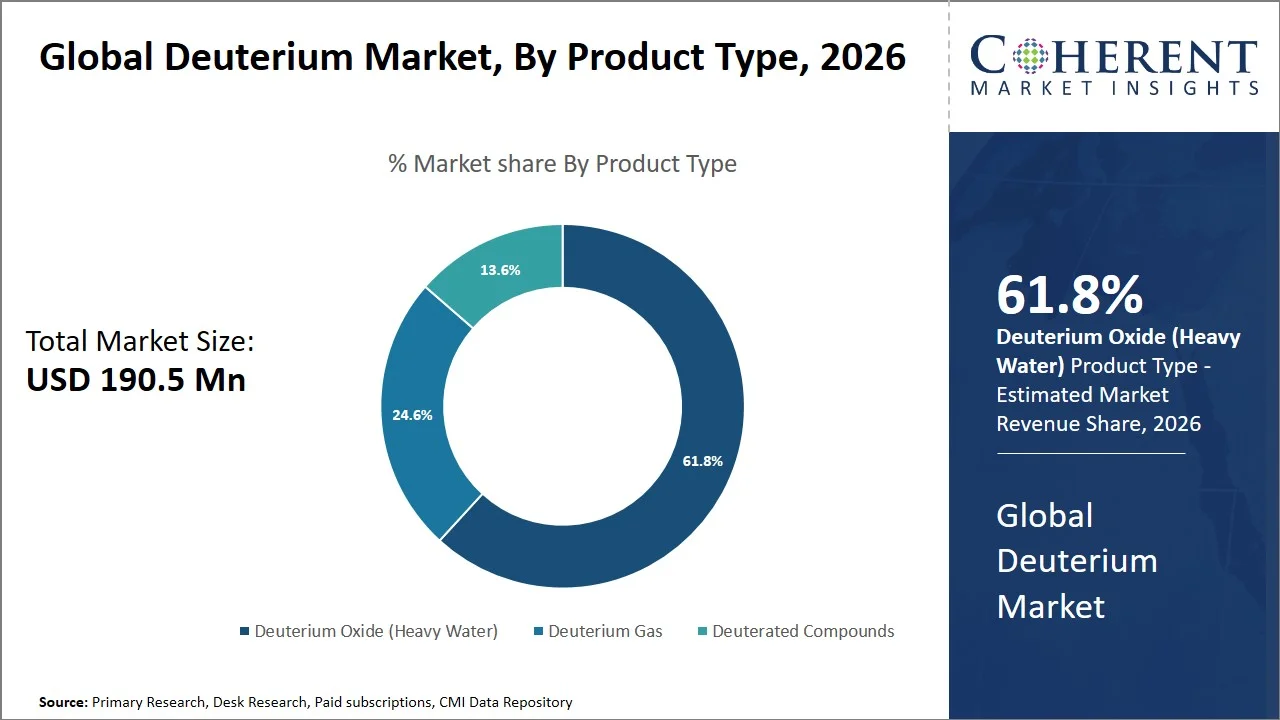
Why Does Deuterium Oxide (Heavy Water) Dominate the Global Deuterium Market?
Deuterium Oxide (Heavy Water) leads the global deuterium market with an expected share of 61.8% in 2026 because it remains the most commercially established deuterium product, supported by its essential role as a moderator and coolant in Pressurized Heavy Water Reactors (PHWRs) and its expanding use in scientific and industrial applications. The segment benefits from complex production infrastructure, specialized enrichment technologies, and limited availability of qualified producers, creating strong entry barriers. Nuclear utilities, research institutions, and specialty material users depend on consistent heavy water quality and reliable supply channels. Commercial opportunities are also expanding through non-nuclear applications, including analytical science and life-science research. In May 2025, Canadian Nuclear Laboratories partnered with Isowater to support expansion of heavy water refinement capabilities, strengthening supply availability for advanced industrial and scientific users.
- Current Industry Events of 2026
- Market Size Estimation
- Regional Breakdown
- Competitive Landscape
- Customer Intelligence
- Segmental Analysis
- Pricing Analysis
- Key Market Drivers, Challenges & Future Trends
- Customized Insights Section
Why Does 99.8% and Above Purity Grade Represent the Largest Purity Segment in the Global Deuterium Market?
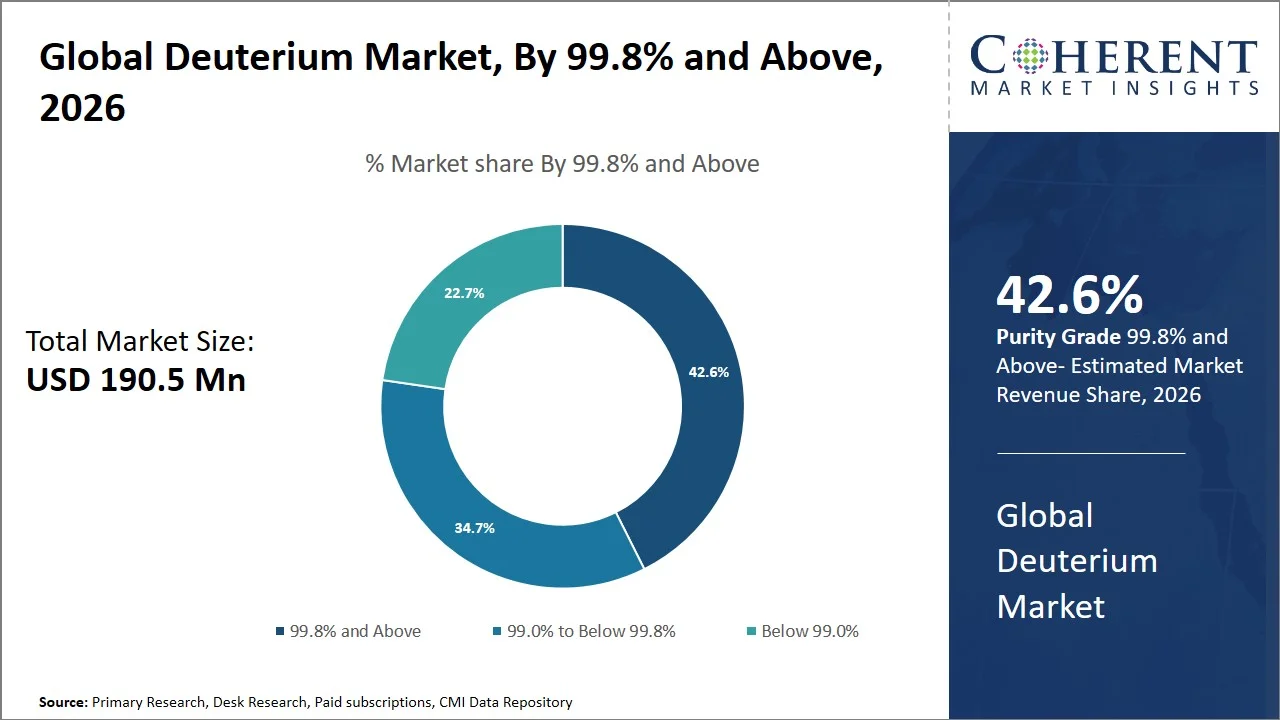
The 99.8% and Above purity grade segment dominates with an expected share of 42.6% in the global deuterium market because nuclear, research, and advanced industrial applications require strict isotopic concentration and impurity control to maintain process reliability. High-purity deuterium products command stronger commercial value due to specialized production processes, analytical verification requirements, and limited tolerance for contamination in sensitive applications. Nuclear operators require reactor-grade heavy water specifications, while laboratories and technology companies rely on consistent isotopic enrichment for reproducible results. Suppliers with advanced separation, purification, and quality-control capabilities are better positioned to serve premium customers. In July 2025, the Department of Atomic Energy of India highlighted that reactor-grade heavy water production requires advanced vacuum distillation technologies to achieve stringent enrichment standards, reinforcing the importance of high-purity production infrastructure.
Why Do Nuclear Reactors and Heavy Water Applications Dominate the Application Segment of the Global Deuterium Market?
Nuclear Reactors and Heavy Water Applications represent the leading application segment with an expected market share of 32.8% in 2026 because deuterium oxide remains a critical operational material for PHWR technology, where it functions as both a neutron moderator and coolant. The installed base of heavy-water reactor systems creates recurring requirements for replenishment, quality monitoring, and lifecycle management rather than one-time consumption. Governments, nuclear utilities, and specialized suppliers benefit from long-term procurement relationships supported by stringent qualification procedures. The segment also benefits from expanding nuclear energy strategies in countries seeking reliable low-carbon electricity generation. In July 2025, India’s Department of Atomic Energy emphasized that PHWRs will remain central to the country’s nuclear expansion plans and highlighted the importance of heavy water production and enrichment technologies for future reactor deployment.
Current Events and their Impact
Current Event | Description and Its Impact |
U.S. NRC Proposed Fusion-Machine Regulatory Framework – February 2026 |
|
UK Draft National Policy Statement EN-8 for Fusion Energy – June 2026 |
|
Global Deuterium Market Dynamics
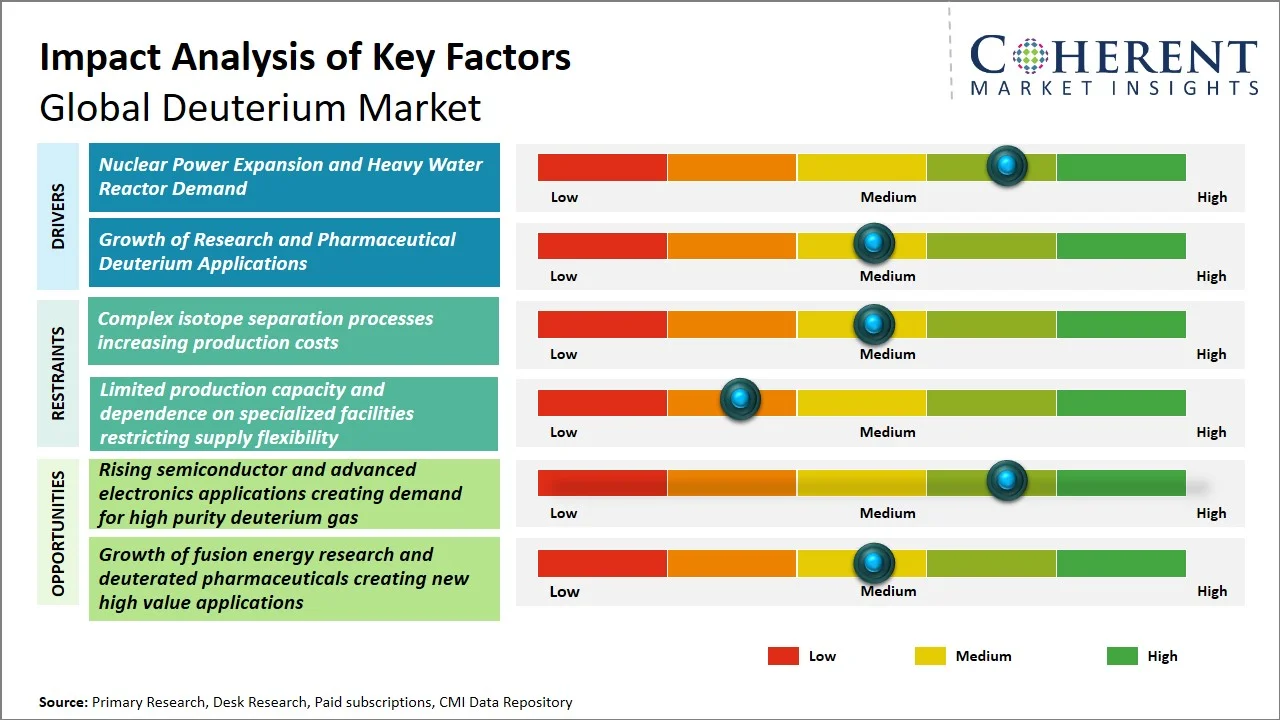
Key Market Drivers
- Nuclear Power Expansion and Heavy Water Reactor Demand: Expansion of nuclear power and heavy-water reactor operations creates long-term demand for deuterium oxide, as it is required for reactor moderation and cooling systems. This benefits heavy-water producers, nuclear utilities, isotope processors, and engineering suppliers capable of meeting strict purity, safety, and supply requirements. Long reactor lifecycles create recurring replenishment needs and increase the importance of qualified suppliers, inventory security, and technical support. In December 2024, the Government of India informed Parliament that heavy-water production capacity expansion and augmentation initiatives were underway at Manuguru, Kota, and Hazira to support nuclear program requirements. This highlights the strategic importance of maintaining upstream production readiness for future reactor demand.
- Growth of Research and Pharmaceutical Deuterium Applications: Expansion of research activities in spectroscopy, pharmaceutical development, and isotope-labelled chemistry is broadening deuterium demand beyond nuclear applications. Deuterated solvents and compounds support NMR analysis, metabolic studies, reaction tracking, and drug development, creating demand for specialized products with strict specifications and consistent quality. Isotope suppliers, pharmaceutical companies, research laboratories, and specialty chemical manufacturers benefit from increasing requirements for application-specific deuterated compounds. Competitive advantage is shifting toward custom synthesis capability, product portfolios, documentation, and analytical expertise. In July 2024, the U.S. FDA approved LEQSELVI containing deuruxolitinib for severe alopecia areata, demonstrating the commercial application of deuterium substitution in therapeutic development and strengthening demand potential for pharmaceutical-grade deuterated intermediates.
Emerging Market Trends
- Transition Toward Application-Specific Deuterium Solutions: The deuterium value chain is shifting from bulk isotope supply toward application-specific solutions tailored to pharmaceutical, semiconductor, spectroscopy, and advanced research requirements. Customers increasingly seek controlled isotopic enrichment, impurity specifications, customized packaging, and detailed documentation rather than standard products alone. This transformation is encouraging suppliers to invest in flexible purification, analytical capabilities, and custom synthesis platforms. Companies with specialized production systems can capture higher-value opportunities, while suppliers focused only on bulk output may face increasing margin pressure. Over the forecast period, customer qualification requirements and technical support capabilities are expected to become stronger competitive differentiators.
- Integrated Deuterium Management for Fusion Applications: Fusion development is transforming deuterium procurement from a simple consumable requirement into a broader fuel-cycle management challenge. Future users will require capabilities covering purification, storage, isotope accounting, recycling, contamination control, and integration with advanced fuel-handling systems. This creates opportunities for isotope specialists, recovery technology providers, and engineering companies offering complete lifecycle solutions. Suppliers focused only on packaged deuterium may face limitations as fusion projects move toward continuous operation and commercial-scale designs. Procurement decisions are expected to increasingly consider lifecycle efficiency, recovery capability, and technical integration rather than only product availability or unit pricing.
Regional Insights
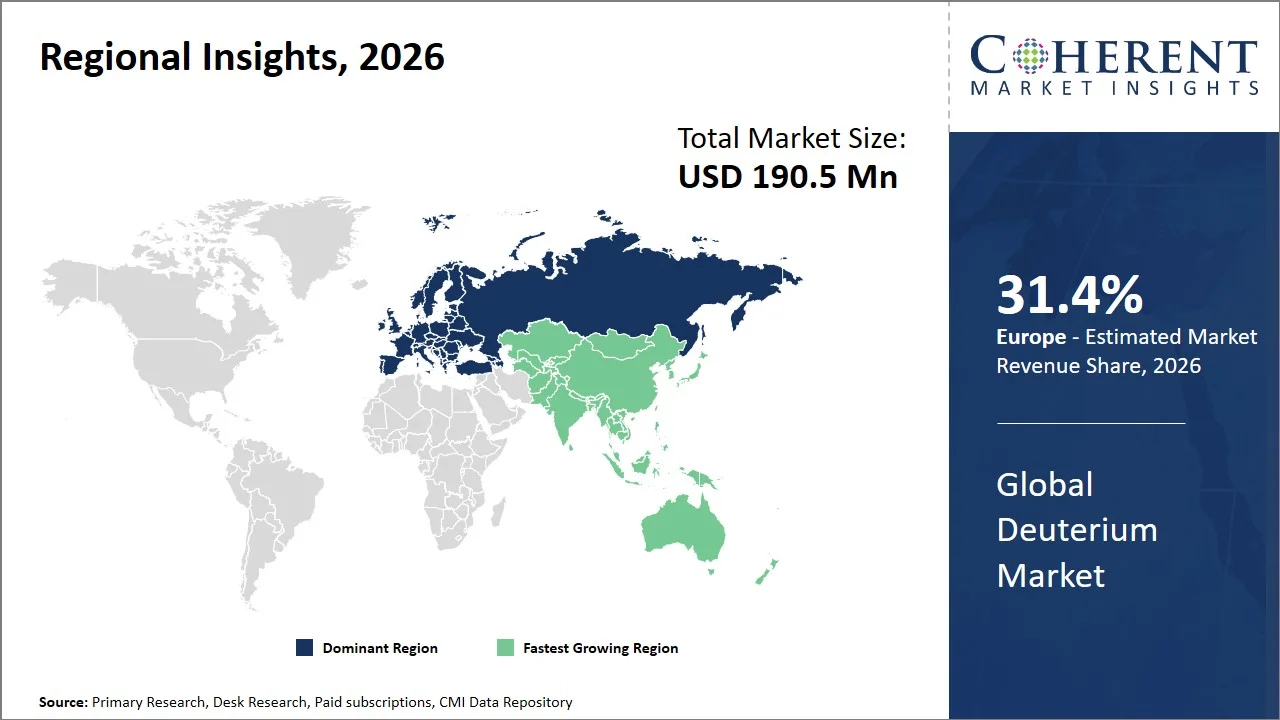
Why Does Europe Dominate the Global Deuterium Market?
Europe is expected to maintain its leading position in the global deuterium market with a 31.4% share in 2026, supported by its established nuclear infrastructure, advanced scientific research ecosystem, and strong presence of isotope-related expertise. The region benefits from long-operating nuclear facilities requiring reliable heavy water management, while research organizations continue utilizing deuterium in spectroscopy, materials science, and fusion-related studies. European countries also maintain strong regulatory frameworks for handling radioactive-adjacent materials and high-purity specialty chemicals, supporting qualified suppliers. The presence of advanced laboratories and international research collaborations strengthens demand for deuterated compounds and analytical-grade products. In November 2024, the European Commission announced the continuation of major fusion research funding through the European Fusion Programmer, reinforcing long-term institutional demand for hydrogen isotopes and related technologies.
Why Is Asia Pacific Emerging as the Fastest-Growing Region in the Global Deuterium Market?
Asia Pacific is projected to be the fastest-growing region in the global deuterium market, accounting for 30.7% share in 2026, supported by expanding nuclear power programs, semiconductor manufacturing capacity, and increasing investment in advanced scientific research. Countries such as China, Japan, and South Korea are strengthening their positions in nuclear technology, electronics manufacturing, and isotope-based research applications. The region’s growing semiconductor ecosystem is particularly relevant for high-purity deuterium gas requirements, while pharmaceutical and research industries are expanding utilization of isotope-labelled compounds. In March 2025, Japan’s Ministry of Education, Culture, Sports, Science and Technology highlighted continued development activities under the country’s fusion research initiatives, supporting future hydrogen isotope technology requirements.
Global Deuterium Market Outlook for Key Countries
Why Is the U.S. a Key Market for the Global Deuterium Market?
The U.S. represents a strategically important market for the global deuterium market due to its advanced research infrastructure, pharmaceutical innovation ecosystem, semiconductor industry, and growing private-sector fusion activities. Demand originates from national laboratories, universities, pharmaceutical developers, and high-technology manufacturers requiring deuterium for research, analytical applications, and specialized materials processing. The country’s strong innovation pipeline supports adoption of deuterated compounds in drug discovery and isotope-labelled research, while government-backed fusion programs are creating long-term demand opportunities. The presence of specialized isotope suppliers and research institutions further strengthens domestic capabilities. In January 2025, the U.S. Department of Energy announced continued investment in fusion research through its Fusion Energy Sciences program, supporting technology development requiring advanced isotope management capabilities.
Why Is Japan Important in the Global Deuterium Market?
Japan plays an important role in the global deuterium market through its advanced nuclear technology base, precision manufacturing capabilities, and globally recognized scientific research infrastructure. The country has long-standing expertise in heavy-water-related technologies, hydrogen isotope research, and high-purity materials used in scientific and industrial applications. Japan’s semiconductor sector, analytical research facilities, and pharmaceutical innovation activities create demand for specialized deuterium products beyond conventional nuclear applications. Strong quality standards and technology-driven manufacturing also support demand for high-grade isotope materials. In April 2025, Japan’s National Institutes for Quantum Science and Technology continued advancing fusion research programs involving hydrogen isotopes, strengthening the country’s position in future isotope-based energy development.
Why Does China Support Growth in the Global Deuterium Market?
China supports growth in the global deuterium market through its expanding nuclear power capacity, large-scale scientific infrastructure, and rapidly developing semiconductor and advanced technology sectors. The country’s nuclear expansion creates sustained requirements for heavy water-related applications, while its research institutions increasingly utilize isotopes for materials science, chemistry, and energy research. China’s domestic manufacturing ecosystem also supports development of isotope-related technologies and downstream applications, reducing reliance on external supply chains. Government-backed investment in advanced energy research further strengthens future demand potential. In December 2024, China’s Institute of Plasma Physics continued operations and research activities associated with the Experimental Advanced Superconducting Tokamak (EAST), supporting ongoing hydrogen isotope research capabilities.
Why Is Germany a Strategic Country in the Global Deuterium Market?
Germany holds strategic importance in the global deuterium market due to its advanced scientific ecosystem, industrial research capabilities, and strong participation in European fusion and isotope-related programs. The country’s universities, research institutes, and technology companies contribute to demand for high-purity deuterium products used in spectroscopy, materials research, and advanced energy studies. Germany’s precision engineering capabilities and emphasis on quality standards support specialized applications requiring reliable isotope supply and analytical verification. Its role within European research networks further enhances commercial relevance for deuterium suppliers. In February 2025, the Max Planck Institute for Plasma Physics continued research activities related to fusion technology development, supporting future requirements for hydrogen isotope expertise and infrastructure.
Why Is South Korea an Important Growth Market for the Global Deuterium Market?
South Korea is becoming increasingly relevant in the global deuterium market due to its advanced semiconductor manufacturing base, nuclear technology expertise, and expanding research activities involving high-purity materials. The country’s semiconductor industry requires stringent process materials and specialty gases, creating opportunities for high-grade deuterium applications. South Korea’s nuclear sector and scientific institutions also contribute to demand for isotope-based technologies, while government-supported research programs encourage development of advanced energy capabilities. The combination of electronics manufacturing strength and scientific investment creates a diversified demand base. In June 2025, the Korea Institute of Fusion Energy continued development activities related to the KSTAR fusion research program, reinforcing South Korea’s long-term involvement in hydrogen isotope-based energy research.
Technology Adoption Landscape in the Global Deuterium Market
Technology | Adoption Level | Key Application Area | Business Impact |
Chemical Exchange Isotope Separation | High | Heavy water production | Enables large-scale enrichment of naturally occurring deuterium and remains commercially important where high-throughput heavy-water production is required. |
Cryogenic Distillation | Medium | High-purity deuterium gas purification | Supports precise hydrogen-isotope separation, improving purity consistency for electronics, fusion research, and specialty scientific applications. |
Electrolytic Deuterium Enrichment | Medium | Laboratory and specialty isotope production | Provides flexible enrichment for smaller production volumes and supports specialty applications where process control is more important than bulk throughput. |
Catalytic H/D Exchange and Selective Deuteration | High | Pharmaceuticals and deuterated compounds | Expands the range of selectively labelled molecules and supports custom synthesis, drug development, isotope tracing, and higher-value specialty chemical portfolios. |
Isotope-Ratio Mass Spectrometry and NMR-Based Quality Verification | High | Quality control and research-grade products | Enables precise isotopic-purity verification, strengthens batch certification, reduces qualification risk, and supports premium pricing for high-specification products. |
Closed-Loop Hydrogen Isotope Recovery and Purification | Medium | Fusion, semiconductor and advanced research facilities | Reduces isotope losses, improves supply security, and can lower lifecycle fuel costs where deuterium is repeatedly circulated through controlled systems. |
How Are Closed-Loop Deuterium Recovery and Purification Systems Creating New Growth Opportunities in the Global Deuterium Market?
A high-potential opportunity in the global deuterium market lies in building integrated deuterium recovery, purification, and reuse solutions for semiconductor, pharmaceutical, research, and emerging fusion users. Many high-specification applications consume deuterium in controlled processes where unreacted material, off-gas, or deuterated solvents can potentially be recovered rather than treated solely as waste. Commercializing closed-loop systems could reduce exposure to isotope costs, improve supply security, and support customers with tighter sustainability and traceability expectations. Suppliers can capture this opportunity by combining isotope products with purification skids, analytical verification, cylinder or bulk-gas management, solvent recovery, and technical service contracts. The model favors specialists and vertically integrated producers that can connect separation technology with application engineering. Market entry will require investment in contamination control, high-vacuum handling, isotope analytics, validated regeneration protocols, and customer-specific safety documentation. Companies that establish recovery performance guarantees and dependable take-back logistics could differentiate beyond unit pricing while creating recurring service revenue and stronger customer retention.
Market Players, Key Development, and Competitive Landscape
Key Developments
- In June 2026, General Fusion announced compressional plasma-heating results from its LM26 Magnetized Target Fusion machine, reporting progress toward conditions relevant to its pathway to commercial fusion. This is important for the global deuterium market because continued validation of large-scale fusion systems strengthens the prospective downstream market for deuterium used in plasma formation, fuel-cycle testing, diagnostic programs, and eventual commercial fusion operations, while creating demand for increasingly sophisticated isotope supply infrastructure.
- In February 2026, Helion Energy announced that its Polaris prototype had demonstrated measurable deuterium-tritium fusion and achieved plasma temperatures of 150 million degrees Celsius. This is important for the global deuterium market because validation of D-T operation by a privately developed fusion machine moves deuterium further from experimental feedstock toward an engineered commercial fuel-cycle requirement, increasing future importance of high-purity supply, isotope handling, and recovery infrastructure.
- In May 2026, Zap Energy announced that the U.S. Department of Energy had approved its preconceptual Z-pinch fusion power plant design milestone. The design incorporates a tritium fuel cycle, while Zap's underlying fusion architecture is based on deuterium-tritium plasma. This is important for the global deuterium market because system-level power-plant engineering creates prospective demand for fuel qualification, purification, storage, circulation, and isotope-accounting solutions rather than laboratory-scale deuterium alone.
Competitive Landscape
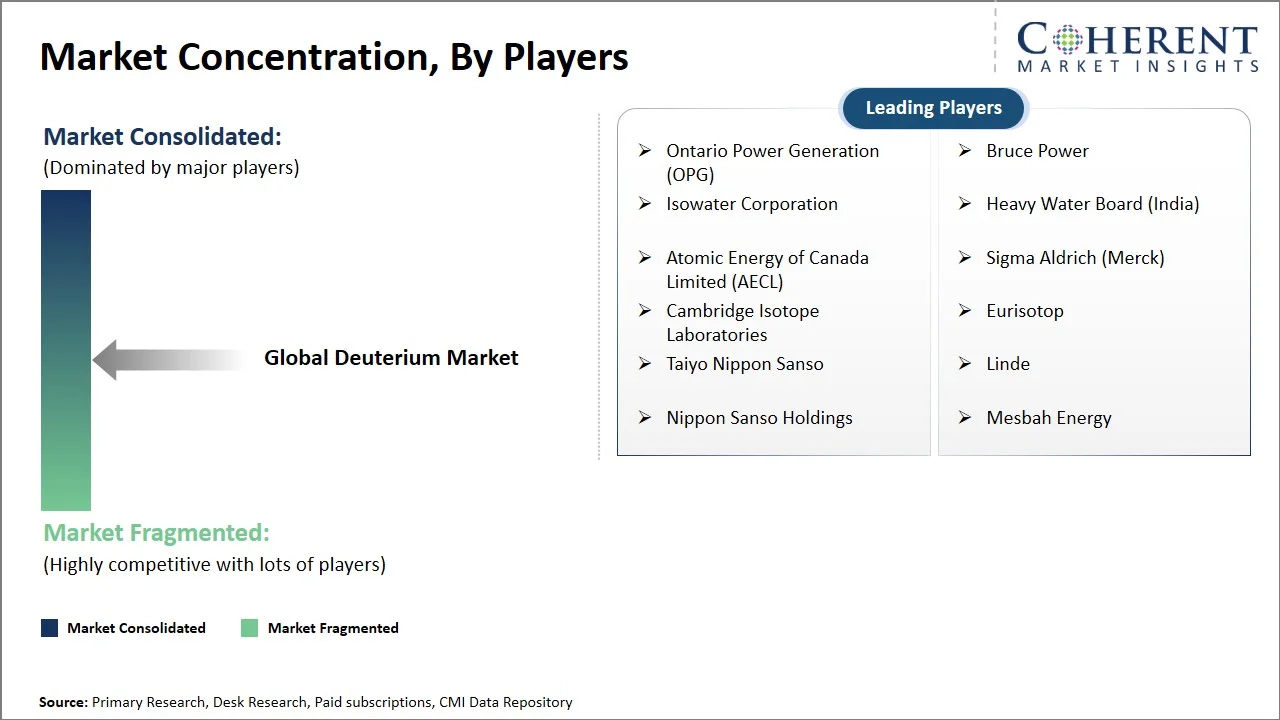
The global deuterium market is moderately consolidated in upstream production but fragmented across specialty deuterated compounds and application-specific supply. High entry barriers arise from complex isotope enrichment infrastructure, analytical verification, safety requirements, and purity control. Competition varies by end user: nuclear customers prioritize supply reliability, while pharmaceutical, research, semiconductor, and fusion users emphasize purity, customization, documentation, and technical support. Regional producers benefit from strategic sourcing needs, whereas specialty chemical suppliers compete through custom synthesis and application expertise. Key focus areas include:
- Isotopic purity and impurity control are central differentiators, particularly for spectroscopy, electronics, pharmaceutical synthesis, and advanced research.
- Production yield and isotope-recovery efficiency directly influence supplier cost structures and pricing flexibility.
- Supply reliability and inventory assurance are critical where customer processes cannot easily substitute conventional hydrogen for deuterium.
- Custom deuteration capability strengthens supplier positioning in pharmaceutical discovery, labelled compounds, and specialized chemical synthesis.
- Quality documentation and traceability increasingly influence vendor qualification for regulated and research-intensive customers.
- Technical application support is becoming more important as customers move from standardized isotope purchases toward process-specific requirements.
- Regional production and secure logistics can improve competitiveness where export controls, nuclear safeguards, or hazardous-material handling complicate cross-border supply. Top of Form
Market Report Scope
Deuterium Market Report Coverage
| Report Coverage | Details | ||
|---|---|---|---|
| Base Year: | 2025 | Market Size in 2026: | USD 190.5 Mn |
| Historical Data for: | 2020 To 2024 | Forecast Period: | 2026 To 2033 |
| Forecast Period 2026 to 2033 CAGR: | 5.2% | 2033 Value Projection: | USD 271.6 Mn |
| Geographies covered: |
| ||
| Segments covered: |
| ||
| Companies covered: | Ontario Power Generation (OPG), Bruce Power, Isowater Corporation, Heavy Water Board (India), Atomic Energy of Canada Limited (AECL), Sigma Aldrich (Merck), Cambridge Isotope Laboratories, Eurisotop, Taiyo Nippon Sanso, Linde, Nippon Sanso Holdings, Mesbah Energy | ||
| Growth Drivers: |
| ||
| Restraints & Challenges: |
| ||
Analyst Opinion (Expert Opinion)
- The global deuterium market is likely to shift from commodity isotope supply toward application-qualified solutions. Suppliers combining purification, custom synthesis, analytical certification, recovery services, and technical support are expected to strengthen customer relationships and competitive positioning.
- Closed-loop isotope management could reshape supplier economics by increasing the importance of recovery, purification, and lifecycle services. Companies offering integrated deuterium supply and recovery solutions may gain an advantage over traditional volume-based suppliers.
- Participants should focus on flexible enrichment capacity, advanced quality control, secure logistics, and hydrogen-isotope expertise. Strategic partnerships with pharmaceutical, research, semiconductor, and fusion stakeholders can improve market access, while avoiding excess commodity capacity without secured demand.
Speak to the analyst
Want personalized insights?
Take the findings above to one of our principal consultants, or have the report rebuilt around the segments, geographies and competitors you actually track.
Market Segmentation
- Product Type Insights (Revenue, USD Mn, 2021 - 2033)
- Deuterium Oxide (Heavy Water)
- Deuterium Gas
- Deuterated Compounds
- Purity Grade Insights (Revenue, USD Mn, 2021 - 2033)
- 99.8% and Above
- 99.0% to Below 99.8%
- Below 99.0%
- Application Insights (Revenue, USD Mn, 2021 - 2033)
- Nuclear Reactors and Heavy Water Applications
- NMR Spectroscopy and Scientific Research
- Pharmaceuticals and Deuterated Drugs
- Semiconductor and Electronics
- Fusion Research
- Others
- End User Insights (Revenue, USD Mn, 2021 - 2033)
- Nuclear Energy Organizations
- Research Institutes and Laboratories
- Pharmaceutical Companies
- Semiconductor Manufacturers
- Others
- Distribution Channel Insights (Revenue, USD Mn, 2021 - 2033)
- Direct Sales
- Indirect Sales
- Regional Insights (Revenue, USD Mn, 2021 - 2033)
- North America
- U.S.
- Canada
- Latin America
- Brazil
- Argentina
- Mexico
- Rest of Latin America
- Europe
- Germany
- U.K.
- Spain
- France
- Italy
- Russia
- Rest of Europe
- Asia Pacific
- China
- India
- Japan
- Australia
- South Korea
- ASEAN
- Rest of Asia Pacific
- Middle East
- GCC Countries
- Israel
- Rest of Middle East
- Africa
- South Africa
- North Africa
- Central Africa
- North America
- Key Players Insights
- Ontario Power Generation (OPG)
- Bruce Power
- Isowater Corporation
- Heavy Water Board (India)
- Atomic Energy of Canada Limited (AECL)
- Sigma Aldrich (Merck)
- Cambridge Isotope Laboratories
- Eurisotop
- Taiyo Nippon Sanso
- Linde
- Nippon Sanso Holdings
- Mesbah Energy
Sources
Primary Research Interviews
- Heavy water producers, isotope enrichment companies, nuclear utilities, reactor operators, and nuclear technology suppliers
- Research institutes, fusion organizations, pharmaceutical companies, semiconductor manufacturers, and specialty chemical users
- Procurement managers, isotope specialists, R&D scientists, nuclear engineers, and industry consultants
Stakeholders
- Deuterium producers, heavy water manufacturers, isotope separation technology providers, and specialty chemical companies
- Nuclear organizations, research laboratories, pharmaceutical developers, semiconductor companies, and fusion technology developers
- Distributors, logistics providers, analytical service providers, and technical solution suppliers
End-use Sectors
- Nuclear power generation and heavy water reactors
- Scientific research and NMR spectroscopy
- Pharmaceuticals and deuterated drugs
- Semiconductor and electronics manufacturing
- Fusion research and advanced energy applications
Regulatory and Government Bodies
- International Atomic Energy Agency (IAEA)
- U.S. Nuclear Regulatory Commission (NRC)
- U.S. Department of Energy (DOE)
- European Commission and Euratom
- National nuclear energy, isotope management, and research authorities
Databases
- UN Comtrade and ITC Trade Map – HS 284590 (Isotopes other than radioactive; compounds enriched in isotopes)
- IAEA databases and nuclear energy statistics
- World Nuclear Association, Eurostat, USITC, national trade databases, and customs records
- Company annual reports, technical publications, product catalogues, and shipment intelligence
Magazines and Journals
- Nuclear Engineering and Design
- Fusion Engineering and Design
- Journal of Radioanalytical and Nuclear Chemistry
- International Journal of Hydrogen Energy
- Nuclear Technology
Associations
- International Atomic Energy Agency (IAEA)
- World Nuclear Association
- Fusion Industry Association
- Nuclear Energy Institute (NEI)
- National isotope and nuclear technology associations
Public Domain Sources
- Heavy water production facilities, isotope enrichment technologies, and capacity developments
- Nuclear reactor projects, fusion research programs, and isotope application advancements
- Product specifications, technical papers, patents, regulatory filings, and research publications
- Import-export data for deuterium, heavy water, and isotope-related products
Key Standards and Regulations
- IAEA nuclear material safeguards and isotope management guidelines
- Nuclear Regulatory Commission (NRC) regulations for nuclear materials
- Euratom nuclear safeguards framework
- ISO quality management standards applicable to isotope production
- Applicable nuclear safety, transport, handling, and quality-control regulations
Proprietary Elements
- CMI Data Analytics Tool, Proprietary CMI Existing Repository of information for the last 10 years
Get access to 250+ pages report
Every segment, forecast, competitor profile and data table behind the analysis above — available for instant download.
- ESOMAR Member
- ISO 9001:2015 Certified
- D-U-N-S Registered
- GDPR & CCPA Compliant
Missing comfort of reading report in your local language? Find your preferred language:
Transform your Strategy with Exclusive Trending Reports
Frequently Asked Questions
The global deuterium market is estimated to be valued at USD 190.5 million in 2026 and is expected to reach USD 271.6 million by 2033.
The major applications of the global deuterium market include nuclear reactors and heavy water applications, NMR spectroscopy and scientific research, pharmaceuticals and deuterated drugs, semiconductor and electronics manufacturing, and fusion research. Deuterium is widely utilized where enhanced isotopic stability, analytical accuracy, and specialized material performance are required.
Emerging opportunities in the global deuterium market include the development of deuterated pharmaceutical compounds, advanced semiconductor applications, fusion energy research, isotope recovery technologies, and customized deuterium solutions for specialized industrial and scientific requirements. Companies investing in purification, custom synthesis, and application-specific solutions are positioned to capture new market opportunities.
A global deuterium market report typically covers market size analysis, growth trends, segmentation insights, competitive landscape, supplier assessment, application analysis, regional opportunities, technology developments, pricing factors, and industry dynamics to support strategic decision-making for investors, manufacturers, suppliers, and end users.
Companies sourcing deuterium products should evaluate supplier reliability, isotopic purity levels, production capabilities, quality certifications, regulatory compliance, supply continuity, logistics requirements, and technical support capabilities. Long-term supply agreements and qualified supplier networks are particularly important for nuclear, pharmaceutical, semiconductor, and research applications.
The global deuterium market is analyzed based on product type, purity grade, application, end user, distribution channel, and region. Key segments include deuterium oxide (heavy water), deuterium gas, deuterated compounds, nuclear applications, research applications, pharmaceutical uses, semiconductor applications, direct sales channels, and regional market dynamics.
Nuclear power expansion and heavy water reactor demand and growth of research and pharmaceutical deuterium applications are the major factors driving the growth of global deuterium market.