

Global Digital Time Switches Market Size and Forecast – 2026 To 2033
The Global Digital Time Switches Market is expected to grow from USD 1.45 Bn in 2026 to USD 2.15 Bn by 2033, registering a compound annual growth rate (CAGR) of 5.7% from 2026 to 2033. The global digital time switches market is driven by the growing deployment of automated lighting control systems. On March 12, 2025, Enlighted unveiled Enlighted Eazy, its new smart lighting control solution designed for the small and medium-sized business (SMB) market that offers fast, intuitive app-based deployment at an accessible price point. (Source: Enlighted)
Key Takeaways of the Global Digital Time Switches Market
- The programmable digital time switches segment is expected to account for 57.0 % of the global digital time switches market share in 2026. Expansion of heating, ventilation and air conditioning (HVAC) automation in commercial buildings is driving the growth of the segment. On December 3, 2024, Schneider Electric launched EcoStruxure Building Activate, an energy management and automation IoT platform for small and mid-size buildings (Source: Schneider Electric)
- The DIN rail mounted segment is estimated to capture 44.0 % of the market share in 2026. Increasing industrial automation and process control requirements is a major factor driving the growth of the segment. On June 23, 2026, Schneider Electric announced ‘Industrial Automation Modernization as a Service’, a new offering designed to help industrial organizations modernize automation environments without disrupting production.
- The lighting control segment is estimated to capture 26.0 % of the market share in 2026. Government regulations promoting energy conservation is driving the growth of the segment. On May 27 2026, Signify delivered an advanced smart lighting solution for Liverpool’s waterfront area. The project, completed in collaboration with McCann Ltd, is a three-year, U.K.-wide program funded by the Department for Transport that aims to decarbonize the local highway network. (Source: Signify)
- North America is expected to dominate the digital time switches market in 2026 with a market share of 36.0 %. Growing adoption of renewable energy management systems in North America is driving the growth of the regional market. On September 18, 2025, Schneider Electric announced the Accelerating Resilient Infrastructure Initiativ, a nationwide effort to rapidly deploy resilient, community-based energy systems across the U.S. The initiative brings together more than 20 partners to support public and private sector organizations with innovative solutions and financing.
- Asia Pacific is expected to account for 29.0 % share in 2026 and is projected to record the fastest growth over the forecast period. Rising demand for wireless and cloud-connected scheduling devices in Asia Pacific is driving the growth of the regional market. Manufacturers like Panasonic and Omron Corporation produce schedule devices that use advanced digital time switches.
- Growing Adoption of IoT-Enabled and Smart Time Switches: Manufacturers are developing more digital time switches with Wi-Fi, Bluetooth and cloud connectivity that enable remote scheduling, real-time monitoring and integration with smart home and building automation platforms. This approach is turning classic time switches into sophisticated gadgets for energy management.
- Integration with Smart Buildings and Energy Management Systems: Digital time switches are being integrated into larger building management systems (BMS) to optimize lighting, HVAC, and electrical loads. Commercial facilities are employing programmable scheduling capabilities to save energy use and meet sustainability and carbon reduction goals.
Segmental Insights
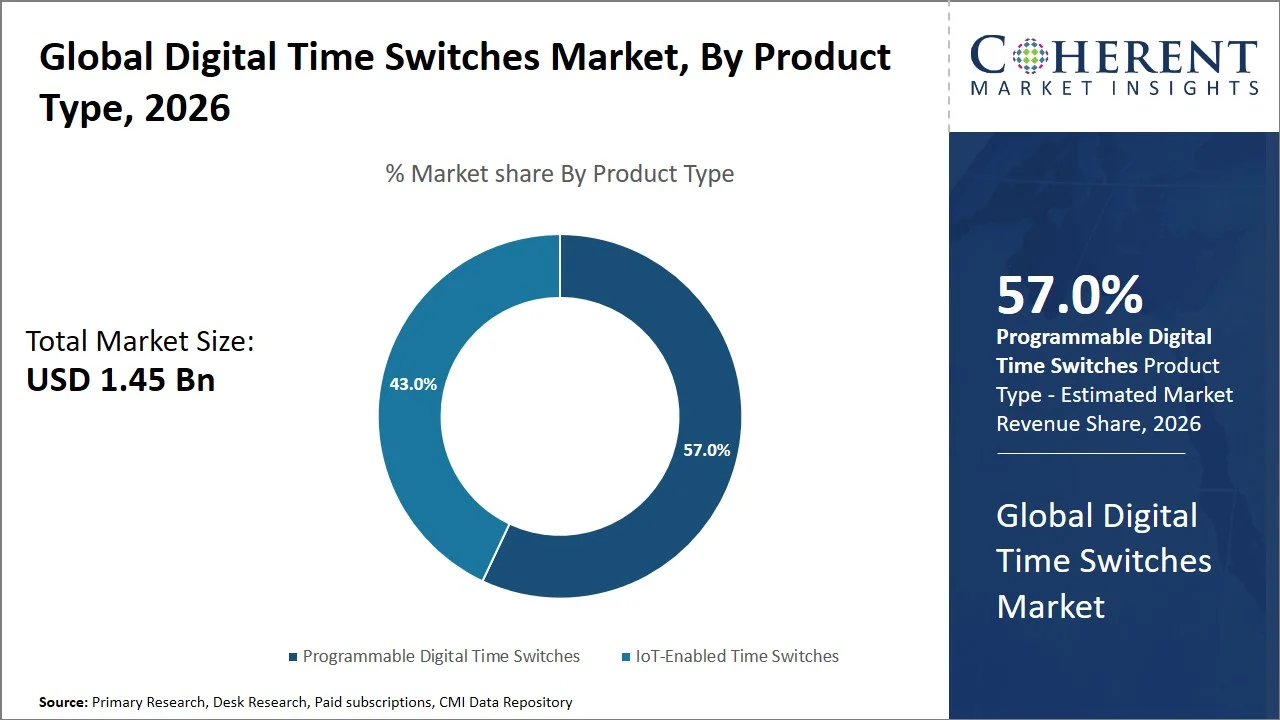
Why Do Programmable Digital Time Switches Dominate the Global Digital Time Switches Market?
The programmable digital time switches segment is expected to account for 57.0% of the global digital time switches market share in 2026. Programmable digital time switches are being rapidly used owing to their capability to enable extremely flexible and accurate scheduling for a variety of electrical loads and applications. Unlike simple digital timers, these products let customers design customized daily, weekly and seasonal operation schedules to assist cut energy consumption, minimize operating expenses and boost automation efficiency in residential, commercial and industrial settings. They are the ideal choice for modern energy management and smart control systems because of their flexibility and simplicity of adaptation to different operating demands. On February 22, 2025, ABB India presented its new LIORA line of modular switches at ELECRAMA 2025. LIORA switches are designed to redefine standards in the modular switch segment of smart residential, commercial and hospitality spaces.
- Current Industry Events of 2026
- Market Size Estimation
- Regional Breakdown
- Competitive Landscape
- Customer Intelligence
- Segmental Analysis
- Pricing Analysis
- Key Market Drivers, Challenges & Future Trends
- Customized Insights Section
Why is DIN Rail Mounted the Most Preferred Mounting Type?
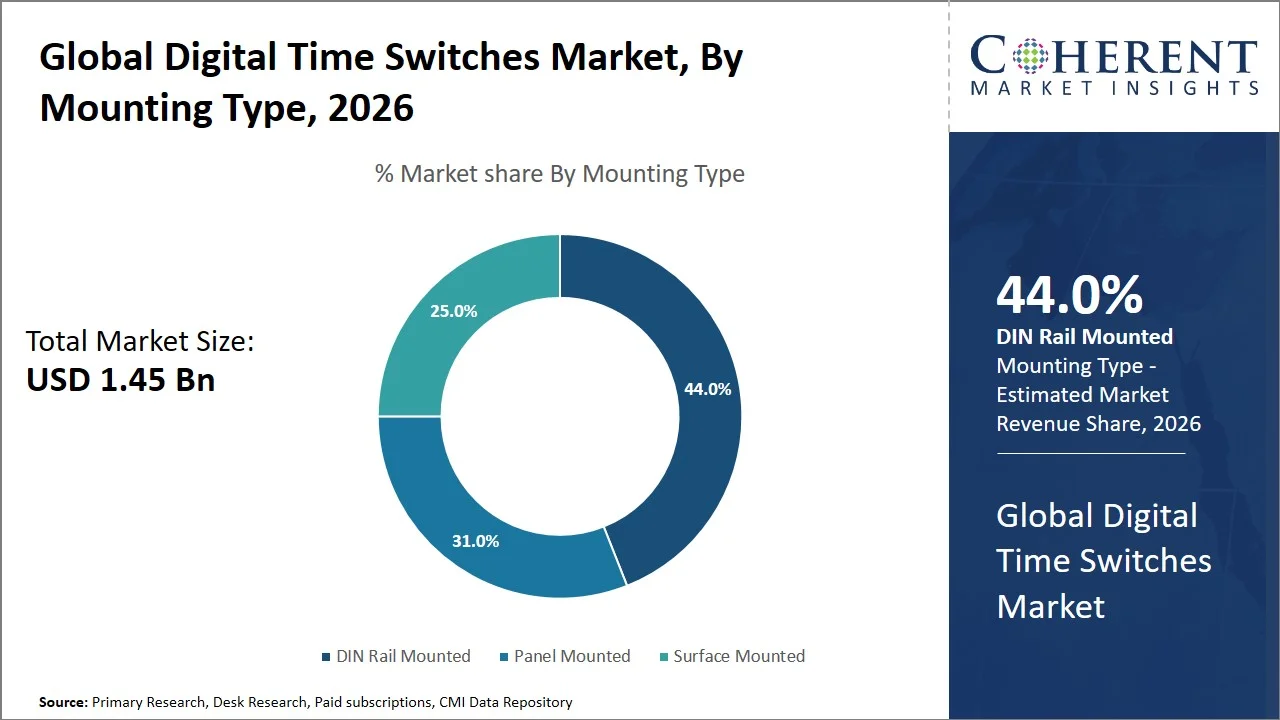
The DIN rail mounted segment is expected to account for 44.0% of the global digital time switches market share in 2026. The DIN rail mounted designs are commonly used since they allow standardized, space-efficient and straightforward installation within electrical control panels and distribution boards. The interoperability with globally standard DIN rail systems allows electricians and facility managers to install, update or expand control devices quickly and without substantial wire changes lowering installation time and maintenance costs. The ease of use, coordinated panel configurations and proven dependability in commercial and industrial settings make DIN rail mounting the ideal option for digital time switch installations. On October 7, 2025, Theben introduced its next-generation KNX-integrated digital time switches with NFC and Bluetooth programming for smart homes and commercial automation systems, concentrating on flexible weekly/yearly scheduling and energy optimization.
Lighting Control Dominates the Global Digital Time Switches Market
The lighting control segment is expected to account for 26.0% of the global digital time switches market share in 2026. A major driver of the use of digital time switches in lighting control applications is the large-scale demand for energy-efficient lighting control in residential, commercial and industrial facilities. These devices enable the automatic programming of indoor and outdoor lights according to the specified operation times, which helps to reduce excessive electricity consumption and lowers utility expenses. They are useful in providing uniform lighting operation, with no human interaction, therefore very appropriate for usage in offices, retail stores, public infrastructure, warehouses and residential buildings for better energy efficiency and operational ease. On March 9, 2026, Signify added four new features to its Interact platform. These innovative technologies can assist businesses and municipalities in making buildings smarter and cities more responsive and sustainable places, all data-driven. The new Interact Building suite allows centralized, real-time control, automation and optimization of lighting across all types of professional indoor settings, big and small.
Currents Events and their Impact
Current Events | Description and its Impact |
Energy Performance of Buildings Directive - European Union |
|
International Energy Conservation Code Adoption and Updates – U.S. |
|
Digital Time Switches Market Dynamics
Market Drivers
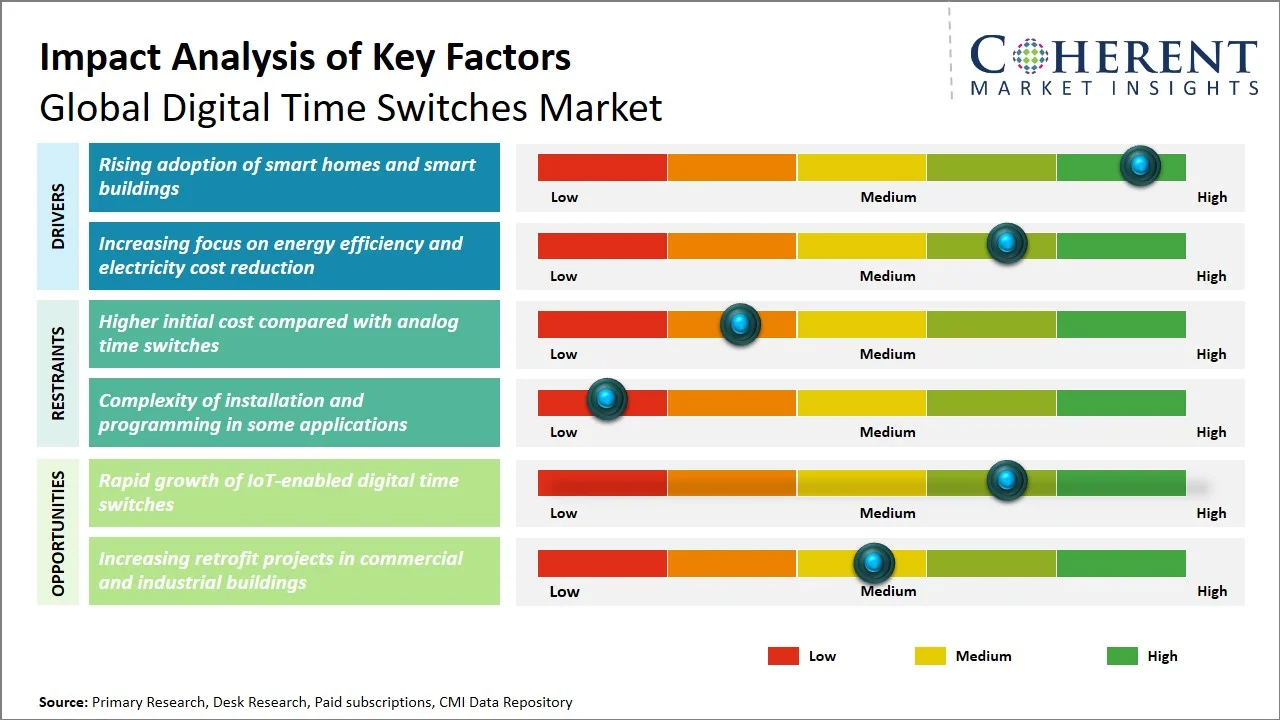
- Rising adoption of smart homes and smart buildings: The growing adoption of smart homes and smart buildings is a significant driver for the need of digital time switches. Property owners are increasingly looking for automated solutions to improve energy efficiency, convenience, and operational control. Digital time switches allow precise control of lighting, HVAC systems, water heaters and other electrical loads, helping to reduce energy waste while improving occupant comfort. They are compatible with smart home ecosystems and building management systems and are an integral part of the current linked infrastructure. They respond to the growing need for intelligent and energy-efficient living and working environments. On September 18, 2024, Johnson Controls released a much-anticipated update to the company’s industry-leading Building Automation System (BAS), Metasys, addressing the needs of commercial, industrial and institutional buildings, across industries.
- Increasing focus on energy efficiency and electricity cost reduction: The rising emphasis on energy efficiency and reduction of power costs is one of the primary factors driving the growth of digital time switches in residential, commercial and industrial sectors. These devices are used to optimize energy usage by automatic control of the running schedules of lighting systems, HVAC equipment, water heaters and other electrical loads to ensure they are operating only when they are needed. The digital time switches assist users to cut electricity bills, promote sustainability goals and enhance energy efficiency by reducing wasteful power use during non-operational hours and improved load control.
- On May 19, 2026, Siemens Smart Infrastructure launched Asset Performance Advanced, a new AI-enabled managed building service. By combining an integrated predictive failure mode classification with advanced fault detection and diagnosis (FDD), the solution helps customers across industries optimize operations, improve energy performance, and enhance occupant comfort. (Source: Siemens)
Emerging Trends
- Rising Demand for DIN-Rail Mounted Industrial Automation Solutions: Industrial users are progressively adopting advanced digital time switches to automate the control of machinery, pumps, motors and production processes. Manufacturing industries, utility companies and infrastructure projects wanting to improve operational efficiency and eliminate manual involvement are especially keen to use it.
- Expansion of Renewable Energy and EV Charging Applications: Digital time switches are being increasingly utilized in solar power systems, battery storage systems and electric car charging infrastructure. Features like programmable load management enable customers to optimize electricity consumption during off-peak hours, improve energy efficiency and contribute to grid-balancing efforts.
Regional Insights
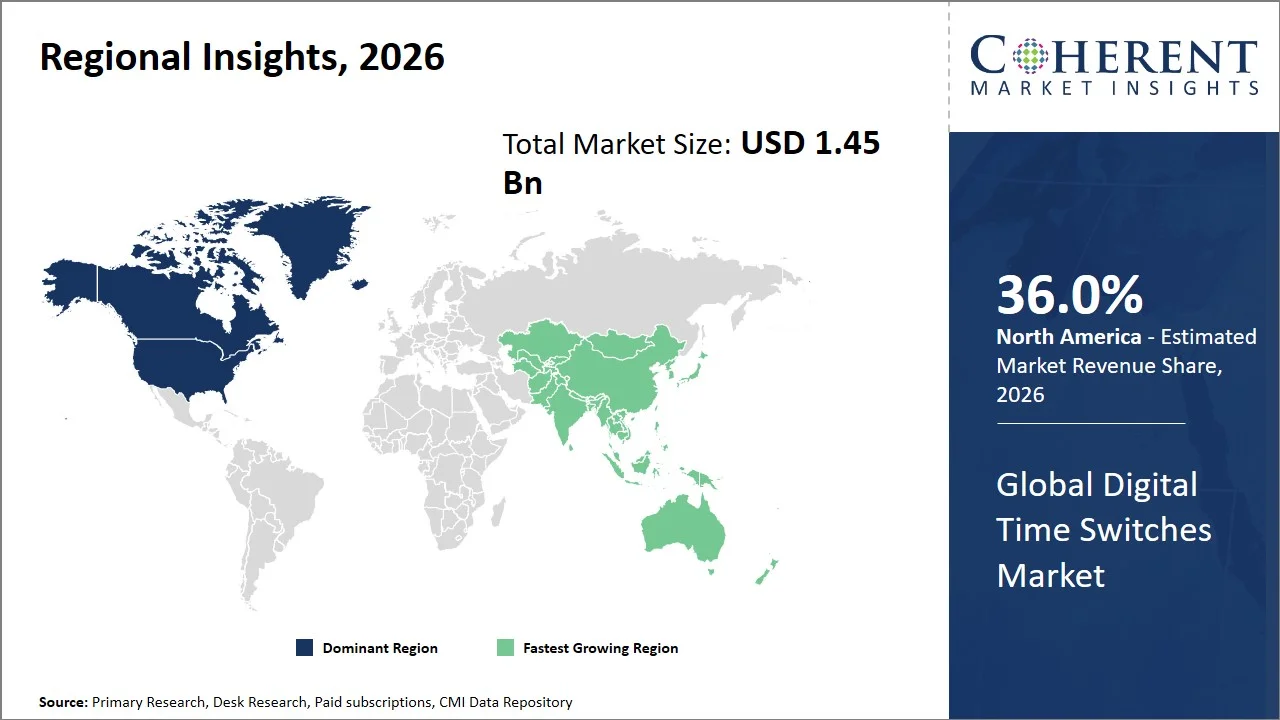
Why is North America a Strong Market for Digital Time Switches?
North America is expected to account for a market share of 36.0% in 2026. Digital time switches are increasingly being employed in North America for commercial buildings, educational institutions, healthcare facilities and municipal infrastructure projects with energy optimization as the goal. Utilities and building owners in the U.S. and Canada are progressively installing programmable time switches to automatically control lighting schedules, HVAC systems, parking lot lights and outdoor signs under tougher energy-efficiency rules. The rising integration of digital time switches with smart building platforms from businesses such as Schneider Electric, Honeywell and Eaton has further bolstered demand across the region.
Moreover, increasing focus on reducing energy usage through automation is also aiding the growth of the regional market. On May 29, 2024, Honeywell announced expanded deployment of its Forge digital automation platform, enabling industrial facilities to reduce energy usage through predictive control and automated scheduling of equipment operations.
Why Does the Asia Pacific Digital Time Switches Market Exhibit High Growth?
Asia Pacific is projected to account for 29.0% of the global digital time switches market and is expected to register the fastest growth. The Asia Pacific region is undergoing a speedy uptake of digital time switching, driven by rising urbanization, industrialization and smart city projects. Countries such as China, India, Japan and South Korea are rolling out automated lighting and electrical control systems for commercial complexes, manufacturing sites, transit hubs and public infrastructure projects. Programmable digital time switches are being used increasingly across the region as intelligent building technologies are deployed in large-scale industrial parks and mixed-use urban complexes.
In addition, growing need of energy efficiency to attain net zero emission goals is driving the growth of the regional market even further. On March 6, 2024, Mahindra Group, and Johnson Controls announced a first of its kind Net Zero Buildings Initiative to decarbonize India’s commercial, urban residential and public buildings. The joint initiative will simplify access to key information and resources to help organizations start their net zero buildings journeys.
Global Digital Time Switches Market Outlook for Key Countries
Why is the U.S. Emerging as a Major Hub in the Digital Time Switches Market?
The U.S. digital time switches market is driven by the adoption of advanced energy management strategies in office buildings, warehouses, schools, hospitals and retail facilities. Building energy rules, such as ASHRAE standards and state-level efficiency requirements, mandate the significant usage of digital time switches to automate lighting and HVAC schedules. Intermatic, Leviton, Honeywell and Eaton are among the leading manufacturers adding more programmable and connected time switches to their portfolios to accommodate the rising adoption of smart building automation and demand-response programs.
Is China the Next Growth Engine for the Digital Time Switches Market?
The China digital time switches market is buoyed by huge investments in smart city construction, industrial automation and energy-efficient building infrastructure. Digital time switches are being used more and more in commercial towers, manufacturing plants, logistics centers and public lighting systems to cut down on electricity usage and increase operating efficiency. The continuous expansion of smart industrial parks and digitally controlled city infrastructure in the country has led to a strong need for programmable electrical control devices, such as sophisticated digital time switches coupled with building automation systems.
Germany Digital Time Switches Market Analysis and Trends
Germany remains an important market in Europe, supported by a strong focus on energy conservation, building automation and industrial efficiency. Digital time switches are extensively used in commercial buildings, manufacturing plants, and public infrastructure to optimize the scheduling of lighting and equipment operation. A notable example is the smart street lighting modernization program in the city of Hamburg, Germany. The country’s focus on smart building technologies, along with increasing investments in energy-efficient retrofitting projects and automated facility management systems, continues to drive the development of advanced programmed time-switching solutions.
India Digital Time Switches Market Analysis and Trends
Demand for digital time switches is rising in India’s commercial real estate developments, industrial facilities, educational campuses and smart city projects. These devices are widely used for automation of street lighting, water pumping systems, commercial buildings lighting and HVAC operations to overcome the increased electricity cost and to optimize the energy consumption. All these factors, including government-supported urban renewal plans, increased commercial construction activity and increasing use of building automation technology across the country, are creating an environment conducive for the use of programmable digital time switches.
Japan Digital Time Switches Market Analysis and Trends
Japan represents one of the most technologically advanced markets for digital time switches, driven by the country's strong focus on building automation, energy conservation, smart infrastructure, and industrial efficiency. One of the key trends is the increasing integration of digital time switches with smart building management systems. For example, Panasonic has expanded its smart building and energy management solutions across office complexes and commercial facilities in Japan, incorporating programmable scheduling functions for lighting and HVAC systems to reduce energy consumption and support carbon-neutrality goals.
Global Digital Time Switches Market - HVAC Systems Controlled by Time Switches
Region | HVAC Systems Controlled by Digital Time Switches (Million Units, 2026) |
North America | 21.4 |
Europe | 18.6 |
Asia Pacific | 25.8 |
Latin America | 4.9 |
Middle East & Africa | 4.3 |
Global Digital Time Switches Market - Smart Lighting Projects Using Digital Time Switches
Project / Deployment | Country | Year | Organization / Company |
Liverpool Adaptive Street Lighting Project | U.K. | 2026 | Signify |
Ahmedabad Smart Street Lighting Program | India | 2025 | Ahmedabad Municipal Corporation |
Kolkata Smart Street Lighting Modernization | India | 2026 | Tata Consultancy Services (TCS) & Kolkata Municipal Corporation |
New York Metropolitan Museum Energy Efficiency Lighting Upgrade | U.S. | 2025 | New York Power Authority |
Mandya Smart LED Street Lighting Program | India | 2026 | Mandya District Administration |
How is Rapid Growth of IoT-Enabled Digital Time Switches Creating New Growth Opportunities in the Digital Time Switches Market?
The proliferation of IoT-enabled digital time switches is providing tremendous growth prospects for the digital time switches market as these switches are replacing the traditional scheduling devices with smart and linked energy-management solutions. These sophisticated switches allow users to remotely monitor, regulate and program electrical loads via smartphones, cloud platforms and building management systems, increasing convenience and operational efficiency. The ability to give real-time data, predictive maintenance insights, and seamless interaction with smart homes, smart buildings, renewable energy systems, and EV charging infrastructure is increasing their use case beyond basic timing functions. With growing demand for connected and automated settings, manufacturers have the opportunity to create value added products with better connection, analytics and energy management capabilities.
On February 16, 2025, Intermatic Inc. announced its new ABRA In-Wall Smart Switch, a versatile Wi-Fi control that delivers best-in-class performance and homeowner-friendly features. The in-wall switch offers simple 7-day Astronomic ON/OFF scheduling and makes it easy to create customized lighting scenes and smart home automations using traditional light bulbs.
Market Players, Key Development, and Competitive Intelligence
Key Developments
- On February 9, 2026, Schneider Electric announced the launch of EcoStruxure Foxboro Software Defined Automation (SDA), the industry’s first open, software‑defined Distributed Control System (DCS). This breakthrough combines the trusted reliability of Foxboro with the agility of open, software‑defined automation, helping hybrid and process industry customers modernize faster, reduce risk, and ensure their operations are future-ready.
- On August 26, 2024, Intermatic Inc. announced the launch of its ALC-2B-BT 2-Button Programmable Switch, ALC-4B-BT 4-Button Programmable Switch, and ALC1-P Phase Dimming Controller. The new devices are an expansion of the ARISTA Advanced Lighting Control System, a customizable, contractor-focused commercial lighting control solution.
Competitive Landscape
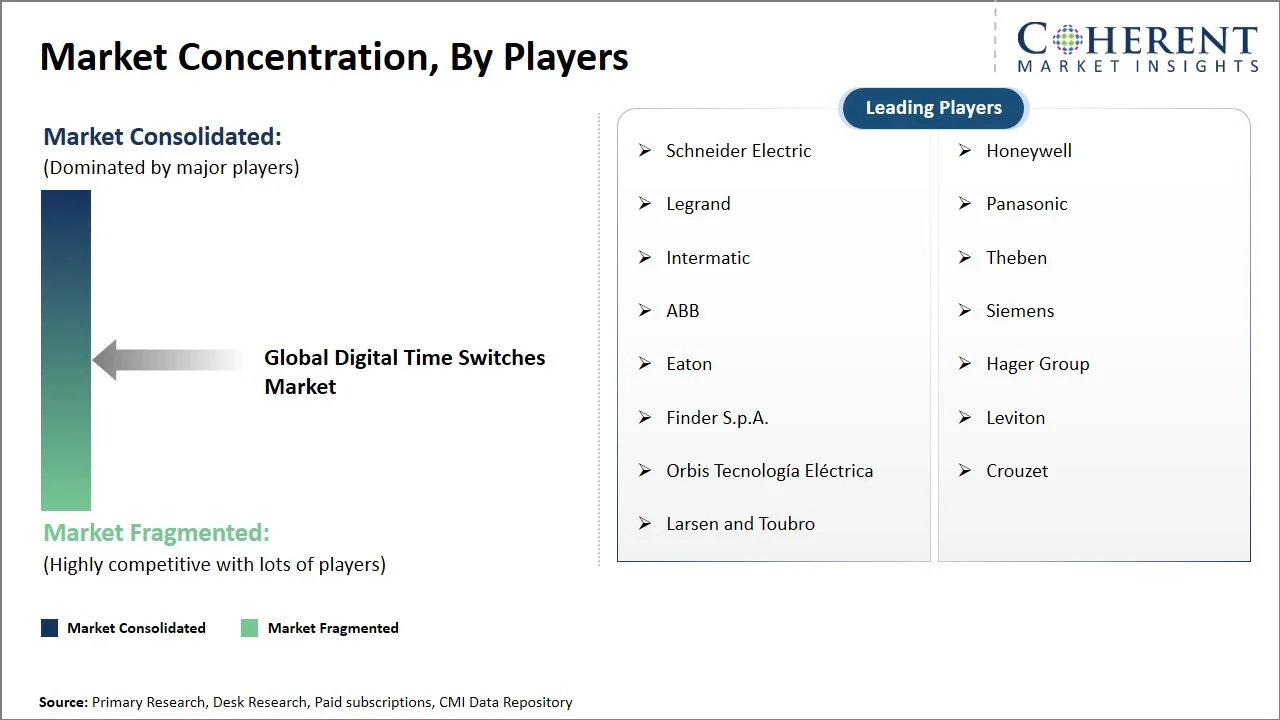
The global market for digital time switches is crowded with well-established electrical equipment and automation manufacturers, who compete on the basis of product innovation, smart connection features, energy-management capabilities, and large distribution networks. To respond to growing client requirements, companies such as Schneider Electric, Honeywell, ABB, Siemens, Eaton, Legrand, Panasonic, Intermatic, Theben and Hager Group are working on expanding their programmable and IoT-enabled time switches range. The increased use of strategic partnerships, product improvements, integration with building automation platforms and development into emerging markets are enhancing market positioning and competitive differentiation.
Market Report Scope
Digital Time Switches Market Report Coverage
| Report Coverage | Details | ||
|---|---|---|---|
| Base Year: | 2025 | Market Size in 2026: | USD 1.45 Bn |
| Historical Data for: | 2020 To 2024 | Forecast Period: | 2026 To 2033 |
| Forecast Period 2026 to 2033 CAGR: | 5.7% | 2033 Value Projection: | USD 2.15 Bn |
| Geographies covered: |
| ||
| Segments covered: |
| ||
| Companies covered: | Schneider Electric, Honeywell, Legrand, Panasonic, Intermatic, Theben, ABB, Siemens, Eaton, Hager Group, Finder S.p.A., Leviton, Orbis Tecnología Eléctrica, Crouzet, and Larsen and Toubro | ||
| Growth Drivers: |
| ||
| Restraints & Challenges: |
| ||
Analyst Opinion (Expert Opinion)
- Growing focus on energy efficiency, building automation and smart electrical control systems in residential, commercial and industrial sectors is likely to favorably influence the market. Continued upgrading of electrical infrastructure, growing acceptance of smart buildings and increasing deployment of connected devices are expected to drive continuous demand for advanced digital time switches. Moreover, increased use of IoT technology and cloud-based monitoring capabilities are projected to be a major element influencing future competitive dynamics within the business.
- Continued expansion of smart cities, intelligent buildings, renewable energy installations and electric vehicle charging infrastructure are likely to provide strong growth possibilities. Increasing investments in energy optimization technology, digital facility management systems, and automated industrial operations are expected to further enhance demand. With the rise of linked ecosystems, digital time switches with remote access, real time monitoring and advanced scheduling functionality will likely be adopted more widely throughout an increasing number of applications around the world.
Speak to the analyst
Want personalized insights?
Take the findings above to one of our principal consultants, or have the report rebuilt around the segments, geographies and competitors you actually track.
Market Segmentation
- Product Type Insights (Revenue, USD Billion, 2021 - 2033)
- Programmable Digital Time Switches
- IoT-Enabled Time Switches
- Mounting Type Insights (Revenue, USD Billion, 2021 - 2033)
- DIN Rail Mounted
- Panel Mounted
- Surface Mounted
- Application Insights (Revenue, USD Billion, 2021 - 2033)
- Lighting Control
- HVAC Systems
- Industrial Equipment and Motors
- Security Systems
- Water Pumps
- Irrigation Systems
- Appliance Control
- Regional Insights (Revenue, USD Billion, 2021 - 2033)
- North America
- U.S.
- Canada
- Latin America
- Brazil
- Argentina
- Mexico
- Rest of Latin America
- Europe
- Germany
- U.K.
- Spain
- France
- Italy
- Russia
- Rest of Europe
- Asia Pacific
- China
- India
- Japan
- Australia
- South Korea
- ASEAN
- Rest of Asia Pacific
- Middle East
- GCC Countries
- Israel
- Rest of Middle East
- Africa
- South Africa
- North Africa
- Central Africa
- North America
- Key Players Insights
- Schneider Electric
- Honeywell
- Legrand
- Panasonic
- Intermatic
- Theben
- ABB
- Siemens
- Eaton
- Hager Group
- Finder S.p.A.
- Leviton
- Orbis Tecnología Eléctrica
- Crouzet
- Larsen and Toubro
Sources
Primary Research Interviews
- Time Switch Manufacturers and Suppliers
- Electrical Equipment Distributors
- Industrial Automation Engineers
- Smart Building Technology Integrators
Magazines
- Electrical Construction & Maintenance Magazine
- Building Operating Management
- Industrial Automation Magazine
- Facility Management Magazine
Journals
- IEEE Transactions on Industrial Electronics
- Journal of Building Engineering
- International Journal of Electrical Power & Energy Systems
Associations
- National Electrical Manufacturers Association (NEMA)
- Building Owners and Managers Association (BOMA)
- International Facility Management Association (IFMA)
Public Domain Sources
- U.S. Department of Energy Reports
- International Energy Agency (IEA) Publications
- National Institute of Standards and Technology (NIST) Documents
Proprietary Elements
- CMI Data Analytics Tool
- Proprietary CMI Existing Repository of information for last 10 years
Get access to 250+ pages report
Every segment, forecast, competitor profile and data table behind the analysis above — available for instant download.
- ESOMAR Member
- ISO 9001:2015 Certified
- D-U-N-S Registered
- GDPR & CCPA Compliant
Missing comfort of reading report in your local language? Find your preferred language:
Transform your Strategy with Exclusive Trending Reports
Frequently Asked Questions
The global digital time switches market is expected to stand at USD 1.45 Bn in 2026 and is expected to reach USD 2.15 Bn by 2033.
The CAGR of the global digital time switches market is projected to be 5.7% from 2026 to 2033.
Yes, they are extensively used in offices, retail stores, hotels, and educational facilities.
Yes, many modern models can be connected to building management and automation platforms.
No, standard digital time switches operate independently, although some smart models use internet connectivity for remote control.
In terms of product type, the programmable digital time switches segment is estimated to dominate the market revenue share in 2026.
Rising adoption of smart homes and smart buildings and increasing focus on energy efficiency and electricity cost reduction are the major factors driving the growth of the global digital time switches market.