

Global Digital Thread Market Size and Forecast – 2026-2033
The global digital thread market is estimated to be valued at USD 16.29 Bn in 2026 and is expected to reach USD 57.02 Bn by 2033, exhibiting a compound annual growth rate (CAGR) of 19.6% from 2026 to 2033.
Key Takeaways of the Global Digital Thread Market
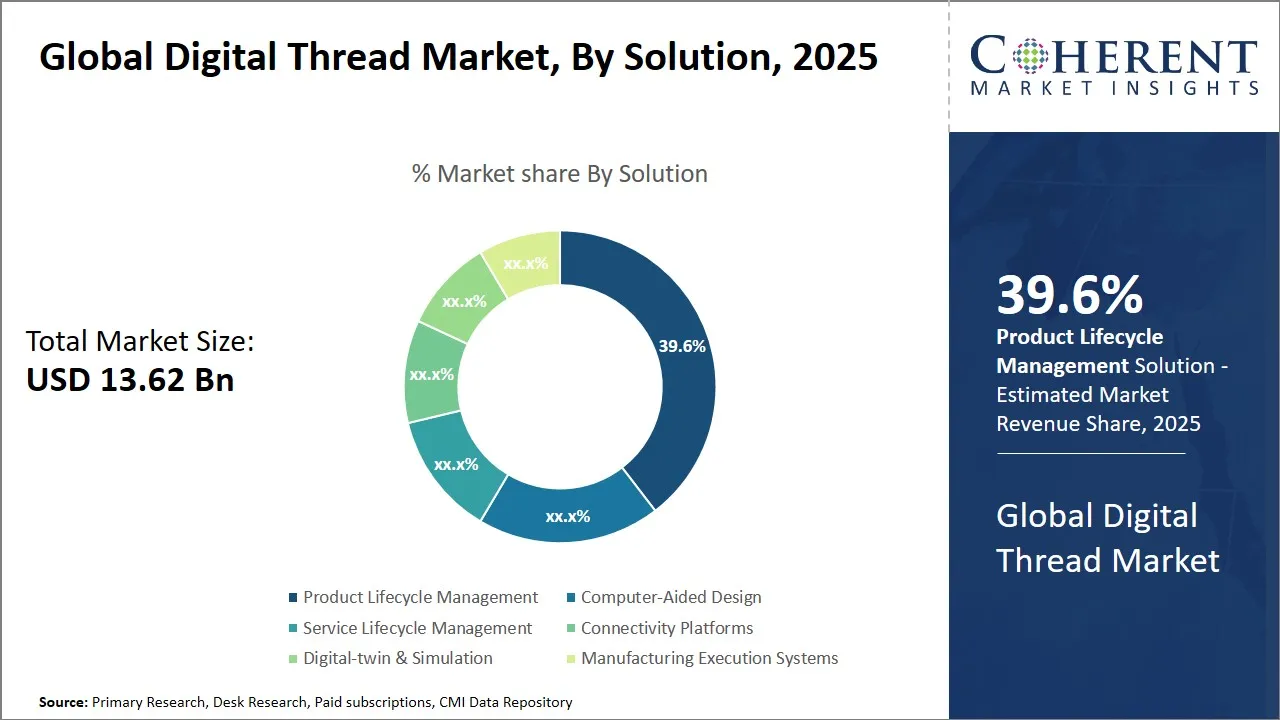
- The product lifecycle management segment leads the market holding an estimated share of 40.6 % in 2026.
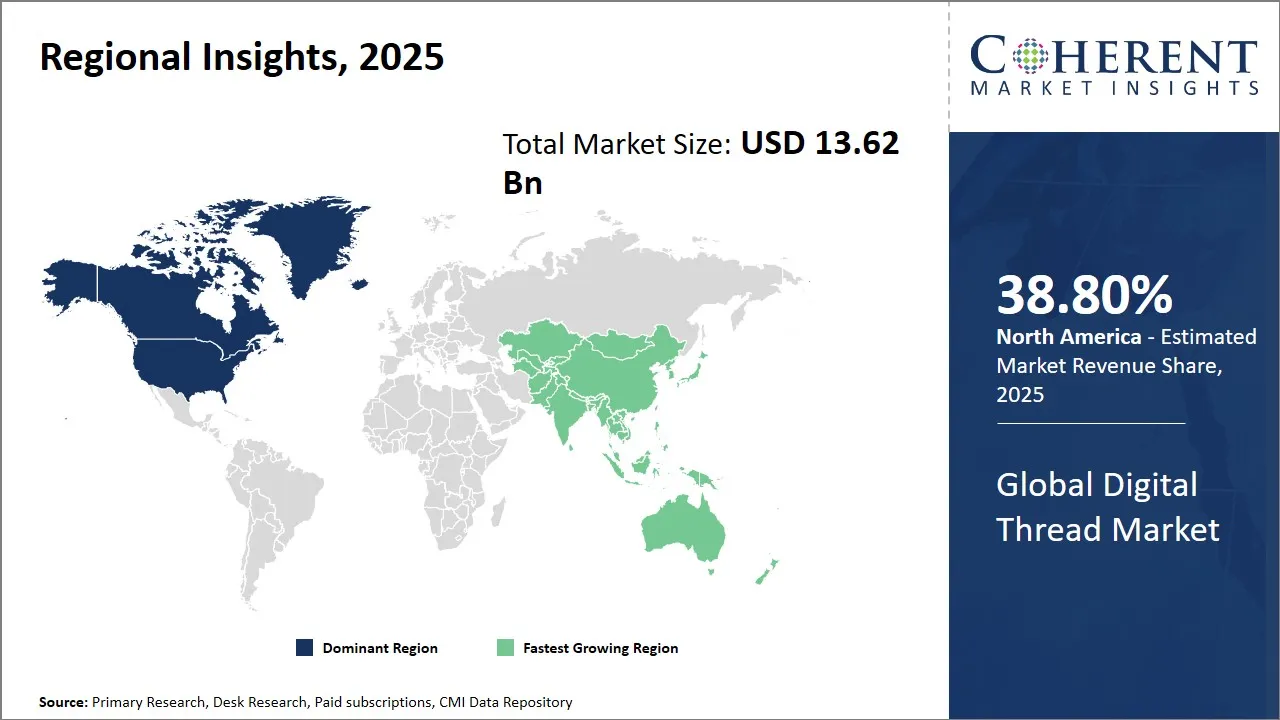
- North America is estimated to lead the market with a share of 38.8 % in 2026.
- Asia Pacific, holding an estimated share of 28.4 % in 2026, and it is projected to be the fastest growing region.
Market Overview
The market is seeing a big shift towards the integration of digital thread technologies with Industry 4.0 and IoT frameworks, making possible smarter, data-driven decision-making processes. Additionally, advancements in AI, machine learning, and cloud computing are fueling the expansion of digital thread applications, promoting seamless connectivity and traceability throughout the supply chain. The growing focus on reducing manufacturing errors and making time-to-market faster adds to the adoption of digital thread solutions in different sectors globally.
Current Events and Its Impact
Current Events | Description and its impact |
Geopolitical and Trade Developments |
|
Economic and Infrastructure Trends |
|
Segmental Insights
- Current Industry Events of 2026
- Market Size Estimation
- Regional Breakdown
- Competitive Landscape
- Customer Intelligence
- Segmental Analysis
- Pricing Analysis
- Key Market Drivers, Challenges & Future Trends
- Customized Insights Section
Global Digital Thread Market Insights, by Solution – Product Lifecycle Management Segment Leads Owing to its Pivotal Role in Streamlining Product Development and Enhancing Cross-Functional Collaboration
The product lifecycle management segment is projected to account for 40.6% share in 2026. Product Lifecycle Management (PLM) systems allow organizations to manage complex product information from inception through design, manufacturing, service, and disposal, making a seamless flow of data that is important for digital thread implementation. As industries such as aerospace, automotive, and consumer electronics innovate rapidly, the need for a centralized platform to manage product data becomes critical. PLM solutions facilitate better decision-making by providing end-to-end visibility into product development processes, reducing errors, and shortening time-to-market. Furthermore, the ongoing digital transformation initiatives worldwide emphasize smart manufacturing and Industry 4.0 adoption, which directly bolster the demand for PLM systems.
Airbus uses 3DEXPERIENCE to connect design, engineering, manufacturing, and maintenance data for programs such as the A350 XWB. Regulatory compliance and quality control also play a big role in amplifying PLM adoption. Industries with strict standards use PLM solutions to maintain accurate documentation, track changes, and ensure traceability throughout production and service phases. Also, the growing focus on sustainability and lifecycle assessment adds to the use of PLM tools. By providing comprehensive insights into materials usage, environmental impact, and end-of-life product management, PLM systems assist organizations in implementing eco-friendly practices and circular economy principles.
Impact of AI on the Digital Thread Market
Artificial Intelligence (AI) is transforming the global digital thread market by making possible real-time insights and predictive capabilities across the entire product lifecycle. Traditional digital thread implementations already unify design, engineering, manufacturing, and service data, but AI dramatically increases the value of that data. Machine-learning models can detect anomalies in sensor streams, optimize production schedules, and predict maintenance needs before any failures take place. This reduces downtime, cuts costs, and shortens product-development cycles, giving manufacturers faster feedback loops and more agile decision-making. AI also enhances interoperability between Computer Aided Design (CAD), PLM, and IoT systems by automating data cleansing and semantic matching, which historically required extensive manual effort.
A good example is Siemens’ addition of generative AI to its Xcelerator and Teamcenter platforms. In 2024, Siemens introduced an AI-powered assistant that uses design data and manufacturing telemetry to suggest engineering changes and improve factory throughput.
Regional Insights
North America Digital Thread Market Analysis and Trends
North America, holding an estimated share of 38.8% in 2026, dominates the global digital thread market because of a mature technological ecosystem, strong industry adoption, and strong government support for advanced manufacturing and digital transformation initiatives. The region's presence of key industrial sectors like aerospace, automotive, and defense makes a lot of demand for integrated digital thread solutions. Favorable regulatory frameworks supporting innovation and investments add to the region's leadership.
Major companies such as Siemens Digital Industries, Rockwell Automation, and PTC have established significant footprints in North America, contributing advanced digital thread platforms and collaborative tools that streamline product design, manufacturing, and after-sales services. Also, North America sees a collaborative innovation network, including research institutions and technology startups, which adds to the adoption of cutting-edge digital thread technologies.
Asia Pacific Digital Thread Market Analysis and Trends
The Asia Pacific region, holding a projected share of 28.4% in 2026, exhibits the fastest growth in the global digital thread market, due to rapid industrialization, expanding manufacturing capabilities, and increasing investments in Industry 4.0 technologies. Nations in this region are quickly modernizing their industrial infrastructure and adopting smart factory concepts, creating demand for digital thread integration in product lifecycles. Government initiatives promoting digital transformation, such as “Made in China 2026” and India’s “Digital India” campaign, make supportive environments for market growth.
The growing presence of global and domestic industry leaders, including companies like Huawei, Mitsubishi Electric, and Tata Consultancy Services, is very important in providing localized solutions tailored to regional manufacturing needs. Also, the region’s competitive labor market and focus on quality improvement make digital thread technologies important tools for improving production efficiency and product customization.
Global Digital Thread Market Outlook for Key Countries
U.S. Digital Thread Market Analysis and Trends
The U.S. is characterized by fast adoption of cutting-edge digital thread solutions backed by major industrial players and high-tech manufacturing clusters. Industry giants such as IBM, General Electric, and Honeywell are developing and deploying advanced digital twin and thread technologies that integrate design, manufacturing, and operational data. Strong research and development ecosystems, combined with government incentives around smart manufacturing and IoT integration, make the U.S. an important market adding to innovation in digital thread offerings, particularly in aerospace and defense sectors.
Germany Digital Thread Market Analysis and Trends
Germany leads the digital thread market because of its advanced manufacturing base and strong emphasis on engineering excellence. The country’s strong industrial environment, a result of automotive giants like Volkswagen, BMW, and manufacturing innovators such as Siemens and Bosch, makes possible widespread adoption of digital thread solutions to optimize production workflows and supply chain transparency. German government initiatives promoting Industry 4.0 and smart factories add to the use of digital thread technologies that improve efficiency, traceability, and product customization across industrial verticals.
China Digital Thread Market Analysis and Trends
China digital thread market is expanding fast because of industrial modernization and supportive policies aimed at embracing next-generation manufacturing technologies. Leading technology providers and manufacturers like Huawei, Haier, and Lenovo are using digital thread systems to support product lifecycle management and quality assurance. State-driven programs focusing on smart manufacturing and automation create a lot of demand for digital thread solutions, while China’s large manufacturing base necessitates scalable and efficient product data management tools.
Japan Digital Thread Market Analysis and Trends
Japan digital thread market uses digital thread technologies in its highly automated and precision-driven industrial sectors. Companies like Mitsubishi Electric, Fanuc, and Hitachi are embedding digital thread frameworks to refine manufacturing operations and make possible predictive maintenance. The country’s focus on robotics, smart manufacturing, and supply chain resilience is amplified by government support programs and collaboration between private enterprises and research institutions, adding to Japan’s role in advancing digital thread innovations.
India Digital Thread Market Analysis and Trends
India digital thread market is gaining momentum because manufacturing sectors are moving toward digitalization and Industry 4.0 integration. Key industrial players such as Tata Consultancy Services, Larsen & Toubro, and Mahindra & Mahindra are adding to adoption by developing scalable digital thread solutions to streamline automotive, aerospace, and heavy equipment manufacturing processes. Government-backed initiatives targeting digital infrastructure development and skill enhancement also add to market growth by helping manufacturers use harness real-time data analytics, improve production agility, and meet rising quality and compliance standards.
Market Players, Key Development, and Competitive Intelligence
Key Developments
- In April 2025, Dassault Systèmes and Airbus extended their long-term strategic partnership, putting the 3DEXPERIENCE platform at the heart of lifecycle management of all new Airbus programs for civil and military aircraft and helicopters.
- In February 2025, Dassault Systèmes announced that 3D UNIV+RSES powered by the 3DEXPERIENCE platform will leverage the power of spatial computing to provide a new dimension to virtual twins, with the new “3DLive” visionOS app. To make this vision a reality, Dassault Systèmes partnered with Apple to integrate Apple Vision Pro into the next generation 3DEXPERIENCE platform.
- In February 2025, Dassault Systèmes and Volkswagen Group announced a long-term partnership to advance Volkswagen Group’s digital infrastructure for state-of-the-art vehicle development by implementing Dassault Systèmes’ 3DEXPERIENCE platform.
- In September 2022, AVEVA, a global leader in industrial software, driving digital transformation and sustainability, and Aras, which provides a low-code platform with applications to design, build, and operate complex products, entered into a strategic OEM partnership to deliver industrial “Asset Lifecycle Management” solutions. AVEVA will license the Aras Innovator platform to deliver a series of scalable, Asset Lifecycle Management solutions, which will integrate Aras’ open and flexible portfolio of applications with AVEVA Unified Engineering and AVEVA Asset Information Management.
Top Strategies Followed by Digital Thread Market Players
- Established industry leaders typically invest heavily in research and development (R&D) to drive innovation and introduce high-performance digital thread solutions.
- Siemens Digital Industries Software continues to pour resources into its Xcelerator portfolio, adding AI-driven generative design and cloud-native collaboration features.
- Mid-level players in the global digital thread market adopt a more cost-efficient growth strategy that prioritizes affordability without compromising essential quality.
- Aras Corporation, while not as large as Siemens or Dassault, offers its Aras Innovator PLM under a subscription-based open architecture. By allowing enterprises to deploy only the modules they need and to customize without high license fees, Aras appeals to manufacturers seeking fully digital-thread capabilities at a lower total cost of ownership.
- Small-scale players carve out niche positions within the global digital thread market by focusing on specialized features, tailored solutions, or innovative products that address specific industry challenges or regional requirements.
- eQ Technologic (eQube platform) concentrates on data federation and integration for digital threads rather than full-suite PLM.
Market Report Scope
Digital Thread Market Report Coverage
| Report Coverage | Details | ||
|---|---|---|---|
| Base Year: | 2025 | Market Size in 2026: | USD 16.29 Bn |
| Historical Data for: | 2020 To 2024 | Forecast Period: | 2026 To 2033 |
| Forecast Period 2026 to 2033 CAGR: | 19.6% | 2033 Value Projection: | USD 57.02 Bn |
| Geographies covered: |
| ||
| Segments covered: |
| ||
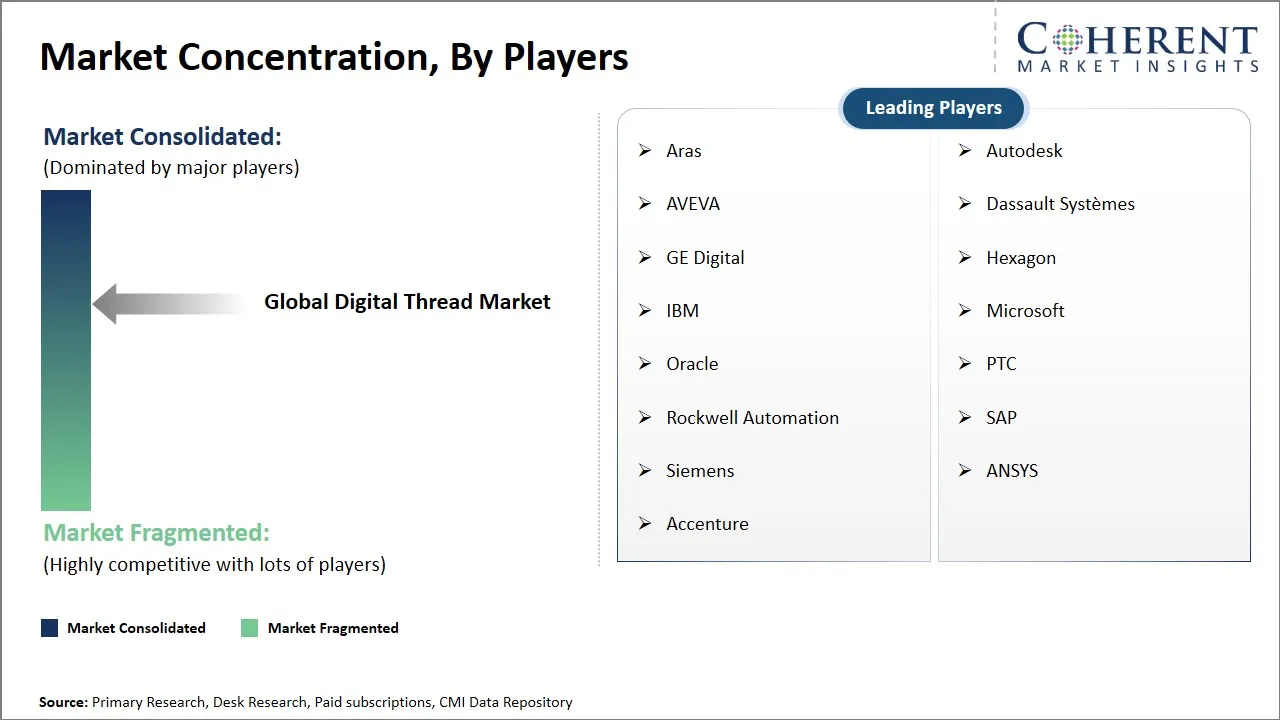
| Companies covered: | Aras, Autodesk, AVEVA, Dassault Systèmes, GE Digital, Hexagon, IBM, Microsoft, Oracle, PTC, Rockwell Automation, SAP, Siemens, ANSYS, and Accenture | ||
| Growth Drivers: |
| ||
| Restraints & Challenges: |
| ||
Market Dynamics
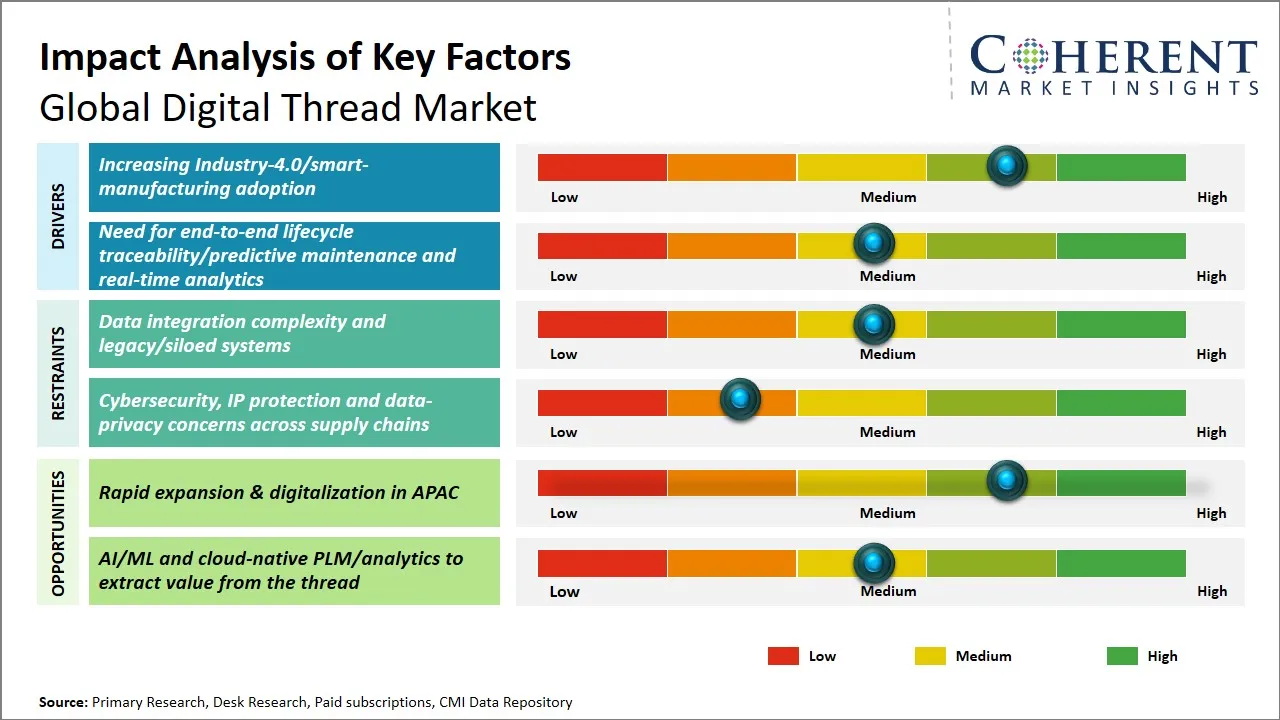
Global Digital Thread Market Driver – Increasing Industry-4.0/Smart-Manufacturing Adoption
The accelerating adoption of industry 4.0 and smart manufacturing across various industrial sectors is a significant driver fueling the demand for digital thread solutions globally. As manufacturers increasingly integrate advanced automation, IoT devices, and real-time data analytics into their production processes, the need for seamless connectivity and traceability throughout the product lifecycle has become critical.
Digital thread technology enables the creation of a unified data framework that links design, engineering, supply chain, and operational data, ensuring that information flows cohesively from product inception to end-of-life. BMW Group’s Regensburg plant in Germany implemented a fully connected digital thread as part of its Industry 4.0 roadmap. The facility uses IoT sensors, automated guided vehicles, and real-time production analytics integrated with BMW’s PLM backbone to link design data directly to manufacturing operations. Moreover, the push toward customization and rapid product innovation necessitates an agile manufacturing environment supported by digital thread frameworks, which facilitate better decision-making through improved visibility and collaboration.
Global Digital Thread Market Opportunity – Rapid Expansion and Digitalization in APAC
Countries such as China, India, Japan, South Korea, and Southeast Asian nations are witnessing increased adoption of Industry 4.0 technologies, fueling the demand for integrated digital thread solutions that enable seamless data flow across product lifecycles. The proliferation of smart manufacturing, IoT integration, and advanced analytics in industries like automotive, aerospace, electronics, and consumer goods is compelling organizations to invest in digital thread platforms to enhance product visibility, improve operational efficiency, and support agile decision-making. In 2024, PTC announced AI-powered anomaly detection and predictive maintenance features running on Microsoft Azure, enabling customers like Raytheon Technologies to analyze real-time field data alongside design and service records.
Additionally, government initiatives promoting digital infrastructure development and smart factory frameworks bolster market penetration in this region. The surge in Small and Medium Enterprises (SMEs) leveraging digital threads to streamline production processes further amplifies growth potential. Furthermore, APAC’s evolving regulatory environment emphasizing product traceability, quality control, and sustainability compliance is driving adoption of digital thread solutions to ensure adherence to stringent standards.
Analyst Opinion (Expert Opinion)
- Vendors are embedding generative design, automated documentation, and conversational analytics directly into PLM and digital-thread platforms. Early deployments—such as Siemens’ AI copilots within Teamcenter—demonstrate how LLMs can shorten design cycles and streamline change-management processes, signaling a shift toward more autonomous, insight-driven engineering environments.
- As manufacturers deploy high-bandwidth sensors and 5G networks on the factory floor, edge computing is increasingly paired with cloud-native PLM. This hybrid model allows instant anomaly detection and low-latency decision-making while maintaining the scalability of cloud analytics, making continuous digital-thread data flows feasible even in latency-sensitive production lines.
- Integration of AR/VR hardware—exemplified by Dassault Systèmes bringing 3DEXPERIENCE to Apple Vision Pro—illustrates how spatial computing is moving from pilot to production. Immersive digital twins enable cross-site design reviews, training, and virtual commissioning, strengthening the collaborative dimension of the digital thread and opening new service-revenue streams for solution providers.
Speak to the analyst
Want personalized insights?
Take the findings above to one of our principal consultants, or have the report rebuilt around the segments, geographies and competitors you actually track.
Market Segmentation
- Solution Insights (Revenue, USD Bn, 2021 - 2033)
- Product Lifecycle Management
- Computer-Aided Design
- Service Lifecycle Management
- Connectivity Platforms
- Digital-twin & Simulation
- Manufacturing Execution Systems
- Regional Insights (Revenue, USD Bn, 2021 - 2033)
- North America
- U.S.
- Canada
- Latin America
- Brazil
- Argentina
- Mexico
- Rest of Latin America
- Europe
- Germany
- U.K.
- Spain
- France
- Italy
- Russia
- Rest of Europe
- Asia Pacific
- China
- India
- Japan
- Australia
- South Korea
- ASEAN
- Rest of Asia Pacific
- Middle East
- GCC Countries
- Israel
- Rest of Middle East
- Africa
- South Africa
- North Africa
- Central Africa
- North America
- Key Players Insights
- Aras
- Autodesk
- AVEVA
- Dassault Systèmes
- GE Digital
- Hexagon
- IBM
- Microsoft
- Oracle
- PTC
- Rockwell Automation
- SAP
- Siemens
- ANSYS
- Accenture
Sources
Primary Research Interviews
Stakeholders
- Industrial Manufacturers and OEMs
- PLM & IoT Platform Providers
- Systems Integrators & Consulting Partners (specialists implementing digital-thread solutions)
- Aerospace and Automotive Engineering Teams (digital twin / smart-factory leads)
- Cloud Infrastructure Vendors (industrial IoT product strategists)
- AI/ML and Analytics Experts focusing on industrial data pipelines
Databases
- World Industrial Connectivity Database (WICD)
- International Manufacturing Data Exchange (IMDX)
- OECD Technology Indicators
- UNIDO Industrial Analytics Hub
Magazines
- Industrial Innovation Today
- Smart Manufacturing Review
- Digital Factory Insights
- Engineering & Data Connectivity Monthly
Journals
- Journal of Digital Manufacturing and Product Lifecycle
- International Journal of Industrial IoT & Analytics
- Advanced PLM Systems Journal
- Edge Computing & Real-Time Analytics Journal
Newspapers
- The Engineering Times (Global Edition)
- Tech Manufacturing Daily
- Industry 4.0 Gazette
- The Economic Times (India)
Associations
- International Digital Thread Consortium (IDTC)
- Global Alliance for Smart Manufacturing (GASM)
- Product Lifecycle Management Association (PLMA)
- Industrial IoT Standards Board (IIoTSB)
- Society of Manufacturing Engineers (SME)
Public Domain Sources
- U.S. Census Bureau – Manufacturing & Technology Stats
- EUROSTAT – Industrial Digitalization Data
- United Nations Industrial Development Organization (UNIDO)
- World Bank – Global Manufacturing Indicators
- ResearchGate
Proprietary Elements
- CMI Data Analytics Tool, Proprietary CMI Existing Repository of information for last 8 years
Get access to 250+ pages report
Every segment, forecast, competitor profile and data table behind the analysis above — available for instant download.
- ESOMAR Member
- ISO 9001:2015 Certified
- D-U-N-S Registered
- GDPR & CCPA Compliant
Missing comfort of reading report in your local language? Find your preferred language:
Transform your Strategy with Exclusive Trending Reports
Frequently Asked Questions
The global digital thread market is estimated to be valued at USD 16.29 billion in 2026 and is expected to reach USD 57.02 billion by 2033.
The CAGR of the global digital thread market is projected to be 19.6% from 2026 to 2033.
Increasing industry-4.0/smart-manufacturing adoption and need for end-to-end lifecycle traceability/predictive maintenance and real-time analytics are the major factors driving the growth of the global digital thread market.
Data integration complexity and legacy/siloed systems and cyber security, IP protection and data-privacy concerns across supply chains are the major factors hampering the growth of the global digital thread market.
Digital thread is a connected data framework linking design, engineering, manufacturing, and service information across a product’s entire lifecycle.
Some end use industries in the market are automotive, aerospace & defense, industrial manufacturing, electronics, energy, and medical devices.
In terms of solution, the product lifecycle management segment is estimated to dominate the market revenue share in 2026.