

Plot Seeders Market Size and Forecast — 2026 - 2033
The Global Plot Seeders Market size is estimated to be valued at USD 1.25 billion in 2026 and is expected to reach USD 2.45 billion by 2033, exhibiting a compound annual growth rate (CAGR) of 10.4% from 2026 to 2033.
Overview
The plot seeders market is driven by the increasing adoption of precision agriculture and the growing demand for efficient seeding equipment to improve crop productivity. Rising global food demand and shrinking arable land are encouraging farmers to invest in advanced mechanized farming solutions. Government subsidies and agricultural modernization programs are further supporting the adoption of plot seeders, especially in developing economies. Technological advancements such as GPS-enabled seeders, automated depth control, and variable-rate seeding systems are enhancing operational efficiency and reducing seed wastage. Additionally, increasing labor shortages in agriculture and the need for cost-effective farming practices continue to accelerate demand for modern plot seeding equipment globally.
Key Takeaways
The pneumatic segment dominates the seeder type category with a 62% market share, attributed to precise seed metering and adaptability across different seed varieties.
Within application segments, research farms represent the largest buyer base, reflecting growing adoption of plot seeding technology for experimental and hybrid crop development.
Geographically, North America leads with over 32% market share, supported by widespread farm mechanization and high technology adoption.
The Asia Pacific region records the highest CAGR, driven by agricultural modernization in India and China and supportive government incentives promoting advanced farming practices.
Plot Seeders Market Segmentation Analysis
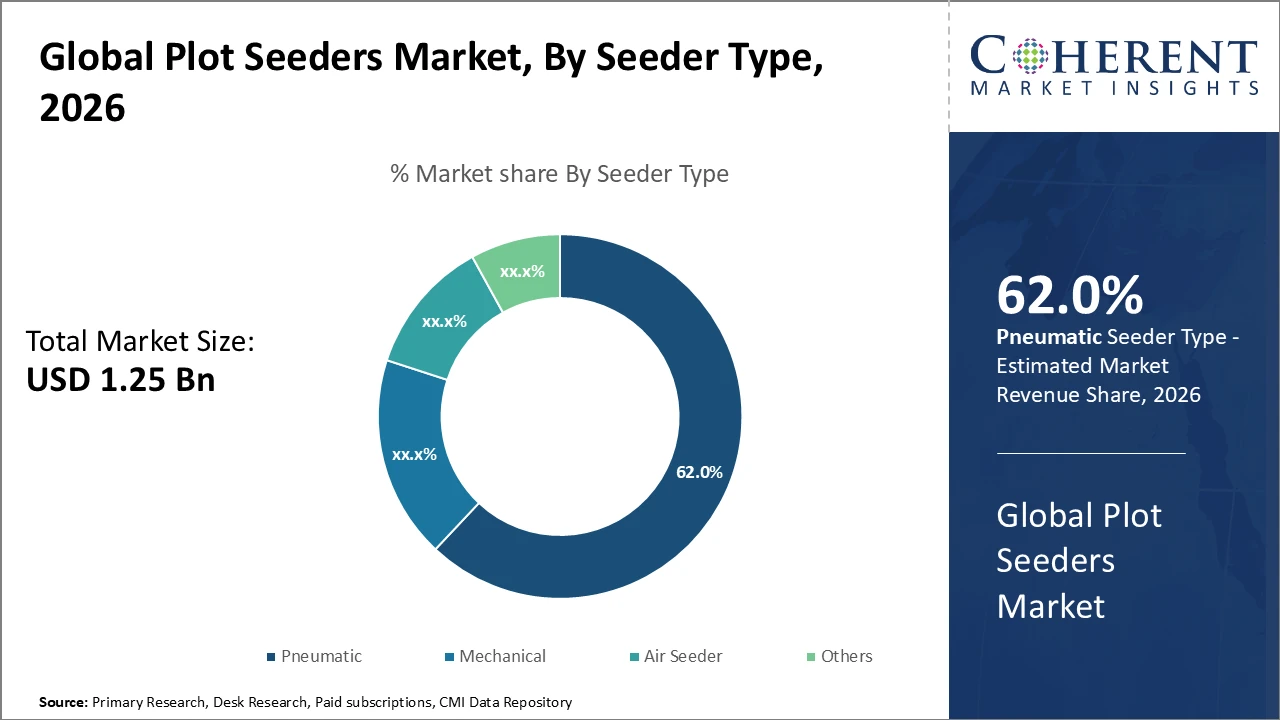
Plot Seeders Market Insights, By Seeder Type
Pneumatic seeders dominate the market with a 62% share, valued for their precise seed metering and versatility across various seed sizes, making them suitable for both research and commercial applications. Their adoption is further boosted by integration with automated systems, reducing seed wastage and enhancing planting accuracy. The fastest-growing subsegment is air seeders, favored for covering large plots efficiently with minimal soil disturbance, supporting no-till and conservation agriculture practices. Mechanical seeders remain popular among smaller farms due to their cost-effectiveness and simplicity, while the “Others” category includes specialized seeders designed for niche crops and experimental research applications.
Plot Seeders Market Insights, By Application
Research farms hold the largest market share at 45%, driven by growing agritech innovations and crop breeding programs. These farms demand advanced plot seeders with precise planting patterns and adjustable sowing depths, boosting the adoption of high-accuracy machinery. Commercial farms are the fastest-growing segment, fueled by rising mechanization in mid-to-large scale farms and the use of data-driven seeding strategies to optimize yield and efficiency. Educational institutions and other buyers, including government agricultural departments, contribute additional demand for training, demonstration, and experimental purposes. The combination of innovation, mechanization, and research applications continues to propel overall market growth.
Plot Seeders Market Insights, By Power Source
The Tractor Mounted category leads the market with a 68% share, driven by widespread tractor ownership and seamless integration with existing farm infrastructure. Its versatility and scalability make it ideal for both large research plots and commercial farms. The fastest-growing subsegment is self-propelled plot seeders, offering superior maneuverability and autonomous operation, supported by robotic automation advancements introduced in 2025. Handheld seeders remain niche, primarily used in nurseries and small research plots where mobility is crucial but scale is limited. Other subsegments, including manual or animal-powered seeders, see restricted adoption due to labor constraints and the ongoing shift toward mechanization.
Plot Seeders Market Trends
Recent years have seen significant technological advancements in plot seeders, combining precision planting hardware with software-enabled monitoring platforms.
IoT-enabled plot seeders introduced in 2026 allow real-time data collection on planting depth and soil conditions, enabling on-the-fly adjustments for improved efficiency.
Integration of eco-friendly fuel options in Europe has driven market trends toward sustainability.
Energy-efficient and battery-powered plot seeders piloted in Germany in 2025 reduced operational emissions by nearly 18%, encouraging regulatory support.
These innovations have accelerated adoption by promoting environmental compliance and operational efficiency across farms and research plots.
Plot Seeders Market Insights, By Geography
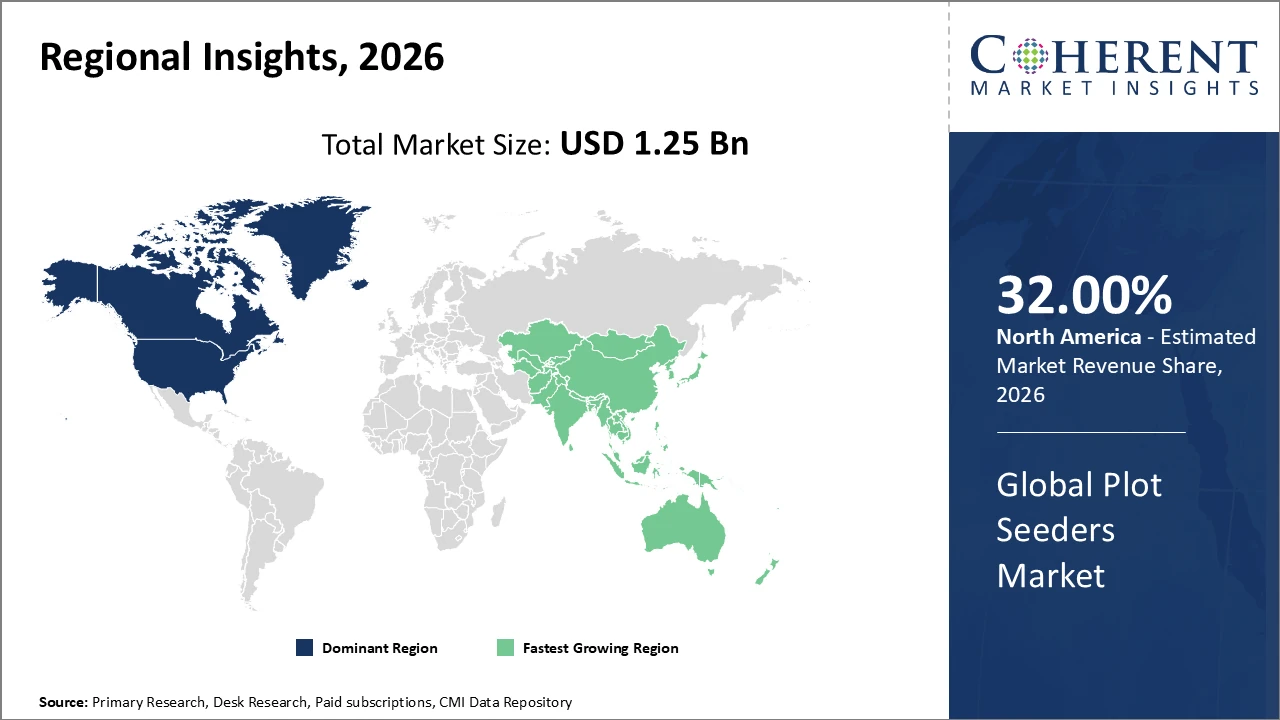
North America Plot Seeders Market Analysis and Trends
In North America, the Plot Seeders market is dominated by widespread farm mechanization and well-established agri-tech infrastructure that supports modern precision farming practices. Large-scale commercial farms and research institutions increasingly rely on automated and GPS-guided plot seeders to optimize planting efficiency and crop yields. The presence of key market players headquartered in the region, offering locally manufactured and technologically advanced seeders, further reinforces North America’s leadership position and continued market growth in the global plot seeders industry.
Asia Pacific Plot Seeders Market Analysis and Trends
The Asia Pacific region is witnessing the fastest growth in the plot seeders market, with a CAGR exceeding 12%, driven by agricultural modernization and supportive government initiatives in countries such as India and China. Investments in mechanized farming and precision agriculture are encouraging the adoption of automated plot seeders across research and commercial farms. Expanding local manufacturing bases and cost-effective production further strengthen the market, making advanced seeders more accessible to small and medium-sized farms. Additionally, rising awareness of sustainable farming practices and crop yield optimization contributes to the region’s rapid revenue growth and positions it as a key global market driver.
Plot Seeders Market Outlook for Key Countries
USA Plot Seeders Market Analysis and Trends
The USA’s plot seeders market continues to benefit from federal agricultural programs promoting precision farming technologies. Leading companies such as John Deere and AGCO maintain dominance by offering GPS-enabled and automated plot seeders designed for large-scale operations. In 2025, sales of automated pneumatic seeders rose by 14%, reflecting growing demand for efficiency and yield optimization. The market is further supported by well-established distribution networks, advanced R&D centers, and farmer education initiatives that encourage mechanization and adoption of modern farming equipment. These factors collectively reinforce the U.S. as a key driver of growth in the global plot seeders market.
Germany Plot Seeders Market Analysis and Trends
The Germany plot seeders market is characterized by high adoption of technologically advanced and sustainable farming equipment, supported by the country’s strong agricultural research sector. Precision and pneumatic seeders are widely used in both research farms and commercial operations, driven by the demand for accurate planting and optimized crop yields. Recent trends include the integration of IoT and automation technologies, enabling real-time monitoring of soil conditions and seed placement. Additionally, energy-efficient and battery-powered seeders are gaining traction due to environmental regulations and sustainability initiatives. Government support, coupled with strong local manufacturing capabilities, continues to propel market growth and innovation.
Analyst Opinion
Technological Innovation Drives Market Expansion: Integration of GPS-guided systems and variable-rate seeding technology has improved planting precision. In 2025, over 45% of newly deployed plot seeders in North America incorporated automation, boosting operational efficiency by 12% and supporting sustained market growth.
Demand from Specialty Crop Research Fuels Equipment Upgrades: Academic and commercial research institutes increased procurement of advanced plot seeders by 18% in 2024 for experimental crop breeding, highlighting the market potential beyond traditional commercial farming.
Supply Chain Resilience and Regional Manufacturing Capacity Expansion: Asia Pacific manufacturers expanded production by 20% in 2026, reducing lead times and transportation costs, enhancing price competitiveness.
Pricing Strategies and Competitive Positioning Influence Market Penetration: In early 2025, market players maintained equipment price increases below 4% despite rising raw material costs to ensure affordability for small-scale farmers, supporting market share retention in developing regions.
- Current Industry Events of 2026
- Market Size Estimation
- Regional Breakdown
- Competitive Landscape
- Customer Intelligence
- Segmental Analysis
- Pricing Analysis
- Key Market Drivers, Challenges & Future Trends
- Customized Insights Section
Market Scope
| Report Coverage | Details | ||
|---|---|---|---|
| Base Year: | 2025 | Market Size in 2026: | USD 1.25 billion |
| Historical Data for: | 2020 To 2024 | Forecast Period: | 2026 To 2033 |
| Forecast Period 2026 to 2033 CAGR: | 10.4% | 2033 Value Projection: | USD 2.45 billion |
| Geographies covered: |
| ||
| Segments covered: |
| ||
| Companies covered: | John Deere, AGCO Corporation, Amazone, Sulky, Monosem, Kubota Corporation, CNH Industrial, Salford Group, Morris Industries Ltd., Vaderstad | ||
| Growth Drivers: |
| ||
Plot Seeders Market Growth Factors
The adoption of precision agriculture technologies remains the primary driver of growth, as farmers increasingly turn to automated plot seeders to improve crop uniformity and minimize seed wastage. Supportive government policies and subsidies in regions like Europe and North America have accelerated investments in farm mechanization, boosting market revenue in 2025 and beyond. Expanding agricultural research worldwide has further extended the application of plot seeders into experimental and niche crop programs. Additionally, rising demand for sustainable farming practices has fueled investment in eco-friendly, fuel-efficient seeding machinery, aligning with environmental regulations and reinforcing overall market growth across global agricultural sectors.
Plot Seeders Market Development
In January 2026, Precision Planting launched ArrowTube, a retrofit seed delivery system, at the PTx Winter Conference in Tremont, Illinois. The technology enhances seed singulation and spacing by positioning corn seeds tip-down and embryo-out to improve planting accuracy and crop emergence.
Key Players
Leading Companies of the Market
John Deere
AGCO Corporation
Kubota Corporation
Amazone
Suly
Morris Industries Ltd.
Monosem
CNH Industrial
Salford Group
Vaderstad
Several leading companies have actively driven market growth through strategic acquisitions and R&D investments. In 2025, John Deere acquired a precision agriculture software startup, enhancing its plot seeders with improved connectivity and advanced data analytics, which contributed to a 15% increase in market penetration in North America. Similarly, AGCO Corporation’s strategic partnership with local distributors in India in 2026 resulted in a 25% year-on-year sales increase in the Asia Pacific region. These examples underscore how targeted collaborations, technological enhancements, and regional market diversification are key strategies for expanding reach and strengthening competitive positioning in the global plot seeders market.
Plot Seeders Market Future Outlook
The Plot Seeders market is poised for steady growth, driven by increasing demand for precision agriculture and mechanized farming solutions. Adoption of advanced technologies, including GPS-guided seeders, variable rate seeding, and smart farm integration, is expected to enhance operational efficiency and crop yields. Rising awareness of sustainable farming practices and labor shortages further support mechanization. Emerging regions in Asia-Pacific and Latin America are anticipated to witness rapid growth due to expanding arable land and government initiatives promoting modern agriculture. Continuous product innovation, coupled with strategic partnerships and after-sales support, will shape market expansion and long-term adoption of plot seeder technologies globally.
Plot Seeders Market Historical Analysis
The Plot Seeders market has experienced gradual growth over the past decade, driven by the mechanization of agriculture and increasing demand for efficient seed sowing techniques. Early adoption focused on mechanical and pneumatic seeders, which improved uniformity and reduced labor requirements compared to traditional manual sowing. North America and Europe led the market due to advanced farming infrastructure and strong research institutions. Over time, technological advancements such as GPS integration, precision seeding, and multi-crop capabilities expanded market applications, particularly in experimental farms and research plots. Growing awareness of sustainable farming practices and the need for higher crop yields contributed to steady historical market expansion.
Sources
Primary Research Interviews:
Agricultural engineers, farm machinery operators, and agronomists involved in seed sowing and field trials.
Procurement managers, farm owners, and supply chain professionals responsible for sourcing plot seeders and agricultural equipment.
Product managers, R&D specialists, and regulatory experts from companies manufacturing plot seeders and precision sowing equipment.
Magazines:
AgriBusiness Global – Coverage of agricultural machinery innovations and market trends.
Precision Ag – Insights into precision farming technologies and seeding equipment.
Modern Farmer – Focus on farm machinery adoption and operational efficiency improvements.
Journals:
Agricultural Systems – Studies on mechanized sowing, crop yield optimization, and farm efficiency.
Precision Agriculture – Research on GPS-guided planting, automated seeders, and smart farming technologies.
Journal of Agricultural Engineering – Design, performance, and effectiveness of sowing and seeding equipment.
Newspapers:
The Financial Times – Global agriculture industry trends, mergers, and investments in farm equipment.
Reuters – Updates on agricultural machinery launches, approvals, and international market expansion.
Bloomberg – Market performance, corporate strategies, and agritech sector developments.
Associations:
International Seed Federation – Guidelines, research, and standards for seed sowing and agricultural equipment.
American Society of Agricultural and Biological Engineers – Advancements in farm machinery, precision sowing, and mechanization.
Food and Agriculture Organization (FAO) – Standards and recommendations for agricultural mechanization and sustainable farming practices.
Get access to 250+ pages report
Every segment, forecast, competitor profile and data table behind the analysis above — available for instant download.
- ESOMAR Member
- ISO 9001:2015 Certified
- D-U-N-S Registered
- GDPR & CCPA Compliant
Missing comfort of reading report in your local language? Find your preferred language:
Transform your Strategy with Exclusive Trending Reports
Frequently Asked Questions
The Plot Seeders market is led by major companies including John Deere, AGCO Corporation, and Kubota Corporation, which collectively maintain strong market positions through continuous innovation and regional expansion strategies.
The market is projected to grow from USD 1.25 billion in 2026 to USD 2.45 billion by 2033, representing a compound annual growth rate (CAGR) of 10.4%.
Research farms offer the largest growth opportunity as they increasingly adopt advanced plot seeders to support crop breeding and agricultural experimentation.
Trends point toward greater automation, IoT-enabled seeders, eco-friendly machinery, and modular designs adaptable to multiple crop types.
The market is highly competitive, with companies focusing on technology differentiation and regional partnerships, while challenges include supply chain constraints and price sensitivity in emerging regions.
Key strategies include strategic acquisitions, localized manufacturing, distributor partnerships, and ongoing product innovation to meet evolving agricultural needs.