

Global Digital Timer Market Size and Forecast – 2026 To 2033
The global digital timer market is expected to grow from USD 1.50 Bn in 2026 to USD 2.40 Bn by 2033, registering a compound annual growth rate (CAGR) of 5.4% from 2026 to 2033. The global digital timer market growth is primarily driven by significant expansion in industrial automation. On December 3, 2024, Schneider Electric launched EcoStruxure Building Activate, an energy management and automation IoT platform for small and mid-size buildings (Source: Schneider Electric)
Key Takeaways of the Global Digital Timer Market
- The LED display digital timer segment is expected to account for 56.0 % of the global digital timer market share in 2026. The integration of digital timers with PLC systems is a key factor driving the growth of the segment. For instance, Schneider Electric has integrated LED-display-based timing modules into PLC-driven automation systems, where operators rely on bright digital readouts for machine scheduling and real-time process control in manufacturing plants. (Source: Schneider Electric)
- The industrial device segment is estimated to capture 52.0 % of the market share in 2026. The growth of the segment is driven by expansion in renewable energy management systems. On November 17, 2025, Schneider Electric announced the availability of its One Digital Grid Platform, a unified, artificial intelligence (AI)-enabled software platform designed to help utilities modernize faster, strengthen grid resilience and reduce energy costs. (Source: Schneider Electric)
- Asia Pacific is expected to dominate the digital timer market in 2026 with a market share of 41.0 %. Ongoing innovations and developments in the region are driving the growth of the market in Asia Pacific. On February 23, 2026, Panasonic Life Solutions India announced the launch of the Roma Urban Smart Touch Series, a next-generation smart home IoT solution designed to deliver enhanced convenience, safety, and lifestyle efficiency for modern Indian homes. (Source: Panasonic)
- North America is expected to account for 24.0 % share in 2026 and is projected to record the fastest growth over the forecast period. Growth in renewable energy systems requiring timed control operations is a major factor driving the growth in North America. On March 25, 2025, Honeywell announced that it is integrating Innowatts as an application on the Honeywell Forge Performance+ for Utilities platform, which uses artificial intelligence (AI) to better manage supply and grid operations for electric utilities. (Source: Honeywell)
- IoT-enabled and cloud-connected timers are being widely adopted: Digital timers linked to IoT devices and platforms allows users to remotely set and monitor timers using mobile apps and smart assistants. Amazon and Google are introducing timer-based automation to their smart home ecosystems for lights, appliances, and HVAC (heating, ventilation and air conditioning) systems.
- Energy efficiency regulations are increasing demand for smart scheduling timers: Commercial buildings and infrastructure are deploying digital timers to optimize electricity usage in response to stringent energy conservation guidelines. An increasing number of building management systems are including timer-based control modules to reduce peak load consumption.
Segmental Insights
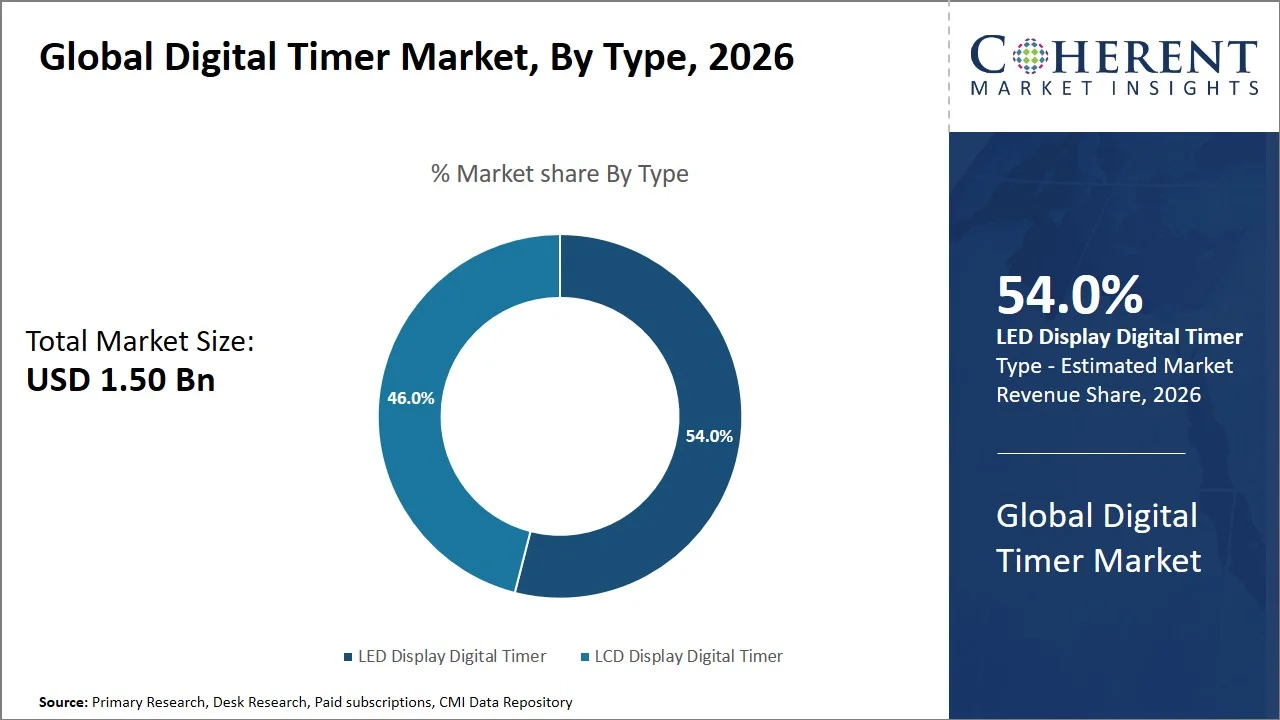
Why Does LED Display Digital Timer Dominate the Global Digital Timer Market?
The LED display digital timer segment is expected to account for 56.0% of the global digital timer market share in 2026. ED display digital timers account for a bigger part of the digital timer market than other forms of digital timers. The key reason behind this is that LED display digital timers have great visibility, minimal power consumption and long life of operation. These digital timers are very reliable for continuous usage in the industrial and domestic settings where there is a need for clear and rapid time reading with diverse lighting conditions. For instance, Signify has deployed its Light-as-a-Service model in facilities such as Nexans’ industrial plants, replacing traditional lighting with connected LED systems that automatically adjust usage and eliminate upfront capital costs. (Source: Signify)
- Current Industry Events of 2026
- Market Size Estimation
- Regional Breakdown
- Competitive Landscape
- Customer Intelligence
- Segmental Analysis
- Pricing Analysis
- Key Market Drivers, Challenges & Future Trends
- Customized Insights Section
Why is Industrial Device the Most Widespread Application?
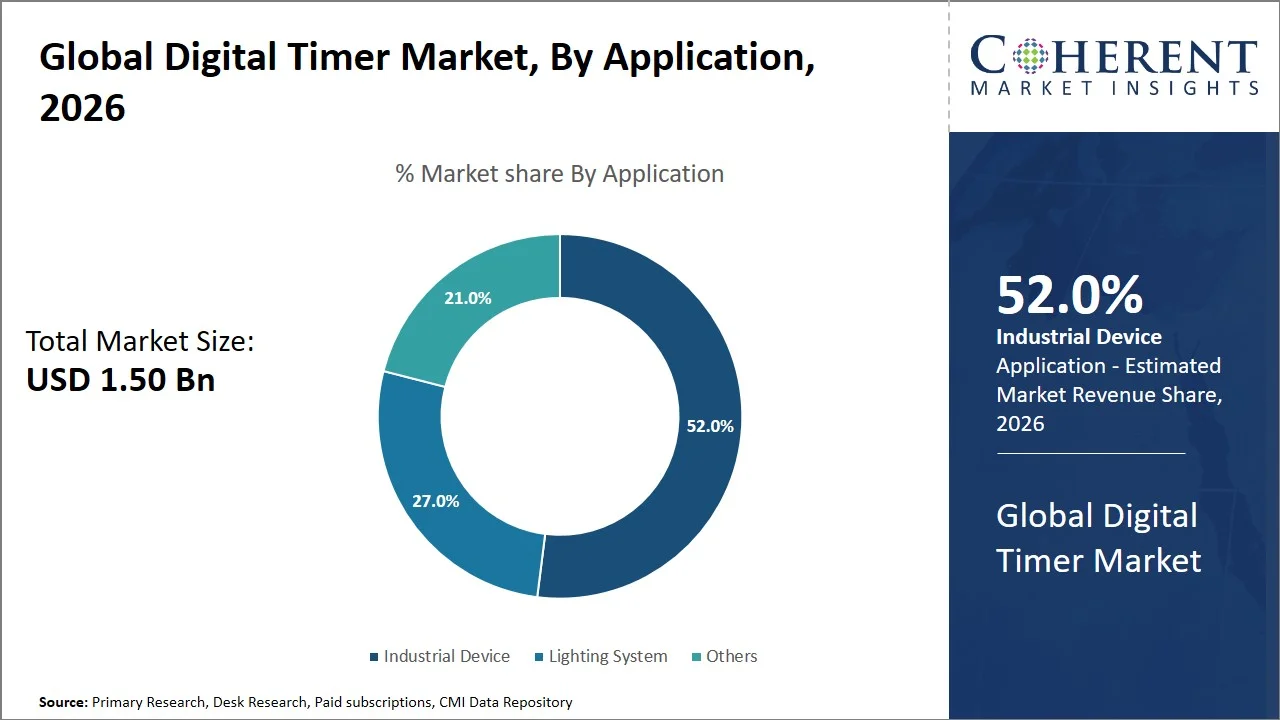
The industrial device segment is expected to account for 52.0% of the global digital timer market share in 2026. Digital timers are most commonly applied within the industrial device segment, as manufacturing settings demand highly accurate and repeatable timing control for machine sequencing, process automation, and safety operations. Even minor timing inaccuracies can affect productivity and product quality. As such, digital timers are extensively employed in PLC-based systems and automated production lines to maintain consistent operational cycles, minimize downtime, and enhance overall process efficiency.
On December 18, 2025, at the SPS 2025 industrial automation event, Siemens showcased its SIMATIC automation ecosystem where PLC-based systems are being used to synchronize machine operations, robotic sequencing, and process timing, reinforcing how industrial timing functions (including timer modules) are embedded directly into large-scale production control architectures. (Source: Siemens)
Currents Events and their Impact
Current Events | Description and its Impact |
EU Energy Efficiency Directive (Revised 2023 - 2024) |
|
U.S. Energy Policy Act (EPAct) & DOE Building Efficiency Standards |
|
(Source: European Commission, Environmental Protection Agency)
Digital Timer Market Dynamics
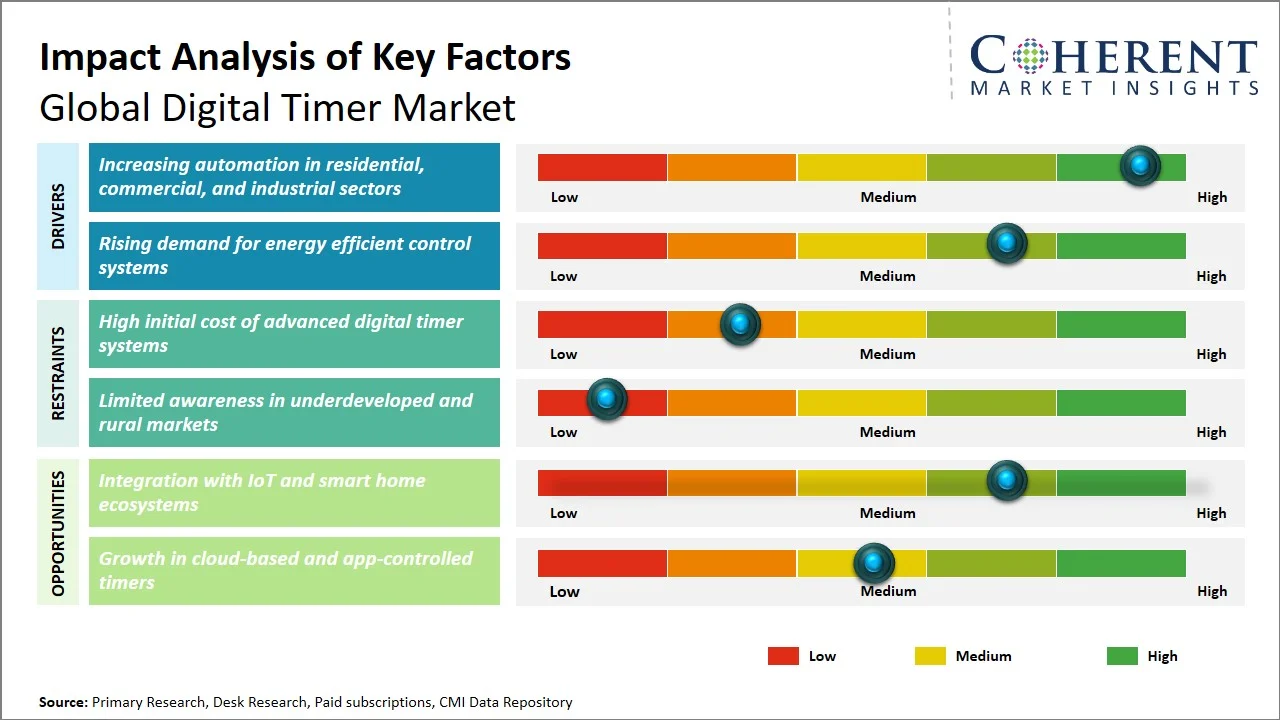
Market Drivers
Increasing automation in residential, commercial, and industrial sectors
The growing automation in the residential, commercial, and industrial sectors is driving the demand for digital timers to automate regular electrical operations such as lighting management, HVAC scheduling and machine sequencing. Timer-based controls are used in homes to schedule smart appliances and home automation systems. Programmable timing devices are used in commercial buildings to manage energy and security systems. Sophisticated digital timers integrated into PLC and control systems from firms such as Siemens coordinate production lines and equipment operations in industrial settings.
On May 19, 2026, Siemens Smart Infrastructure launched Asset Performance Advanced, a new AI-enabled managed building service. By combining an integrated predictive failure mode classification with advanced fault detection and diagnosis (FDD), the solution helps customers across industries optimize operations, improve energy performance, and enhance occupant comfort. (Source: Siemens)
Rising demand for energy-efficient control systems Increasing demand to reduce electricity consumption in residential, commercial and industrial applications is driving the demand for energy efficient control systems where digital timers are being extensively used to automate on/off cycles and optimize power consumption. For example, programmable timers are being incorporated into management systems for buildings and industrial control systems to reduce energy wasted during idle periods. Companies like Schneider Electric are incorporating sophisticated timer controls into energy management solutions, to allow load scheduling and efficiency optimization across smart infrastructure.
On September 18, 2024, Johnson Controls launched a highly anticipated update to the company’s industry-leading Building Automation System (BAS), Metasys, which serves the needs of commercial, industrial and institutional buildings, regardless of industry. (Source: Johnson Controls)
Emerging Trends
- Industrial automation is driving programmable multi-function timer adoption: Advanced programmable digital timers are being used in manufacturing environments to control production cycles, machine sequencing, and safety shutdowns, particularly through industrial automation solutions provided by companies such as Siemens and Schneider Electric in factory and process control systems.
- Integration of digital timers into smart consumer appliances is expanding rapidly: Companies like LG Electronics and Samsung Electronics are integrating digital timers into commonplace appliances like air conditioners, washing machines and kitchen gadgets, providing advanced scheduling and delay-start features to improve convenience and energy management.
Regional Insights
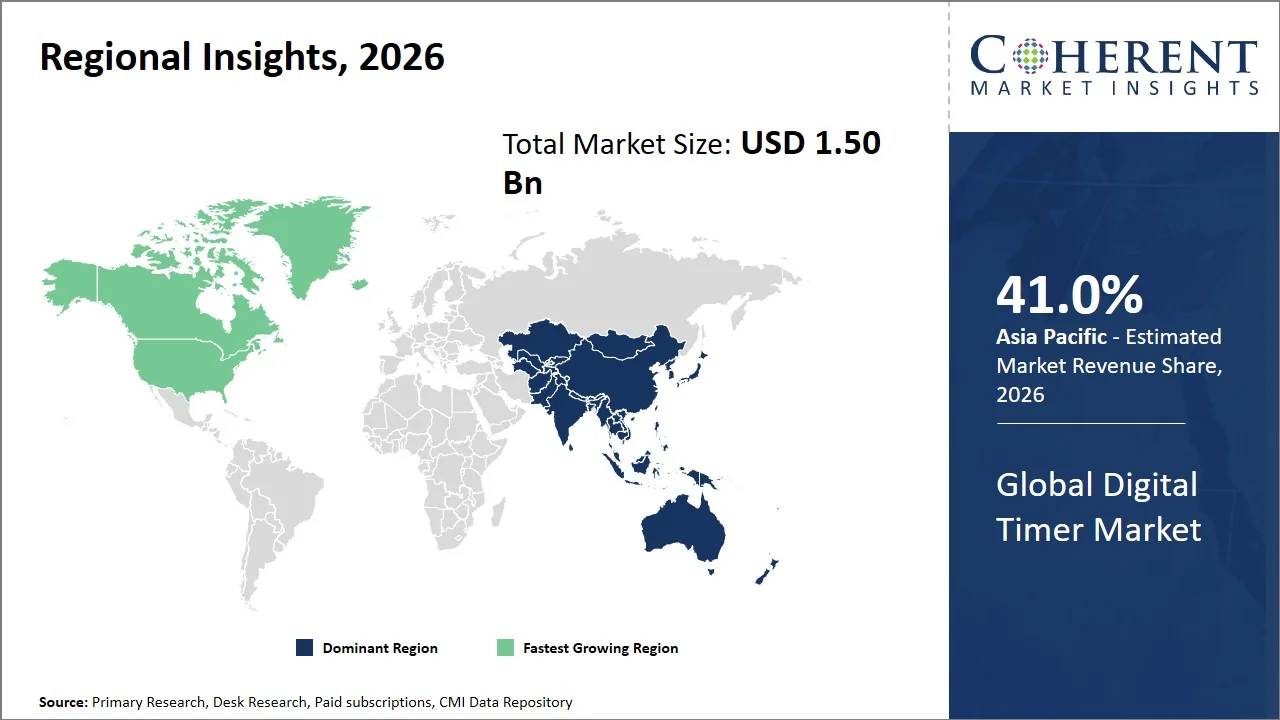
Why is Asia Pacific a Strong Market for Digital Timers?
Asia Pacific is expected to account for a market share of 41.0% in 2026. The electronic and automation manufacturing in the Asia Pacific region is driving the demand for digital timers on a large scale with China, Japan, South Korea and India emerging as the key markets for this product. Companies such as Panasonic and Omron are offering industrial-grade programmable timers to assembly lines and robotics systems. The fast-growing adoption of smart appliances in India is supported by brands such as Havells that are integrating digital timers into consumer switchboards and home automation products.
In addition, the use of digital timers in eco-friendly initiatives to maximize efficiency and minimize cost is also proving helpful for the Asia Pacific digital timer market. On March 6, 2024, Mahindra Group, and Johnson Controls announced a first of its kind Net Zero Buildings Initiative to decarbonize India’s commercial, urban residential and public buildings. The joint initiative will simplify access to key information and resources to help organizations start their net zero buildings journeys. (Source: Johnson Controls)
Why Does the North America Digital Timer Market Exhibit High Growth?
North America is projected to account for 24.0% of the global digital timer market and is expected to register the fastest growth. In North America, the demand for digital timers is largely driven by industrial automation and smart energy management systems. Companies like Honeywell offer programmable control timers for HVAC scheduling in commercial buildings, while Intermatic provides heavy-duty timers for outdoor lighting and pool systems. These are widely used in the U.S>, where energy optimization in residential and commercial infrastructure is a top priority.
On May 29, 2024, Honeywell announced expanded deployment of its Forge digital automation platform, enabling industrial facilities to reduce energy usage through predictive control and automated scheduling of equipment operations. (Source: Honeywell)
Global Digital Timer Market Outlook for Key Countries
Why is China Emerging as a Major Hub in the Digital Timer Market?
In China, the digital timer market is rapidly expanding through integration with smart home ecosystems led by companies such as Xiaomi, where Wi-Fi-enabled plug timers are being embedded in ecosystem products such as smart sockets and air purifier scheduling systems. Industrial demand is being supported by large manufacturing hubs in Guangdong and Jiangsu using programmable timers in electronics production and automated assembly operations.
Is the U.S. the Next Growth Engine for the Digital Timer Market?
Digital timers are being used widely in irrigation automation, HVAC control and industrial scheduling systems in the U.S. In agriculture and landscaping, products like Orbit sprinkler timers are widely used. Smart home integration is being enhanced via ecosystems supported by Google and Amazon where timers are being integrated into voice-controlled routines via smart assistants.
Germany Digital Timer Market Analysis and Trends
In industrial engineering and factory automation, high-precision digital timers are common in Germany. Siemens has integrated timing modules into control systems based on PLCs for the production of automobiles and machinery. Hager Group offers DIN-rail mounted timers for building energy management systems in commercial infrastructure.
The India digital timer market is expanding due to rising residential electrification and industrial automation. For example, Anchor by Panasonic provides modular digital timers for home switchboards, and Crompton Greaves Consumer Electricals supplies timer-enabled fans and lighting systems. Moreover, small manufacturing units are increasingly using digital timers to manage machinery cycles and improve energy efficiency.
How is Integration with IoT and Smart Home Ecosystems Creating New Growth Opportunities in the Digital Timer Market?
Integration with IoT and smart home ecosystems is opening up new growth avenues in the digital timer market by facilitating remote control, real-time monitoring and automation through smartphones and connected platforms. Digital timers are rapidly being included into smart home products like lighting systems, HVAC units and kitchen appliances, allowing users to schedule and optimize energy usage more effectively. This connectivity is adding ease, boosting energy management and generating demand for improved programmable timers. Therefore, manufacturers are trying to develop IoT-enabled timers that can easily be integrated with platforms such as Google Home and Amazon Alexa to increase their market potential. On December 19, 2025, Samsung Electronics announced that its smart home platform, SmartThings, now supports Matter 1.5, the global smart home standard, making it the first in the industry to support Matter-compatible cameras. (Source: Samsung)
Global Digital Timer Market - Factory Modernization and Industry 4.0 Investments
Company | Recent Factory Modernization / Industry 4.0 Investment | Specific Investment / Expansion Data |
Siemens | Siemens announced major U.S. manufacturing and AI infrastructure expansion in 2025 | More than USD 10 billion total U.S. investment; new factories in Texas and California; over 900 manufacturing jobs planned |
Schneider Electric | Schneider Electric launched a new smart factory in Tamil Nadu, India in 2025 | New 500,000 sq. ft. smart manufacturing facility; around 1,000 jobs expected |
ABB | ABB expanded Industry 4.0 deployments through ABB Ability industrial automation platform | ABB identified among top global smart-factory integration vendors |
Rockwell Automation | Rockwell Automation increased investments in software-defined factory automation and digital manufacturing | Expanded focus on additive manufacturing and integrated FactoryTalk automation stack in 2025 |
Market Players, Key Development, and Competitive Intelligence
Key Developments
- On April 23, 2025, Intermatic LLC announced the launch of its new ABRA Smart Bulbs, Surface Switch, and Smart Plug Gateway, premium smart home solutions that make it easy for homeowners and renters to create customized, energy-saving indoor lighting environments.
Competitive Landscape
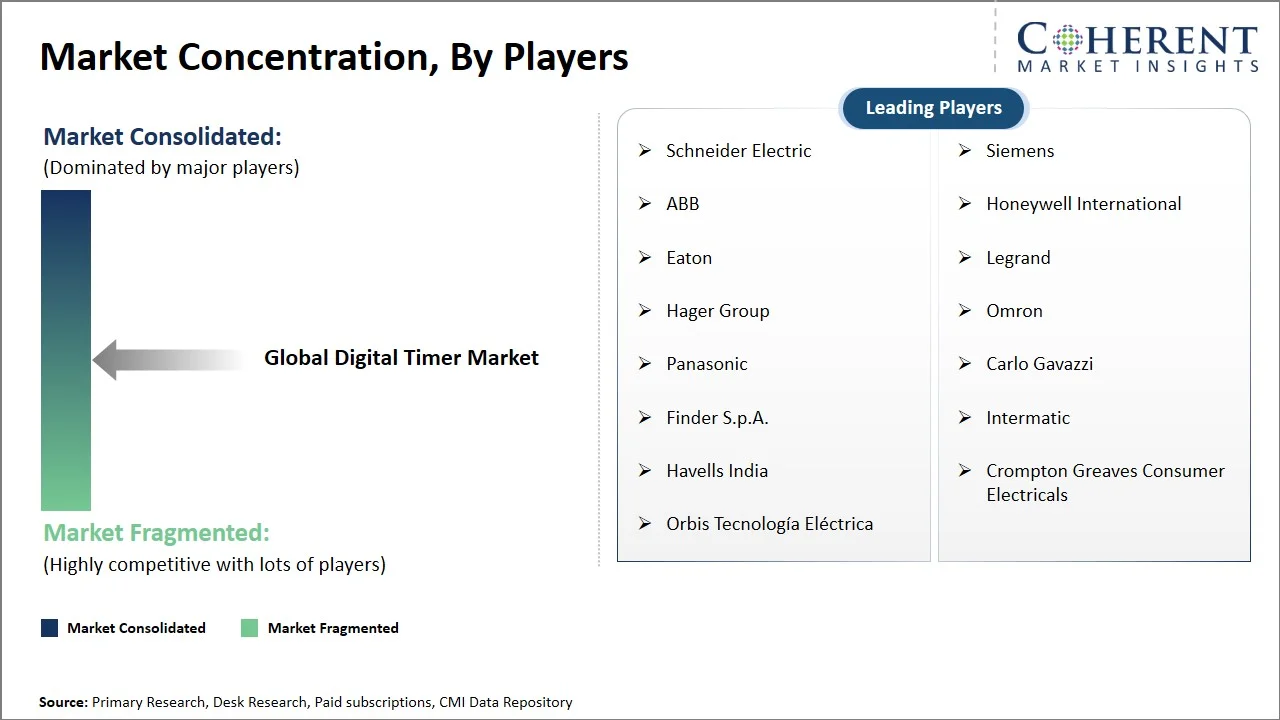
The digital timer market is extremely fragmented and competitive in nature with the presence of prominent multinational electronics manufacturers and several regional players across consumer and industrial segments. Intense rivalry exists due to product differentiation being mainly in cost, durability, programmability and smart connectivity capabilities. Key players are concentrating on continuous innovation to embed IoT-enabled functions and improve energy efficiency to maintain market share. Strategic initiatives for strengthening worldwide presence and improving distribution networks are being performed such as mergers, acquisitions, collaborations, and growth of product line.
Market Report Scope
Digital Timer Market Report Coverage
| Report Coverage | Details | ||
|---|---|---|---|
| Base Year: | 2025 | Market Size in 2026: | USD 1.50 Bn |
| Historical Data for: | 2020 To 2024 | Forecast Period: | 2026 To 2033 |
| Forecast Period 2026 to 2033 CAGR: | 5.4% | 2033 Value Projection: | USD 2.40 Bn |
| Geographies covered: |
| ||
| Segments covered: |
| ||
| Companies covered: | Schneider Electric, Siemens, ABB, Honeywell International, Eaton, Legrand, Hager Group, Omron, Panasonic, Carlo Gavazzi, Finder S.p.A., Intermatic, Havells India, Crompton Greaves Consumer Electricals, and Orbis Tecnología Eléctrica | ||
| Growth Drivers: |
| ||
| Restraints & Challenges: |
| ||
Analyst Opinion (Expert Opinion)
- The digital timer market is largely seen to be driven by increasing automation trends and the rising adoption of smart devices in both residential and industrial applications. Growth is expected to be steady on the basis of increasing demand for precision timing solutions in manufacturing and process control contexts. However, economic concerns and fast technology convergence with multifunction smart controllers are being seen as issues that could limit standalone digital timer demand. During the projection period, the market is witnessing a slow transition towards integrated and software-based timing systems.
- The global digital timer market is anticipated to observe significant development potential owing to increased prevalence of smart homes, adoption of Industry 4.0, and expansion of automated production systems. Next-generation goods are likely to have more connectivity features such as Wi-Fi and Bluetooth integration. Rising energy management applications and tougher efficiency regulations across industries are expected to increase demand. As time moves on, classic stand-alone timers will slowly be replaced or improved upon by smart connected timing systems.
Speak to the analyst
Want personalized insights?
Take the findings above to one of our principal consultants, or have the report rebuilt around the segments, geographies and competitors you actually track.
Market Segmentation
- Type Insights (Revenue, USD Billion, 2021 - 2033)
- LED Display Digital Timer
- LCD Display Digital Timer
- Application Insights (Revenue, USD Billion, 2021 - 2033)
- Industrial Device
- Lighting System
- Others
- Regional Insights (Revenue, USD Billion, 2021 - 2033)
- North America
- U.S.
- Canada
- Latin America
- Brazil
- Argentina
- Mexico
- Rest of Latin America
- Europe
- Germany
- U.K.
- Spain
- France
- Italy
- Russia
- Rest of Europe
- Asia Pacific
- China
- India
- Japan
- Australia
- South Korea
- ASEAN
- Rest of Asia Pacific
- Middle East
- GCC Countries
- Israel
- Rest of Middle East
- Africa
- South Africa
- North Africa
- Central Africa
- North America
- Key Players Insights
- Schneider Electric
- Siemens
- ABB
- Honeywell International
- Eaton
- Legrand
- Hager Group
- Omron
- Panasonic
- Carlo Gavazzi
- Finder S.p.A.
- Intermatic
- Havells India
- Crompton Greaves Consumer Electricals
- Orbis Tecnología Eléctrica
Sources
Primary Research Interviews
- Digital timer manufacturers and suppliers
- Electronic component distributors and retailers
- Industrial automation engineers and
Magazines
- Electronic Design Magazine
- Control Engineering Magazine
- Automation World Magazine
- Electronic Products Magazine
Journals
- IEEE Transactions on Industrial Electronics
- Journal of Manufacturing Systems
- International Journal of Advanced Manufacturing Technology
Associations
- National Electrical Manufacturers Association (NEMA)
- Electronic Industries Alliance (EIA)
- International Association of Electrical Inspectors (IAEI)
- Automation Federation
Public Domain Sources
- U.S. Census Bureau - Manufacturing Statistics
- European Commission Trade Statistics
- World Trade Organization (WTO) Trade Profiles
- International Trade Centre (ITC) Market Analysis
Proprietary Elements
- CMI Data Analytics Tool
- Proprietary CMI Existing Repository of information for last 10 years
Get access to 250+ pages report
Every segment, forecast, competitor profile and data table behind the analysis above — available for instant download.
- ESOMAR Member
- ISO 9001:2015 Certified
- D-U-N-S Registered
- GDPR & CCPA Compliant
Missing comfort of reading report in your local language? Find your preferred language:
Transform your Strategy with Exclusive Trending Reports
Frequently Asked Questions
The global digital timer market is expected to stand at USD 1.50 Bn in 2026 and is expected to reach USD 2.40 Bn by 2033.
The CAGR of the global digital timer market is projected to be 5.4% from 2026 to 2033.
Increasing automation in residential, commercial, and industrial sectors and rising demand for energy efficient control systems are the major factors driving the growth of the global digital timer market.
High initial cost of advanced digital timer systems and limited awareness in underdeveloped and rural markets are the major factors hampering the growth of the global digital timer market.
In terms of type, the LED display digital timer segment is estimated to dominate the market revenue share in 2026.
Yes, many modern digital timers integrate with smart home ecosystems for automation.
Digital timers offer higher precision and programmable features compared to mechanical analog timers.