

Robot Teach Pendant Market Size and Share Analysis- 2026 To 2033
The Robot Teach Pendant Market size is anticipated to grow at a CAGR of 10.1% with USD 750 Mn in 2026 and is expected to reach USD 1,470 Mn in 2033. The primary drivers are defined by expanding industrial automation, rising deployment of collaborative robots, increasing need for intuitive robot programming, and integration of touchscreen and safety-enabled control interfaces. According to the International Federation of Robotics, 542,000 industrial robots were installed globally in 2024, thereby creating stronger demand for reliable operator interfaces for robot setup, programming, diagnostics, and maintenance. This is strengthening demand for robot teach pendants across material handling, welding, painting, assembly, machine tending, and inspection applications in automotive, electronics, aerospace, healthcare, defense, general manufacturing, packaging operations, and logistics.
Key Takeaways
- The on-premises model segment is likely to dominate the market with 82.6% in 2026. The segment’s growth is owing to the need for secure, low-latency robot programming and direct integration with industrial controllers.
- The automotive segment is set to lead with 31.8% in 2026. The segment’s growth is owing to the extensive robot deployment across welding, assembly, painting, and component handling operations.
- The material handling segment is set to lead with 43.7% in 2026. The segment’s growth is owing to the growing automation of picking, loading, palletizing, machine tending, and component transfer operations. Mobile manipulators are increasingly being deployed for material handling applications across automotive, logistics, and aerospace industries.
- North America is expected to acquire the prominent share of 20.7% in 2026. The region’s growth is owing to the strong manufacturing automation, automotive robot deployment, and adoption of advanced robotic systems.
Segmental Insights
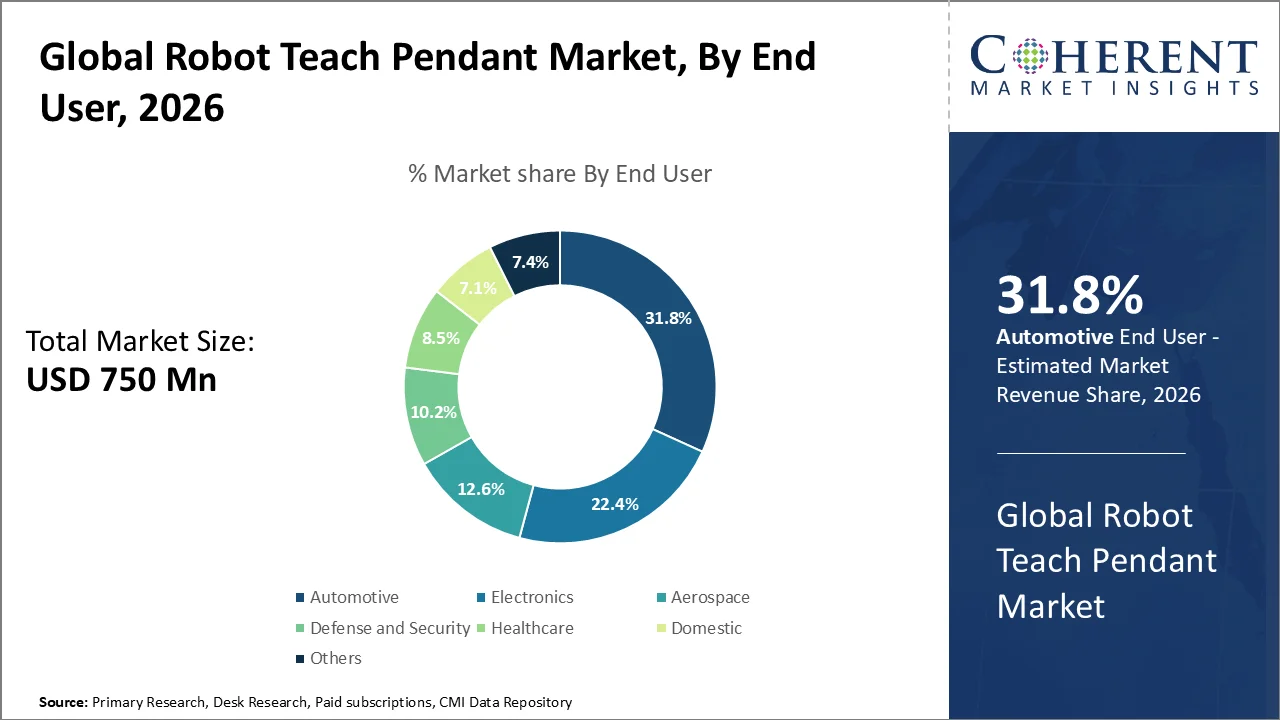
Why is Automotive Segment Acquiring the Largest Share?
On the basis of end user, the automotive segment is projected to account for the largest Robot Teach Pendant Market share of 31.8% in 2026. The segment’s growth is owing to the rising automotive output and the parallel expansion of industrial robotics used for welding, painting, assembly, material handling, and inspection.
China’s National Bureau of Statistics reported that industrial robot production reached 91,088 units during January–February 2025, increasing 27.0% year on year. During the same period, motor vehicle output reached 4.454 million units, up 13.9% year on year, indicating expanding automated production requirements across vehicle plants. The higher robot deployment increases the need for teach pendants for programming, commissioning, position teaching, maintenance, troubleshooting, and servicing on production lines.
- Current Industry Events of 2026
- Market Size Estimation
- Regional Breakdown
- Competitive Landscape
- Customer Intelligence
- Segmental Analysis
- Pricing Analysis
- Key Market Drivers, Challenges & Future Trends
- Customized Insights Section
Material Handling hold the Largest Market Share
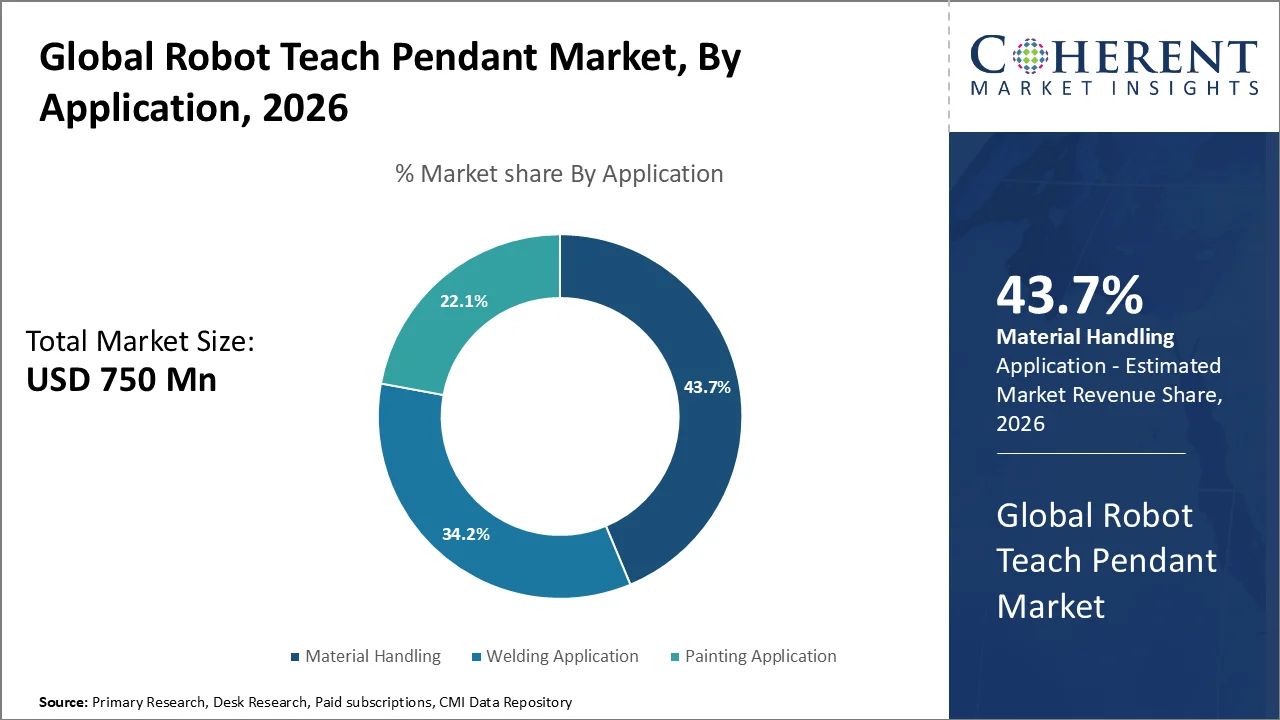
On the basis of application, the material handling segment lead with a major 43.7% share in 2026. The growth is owing to the industrial robots used for pick-and-place, machine loading and unloading, packaging, palletizing, and internal transfer, where teach pendants remain essential for setup, jogging, path teaching, recovery, and maintenance.
U.S. Census Bureau data reinforce this automation base. U.S. businesses recorded USD 12.96 billion in robotic-equipment capital expenditures, thereby supporting the demand for robot-control interfaces. Manufacturing accounted for 56.2% of total U.S. robotic-equipment expenditure, making factories the environment for pendant-controlled material-handling robots.
Market Drivers
Rising Innovations in Lightweight and Touchscreen Robot Interfaces are Transforming the Robot Teach Pendant Market in Japan
Japan remains one of the world's most important robotics technology hubs, with leading manufacturers continuously enhancing robot controllers, programming interfaces, and operator ergonomics. Teach-pendant development is shifting toward lighter housings, large graphical displays, touchscreen interaction, improved processing capability, reduced operator fatigue, and interfaces familiar to users accustomed to tablets and smartphones. These characteristics are becoming particularly important as robots expand beyond automotive plants into SMEs, food processing, logistics, electronics, education, and other sectors where users may have less specialist robot-programming expertise.
Japan maintained one of the largest industrial robot markets globally in 2024, with approximately 44,500 industrial robots installed and an operational stock of about 450,500 units, according to IFR. The large installed base creates continued requirements for programming devices, replacement hardware, servicing, and interface upgrades.
A significant product development occurred when FANUC introduced its new lightweight Teach Pendant, representing the product's first major redesign in approximately 17 years. The firm stated that shipments began in February 2025. The new interface was developed around a lighter and more ergonomic form factor, thereby addressing operator usability as well as fatigue during robot teaching operations. FANUC subsequently showcased the pendant at Automate 2025 in the U.S., thus highlighting lighter weight and improved performance.
BYOD and Software-Defined Robot Programming: A Major Breakthrough in the Robot Teach Pendant Market
One of the most important technological transitions in the Robot Teach Pendant Market is the movement from fully proprietary handheld terminals toward software-defined interfaces and Bring Your Own Device (BYOD) architectures. Traditional teach pendants combine the screen, computing interface, emergency-stop functionality, enabling device, and robot-programming controls in a single proprietary unit. New architectures can separate safety-critical physical controls from the graphical interface, enabling approved tablets or laptops to provide the display and programming environment.
In April 2025, KUKA announced iiQKA.OS2, a scalable and AI-capable robot operating system containing a virtual robot controller. The platform uses a web-based user interface and allows users to operate robots through KUKA equipment or compatible user devices. KUKA also positioned the system as ready for ISO 10218:2025 requirements and future machinery-regulation requirements.
Current Events and Their Impact on the Robot Teach Pendant Market
Current Event | Description and its Impact |
2025 ANSI/A3 R15.06-2025 Industrial Robot Safety Standard Update
|
|
U.S. Section 232 Investigation into Robotics and Industrial Machinery Imports |
|
Robot Teach Pendant Market Trends
- Rising adoption of touchscreen and tablet-style robot teach pendants enables intuitive programming, faster robot setup, and simplified operation for manufacturing personnel.
- Growing demand for lightweight and ergonomic teach pendants improves operator mobility, comfort, and efficiency while programming industrial and collaborative robots across production environments.
- Integration of graphical, drag-and-drop, and low-code programming interfaces within teach pendants reduces dependence on specialized robot programmers and supports faster deployment. ABB also enables customized graphical interfaces for its OmniCore FlexPendant using web technologies and drag-and-drop development tools.
- Expanding industrial robot deployment increases demand for teach pendants used in robot programming, commissioning, troubleshooting, and maintenance. In 2024, China’s operational industrial robot stock exceeded 2 million units, around 4.5 times Japan’s installed stock, thereby highlighting the growing base of robots requiring programming and control interfaces.
- Increasing adoption of web-based and wireless robot programming interfaces is transforming traditional teach pendant designs toward more flexible and software-driven solutions. FANUC’s iRProgrammer, introduced as a web-based interface, allows robot programming through PCs and tablets without requiring a physical teach pendant, highlighting the growing shift toward hybrid and virtual pendant technologies.
Regional Insights
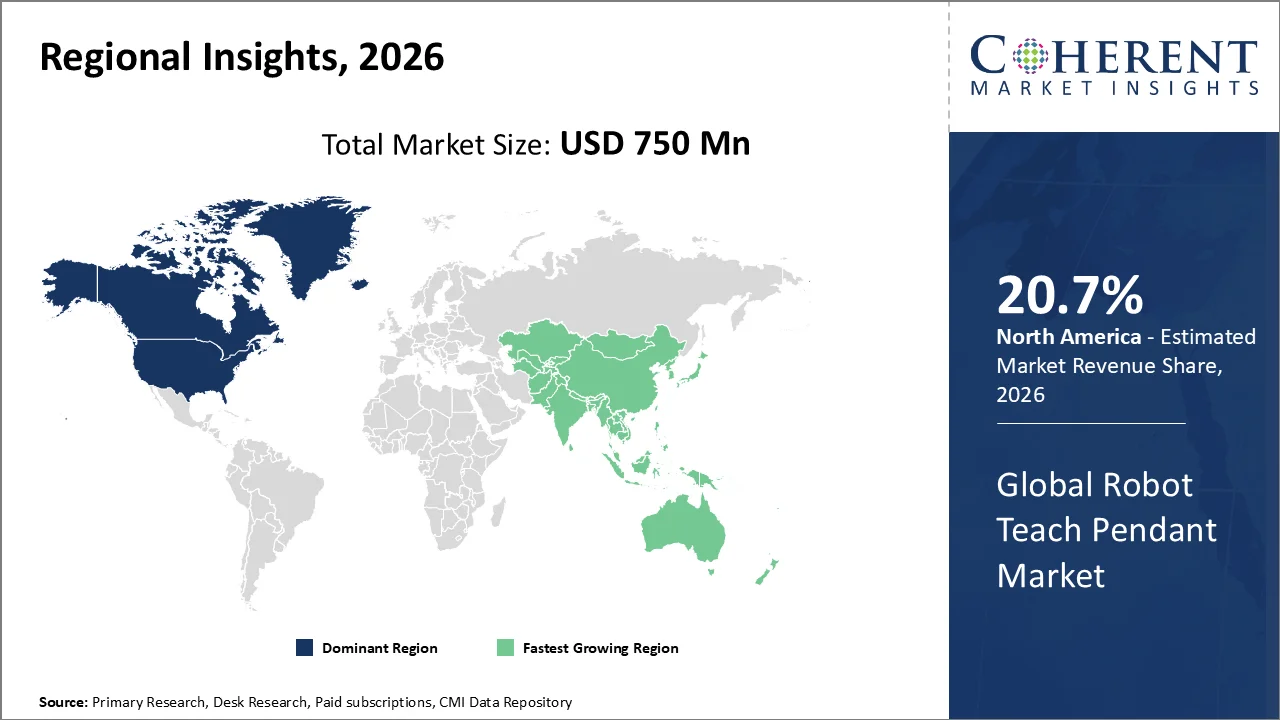
North America Dominates Owing to the Strong Industrial Robotics Deployment
The North America region accounts for 20.7% of the market share in 2026. The region’s growth is owing to industrial robot deployment, automation spending, and modernization of manufacturing controls.
According to the U.S. Census Bureau’s Economic Census, 6.4% of U.S. manufacturing plants had industrial robots, indicating a substantial installed base requiring robot programming, setup, jogging, diagnostics, and operator-control interfaces such as teach pendants. The same Census robotics dataset reported approximately USD 3.905 billion in capital expenditure on industrial robotic equipment across U.S. manufacturing, reflecting continued investment in robotic systems and associated control hardware.
In March 2026, FANUC America showcased its Tablet Teach Pendant with the CRX-10iA collaborative robot at MODEX 2026. The interface enables intuitive free-hand teaching and drag-and-drop programming, simplifying robot setup for label inspection and barcode-reading applications using integrated 3D vision.
Asia Pacific Robot Teach Pendant Market Trends
Asia Pacificis expected to witness strong growth in Robot Teach Pendant Market over the forecast period. The region’s growth is owing to rising industrial-robot production, factory automation, and demand for intuitive robot programming interfaces.
China’s National Bureau of Statistics reported industrial robot output of 556,000 sets in 2024, representing a 14.2% increase over 2023. In 2025, output climbed further to 773,074 sets, up 28.0% year on year, demonstrating accelerating deployment of robotic systems across manufacturing operations. This expansion enlarges the installed base requiring teach pendants for robot setup, jogging, programming, calibration, troubleshooting, and maintenance, particularly across automotive, electronics, metalworking, and material-handling applications.
In June 2025, FANUC introduced a new lightweight teach pendant with its M-410/800F-32C palletizing robot. The device weighs 750 g and offers full touch-panel operation, thereby supporting faster programming and greater HMI flexibility.
Rising Industrial Automation and Demand for Simplified Robot Programming are Accelerating the Market in United States
The Canadian Robot Teach Pendant Market is driven by rising industrial automation and demand for simpler robot programming. Statistics Canada reported that 2.1% of Canadian businesses used robotics in 2023, thereby indicating a growing installed base requiring operator interfaces for setup, jogging, programming, and maintenance.
In May 2024, FANUC America launched the CRX-10iA/L Paint collaborative robot for North and South America, designed to meet Canadian explosion-proof requirements and programmed through its CRX Tablet Teach Pendant with drag-and-drop functions.
Japan Robot Teach Pendant Market Trends
Japan is emerging as a high-growth country for Robot Teach Pendant owing to the country’s established industrial-robot manufacturing base and continued factory automation across automotive, electronics, and machinery industries. Japan’s official e-Stat/METI production survey recorded ¥37.15 billion in 2024 production value for industrial robot parts and ancillary equipment, a category directly supporting robot-control hardware ecosystems.
In May 2026, FANUC strengthened its collaboration with NVIDIA by enabling robots in NVIDIA Isaac Sim to be operated through virtual or physical ROBOGUIDE teach pendants. Users can perform jogging, teach programs, execute operations, and verify results within a virtual factory environment.
Who are the Major Companies in Robot Teach Pendant Industry
Some of the major key players in Robot Teach Pendant Market are ABB Ltd, Fanuc Corporation, KUKA AG, Omron Adept Technologies, Inc., Yaskawa Motoman, COMAU S.p.A., DENSO Robotics, Epson America, Inc., Festo, Intelitek, Mitsubishi Electric Corporation, Nachi Robotic Systems Inc, Stäubli International, Yamaha Robotics Inc.
Key News
- In May 2026, Universal Robots confirmed that its new ISO 10218-1:2025-certified robot products will use the 3PE Teach Pendant, incorporating a three-position enabling device for safer manual robot teaching and programming. The company also stated that new robots will ship exclusively with the 3PE Teach Pendant, while the conventional standard pendant is planned to be phased out by Q1 2027.
- In March 2026, KUKA introduced the smartPLUG teach pendant as part of its upgraded KR CYBERTECH automation package. Integrated with the KR C5 slim controller and iiQKA.OS2, the teach pendant supports intuitive robot operation and a fully integrated, AI-ready production environment.
- In September 2025, Kawasaki announced hands-on demonstrations of its new F0X robot controller and new teach pendant at FABTECH 2025. The event also highlighted its Easy Teach programming interface
Market Report Scope
Robot Teach Pendant Market Report Coverage
| Report Coverage | Details | ||
|---|---|---|---|
| Base Year: | 2025 | Market Size in 2026: | USD 750 Mn |
| Historical Data for: | 2020 To 2024 | Forecast Period: | 2026 To 2033 |
| Forecast Period 2026 to 2033 CAGR: | 10.1% | 2033 Value Projection: | USD 1,470 Mn |
| Geographies covered: |
| ||
| Segments covered: |
| ||
| Companies covered: | ABB Ltd, Fanuc Corporation, KUKA AG, Omron Adept Technologies, Inc., Yaskawa Motoman, COMAU S.p.A., DENSO Robotics, Epson America, Inc., Festo, Intelitek, Mitsubishi Electric Corporation, Nachi Robotic Systems Inc, Stäubli International, Yamaha Robotics Inc. | ||
| Growth Drivers: |
| ||
| Restraints & Challenges: |
| ||
Analyst Opinion
- Robot teach pendant demand is supported by rising automation intensity across manufacturing. In 2024, Western Europe recorded 267 industrial robots per 10,000 manufacturing employees, compared with 204 in North America and 131 in Asia. Higher robot density increases the need for efficient programming, commissioning, diagnostics, and operator-control interfaces such as robot teach pendants.
- Automotive manufacturing remains one of the strongest users of robot control systems. In 2024, Europe’s automotive industry installed about 23,000 industrial robots, while the U.S. automotive industry installed around 13,700 units. Higher robot deployment supports demand for teach pendants used in welding, material handling, assembly, and maintenance.
- Modern teach pendants are gaining traction as manufacturers shift toward touchscreen interfaces, ergonomic designs, simplified programming, and safer human-robot interaction. These improvements reduce programming complexity and training requirements, encouraging broader adoption among automation users and small and medium-sized manufacturers implementing flexible production systems.
Speak to the analyst
Want personalized insights?
Take the findings above to one of our principal consultants, or have the report rebuilt around the segments, geographies and competitors you actually track.
Market Segmentation
- By Deployment Model (Revenue, USD Mn, 2021-2033)
- On-premises Model
- Cloud Based Model
- By End User (Revenue, USD Mn, 2021-2033)
- Healthcare
- Defense and Security
- Aerospace
- Automotive
- Electronics
- Domestic
- Others
- By Application (Revenue, USD Mn, 2021-2033)
- Material Handling
- Welding Application
- Painting Application
- By Region (Revenue, USD Mn, 2021-2033)
- North America
- U.S.
- Canada
- Latin America
- Brazil
- Mexico
- Argentina
- Rest of Latin America
- Europe
- Germany
- U.K.
- France
- Italy
- Spain
- Russia
- Rest of Europe
- Asia Pacific
- China
- India
- Japan
- Australia
- South Korea
- ASEAN
- Rest of Asia Pacific
- Middle East
- GCC
- Israel
- Rest of Middle East
- Africa
- South Africa
- Central Africa
- North Africa
- North America
Sources
Primary Research Interviews
- Industrial robot OEM product managers
- Robot controller and teach pendant R&D engineers
- Robotics system integrators
- Factory automation engineers
- Robot programmers and operators
- Manufacturing plant managers
- Industrial automation distributors
- Robot safety and certification specialists
- Key opinion leaders (KOLs) in robotics and industrial automation
Databases
- International Federation of Robotics (IFR) – World Robotics Database
- UN Comtrade Database
- International Trade Centre (ITC) Trade Map
- Eurostat
- Organisation for Economic Co-operation and Development (OECD)
- World Bank Database
- National manufacturing and industrial statistics databases
Magazines
- The Robot Report
- Automation World
- Control Engineering
- Robotics 24/7
- Robotics Tomorrow
- Automation & Robotics World
Journals
- IEEE Transactions on Robotics
- IEEE Robotics and Automation Letters
- IEEE Robotics & Automation Magazine
- Robotics and Computer-Integrated Manufacturing
- International Journal of Advanced Robotic Systems
- Robotics and Autonomous Systems
Newspapers
- Reuters
- Financial Times
- The Wall Street Journal
- Nikkei Asia
- The Economic Times
Associations
- International Federation of Robotics (IFR)
- Association for Advancing Automation (A3)
- VDMA Robotics + Automation
- Japan Robot Association (JARA)
- IEEE Robotics and Automation Society (IEEE RAS)
Public Domain Sources
- Company annual reports and investor presentations
- Robot teach pendant product catalogs and technical datasheets
- Robot controller and teach pendant operating manuals
- Manufacturer product launches and press releases
- Government manufacturing and industrial automation publications
- WIPO PATENTSCOPE
- Google Patents
- Publicly available robot safety and industrial automation regulatory documents
Proprietary Elements
- CMI Data Analytics Tool
- Proprietary CMI Existing Repository of Information for the Last 10 Years
Get access to 250+ pages report
Every segment, forecast, competitor profile and data table behind the analysis above — available for instant download.
- ESOMAR Member
- ISO 9001:2015 Certified
- D-U-N-S Registered
- GDPR & CCPA Compliant
Missing comfort of reading report in your local language? Find your preferred language:
Transform your Strategy with Exclusive Trending Reports
Frequently Asked Questions
The Robot Teach Pendant Market is expected to reach USD 1,470 Mn in 2033.
Major players operating in the global Robot Teach Pendant Market include ABB Ltd, Fanuc Corporation, KUKA AG, Omron Adept Technologies, Inc., Yaskawa Motoman, COMAU S.p.A., DENSO Robotics, Epson America, Inc., Festo, Intelitek, Mitsubishi Electric Corporation, Nachi Robotic Systems Inc, Staubli International, Yamaha Robotics Inc.
The rapid rise of alternative programming methods like offline and simulation software, high hardware and replacement costs, and a shortage of skilled automation technicians are the key factors hampering growth of the market.
The increasing industrial automation, a rising demand for precise and user-friendly robot programming, and the widespread adoption of Industry 4.0 smart factory concepts across automotive, electronics, and manufacturing sectors is boosting the demand for Robot Teach Pendant.
The Robot Teach Pendant Market is anticipated to grow at a CAGR of 10.1% between 2026 and 2033.
Among regions, North America is expected to account for a largest market share in the global Robot Teach Pendant Market over the forecast period.
The robot teach pendant market is the global industry for handheld control and programming devices used to operate industrial robots.