

Global Driving Simulator Market Size and Forecast – 2026 To 2033
The global driving simulator market is expected to grow from USD 2.50 Bn in 2026 to USD 4.80 Bn by 2033, registering a compound annual growth rate (CAGR) of 7% from 2026 to 2033. The global driving simulator market is driven by the increasing focus on road safety and driver behavior analysis. On July 21, 2026, Mobileye announced that its Cloud-Enhanced Advanced Driver Assist technology will be integrated into select future Stellantis vehicles from 2027, supporting safety and convenience features through advanced crowdsource intelligence.
Key Takeaways of the Global Driving Simulator Market
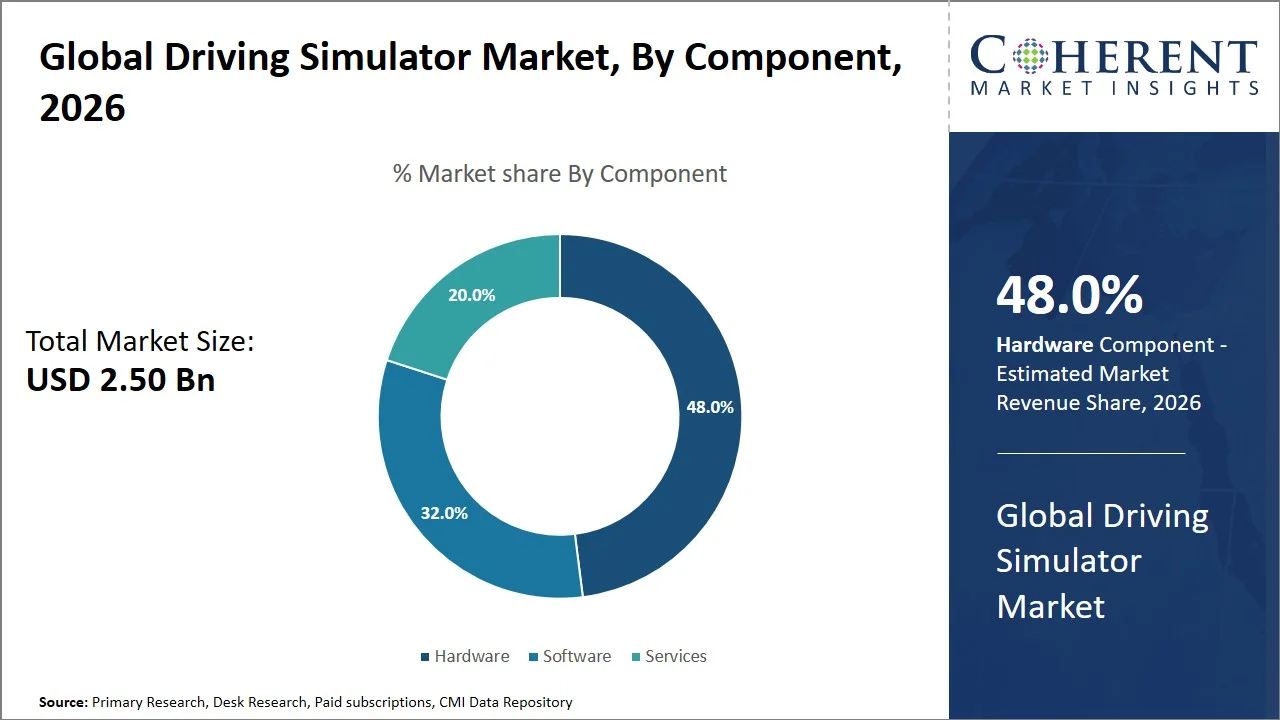
- The hardware segment is expected to account for 48.0 % of the global driving simulator market share in 2026. Expansion of electric vehicle development programs is driving the growth of the segment. On January 6, 2025, Volkswagen Group China announced a strategic collaboration with XPENG to develop more than 20,000 charging points operated by both companies in 420 cities all over China.
- The compact driving simulator segment is estimated to capture 51.0 % of the market share in 2026. Advancements in motion platforms and immersive simulation technologies is majorly driving the growth of the segment. On January 5, 2026, Kumho Tire and Ansible Motion announced a strategic collaboration to use high-fidelity Driver-in-the-Loop simulation for next-generation tire development.
- The passenger vehicles segment is estimated to capture 54.0 % of the market share in 2026. Growing demand for AI-based driver behavior modeling is driving the growth of the segment. On January 27, 2026, WeRide announced the launch of WeRide GENESIS, its proprietary general-purpose simulation model. WeRide GENESIS bridges physical AI and generative AI, connecting the real and simulated worlds to accelerate the development, training, and validation of autonomous vehicles (AVs) at scale.
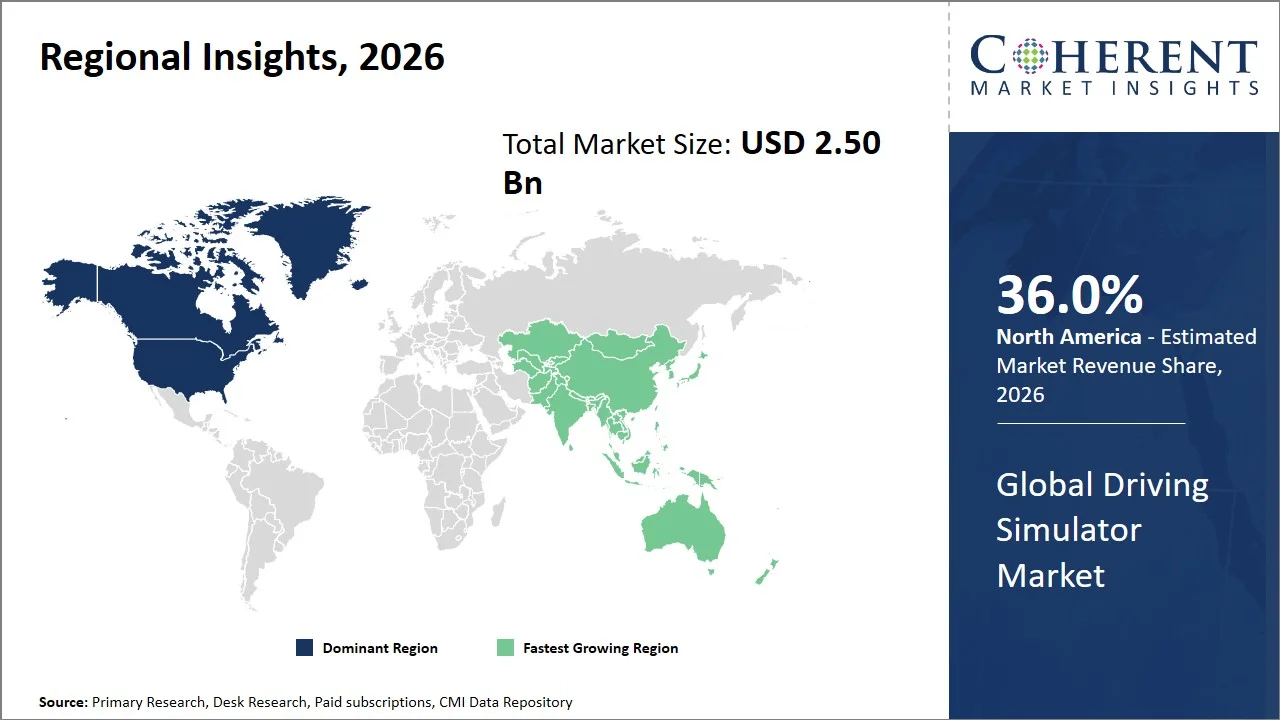
- North America is expected to dominate the driving simulator market in 2026 with a market share of 36.0 %. Increasing use of cloud connected simulation platforms in North America is driving the growth of the regional market. In February 2026, VI-grade completed deployment of its DiM500 Driver-in-the-Loop simulator for Bridgestone's R&D operations, with the platform supporting centralized management of virtual vehicle models, simulation data, and engineering workflows that can be shared across global development teams, including North American research centers.
- Asia Pacific is expected to account for 31.0 % of the market share in 2026 and is projected to record the fastest growth over the forecast period. Growth in military and emergency response driver training across Asia Pacific is driving the growth of the regional market. On June 19, 2024, Tecknotrove provided superior military vehicle driver simulators to the Indian Army and has been continuously developing its land-force simulation skills.
- AI-powered autonomous quote to cash automation: CPQ platforms are evolving into intelligent revenue management platforms with the addition of generative artificial intelligence and autonomous agents that automate product configuration, pricing decisions, quote generation, approvals, contract creation and sales recommendations with little to no human intervention.
- Expansion of unified revenue lifecycle management platforms: Vendors are combining CPQ with customer relationship management, enterprise resource planning, contract lifecycle management, billing, subscription management and digital commerce applications to build end-to-end revenue lifecycle platforms that simplify commercial operations.
Segmental Insights
Why Does Hardware Dominate the Global Driving Simulator Market?
The hardware segment is expected to account for 48.0% of the global driving simulator market share in 2026. High-fidelity driving simulators integrate advanced hardware components such as motion platforms, steering and pedal systems, force feedback devices, panoramic display systems, projection units, sensor arrays, and realistic vehicle cockpits to accurately replicate real-world driving conditions. These hardware components offer realistic car dynamics, immersive driver contact, and exact performance evaluation and are therefore indispensable for driver instruction, automotive research and development, autonomous vehicle testing, motorsport simulation, and regulatory validation. On June 6, 2024, VI-grade and Rohde & Schwarz showed how to integrate sensor fusion and simulation technologies to speed up autonomous car testing by pairing robust driving simulator hardware with radar, LiDAR, and video sensor validation and immersive driver experiences.
- Current Industry Events of 2026
- Market Size Estimation
- Regional Breakdown
- Competitive Landscape
- Customer Intelligence
- Segmental Analysis
- Pricing Analysis
- Key Market Drivers, Challenges & Future Trends
- Customized Insights Section
Why is Compact Driving Simulator the Most Preferred Simulator Type?
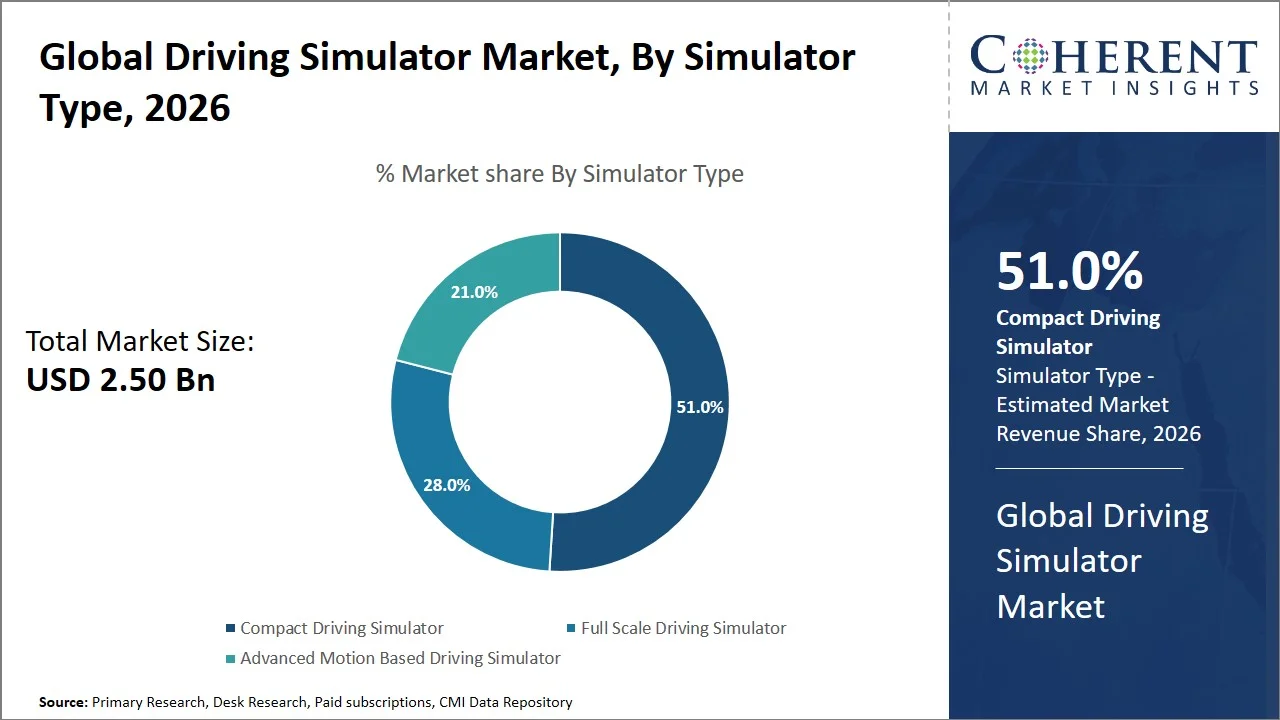
The compact driving simulator segment is expected to account for 51.0% of the global driving simulator market share in 2026. Compact driving simulators are preferred because they provide the best compromise between simulation capability, installation cost and operational flexibility, making them suitable to a wide range of commercial and institutional users. Their more compact footprint allows them to be used in driving schools, fleet training centers, universities, automotive laboratories and research institutes where space and budget constraints make huge full-motion systems impossible. In addition, modern compact simulators are equipped with advanced visual displays, realistic steering feedback and configurable driving scenarios to enable organizations to provide effective driver training, safety assessments and vehicle evaluation while still keeping the acquisition and maintenance costs lower. On January 5, 2026, Bosch and Microsoft expanded their cooperation in software-defined vehicle engineering to pave the way for cloud-connected simulation and validation workflows that allow automotive developers to rely on compact Driver-in-the-Loop simulator setups instead of large dedicated facilities during the early phase of software testing.
Passenger Vehicles Segment Dominates the Global Driving Simulator Market
The passenger vehicles segment is expected to account for 54.0% of the global driving simulator market share in 2026. Passenger vehicle simulators are extensively used by automotive manufacturers, driving schools, research organizations, and regulatory bodies to evaluate driver behavior, validate advanced driver assistance systems, improve vehicle ergonomics, and develop electric and autonomous vehicles, which leads to a continued higher demand for simulators as compared to commercial and specialty vehicles. On June 5, 2025, Renault Group and OXA announced that they will be launching autonomous electric passenger vehicle shuttles in several places around Europe. The work is based on comprehensive virtual simulation and passenger car validation to validate automated driving behavior, passenger safety and urban transportation scenarios before commercial use.
Current Events and their Impact
Current Events | Description and its Impact |
European Union Artificial Intelligence Act (AI Act) |
|
General Safety Regulation (EU) 2019/2144 |
|
Global Driving Simulator Market Dynamics
Market Drivers
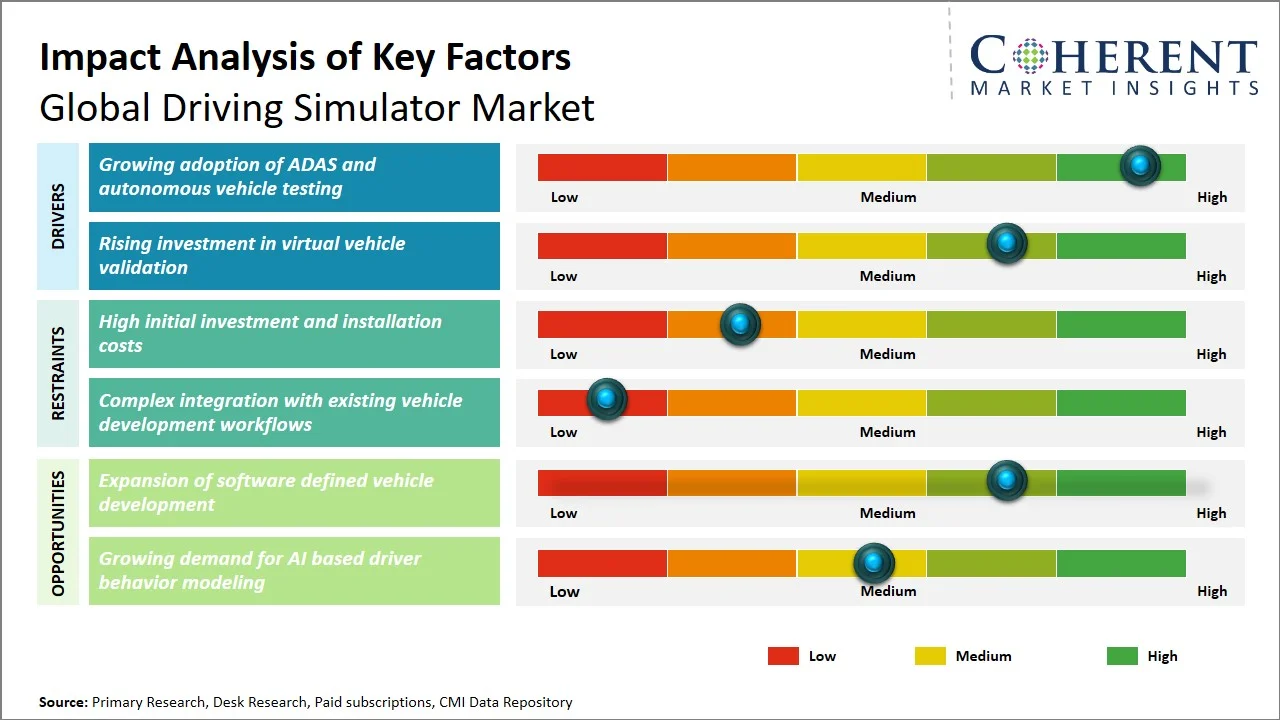
- Growing adoption of ADAS and autonomous vehicle testing: Automotive manufacturers are increasingly adopting driving simulators for the development and validation of advanced driver assistance systems (ADAS) and autonomous driving technologies before deploying them on the road. High-fidelity simulation environments allow engineers to test features such as adaptive cruise control, automatic emergency braking, lane keeping assistance, driver monitoring and automated parking in thousands of realistic traffic, weather and road scenarios, reducing development time and improving safety validation and the cost of physical testing, while supporting compliance with evolving global automotive safety regulations. On July 15, 2025, BMW Group announced that it is expanding its footprint in China’s digital innovation landscape with a new partnership focused exclusively on China. In collaboration with Momenta, a leading Chinese ADAS technology provider, BMW will co-develop advanced driver assistance solutions specifically for the BMW product portfolio offered in China.
- Rising investment in virtual vehicle validation: Automakers, technology companies, and research institutes are increasing investment in virtual vehicle validation to accelerate vehicle development and decrease costly prototype testing. Advanced driving simulators based on digital twins, artificial intelligence, software-in-the-loop and hardware-in-the-loop technologies allow continuous validation of vehicle dynamics, software updates, autonomous driving algorithms and human-machine interaction, allowing manufacturers to identify design problems earlier, improve engineering efficiency and shorten product development cycles. On February 4, 2025, Waabi entered into a strategic partnership with Volvo Autonomous Solutions for the joint development and deployment of autonomous trucks. The partnership combines Waabi’s groundbreaking innovation in generative AI with Volvo’s leadership in automation and safety innovation to unleash autonomous trucking and usher in a new era of safer, more efficient, and sustainable freight transportation.
Emerging Trends
- Growth of usage based and hybrid pricing models: Companies are increasingly adopting usage-based, subscription and hybrid pricing strategies, which are driving CPQ providers to develop sophisticated pricing engines that can manage recurring revenue, consumption-based billing and dynamic commercial agreements across various sales channels.
- Rise of industry specific cloud native CPQ solutions: Cloud-native CPQ platforms tailored for industries such as manufacturing, healthcare, telecommunications, and automotive are gaining traction by addressing sector-specific pricing, configuration, and compliance requirements. These specialized solutions enable faster deployments, greater scalability, and seamless integration with industry-focused enterprise applications.
Regional Insights
Why is North America a Strong Market for Driving Simulators?
North America is expected to account for a market share of 36.0% in 2026. North America is anticipated to be the largest driving simulator market driven by the presence of automotive manufacturers, autonomous vehicle developers, motorsport organizations, and government-funded research programs. Companies like General Motors, Ford, Tesla, NVIDIA and Torc Robotics extensively use advanced driving simulators to validate advanced driver assistance systems (ADAS), autonomous driving software and driver monitoring technologies before they are deployed on public roads.
In the region, research centers are conducting study on impaired driving, linked vehicles, human factors, and transportation safety, including the University of Iowa National Advanced Driving Simulator, one of the world’s largest high-fidelity driving simulation facilities. Canadian universities like the University of Toronto and the University of Waterloo are increasing their research into autonomous mobility using simulation platforms, while simulator vendors such as VI-grade, Cruden, and Ansible Motion are consolidating their position through partnerships with automotive OEMs and engineering service providers.
Why Does the Asia Pacific Driving Simulator Market Exhibit High Growth?
Asia Pacific is projected to account for 31.0% of the global driving simulator market in 2026 and is expected to register the fastest growth. Asia Pacific is the fastest expanding regional market with substantial investments in electric vehicles, intelligent transportation systems and autonomous mobility throughout China, Japan, South Korea and India. Toyota, Honda, Nissan, Hyundai, BYD, Geely, SAIC Motor and Tata Motors are increasingly using high-fidelity simulations for validation of vehicle dynamics, software-defined cars and ADAS functionalities before any physical testing. China is integrating simulation into intelligent connected car research under national smart mobility programs, while Japan keeps increasing virtual validation for autonomous mobility through collaborations with automotive firms and universities. Simulators are being increasingly used by Automotive Research Association of India (ARAI), IITs and vehicle manufacturers in India to improve driver training and safety of commercial vehicles. The region is also experiencing an accelerated need for advanced simulation technologies with the expansion of local proving grounds and software-defined vehicle development.
Global Driving Simulator Market Outlook for Key Countries
Why is the U.S. Emerging as a Major Hub in the Driving Simulator Market?
The U.S. is the largest national market, with strong investment in autonomous driving, defense vehicle simulation and commercial driver training. Tesla, General Motors, Ford, Waymo, Zoox, Aurora Innovation, NVIDIA and Torc Robotics are all using simulation environments to verify their autonomous driving algorithms over millions of virtual driving scenarios before road trials. The University of Iowa's National Advanced Driving Simulator remains a globally recognized research center for studying driver behavior, distraction, aging drivers, and transportation safety. NASCAR teams and other major motorsport organizations use professional grade simulators to prepare for races and to optimize vehicle setups. Engineering firms are using software-in-the-loop and hardware-in-the-loop testing more and more in vehicle development programs.
Is China the Next Growth Engine for the Driving Simulator Market?
The rapid development of intelligent networked vehicles and autonomous driving technology has made China one of the most active markets for driving simulators. Automakers including BYD, SAIC Motor, Geely, Changan Automobile, NIO, XPeng, and Li Auto use advanced simulation platforms to validate perception systems, autonomous driving software, and vehicle control algorithms before public road deployment. Instead, tech giants like Huawei and Baidu Apollo are continuing to push autonomous driving technologies, using large-scale virtual testing environments. National intelligent connected vehicle demonstration zones in cities such as Beijing, Shanghai, Shenzhen and Wuhan support simulator-assisted validation and real-world testing and accelerate the development of next-generation mobility technologies.
Germany Driving Simulator Market Analysis and Trends
Germany remains a large market due to its premium automotive manufacturers and engineering excellence. Mercedes-Benz, BMW, Volkswagen Group, Porsche, Audi, Bosch, Continental and ZF Friedrichshafen extensively use driving simulators to validate vehicle dynamics, ADAS technologies, human-machine interfaces and autonomous driving functions. Research organizations such as the German Aerospace Center (DLR), the Technical University of Munich, and RWTH Aachen University operate advanced driving simulation laboratories supporting automotive innovation. German engineering service providers increasingly combine digital twins, real-time simulation, and hardware-in-the-loop systems to reduce prototype development and accelerate software-defined vehicle validation.
Japan Driving Simulator Market Analysis and Trends
Japan maintains strong demand for driving simulators through continuous investment in vehicle safety, mobility innovation, and driver assistance technologies. Toyota, Honda, Nissan, Subaru, Mazda, and Denso use sophisticated simulation systems to evaluate driver behavior, vehicle control systems, hybrid and electric vehicle performance, and autonomous driving technologies before production. Research on traffic safety, intelligent transportation systems and human factors engineering are being conducted by universities such as University of Tokyo and Nagoya University using immersive simulation environments. The country’s drive to cut road deaths and support future mobility options is continuing to fuel the momentum for advanced simulator technologies among car makers and research bodies.
U.K. Driving Simulator Market Analysis and Trends
The U.K. is a key European center for the engineering of high performance vehicles, motorsport and research into autonomous mobility. Jaguar Land Rover, McLaren Automotive, Williams Racing, and numerous Formula One teams deploy complex driving simulators for vehicle development, aerodynamic optimization, chassis tuning, and driver performance monitoring. Research organizations including HORIBA MIRA, WMG at the University of Warwick, and the University of Leeds operate sophisticated driving simulation facilities supporting connected and autonomous vehicle development. The Centre for Connected and Autonomous Vehicles (CCAV) continues to support government-backed programs to encourage the virtual validation of automated driving technologies so that manufacturers can verify complicated traffic situations and safety functions before hitting the road.
Global Driving Simulator Market - Automotive OEM Investment In Virtual Validation (2025)
Automotive OEM | Primary Virtual Validation Focus | Estimated Virtual Validation Investment Share |
Volkswagen Group | Software-defined vehicle development | 15.8% |
Toyota Motor Corporation | Hybrid and autonomous vehicle validation | 13.9% |
Mercedes-Benz Group | MB.OS software platform validation | 11.8% |
BMW Group | Neue Klasse vehicle development | 10.7% |
Hyundai Motor Group | SDV and EV engineering | 9.8% |
General Motors | Ultifi software platform | 8.9% |
Ford Motor Company | BlueCruise and EV programs | 7.9% |
Stellantis | STLA software platform | 7.2% |
Honda Motor Co. | Intelligent mobility development | 6.5% |
Geely Holding Group | Intelligent EV platforms | 5.6% |
How is the Expansion of Software Defined Vehicle Development Creating New Growth Opportunities in the Driving Simulator Market?
The surge in the development of software defined vehicle (SDV) is creating substantial prospects for the driving simulator market by moving the vehicle innovation from hardware-centric engineering to continuous software validation throughout the product lifecycle. Car makers such as Mercedes-Benz, BMW, Volkswagen Group, Toyota, General Motors, Hyundai Motor Group and Volvo Cars are using software-in-the-loop (SIL), hardware-in-the-loop (HIL) and driver-in-the-loop (DIL) simulations in their SDV development to validate over-the-air software updates, centralized vehicle computing architectures, advanced driver assistance systems, cockpit software and autonomous driving functions before they are deployed.
Companies including NVIDIA, dSPACE, AVL, Siemens, IPG Automotive, VI-grade, and Ansible Motion are expanding simulator platforms that combine digital twins, real-time physics models, sensor simulation, and artificial intelligence to recreate millions of virtual driving scenarios that would be impractical to perform on public roads. This transition toward continuous software verification is increasing demand for scalable, high-fidelity driving simulators capable of supporting rapid software releases, cybersecurity testing, functional safety validation under ISO 26262, and compliance with evolving regulations governing automated and connected vehicles, making simulation an essential component of modern software defined vehicle development.
On June 20, 2025, Tata Consultancy Services announced the expansion of its capabilities in the rapidly evolving Software-Defined Vehicles space. TCS established two new Automotive Delivery Centers in Germany, located in Munich and Villingen-Schwenningen as well as an engineering center in Romania. These new hubs mark a strategic move to help TCS’ global automotive clients accelerate their transition to next-gen mobility solutions.
Market Players, Key Development, and Competitive Landscape
Key Developments
- On February 25, 2026, Bridgestone reached a key milestone in its digital tyre development journey with its state-of-the-art driving simulator becoming fully operational. Installed at the company’s R&D Centre near Rome, Italy, the VI-grade DiM500 Driver-in-the-Loop simulator enables Bridgestone to assess tyre performance in a fully virtual environment.
- On June 24. 2025, Hyundai Motor announced its plans to acquire an Ansible Motion Delta series DIL simulator to assist its new car developments. Hyundai Motor’s DIL simulator features a high-fidelity, six-degrees-of-freedom (6DOF) Stratiform 3 dynamic motion system, a 270-degree curved display driven by nine 4K projectors at 240 Hz for complete visual immersion, a quick-change carbon fiber cabin.
Competitive Landscape
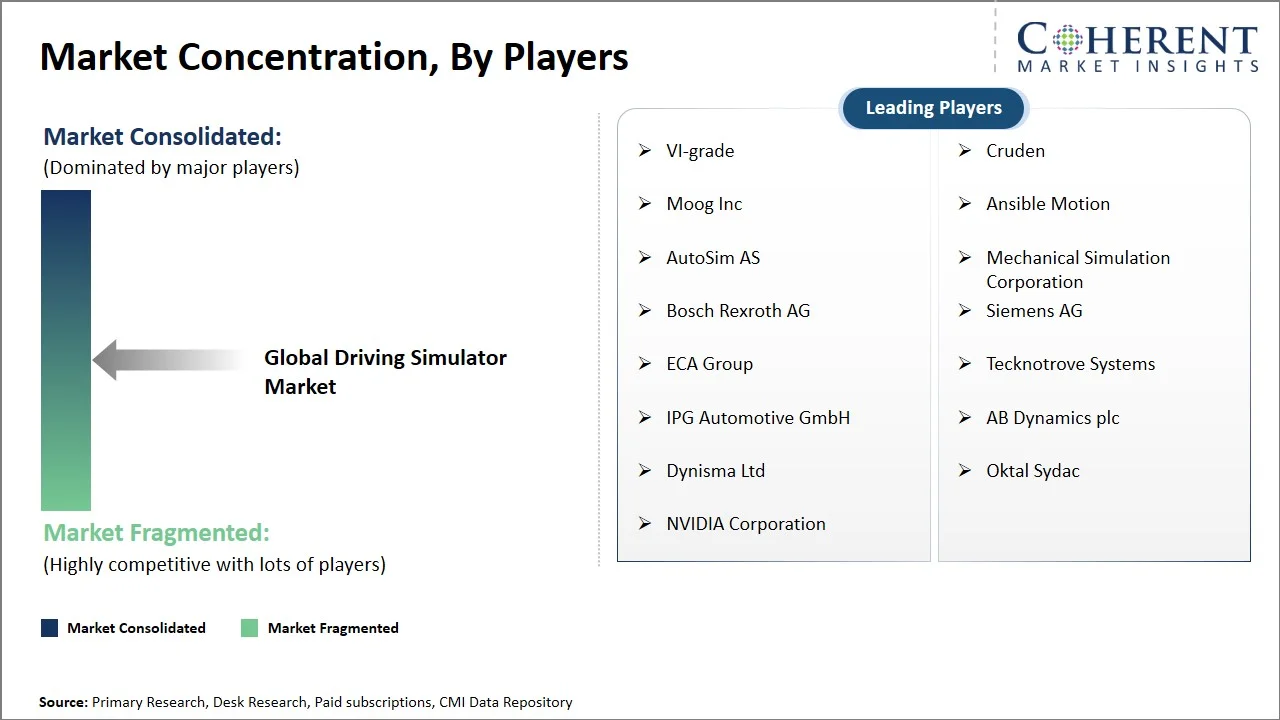
The global driving simulator market is led by companies including VI-grade, Cruden, Ansible Motion, IPG Automotive, Moog Inc., Tecknotrove, ECA Group, Bosch Rexroth, CAE Inc., and Mechanical Simulation Corporation, each focusing on specialized simulation capabilities rather than competing solely on hardware. VI-grade has expanded its Driver-in-the-Loop (DiL) simulator portfolio with high-fidelity vehicle dynamics solutions used by Ferrari, Porsche, Hyundai Motor Group, and major Formula One teams for chassis tuning and software-defined vehicle validation. Cruden continues to build on its position with modular simulators for autonomous vehicle development and human factors research, and Ansible Motion supplies Delta Series simulators to premium automotive manufacturers and motorsport organizations for ADAS and vehicle dynamics testing.
IPG Automotive integrates CarMaker with immersive simulators to allow the validation of software-in-the-loop, hardware-in-the-loop and driver-in-the-loop in one workflow, becoming a preferred partner in software-defined vehicle development. Meanwhile, Tecknotrove is growing across Asia in commercial driver training, defense simulation and mining vehicle simulators, highlighting how vendors are increasingly differentiating themselves through AI-enabled simulation, digital twin integration, cloud-connected engineering environments and scalable modular platforms.
Market Report Scope
Driving Simulator Market Report Coverage
| Report Coverage | Details | ||
|---|---|---|---|
| Base Year: | 2025 | Market Size in 2026: | USD 2.50 Bn |
| Historical Data for: | 2020 To 2024 | Forecast Period: | 2026 To 2033 |
| Forecast Period 2026 to 2033 CAGR: | 7% | 2033 Value Projection: | USD 4.80 Bn |
| Geographies covered: |
| ||
| Segments covered: |
| ||
| Companies covered: | VI-grade, Cruden, Moog Inc, Ansible Motion, AutoSim AS, Mechanical Simulation Corporation, Bosch Rexroth AG, Siemens AG, ECA Group, Tecknotrove Systems, IPG Automotive GmbH, AB Dynamics plc, Dynisma Ltd, Oktal Sydac, and NVIDIA Corporation | ||
| Growth Drivers: |
| ||
| Restraints & Challenges: |
| ||
Analyst Opinion (Expert Opinion)
- The future of the industry is expected to be shaped by software-defined vehicles, autonomous driving, and continuous over-the-air software updates rather than conventional vehicle development alone. Driving simulators are likely to become integrated engineering platforms where artificial intelligence, digital twins, sensor simulation, and real-time validation are used throughout the entire vehicle lifecycle, significantly reducing dependence on physical prototypes and accelerating software verification.
- The strongest growth opportunity is expected in compact driving simulators for ADAS and software-defined vehicle validation in China, where domestic manufacturers including BYD, Geely, SAIC Motor, XPeng, and NIO are rapidly expanding intelligent vehicle development programs. Further opportunities are expected in Germany and the U.S., where premium automobile manufacturers and autonomous driving developers continue to invest extensively in virtual validation environments for centralized vehicle computing and next-generation mobility platforms.
- Instead of producing isolated simulation gear, companies should develop open, modular simulator architectures that are easy to connect to software-in-the-loop, hardware-in-the-loop, digital engineering and artificial intelligence ecosystems. Strategic partnerships with automotive OEMs, semiconductor firms, cloud platform providers and autonomous driving software developers will be key to providing end-to-end validation solutions that will be able to handle ever more sophisticated software-defined vehicle programs.
Speak to the analyst
Want personalized insights?
Take the findings above to one of our principal consultants, or have the report rebuilt around the segments, geographies and competitors you actually track.
Market Segmentation
- Component Insights (Revenue, USD Billion, 2021 - 2033)
- Hardware
- Software
- Services
- Simulator Type Insights (Revenue, USD Billion, 2021 - 2033)
- Compact Driving Simulator
- Full Scale Driving Simulator
- Advanced Motion Based Driving Simulator
- Vehicle Type Insights (Revenue, USD Billion, 2021 - 2033)
- Passenger Vehicles
- Commercial Vehicles
- Off Highway Vehicles
- Application Insights (Revenue, USD Billion, 2021 - 2033)
- Automotive Research and Development
- Driver Training
- ADAS Validation
- Autonomous Vehicle Testing
- Human Factors Research
- Military and Defense
- End User Insights (Revenue, USD Billion, 2021 - 2033)
- Automotive OEMs
- Tier 1 Suppliers
- Research Institutes
- Universities
- Defense Organizations
- Driving Schools
- Regional Insights (Revenue, USD Billion, 2021 - 2033)
- North America
- U.S.
- Canada
- Latin America
- Brazil
- Argentina
- Mexico
- Rest of Latin America
- Europe
- Germany
- U.K.
- Spain
- France
- Italy
- Russia
- Rest of Europe
- Asia Pacific
- China
- India
- Japan
- Australia
- South Korea
- ASEAN
- Rest of Asia Pacific
- Middle East
- GCC Countries
- Israel
- Rest of Middle East
- Africa
- South Africa
- North Africa
- Central Africa
- North America
- Key Players Insights
- VI-grade
- Cruden
- Moog Inc
- Ansible Motion
- AutoSim AS
- Mechanical Simulation Corporation
- Bosch Rexroth AG
- Siemens AG
- ECA Group
- Tecknotrove Systems
- IPG Automotive GmbH
- AB Dynamics plc
- Dynisma Ltd
- Oktal Sydac
- NVIDIA Corporation
Sources
Primary Research Interviews
- Driving Simulator Manufacturers & OEMs
- Automotive Training & Fleet Management Companies
- Defense & Military Training Simulation Experts
- Research & Academic Institutions (Automotive Engineering)
Magazines
- Automotive Engineering International
- Simulation & Training Magazine
- Professional Motor Magazine
- Driver Training Today
Journals
- Journal of Driving Simulation and Virtual Reality
- IEEE Transactions on Intelligent Transportation Systems
- Transportation Research Part F: Traffic Psychology and Behaviour
Associations
- National Highway Traffic Safety Administration (NHTSA)
- Intelligent Transportation Society of America (ITSA)
- Association for Driver Rehabilitation Specialists (ADED)
- Society of Automotive Engineers (SAE International)
Public Domain Sources
- U.S. Department of Transportation (DOT) – Official Reports & Publications
- European Commission – Transport & Mobility Reports
- National Aeronautics and Space Administration (NASA) – Simulation Research Data
- United Nations Economic Commission for Europe (UNECE) – Road Safety Statistics
Proprietary Elements
- CMI Data Analytics Tool
- Proprietary CMI Existing Repository of Information for the Last 10 Years
Get access to 250+ pages report
Every segment, forecast, competitor profile and data table behind the analysis above — available for instant download.
- ESOMAR Member
- ISO 9001:2015 Certified
- D-U-N-S Registered
- GDPR & CCPA Compliant
Missing comfort of reading report in your local language? Find your preferred language:
Transform your Strategy with Exclusive Trending Reports
Frequently Asked Questions
The global driving simulator market is expected to stand at USD 2.50 Bn in 2026 and is expected to reach USD 4.80 Bn by 2033.
The CAGR of the global driving simulator market is projected to be 7% from 2026 to 2033.
Growing adoption of ADAS and autonomous vehicle testing and rising investment in virtual vehicle validation are the major factors driving the growth of the global driving simulator market.
High initial investment and installation costs and complex integration with existing vehicle development workflows are the major factors hampering the growth of the global driving simulator market.
In terms of component, the hardware segment is estimated to dominate the market revenue share in 2026.
They allow drivers to practice hazardous situations without exposure to real-world risks.
They use simulators to validate vehicle performance, software functions, and advanced safety technologies more efficiently.