

Global Electrical Digital Twin Market Size and Forecast – 2026 To 2033
The global electrical digital twin market is expected to grow from USD 1.60 Bn in 2026 to USD 6.65 Bn by 2033, registering a compound annual growth rate (CAGR) of 8.3% from 2026 to 2033. The global electrical digital twin market is driven by the growing demand for real-time monitoring and asset performance optimization. On December 10, 2025, GE Vernova upgraded its Asset Performance Management (APM) platform, which leverages integrated digital twin technology and AI/ML-driven blueprints to transform power generation. By simulating real-world asset conditions, the platform enables power operators to shift from reactive maintenance to proactive, predictive failure forecasting and optimization. (Source: GE Vernova)
Key Takeaways of the Global Electrical Digital Twin Market
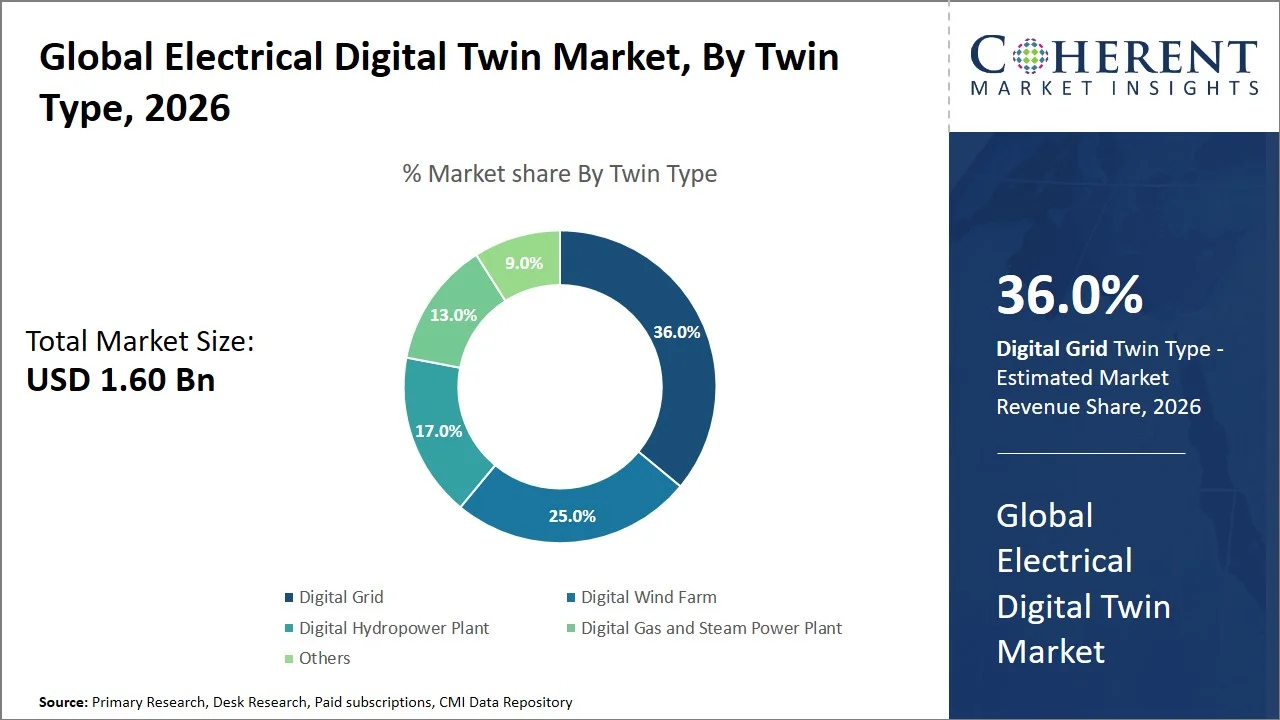
- The digital grid segment is expected to account for 36.0 % of the global electrical digital twin market share in 2026. Growing investment in digital transformation of utilities is driving the segment’s demand. On November 18, 2025, Schneider Electric announced the availability of its One Digital Grid Platform, an unified artificial intelligence (AI)-enabled software platform designed to help utilities modernize faster, strengthen grid resilience, and reduce energy costs. (Source: Schneider Electric)
- The asset performance management segment is estimated to capture 39.0 % of the market share in 2026. Need to reduce operational downtime and maintenance costs is a major factor driving the growth of the segment. On March 23, 2026, Hexagon Manufacturing Intelligence announced the launch of APOLLO, an AI-driven platform designed to transform how manufacturers manage their metrology assets. (Source: Hexagon)
- The cloud-based segment is estimated to capture 61.0 % of the market share in 2026. Expansion of Industrial IoT (IIoT) and connected electrical infrastructure is majorly driving the growth of the cloud-based segment. On March 23, 2026, Hitachi Energy announced the launch of HMAX Energy, an AI-powered suite of services and solutions designed to safeguard critical energy infrastructure while enabling operational efficiency. (Source: Hitachi Energy)
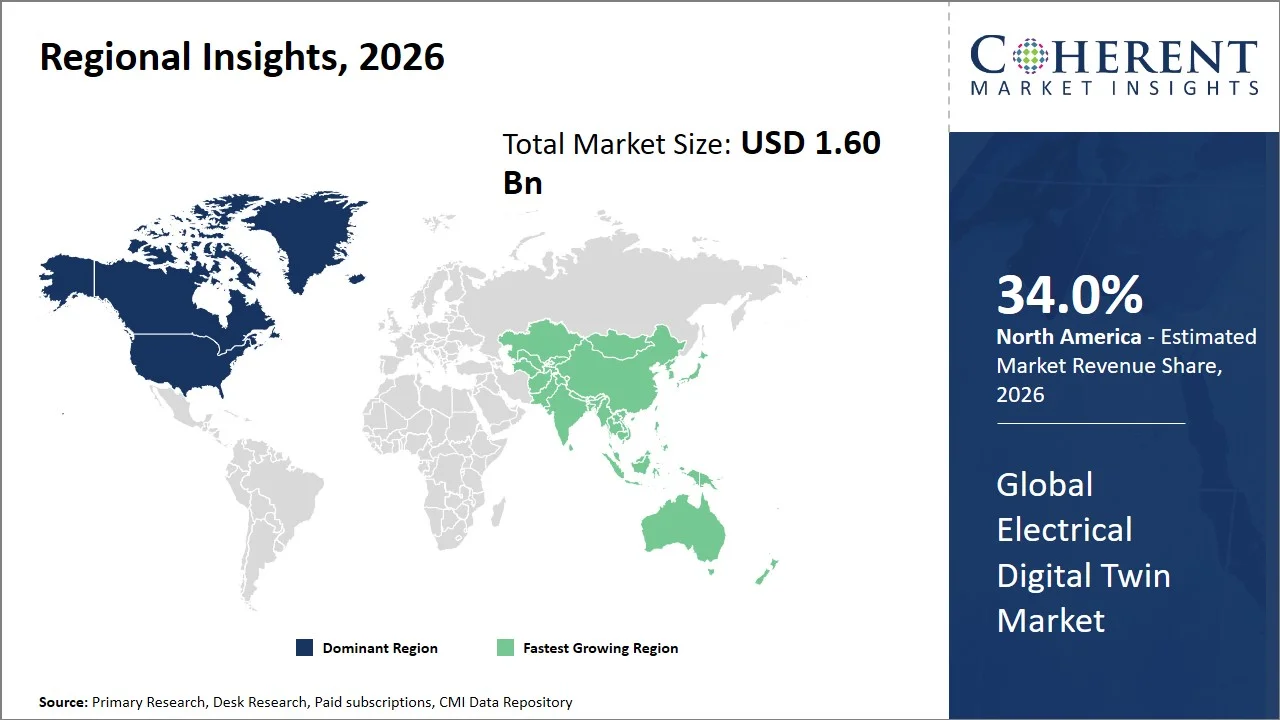
- North America is expected to dominate the electrical digital twin market in 2026 with a market share of 34.0 %. Growth in renewable energy farms and microgrids in North America is driving the growth of the regional market. On June 18, 2026, Pattern Energy Group announced that SunZia, the largest renewable energy infrastructure project in U.S. history is fully operational. The SunZia project can generate and deliver more power than the Hoover Dam and supply affordable, reliable energy to the western U.S. (Source: Pattern Energy)
- Asia Pacific is expected to account for 30.0 % share in 2026 and is projected to record the fastest growth over the forecast period. Increasing electrification of transportation and EV charging networks in Asia Pacific is driving the growth of the regional market. On February 13, 2025, TATA.ev, the leader of India’s electric vehicle (EV) revolution, announced a bold, groundbreaking initiative to transform the nation’s charging infrastructure. Building on the success of surpassing 200,000 EV sales, TATA.ev boosted its commitment to make EVs more accessible and convenient by more than doubling the number of available charge points to 400,000 by 2027. (Source: Tata Motors)
- AI-Powered Predictive and Autonomous Grid Operations: Electrical digital twins are being integrated with artificial intelligence (AI), machine learning and advanced analytics to move from visualization to autonomous decision-making. Utilities are using AI-powered digital twins to predict equipment failure, optimize load balancing, identify network vulnerabilities and automate maintenance schedules, greatly improving grid systems and operating efficiency.
- Digital Twins for Renewable Energy and Distributed Energy Resources (DERs): As the use of solar farms, wind parks, battery storage systems, and distributed energy resources (DERs) continues to grow, so does the need for digital twins that can model complex energy ecosystems. Within the electrical sector, digital twins allow operators to model variability in generation, anticipate energy output, maximize the usage of storage and tackle grid integration challenges arising from renewable energy assets.
Segmental Insights
Why Does Digital Grid Dominate the Global Electrical Digital Twin Market?
The digital grid segment is expected to account for 36.0% of the global electrical digital twin market share in 2026. The digital grid segment’s growth is mostly driven by increased spending on smart grid upgrades. Utilities worldwide are employing digital grid twins to develop real-time virtual models of transmission and distribution networks to monitor 24/7, predict maintenance and optimize operations. These solutions allow grid operators to model power flows, better incorporate renewable energy sources, improve outage management and boost network stability, making digital grids a vital component of next-generation electrical infrastructure.
On June 16, 2025, Siemens Smart Infrastructure announced that it has strengthened its partnership with Italian DSO, AcegasApsAmga, announcing the commencement of a project, utilizing Siemens’ Gridscale X technology to enable full situational awareness of the power grid of the Municipality of Trieste in Italy. (Source: Siemens)
- Current Industry Events of 2026
- Market Size Estimation
- Regional Breakdown
- Competitive Landscape
- Customer Intelligence
- Segmental Analysis
- Pricing Analysis
- Key Market Drivers, Challenges & Future Trends
- Customized Insights Section
Why is Asset Performance Management the Most Preferred Usage Type?
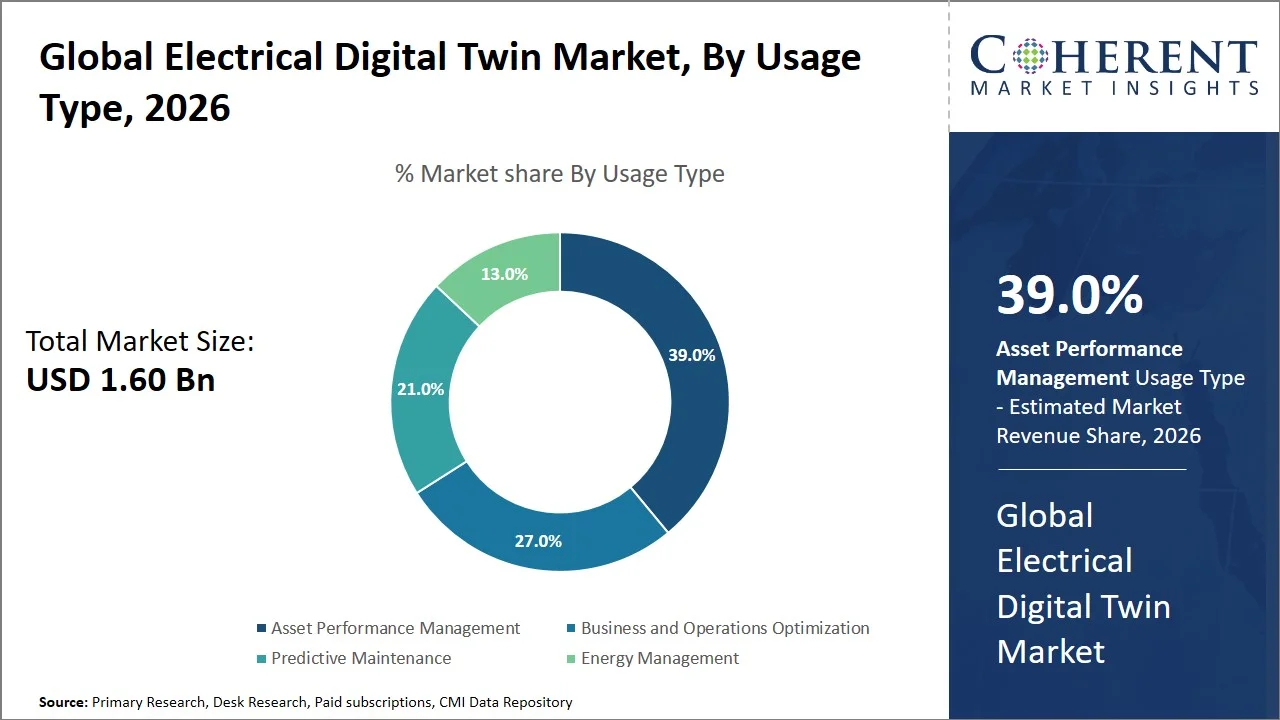
The asset performance management segment is expected to account for 39.0% of the global electrical digital twin market share in 2026. A major driver for adoption of asset performance management is increased demand for maximizing dependability and longevity of essential electrical assets. Digital twins for electrical systems combine real-time operational data with predictive analytics to provide continuous monitoring for transformers, switchgear, substations, generators and transmission equipment. This enables utilities and industrial operators to identify performance degradation at an early stage, minimize unplanned downtime, optimize maintenance schedules and extend asset life, leading to considerable cost savings and better operational efficiency.
On January 28, 2026, Hitachi Energy, in collaboration with Microsoft, accelerated the digital transformation of essential infrastructure, from electricity networks and transportation corridors to heavy industrial operations, by reinventing how critical assets are managed and maintained. (Source: Hitachi)
Cloud-Based Dominates the Global Electrical Digital Twin Market
The cloud-based segment is expected to account for 61.0% of the global electrical digital twin market share in 2026. The growing need for scalable real-time monitoring and analytics of globally dispersed electrical assets is mostly driving cloud-based implementation. With cloud platforms, utilities and industrial operators may collect, process and analyze enormous volumes of operational data from substations, transmission networks, renewable energy installations and power plants in a single environment. It helps in better cooperation, accelerates the implementation of digital twin solutions, decreases infrastructure costs, and allows for easy integration with emerging technologies like artificial intelligence, IoT, and predictive analytics.
On September 8, 2026, GE Vernova Inc. announced the launch of PlanOS, a unified software suite designed to empower energy planners, utilities, and regulators with an integrated system planning platform for a smarter grid of the future. (Source: GE Vernova)
Currents Events and their Impact
Current Events | Description and its Impact |
NIST Digital Twin Security and Trust Framework (U.S., 2025) |
|
EU Strategic Roadmap for Digitalisation and AI in the Energy Sector (European Union, 2026) |
|
(Source: National Institute of Standard and Technology, European Commission)
Global Electrical Digital Twin Market - Industrial Facilities Using Electrical Twins (2026)
Electrical digital twins are increasingly being deployed in industrial sites between 2024 and 2026. Manufacturers, power-hungry industries, data centers and process plants are all turning to real-time digital replicas of their electrical assets to improve reliability, predictive maintenance and energy efficiency. North America, Europe, China, Japan and India are using digital twin technology broadly especially in industrial sector. Here it is employed for smart factories, industrial parks and important infrastructure projects.
- Approximately 42-45% of big manufacturing plants in North America are using electrical digital twin or electrical asset digitalization platforms to monitor substations, switchgear and power distribution systems.
- Industry 4.0 and energy management programs are deploying electrical digital twins at around 38-41% of industrial sites in Western Europe.
- Electrical digital twin capabilities have been included into the design and commissioning stages of around 35% of new semiconductor fab plants in East Asia.
- Nearly 48% of hyperscale data center facilities globally are leveraging advanced electrical digital twin environments for power infrastructure management and capacity planning.
- Digital twin technologies were used to monitor electrical assets and for predictive maintenance in over 40% of newly commissioned smart manufacturing plants in China.
- Digital twin-based electrical asset management systems are used by an estimated 33-36% of mining and metals operations in Australia.
- Almost 30% of large oil & gas processing plants in the Middle East have adopted electrical digital twin solutions to optimize essential power infrastructure.
- About 37% of Japan’s industrial facilities use electric digital twins for factory energy management and equipment dependability programs.
- Nearly 32% of car manufacturing plants in India embraced electrical digitalization and digital twin technology for plant-wide power system monitoring.
- Almost 45% of all greenfield industrial projects worldwide have electrical digital twin capabilities in the designing and commissioning phases.
Electrical Digital Twin Market Dynamics
Market Drivers
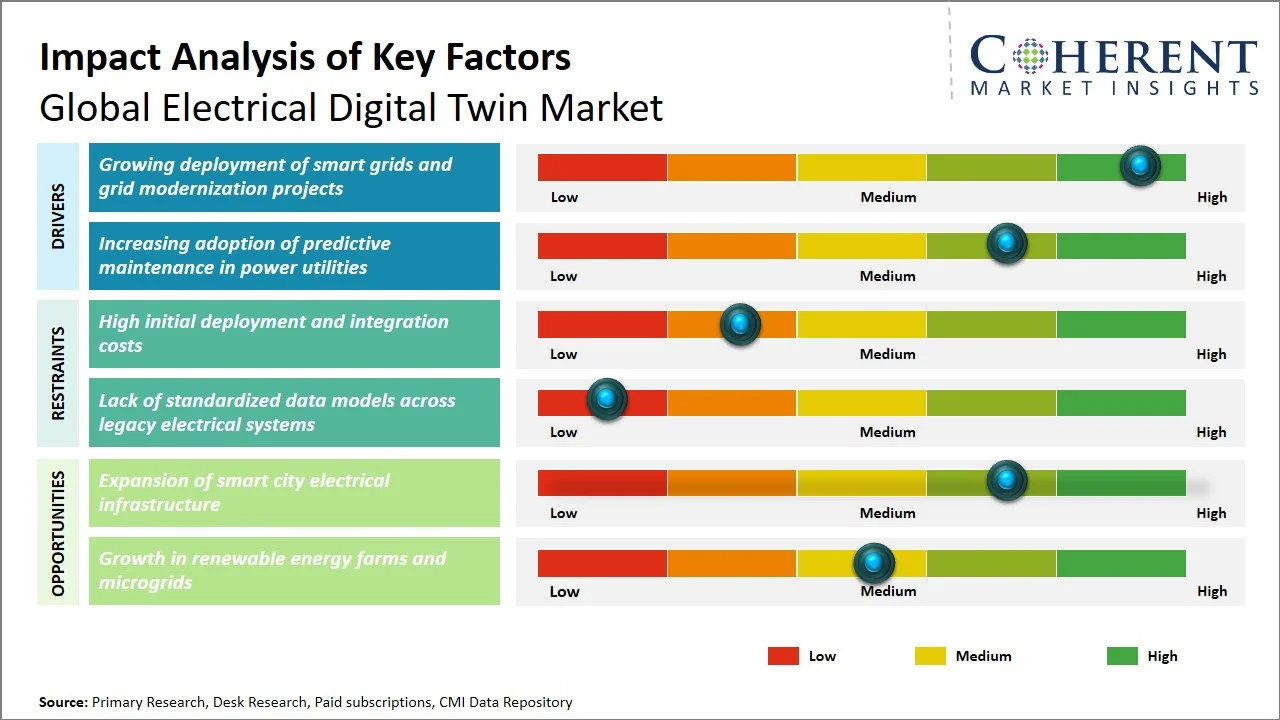
Growing deployment of smart grids and grid modernization projects
The surge in adoption of smart grids and grid modernization initiatives is one of the major factors driving the growth of the electrical digital twin market, as utility companies look for better solutions to manage complex and data-intensive power networks. Electrical digital twins are real-time virtual models of grid infrastructure. They assist operators to monitor asset performance, simulate network behavior, optimize power flows and predict likely breakdowns before they occur. As governments and utilities invest in updating transmission and distribution systems to increase reliability, incorporate renewable energy sources and boost grid resilience, the demand for digital twin solutions continues to grow to support more efficient and smarter grid operations.
On May 28, 2026, Hitachi Energy, a global leader in electrification, officially opened its new UK Engineering Centre of Excellence in Glasgow, marking a major investment in the specialist skills needed to modernize the U.K. electricity grid and support Scotland’s clean energy ambitions. (Source: Hitachi)
Increasing adoption of predictive maintenance in power utilities
Increasing adoption of predictive maintenance in power utilities is driving the growth of the electrical digital twin market as utility operators look to reduce the equipment failures and costly unscheduled outages. Electrical digital twins continually gather and analyze real-time data from essential assets such transformers, substations, switchgear and transmission lines, enabling early detection of anomalies in performance and possible failures. These technologies make condition-based maintenance strategies possible and assist utilities extend asset life, increase operational reliability, optimize maintenance schedules and reduce total maintenance costs, making predictive maintenance a crucial use for digital twin technology.
On May 7, 2026, Kyndryl unveiled a new patented capability in Kyndryl Bridge, the company’s AI-powered, open integration platform, that enables customers to automatically detect and resolve IT risks before they escalate into business-impacting outages. (Source: Kendryl)
Emerging Trends
- Cloud-Based and Real-Time Digital Twin Platforms: Digital twin platforms that are cloud-native are increasingly being used by companies to enable real-time monitoring, scalability and remote access to geographically scattered electrical assets. These solutions combine cloud computing, IoT sensors and edge analytics to ensure continuous synchronization between physical infrastructure and virtual models, which allows for faster decision-making and lower infrastructure management expenses.
- Smart Grid Modernization and Grid Resilience Enhancement: Utilities are making huge investments in smart grid modernization and electrical digital twins are emerging as critical tools for network planning, outage management and resilience assessment. As energy demand and climate-related risks continue to grow, utilities are leveraging digital twins to simulate extreme weather conditions, evaluate opportunities for grid expansion, optimize transmission and distribution assets and enhance grid dependability.
Global Electrical Digital Twin Market - AI-Driven Electrical Asset Monitoring Installations (2026)
As utilities, industrial operators, renewable energy developers and data center operators are increasingly deploying artificial intelligence within electrical digital twin platforms, AI-driven electrical asset monitoring installations are growing rapidly. These systems continually monitor data from transformers, substations, switchgear, transmission lines and distributed energy assets and detect anomalies, predict breakdowns and optimize maintenance procedures. Strongest adoption is in locations with significant investments in grid modernization, renewable integration, and industrial digitization, where AI-powered monitoring is becoming a major component of asset performance management strategies.
- Approximately 58-62% of new utility digital twin projects in North America include AI-powered asset monitoring capabilities for transmission and distribution assets.
- In China, almost 52% of the digital substations commissioned are equipped with AI-enabled monitoring systems for transformers, circuit breakers and protective equipment.
- Around 47% of utility asset management programs in Western Europe are using AI-based condition monitoring connected with digital twin systems.
- About 44% of offshore wind farms commissioned in Northern Europe used AI-based electrical asset monitoring for substations and export cable systems.
- About 55% of hyperscale data center operators in the U.S. are currently using AI-driven monitoring of electrical distribution systems to achieve uptime and predictive maintenance.
- Roughly 39% of industrial manufacturing facilities in Japan have added AI-enabled electrical asset monitoring to their plant energy management and reliability programs.
- About 42% of transmission utilities in India are expected to employ AI-assisted monitoring solutions for critical grid assets as part of modernization programs.
- About 48% of new battery energy storage projects in the Asia Pacific included AI-based electrical asset performance monitoring systems.
- Nearly 45% of mining and metals plants in Australia are using AI-based monitoring solutions to increase dependability of electrical equipment and decrease downtime linked to maintenance.
- Nearly half of the newly commissioned smart grid control centers in the Middle East used AI-powered monitoring and predictive analytics for electrical asset management.
Regional Insights
Why is North America a Strong Market for Electrical Digital Twin?
North America is expected to account for a market share of 34.0% in 2026. Real-world deployments in large utility modernization programs like the Tennessee Valley Authority’s grid analytics initiatives and Duke Energy’s use of GE Digital’s APM-based digital twin models for substation and transformer monitoring are fueling the North America electrical digital twin market. Schneider Electric and Siemens are deploying digital twin systems in transmission networks in the U.S. and Canada to simulate stress on the grid from extreme weather, such as hurricanes and winter storms. The region also sees extensive integration of digital twins in EV charging infrastructure development by utilities like Pacific Gas and Electric, where grid simulation is employed to avoid overload problems during peak charging demand. On March 6, 2026, Tennessee Valley Authority expanded testing and deployment of advanced grid-enhancing technologies, including dynamic line rating and transmission optimization solutions. The initiative is intended to increase transmission capacity, improve operational visibility, and modernize the utility's network without relying solely on new transmission line construction. (Source: Tennessee Valley Authority)
Why Does the Asia Pacific Electrical Digital Twin Market Exhibit High Growth?
Asia Pacific is projected to account for 30.0% of the global electrical digital twin market and is expected to register the fastest growth. The Asia Pacific region demonstrates substantial acceptance, with large-scale national grid expansion and renewable integration projects, especially in China, India, Japan and South Korea. The China State Grid Corporation has created sophisticated digital twin platforms for ultra-high-voltage transmission lines to observe the long-distance flow of power from the western renewable hubs to the eastern industrial zones.
In India, Power Grid Corporation is applying digital modelling techniques for better load balancing in fast-growing transmission corridors, and in Japan, TEPCO is employing twin-based simulation to help with earthquake-resilient grid planning. On December 6, 2025, Jaipur Vidyut Vitran Nigam Ltd. (JVVNL), together with the International Solar Alliance, initiated India's first digital twin-based electricity distribution network. The project will create a real-time digital replica of the power grid for load-flow analysis, AI-based grid management, renewable energy integration, and operational planning, making it one of the most significant electrical digital twin deployments in Asia Pacific.
Global Electrical Digital Twin Market Outlook for Key Countries
Why is the U.S. Emerging as a Major Hub in the Electrical Digital Twin Market?
Utility-scale pilot projects like Microsoft Azure Digital Twins integrated with electric utilities for substation monitoring and predictive outage avoidance, are among the biggest drivers in the U.S. electrical digital twin sector. Transformers are being modeled to help mitigate failures during peak summer demand, with utilities including Southern Company and Duke Energy leveraging digital twin technologies from Siemens’ Grid Edge and GE Vernova. Federal programs associated with FERC grid reliability regulations also encourage utilities to use real-time digital modeling for contingency planning and resilience testing.
Is China the Next Growth Engine for the Electrical Digital Twin Market?
China’s State Grid Corporation’s implementation of AI-enabled digital twin platforms for ultra-high-voltage (UHV) grids connecting distant renewable energy bases in Xinjiang and Inner Mongolia with the coastal cities has a big impact on China’s electrical digital twin ecosystem. Huawei and Alibaba Cloud enable digital twin infrastructure for substations and smart grid control centers, offering real-time fault detection and load optimization for large-scale transmission networks. These installations are highly relevant to China’s objective of integrating renewable energy, notably in reducing the curtailment of solar and wind power.
Germany Electrical Digital Twin Market Analysis and Trends
Germany’s adoption of electrical digital twin is connected to its Energiewende transformation, with companies like Siemens Energy and 50Hertz Transmission employing digital twin platforms to simulate grid stability amid rising renewable penetration. Digital twin systems are actively employed in managing the fluctuation of wind energy from offshore North Sea farms and optimizing the cross-border flow of power with other EU countries. High-fidelity grid simulation models for industrial-scale energy systems are also being developed at research institutions like Fraunhofer Institutes.
India Electrical Digital Twin Market Analysis and Trends
The growth of the electrical digital twin market in India is closely linked to the deployment of smart grid control centers by Power Grid Corporation of India and state distribution companies under the National Smart Grid Mission. One of the initiatives where digital twin tools are being deployed is for automated load forecasting of Delhi and Maharashtra distribution networks. Tata Power and CESC are integrating real-time feeder monitoring systems. These technologies enable to cope with the rapidly increasing urban energy load and to enhance outage response time in case of monsoon related disruption.
Japan Electrical Digital Twin Market Analysis and Trends
TEPCO is leading Japan in the adoption of electrical digital twins with simulation systems to model seismic risks and maintain grid stability after earthquakes. Hitachi Energy and Mitsubishi Electric are also developing digital twin-based asset management platforms for substations and industrial power systems, aimed at planning for the replacement of aged infrastructure. Japan is particularly focused on resilience engineering, notably in its disaster-prone coastal and high-density metropolitan areas.
Global Electrical Digital Twin Market - Utility Digital Transformation Spending on Twin Technologies (2026)
Region | Utility Spending on Electrical Digital Twin Technologies (USD Billion) | Share of Total Utility Twin Spending |
North America | 2.85 | 31.0% |
Europe | 2.15 | 23.4% |
Asia Pacific | 3.10 | 33.8% |
Latin America | 0.52 | 5.7% |
Middle East & Africa | 0.56 | 6.1% |
How is the Growing Expansion of Smart City Electrical Infrastructure Creating New Growth Opportunities in the Electrical Digital Twin Market?
The rapid development of smart city electrical infrastructure is driving new growth prospects for the electrical digital twin industry, as the demand for real-time monitoring, modeling and optimization of complicated urban power systems is growing. As cities implement interlinked systems like smart grids, intelligent street lighting, automated substations, EV charging networks and distributed renewable energy sources, digital twins enable authorities and utilities to build virtual twins of complete metropolitan electrical ecosystems. These models are used to estimate power demand patterns, manage peak loads in densely populated areas, locate faults in underground and overhead networks, and improve the coordination of energy distribution among several city zones. This is especially the case for large urban developments that have to plan infrastructure for rapidly growing populations, the electrification of transport and the integration of decentralized energy sources, making digital twins a key tool for building resilient and efficient smart city power systems.
On April 13, 2026, Hitachi Energy and Adani Energy Solutions Ltd. successfully commissioned one of the world’s largest high-voltage direct current (HVDC) city center infeed in Mumbai, India, increasing power supply coming from outside the city by 50%. (Source: Hitachi)
Global Electrical Digital Twin Market - Digital Twin-Enabled Electrical Assets Installed Base (2026)
Asset Category | Installed Base | Digital Twin Penetration |
Power transformers | 2.8 Million assets | 18.5% |
Distribution transformers | 12.4 Million assets | 11.2% |
Electrical substations | 168,000 Sites | 24.8% |
High-voltage switchgear systems | 1.95 Million units | 20.1% |
Medium-voltage switchgear systems | 8.7 Million units | 14.6% |
Transmission line monitoring assets | 425,000 Circuit-km equivalents | 16.9% |
Renewable energy substations | 32,500 Sites | 29.4% |
Battery energy storage systems (BESS) | 58,000 Installations | 34.7% |
Power generation plant electrical systems | 21,800 Facilities | 27.3% |
Industrial electrical distribution networks | 96,000 Facilities | 22.8% |
Data center electrical infrastructure systems | 12,400 Facilities | 41.5% |
Market Players, Key Development, and Competitive Intelligence
Key Developments
- On March 18, 2025, Schneider Electric and ETAP unveiled a cutting-edge digital twin that can accurately design and simulate the power needs of AI Factories. Leveraging the NVIDIA Omniverse Blueprint for AI factory digital twins, Schneider Electric and ETAP enable the development of digital twins that bring together multiple inputs for mechanical, thermal, networking, and electrical systems to simulate how an AI Factory operates.
- On February 28, 2024, Siemens announced the launch of Gridscale X to support autonomous grid management and accelerate digital transformation for grid operators at speed and scale. The software will help grid operators increase their Distributed Energy Resources (DER) visibility, support grid decarbonization and the transition to net zero.
Competitive Landscape
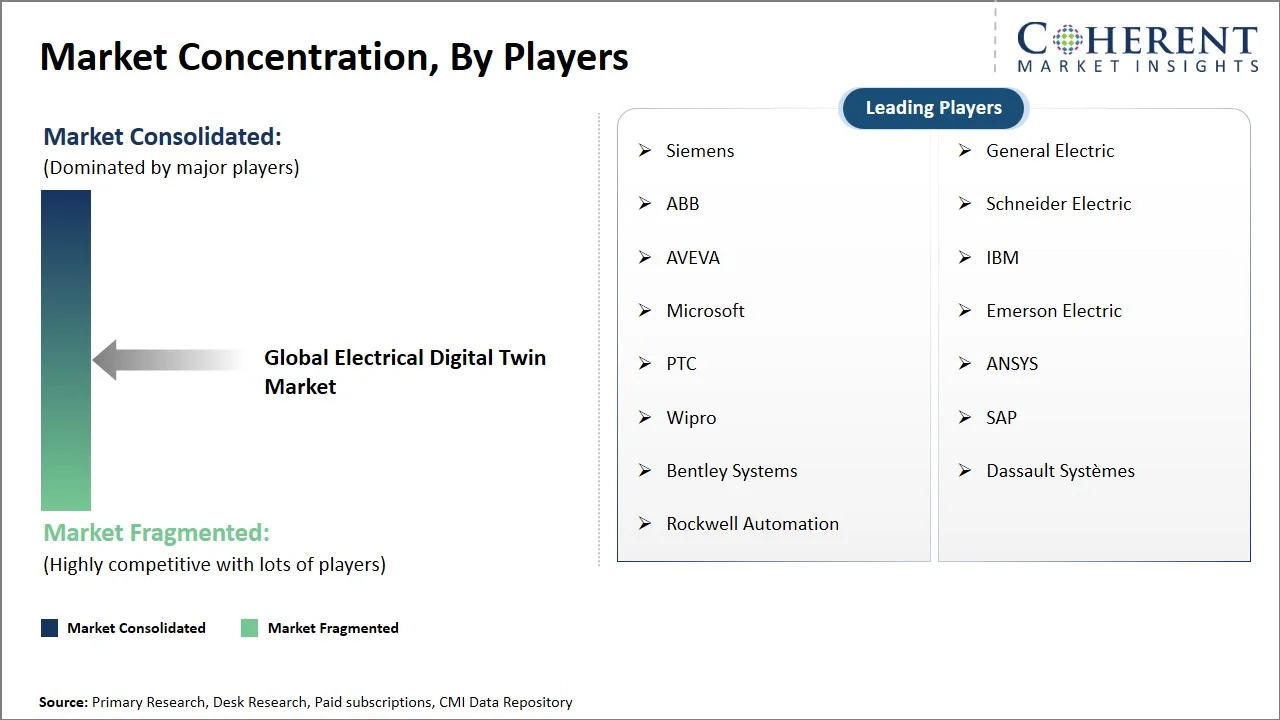
The competitive landscape of the electrical digital twin market is characterized by the presence of established industrial automation, software, and cloud technology vendors developing and integrating solutions within larger energy management and industrial digitalization ecosystems. Siemens, General Electric, Schneider Electric, ABB, IBM, Microsoft and Dassault Systèmes are among the corporations competing fiercely with products being developed using AI, IoT and cloud-based platforms. Utilities are collaborating strategically with technology providers to enhance grid simulation accuracy, predictive maintenance capabilities, and real-time operational intelligence, while using partnerships and acquisitions to build out digital twin portfolios and geographic reach.
Market Report Scope
Electrical Digital Twin Market Report Coverage
| Report Coverage | Details | ||
|---|---|---|---|
| Base Year: | 2025 | Market Size in 2026: | USD 1.60 Bn |
| Historical Data for: | 2020 To 2024 | Forecast Period: | 2026 To 2033 |
| Forecast Period 2026 to 2033 CAGR: | 8.3% | 2033 Value Projection: | USD 6.65 Bn |
| Geographies covered: |
| ||
| Segments covered: | By Twin Type:
| ||
| Companies covered: | Siemens, General Electric, ABB, Schneider Electric, AVEVA, IBM, Microsoft, Emerson Electric, PTC, ANSYS, Wipro, SAP, Bentley Systems, Dassault Systèmes, and Rockwell Automation | ||
| Growth Drivers: |
| ||
| Restraints & Challenges: |
| ||
Analyst Opinion (Expert Opinion)
- The electrical digital twin market is a key facilitator of next-generation power system modernization, especially with the growing complexity of the grid and rising integration of renewables worldwide. Increasing investments in smart grids, predictive maintenance, and real-time asset monitoring across utilities and industrial sectors are being attributed to strong development potential. But interoperability issues, cybersecurity risks and the complexity of implementation are being seen as major limiting factors which could hold down adoption in some parts of the world, particularly where legacy infrastructure still prevails.
- The future of the electrical digital twin industry will probably be determined by the further integration of artificial intelligence, edge computing and autonomous grid management systems, which will result in more self-optimizing and resilient electrical networks. Growing smart city projects, electrification of transportation systems and expanded deployment of distributed energy resources such as solar and battery storage will propel wider use. Digital twins are expected to evolve over time from monitoring tools to fully predictive and prescriptive systems supporting automated decision-making throughout generating, transmission and distribution networks.
Speak to the analyst
Want personalized insights?
Take the findings above to one of our principal consultants, or have the report rebuilt around the segments, geographies and competitors you actually track.
Market Segmentation
- Twin Type Insights (Revenue, USD Billion, 2021 - 2033)
- Digital Grid
- Digital Wind Farm
- Digital Hydropower Plant
- Digital Gas and Steam Power Plant
- Others
- Usage Type Insights (Revenue, USD Billion, 2021 - 2033)
- Asset Performance Management
- Business and Operations Optimization
- Predictive Maintenance
- Energy Management
- Deployment Mode Insights (Revenue, USD Billion, 2021 - 2033)
- Cloud-Based
- On-Premise
- Application Insights (Revenue, USD Billion, 2021 - 2033)
- Grid Management and Optimization
- Asset Management
- Predictive Maintenance
- Renewable Energy Integration
- Power Generation Optimization
- End User Insights (Revenue, USD Billion, 2021 - 2033)
- Energy and Utilities
- Manufacturing
- Transportation
- Automotive
- Aerospace and Defense
- Smart Infrastructure
- Regional Insights (Revenue, USD Billion, 2021 - 2033)
- North America
- U.S.
- Canada
- Latin America
- Brazil
- Argentina
- Mexico
- Rest of Latin America
- Europe
- Germany
- U.K.
- Spain
- France
- Italy
- Russia
- Rest of Europe
- Asia Pacific
- China
- India
- Japan
- Australia
- South Korea
- ASEAN
- Rest of Asia Pacific
- Middle East
- GCC Countries
- Israel
- Rest of Middle East
- Africa
- South Africa
- North Africa
- Central Africa
- North America
- Key Players Insights
- Siemens
- General Electric
- ABB
- Schneider Electric
- AVEVA
- IBM
- Microsoft
- Emerson Electric
- PTC
- ANSYS
- Wipro
- SAP
- Bentley Systems
- Dassault Systèmes
- Rockwell Automation
Sources
Primary Research Interviews
- Electrical Engineers & Grid Infrastructure Specialists
- Digital Twin Solution Providers & Software Developers
- Power Utility Companies & Energy Management Executives
- Industrial Automation & IoT Integration Experts
Magazines
- IEEE Spectrum
- Power & Energy Magazine
- T&D World (Transmission & Distribution World)
- Smart Energy International
Journals
- IEEE Transactions on Power Systems
- Journal of Industrial Information Integration (Elsevier)
- Energy and AI (Elsevier)
Associations
- International Electrotechnical Commission (IEC)
- Institute of Electrical and Electronics Engineers (IEEE)
- Electric Power Research Institute (EPRI)
- Digital Twin Consortium (DTC)
Public Domain Sources
- U.S. Department of Energy (DOE)
- European Commission – Digital Strategy & Energy Reports
- International Energy Agency (IEA)
- National Institute of Standards and Technology (NIST)
Proprietary Elements
- CMI Data Analytics Tool
- Proprietary CMI Existing Repository of Information for Last 10 Years
Get access to 250+ pages report
Every segment, forecast, competitor profile and data table behind the analysis above — available for instant download.
- ESOMAR Member
- ISO 9001:2015 Certified
- D-U-N-S Registered
- GDPR & CCPA Compliant
Missing comfort of reading report in your local language? Find your preferred language:
Transform your Strategy with Exclusive Trending Reports
Frequently Asked Questions
The global electrical digital twin market is expected to stand at USD 1.60 Bn in 2026 and is expected to reach USD 6.65 Bn by 2033.
The CAGR of the global electrical digital twin market is projected to be 8.3% from 2026 to 2033.
Growing deployment of smart grids and grid modernization projects and increasing adoption of predictive maintenance in power utilities are the major factors driving the growth of the global electrical digital twin market.
High initial deployment and integration costs and lack of standardized data models across legacy electrical systems are the major factors hampering the growth of the global electrical digital twin market.
In terms of twin type, the digital grid segment is estimated to dominate the market revenue share in 2026.
It reduces unexpected equipment failures by identifying issues before they occur.
AI enhances decision-making by analyzing data patterns and predicting system behavior.