

Global External Defibrillators Market Size and Forecast – 2026 To 2033
The global external defibrillators market is expected to grow from USD 4.74 Bn in 2026 to USD 9.28 Bn by 2033, registering a compound annual growth rate (CAGR) of 10.1% from 2026 to 2033. The market for external defibrillators is poised for significant expansion, fueled by the rising prevalence of cardiovascular diseases (CVDs) and sudden cardiac arrest (SCA), which continue to increase the demand for rapid defibrillation technologies.
According to the World Health Organization, cardiovascular diseases (CVDs) were the leading cause of death globally in 2022, accounting for an estimated 19.8 million deaths, or approximately 32% of all global deaths of which 85% of these deaths were due to heart attack and stroke. This highlights the growing need for timely cardiac emergency response and wider adoption of external defibrillators across healthcare facilities and public settings.
Key Takeaways of the Global External Defibrillators Market
- Automated external defibrillators (AEDs) are projected to hold 54.7 % of the global external defibrillators market share in 2026, making it the dominant product type segment across North America due to stringent public-access defibrillation regulations. For instance, Massachusetts law (Chapter 71, Section 54C) requires every public and private school facility to maintain at least one AED on-site and ensure certified personnel are available during school activities and athletic events. Such mandatory AED deployment policies continue to strengthen institutional demand for AEDs across the region.
- Hospitals are projected to hold 52.8 % of the global external defibrillators market share in 2026, making it the dominant end user segment across Europe due to stringent regional clinical regulations governing cardiac emergency care. For instance, the European Resuscitation Council (ERC) Guidelines mandate that all hospitals maintain immediate access to defibrillation and ensure defibrillation can be delivered within minutes of recognizing a shockable cardiac arrest rhythm, reinforcing continuous procurement of external defibrillators by hospitals across Europe.
- North America maintains its dominance with an expected share of 41.8 % in 2026, bolstered by stringent public-access AED legislation and well-established emergency medical infrastructure. For instance, the U.S. Cardiac Arrest Survival Act authorizes the placement and use of Automated External Defibrillators (AEDs) in federal buildings while providing Good Samaritan liability protection for AED users, supporting widespread deployment across public facilities.
- Asia Pacific is expected to exhibit the fastest growth with an estimated contribution of 21.3 % share in 2026, driven by expanding government initiatives to strengthen emergency cardiac care and increasing public access to Automated External Defibrillators (AEDs). For instance, Japan's Ministry of Health, Labour and Welfare has promoted nationwide Public Access Defibrillation (PAD) by authorizing layperson use of Automated External Defibrillators (AEDs) and supporting their installation across airports, railway stations, schools, sports facilities, and other public locations, significantly improving access to emergency defibrillation.
- Rising Adoption of Connected and AI-Enabled External Defibrillators: The integration of artificial intelligence (AI), cloud connectivity, and real-time monitoring capabilities into external defibrillators is transforming emergency cardiac care. Connected Automated External Defibrillators (AEDs) enable remote device monitoring, predictive maintenance, and instant event data transmission, improving device readiness and emergency response efficiency. Growing demand for smart emergency medical devices across healthcare facilities and public settings is expected to accelerate the adoption of next-generation external defibrillators.
- Integration of External Defibrillators with Remote Cardiac Monitoring Platforms: The rapid adoption of remote cardiac monitoring and connected healthcare ecosystems presents a significant opportunity for the external defibrillators market. Integration of external defibrillators with cloud-based monitoring platforms and remote patient management systems enables real-time device status monitoring, automated maintenance alerts, and seamless transmission of cardiac event data. As healthcare providers increasingly adopt digital cardiac care solutions, the demand for connected external defibrillators is expected to strengthen during the forecast period.
Segmental Insights
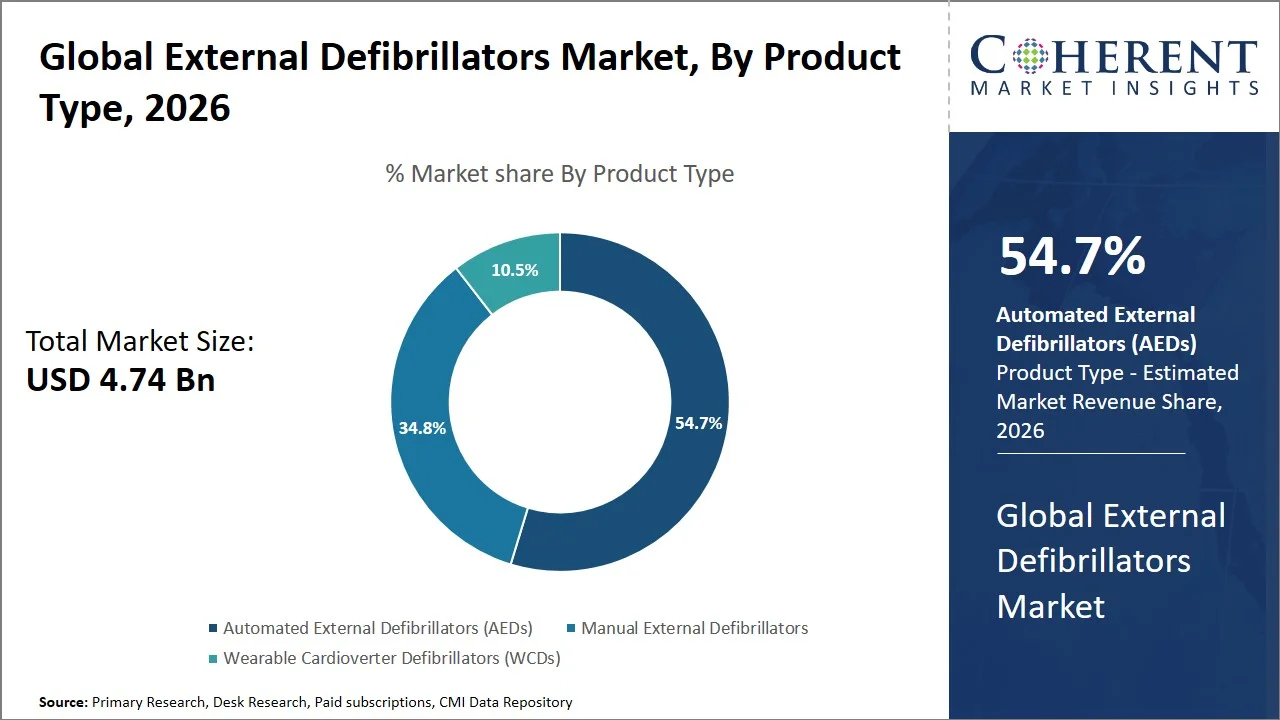
Why Do Automated External Defibrillators (AEDs) Dominate the Global External Defibrillators Market?
Automated external defibrillators (AEDs) are projected to hold a market share of 54.7% in 2026, owing to their ease of use, faster automated rhythm analysis capability and suitability for use by both trained responders and the general public. These devices are being used increasingly at various places like hospital premises, schools, airports, work places, sports academies, and have widened the scope for prompt defibrillation in cases of sudden cardiac arrest. Continuous developments in portability, voice assistance features, connectivity and real-time feedback for cardiopulmonary resuscitation (CPR) are adding to their expansion across end-user segments. For instance, in January 2025, the UK Department for Education updated its formal guidance on the use of automated external defibrillators (AEDs) in schools. The guidance outlines best practices on how AEDs should be installed and maintained, registered on the “Circuit national defibrillator network” and how staff should be trained to ensure effective responses in an emergency, to continue to drive the continued implementation of AEDs in schools and other public-access environments.
- Current Industry Events of 2026
- Market Size Estimation
- Regional Breakdown
- Competitive Landscape
- Customer Intelligence
- Segmental Analysis
- Pricing Analysis
- Key Market Drivers, Challenges & Future Trends
- Customized Insights Section
Why Does the Hospitals Segment Represent the Largest End User Segment in the External Defibrillators Market?
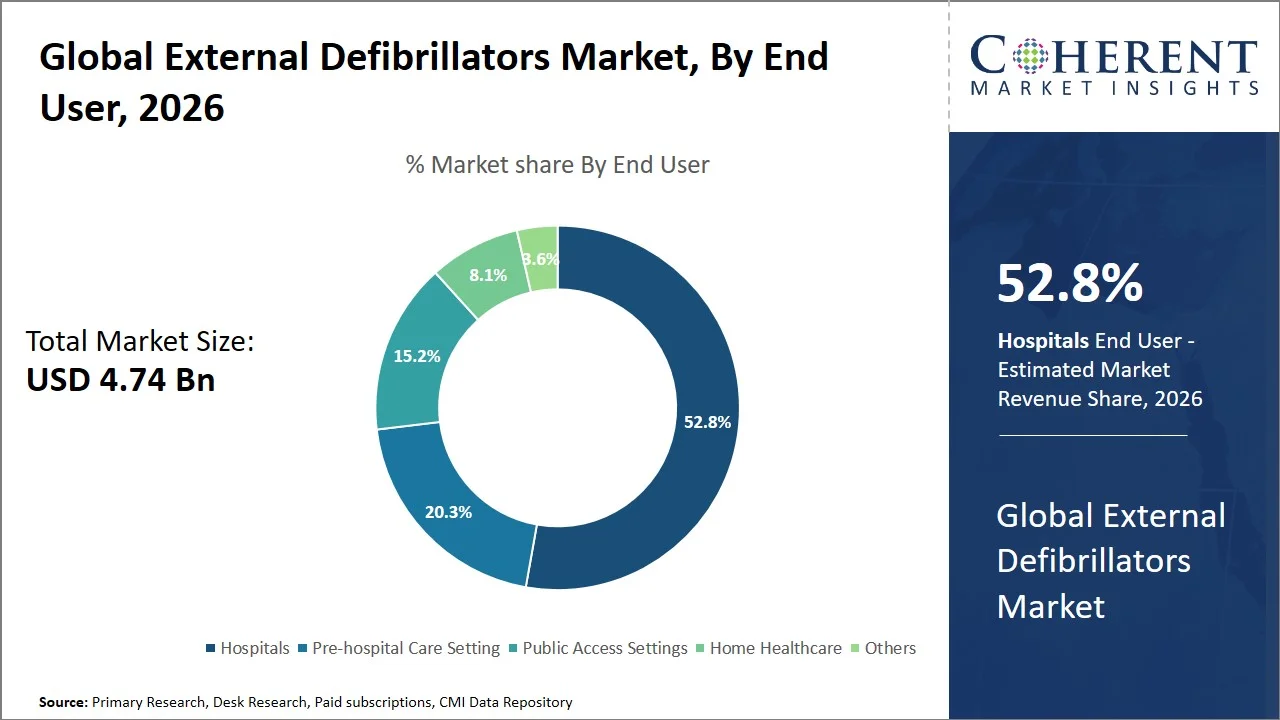
Hospitals are projected to hold a market share of 52.8% in 2026, owing to their considerable number of cardiac emergencies, a developed infrastructure for advanced care and high demand of defibrillators in emergency wards, ICUs, OTs and cardiac catheterization labs. The availability of trained personnel, a surge in cardiac-related procedures, and scheduled maintenance and replacement of existing defibrillator units contribute to steady purchases of automated external defibrillators and manual external defibrillators for hospitals. Furthermore, investment by hospitals towards infrastructure modernization and emergency preparedness will drive the segment’s expansion. For instance, in September 2025, the American Heart Association introduced its 2025 Resuscitation Quality Improvement (RQI) Hospital Program. The program provides hospitals the tools needed to improve cardiopulmonary resuscitation (CPR) and defibrillator competency through simulation and continuous quality improvement to enhance in-hospital cardiac arrest response, highlighting a continued requirement to maintain access to an advanced external defibrillator.
Current Events and their Impact
Current Events | Description and its Impact |
U.S. FDA Prioritizes Medical Device Regulatory Modernization Through FY2026 Center for Devices and Radiological Health (CDRH) Guidance Agenda (November 2025) |
|
Delaware Updates Automatic External Defibrillation Regulations to Standardize Public Automated External Defibrillator (AED) Programs (August 2025) |
|
Global External Defibrillators Market Dynamics
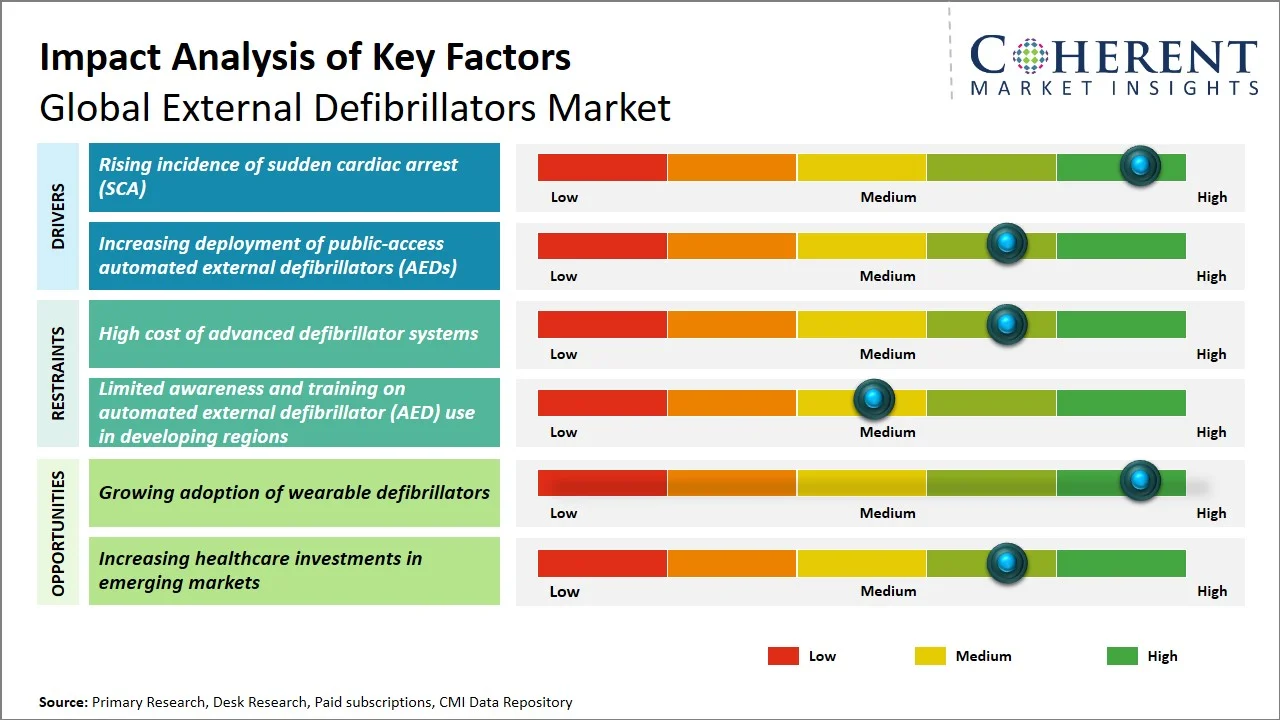
Market Drivers
- Rising incidence of sudden cardiac arrest (SCA): The critical importance of early defibrillation in improving survival outcomes following sudden cardiac arrest (SCA) is accelerating the adoption of external defibrillators across healthcare facilities and public-access settings. Governments, healthcare providers, and organizations are increasingly prioritizing emergency preparedness by expanding access to automated external defibrillators (AEDs) in high-traffic locations. In addition, continuous advancements in device portability, ease of use, and real-time guidance features are supporting wider adoption among healthcare professionals, first responders, and the general public. For instance, according to the American Heart Association (AHA), more than 356,000 out-of-hospital cardiac arrests occur annually in the U.S., with nearly 90% proving fatal. The AHA highlights that immediate cardiopulmonary resuscitation (CPR) combined with rapid use of an Automated External Defibrillator (AED) can significantly improve survival, reinforcing the need for broader deployment of external defibrillators.
- Increasing deployment of public-access automated external defibrillators (AEDs): The increasing deployment of Public-Access Automated External Defibrillators (AEDs) is enhancing emergency response capabilities and improving survival outcomes following sudden cardiac arrest (SCA). Governments, healthcare authorities, and private organizations are expanding AED installations across schools, airports, transportation hubs, workplaces, and other high-traffic public locations. Growing legislative support, community awareness initiatives, and investments in public-access defibrillation programs are further driving the adoption of external defibrillators globally. For instance, in December 2025, the Government of South Australia announced the installation of more than 500 Automated External Defibrillators (AEDs) across public schools through its Public Schools Automated External Defibrillator Program to strengthen emergency preparedness.
Emerging Trends
- Shift Toward Compact and Ultra-Portable External Defibrillators: Manufacturers are increasingly developing lightweight, compact, and user-friendly external defibrillators to improve portability and facilitate deployment in schools, workplaces, transportation hubs, and remote locations. Advancements in battery technology, ergonomic designs, and simplified user interfaces are enabling broader adoption beyond traditional healthcare settings.
- Growing Adoption of Bilingual and Multilingual Voice-Guided Defibrillators: Manufacturers are incorporating multilingual voice prompts and visual guidance into Automated External Defibrillators (AEDs) to improve usability among diverse populations and untrained responders. This trend is particularly gaining traction in airports, tourism hubs, multinational workplaces, and public institutions, where language accessibility is critical for effective emergency response.
Regional Insights
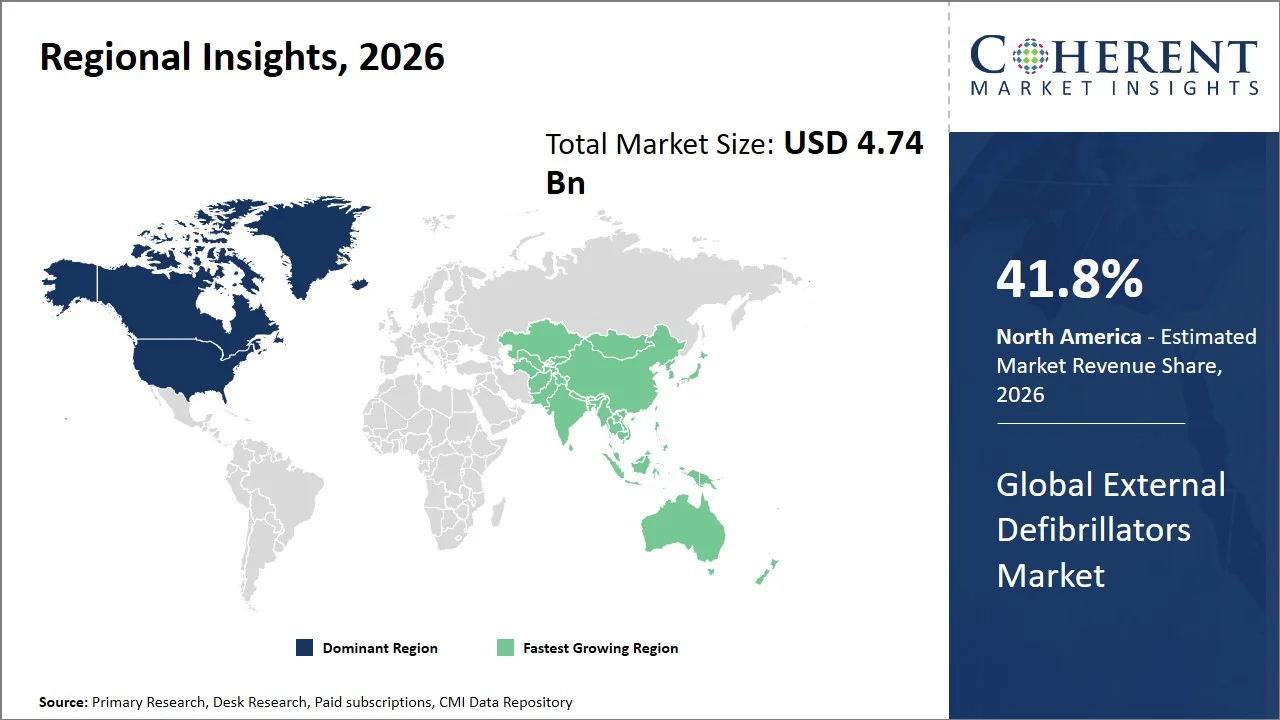
Why is North America a Strong Market for External Defibrillators?
North America leads the global external defibrillators market, accounting for an estimated 41.8% share in 2026, driven by a mature healthcare infrastructure, sophisticated emergency medical services infrastructure and a significant spending on cardio-protective devices and treatments. The market in this region is characterized by the extensive availability and adoption of external defibrillators in various end-use facilities including hospitals, as part of emergency response systems and public access locations. Furthermore, the presence of strict regulations governed by the U.S. FDA assures high standards of quality and safety that would contribute in increasing the market size in this region. For instance, the U.S. Food and Drug Administration mandates that all automated external defibrillators (AEDs) and their vital accessory devices submit a premarket approval (PMA), in which manufacturers must demonstrate with credible scientific evidence that the devices are safe and effective for commercial marketing.
Why Does the Asia Pacific External Defibrillators Market Exhibit High Growth?
The Asia Pacific external defibrillators market is expected to exhibit the fastest growth with an estimated contribution of 21.3% share to the global market in 2026, due to the escalating burden of cardiovascular diseases, increased healthcare spending and ongoing expansion of healthcare infrastructure within nascent economics such as China and India. In addition, government initiatives have increased in an endeavor to encourage market growth by bolstering emergency services and providing public with a more easily accessible array of vital equipment.
For instance, NITI Aayog in its Emergency and Injury Care at Secondary and Tertiary Level Centres report suggested creating a comprehensive integrated emergency care system and installing automated external defibrillators (AEDs) in public areas as a national plan to bolster response to medical emergencies and enhance survival rates from sudden cardiac arrest. Furthermore, market adoption rates are expected to remain high as awareness levels continue to expand regarding sudden cardiac arrests coupled with an increase in investments for hospitals, emergency medical services (EMS) and public access defibrillation (PAD) facilities.
Global External Defibrillators Market Outlook for Key Countries
Why is the U.S. Leading Innovation and Adoption in the External Defibrillators Market?
The U.S. dominates the external defibrillators market due to its sophisticated integrated cardiac emergency care infrastructure and the widespread acceptance of latest defibrillation techniques within healthcare centers. Robust coordination among manufacturers, healthcare facilities, emergency medical services (EMS) and resuscitation societies in the country helps in the quicker deployment of smart and cloud enabled external defibrillators systems having fleet management capabilities and cardiopulmonary resuscitation (CPR) monitoring functionality. Furthermore, a well-established external defibrillators replacement industry supports the continuous adoption of next-generation external defibrillation systems.
Is Japan a Favorable Market for External Defibrillators?
Japan is one of the most promising markets for the external defibrillators market driven by its strong domestic production capacity and the early launch of space-efficient, high-performance defibrillation solutions. The country is a pioneer in a mature ecosystem for automated external defibrillators (AED) deployment including sustained device innovation, integration with the public health response system, and well-developed replacement market for next-generation devices.
Is China Emerging as a Key Growth Hub for the External Defibrillators Market?
China is positioned as a key growth hub in the global external defibrillators market owing to rapid advancements in local manufacturing infrastructure, rising penetration of locally manufactured innovative defibrillation technologies, and quick adoption of smart and connected automated external defibrillators (AEDs) in emergency response & clinical environments. A developed production ecosystem for medical equipment and continuous modernization of hospitals is further accelerating market expansion.
Why Does Germany Top the European External Defibrillators Market?
Germany leads the European external defibrillators market due to the presence of a comprehensive medical device industry in the country coupled with extensive clinical engineering infrastructure and the rapid introduction of next-generation defibrillation technologies. Furthermore, robust healthcare facilities, extensive use of state-of-the-art equipment for emergency services and persistent drive for newer technologies ensure a sustained market for external defibrillators in various acute care facilities across the country.
Is the External Defibrillators Market Developing in India?
India is a high-potential market for external defibrillators owing to the growing infrastructure of emergency services, adoption of AED devices in private healthcare settings, and higher investment in organized emergency medical services. Furthermore, growing domestic capabilities in manufacturing medical devices, rising penetration in tier II & III cities, and increased adoption of the devices at work place and institutional areas are anticipated to drive the market growth.
Evolution of the Global External Defibrillators Market (2020–2033)
Market Dimension | 2020–2022 (Foundation Phase) | 2023–2025 (Expansion Phase) | 2026–2033 (Future Outlook) |
Technology | Conventional AEDs and manual defibrillators | Connected AEDs with cloud monitoring | AI-enabled, predictive and interoperable defibrillators |
Deployment | Primarily hospitals and EMS | Expansion into schools, airports and workplaces | Smart cities, residential communities and public infrastructure |
End Users | Hospitals dominate | Hospitals + public institutions | Community responders, corporate campuses, home care |
Regulatory Focus | Product safety and compliance | Public-access AED initiatives | Digital health integration and cybersecurity compliance |
Market Focus | Clinical emergency response | Public-access defibrillation | Preventive and connected cardiac emergency ecosystem |
How is the growing adoption of wearable defibrillators creating new growth opportunities in the global external defibrillators market?
Increasing adoption of wearable cardioverter defibrillators (WCDs) offers substantial opportunities within the external defibrillators market due to their capacity to offer temporary safeguard for high-risk cardiac arrest patients, who are ineligible for immediate implantation of internal devices. Evolving, lightweight design, constant cardiac monitoring, integrated wireless connectivity, and human-centered features are helping wearable cardioverter defibrillators (WCDs) to penetrate clinical boundaries and enhance patient compliance. The steady climb among physician preferability, alongside the encouraging reimbursement policies, will also likely accelerate the adoption of wearable defibrillation technologies. For instance, in March 2026, the U.S. Food and Drug Administration (FDA) issued Premarket Approval (PMA) for Kestra Medical Technologies ASSURE Wearable Cardioverter Defibrillator (WCD) System, increasing patient access to the latest wearable defibrillation therapy for patients at a temporary risk for life-threatening ventricular arrhythmias.
Market Players, Key Development, and Competitive Landscape
Key Developments
- In June 2025, Bridgepoint Group announced a partnership with Safe Life, a global provider of automated external defibrillators (AEDs) and emergency response solutions, to support the company's next phase of international growth. Through this partnership, Safe Life aims to strengthen its global AED distribution network, expand its product portfolio, and accelerate the adoption of public-access defibrillation solutions across healthcare, workplaces, educational institutions, and public settings.
- In April 2024, Avive Solutions secured USD 56.5 million in funding to expand its connected automated external defibrillator (AED) network across the U.S. The investment is being used to accelerate the deployment of its FDA-approved Avive Connect AED platform, strengthen cloud-based emergency response capabilities, and improve rapid public access to defibrillation during sudden cardiac arrest events.
- In March 2024, Stryker launched the next-generation LIFEPAK CR2 Automated External Defibrillator (AED) at CritiCare 2024. The device features enhanced cardiac emergency response capabilities, including advanced CPR guidance and connectivity features that support rapid intervention during sudden cardiac arrest. This launch strengthens Stryker's external defibrillator portfolio and supports the increasing adoption of public-access AEDs across healthcare and non-healthcare settings.
Competitive Landscape
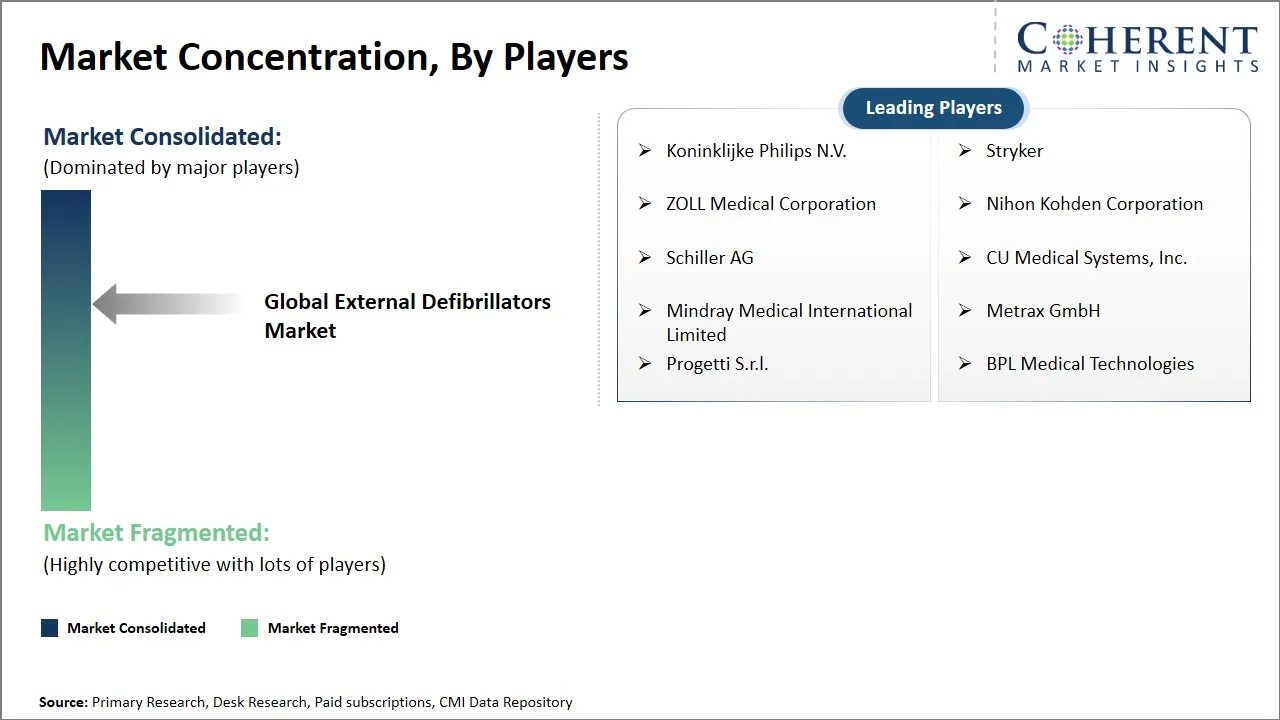
The global external defibrillators market is moderately consolidated, with leading players competing through continuous product innovation, technological advancements, and geographic expansion. Manufacturers are increasingly focusing on connected and AI-enabled external defibrillators, strategic partnerships with healthcare providers and emergency response organizations, and expanding public-access defibrillation solutions to strengthen their market position. Key players are also investing in regulatory approvals, digital device management platforms, and after-sales service networks to enhance product differentiation and customer retention. Key focus areas include:
- Development of connected, AI-enabled, and cloud-integrated external defibrillators
- Expansion of public-access Automated External Defibrillator (AED) deployment and emergency response solutions
- Strategic partnerships, acquisitions, and regional expansion to strengthen market presence
- Investment in regulatory approvals, digital fleet management, and value-added maintenance services
Market Report Scope
External Defibrillators Market Report Coverage
| Report Coverage | Details | ||
|---|---|---|---|
| Base Year: | 2025 | Market Size in 2026: | USD 4.74 Bn |
| Historical Data for: | 2020 To 2024 | Forecast Period: | 2026 To 2033 |
| Forecast Period 2026 to 2033 CAGR: | 10.1% | 2033 Value Projection: | USD 9.28 Bn |
| Geographies covered: |
| ||
| Segments covered: |
| ||
| Companies covered: | Koninklijke Philips N.V., Stryker, ZOLL Medical Corporation, Nihon Kohden Corporation, Schiller AG, CU Medical Systems, Inc., Mindray Medical International Limited, Metrax GmbH, Progetti S.r.l., and BPL Medical Technologies | ||
| Growth Drivers: |
| ||
| Restraints & Challenges: |
| ||
Analyst Opinion (Expert Opinion)
- The future outlook for the global external defibrillators market will be shaped by the evolution of smart, connected, and publicly accessible defibrillation ecosystems. Advancements in artificial intelligence (AI), cloud connectivity, real-time device monitoring, and integration with emergency response networks are expected to improve device readiness, reduce response times, and enhance survival outcomes. Increasing public-access automated external defibrillator (AED) deployment and digital healthcare adoption will further transform the market over the forecast period.
- The maximum opportunities will probably exist within the deployment of automated external defibrillators (AEDs) for public access defibrillation (PAD) programs across India. Increasing investments in emergency medical infrastructure, smart city initiatives, airports, metro rail networks, educational institutions, and commercial facilities are creating favorable conditions for large-scale automated external defibrillator (AED) deployment. Coupled with low existing automated external defibrillator (AED) penetration and growing emphasis on improving out-of-hospital cardiac arrest response, these factors position India as a high-potential market for sustained growth during the forecast period.
- In order to obtain a competitive advantage, market participants should focus on developing next-generation connected automated external defibrillators (AEDs) with cloud-based fleet management, multilingual voice guidance, AI-assisted cardiopulmonary resuscitation (CPR) support, and remote readiness monitoring. Strengthening collaborations with governments, emergency medical service providers, educational institutions, and corporate organizations, while expanding preventive maintenance, training, and managed automated external defibrillator (AED) service offerings, will enable companies to differentiate themselves in an increasingly competitive market.
Speak to the analyst
Want personalized insights?
Take the findings above to one of our principal consultants, or have the report rebuilt around the segments, geographies and competitors you actually track.
Market Segmentation
- Product Type Insights (Revenue, USD Bn, 2021 - 2033)
- Automated External Defibrillators (AEDs)
- Manual External Defibrillators
- Wearable Cardioverter Defibrillators (WCDs)
- End User Insights (Revenue, USD Bn, 2021 - 2033)
- Hospitals
- Pre-hospital Care Setting
- Public Access Settings
- Home Healthcare
- Others
- Regional Insights (Revenue, USD Bn, 2021 - 2033)
- North America
- U.S.
- Canada
- Latin America
- Brazil
- Argentina
- Mexico
- Rest of Latin America
- Europe
- Germany
- U.K.
- Spain
- France
- Italy
- Russia
- Rest of Europe
- Asia Pacific
- China
- India
- Japan
- Australia
- South Korea
- ASEAN
- Rest of Asia Pacific
- Middle East
- GCC Countries
- Israel
- Rest of Middle East
- Africa
- South Africa
- North Africa
- Central Africa
- North America
- Key Players Insights
- Koninklijke Philips N.V.
- Stryker
- ZOLL Medical Corporation
- Nihon Kohden Corporation
- Schiller AG
- CU Medical Systems, Inc.
- Mindray Medical International Limited
- Metrax GmbH
- Progetti S.r.l.
- BPL Medical Technologies
Sources
Primary Research Interviews
- External defibrillator manufacturers and Automated External Defibrillator (AED) solution providers
- Cardiologists, electrophysiologists, and emergency medicine physicians
- Emergency Medical Services (EMS) directors and paramedics
- Hospital biomedical engineering and procurement managers
- Cardiac care and resuscitation program coordinators
- Public Access Defibrillation (PAD) program administrators and workplace safety managers
Stakeholders
- External defibrillator and Automated External Defibrillator (AED) manufacturers
- Hospitals, integrated delivery networks (IDNs), and cardiac specialty centers
- Emergency Medical Services (EMS) providers
- Public health agencies and emergency preparedness organizations
- Schools, universities, airports, transportation authorities, and corporate facilities
- Distributors and medical device service providers
- End-use Sectors
- Hospitals and cardiac care centers
- Emergency Medical Services (EMS)
- Ambulatory surgical centers and urgent care clinics
- Public Access Defibrillation (PAD) locations (airports, schools, sports venues, workplaces)
- Long-term care facilities and nursing homes
- Home healthcare settings
- Regulatory & Health Bodies
- World Health Organization (WHO)
- U.S. Food and Drug Administration (FDA)
- U.S. Centers for Disease Control and Prevention (CDC)
- European Commission – Directorate-General for Health and Food Safety (DG SANTE)
- European Resuscitation Council (ERC)
- Medicines and Healthcare products Regulatory Agency (MHRA), UK
- Pharmaceuticals and Medical Devices Agency (PMDA), Japan
- Therapeutic Goods Administration (TGA), Australia
Databases
- WHO Global Health Observatory (GHO)
- U.S. Food and Drug Administration (FDA) Medical Device Databases
- American Heart Association (AHA) Statistics
- OECD Health Statistics
- Eurostat
- World Bank Open Data
- Centers for Medicare & Medicaid Services (CMS) Data
- National Center for Health Statistics (NCHS)
Magazines
- Medical Device & Diagnostic Industry (MD+DI)
- Cardiovascular Business Magazine
- Health Technology Magazine
- Medical Design & Outsourcing
Journals
- Journal of the American College of Cardiology (JACC)
- Resuscitation Journal (Elsevier)
- European Heart Journal
Newspapers
- The Wall Street Journal (Healthcare Section)
- Financial Times (Healthcare & Life Sciences)
Associations
- American Heart Association (AHA)
- European Resuscitation Council (ERC)
- Heart Rhythm Society (HRS)
- Association for the Advancement of Medical Instrumentation (AAMI)
Public Domain Sources
- U.S. Food and Drug Administration (FDA) – Medical Device Database
- World Health Organization (WHO) – Cardiovascular Disease Reports
- U.S. Centers for Medicare & Medicaid Services (CMS)
- European Medicines Agency (EMA)
Proprietary Elements
- CMI Data Analytics Tool, Proprietary CMI Existing Repository of information for last 10 years.
Get access to 250+ pages report
Every segment, forecast, competitor profile and data table behind the analysis above — available for instant download.
- ESOMAR Member
- ISO 9001:2015 Certified
- D-U-N-S Registered
- GDPR & CCPA Compliant
Missing comfort of reading report in your local language? Find your preferred language:
Transform your Strategy with Exclusive Trending Reports
Frequently Asked Questions
The global external defibrillators market is estimated to be valued at USD 4.74 Bn in 2026 and is expected to reach USD 9.28 Bn by 2033.
Automated external defibrillators (AEDs) dominate due to their ease of use, rapid emergency response capabilities, and increasing deployment across hospitals, public spaces, workplaces, and educational institutions.
External defibrillators are medical devices that deliver a controlled electric shock to restore normal heart rhythm during sudden cardiac arrest and other life-threatening cardiac arrhythmias.
The CAGR of the global external defibrillators market is projected to be 10.1% from 2026 to 2033.
Rising incidence of sudden cardiac arrest (SCA), and increasing deployment of public-access automated external defibrillators (AEDs) are the major factors driving the growth of the global external defibrillators market.
High cost of advanced defibrillator systems, and limited awareness and training on automated external defibrillator (AED) use in developing regions are the major factors hampering the growth of the global external defibrillators market.
AEDs use built-in electrocardiogram (ECG) analysis algorithms to automatically detect shockable rhythms such as ventricular fibrillation and pulseless ventricular tachycardia.