

Electroencephalography Devices Market Size and Trends - 2026 to 2033
Electroencephalography devices market is estimated to be valued at USD 505.5 Mn in 2026 and is expected to reach USD 827.2 Mn by 2033, exhibiting a compound annual growth rate (CAGR) of 7.3% from 2026 to 2033.
Key Takeaways
- By Device Type, the 32‑Channel EEG segment is expected to lead the market with 28% share in 2026, due to its optimal balance of diagnostic detail and cost-effectiveness.
- By Modality, the Standalone segment is expected to hold 72% share of the market in 2026, as hospitals and clinics prefer independent, high 36%-performance systems.
- By End User, the Hospitals segment is expected to hold a market share of 62% by 2026, due to the high demand for the solution by hospitals for the long-term monitoring of patients.
- By Region, the North America segment is expected to lead with share in 2026, driven by advanced healthcare infrastructure and early adoption of EEG technology.
Market Overview
Increase in cases of neurological disorders such as epilepsy, Alzheimer's, and sleep disorders is driving the market for highly advanced electroencephalographic systems. Highly advanced electroencephalographic systems for early detection, continuous monitoring, research studies, and development are opening huge opportunities. Advancements like development of portable electroencephalographic systems, wireless electroencephalographic systems, along with electroencephalographic systems enhanced by the capabilities of artificial intelligence, are further increasing the accuracy level of electroencephalographic systems.
Current Events and Its Impacts on the Electroencephalography Devices Market
Current Events | Description and its impact |
AI and Machine Learning Integration in Healthcare Technology |
|
Global Supply Chain Disruptions and Semiconductor Shortages |
|
How is product innovation driving growth in Electroencephalography devices?
- Portable & Wearable EEG Devices: There are small, wireless EEG devices that are capable of real-time brain surveillance beyond the confines of a hospital.
- AI-Powered Signal Analysis: Use of artificial intelligence to detect patterns and anomalies helps in the accuracy of diagnosis results and quick analysis.
- Hybrid Neuro-Diagnostic Systems: Those which are integrated with fNIRS and/or MRI and EEG, and are hence providing a complete assessment and analysis of the brain.
- Tele-EEG Solutions: The Tele-EEG Solutions will provide cloud solutions for remote EEG monitoring and telemedicine consultations. This will allow the treatment of the patients remotely from home and will also help the observation of the patients continuously.
- Child & Special EEG Setup: The child and special EEG setup is designed for infants and children and for patients having a disability in mobility to promote optimal functionality for long periods.
- Current Industry Events of 2026
- Market Size Estimation
- Regional Breakdown
- Competitive Landscape
- Customer Intelligence
- Segmental Analysis
- Pricing Analysis
- Key Market Drivers, Challenges & Future Trends
- Customized Insights Section
Segmental Insights
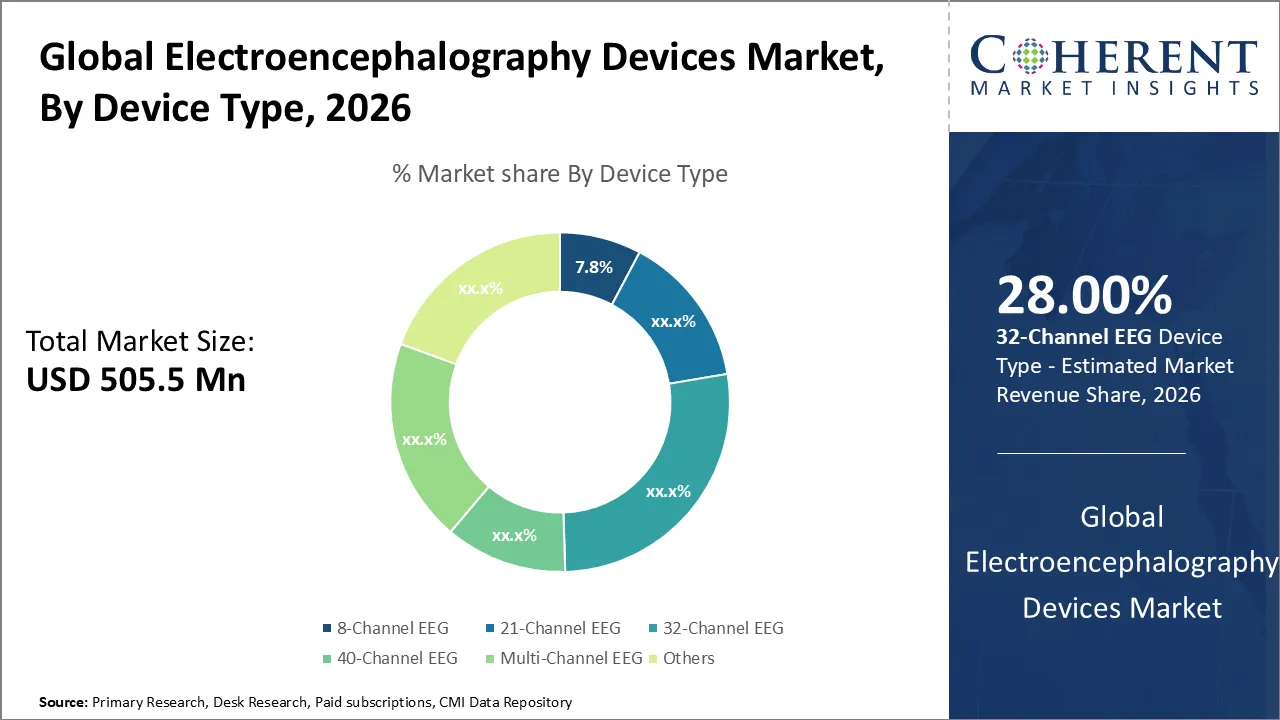
Electroencephalography Devices Market Insights, By Device Type – 32‑Channel EEG dominates due to optimal balance of diagnostic detail and cost-effectiveness
Based on device type, the 32‑Channel EEG segment is estimated to contribute the highest market share of 28% in 2026, owing to its ability to provide detailed neurological data while remaining cost-effective for hospitals and clinics. The configuration offers an ideal compromise between the number of electrodes needed for precise brain mapping and affordability, making it the preferred choice for both routine diagnostics and advanced neurological studies.
For instance, In February 2024, Neurotechnology announced an updated BrainAccess Extended+ Kit that now comes with a 32 channel EEG system. This BrainAccess kit is designed for researchers who want to record data from a large area of the brain cortex.
Electroencephalography Devices Market Insights, By Modality – Standalone EEG devices lead due to preference for independent high-performance systems
By modality type, the Standalone EEG segment is projected to hold the largest market share of 72% in 2026. Standalone systems are widely preferred at hospitals and diagnostic centers due to their reliability, whereby monitoring functions do not have to be dependent on any network. Standalone systems are developed for heavy clinical usage, such as continuous monitoring, high-resolution data acquisition, and simplified interfaces.
For instance, in October 2025, OpenBCI and Pupil Labs unveiled a wireless, all‑in‑one brain, body, and eye tracking headset that integrates EEG capabilities in a standalone, mobile format.
Electroencephalography Devices Market Insights, By End User – Hospitals dominate due to high adoption for neurological diagnostics and long-term monitoring
By end user, the Hospitals segment is expected to hold 62% of the market share in 2026. Hospitals continue to be the largest purchaser of EEG devices, coupled with an increasing prevalence of neurological diseases and the need for continuous patient monitoring. Integration of EEG devices in day-to-day diagnostic processes for epilepsy, sleep disorder, and neurodegenerative disorders fuels the growth demands for EEG devices.
For instance, in June 2025, Huntsville Memorial Hospital unveiled an on-site EEG diagnostic program powered by Zeto, Inc. The move reduced transfers while offering increased access to neurodiagnostic care to the local community with on-site EEG services inside a hospital.
Regional Insights
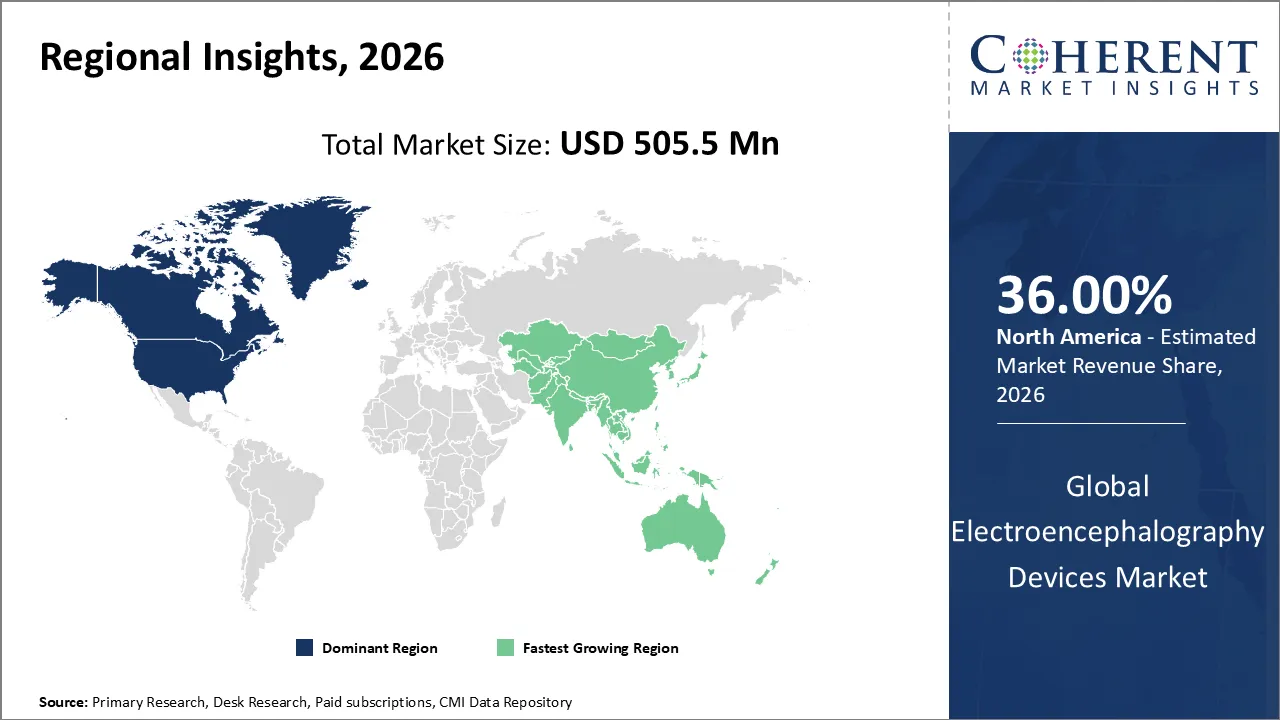
North America Electroencephalography Devices Market Analysis & Trends
North America is anticipated to capture the largest share in the EEG devices market in 2026, accounting for around 36% of the market. Advanced health infrastructures, early adoption of novel EEG technologies, and supportive presence of key medical device companies drive market growth in the region. The increasing amount of investment in neurology departments, better awareness of neurological conditions, and integration of EEG systems with telemedicine and AI-based diagnostic platforms further support the market expansion.
For instance, in December 2024, Huntsville Memorial Hospital in Texas introduced an EEG diagnostic service on site, utilizing the Zeto, Inc. system, allowing for the diagnosis of patients’ EEG directly in the hospital. This project helped decrease the transfer of patients and improve the availability of neurodiagnostic services, exemplifying the implementation of modern EEG solutions in North American hospitals.
Asia Pacific Electroencephalography Devices Market Analysis & Trends
The Asia Pacific market shows the fastest growth in the EEG devices market with increasing awareness of neurological conditions, healthcare expenditures, and government support for enhanced diagnostic facilities. Emerging healthcare facilities such as hospitals and diagnostic centers in countries such as India, China, and Japan increasingly choose advanced EEG devices like portable and standalone devices to address the demand for neurological testing. Cost-effective and advanced EEG devices offered by indigenous and regional players improve accessibility and adoption of the devices.
For instance, in March 2025, Apollo Hospitals in India collaborated with Neurotechnology to install advanced 32-channel and standalone EEG solutions across various branches. The project aimed to improve the speed and efficacy of neurological diagnoses, as well as develop the reach of tele-EEG and remote surveillance for patients in distant regions.
Electroencephalography Devices Market Outlook for Key Countries
Is the U.S. EEG devices market growing due to advanced healthcare infrastructure and early adoption of technology?
The U.S. market for EEG devices is experiencing rapid growth owing to its advanced healthcare infrastructure, adoption of innovative EEG technology, and increasing awareness about neurological disorders. There is a growing interest on the part of hospitals and institutes to set up a stand-alone and portable EEG system of higher density.
For instance, in November 2025, Ceribell, Inc. announced that the U.S. Food and Drug Administration (FDA) granted 510(k) clearance for its Clarity® AI‑powered EEG algorithm, making it the first and only FDA‑cleared seizure detection tool usable from pre‑term neonates through adults.
Is Canada’s focus on healthcare modernization driving EEG adoption?
Canada’s healthcare modernization initiatives are boosting demand for EEG devices across hospitals and research centers. The combination of tele-EEG technology, portable EEG machines, and high-density EEG systems enables distant patient surveillance and fast diagnoses in both urban and rural settings.
For instance, in June 2025, Toronto General Hospital expanded its neurology department with advanced standalone EEG systems to improve monitoring of epilepsy and sleep disorder patients. This adoption reflects Canada’s commitment to improving access to specialized neurological diagnostics and supporting patient-centered care.
Is China’s healthcare and wellness emphasis driving EEG market growth?
China’s growing investment in healthcare infrastructure and its focus on wellness and neurological research are accelerating EEG device adoption. Hospitals and research centers are increasingly adopting the use of EEG systems for the purposes of diagnosis and brain research. Online health services are further increasing the use of EEG.
For instance, In October 2025, Tianjin Municipality launched a magnetic resonance platform tailored for brain‑computer interface research, providing critical imaging and EEG support to advance next‑generation neurotechnologies.
Market Report Scope
Electroencephalography Devices Market Report Coverage
| Report Coverage | Details | ||
|---|---|---|---|
| Base Year: | 2025 | Market Size in 2026: | USD 505.5 Mn |
| Historical Data for: | 2020 To 2024 | Forecast Period: | 2026 To 2033 |
| Forecast Period 2026 to 2033 CAGR: | 7.3% | 2033 Value Projection: | USD 827.2 Mn |
| Geographies covered: |
| ||
| Segments covered: |
| ||
| Companies covered: | Cadwell Laboratories Inc., Compumedics Limited, Natus Medical Incorporated, Neurosoft Ltd., Elekta AB, Electrical Geodesics, Inc., NeuroWave Systems Inc., EB Neuro S.p.A., and Nihon Kohden Corporation. | ||
| Growth Drivers: |
| ||
| Restraints & Challenges: |
| ||
Electroencephalography Devices Market Driver
Rising prevalence of neurological disorders and demand for early diagnosis
The increasing incidence of neurological disorders, such as epilepsy, Alzheimer's, Parkinson's disease, and sleep disorders, is raising demand for EEG devices. Early detection and continuous monitoring solutions remain important, and hospitals and diagnostic centers are giving utmost priority to these solutions, which, in turn, accelerates the adoption rate of high-density, portable, and standalone EEG systems.
Electroencephalography Devices Market Opportunity
Integration of AI, telemedicine, and portable EEG solutions
The growth opportunities in the EEG industry are immense due to their integration with artificial intelligence and telemedicine. This is especially so due to their potential in diagnosing seizures, intellectual assessments, and predictive analysis. In addition, their portability with communication technologies allows their usage in medical institutions, ambulance facilities, and in-home care. Furthermore, emerging countries pose immense opportunities since cost-effective solutions of EEGs would be highly beneficial in countries with poor medical facilities.
Analyst Opinion (Expert Opinion)
The market for electroencephalography devices is growing rapidly due to the increasing concern for neurological health across the world. Hospitals and diagnostic centers are realizing the significance of advanced electroencephalography devices. Multi-channel electroencephalography devices are gaining popularity because they are capable of recording the activity of the entire brain and hence are much more reliable in determining the abnormality of the brain waves compared to the conventional electroencephalography devices.
Stand-alone EEG solutions are most widely used in many medical institutions as they are flexible to set up, easy to manage, as well as independent of central monitoring units. Portable as well as wireless EEG solutions are revolutionizing patient care, as they are easy to set up in emergency situations. Artificial intelligence-based EEG solutions are recently revolutionizing patient care as they allow doctors to interpret EEG data more accurately.
Overall, the market for EEG devices is shifting towards niche and high-accuracy systems with the incorporation of AI, portability, and scalability. and research institutions are treating these devices not just as diagnostic tools, but as strategic assets that improve patient care, streamline clinical workflows, and support neurological research initiatives.
Speak to the analyst
Want personalized insights?
Take the findings above to one of our principal consultants, or have the report rebuilt around the segments, geographies and competitors you actually track.
Electroencephalography Devices Industry News
- In December 2025, Cadwell announced a strategic partnership to integrate neurodiagnostic data into broader clinical intelligence ecosystems, aimed at enabling more seamless EEG data flow between devices and healthcare analytics platforms.
- In May 2025, Natus Medical introduced BrainWatch™, a point‑of‑care EEG designed for critical care environments such as emergency rooms and ICUs, with integrated AI analysis and rapid deployment.
- In November 2024, Nihon Kohden enhanced its EEG portfolio by acquiring a majority stake in Ad‑Tech Medical Instrument Corporation, a specialist in neurologic electrodes used in EEG monitoring and SEEG procedures; this strategic move supports comprehensive epilepsy diagnostics and care.
Market Segmentation
- Device Type Insights (Revenue, USD Mn, 2026 - 2033)
- 8-Channel EEG
- 21-Channel EEG
- 32-Channel EEG
- 40- Channel EEG
- Multi-Channel
- Others
- Modality Insights (Revenue, USD Mn, 2026 - 2033)
- Standalone
- Portable
- End User Insights (Revenue, USD Mn, 2026 - 2033)
- Hospitals
- Diagnostic Centers
- Others
- Regional Insights (Revenue, USD Mn, 2026 - 2033)
- North America
- U.S.
- Canada
- Latin America
- Brazil
- Argentina
- Mexico
- Rest of Latin America
- Europe
- Germany
- U.K.
- Spain
- France
- Italy
- Russia
- Rest of Europe
- Asia Pacific
- China
- India
- Japan
- Australia
- South Korea
- ASEAN
- Rest of Asia Pacific
- Middle East
- GCC Countries
- Israel
- Rest of Middle East
- Africa
- South Africa
- North Africa
- Central Africa
- North America
- Key Players Insights
- Cadwell Laboratories Inc.
- Compumedics Limited
- Natus Medical Incorporate
- Neurosoft Ltd.
- Elekta AB
- Electrical Geodesics, Inc.
- NeuroWave Systems Inc.
- EB Neuro S.p.A.
- Nihon Kohden Corporation.
Sources
Primary Research Interviews
- Neurologists & Clinical EEG Specialists
- Hospital & Diagnostic Center Administrators
- EEG Device Engineers & Product Managers
- Biomedical & Medical Equipment Distributors
- Neuroscience Researchers & Academic Experts
- EEG Technicians & Neurophysiology Lab Heads
- Clinical Trial Coordinators & Study Investigators
- Others
Databases
- U.S. Food & Drug Administration (FDA) Device Database
- ClinicalTrials.gov
- World Health Organization (WHO) Global Health Observatory
- U.S. National Library of Medicine – PubMed
- European Medicines Agency (EMA) Device Database
- Scopus
- Others
Magazines
- Neurology Today
- EEG & Clinical Neurophysiology Review
- Neuroscience News
- Medical Device & Diagnostic Industry (MD+DI)
- HealthTech Magazine
- Others
Journals
- Journal of Clinical Neurophysiology
- Frontiers in Human Neuroscience
- Clinical Neurophysiology Journal
- Brain & Behavior
- NeuroImage
- Others
Newspapers
- The New York Times – Health Section
- The Wall Street Journal – Health & Technology Section
- Reuters Health
- Bloomberg News – Medical Devices Section
- The Guardian – Science & Health Section
- Others
Associations
- American Clinical Neurophysiology Society (ACNS)
- International Federation of Clinical Neurophysiology (IFCN)
- World Federation of Neurology (WFN)
- European Society of Clinical Neurophysiology (ESCN)
- Others
Public Domain Sources
- U.S. Centers for Disease Control & Prevention (CDC) Reports
- World Health Organization (WHO) Neurology Reports
- U.S. National Institutes of Health (NIH) Publications
- EU Health Data Portal – Neurology Devices
- National Health Service (NHS) – Neurology & EEG Guidelines
- Others
Proprietary Elements
- CMI Data Analytics Tool
- Proprietary CMI Existing Repository of Information for the Last 8 Years
Get access to 250+ pages report
Every segment, forecast, competitor profile and data table behind the analysis above — available for instant download.
- ESOMAR Member
- ISO 9001:2015 Certified
- D-U-N-S Registered
- GDPR & CCPA Compliant
Missing comfort of reading report in your local language? Find your preferred language:
Transform your Strategy with Exclusive Trending Reports
Frequently Asked Questions
The EEG devices market is estimated to be valued at USD 505.5 Mn in 2026, and is expected to reach USD 827.2 Mn by 2033.
The CAGR of the EEG devices market is projected to be 7.3% from 2026 to 2033.
Rising prevalence of neurological disorders, increasing awareness about cognitive health, adoption of advanced portable and standalone EEG systems, and integration of AI for improved diagnostic accuracy are the key factors driving market growth.
High costs of advanced EEG systems, limited skilled workforce in neurodiagnostics, and competition from alternative neuroimaging and brain monitoring technologies are the major factors restraining market growth.
In terms of device type, the 32-channel EEG segment is expected to dominate due to its optimal balance of diagnostic detail and cost-effectiveness.
Cadwell Laboratories Inc., Compumedics Limited, Natus Medical Incorporated, Neurosoft Ltd., Elekta AB, Electrical Geodesics, Inc., NeuroWave Systems Inc., EB Neuro S.p.A., and Nihon Kohden Corporation are some of the leading players.
North America is expected to lead the EEG devices market, driven by advanced healthcare infrastructure and early adoption of EEG technology.