

Cardiac Remote Patient Monitoring Devices Market Size and Share Analysis- 2026 To 2033
The cardiac remote patient monitoring devices market size is anticipated to grow at a CAGR of 11.7% with USD 2.5 Bn in 2026 and is expected to reach USD 5.54 Bn in 2033. The primary drivers are largely defined by the growing demand for continuous cardiac monitoring and early detection of heart-related risks. Some of the other factors are the rising burden of arrhythmia, hypertension, and ischemic heart diseases, along with the need for remote care and reduced hospital visits. In addition, the growing adoption of wearable ECG devices and connected monitoring platforms is also propelling the market growth.
Key Takeaways
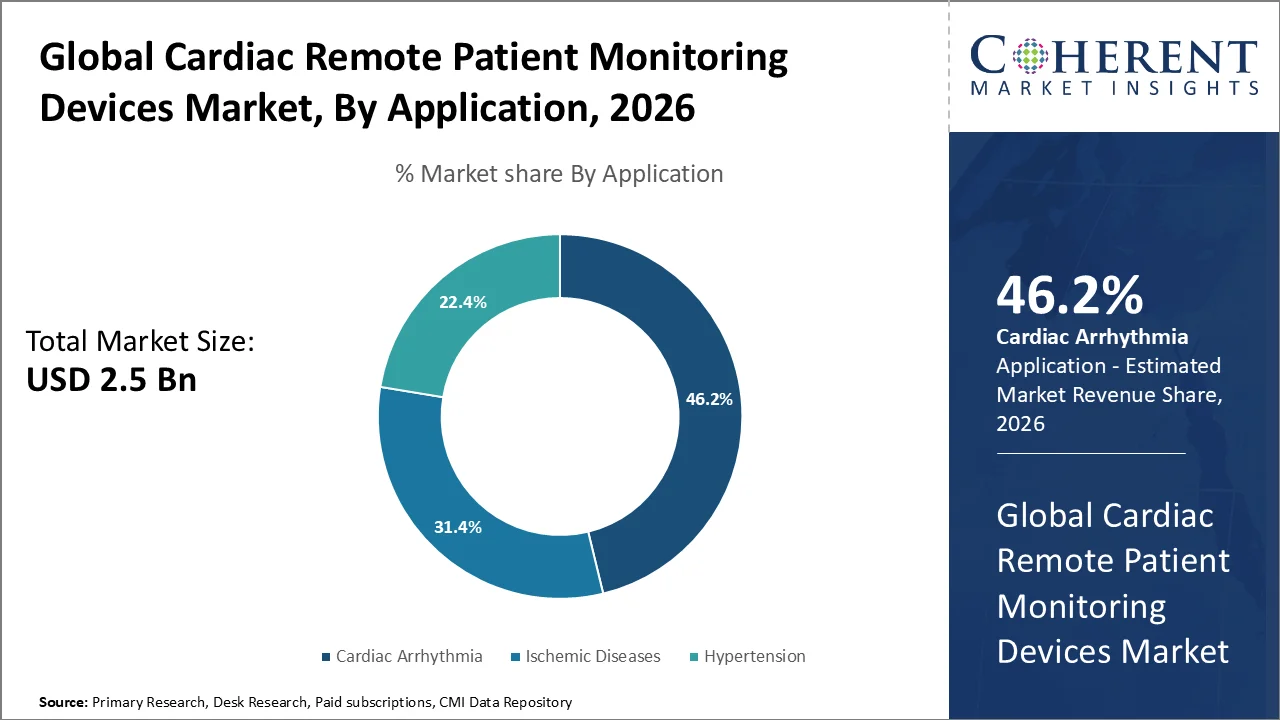
- Cardiac arrhythmia is set to lead with 46.2% in 2026. The segment’s growth is owing to the rising need for continuous rhythm tracking and early AFib detection. CDC’s May 2024 update states that AFib is the most common treated heart arrhythmia, with 12.1 million U.S. people expected to have AFib by 2050.
- The hospitals segment is likely to dominate the market with 48.5% in 2026. The segment’s growth is due to higher use of remote monitoring for post-discharge cardiac follow-up and readmission risk management. CDC’s May 2024 AFib page states that over 454,000 U.S. hospitalizations occur each year with AFib as the primary diagnosis.
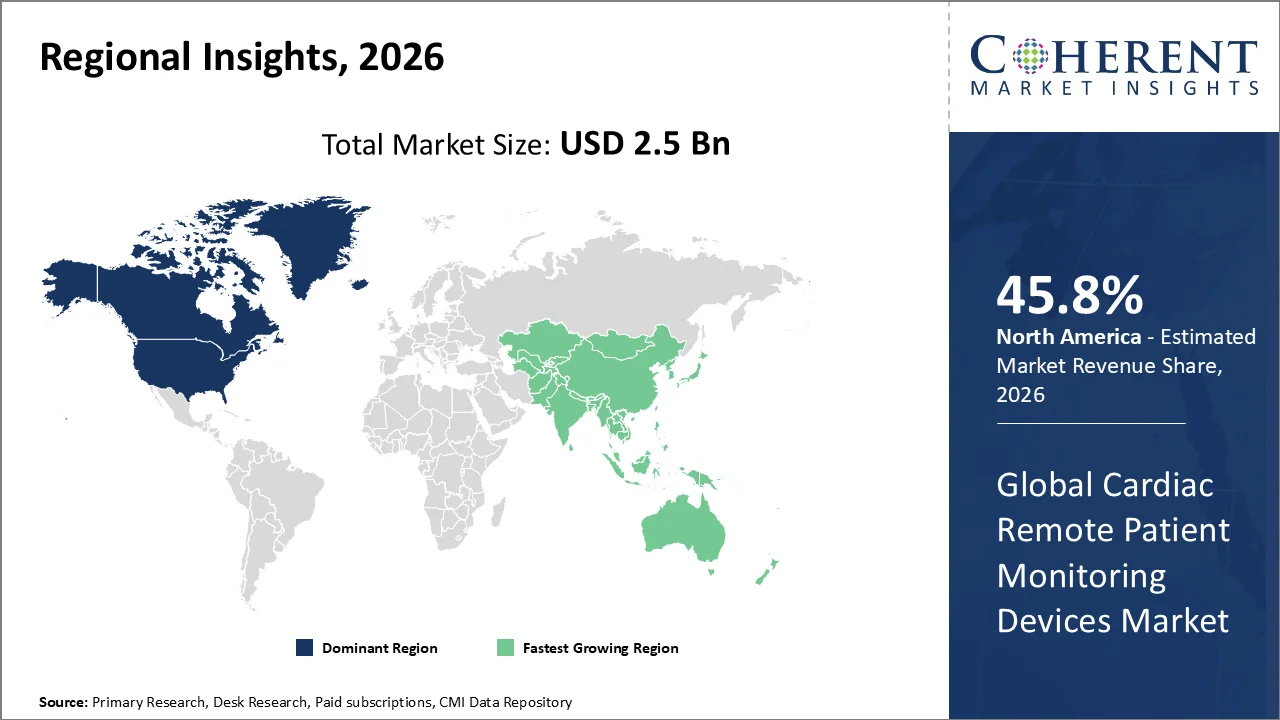
- North America is expected to acquire the prominent share of 45.80% in 2026. This is due to region’s high cardiovascular disease burden, strong hospital networks, and wider reimbursement support for remote monitoring. CDC’s October 2024 heart disease facts state that 919,032 people died from cardiovascular disease in the U.S. in 2023, equal to 1 in every 3 deaths.
Shift Toward Home-based Care is Transforming the Cardiac Remote Patient Monitoring Devices Market in the US
Shift toward home-based care is transforming the U.S. cardiac remote patient monitoring devices market. It is moving ECG, heart-rate, blood-pressure, weight, and oxygen monitoring from periodic clinic visits to continuous connected monitoring at home.
Reimbursement support is also encouraging adoption of remote patient monitoring devices. HHS OIG reported on August 2025, that Medicare payments for remote patient monitoring exceeded USD 500 million in 2024. CMS permits remote patient monitoring for acute or chronic conditions when patients use an internet-connected medical device that digitally uploads data and transmits readings for at least 16 days in every 30-day period. Product development is further supporting the cardiac remote patient monitoring devices market growth.
On November 2024, the FDA cleared LifeSignals’ UbiqVue 2A Multi-parameter System, a cardiovascular-classified wireless system designed for remote physiological monitoring. This clearance strengthens the infrastructure for home-based and outpatient cardiac monitoring devices in the U.S.
Major Breakthrough in Cardiac Remote Patient Monitoring Devices Market: AI-enabled ECG and Arrhythmia Detection
AI-enabled ECG and arrhythmia detection is becoming a key breakthrough in the cardiac remote patient monitoring devices market because it helps clinicians identify abnormal heart rhythms from continuously transmitted ECG data instead of depending only on periodic clinic-based tests.
The need for such monitoring is rising as CDC reported that an estimated 12.1 million people in the U.S. may have atrial fibrillation by 2050. The CDC also reported that atrial fibrillation was mentioned on 232,030 U.S. death certificates in 2021, thereby showing the clinical importance of earlier rhythm detection.
In January 2026, the FDA cleared Boston Scientific’s BodyGuardian Remote Monitoring System, which detects and monitors cardiac arrhythmias in ambulatory patients and transmits ECG data from clinical as well as non-clinical settings. The system includes BeatLogic AI, which uses deep neural networks for beat, rhythm, and waveform classification under clinician review.
- Current Industry Events of 2026
- Market Size Estimation
- Regional Breakdown
- Competitive Landscape
- Customer Intelligence
- Segmental Analysis
- Pricing Analysis
- Key Market Drivers, Challenges & Future Trends
- Customized Insights Section
Current Events and Their Impact on the Cardiac Remote Patient Monitoring Devices Market
Current Event | Description and its Impact |
CMS Remote Patient Monitoring Coverage and CY 2026 Medicare Physician Fee Schedule Updates |
|
FDA Cybersecurity Guidance for Connected Medical Devices
|
|
European Health Data Space Regulation Implementation |
|
Segmental Insights
Why is Cardiac Arrhythmia Acquiring the Largest Share?
Cardiac arrhythmia is projected to account for the largest cardiac remote patient monitoring devices market share of 46.2% in 2026. The segment’s growth is owing to the strong clinical need for continuous rhythm tracking. The arrhythmias are often intermittent and may not be detected during a short in-clinic ECG test. Remote ECG patches, Holter monitors, and mobile cardiac telemetry devices help capture irregular heart rhythms over longer monitoring periods, supporting early diagnosis and timely clinical intervention.
The high burden of atrial fibrillation is also responsible for the growth of the cardiac arrhythmia monitoring devices. According to the CDC, AFib causes about 1 in 7 strokes and is associated with nearly a fivefold higher risk of ischemic stroke. These risks create strong demand for outpatient rhythm surveillance, early event detection, and clinician-reviewed ECG interpretation.
In May 2024, Vivalink, a leading provider of digital healthcare solutions, announced the launch of its comprehensive technology solution for Mobile Cardiac Telemetry and Holter monitoring. The solution integrates remote patient monitoring technologies with cutting edge arrhythmia detection algorithms. It is designed to simplify deployment, improve patient care, and facilitate the growing demand for efficient ambulatory ECG monitoring solutions.
Hospitals hold the Largest Market Share
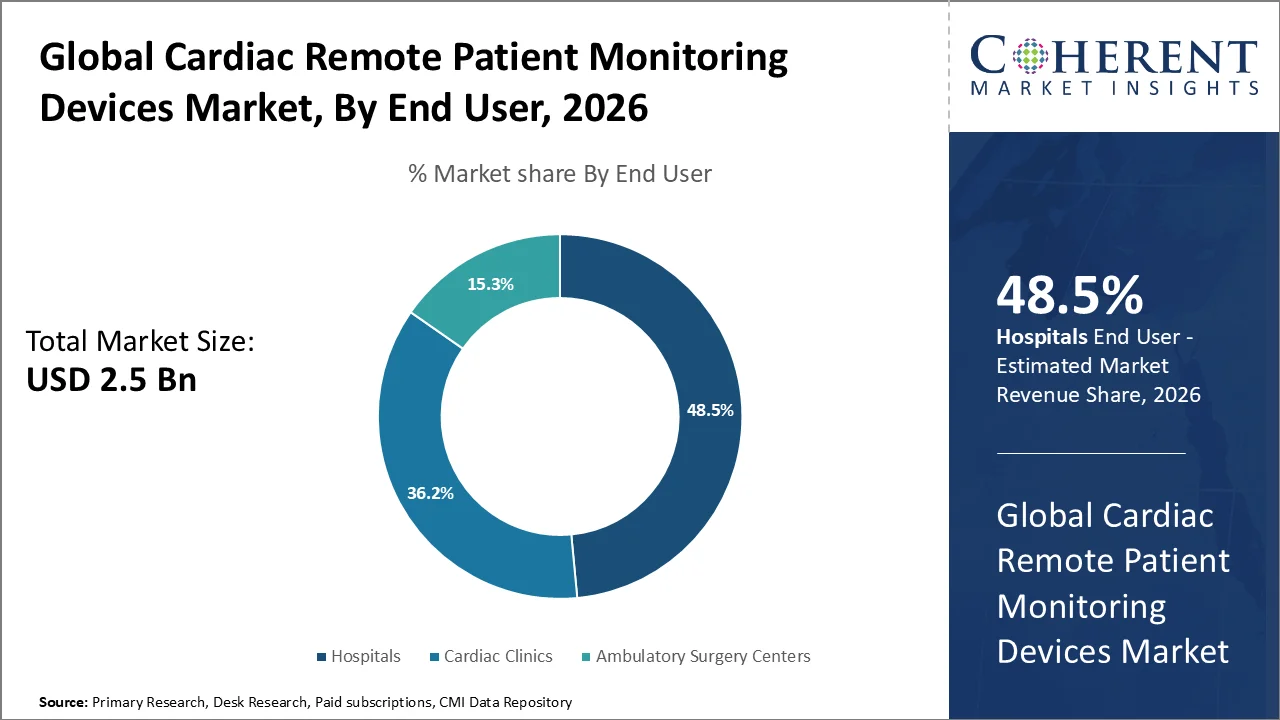
On the basis of end user, hospitals lead with a major 48.5% share in 2026. The growth is due to their role in initiating remote ECG, Holter, mobile cardiac telemetry, and post-discharge monitoring for patients with arrhythmia, heart failure, and high cardiovascular risk.
The CDC reported in May 2024 that 12.1 million people in the U.S. are expected to have atrial fibrillation by 2050, thus supporting the hospital demand for long-term rhythm monitoring. The CDC also reported in May 2024 that nearly 6.7 million U.S. adults aged 20 years or older have heart failure, thus increasing the need for connected blood pressure, weight, pulse oximetry, and ECG monitoring after discharge.
InfoBionic.Ai, a Boston-based leader in AI-enabled remote cardiac monitoring, announced in August 2025, that the U.S. FDA granted 510(k) clearance for its MoMe ARC 1-Lead Patch. This new configuration supports extended-duration ECG monitoring and marks an important advancement in the company’s MoMe ARC® strategy. The patch is designed to improve both patient comfort as well as clinician workflow.
Cardiac Remote Patient Monitoring Devices Market Trends
- The rising adoption of wearable ECG patches, Holter monitors, implantable cardiac monitors, and connected blood pressure devices is improving continuous cardiac tracking. The WHO stated on July 2025 that cardiovascular diseases caused 19.8 million deaths in 2022, thus representing nearly 32% of the global deaths.
- The remote cardiac monitoring is gaining importance because many cardiac events require faster detection and follow-up. The CDC reported on October 2024 that about 805,000 people in the U.S. have a heart attack every year, and one heart attack occurs every 40 seconds.
- The AI-enabled cardiac monitoring is expanding because platforms can support automated ECG review, rhythm detection, and faster clinical decision-making. A 2025 JACC: Advances study identified 209 FDA-approved AI/ML-enabled cardiovascular devices among 1,016 AI-enabled products reviewed from 1995 to 2024.
- Reimbursement-backed remote monitoring is becoming a major trend because Medicare use of RPM has increased sharply. HHS-OIG reported on September 24, 2024 that slightly more than 570,000 Medicare enrollees received remote patient monitoring in 2022, compared with about 55,000 enrollees in 2019, showing more than 10-times growth in Medicare-supported RPM adoption.
- Cost-control pressure is encouraging the wider use of remote cardiac care platforms. The CDC reported on October 2024 that heart disease-related healthcare services and medication costs reached more than USD 168 billion between 2021 and 2022. This facilitates the demand for monitoring tools which help reduce avoidable complications and readmissions.
Regional Insights
North America Dominates Owing to the Strong Clinical Need for Continuous Cardiac Surveillance
The North America region accounts for 45.8% of the market share in 2026. The region’s growth is owing to the strong clinical need for continuous cardiac surveillance, favorable Medicare coverage, and faster regulatory adoption of connected ECG technologies.
According to the CDC update published in May 2024, approximately 158,000 deaths in the U.S. each year are linked to atrial fibrillation. This demonstrates the growing need for continuous remote ECG and cardiac rhythm monitoring for early detection as well as disease management. The CMS also stated in January 2026 that remote patient monitoring includes physiologic data collection like electrocardiogram, blood pressure, and glucose monitoring, which patients or caregivers can transmit digitally.
In September 2025, Philips unveiled an innovative telemetry platform in Cambridge, Massachusetts. The platform is designed to help healthcare providers address key challenges, including staff shortages and alarm management. A major component of this solution is the next-generation Telemetry Monitor 5500, which provides a comprehensive, data-driven approach to improving operational performance and supporting cardiac patient monitoring.
Asia Pacific Cardiac Remote Patient Monitoring Devices Market Trends
Asia Pacific is expected to witness strong growth in cardiac remote patient monitoring devices market over the forecast period. The region’s growth is owing to the rising cardiovascular disease burden, increasing need for home-based monitoring, and expanding use of connected ECG, blood pressure, and heart-rate monitoring devices.
WHO South-East Asia reported in October 2025 that cardiovascular diseases caused 4.3 million deaths, accounting for 32% of all deaths in the region, with 44.7% occurring prematurely among people aged 30–70 years. WHO also reported in July 2025 that cardiovascular diseases caused 19.8 million deaths globally in 2022, with over three-quarters occurring in low- and middle-income countries. This creates strong demand for scalable cardiac monitoring outside the hospitals.
In May 2024, OMRON Healthcare India, the Indian arm of the Japanese medical equipment firm, announced its collaboration with AliveCor India, a top player in personal electrocardiogram technology. Through this partnership, OMRON Healthcare India expanded its portfolio beyond blood pressure monitors by offering AI-based handheld ECG technology in India.
Rising Burden of Cardiovascular Disease is Accelerating the Cardiac Remote Patient Monitoring Devices Market in US
The U.S. market is gaining momentum as cardiovascular disease creates a stronger need for continuous ECG, heart-rate, and arrhythmia monitoring outside hospitals. According to the CDC FastStats, 5.0% of U.S. adults had ever been diagnosed with coronary heart disease in 2024, which supports demand for home-based and ambulatory cardiac surveillance.
In April 2026, RhythMedix, LLC, cardiac monitoring firm from U.S., announced the release of its next-generation RhythmStar SL cardiac monitoring wearable. The third-generation device is designed to improve the patient experience by offering better comfort, wearability, and adherence. These improvements are supported by a compact lead configuration, an IPX-6 waterproof rating, and longer battery life.
China Cardiac Remote Patient Monitoring Devices Market Trends
China’s market is witnessing growth with the rising cardiovascular disease burden is increasing the need for continuous ECG, heart-rate, and arrhythmia monitoring outside hospitals. The 2024 Annual Report on Cardiovascular Health and Diseases in China estimated that around 330 million people in China are living with cardiovascular disease, including 11.39 million coronary heart disease cases. This large patient pool supports stronger demand for home-based and ambulatory cardiac surveillance.
In January 2026, Cardiac Biotech Solutions announced the activation of China production and final NMPA submission preparation for its MyCardia AT cardiac event monitor with Ebulent Medical in Shenzhen. This development is relevant because the device supports ambulatory ECG monitoring and hospital field testing for local regulatory clearance.
Who are the Major Companies in Cardiac Remote Patient Monitoring Devices Industry
Some of the major key players in cardiac remote patient monitoring devices market are A & D Medical, BIOTRONIK SE & Co. KG, Boston Scientific, GE Healthcare, Honeywell, Medtronic plc, Nihon Khoden, Philips Healthcare, Spacelabs Healthcare, Abbott Laboratories, St. Jude Medical, VitalConnect Inc., OSYPKA, MeTrax GmbH, and Lepu Medical Technology.
Key News
- In December 2025, vTitan Corporation launched vCardio, a single-lead wearable point-of-care cardiac monitor. The vCardio device is designed and manufactured entirely in India. This makes vTitan one of the early companies in India to provide a complete end-to-end health-tech solution, covering device hardware, cloud connectivity, and AI-based analytics.
- In July 2025, Omron Healthcare, a global leader in innovative home health monitoring solutions, expanded its collaboration with Tricog Health, an AI-driven cardiac care company, to launch KeeboHealth. KeeboHealth is an advanced connected health platform designed to transform remote cardiac care. The platform also supports Omron’s “Going for Zero” vision, which aims to create a world with zero cardiovascular events.
Market Report Scope
Cardiac Remote Patient Monitoring Devices Market Report Coverage
| Report Coverage | Details | ||
|---|---|---|---|
| Base Year: | 2025 | Market Size in 2026: | USD 2.5 Bn |
| Historical Data for: | 2020 To 2024 | Forecast Period: | 2026 To 2033 |
| Forecast Period 2026 to 2033 CAGR: | 11.7% | 2033 Value Projection: | USD 5.54 Bn |
| Geographies covered: |
| ||
| Segments covered: |
| ||
| Companies covered: | A & D Medical, BIOTRONIK SE & Co. KG, Boston Scientific, GE Healthcare, Honeywell, Medtronic plc, Nihon Khoden, Philips Healthcare, Spacelabs Healthcare, Abbott Laboratories, St. Jude Medical, VitalConnect Inc., OSYPKA, MeTrax GmbH, and Lepu Medical Technology | ||
| Growth Drivers: |
| ||
| Restraints & Challenges: |
| ||
Analyst Opinion
- Cardiac remote patient monitoring is driven by clear medical need. Cardiovascular disease caused 919,032 deaths in the U.S. in 2023, equal to 1 in every 3 deaths, showing why continuous cardiac tracking is becoming a care necessity, not only a technology trend.
- Arrhythmia monitoring is one of the strongest demand areas. The CDC states that 12.1 million people in the U.S. are expected to have atrial fibrillation by 2050, thereby creating sustained need for ECG patches, wearable monitors, as well as connected rhythm-tracking devices.
- Hypertension-linked cardiac monitoring is gaining substantial traction. The CDC reported in August 2025 that nearly 119.9 million U.S. adults have high blood pressure, while 92.9 million do not have it under control. This large unmanaged patient pool is encouraging wider use of connected blood pressure monitors and remote cardiac care platforms.
Speak to the analyst
Want personalized insights?
Take the findings above to one of our principal consultants, or have the report rebuilt around the segments, geographies and competitors you actually track.
Market Segmentation
- By Application (Revenue, USD Bn, 2021-2033)
- Cardiac Arrhythmia
- Ischemic Diseases
- Hypertension
- By End User (Revenue, USD Bn, 2021-2033)
- Hospitals
- Cardiac Clinics
- Ambulatory Surgery Centers
- By Region (Revenue, USD Bn, 2021-2033)
- North America
- U.S.
- Canada
- Latin America
- Brazil
- Mexico
- Argentina
- Rest of Latin America
- Europe
- Germany
- U.K.
- France
- Italy
- Spain
- Russia
- Rest of Europe
- Asia Pacific
- China
- India
- Japan
- Australia
- South Korea
- ASEAN
- Rest of Asia Pacific
- Middle East
- GCC
- Israel
- Rest of Middle East
- Africa
- South Africa
- Central Africa
- North Africa
- North America
Sources
Primary Research Interviews
- Cardiac Remote Patient Monitoring Device Manufacturers
- Wearable Cardiac Device Manufacturers
- ECG Patch and Holter Monitor Providers
- Implantable Cardiac Monitor Companies
- Connected Cardiac Care Platform Providers
- Cardiologists and Electrophysiologists
- Hospital Procurement Managers
- Remote Patient Monitoring Service Providers
- Telehealth and Digital Health Solution Providers
- Others
Databases
- Bloomberg Terminal
- Thomson Reuters Eikon
- IQVIA
- PubMed
- ClinicalTrials.gov
- Others
Magazines
- Medical Device Network
- MedTech Dive
- Healthcare IT News
- Cardiovascular Business
- MobiHealthNews
- MedTech Insight
- Others
Journals
- Journal of the American College of Cardiology
- Circulation
- European Heart Journal
- Journal of Medical Internet Research
- The Lancet Digital Health
- Heart Rhythm Journal
- Others
Newspapers
- Reuters
- Bloomberg News
- The Wall Street Journal
- Financial Times
- The New York Times
- Others
Associations
- American Heart Association
- American College of Cardiology
- Heart Rhythm Society
- European Society of Cardiology
- Healthcare Information and Management Systems Society
- Advanced Medical Technology Association
- Others
Public Domain Sources
- U.S. Food and Drug Administration
- Centers for Medicare & Medicaid Services
- Centers for Disease Control and Prevention
- World Health Organization
- National Institutes of Health
- European Medicines Agency
- European Commission – Medical Devices
- ClinicalTrials.gov
- U.S. Census Bureau
- Others
Proprietary Elements
- CMI Data Analytics Tool
- Proprietary CMI Existing Repository of Information for the Last 10 Years
Get access to 250+ pages report
Every segment, forecast, competitor profile and data table behind the analysis above — available for instant download.
- ESOMAR Member
- ISO 9001:2015 Certified
- D-U-N-S Registered
- GDPR & CCPA Compliant
Missing comfort of reading report in your local language? Find your preferred language:
Transform your Strategy with Exclusive Trending Reports
Frequently Asked Questions
The Cardiac Remote Patient Monitoring Devices Market is expected to reach USD 5.54 Bn in 2033.
Major players operating in the global Cardiac Remote Patient Monitoring Devices Market include A & D Medical, BIOTRONIK SE & Co. KG, Boston Scientific, GE Healthcare, Honeywell, Medtronic plc, Nihon Khoden, Philips Healthcare, Spacelabs Healthcare, Abbott Laboratories, St. Jude Medical, VitalConnect Inc., OSYPKA, MeTrax GmbH, and Lepu Medical Technology.
The high upfront costs, significant data security/privacy concerns (HIPAA/GDPR compliance), and inadequate reimbursement policies are the key factors hampering growth of the market.
The favorable reimbursement policies, the need to reduce hospital readmissions, and a shift toward proactive, home-based care is boosting the demand for cardiac remote patient monitoring devices.
The Cardiac Remote Patient Monitoring Devices Market is anticipated to grow at a CAGR of 11.7% between 2026 and 2033.
Among regions, North America is expected to account for a largest market share in the global Cardiac Remote Patient Monitoring Devices Market over the forecast period.
AI-enabled ECG and arrhythmia detection tools support faster identification of abnormal heart rhythms in remote patients. They reduce clinician workload by automatically analyzing ECG signals and prioritizing high-risk cases.