

Pen Needles Market Size and Share Analysis- Growth Trends and Forecasts (2026-2033)
The Pen Needles Market size is anticipated to grow at a CAGR of 10.4% with USD 3.14 Bn in 2026 and is expected to reach USD 6.28 Bn in 2033. The primary drivers are defined by the increasing prevalence of diabetes, rising adoption of insulin and other injectable therapies, expansion of home-based disease management, and growing preference for shorter and thinner needles. According to the International Diabetes Federation, approximately 589 million adults aged 20–79 years were living with diabetes in 2024, and the number is projected to reach 853 million by 2050. This expanding treatment population is strengthening demand for conventional, ultra-thin, safety-engineered, and short-length pen needles across retail pharmacies, hospitals, clinics, and homecare settings.
Key Takeaways
- The standard pen needles segment is likely to dominate the market with 68.1% in 2026. The segment’s growth is owing to the lower cost, wide compatibility with reusable and disposable injection pens, and established use in self-administered insulin therapy.
- The 4 mm segment is set to lead with 49.6% in 2026. The segment’s growth is owing to the lower intramuscular injection risk, compatibility across body-mass categories, and improved comfort.
- The retail pharmacy segment is set to lead with 47.2% in 2026. The segment’s growth is owing to the repeat monthly purchases, pharmacist-led product selection, insurance-linked dispensing, private-label availability, and convenient access for home users. The U.S. Centers for Disease Control and Prevention estimates that 40.1 million people in the U.S. had diabetes in 2023, sustaining a large recurring customer base for injection supplies.
- North America is expected to acquire the prominent share of 39.5% in 2026. The region’s growth is owing to the high diagnosed diabetes prevalence, broad availability of insulin pens, established reimbursement systems, and strong retail pharmacy infrastructure. The International Diabetes Federation estimates that the U.S. had 38.5 million adults aged 20–79 years with diabetes in 2024, the third-highest national total globally.
Segmental Insights
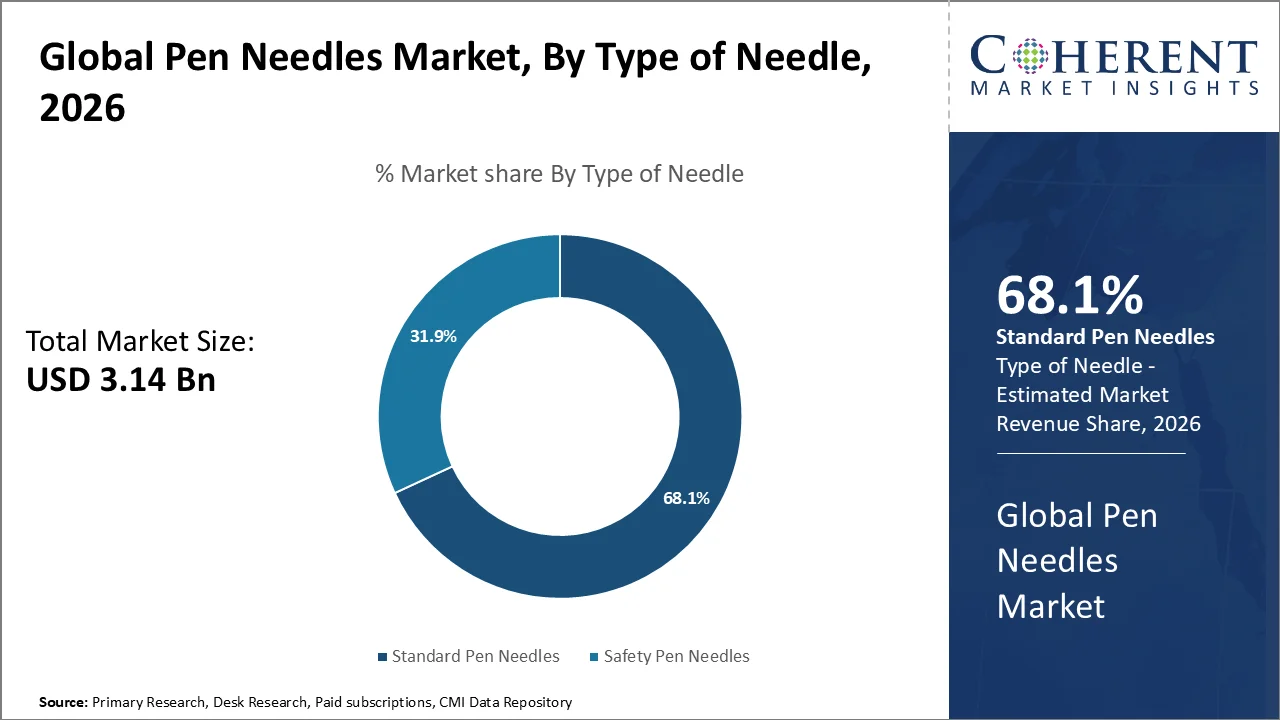
Why is Standard Pen Needles Segment Acquiring the Largest Share?
On the basis of type of needle, the standard pen needles segment is projected to account for the largest Pen Needles Market share of 68.1% in 2026. The segment’s growth is owing to the lower unit prices, simple product architecture, extensive availability, broad pen compatibility, and widespread use in patient-administered insulin therapy.
Embecta states that it supplies approximately 8 billion injection units annually through manufacturing facilities in the U.S., Ireland, and China. Its January 2026 investor presentation further indicated that pen needle and safety products represented approximately 85% of fiscal 2025 adjusted revenue, thereby highlighting the commercial importance of these product categories.
In November 2025, Embecta reported additional contracts and purchase orders from pharmaceutical partners seeking to co-package its pen needles with potential generic GLP-1 therapies. The company stated that its needles had been included in multiple partner-managed regulatory submissions, with selected commercial launches potentially beginning in 2026.
- Current Industry Events of 2026
- Market Size Estimation
- Regional Breakdown
- Competitive Landscape
- Customer Intelligence
- Segmental Analysis
- Pricing Analysis
- Key Market Drivers, Challenges & Future Trends
- Customized Insights Section
4 mm hold the Largest Market Share
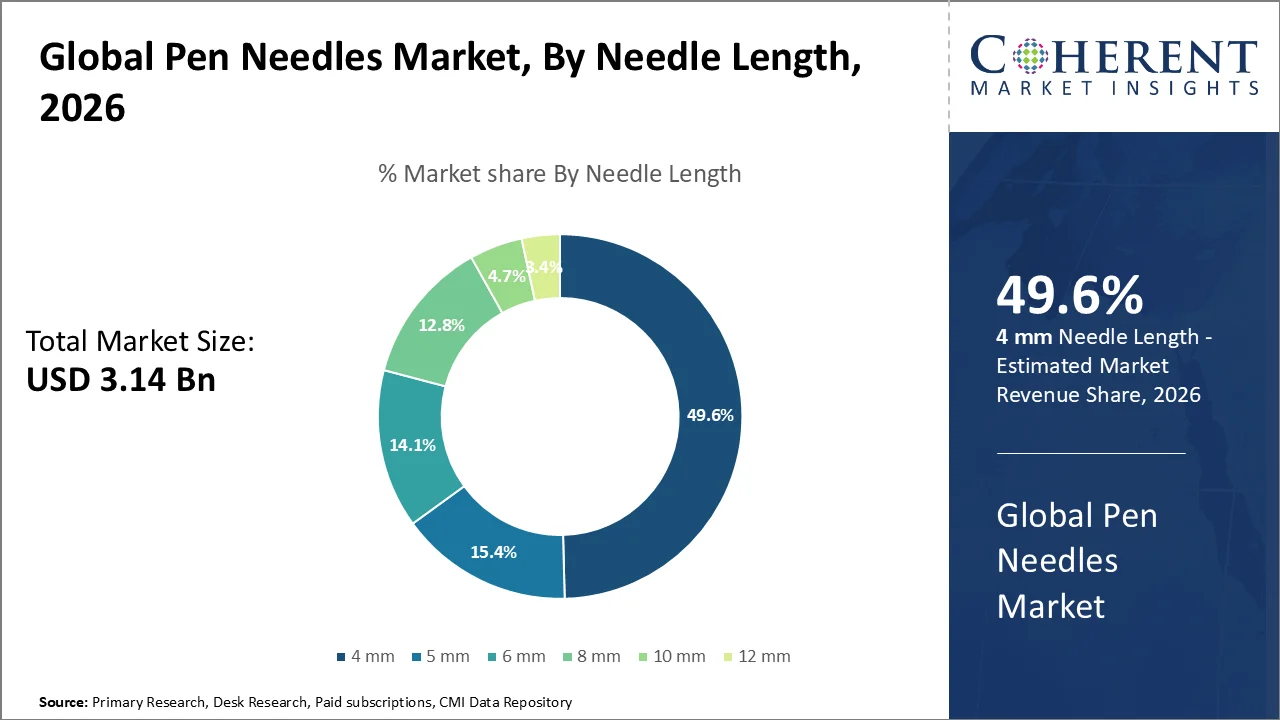
On the basis of needle length, the 4 mm segment lead with a major 49.6% share in 2026. The growth is owing to their wide usage. They are designed to deliver medication into subcutaneous tissue while reducing the probability of an intramuscular injection. They are suitable for children, adults, older patients, and individuals across different body-mass categories when used according to product instructions and clinical guidance.
Novo Nordisk states that 4 mm needles are associated with a lower risk of intramuscular injection than 6 mm needles and that the 4 mm length is suitable regardless of body mass index. Its NovoFine Plus product uses a 32G cannula and SuperFlow technology intended to support medication flow. Owen Mumford supplies both 32G and 33G products at the 4 mm length, demonstrating the industry’s movement toward a combination of shorter length and smaller external diameter.
Market Drivers
Rising Innovations in Ultra-Thin Pen Needles Are Transforming the Market in the U.S.
Innovation in the U.S. Pen Needles Market is centered on shorter needle lengths, higher gauges, thin-wall cannulas, improved silicone coatings, better medication flow, and mechanisms that reduce exposure to the needle before and after an injection. Manufacturers are also expanding compatibility with different insulin, human growth hormone, obesity, and metabolic-disease injection pens.
In November 2025, the U.S. Food and Drug Administration cleared Terumo Corporation’s Pen Injector Needle 32.5 through the 510(k) pathway. The device uses a thin-wall 32.5G stainless-steel cannula, is available in lengths ranging from 4 mm to 8 mm, and is intended for subcutaneous administration of medicines including insulin and human growth hormone.
Ultra-Thin and Safety-Engineered Pen Needles: A Major Breakthrough in the Market
Ultra-thin and safety-engineered pen needles represent a major technology breakthrough because they address two persistent challenges in injectable therapy: patient discomfort and accidental sharps exposure. Ultra-thin needles generally use higher gauge cannulas, thin-wall construction, optimized bevel geometry, and silicone lubrication to reduce insertion force while maintaining sufficient internal diameter for medication flow. Shorter needle lengths also simplify injection technique for many patients because extensive skin-fold formation may not be required.
The U.S. Occupational Safety and Health Administration reports approximately 385,000 sharps-related injuries among hospital-based healthcare workers annually, supporting institutional interest in protected needle systems.
In January 2026, the FDA cleared an HH Global Technology pen needle portfolio containing both ordinary as well as safety configurations. The devices are individually packaged, sterilized by irradiation, and designed for use by healthcare personnel, adult patients, and lay users.
Current Events and Their Impact on the Pen Needles Market
Current Event | Description and its Impact |
Mandatory use of four EUDAMED modules from May 2026 |
|
FDA recognition of updated sharps-protection standard |
|
Pen Needles Market Trends
- The rising adoption of shorter, thinner 4 mm pen needles improves injection comfort, lowers intramuscular injection risk, as well as supports easier daily diabetes management.
- Advanced five-bevel tips, extra-thin walls, silicone coatings, and ergonomic hubs enhance needle penetration, insulin flow, stability, and overall patient satisfaction.
- The increasing preference for insulin pens and home-based self-administration is expanding the demand for convenient, disposable pen needles across adult and pediatric populations.
- The growing global diabetes prevalence strengthens the long-term demand for insulin-delivery devices as well as associated injection supplies. The number of people living with diabetes increased from approximately 200 million in 1990 to 830 million in 2022, representing more than a fourfold rise. Over half of these patients did not receive diabetes medication in 2022.
- Supportive reimbursement and pharmacy coverage improve access to insulin injection supplies, encouraging regular product usage. In the United States, Medicare Part D plans may cover medical supplies required for insulin injections like pen needles, syringes, alcohol swabs, and gauze. However, Medicare Part B generally excludes self-administered insulin pens and related needles unless insulin is administered through a covered durable medical equipment pump.
Regional Insights
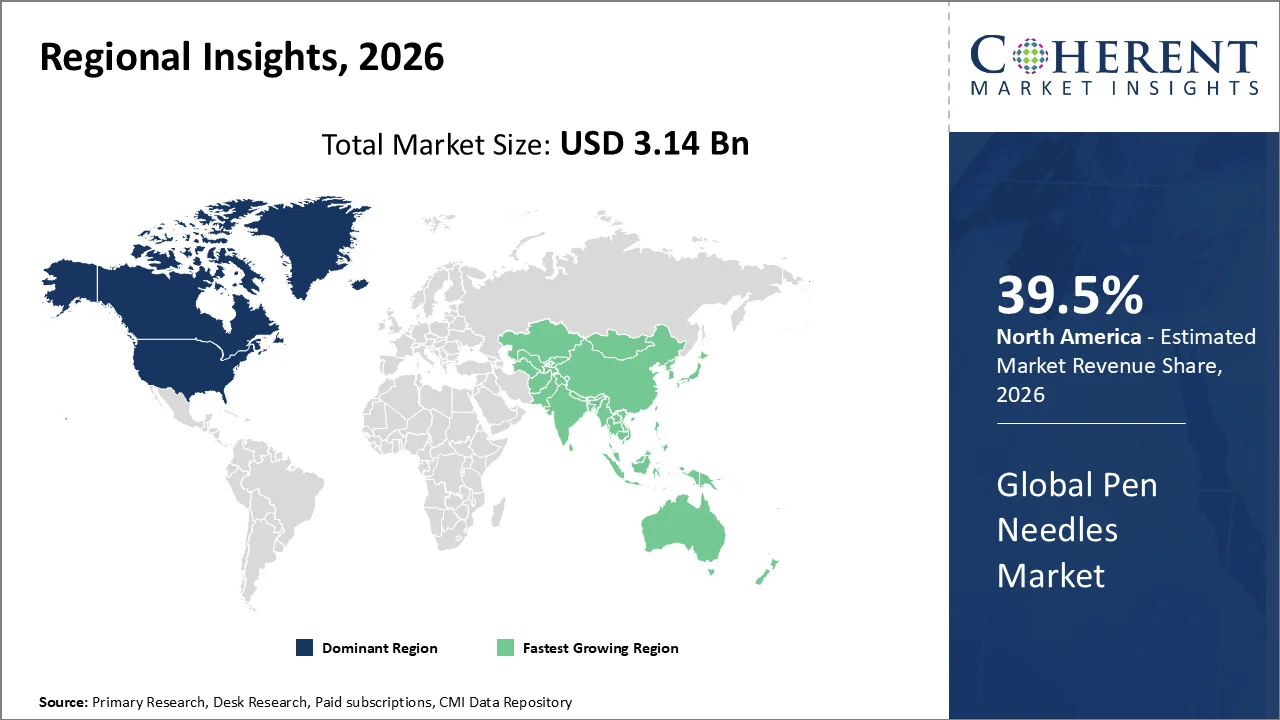
North America Dominates Owing to the High Treatment Access and Established Retail Distribution
The North America region accounts for 39.5% of the market share in 2026. The region’s growth is owing to the high diagnosed diabetes prevalence, broad access to insulin pens, strong pharmacy networks, well-developed reimbursement systems, and substantial healthcare expenditure.
North America also has a substantial injectable GLP-1 user base. The U.S. National Center for Health Statistics reported that 6.9 million adults with diagnosed diabetes used GLP-1 injectable treatments in 2024. The growing use of injectable metabolic therapies is encouraging manufacturers to evaluate retail packs and co-packaged pen needles for non-insulin applications.
In March 2026, the U.S. FDA cleared Sandstone Medical’s Easydrip Classic, Plus, Classic Pro, and Plus Pro pen needles through the 510(k) pathway. The Class II devices include new five-bevel models and broader use for subcutaneous delivery of FDA-approved drugs.
Asia Pacific Pen Needles Market Trends
Asia Pacificis is expected to witness strong growth in market over the forecast period. The region’s growth is owing to the large diabetes population, increasing diagnosis rates, expanding retail pharmacy networks, growth in private healthcare expenditure, and gradual transition from vial-and-syringe administration to portable injection pens.
The International Diabetes Federation estimates that China had 148.0 million adults aged 20–79 years with diabetes in 2024, the highest national total worldwide. India had approximately 89.8 million adults with diabetes, while Japan had approximately 10.8 million. This is creating opportunities for premium ultra-thin needles as well as value-oriented standard products.
In August 2024, MTD Group completed the acquisition of Ypsomed’s pen needle and blood glucose monitoring businesses, increasing annual pen needle production capacity beyond 2.5 billion units. The deal expanded MTD’s presence in China and India and supported major investments in European manufacturing facilities.
Large Treated Diabetes Population is Accelerating the Pen Needles Market in United States
In the United States, the Pen Needles Market is influenced by the large treated diabetes population, substantial use of insulin and GLP-1 medicines, and highly developed pharmacy distribution system. The Diabetes.org estimates that 29.1 million people had diagnosed diabetes in 2023, while approximately 11.0 million adults with diabetes remained undiagnosed. The large diagnosed population generates recurring demand for pen needles, test supplies, continuous-glucose-monitoring products, insulin pens, as well as related consumables.
In April 2025, Owen Mumford launched UnifineOTC pen needles, an affordable cash-pay option designed for uninsured, underinsured, and high-copayment diabetes patients. Available in 4mm and 5mm sizes, the product simplifies pharmacy dispensing while maintaining trusted Unifine quality and performance standards.
China Pen Needles Market Trends
China is emerging as a major growth market for Pen Needles. The growth is owing to the large diabetes treatment population and wider use of injectable therapies. Official Shanghai government reporting cited 2024 national data showing diabetes prevalence among Chinese adults at 12%, sustaining demand for insulin pens and compatible disposable needles.
Who are the Major Companies in Pen Needles Industry
Some of the major key players in Pen Needles Market are Novo Nordisk A/S, Becton, Dickinson and Company, Ypsomed AG, UltiMed, Inc., TERUMO CORPORATION, HTL-STREFA, Owen Mumford Ltd., B. Braun Melsungen AG, Allison Medical, Inc., Hindustan Syringes and Medical Devices Ltd., and Artsana S.p.a.
Key News
- In June 2026, Ascensia Diabetes Care launched CONTOUR COMFORT pen needles, featuring a five-bevel tip and anti-tilt hexagonal base to improve injection comfort, stability, and depth control. The product debuted in Germany, Austria, and Switzerland, with broader global expansion planned.
- In October 2025, Sandstone Medical introduced Easydrip Plus pen needles in Turkey, featuring a patent-protected hexagonal hub for improved stability, grip, comfort, and dosing control. The ISO 13485- and CE-certified product supports regional expansion plans.
- In August 2025, Trividia Health UK launched TRUEplus 5-Bevel Pen Needles in the United Kingdom, offering multiple gauges and lengths designed to improve injection comfort, safety, and ease of use. The range marked the product’s first availability outside the United States.
Market Report Scope
Pen Needles Market Report Coverage
| Report Coverage | Details | ||
|---|---|---|---|
| Base Year: | 2025 | Market Size in 2026: | USD 3.14 Bn |
| Historical Data for: | 2020 To 2024 | Forecast Period: | 2026 To 2033 |
| Forecast Period 2026 to 2033 CAGR: | 10.4% | 2033 Value Projection: | USD 6.28 Bn |
| Geographies covered: |
| ||
| Segments covered: |
| ||
| Companies covered: | Novo Nordisk A/S, Becton, Dickinson and Company, Ypsomed AG, UltiMed, Inc., TERUMO CORPORATION, HTL-STREFA, Owen Mumford Ltd., B. Braun Melsungen AG, Allison Medical, Inc., Hindustan Syringes and Medical Devices Ltd., and Artsana S.p.a. | ||
| Growth Drivers: |
| ||
| Restraints & Challenges: |
| ||
Analyst Opinion
- The Pen Needles Market growth is primarily driven by the rapidly expanding diabetes treatment needs. More than half of people living with diabetes did not receive diabetes medication in 2022, indicating substantial unmet treatment demand.
- Insulin therapy generates sustained demand for pen needles worldwide. WHO estimates that approximately 9 million people with type 1 diabetes require insulin, while around 60 million people with type 2 diabetes also need insulin treatment. This sizeable insulin-dependent population creates recurring demand for disposable pen needles across home-care and clinical settings.
- Shorter pen needles are gaining clinical preference. The ADA’s 2026 Standards recommend 4-mm pen needles across ages and body types to reduce accidental intramuscular insulin delivery. Better comfort, simpler handling, and compatibility with insulin pens are likely to strengthen adherence, replacement frequency, and adoption across home-care and clinical settings.
Speak to the analyst
Want personalized insights?
Take the findings above to one of our principal consultants, or have the report rebuilt around the segments, geographies and competitors you actually track.
Market Segmentation
- By Type of Needle (Revenue, USD Bn, 2021-2033)
- Standard Pen Needles
- Safety Pen Needles
- By Needle Length (Revenue, USD Bn, 2021-2033)
- 4mm
- 5mm
- 6mm
- 8mm
- 10mm
- 12mm
- By Distribution Channel (Revenue, USD Bn, 2021-2033)
- Retail Pharmacy
- Hospital Pharmacy
- Online Pharmacies
- Global Pen Needles Market, By Region (Revenue, USD Bn, 2021-2033)
- North America
- U.S.
- Canada
- Latin America
- Brazil
- Mexico
- Argentina
- Rest of Latin America
- Europe
- Germany
- U.K.
- France
- Italy
- Spain
- Russia
- Rest of Europe
- Asia Pacific
- China
- India
- Japan
- Australia
- South Korea
- ASEAN
- Rest of Asia Pacific
- Middle East
- GCC
- Israel
- Rest of Middle East
- Africa
- South Africa
- Central Africa
- North Africa
- North America
Sources
Primary Research Interviews
- Endocrinologists and diabetologists
- Diabetes educators and specialist nurses
- Hospital and diabetes clinic administrators
- Pharmacy and healthcare procurement managers
- Pen needle manufacturers and medical device distributors
- Key opinion leaders (KOLs) in diabetes care and insulin delivery
Databases
- World Health Organization (WHO)
- International Diabetes Federation (IDF)
- Centers for Disease Control and Prevention (CDC)
- National Institutes of Health (NIH)
- Organisation for Economic Co-operation and Development (OECD)
- U.S. Food and Drug Administration (FDA)
Magazines
- Diabetes Self-Management
- MedTech Dive
- Medical Device and Diagnostic Industry (MD+DI)
Journals
- Diabetes Care
- Diabetes Technology & Therapeutics
- Journal of Diabetes Science and Technology
- The Lancet Diabetes & Endocrinology
Newspapers
- The New York Times
- The Guardian
- The Wall Street Journal
Associations
- American Diabetes Association (ADA)
- International Diabetes Federation (IDF)
- European Association for the Study of Diabetes (EASD)
- Association of Diabetes Care & Education Specialists (ADCES)
Public Domain Sources
- Company Annual Reports and Investor Presentations
- Government Health Ministry Publications
- Medical Device Approval and Regulatory Databases
- Clinical Trial Registries such as ClinicalTrials.gov
- Public Procurement and Reimbursement Databases
Proprietary Elements
- CMI Data Analytics Tool
- Proprietary CMI Existing Repository of Information for Last 10 Years
Get access to 250+ pages report
Every segment, forecast, competitor profile and data table behind the analysis above — available for instant download.
- ESOMAR Member
- ISO 9001:2015 Certified
- D-U-N-S Registered
- GDPR & CCPA Compliant
Missing comfort of reading report in your local language? Find your preferred language:
Transform your Strategy with Exclusive Trending Reports
Frequently Asked Questions
The Pen Needles Market is expected to reach USD 6.28 Bn in 2033.
Major players operating in the global Pen Needles Market include Novo Nordisk A/S, Becton, Dickinson and Company, Ypsomed AG, UltiMed, Inc., TERUMO CORPORATION, HTL-STREFA, Owen Mumford Ltd., B. Braun Melsungen AG, Allison Medical, Inc., Hindustan Syringes and Medical Devices Ltd., and Artsana S.p.a.
The high costs of advanced safety needles, competition from needle-free alternatives, needle anxiety, and inconsistent reimbursements in emerging regions are the key factors hampering growth of the market.
The escalating prevalence of diabetes, the boom in GLP-1 and other injectable weight-loss therapies, a widespread shift toward home-based self-administration, and technological innovations in minimally painful, ultra-short needle designs is boosting the demand for Pen Needles.
The Pen Needles Market is anticipated to grow at a CAGR of 10.4% between 2026 and 2033.
Among regions, North America is expected to account for a largest market share in the global Pen Needles Market over the forecast period.
The market outlook is positive owing to the rising prevalence of diabetes, an aging global population, and the booming use of GLP-1 weight-management injectables.