

Holter Monitoring Systems Market Size and Share Analysis - 2026 To 2033
The global Holter monitoring systems market is estimated to be valued at USD 1,330.6 Mn in 2026 and is expected to grow at a CAGR of 5.0% during the forecast period (2026-2033), reaching USD 1,872.3 Mn by 2033. This growth can be attributed to increasing prevalence of cardiovascular diseases, rising demand for continuous and remote cardiac monitoring solutions, and growing adoption of wearable healthcare technologies. Cardiovascular disease caused 919,032 deaths in 2023, accounting for nearly one-third of all deaths.
Key Takeaways from the Holter Monitoring Systems Market Report
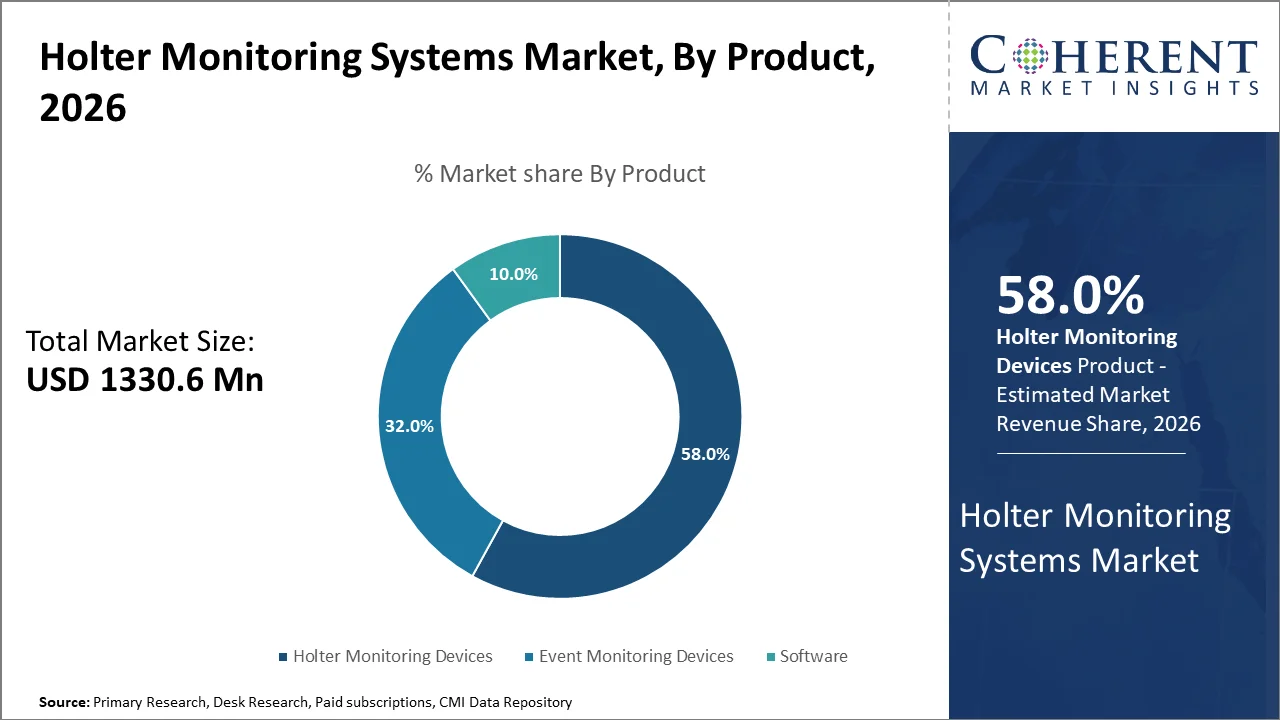
- Holter monitoring devices are expected to lead the market with a share of 58% in 2026 due to their widespread use as the primary hardware component for continuous ambulatory ECG monitoring. For instance, according to the 2026 StatPearls review on Ambulatory ECG Monitoring, Holter monitors are the most commonly used ambulatory providing continuous 24–72-hour cardiac rhythm recording for arrhythmia detection. Their high clinical use supports their leading market position.
- Hospitals are slated to hold the largest market share of 47% in 2026, due to higher patient volumes, advanced cardiology departments, and greater utilization of ambulatory cardiac monitoring services.
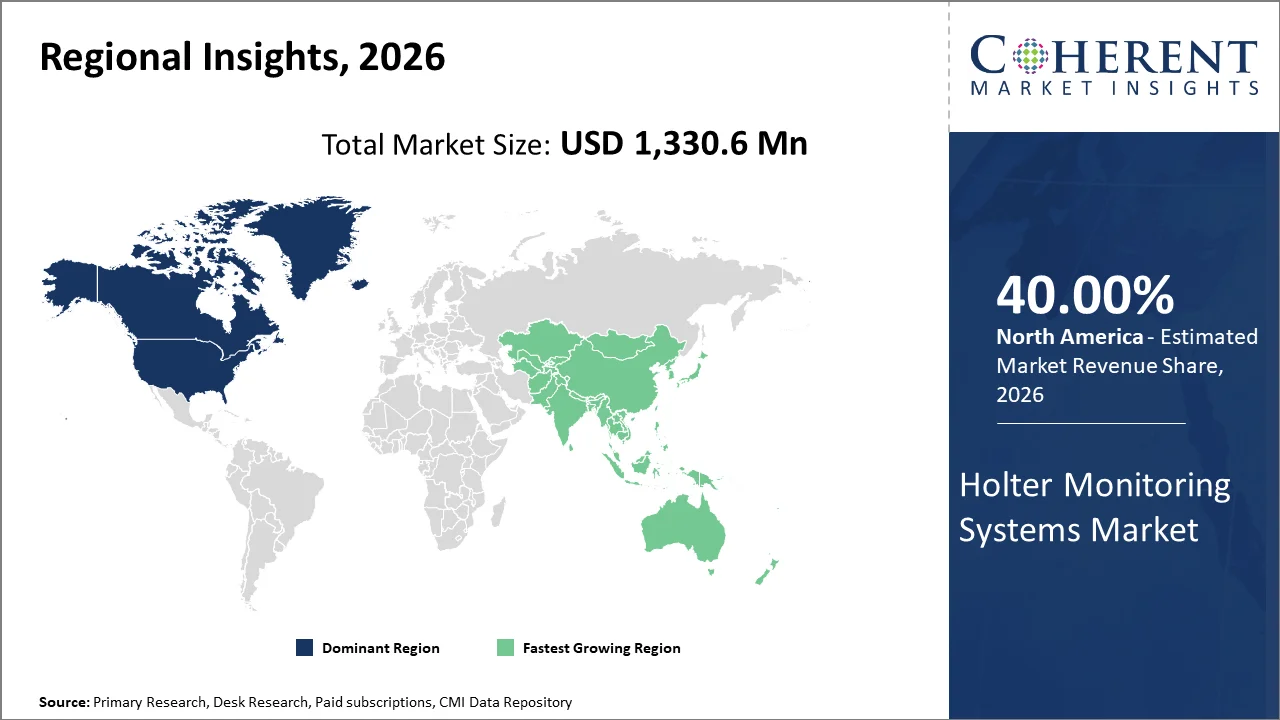
- North America is projected to dominate the global Holter monitoring systems industry with a share of 40% in 2026, owing to high prevalence of cardiovascular diseases, favorable reimbursement policies, and rising adoption of remote cardiac monitoring technologies. For example, the highlighting a large patient population requiring continuous cardiac monitoring and diagnostic evaluation.
- Asia Pacific, holding a share of 23% in 2026, is anticipated to emerge as a highly lucrative pocket for Holter monitoring system manufacturers during the forecast period, thanks to high patient pool, increasing healthcare expenditure, improving access to advanced cardiac diagnostic technologies, and rising adoption of remote patient monitoring solutions across nations like China, India, and Japan.
Holter Monitoring Systems Market Overview
The global Holter monitoring systems market is projected to grow steadily during the forecast period. This is primarily due to rising prevalence of cardiovascular diseases (CVDs), growing awareness regarding early diagnosis of cardiac disorders, and increasing demand for continuous ambulatory cardiac monitoring.
A Holter monitor is a portable electrocardiogram (ECG) device used to continuously record a patient’s heart's electrical activity. It is typically the size of a small camera and is connected to the skin through wires attached to adhesive electrodes placed on the chest. A Holter monitor is battery-powered and can operate continuously for 24 to 48 hours or longer, depending on the type and duration of monitoring prescribed.
Holter monitoring systems are widely used to detect irregular heart rhythms, evaluate symptoms such as palpitations and dizziness, and monitor patients at risk of arrhythmias and other cardiac conditions. The growing geriatric population, which is more susceptible to heart-related ailments, is also boosting Holter monitoring systems market growth.
Technological advancements in wearable healthcare devices, wireless monitoring solutions, and data analytics platforms are significantly improving the efficiency and convenience of Holter monitoring systems. Similarly, adoption of artificial intelligence (AI), cloud-based data storage, and remote patient monitoring capabilities is enhancing diagnostic accuracy and enabling healthcare providers to deliver timely interventions.
Expansion of remote patient monitoring (RPM) and telehealth is positively impacting sales of Holter monitoring systems. Rise of digital healthcare platforms is accelerating adoption of Holter systems in remote cardiac monitoring programs, post-surgical follow-ups, and chronic disease management.
In addition, shift towards ambulatory and outpatient care is also fueling demand for Holter monitoring systems. Healthcare systems are increasingly moving away from hospital-based diagnostics toward outpatient and home-based monitoring. Holter monitors enable patients to be evaluated outside clinical settings, reducing hospital burden and costs.
Segmental Insights
Which Product Leads the Holter Monitoring Systems Market?
Holter Monitoring Devices Continue to Lead Market Demand
According to Coherent Market Insights’ latest holter monitoring systems market analysis, Holter monitoring devices segment is set to dominate the market, accounting for a share of 58% in 2026. This can be attributed to rising prevalence of cardiovascular diseases and cardiac arrhythmias, increasing demand for continuous ambulatory ECG monitoring, and growing adoption of portable diagnostic devices.
Holter monitoring devices are widely preferred by healthcare providers because they enable continuous heart rhythm tracking over 24 to 48 hours or longer. These medical devices have the tendency to help detect irregular cardiac events that may not be captured during routine electrocardiogram (ECG) tests. Their ability to provide accurate and comprehensive cardiac data supports early diagnosis and effective patient management, contributing to their widespread adoption.
- Current Industry Events of 2026
- Market Size Estimation
- Regional Breakdown
- Competitive Landscape
- Customer Intelligence
- Segmental Analysis
- Pricing Analysis
- Key Market Drivers, Challenges & Future Trends
- Customized Insights Section
Who is the Leading End User of Holter Monitoring Systems?
Holter Monitoring System Demand Remains High in Hospitals
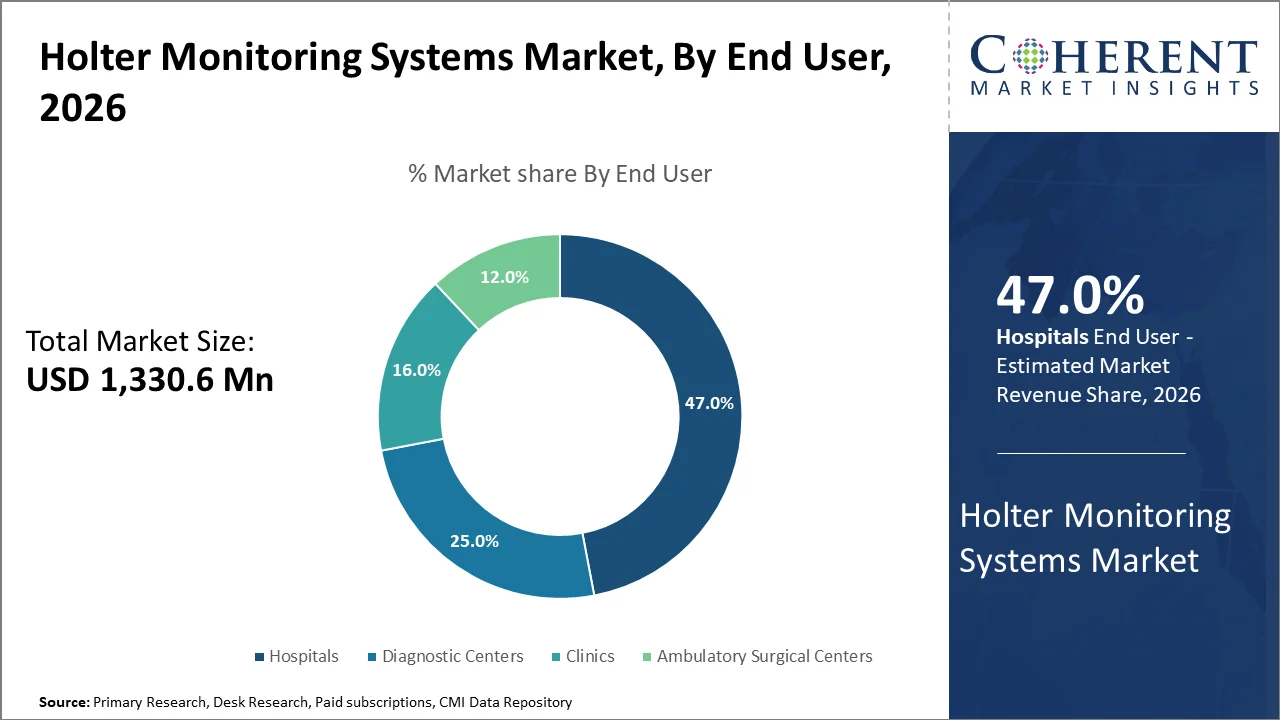
Based on end user, hospitals segment is expected to account for the largest market revenue share of 47% in 2026. This is mostly due to increasing number of patients undergoing cardiovascular diagnostics and monitoring in hospital settings, along with high use of ambulatory cardiac monitoring services.
Hospitals are equipped with advanced diagnostic infrastructure, skilled healthcare professionals, and integrated patient care systems that enable accurate detection and management of cardiac arrhythmias and other heart-related disorders. In addition, growing prevalence of cardiovascular diseases, rising hospital admissions for cardiac conditions, and availability of reimbursement support for diagnostic procedures are driving adoption of Holter monitoring systems in hospitals.
Holter Monitoring Systems Market Growth Drivers
Rising Prevalence of Cardiovascular Diseases (CVDs)
Increasing global burden of cardiovascular diseases is providing a strong impetus for the growth of the Holter monitoring systems market. There is a spike in cases of arrhythmias, atrial fibrillation, and ischemic heart disease. For example, according to the European Society of Cardiology, approximately one in three people worldwide will be at risk of developing a serious heart rhythm disorder during their lifetime. These conditions require continuous ECG monitoring for accurate diagnosis, significantly boosting demand for Holter monitoring systems.
Holter Monitoring Systems Market Opportunities
Technological Advancements in Holter Monitors
Technological advancements in Holter monitors are transforming the Holter monitoring systems market. Companies are developing wireless Holter devices, patch-based and wearable ECG monitors, as well as improving signal accuracy, battery life, and device miniaturization for better patient comfort. These improvements enhance patient compliance and enable longer monitoring durations. They are expected to create lucrative growth opportunities for the Holter monitoring systems market during the forecast period.
Holter Monitoring Systems Market Trends
Integration of AI and Machine Learning in Holter Systems
Increasing adoption of advanced technologies is a key trend shaping the Holter monitoring systems market. There is a growing use of AI-powered ECG interpretation tools that automate arrhythmia detection, reduce physician workload, improve diagnostic accuracy, and enable faster reporting. This is enhancing scalability in high-volume cardiac testing environments.
For example, in 2025, The system uses an FDA-cleared AI algorithm to automatically detect and classify cardiac arrhythmias from multi-day recordings. Such innovations are expected to boost growth of Holter monitoring systems market during the forthcoming period.
Current Events and Their Impact on the Holter Monitoring Systems Market
Current Event | Description and its Impact |
Expansion of Remote Cardiac Monitoring Reimbursement (2026) |
|
FDA Clearances for AI-Powered ECG Analysis Platforms (2025–2026) |
|
Regional Insights
North America Remains at the Epicenter of Holter Monitoring Systems Market Growth
North America is expected to lead the global Holter monitoring systems market during the forecast period, accounting for a share of 40% in 2026. This can be attributed to rising burden of cardiovascular diseases and widespread use of ambulatory ECG monitoring for early detection of arrhythmias.
Rising prevalence of heart disease is playing a key role in boosting growth of the Hotler monitoring systems market. According to the CDC, about 1 in every 5 deaths in the United States is caused by cardiovascular disease, highlighting the strong need for continuous heart rhythm monitoring solutions like Holter devices. Increasing adoption of wearable and portable ECG technologies in hospitals and homecare settings is also supporting regional demand.
Asia Pacific to Emerge as Central Hub for Holter Monitor Manufacturers
Asia Pacific is set to emerge as a happy hunting ground for manufacturers of Holter monitoring systems during the forecast period, holding a share of 23% in 2026. This is mostly due to rising cases of cardiovascular disorders, expanding healthcare infrastructure, and rising diagnostic awareness.
Growing burden of cardiovascular disorders is expected to boost growth of the Asia Pacific Holter monitoring systems market. According to the World Health Organization, cardiovascular diseases are the leading cause of death globally, accounting for an estimated 19.8 million deaths each year, with a large share occurring in low- and middle-income countries in Asia. This rising disease load, along with increasing access to ECG-based diagnostic tools in emerging economies, is fueling adoption of Holter monitoring systems across the region.
Holter Monitoring Systems Market Outlook – Country-wise
U.S. Holter Monitoring Systems Market Trends
The United States is expected to remain the leading market for Holter monitoring systems during the assessment period. This is mostly due to advanced healthcare infrastructure, high diagnostic volumes, and strong adoption of continuous ECG monitoring for early detection of cardiac disorders. In addition, growing cases of atrial fibrillation and other arrhythmias, along with increasing use of wearable and AI-enabled cardiac monitoring technologies, are also boosting sales growth in the region.
China Holter Monitoring Systems Market Forecast
The Holter monitoring systems market in China is expected to grow steadily during the assessment period. This can be attributed to rapid expansion of healthcare infrastructure, increasing hospital admissions, and rising awareness of early cardiac diagnosis. Growing government investment in modern hospitals, expansion of cardiac care facilities, and improved access to ECG-based diagnostic tools are also supporting adoption of Holter monitoring systems across the country.
Who are the Major Companies in the Holter Monitoring Systems Market?
Some of the major players in Holter Monitoring Systems Market are Koninklijke Philips N.V., Welch Allyn, Inc., Biotricity Inc., Bittium Corporation, Schiller AG, Shimmer, Fukuda Denshi Co., Ltd., Nihon Kohden Corporation, VivaQuant, and GE Healthcare.
Key Strategies Adopted by Industry Players
Top Holter Monitoring System companies are adopting various organic and inorganic strategies to boost their revenue as well as gain a competitive edge over the industry. These include new product launches and approvals, mergers, partnerships, acquisitions, and distribution agreements. Leading manufacturers are increasingly focusing on integrating advanced technologies such as artificial intelligence (AI), cloud-based data management, and remote patient monitoring capabilities into their Holter monitoring solutions to enhance diagnostic accuracy as well as improve patient outcomes.
- In April 2025, LifeSignals and UltraLinQ announced the UbiqVue Holter System at Heart Rhythm 2025. The system is designed to speed up cardiac monitoring by helping doctors generate ECG reports faster using automated analysis.
- In May 2025, iRhythm launched its Zio long-term continuous cardiac monitoring system in Japan. The system provides continuous ECG monitoring to help detect and analyze heart rhythm problems over several days.
Market Report Scope
Holter Monitoring Systems Market Report Coverage
| Report Coverage | Details | ||
|---|---|---|---|
| Base Year: | 2025 | Market Size in 2026: | USD 1,330.6 Mn |
| Historical Data for: | 2020 To 2024 | Forecast Period: | 2026 To 2033 |
| Forecast Period 2026 to 2033 CAGR: | 5.0% | 2033 Value Projection: | USD 1,872.3 Mn |
| Geographies covered: |
| ||
| Segments covered: |
| ||
| Companies covered: | Koninklijke Philips N.V., Welch Allyn, Inc., Biotricity Inc., Bittium Corporation, Schiller AG, Shimmer, Fukuda Denshi Co., Ltd., Nihon Kohden Corporation, VivaQuant, and GE Healthcare. | ||
| Growth Drivers: |
| ||
| Restraints & Challenges: |
| ||
Analyst Opinion (Expert Opinion)
- The Holter monitoring systems market is growing due to the rising burden of cardiac arrhythmias and heart disease worldwide. Continuous heart rhythm monitoring is becoming essential for early diagnosis and treatment planning.
- One factor that drives the demand for the product is the growing incidence of AFib. As per information provided by the CDC, 1 million Americans are expected to have AFib by 2050, which means that there will be considerable demand for devices such as the Holter monitors.
- Technological advancements, including wireless Holter monitors, patch-based devices, and AI-enabled data analysis, are improving patient comfort and diagnostic accuracy, encouraging wider adoption across hospitals, clinics, and ambulatory care settings.
Speak to the analyst
Want personalized insights?
Take the findings above to one of our principal consultants, or have the report rebuilt around the segments, geographies and competitors you actually track.
Market Segmentation
- By Product Insights (Revenue, USD Mn, 2021 - 2033)
- Holter Monitoring Devices
- Event Monitoring Devices
- Software
- By End User Insights (Revenue, USD Mn, 2021 - 2033)
- Hospitals
- Diagnostic Centers
- Clinics
- Ambulatory Surgical Centers
- By Region Insights (Revenue, USD Mn, 2021 - 2033)
- North America
- U.S.
- Canada
- Latin America
- Brazil
- Argentina
- Mexico
- Rest of Latin America
- Europe
- Germany
- U.K.
- Spain
- France
- Italy
- Russia
- Rest of Europe
- Asia Pacific
- China
- India
- Japan
- Australia
- South Korea
- ASEAN
- Rest of Asia Pacific
- Middle East
- GCC Countries
- Israel
- Rest of Middle East
- Africa
- South Africa
- North Africa
- Central Africa
- North America
Sources
Primary Research Interviews
- Cardiologists
- Electrophysiologists
- Cardiac Technicians
- Hospital Procurement Managers
- Ambulatory Care Center Administrators
- Medical Device Distributors
- Healthcare IT Specialists
- Executives from Holter Monitoring System Manufacturers
Databases
- World Health Organization (WHO)
- World Bank Data
- United Nations (UN) Data
- Organisation for Economic Co-operation and Development (OECD) Health Statistics
- Centers for Disease Control and Prevention (CDC)
- National Center for Biotechnology Information (NCBI)
- Eurostat
- U.S. Food and Drug Administration (FDA) Databases
Magazines
- Medical Design & Outsourcing
- Cardiovascular Business
- Medical Device Network
- Healthcare Innovation
- MedTech Dive
Journals
- Journal of the American College of Cardiology (JACC)
- Heart Rhythm
- European Heart Journal
- Journal of Electrocardiology
- Circulation
- BMJ Heart
- Journal of Cardiovascular Electrophysiology
Newspapers
- The Wall Street Journal
- Financial Times
- The New York Times
- The Guardian
- USA Today
Associations
- American Heart Association (AHA)
- European Society of Cardiology (ESC)
- Heart Rhythm Society (HRS)
- American College of Cardiology (ACC)
- World Heart Federation (WHF)
- Asia Pacific Heart Rhythm Society (APHRS)
Public Domain Sources
- World Health Organization (WHO)
- Centers for Disease Control and Prevention (CDC)
- U.S. Food and Drug Administration (FDA)
- National Institutes of Health (NIH)
- National Center for Biotechnology Information (NCBI)
- European Medicines Agency (EMA)
- NHS England
- Government Health Departments and National Statistics Offices
Proprietary Elements
- CMI Data Analytics Tool
- Proprietary CMI Existing Repository of Information for Last 10 Years
Get access to 250+ pages report
Every segment, forecast, competitor profile and data table behind the analysis above — available for instant download.
- ESOMAR Member
- ISO 9001:2015 Certified
- D-U-N-S Registered
- GDPR & CCPA Compliant
Missing comfort of reading report in your local language? Find your preferred language:
Transform your Strategy with Exclusive Trending Reports
Frequently Asked Questions
The global Holter Monitoring Systems Market is estimated to be valued at USD 1,330.6 Mn in 2026.
The global Holter Monitoring Systems Market value is expected to reach USD 1,872.3 Mn by 2033.
The global market is poised to exhibit a CAGR of 5.0% from 2026 to 2033.
Major growth factors include rising prevalence of cardiovascular diseases and growing demand for continuous and remote cardiac monitoring solutions.
Holter monitoring devices are expected to lead the market with a share of 58% in 2026.
Some major companies in the Holter Monitoring Systems Market include Koninklijke Philips N.V., Welch Allyn, Inc., Biotricity Inc., Bittium Corporation, Schiller AG, Shimmer, Fukuda Denshi Co., Ltd., Nihon Kohden Corporation, VivaQuant, and GE Healthcare.
North America, with 40% share in 2026, is set to lead the market during the forecast period.