

Pupillometer Market Size and Forecast — 2026 - 2033
The Global Pupillometer Market size is estimated to be valued at USD 325 million in 2026 and is expected to reach USD 620 million by 2033, exhibiting a compound annual growth rate (CAGR) of 9.4% from 2026 to 2033.
Overview
The pupillometer market is driven by the rising incidence of neurological disorders such as traumatic brain injury, stroke, and neurodegenerative diseases, where pupil response assessment is a key diagnostic tool. Increasing use of pupillometry in intensive care units and emergency settings for rapid, non-invasive neurological evaluation is further boosting adoption. Growing emphasis on objective and quantitative pupil measurement over manual assessment improves clinical accuracy and decision-making. Advancements in automated, handheld, and infrared digital pupillometers are enhancing ease of use and portability. Additionally, expanding applications in ophthalmology, anesthesiology, and sports medicine, along with rising healthcare infrastructure development, are supporting overall market growth globally.
Key Takeaways
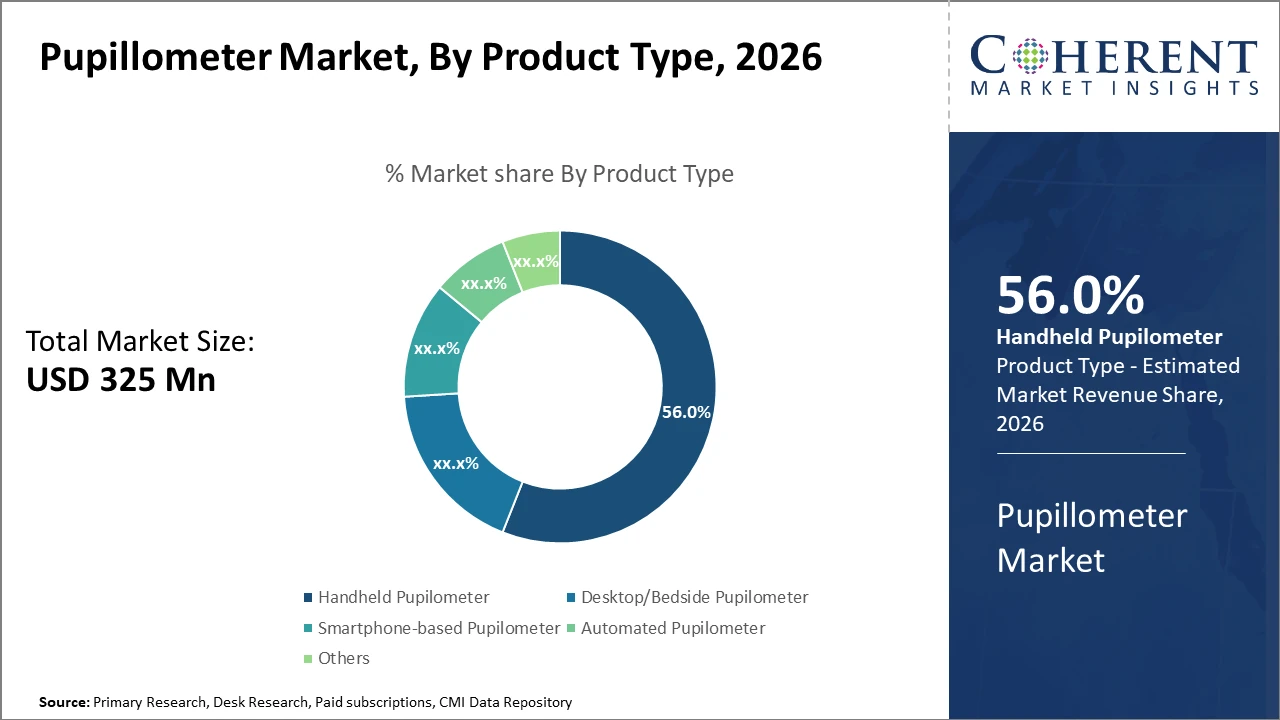
The handheld pupillometer segment dominates the market with around 56% share, driven by its portability, ease of use, and suitability for emergency and bedside clinical settings. It is also the fastest-growing segment due to continuous miniaturization, improved accuracy, and integration of digital and AI-enabled features.
Neurology remains the leading application segment, accounting for the largest revenue share, supported by the rising incidence of traumatic brain injuries and neurological disorders where pupillometry plays a key role in diagnosis and patient monitoring.
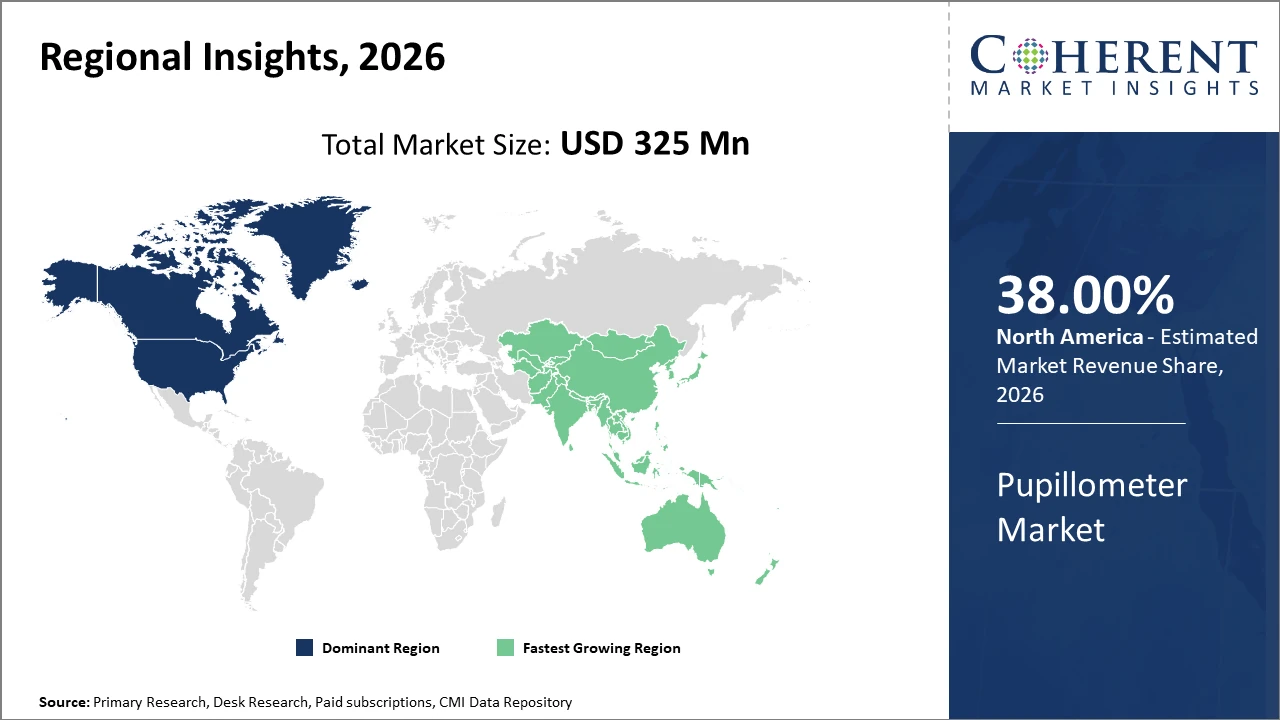
North America holds the largest regional share at approximately 38%, backed by advanced healthcare infrastructure, high adoption of medical technologies, and supportive reimbursement frameworks.
Asia Pacific is the fastest-growing region, driven by increasing healthcare investments, expanding hospital infrastructure, rising disease awareness, and growing access to cost-effective diagnostic devices in countries such as China and India.
Pupillometer Market Segmentation Analysis
Pupillometer Market Insights, By Product Type
Handheld pupillometers dominate the market with approximately 56% share due to their portability, ease of use, and suitability for rapid neurological assessment across emergency and bedside clinical settings. Their versatility enables clinicians to perform quick, point-of-care evaluations, making them highly preferred in hospitals and trauma care units. Smartphone-based pupillometers represent the fastest-growing segment, driven by integration with mobile health platforms and telemedicine solutions, offering cost-effective and accessible monitoring. Desktop or bedside pupillometers are widely used in neurology departments for continuous patient monitoring, while automated systems provide high-precision measurement with advanced data integration. Other niche devices serve specialized clinical research and veterinary applications.
Pupillometer Market Insights, By Application
Neurology dominates the pupillometer market in both revenue and overall share, as pupillometry is widely used for brain injury detection, neurodegenerative disease monitoring, and critical care assessment. Its ability to provide rapid, objective neurological evaluation makes it essential in intensive care and neurosurgical settings. The fastest-growing application segment is trauma and emergency care, driven by rising road traffic accidents and the need for quick pupillary reflex assessment in critical situations. Ophthalmology applications focus on diagnosing ocular disorders and evaluating drug responses, while anesthesiology increasingly uses pupillometry for monitoring depth of anesthesia. Other uses include research applications in neuroscience and pharmacology.
Pupillometer Market Insights, By End User
Hospitals dominate the pupillometer market in terms of both revenue and share due to their central role in neurological diagnostics, critical care, and emergency medicine. They widely deploy handheld and automated pupillometers in ICUs, neurology departments, and trauma units for rapid and accurate patient assessment. Ambulatory care centers represent the fastest-growing segment, driven by the increasing shift toward outpatient neurological evaluations and preventive healthcare services. Research centers use pupillometers extensively for clinical studies and neurological research, though they contribute a smaller share of overall revenue. Other end users include veterinary clinics and specialized diagnostic laboratories that utilize pupillometry for niche and experimental applications.
Pupillometer Market Trends
The pupillometer market is increasingly shaped by automation and AI integration, which have significantly enhanced diagnostic accuracy, workflow efficiency, and real-time neurological assessment capabilities across clinical settings.
In 2025, AI-based pupillometry platforms such as those introduced by Diopsys improved diagnostic throughput by approximately 25%, highlighting the growing role of intelligent analytics in medical decision-making.
The expansion of telehealth services has accelerated adoption of smartphone-compatible pupillometers, improving accessibility in remote and underserved regions, with Asia Pacific witnessing around a 30% increase in penetration in 2026 due to digital healthcare expansion and rural outreach initiatives.
Pupillometer Market Insights, By Geography
North America Pupillometer Market Analysis and Trends
In North America, the pupillometer market demonstrates strong dominance supported by advanced healthcare infrastructure, high adoption of medical technologies, and substantial investment in research and development. The region accounts for approximately 38% of the global market share, driven by widespread integration of pupillometry in neurology, emergency care, and intensive care units. Leading companies such as Neuroptics and Konan Medical play a key role in advancing product innovation and market expansion. Favorable reimbursement policies and government initiatives focused on neurological health monitoring further strengthen adoption rates. Additionally, the high prevalence of neurological disorders continues to sustain steady demand across hospitals and clinical settings.
Asia Pacific Pupillometer Market Analysis and Trends
Asia Pacific is the fastest-growing region in the pupillometer market, with a CAGR exceeding 11%. This growth is driven by improving healthcare infrastructure, rising healthcare expenditure, and increasing awareness of advanced neurological diagnostic tools. Countries such as India and China are witnessing strong adoption of pupillometers across tertiary care hospitals, emergency departments, and outpatient clinics. Expanding government initiatives to modernize healthcare systems and improve critical care capabilities are further supporting market penetration. Additionally, the availability of cost-effective devices from regional manufacturers is accelerating adoption in price-sensitive markets, making Asia Pacific a key growth hub for pupillometry solutions globally.
Pupillometer Market Outlook for Key Countries
USA Pupillometer Market Analysis and Trends
The USA pupillometer market has experienced rapid adoption, particularly in neurology and emergency care, driven by a rising incidence of traumatic brain injuries and increased use of automated diagnostic devices. In 2025, leading companies such as Neuroptics expanded their market presence through strategic partnerships with major hospital networks, significantly boosting device deployment across critical care settings. This contributed to approximately 40% of North America’s total pupillometer market revenue. Additionally, supportive regulatory pathways and U.S. FDA approvals for advanced pupillometry technologies have accelerated innovation and clinical adoption. These factors collectively reinforce the United States as a key global hub for pupillometric diagnostics and innovation.
Germany Pupillometer Market Analysis and Trends
Germany plays a significant role in the global pupillometer market, driven by its advanced healthcare infrastructure, strong neurology and ophthalmology research base, and high adoption of precision diagnostic tools. The country’s hospitals and specialized clinics increasingly use automated digital pupillometers for critical care monitoring, particularly in neurosurgery and intensive care units. Market trends indicate rising demand for AI-integrated and infrared-based pupillometry systems that enhance diagnostic accuracy and patient monitoring efficiency. Germany’s strict regulatory standards ensure high-quality medical device adoption, while strong R&D investments from domestic and international manufacturers support innovation. Additionally, growing cases of neurological disorders further contribute to steady market expansion.
Analyst Opinion
Advanced miniaturization and integration of infrared pupil measurement technology have significantly expanded pupillometer applications, with European hospitals reporting a 15% increase in neurological ICU monitoring in 2024, highlighting improved clinical utilization and diagnostic precision.
Demand-side growth is being driven by rising emergency and trauma care needs, with U.S. emergency units recording a 12% increase in pupillometer usage in 2025 due to higher cases of traumatic brain injuries and road accidents.
On the supply side, global manufacturing capacity for portable handheld pupillometers increased by around 20% in 2026, supporting rising demand from outpatient and ambulatory care settings and enabling broader market penetration.
Pricing trends show a decline of nearly 10% since 2024, driven by improved production efficiencies and economies of scale, making pupillometers more affordable and accessible in emerging and cost-sensitive markets.
- Current Industry Events of 2026
- Market Size Estimation
- Regional Breakdown
- Competitive Landscape
- Customer Intelligence
- Segmental Analysis
- Pricing Analysis
- Key Market Drivers, Challenges & Future Trends
- Customized Insights Section
Market Scope
| Report Coverage | Details | ||
|---|---|---|---|
| Base Year: | 2025 | Market Size in 2026: | USD 325 million |
| Historical Data for: | 2020 To 2024 | Forecast Period: | 2026 To 2033 |
| Forecast Period 2026 to 2033 CAGR: | 9.4% | 2033 Value Projection: | USD 620 million |
| Geographies covered: |
| ||
| Segments covered: |
| ||
| Companies covered: | Neuroptics Inc., Diopsys Inc., Keeler Ltd., Invoxia, CSO, Crochet-Bonnet, Konan Medical USA Inc., ALCON Laboatories Inc. | ||
| Growth Drivers: |
| ||
Pupillometer Market Growth Factors
The global pupillometer market is primarily driven by the rising prevalence of neurological disorders and traumatic brain injuries, with the WHO reporting a 14% increase in neuro-related emergencies between 2024 and 2025. Technological advancements, particularly automated pupillometers integrated with telemedicine platforms, are expanding their use in remote monitoring and acute care settings. Favorable regulatory approvals and reimbursement policies in developed economies are further supporting market growth by lowering adoption barriers and reducing overall healthcare costs. Additionally, the growing shift toward portable and multi-modal diagnostic devices is enhancing accessibility in emerging markets, enabling faster neurological assessments and significantly accelerating overall market expansion.
Pupillometer Market Development
In October 2023, NeurOptics launched the NPi-300 Pupillometer, a handheld device designed to measure pupil size and reactivity. The automated system enhances clinical assessment by supporting diagnosis, treatment decisions, and prognosis of brain injuries, while also aiding in the detection of neurological conditions such as traumatic brain injury, stroke, and seizures in both adult and pediatric patients.
Key Players
Leading Companies of the Market
Neuroptics Inc.
Diopsys Inc.
Keeler Ltd.
CSO
Invoxia
ALCON Laboratories Inc.
Crochet-Bonnet
Konan Medical USA Inc.
Competitive companies in the pupillometer market are increasingly focusing on innovation-driven growth and strategic collaborations to strengthen their market position. For instance, Neuroptics introduced wireless pupillometers in 2025, which enhanced device mobility and increased its penetration in outpatient clinical settings by approximately 18%. Similarly, Konan Medical expanded its footprint through collaborations with leading neurology centers across North America, resulting in a 22% rise in clinical trial deployments and reinforcing its regional presence. Additionally, Diopsys has emphasized AI-powered pupillary data analytics, improving diagnostic accuracy and broadening the clinical applications of pupillometry. These strategies collectively highlight the industry’s shift toward advanced, data-driven, and connected diagnostic solutions.
Pupillometer Market Future Outlook
The global pupillometer market is expected to witness strong growth driven by increasing prevalence of neurological disorders, traumatic brain injuries, and expanding use in critical care monitoring. Future advancements will focus on AI-powered diagnostic capabilities, enabling real-time assessment of pupil response for early detection of neurological abnormalities. Integration with hospital information systems and wireless connectivity will enhance workflow efficiency in intensive care and emergency settings. Growing demand for portable and user-friendly devices will expand adoption in ambulatory and pre-hospital care. Additionally, rising healthcare investments in emerging economies and continuous innovation by medical device manufacturers will further support long-term market expansion globally.
Pupillometer Market Historical Analysis
The pupillometer market has evolved significantly over the past decades, transitioning from manual pupil assessment methods to advanced digital diagnostic devices. Initially, pupil examination relied on subjective visual inspection using penlights, which limited accuracy and consistency in clinical evaluations. The introduction of infrared-based pupillometers marked a major advancement, enabling objective and quantitative measurement of pupil size and reactivity. Over time, adoption expanded across neurology, ophthalmology, and critical care settings due to improved diagnostic reliability. In recent years, integration of automation, portability, and digital data recording has further enhanced clinical efficiency. Growing awareness of neurological assessment tools has steadily supported historical market expansion.
Sources
Primary Research Interviews:
Medical device manufacturers, hospital procurement managers, neurologists, ophthalmologists, ICU specialists, emergency medicine physicians, and clinical diagnostic equipment distributors involved in pupillometer usage and deployment.
Biomedical engineers, neurodiagnostic researchers, critical care specialists, regulatory consultants, and R&D directors specializing in neurological monitoring devices, infrared diagnostic systems, and digital medical imaging technologies.
Magazines:
Medical Device & Diagnostic Industry (MD+DI) – Coverage of medical imaging and diagnostic device innovations.
MedTech Dive – Insights into healthcare technology trends, hospital equipment adoption, and digital diagnostics.
Healthcare Technology Report – Updates on advanced patient monitoring systems and neurodiagnostic tools.
Journals:
Journal of Clinical Monitoring and Computing – Research on patient monitoring systems and neurological assessment tools.
Neurocritical Care – Studies on brain injury monitoring, ICU diagnostics, and pupillometry applications.
IEEE Journal of Biomedical and Health Informatics – Research on digital health devices, AI integration, and medical diagnostic technologies.
Newspapers:
Financial Times – Coverage of medical device industry investments and healthcare technology markets.
Reuters – Reporting on healthcare innovation, regulatory approvals, and medical device expansion.
Bloomberg – Insights into medtech companies, diagnostic device markets, and global healthcare industry trends.
Associations:
American Academy of Neurology – Guidelines and research on neurological diagnostics and clinical practice.
World Federation of Neurology – International initiatives in brain health and neurological disorder management.
Association for the Advancement of Medical Instrumentation – Standards and regulatory frameworks for medical diagnostic equipment.
Get access to 250+ pages report
Every segment, forecast, competitor profile and data table behind the analysis above — available for instant download.
- ESOMAR Member
- ISO 9001:2015 Certified
- D-U-N-S Registered
- GDPR & CCPA Compliant
Missing comfort of reading report in your local language? Find your preferred language:
Transform your Strategy with Exclusive Trending Reports
Frequently Asked Questions
Leading companies in the pupillometer market include Neuroptics, Diopsys, and Konan Medical. These players maintain strong market positions through continuous innovation, strategic partnerships with healthcare providers, and expanding global distribution networks.
The pupillometer market is projected to reach approximately USD 620 million by 2033, growing at a CAGR of 9.4% between 2026 and 2033, driven by rising neurological disorder cases and technological advancements.
Neurology represent the largest growth opportunities due to increasing incidence of brain injuries and the need for rapid, accurate critical care diagnostics.
Market trends will increasingly focus on AI-enabled diagnostics, integration with telemedicine platforms, and portable device innovations that enhance clinical efficiency and expand usage scenarios.
The market is highly competitive and innovation-driven, with key challenges including high device costs, regulatory approval complexities, and slower adoption in price-sensitive regions.
Common strategies include strategic partnerships with hospitals and clinics, continuous product innovation, expansion into emerging markets, and strengthening distribution networks globally.