

Scoliosis Management Market Size and Forecast – 2026 to 2033
The Scoliosis Management Market is estimated to be valued at USD 4.06 Bn in 2026 and is expected to reach USD 6.01 Bn by 2033, exhibiting a compound annual growth rate (CAGR) of 5.2% from 2026 to 2033.
Key Takeaways
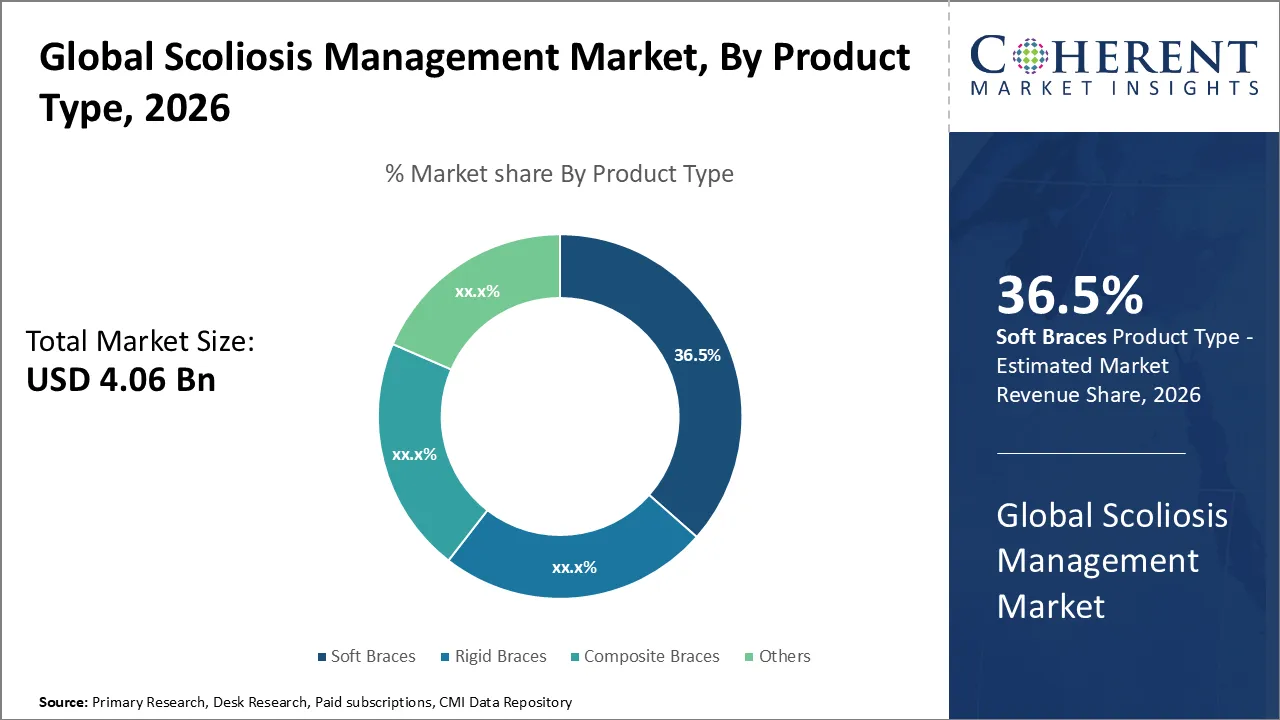
- By Product Type, Soft Braces hold the largest market share of 36.5% in 2026 owing to its preference for non-invasive and conservative treatments.
- By Spinal Location, Lumbosacral Orthosis (LSO) expected to hold largest market share of 32.2% in 2026 owing to the rising prevalence of spinal and musculoskeletal disorders.
- By Demographics, Pediatric acquired the prominent market share of 56.6% in 2026 owing to the high prevalence of adolescent idiopathic scoliosis.
- By Disease Type, Juvenile Idiopathic Scoliosis hold the largest market share of 43.3% in 2026 owing to its rising early diagnosis and pediatric screening programs.
- By End User, Hospitals & Clinics capture the largest market share of 45.6% in 2026 owing to the comprehensive, multidisciplinary care capabilities.
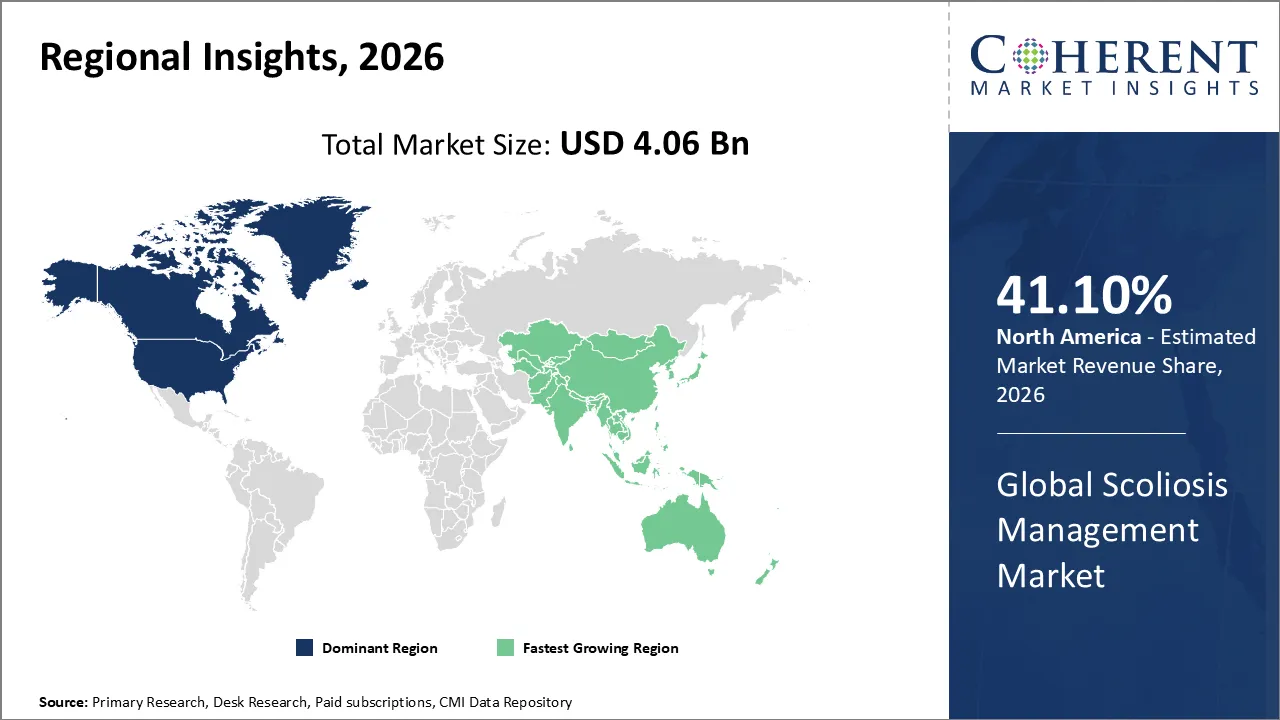
- By Region, North America dominates the overall market with an estimated share of 41.1% in 2026 owing to the advanced healthcare infrastructure.
Market Overview
The scoliosis management market is for diagnosing, monitoring, and treating spinal curvature conditions in both children and adults. It has both surgical and non-surgical options, like bracing, physiotherapy, and monitoring technologies, as well as surgical treatments for extremely serious cases. Growing awareness, earlier diagnosis, technological advancements in orthopedics, and a stronger preference for conservative care continue to drive the market.
Current Events and Its Impacts on the Scoliosis Management Market
Current Events | Description and its impact |
Technological Innovations in Scoliosis Treatment |
|
Regulatory and Reimbursement Landscape Changes |
|
Geopolitical and Economic Developments |
|
Segmental Insights
- Current Industry Events of 2026
- Market Size Estimation
- Regional Breakdown
- Competitive Landscape
- Customer Intelligence
- Segmental Analysis
- Pricing Analysis
- Key Market Drivers, Challenges & Future Trends
- Customized Insights Section
Scoliosis Management Market Insights, By Product Type: Soft Braces contribute the highest share of the market owing to its rising early diagnosis and awareness.
Soft Braces hold the largest market share of 36.5% in 2026. Growing demand for patient-friendly and non-invasive treatment options drives the use of soft braces, especially for mild to moderate scoliosis cases. Their lightweight, flexible construction improves comfort, enabling patients to wear them daily and maintain long-term compliance, particularly among children and adolescents. Greater emphasis on early intervention, mobility, and quality of life further boosts adoption. Innovations in materials and customization technologies improve fit and functionality, while increased reliance on home-based and outpatient care supports the integration of soft braces into conservative scoliosis management.
For instance, DJO Global Inc. has launched the Clima-Flex OA Knee Brace from DonJoy for patients with mild to moderate osteoarthritis knee pain. The brace provides relief through cooling, compression, and offloading, and features DonJoy C-6 Fabric Technology, offering breathable, moisture-wicking, temperature-controlled, and antimicrobial comfort. Such innovations are accelerating the scoliosis market demand.
Scoliosis Management Market Insights, By Spinal Location: Lumbosacral Orthosis (LSO) contribute the highest share of the market owing to its shift toward non-invasive and conservative management.
Lumbosacral Orthosis (LSO) expected to hold largest market share of 32.2% in 2026. The rising prevalence of lower back disorders and adult degenerative scoliosis drives demand for lumbosacral orthosis in scoliosis management. Healthcare providers increasingly prescribe LSOs to stabilize the lumbar spine, relieve pain, and improve posture without surgery.
An aging population, growing cases of chronic spinal conditions, and stronger preference for conservative care support adoption. Better ergonomic designs, breathable materials, and easy-to-use features make patients more comfortable and willing to use LSO. More outpatient and rehabilitation services also make LSO use growing in popularity.
For example, in January 2026, Aspen Medical Products released the Popple LSO, the first clinically designed maternity lower spine brace. It is meant to help with symptoms and provide support.
Scoliosis Management Market Insights, By Demographics: Pediatric contribute the highest share of the market owing to its growing parental & caregiver awareness.
Pediatric acquired the prominent market share of 56.6% in 2026. The high incidence of spinal curvature during childhood growth stages and a stronger focus on early detection drive the pediatric scoliosis management market. Parents, schools, and pediatricians all work hard to raise awareness, which leads to timely screening and intervention. Healthcare professionals prefer non-surgical treatments like bracing and physiotherapy to prevent the curve from getting worse in kids who are still growing. New designs for braces that are better for kids, more comfortable, and better at long-term monitoring all help to keep up the demand for pediatric scoliosis care.
In February 2025, SpringWorks Therapeutics said that the FDA had approved GOMEKLI™ (mirdametinib), its MEK inhibitor, for treating adults and children aged 2 and older with neurofibromatosis type 1 and symptomatic plexiform neurofibromas that cannot be completely removed.
Scoliosis Management Market Insights, By Disease Type: Juvenile Idiopathic Scoliosis contribute the highest share of the market owing to its technological advancements in pediatric-friendly solutions.
Juvenile Idiopathic Scoliosis hold the largest market share of 43.3% in 2026. The high risk of curve progression during early childhood growth drives demand for juvenile idiopathic scoliosis management. Healthcare providers emphasize early diagnosis and regular monitoring to limit deformity and lower the likelihood of future surgery.
Parents actively pursue proactive, conservative treatments such as customized bracing and targeted physiotherapy. Expanded pediatric orthopedic services, improved access to specialists, and advances in child-friendly treatment technologies further strengthen ongoing demand for juvenile idiopathic scoliosis management solutions.
Regional Insights
North America Scoliosis Management Market Trends
North America dominates the overall market with an estimated share of 41.10% in 2026. The North American scoliosis management market grows as healthcare providers increasingly adopt advanced diagnostic and treatment technologies, such as 3D-printed braces, smart monitoring systems, and minimally invasive surgical procedures. Heightened awareness of early detection and preventive care prompts more patients to seek timely intervention. Well-established healthcare infrastructure, broad insurance coverage, and the presence of top orthopedic specialists enable comprehensive care. Moreover, increased focus on both pediatric and adult scoliosis, along with expanding outpatient and home-based services, drives innovation and market development across the region.
Image Biopsy Lab has launched its SQUIRREL module for X-ray scoliosis assessment and received MDR CE certification for the device.
Asia Pacific Scoliosis Management Market Trends
The Asia Pacific scoliosis management market is expanding as healthcare providers and patients increasingly adopt early detection and treatment solutions, supported by improved infrastructure and greater access to specialized orthopedic care. Patients actively use non-surgical interventions like braces and physiotherapy, while urban centers gradually implement advanced surgical procedures.
Government programs promoting early screening and the growing pediatric and adolescent population drive demand further. Innovations in affordable braces, telemedicine follow-ups, and rehabilitation services actively enhance access and effectiveness of scoliosis management across the region.
United States Scoliosis Management Market Trends
The United States scoliosis management market grows as healthcare providers actively adopt advanced diagnostic and treatment technologies, including custom braces, digital monitoring systems, and minimally invasive surgical procedures. Parents and patients increasingly pursue early screening and timely intervention, especially for pediatric cases.
Robust healthcare infrastructure, widespread insurance coverage, and access to leading orthopedic specialists allow providers to deliver comprehensive care. Furthermore, the growth of outpatient centers, home-based follow-up programs, and multidisciplinary treatment approaches actively enhances scoliosis management and improves patient outcomes across the country.
India Scoliosis Management Market Trends
The India scoliosis management market is growing as patients and healthcare providers increasingly prioritize spinal health and access specialized orthopedic care. Providers actively implement non-surgical treatments such as braces and physiotherapy, while advanced surgical procedures steadily expand in urban hospitals. Government programs promoting early school screenings, along with a rising pediatric and adolescent population, drive further demand.
Moreover, innovations in affordable braces, telemedicine consultations, and rehabilitation services actively enhance accessibility and improve the effectiveness of scoliosis management across urban and semi-urban areas.
End-User Feedback and Unmet Needs in the Scoliosis Management Market
- Patient Comfort and Compliance: Patients often struggle with long-term use of braces due to discomfort, heat, and restricted mobility. There is a demand for lightweight, breathable, and ergonomically designed braces that allow normal daily activities. Improving comfort and customization can enhance adherence and overall treatment effectiveness for both children and adults.
- Early Detection and Awareness: Parents and caregivers frequently lack awareness of scoliosis signs in children, delaying intervention. Schools and community programs for early screening are limited, leaving gaps in timely diagnosis. Enhancing educational initiatives and awareness campaigns can support earlier intervention, prevent curve progression, and reduce the need for surgical procedures.
- Monitoring and Treatment Accuracy: Healthcare providers report challenges in tracking brace compliance and curve progression outside clinical settings. There is a need for digital monitoring tools and real-time feedback systems that provide accurate, continuous data, allowing clinicians to make timely adjustments and optimize patient outcomes across both pediatric and adult populations.
Scoliosis Management Market Trend
Rising Adoption of Non-Surgical Treatments
The market is shifting toward non-invasive scoliosis management solutions such as bracing, physiotherapy, and posture-correcting devices. Patients and clinicians prefer these approaches to delay or avoid surgery, especially in pediatric and adolescent populations. Innovations in lightweight, flexible, and customized braces improve comfort and compliance, while digital monitoring tools enable real-time progress tracking, supporting more effective, patient-centered care. This trend emphasizes preventive intervention and long-term management over invasive procedures.
Scoliosis Management Market Opportunity
Integration of Digital Monitoring and Smart Devices
Opportunities exist in deploying smart braces and digital monitoring systems that track spinal curvature progression and patient compliance. These connected solutions enable clinicians to adjust treatment plans remotely, enhance data-driven decision-making, and improve patient engagement. Companies can innovate wearable sensors, mobile applications, and AI-powered analytics platforms to provide real-time feedback, offering a competitive edge and creating long-term adherence solutions for both pediatric and adult scoliosis patients.
Market Report Scope
Scoliosis Management Market Report Coverage
| Report Coverage | Details | ||
|---|---|---|---|
| Base Year: | 2025 | Market Size in 2026: | USD 4.06 Bn |
| Historical Data for: | 2020 To 2024 | Forecast Period: | 2026 To 2033 |
| Forecast Period 2026 to 2033 CAGR: | 5.2% | 2033 Value Projection: | USD 6.01 Bn |
| Geographies covered: |
| ||
| Segments covered: |
| ||
| Companies covered: | Boston Orthotics & Prosthetics, Aspen Medical Products, Lawall Prosthetics and Orthotics, Horton’s Orthotics & Prosthetics, Spinal Technology Inc., Ortholutions GmbH & Co. KG, Ossur Hf, Charleston Bending Brace, UNYQ, and Pro-Tech Orthopedics. | ||
| Growth Drivers: |
| ||
| Restraints & Challenges: |
| ||
Scoliosis Management Market News
In March 2025, Cedars-Sinai Spine unveiled a pilot program for pediatric patients that leverages artificial intelligence to enable radiation-free, at-home scoliosis monitoring and brace compliance tracking. The program features Momentum Spine—an AI-powered, mobile spine imaging and monitoring platform and a graduate of the Cedars-Sinai Accelerator—that personalizes spinal deformity monitoring while minimizing the long-term risks associated with repeated radiation exposure.
Analyst Opinion (Expert Opinion)
- The scoliosis management market is unmistakably shifting from rigid, one‑size‑fits‑all approaches toward precision‑oriented, patient‑centric care. Clinical evidence underscores this evolution: thoracolumbosacral orthoses (TLSO) remain the predominant non‑surgical intervention, prescribed in approximately 58% of brace cases globally due to robust clinical outcomes in adolescent idiopathic scoliosis (AIS). Contemporary cohort studies demonstrate that up to 79% of moderate AIS curves stabilize with appropriate bracing regimens, underscoring that conservative care, when executed with precision, can rival surgical outcomes in select populations.
- Investment and innovation are disproportionately concentrated in technologies that enhance both compliance and clinical performance. The adoption of custom‑fit and 3D‑printed braces — accounting for roughly 21–25% of brace utilization — reflects clinician and patient demand for comfort without compromising corrective biomechanics. Meanwhile, digital monitoring tools are no longer fringe; they now support tens of millions of treatment interactions, indicating that data‑driven adherence tracking is becoming a standard of care rather than an optional add‑on.
- However, this progress obscures a persistent dichotomy: clinical evidence supporting brace effectiveness remains heterogeneous, with systematic reviews highlighting variable methodology and limited high‑quality trials, complicating the establishment of universal treatment protocols. The broader market must reconcile technological sophistication with rigorously validated outcomes to justify wider clinical adoption. Moreover, compliance rates — influenced by comfort, wear time, and psychosocial factors — remain a significant barrier, particularly among adolescents, where real‑world adherence is demonstrably suboptimal.
Speak to the analyst
Want personalized insights?
Take the findings above to one of our principal consultants, or have the report rebuilt around the segments, geographies and competitors you actually track.
Market Segmentation
- By Product Type
- Soft Braces
- Rigid Braces
- Composite Braces
- Others
- By Spinal Location
- Thoracolumbosacral Orthosis (TLSO)
- Cervical Thoracic Lumbar Sacral Orthosis (CTLSO)
- Lumbosacral Orthosis (LSO)
- Others
- By Demographics
- Adult
- Pediatric
- By Disease Type
- Infantile Idiopathic Scoliosis
- Juvenile Idiopathic Scoliosis
- Adolescent Idiopathic Scoliosis
- Neuromuscular Scoliotic Curves
- Congenital Scoliotic Curves
- Adult Scoliosis
- By Regional Insights
- North America
- U.S.
- Canada
- Latin America
- Brazil
- Argentina
- Mexico
- Rest of Latin America
- Europe
- Germany
- U.K.
- Spain
- France
- Italy
- Russia
- Rest of Europe
- Asia Pacific
- China
- India
- Japan
- Australia
- South Korea
- ASEAN
- Rest of Asia Pacific
- Middle East
- GCC Countries
- Israel
- Rest of Middle East
- Africa
- South Africa
- North Africa
- Central Africa
- North America
- Key Players Insights
- Boston Orthotics & Prosthetics
- Aspen Medical Products
- Lawall Prosthetics and Orthotics
- Horton’s Orthotics & Prosthetics
- Spinal Technology Inc.
- Ortholutions GmbH & Co. KG
- Ossur Hf
- Charleston Bending Brace
- UNYQ
- Pro-Tech Orthopedics
Sources
Primary Research interviews
- Orthopedic surgeons and spine specialists
- Pediatricians and physiotherapists
- Hospital administrators and clinic managers
- Rehabilitation and brace fitting experts
- Patient advocacy group representatives
Databases
- PubMed
- National Center for Biotechnology Information (NCBI)
- World Health Organization (WHO) health statistics
- Centers for Disease Control and Prevention (CDC) databases
- ClinicalTrials.gov
Magazines
- Orthopedics Today
- Spine & Orthopedic Journal Magazine
- Physical Therapy Product News
- Pediatric Orthopedic Practice
Journals
- The Spine Journal
- Journal of Pediatric Orthopaedics
- Scoliosis and Spinal Disorders
- European Spine Journal
- Clinical Spine Surgery
Newspapers
- The New York Times – Health Section
- The Guardian – Health & Science Section
- The Times of India – Health & Wellness
- The Washington Post – Medical Reports
Associations
- Scoliosis Research Society (SRS)
- Pediatric Orthopaedic Society of North America (POSNA)
- American Academy of Orthopaedic Surgeons (AAOS)
- International Society on Scoliosis Orthopaedic and Rehabilitation Treatment (SOSORT)
Public Domain sources
- National Institutes of Health (NIH) publications
- WHO annual health reports
- Government health portals (e.g., CDC, NHS)
- Peer-reviewed open-access research articles
Proprietary Elements
- CMI Data Analytics Tool
- Proprietary CMI Existing Repository of information for last 8 years
Get access to 250+ pages report
Every segment, forecast, competitor profile and data table behind the analysis above — available for instant download.
- ESOMAR Member
- ISO 9001:2015 Certified
- D-U-N-S Registered
- GDPR & CCPA Compliant
Missing comfort of reading report in your local language? Find your preferred language:
Transform your Strategy with Exclusive Trending Reports
Frequently Asked Questions
The Logistics Robots Market is estimated to be valued at USD 4.06 Bn in 2026 and is expected to reach USD 6.01 Bn by 2033.
The CAGR of the Scoliosis Management Market is projected to be 5.2% from 2026 to 2033.
Key drivers include rising awareness and early diagnosis, technological advancements in braces and monitoring systems, growing preference for non-surgical interventions, and expansion of pediatric and adolescent care.
Challenges include high costs of advanced braces and surgical procedures, and patient compliance issues—especially with long-term brace use—limited awareness in rural regions.
North America leads due to advanced healthcare infrastructure, high awareness, and technological adoption.