

Spinal Implants Market Size and Forecast — 2026 - 2033
The Global Spinal Implants Market size is estimated to be valued at USD 9.8 billion in 2026 and is expected to reach USD 16.5 billion by 2033, exhibiting a compound annual growth rate (CAGR) of 7.5% from 2026 to 2033.
Overview
The spinal implants market comprises a range of medical devices designed to treat spinal disorders, injuries, and deformities. Key products include spinal fusion devices, such as interbody cages and pedicle screws, which stabilize vertebrae and promote bone growth. Non-fusion implants, including artificial discs and dynamic stabilization systems, aim to maintain spinal mobility while providing support. Minimally invasive implants, such as percutaneous screws and expandable cages, reduce surgical trauma and recovery time. Additionally, biologics and bone graft substitutes complement implant functionality by enhancing fusion and healing. Advanced materials like titanium, PEEK, and bioresorbable polymers improve durability, biocompatibility, and patient outcomes.
Key Takeaways
The spinal fusion implant segment dominates the market with a 47% share, driven by the high frequency of spinal fusion surgeries and favorable clinical outcomes.
Titanium and its alloys are the preferred material, holding the largest market share due to their strength and biocompatibility. PEEK is the fastest-growing material segment, supported by increasing use in minimally invasive surgeries.
North America holds the largest industry share, driven by advanced healthcare infrastructure, robust reimbursement systems, and a strong presence of leading market players.
Asia Pacific is the fastest-growing region, fueled by healthcare modernization, rising awareness, and increased investments in spinal implant manufacturing by domestic and international companies.
Spinal Implants Market Segmentation Analysis
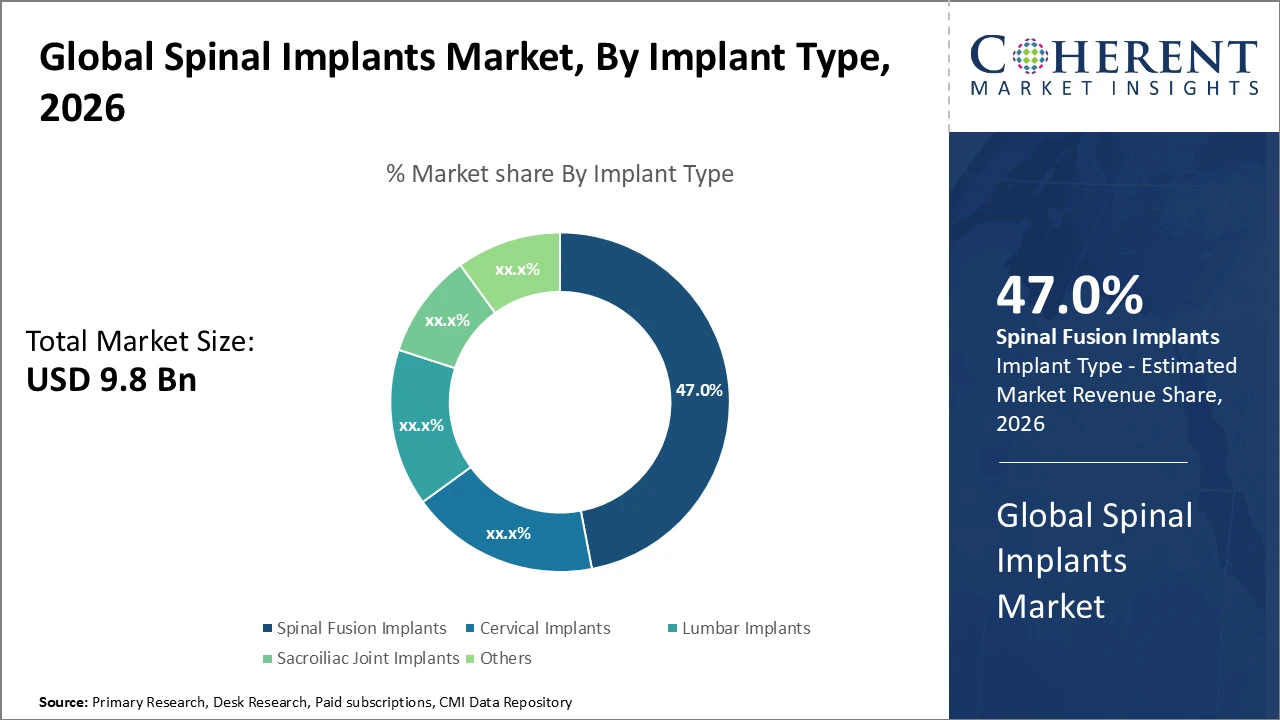
Spinal Implants Market Insights, By Implant Type
Spinal fusion implants dominate the market with a 47% share, driven by their extensive use in treating conditions such as scoliosis, degenerative disc disease, and spinal trauma. Cervical implants represent the fastest-growing subsegment, benefiting from advanced biomaterials and minimally invasive anterior cervical discectomy and fusion procedures, offering precision and reduced recovery time. Lumbar implants provide essential stability in the lower spine, supporting load-bearing and preserving mobility. Sacroiliac joint implants are expanding due to rising diagnosis of joint dysfunction, while the ‘Others’ category includes emerging devices targeting niche spinal disorders. Collectively, these implants address diverse clinical needs, driving overall market growth.
Spinal Implants Market Insights, By Material Type
Titanium and its alloys hold the largest market share, mainly due to their superior strength-to-weight ratio, corrosion resistance, and biocompatible properties. This subsegment has long been preferred in surgical practice. The fastest growing material subsegment is PEEK, widely favored for its radiolucency, elasticity similar to bone, and compatibility with minimally invasive surgeries. Stainless Steel serves well in cost-sensitive regions but is limited by lower biocompatibility and corrosion issues. Cobalt-Chromium finds use in implants requiring exceptional wear resistance, whereas the ‘Others’ category holds emerging biomaterials and composites that target enhanced bioactivity or flexible support for spinal structures.
Spinal Implants Market Insights, By Surgery Type
Minimally invasive surgery (MIS) dominates the spinal implants market due to patient benefits such as reduced hospital stays, lower complication rates, and faster recovery. MIS is also the fastest-growing subsegment, driven by technological advancements including robotic-assisted systems, enhanced imaging, and navigation tools, which improve precision and accessibility globally. Open surgery remains a key segment for complex or multi-level spinal pathologies requiring extensive decompression and fusion. The ‘Others’ category includes hybrid techniques and emerging approaches that integrate robotic and AI-assisted systems, highlighting future growth opportunities. Overall, MIS adoption is reshaping surgical practices and expanding the spinal implant market.
Spinal Implants Market Trends
The spinal implants market is rapidly evolving due to increased adoption of advanced biomaterials, AI integration in surgeries, and personalized implant solutions.
Titanium and PEEK implants with enhanced osteointegration capabilities demonstrate a focus on improving biocompatibility, durability, and clinical outcomes.
AI-driven pre-surgical planning tools introduced in 2025 have improved implant placement accuracy by approximately 15%, enhancing surgical precision.
Robotic-assisted surgeries now account for nearly one-third of minimally invasive spinal procedures globally in 2026, reflecting significant technological shifts shaping market dynamics and driving adoption of advanced surgical techniques.
Spinal Implants Market Insights, By Geography
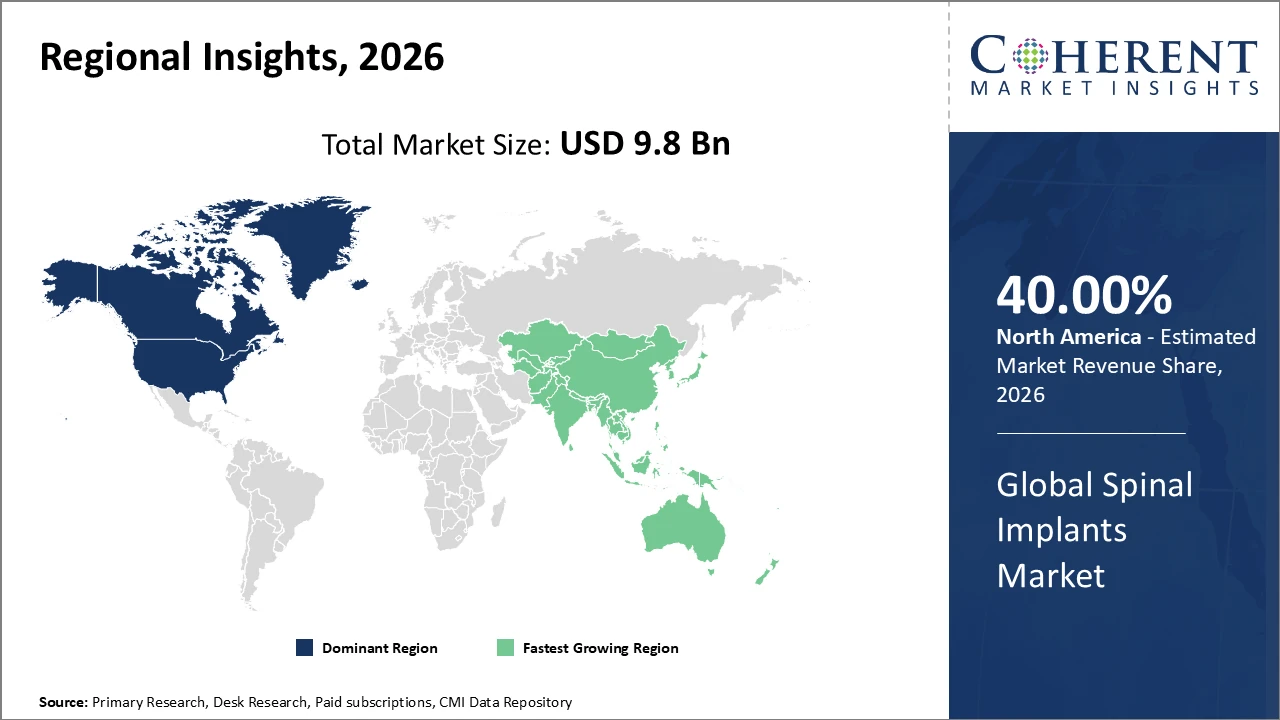
North America Spinal Implants Market Analysis and Trends
In North America, the spinal implants market is dominated by advanced healthcare infrastructure, substantial government healthcare expenditure exceeding USD 4 trillion annually, and the presence of key players such as Medtronic and Stryker. The region accounted for around 40% of the global market share in 2026. Favorable reimbursement policies support the adoption of innovative spinal implants, encouraging hospitals and surgical centers to invest in advanced technologies. High prevalence of spinal disorders, growing demand for minimally invasive procedures, and ongoing R&D initiatives further strengthen market growth, making North America a leading contributor to global revenue and shaping regional competitive dynamics.
Asia Pacific Spinal Implants Market Analysis and Trends
Asia Pacific is the fastest-growing spinal implants market, with a projected CAGR exceeding 9% from 2026 to 2033. Growth is fueled by expanding healthcare access, rising rates of spinal surgeries in populous countries like China and India, and advancements in domestic manufacturing of implants. Government initiatives aimed at improving healthcare infrastructure, coupled with increasing patient awareness of spinal disorders and treatment options, further support market expansion. Additionally, international companies are establishing local partnerships and production facilities to meet rising demand, making the region a key growth hub for spinal implants and a significant contributor to the global market trajectory.
Spinal Implants Market Outlook for Key Countries
USA Spinal Implants Market Analysis and Trends
The U.S. spinal implants market is the most influential globally, driven by high procedure volumes, strong reimbursement frameworks, and significant R&D investments by companies such as Johnson & Johnson and NuVasive. Over 60% of spinal surgeries worldwide are performed in the U.S., with spinal implant revenue surpassing USD 3.8 billion in 2025. The country leads in innovations, including minimally invasive implant systems and AI-assisted surgical planning tools, setting industry benchmarks. Favorable regulatory support, advanced healthcare infrastructure, and physician preference for cutting-edge implant technologies further reinforce market growth, making the U.S. a key driver of global spinal implants market trends.
Germany Spinal Implants Market Analysis and Trends
Germany’s spinal implants market is supported by a robust healthcare system, high adoption of spinal surgical procedures, and active industry participation from key players such as Zimmer Biomet and B. Braun Melsungen AG. In 2025, the country saw a 5.5% increase in spinal surgeries, indicating rising clinical demand. Strong government support for healthcare innovation, along with favorable reimbursement policies, enhances accessibility to advanced implant technologies. Growth opportunities are particularly notable in bioactive implant materials and personalized spinal solutions, reflecting the market’s focus on improving patient outcomes, surgical precision, and long-term implant performance, driving steady revenue expansion.
Analyst Opinion
Supply-side dynamics are expanding the spinal implants market, with increased production capacity among leading manufacturers boosting availability of advanced materials like titanium alloys and PEEK composites. In 2025, production volumes of high-grade implants rose 18% year-over-year to meet growing surgical demand.
Demand-side indicators show rising spinal surgery volumes driven by demographics and increasing prevalence of degenerative spinal diseases. The U.S. alone recorded over 600,000 spinal fusion surgeries in 2024, a 7% increase from 2023, fueling both domestic consumption and imports of implants.
Pricing trends remain stable despite raw material fluctuations, aided by economies of scale and process optimization, supporting adoption in price-sensitive emerging regions. Between 2024 and 2026, global implant prices varied less than 3%.
Micro-level factors include growing R&D investments in bioactive and 3D-printed spinal implants, with approximately USD 450 million invested globally in 2025, strengthening innovation pipelines and competitive positioning.
- Current Industry Events of 2026
- Market Size Estimation
- Regional Breakdown
- Competitive Landscape
- Customer Intelligence
- Segmental Analysis
- Pricing Analysis
- Key Market Drivers, Challenges & Future Trends
- Customized Insights Section
Market Scope
| Report Coverage | Details | ||
|---|---|---|---|
| Base Year: | 2025 | Market Size in 2026: | USD 9.8 billion |
| Historical Data for: | 2020 To 2024 | Forecast Period: | 2026 To 2033 |
| Forecast Period 2026 to 2033 CAGR: | 7.5% | 2033 Value Projection: | USD 16.5 billion |
| Geographies covered: |
| ||
| Segments covered: |
| ||
| Companies covered: | Stryker Corporation, Medtronic, NuVasive Inc., Johnson & Johnson, Globus Medical, Zimmer Biomet Holdings Inc., Ulrich Medical, LDR Holding Corporation, RTI Surgical Inc., Orthofix Holdings Inc. | ||
| Growth Drivers: |
| ||
Spinal Implants Market Growth Factors
The global spinal implants market is driven by the rising prevalence of spinal disorders, particularly degenerative diseases and trauma, affecting over 15% of the population in 2025. Technological advancements, including 3D-printed custom implants, bioactive coatings, and robotic-assisted surgeries, are improving surgical precision and patient outcomes, fueling market growth. Increased healthcare spending and expanded insurance coverage in North America and Europe enhance affordability and procedure volumes. Additionally, the shift toward minimally invasive spinal surgeries, which reduce recovery times and complications, is driving demand for compatible implants, with minimally invasive procedures increasing by 23% between 2024 and 2026.
Spinal Implants Market Development
In January 2026, Spineology Inc. unveiled OptiMesh HA Nano, its latest innovation in personalized spinal care. The product advances expandable interbody fusion by combining the OptiMesh implant platform with Promimic AB’s patented HA Nano Surface technology.
Key Players
Leading Companies of the Market
Stryker Corporation
Zimmer Biomet Holding Inc.
NuVasive Inc.
Medtronic
Globus Medical
Johnson & Johnson
Ulrich Medical
LDR Holding Corporation
Orthofix Holdings Inc.
RTI Surgical Inc.
Companies are leveraging growth strategies including mergers and acquisitions, technological collaborations, and geographic expansion to strengthen their market positions. In 2025, Medtronic’s acquisition of a specialized 3D printing firm enhanced its ability to deliver patient-specific spinal implants, resulting in a 12% revenue increase in North America. Similarly, Stryker partnered with academic institutions across Asia Pacific to accelerate the launch of minimally invasive implant systems, effectively meeting rising demand in emerging markets. These strategic initiatives not only expand product portfolios but also improve regional market penetration, reinforce competitive advantage, and drive overall growth in the spinal implants sector.
Spinal Implants Market Future Outlook
The spinal implants market is poised for strong growth over the coming years, driven by rising spinal disorder prevalence, technological advancements, and expanding healthcare access globally. Innovations such as 3D-printed patient-specific implants, bioactive coatings, and robotic-assisted minimally invasive surgeries are expected to enhance surgical precision and improve patient outcomes, fueling adoption. Increasing healthcare expenditure and favorable reimbursement policies in North America and Europe, alongside growing investments in emerging regions like Asia Pacific, will further expand market reach. Continued R&D, strategic collaborations, and a shift toward personalized spinal solutions are anticipated to sustain competitive dynamics and support long-term market expansion through 2033.
Spinal Implants Market Historical Analysis
The spinal implants market has witnessed steady growth over the past decade, driven by rising incidence of spinal disorders, technological innovations, and increasing surgical interventions. Between 2015 and 2025, adoption of spinal fusion implants, particularly titanium and PEEK-based devices, dominated the market due to their durability and biocompatibility. Minimally invasive surgical techniques gained momentum during this period, improving patient outcomes and reducing hospital stays. Key regions like North America led market expansion, supported by advanced healthcare infrastructure and reimbursement policies, while Asia Pacific began emerging as a high-growth market due to increasing healthcare access and rising awareness of spinal treatments.
Sources
Primary Research Interviews:
Orthopedic surgeons, neurosurgeons, and spinal specialists at leading hospitals and clinics
Chief medical officers, clinical directors, and biomedical engineers at spinal implant manufacturers
Hospital procurement managers, healthcare consultants, and clinical research professionals advising on implant adoption, surgical optimization, and patient outcomes
Magazines:
Orthopedic Design & Technology – Implant Innovations and Clinical Integration
Becker’s Spine Review – Spinal Surgery Procedures and Device Updates
Spine Surgery Today – Minimally Invasive Spine Trends and Implant Techniques
Orthopedics Today – Surgical Advancements and Spinal Implant Developments
Journals:
Spine Journal – Advances in Spinal Implant Technologies
Journal of Orthopaedic Research – Device Innovation and Surgical Optimization
European Spine Journal – Clinical Outcomes and Efficacy of Spinal Implants
International Journal of Spine Surgery – Procedural Trends and Implant Performance
Newspapers:
The Wall Street Journal – Healthcare Technology Developments and Spinal Surgery Market Trends
Financial Times – Healthcare Investments and Spinal Implants Market Growth
MedTech Dive – Innovations, Startups, and Competitive Movements in Spine Devices
Business Insider – Orthopedic Device Industry Updates and Market Dynamics
Associations:
North American Spine Society (NASS) – Guidelines and Best Practices in Spinal Surgery
American Academy of Orthopaedic Surgeons (AAOS) – Standards for Spinal Procedures and Implant Adoption
International Society for the Advancement of Spine Surgery (ISASS) – Implant Guidelines and Market Trends
Scoliosis Research Society (SRS) – Clinical Standards and Spinal Implant Practices
Get access to 250+ pages report
Every segment, forecast, competitor profile and data table behind the analysis above — available for instant download.
- ESOMAR Member
- ISO 9001:2015 Certified
- D-U-N-S Registered
- GDPR & CCPA Compliant
Missing comfort of reading report in your local language? Find your preferred language:
Transform your Strategy with Exclusive Trending Reports
Frequently Asked Questions
Leading companies include Medtronic plc, Johnson & Johnson, Stryker Corporation, NuVasive, Inc., and Zimmer Biomet Holdings, Inc., who collectively hold significant market share and drive continuous innovations.
The Spinal Implants market size is projected to grow from USD 9.8 billion in 2026 to USD 16.5 billion by 2033, highlighting a robust CAGR of 7.5%, driven by rising spinal disorder incidence and technological advancements.
Spinal fusion implants dominates the market.
Trends are moving towards biologics-infused implants, 3D printing, and AI-enhanced digital surgery platforms, which promise to improve surgical outcomes and operational efficiencies.
The landscape is competitive, with companies focusing on innovation, partnerships, and regional expansion, while challenges include high treatment costs and stringent regulatory frameworks.
Strategies include mergers & acquisitions, technology collaborations, and targeted marketing towards minimally invasive and outpatient surgery adoption, with emphasis on surgeon education and patient outcomes.