

Fishing Net and Aquaculture Cage Market Size and Share Analysis- 2026 To 2033
The Fishing Net and Aquaculture Cage Market size is estimated to be valued at USD 3.34 Bn in 2026 and is expected to reach USD 4.30 Bn by 2033, exhibiting a CAGR of approximately 3.7% during the forecast period. The key drivers are mainly the increasing demand for seafood, expansion of commercial aquaculture operations, rising investments in offshore fish farming, and growing adoption of durable and sustainable fishing nets and aquaculture cage systems. The Food and Agriculture Organization (FAO) announced in June 2024 that global aquaculture production in 2022 reached 130.9 million tons, of which 94.4 million tons were aquatic animals.
Key Takeaways
- The fishing net segment is expected to account for 65.0% of the market by 2026. The segment growth is driven by high prevalence of commercial fishing activities, increasing demand for high strength synthetic netting materials, and constant replacement of fishing nets owing to wear and tear and damage. In June 2026, the Food and Agriculture Organization (FAO) announced that the world caught around 92 million tons of fish in 2024, reflecting the ongoing magnitude of fishing operations and the accompanying need for fishing gear.
- The marine water segment is anticipated to dominate the market with a share of 63.0% by 2026. The segment is driven by widespread offshore fishing activities, growing marine aquaculture infrastructure and rising usage of durable netting and cage systems that can withstand harsh ocean conditions. According to the State Council of the People’s Republic of China, the country’s aquatic products production in 2025 was 76.52 million tons, of which aquaculture output was 63.26 million tons.
- Asia Pacific is projected to hold the largest market share of 45.0% by 2026. The region’s pre-eminence is underpinned by large-scale seafood production, extensive aquaculture infrastructure, cost-effective manufacturing of fishing equipment and increasing investment in modern fish farming systems across China, India, Indonesia and Vietnam. In June 2026, Asia accounted for around 76% of global output of aquatic animals and algae in 2024, at 179 million tons, including about 130 million tons from aquaculture, the FAO said, highlighting the region’s strong position in global fisheries and aquaculture.
Market Drivers
Rising Global Seafood Trade and Commercial Fishing Activities Driving Demand for Fishing Nets
The Global Fishing Net and Aquaculture Cage Market is growing steadily due to the increasing international seafood trade, ongoing commercial fishing activities, and the rising demand for durable fishing equipment. Commercial fishing operators are turning to high strength synthetic fishing nets, advanced trawl netting systems and improved fishing gear for the benefits of increased operational efficiency, reduced equipment damage and economically viable harvesting operations.
According to the Food and Agriculture Organization (FAO), more than one third of aquatic animal production is traded internationally and world trade in aquatic animal products reached almost USD 184 billion in June 2026. The scale of this worldwide trade in seafood demonstrates the significance of reliable fishing equipment and efficient harvesting infrastructure in the world's leading fish producing countries.
Government Investments in Aquaculture Infrastructure Accelerating Adoption of Fish Farming Cages
Government-sponsored aquaculture development programs are propelling the fishing net and aquaculture cage market. The growing investment in pond fish farming, marine cage culture and organized aquaculture facilities is stimulating the installation of floating cage systems, containment nets and supporting infrastructure. The developments are opening up new sources of income for manufacturers of aquaculture cages, netting materials and associated equipment.
According to India’s Ministry of Fisheries, Animal Husbandry and Dairying approved 56,643 cage units for fish culture under the Pradhan Mantri Matsya Sampada Yojana (PMMSY) during FY 2020–21 through FY 2024–25 in February 2025. The scheme also provides financial assistance of 40% and 60% of the eligible project cost for general category beneficiaries and SC/ST and women beneficiaries respectively for promotion of adoption of cage based aquaculture systems.
In July 2025, the Government of India announced fisheries infrastructure projects worth a total approved outlay of INR 17,210.46 crore under PMMSY during FY 2020-21 to FY 2024-25. Supported activities include cage culture, fish hatcheries, pond development and fishing infrastructure. This reflects continued public sector investment in expanding the capacity of organized fisheries and aquaculture.
Current Events and Their Impact on the Fishing Net and Aquaculture Cage Market
Current Event | Description and its Impact |
European Union Implements Updated Fishing Gear Marking and Fisheries Control Regulations (January 2026) |
|
Government of India Expands Policy Support for Aquaculture Insurance and Cage Farming (2025–2026) |
|
- Current Industry Events of 2026
- Market Size Estimation
- Regional Breakdown
- Competitive Landscape
- Customer Intelligence
- Segmental Analysis
- Pricing Analysis
- Key Market Drivers, Challenges & Future Trends
- Customized Insights Section
Segmental Insights
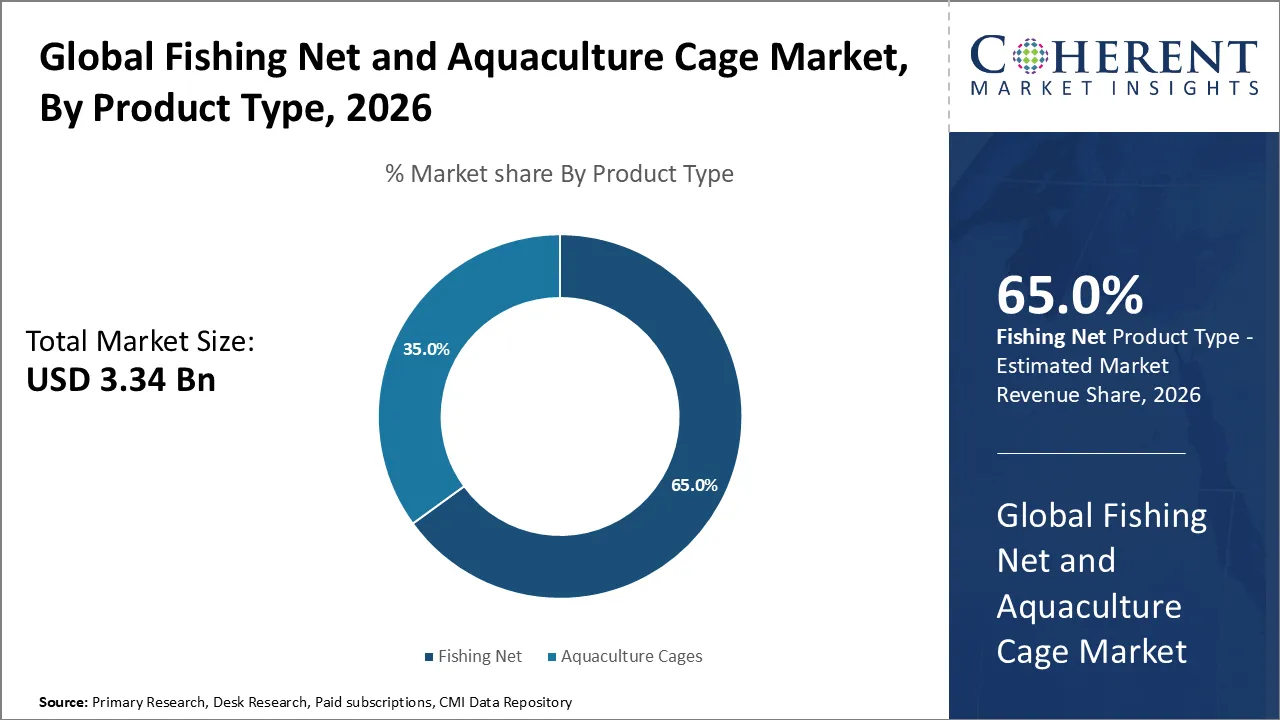
Why is the Fishing Net Segment Acquiring the Largest Market Share?
On the basis of product type, the fishing net segment is projected to account for the largest Fishing Net and Aquaculture Cage Market share of 65.0% in 2026. This segment’s dominance can be attributed to the high level of commercial fishing operations, the widespread use of trawl nets, gillnets and purse seine nets and the constant need to replace these tools due to wear and tear and operational damage. The increasing uptake of high-strength polyethylene and nylon netting materials is further driving demand for fishing nets in industrial and small-scale fishing operations.
The National Oceanic and Atmospheric Administration (NOAA) reported that in February 2026, U.S. commercial fishermen landed approximately 8.4 billion pounds of seafood valued at around USD 5.1 billion. The extent of commercial fishing activity in this volume points to the continuing demand for fishing gear including the nets used in the harvesting operations.
In April 2026, Garware Technical Fibers launched its Max Pro X18 predator net, at AquaSur 2026 in Chile, with high-stiffness mesh, enhanced cut and abrasion resistance, and optional copper-based antifouling technology.
Why Does the Marine Water Segment Hold the Largest Market Share?
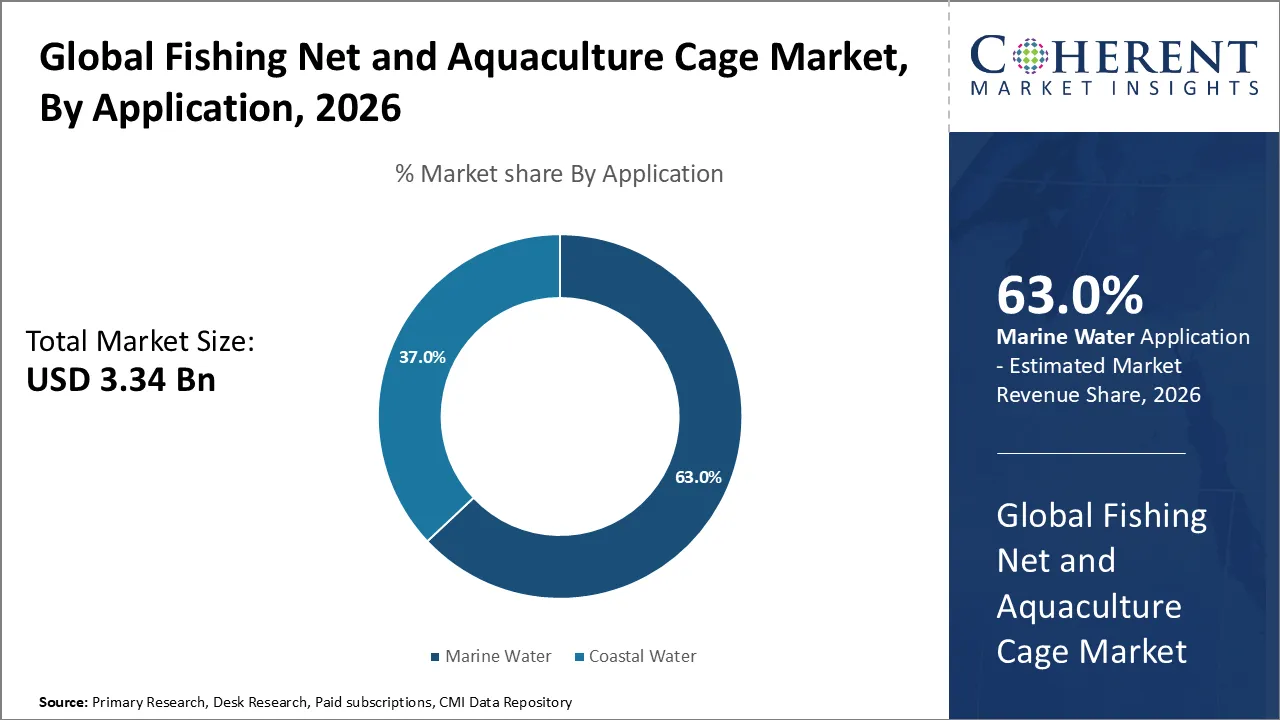
On the basis of application, the marine water segment is expected to dominate the Fishing Net and Aquaculture Cage Market with a share of 63.0% in 2026. The segment’s growth is driven by extensive ocean-based capture fisheries, increasing utilization of offshore aquaculture cages, and growing demand for corrosion-resistant cage structures and durable marine netting systems.
The FAO’s State of World Fisheries and Aquaculture 2026 reported that global aquaculture production of aquatic animals reached 103 million tons in 2024, accounting for about 53% of the total aquatic animal production.
In June 2026, the Food and Agriculture Organization (FAO) reported that, in 2024, marine capture fisheries around the world produced 80 million tons of aquatic animals, indicating the huge scale of commercial fishing activities in marine environments.
Fishing Net and Aquaculture Cage Market Trends
- The growing use of recyclable and biodegradable materials for fishing nets is driving manufacturers to develop fishing gear that is environmentally sustainable and can help in reducing plastic pollution, ghost fishing, and damage to marine environments. According to AZTI, about 26,000 tons of end-of-life fishing gear arrive at European ports each year. The EU-funded SEARCULAR project also tested four circular fishing gear solutions, from recycled ropes to biodegradable fishing components.
- The increasing use of submersible aquaculture cage systems is improving fish welfare, sea lice prevention and production efficiency. In March 2026, Norwegian company Hofseth launched the submersible aquaculture cage Havliljen, which is 62 meters (200 ft) across and about 15 meters (49 ft) below the surface. The report highlights growing investment in advanced cage systems for farming marine fish.
- The increasing emphasis on selective fishing nets and bycatch reduction technologies is spurring the development of modified trawl designs, improved mesh configurations and ecologically sound harvesting equipment. The European Commission pointed out in April 2025 the efforts of the EcoeFISHent project in designing and testing fishing nets with wider openings in an effort to reduce the catch of juvenile shrimp in the Mediterranean, illustrating the advancement of more sustainable commercial fishing practices.
Regional Insights
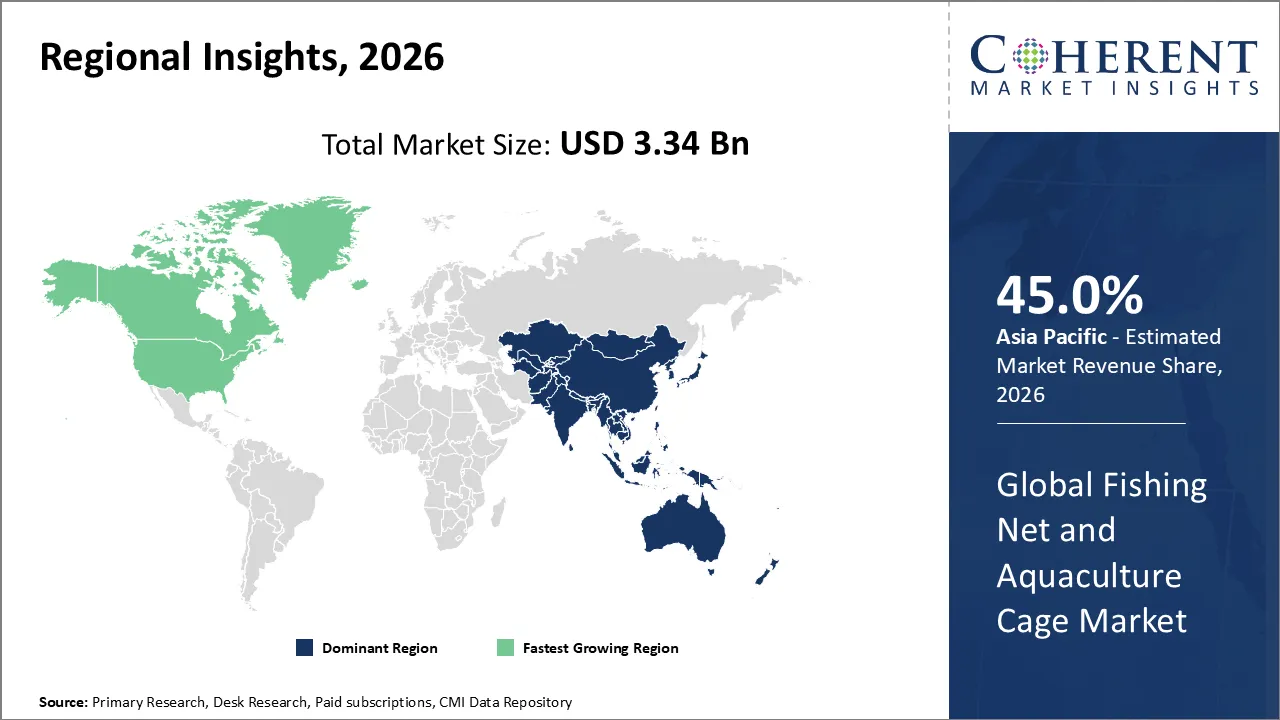
Asia Pacific Dominates Owing to Large-Scale Fisheries Production and Expanding Aquaculture Infrastructure
The Asia Pacific region is projected to hold the major share of the Fishing Net and Aquaculture Cage Market with 45.0% in 2026. The region’s dominance is due to its large commercial fishing industry, large aquaculture industry, strong fishing net manufacturing industry, and growing demand for durable cage systems in China, India, Indonesia, Vietnam and Japan. The availability of low-cost synthetic netting materials and increasing seafood exports are further supporting the growth of the regional market.
The Ministry of Fisheries, Animal Husbandry and Dairying of India said that the volume of seafood exports from India increased by about 47.8% to 1.698 million metric tons in FY 2024-25 from 1.149 million metric tons in FY 2020-21. Seafood exports increased by about 42.7% to INR 62,408.45 crore during the same period, reflecting the increasing commercial scale of the country’s seafood industry and the corresponding demand for fishing and aquaculture equipment.
In April 2026, the Government of India reported that the country accounts for approximately 8% of global fish production and has become the world's second-largest aquaculture producer. This strong production base supports sustained requirements for fishing nets, aquaculture containment systems, and associated harvesting infrastructure across the Asia Pacific region.
North America Fishing Net and Aquaculture Cage Market Trends
North America is expected to witness strong growth in the Fishing Net and Aquaculture Cage Market during the forecast period. The region’s expansion is supported by increasing investments in sustainable marine aquaculture, modernization of commercial fishing equipment, adoption of advanced containment technologies, and government-backed initiatives promoting domestic seafood production. Growing demand for durable cage systems, specialized netting materials, and environmentally responsible fish farming solutions is creating additional opportunities for regional manufacturers.
In November 2025, Statistics Canada announced that Canada’s sales of aquaculture products and services in 2024 reached CAD 1.4 billion, up 8.8% year-over-year, and production of farmed finfish up 11.6%, to 122,280 tons. This growth is indicative of an expanding commercial aquaculture activity, which would support potential demand for fish farming cages, containment nets and related marine infrastructure.
In June 2026, the U.S. National Oceanic and Atmospheric Administration (NOAA) announced the establishment of the Cooperative Institute Fostering Aquaculture Research and Markets (CIFARM) hosted by the University of New Hampshire.
Expansion of Offshore Aquaculture and Federal Research Investments is Accelerating the Fishing Net and Aquaculture Cage Market in the United States
The U.S. Fishing Net and Aquaculture Cage Market is expected to witness significant growth opportunities with the expansion of offshore aquaculture, increasing adoption of advanced fish containment systems and government-backed initiatives to support the domestic seafood production. Increasing focus on sustainable marine farming is driving investment in strong fishing nets, high-density polyethylene cage structures and offshore aquaculture technologies able to withstand adverse marine conditions.
In April 2026, the National Oceanic and Atmospheric Administration (NOAA) identified 13 Aquaculture Opportunity Areas in the Gulf of America and off Southern California, totaling more than 21,000 acres of U.S. federal waters. Such designated areas would provide a scientific basis for future commercial aquaculture development that could support a demand for floating cage systems, containment nets and associated offshore farming infrastructure.
In 2025, NOAA announced 13 Aquaculture Opportunity Areas in U.S. federal waters in the Gulf of America and off Southern California that cover more than 21,000 acres in April 2026. The designated areas provide a scientific basis for future commercial aquaculture development, with the potential demand for floating cage systems, containment nets and associated offshore farming infrastructure.
China Fishing Net and Aquaculture Cage Market Trends
China is anticipated to continue as a key market for fishing nets and aquaculture cages during the forecast period. The country’s growth is supported by the large-scale aquaculture production, increasing modernization of the marine farming infrastructure, development of the deep-sea aquaculture facilities, and government initiatives that promote sustainable fisheries. High strength synthetic nets, offshore containment systems and intelligent aquaculture equipment are expected to strengthen the demand for advanced fishing and cage technologies.
In September 2026, the Chinese government announced a fisheries development plan that targets 110 million tons of aquatic product supply capacity by 2030, according to the State Council of China. The plan highlights the continuous investment opportunities in advanced aquaculture cage systems and associated netting infrastructure through the upgrading of freshwater aquaculture and mariculture facilities, the expansion of artificial intelligence applications and the improvement of fisheries equipment.
Who are the Major Companies in Fishing Net and Aquaculture Cage Industry
Some of the major key players in Fishing Net and Aquaculture Cage Market are Miller Net Company Inc., Brunsonnet and Supply Inc., Magnum polymers Pvt. ltd., Siang May, Memphis Net and Twine, Viet AU ltd., Nitto Seimo, Naguara Net Co. Inc., Siang May, and SNC.
Key News
- In September 2025, Nitto Seimo Co., Ltd., Toray Industries, Inc., and Tateura Fisheries Cooperative Association announced the expansion of their fishing net-to-fishing net recycling initiative by developing polyester fishing nets using recycled manufacturing waste.
Market Report Scope
Fishing Net and Aquaculture Cage Market Report Coverage
Report Coverage | Details | ||
Base Year: | 2025 | Market Size in 2026: | USD 3.34 Bn |
Historical Data for: | 2020 to 2024 | Forecast Period: | 2026 to 2033 |
CAGR: | 4.7% | 2033 Value Projection: | USD 4.30 Bn |
Geographies covered: |
| ||
Segments covered: |
| ||
Companies covered: | Miller Net Company Inc., Brunsonnet and Supply Inc., Magnum polymers Pvt. ltd., Siang May, Memphis Net and Twine, Viet AU ltd., Nitto Seimo, Naguara Net Co. Inc., Siang May, and SNC. | ||
Growth Drivers: |
| ||
Restraints & Challenges: |
| ||
Analyst Opinion
- The Fishing Net and Aquaculture Cage Market is expected to benefit from increasing efforts to strengthen domestic seafood production and reduce import dependency, particularly in North America. U.S. had a USD 20.7 billion seafood trade deficit in 2025. Heavy reliance on imports creates opportunities for growth in domestic aquaculture, which could boost demand for fish farming cages, containment nets and related harvesting equipment.
- The shift to sustainable fishing gear and the circular management of materials are projected to impact the purchasing choices and product creativity of fishing net manufacturers. In 2022 nearly 22 900 tons of plastic-containing fishing gear were placed on the EU market, but only around one third was collected as waste. This is a huge opportunity for manufacturers to create recyclable netting materials, fishing gear collection systems and environmentally responsible fishing equipment.
- The modernization of commercial fishing fleets and a growing emphasis on efficient fisheries management are expected to drive the demand for durable, specialized fishing nets. The global fleet in 2022 was estimated to consist of about 4.9 million vessels, with Asia accounting for approximately 71% of the total. This large operating base underpins recurring needs for maintenance and replacement of fishing gear. The adoption of selective net designs and improved fishing technologies offer opportunities for higher value products.
Speak to the analyst
Want personalized insights?
Take the findings above to one of our principal consultants, or have the report rebuilt around the segments, geographies and competitors you actually track.
Market Segmentation
- By Product Type (Revenue, USD Bn, 2021-2033)
- Fishing Net
- Aquaculture Cages
- By Application (Revenue, USD Bn, 2021-2033)
- Marine Water
- Coastal Water
- By Region (Revenue, USD Bn, 2021-2033)
- North America
- U.S.
- Canada
- Latin America
- Brazil
- Mexico
- Argentina
- Rest of Latin America
- Europe
- Germany
- U.K.
- France
- Italy
- Spain
- Russia
- Rest of Europe
- Asia Pacific
- China
- India
- Japan
- Australia
- South Korea
- ASEAN
- Rest of Asia Pacific
- Middle East
- GCC
- Israel
- Rest of Middle East
- Africa
- South Africa
- Central Africa
- North Africa
- North America
Sources
Primary Research Interviews
- Fishing net manufacturers and suppliers
- Aquaculture cage manufacturers and system integrators
- Commercial fishing operators and fleet managers
- Marine aquaculture farm owners and operators
- Fisheries equipment distributors and procurement managers
- Marine engineers and aquaculture technology specialists
- Fisheries scientists and aquaculture industry experts
- Key opinion leaders (KOLs) in fisheries and aquaculture
Databases
- Food and Agriculture Organization (FAO) – FishStat
- World Bank
- Organisation for Economic Co-operation and Development (OECD)
- National Oceanic and Atmospheric Administration (NOAA) – Fisheries Statistics
- European Commission – Eurostat Fisheries Database
- United Nations Comtrade Database
- International Trade Centre (ITC) – Trade Map
- Fisheries and Oceans Canada (DFO)
Magazines
- The Fish Site
- Fish Farmer Magazine
- SeafoodSource
- World Fishing & Aquaculture
- International Aquafeed
- Aquaculture North America
Journals
- Aquaculture
- Aquaculture Reports
- Fisheries Research
- Marine Policy
- Journal of Fisheries and Environment
- Aquacultural Engineering
- Reviews in Aquaculture
- Marine Pollution Bulletin
Newspapers
- The Guardian
- Financial Times
- The Economic Times
- The Hindu BusinessLine
- South China Morning Post
- The Japan Times
Associations
- Global Seafood Alliance (GSA)
- World Aquaculture Society (WAS)
- European Aquaculture Society (EAS)
- National Fisheries Institute (NFI)
- International Coalition of Fisheries Associations (ICFA)
- International Council for the Exploration of the Sea (ICES)
- Aquaculture Stewardship Council (ASC)
- Marine Stewardship Council (MSC)
Public Domain Sources
- Company Annual Reports and Investor Presentations
- Government Fisheries and Aquaculture Statistics
- FAO Fisheries and Aquaculture Publications
- NOAA Fisheries Research and Industry Reports
- National Fisheries and Aquaculture Development Policies
- University Research Publications on Fishing Gear and Aquaculture Technologies
- Patent Databases such as WIPO, USPTO, and Google Patents
- Fishing Gear Sustainability and Marine Pollution Studies
- Regulatory Publications on Fisheries Management and Aquaculture Cage Standards
- Publicly Available Fishing Net and Aquaculture Cage Product Catalogs
Proprietary Elements
- CMI Data Analytics Tool
- Proprietary CMI Existing Repository of Information for the Last 10 Years
Get access to 250+ pages report
Every segment, forecast, competitor profile and data table behind the analysis above — available for instant download.
- ESOMAR Member
- ISO 9001:2015 Certified
- D-U-N-S Registered
- GDPR & CCPA Compliant
Missing comfort of reading report in your local language? Find your preferred language:
Transform your Strategy with Exclusive Trending Reports
Frequently Asked Questions
The Fishing Net and Aquaculture Cage Market is expected to reach USD 4.30 Bn by 2033, compared to USD 3.34 Bn in 2026.
Major players operating in the global Fishing Net and Aquaculture Cage Market include Miller Net Company Inc., Brunsonnet and Supply Inc., Magnum Polymers Pvt. Ltd., Siang May, Memphis Net and Twine, Viet AU Ltd., Nitto Seimo, Naguara Net Co. Inc., and SNC.
High initial investment and maintenance costs, stringent fishing gear regulations, and environmental concerns related to marine plastic pollution are the key factors hampering market growth.
Increasing commercial fishing activities, rising seafood demand, expanding offshore aquaculture operations, and growing government investments in fish farming infrastructure are driving market growth.
The Fishing Net and Aquaculture Cage Market is anticipated to grow at a CAGR of approximately 3.7% between 2026 and 2033.
Among regions, Asia Pacific is expected to account for the largest market share of 45.0% in 2026, supported by extensive fishing activities and expanding aquaculture production across China, India, Indonesia, and Vietnam.
Fishing nets are mesh-based equipment used to capture fish and other aquatic species, while aquaculture cages are enclosed structures deployed in aquatic environments to cultivate fish under controlled farming conditions.