

U.S. Seafood Market Size and Forecast – 2026-2033
The U.S. Seafood Market is estimated to be valued at USD 58.81 Bn in 2026 and is expected to reach USD 73.81 Bn by 2033, exhibiting a compound annual growth rate (CAGR) of 3.3% from 2026 to 2033.
Key Takeaways of the U.S. Seafood Market
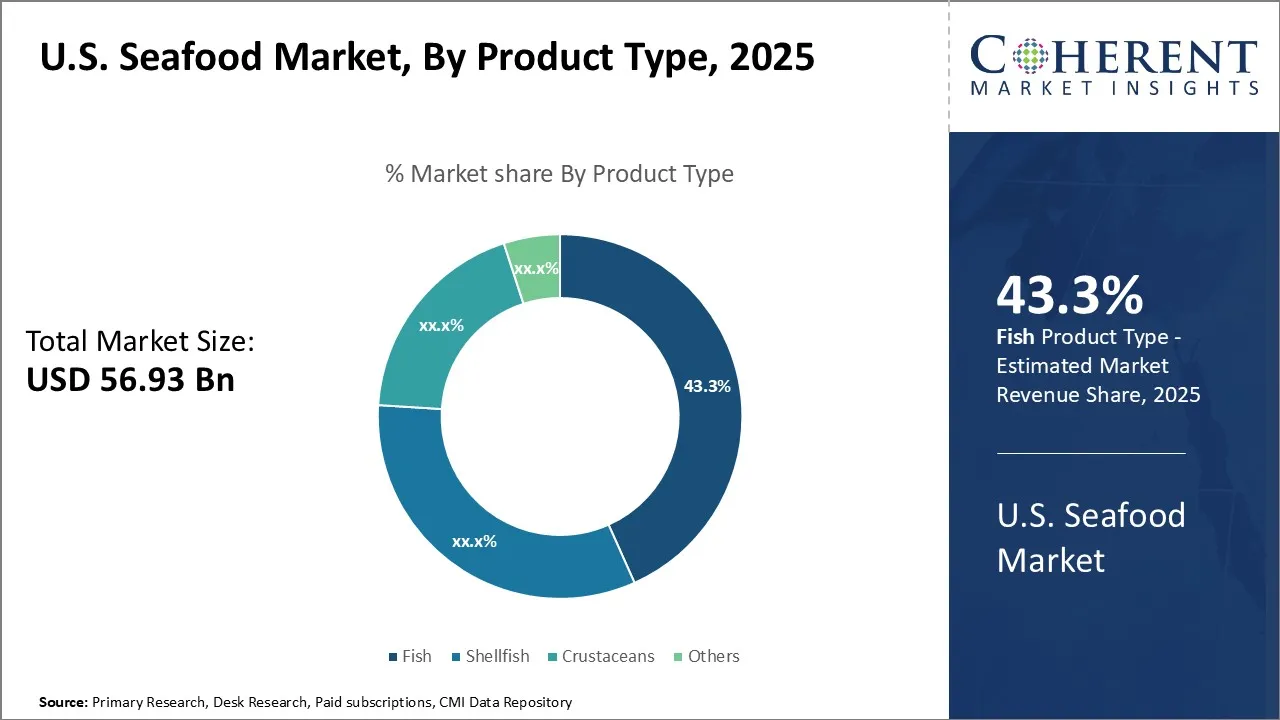
- The fish segment is expected to hold a 44.3% share of the U.S. seafood market in 2026.
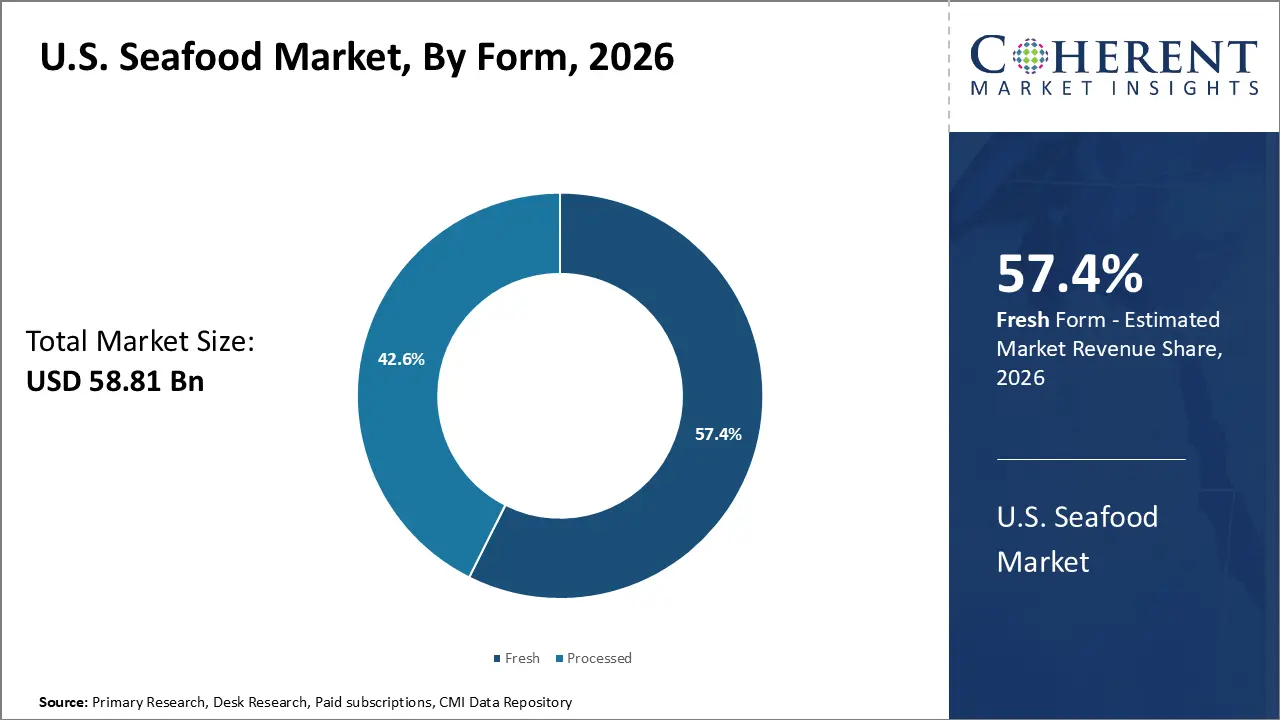
- The fresh segment is projected to capture 42.6% of the U.S. seafood market in 2026.
- The B2C segment is expected to account for 58. 5% of the U.S. seafood market in 2026.
Market Overview
Current market trends highlight a rising preference for responsibly sourced seafood, with consumers showing greater awareness of environmental impact and traceability. Additionally, innovation in alternative seafood products, such as plant-based and cell-cultured options, is gaining traction. Demand for seafood rich in omega-3 products and those fortified with vitamin supplements is also increasing, driven by their recognized health benefits and role in supporting overall wellness. E-commerce platforms and direct-to-consumer sales are reshaping purchase behaviors, offering greater convenience and product variety, thereby supporting market expansion in the coming years.
Current Events and Its Impact
Current Events | Description and its impact |
Expansion of Sustainable Aquaculture Practices in the U.S. (July 2025) |
|
NOAA’s Climate-Driven Fishing Quotas Update (June 2025) |
|
Segmental Insights
- Current Industry Events of 2026
- Market Size Estimation
- Regional Breakdown
- Competitive Landscape
- Customer Intelligence
- Segmental Analysis
- Pricing Analysis
- Key Market Drivers, Challenges & Future Trends
- Customized Insights Section
U.S. Seafood Market Insights, By Product Type – Fish Segment Dominates Due to Its Nutritional Appeal and Consumer Preference
Fish segment is expected to command 44.3% share of the U.S. seafood market in 2026, primarily propelled by its wide-ranging nutritional benefits and growing consumer health consciousness. Fish, especially varieties rich in omega-3 fatty acids such as salmon, tuna, and mackerel, are increasingly favored for their well-documented positive effects on cardiovascular health, brain function, and general wellbeing. This perception fuels steady demand among health-conscious consumers who actively seek lean protein sources and nutritious alternatives to traditional meats.
For example, according to the National Fisheries Institute (NFI), U.S. per capita consumption of salmon reached a record approx. Americans consumed 19.7 pounds of seafood per capital in 2022, driven by its positioning as a premium health food and the expansion of value-added, ready-to-cook salmon products by major retailers like Costco and Whole Foods. The growing popularity of meal-kit services such as Blue Apron and HelloFresh, which frequently feature salmon and tuna-based recipes, has further boosted fish consumption in the home-cooking segment.
U.S. Seafood Market Insights, By Form – Fresh Segment Dominates Meeting Consumer Demand for Quality and Flavor
Fresh segment is projected to account for 42.6% share within the U.S. seafood market in 2026, a status driven largely by consumer preference for superior flavor, texture, and perceived quality. Fresh seafood is widely regarded as the gold standard for taste, offering a natural flavor profile that frozen or processed options often cannot match. This preference is particularly strong among gourmet consumers and food enthusiasts who prioritize the sensory experience and freshness of ingredients in their home cooking or dining-out choices.
U.S. Seafood Market Insights, By Distribution channel - B2C Segment Dominates Fueled by Direct Consumer Engagement and Changing Shopping Habits
The B2C segment is expected to hold 59.5% share in the U.S. seafood market in 2026, a reflection of shifting consumer shopping habits and growing emphasis on direct engagement between producers, retailers, and end-users. Increasingly, consumers prioritize convenience and experience when purchasing seafood, driving demand for B2C channels such as supermarkets, specialty seafood retailers, online platforms, and farmers' markets. The rise of e-commerce and direct-to-consumer delivery services has further accelerated B2C growth, offering shoppers a seamless way to purchase fresh and specialty seafood products from home.
Export Dataset
India — shrimp surge then tariff shock
India has grown into a major supplier of frozen shrimp to the U.S., with industry figures showing multi-billion-dollar shrimp exports in recent years and a large share of India’s seafood export value driven by shrimp shipments to the U.S. However, in August 2025 sudden U.S. tariff actions (announced by the U.S. administration) have placed steep duties on many Indian exports, provoking industry warnings that as much as USD ~2–3 billion of shrimp exports could be at risk and prompting exporters to seek government support and rapid market diversification. These tariff developments are already affecting export competitiveness and near-term shipment decisions.
Ecuador — record shrimp volumes and growing U.S. share
Ecuador’s farmed shrimp industry set new records in H1 2025, shipping large volumes (hundreds of thousands of tonnes) and lifting export value sharply year-on-year. Notably, U.S. purchases of Ecuadorian shrimp rose in early 2025 — for example, the U.S. accounted for an increased share of Ecuador’s shrimp exports in April 2025 (both volumes and value posted sizeable year-over-year gains) — reinforcing Ecuador’s position as a resilient and expanding supplier to the U.S. market.
Thailand — canned/prepared tuna and tariff sensitivity
Thailand continues to dominate the U.S. canned/prepared tuna trade (historically the largest supplier by volume). Recent industry reporting shows Thailand holding nearly half of U.S. canned tuna imports as of 2024, and the sector is highly sensitive to tariff shifts and strategic stocking by U.S. buyers. In 2025 there were industry warnings that higher U.S. duties on certain suppliers could sharply depress Thai shipments to the U.S., which would quickly reconfigure supply chains for prepared tuna and related value-added products.
Vietnam — pangasius and shifting shrimp/tuna flows amid tariff uncertainty
Vietnam remains an important supplier of pangasius (frozen whitefish) and also ships shrimp and tuna products to the U.S. Early-2025 pangasius exports to the U.S. showed strong growth, but shipments of shrimp and tuna have been volatile month-to-month as exporters reacted to temporary tariff suspensions and the risk of much higher duties if bilateral agreements lapsed. That uncertainty led to shipment surges ahead of tariff deadlines and subsequent dips — a tactical pattern that has shortened planning horizons for U.S. buyers reliant on Vietnamese supply.
Market Players, Key Development, and Competitive Intelligence
Key Developments
- On August 11, 2025, the Indian government urged seafood exporters to explore alternative markets following a recent hike in U.S. tariffs. Announcing the move at a press conference, Union Minister for Fisheries Mr. Rajiv Ranjan Singh identified the EU, Japan, South Korea, the U.K., Russia, Australia, West Asia, and Southeast Asia as key potential destinations for expanding India’s seafood export footprint.
- In February 2024, Gorton’s Seafood, based in Gloucester, Massachusetts, announced plans to invest USD 89.3 million in a new 110,000-square-foot production facility in Lebanon. The project, located at 419 S. Mt. Zion Road in Lebanon Business Park adjacent to the United States Cold Storage warehouse, is expected to create 163 jobs by 2029, according to Boone County and city officials.
Top Strategies Followed by U.S. Seafood Market Players
- Established companies dominate the industry by heavily investing in research and development (R&D), aiming to innovate high-performance products that meet evolving consumer demands for quality, sustainability, and convenience. These market leaders prioritize technological advancements to enhance product freshness, shelf life, and nutritional value, thereby differentiating themselves from competitors. Large seafood corporations in the U.S., such as Trident Seafoods, High Liner Foods, and Pacific Seafood, dominate the market through heavy investment in research and development (R&D) to create innovative, high-performance products that meet evolving consumer demands for quality, sustainability, and convenience.
- For instance, Trident Seafoods has implemented advanced freezing and processing technologies to maintain product freshness and extend shelf life without compromising nutritional value.
- Mid-level players in the U.S. seafood market focus primarily on delivering cost-effective solutions that strike a balance between quality and affordability. Recognizing the significant segment of price-sensitive consumers, they tailor their product offerings to meet this demand without drastically compromising on taste or nutritional content. Their business models emphasize operational efficiency and strategic resource allocation to maintain competitive pricing.
- For example, Aqua Star offers frozen shrimp and fish fillets at competitive prices in major retail chains like Walmart and Costco, catering to budget-conscious families.
- Small-scale players carve out their niche in the competitive U.S. seafood market by concentrating on specialized features and innovative products that cater to specific consumer segments. Unlike larger firms, these companies often focus on artisanal, sustainably sourced, or value-added seafood options that emphasize unique flavors, health benefits, or environmental responsibility. To stay competitive, small businesses adopt cutting-edge technologies such as blockchain for traceability, advanced packaging solutions, or aquaculture innovations that enhance product differentiation.
- For example, Blue Circle Foods has launched organic salmon burgers and antibiotic-free shrimp products, appealing to health-conscious and environmentally aware consumers.
Market Report Scope
U.S. Seafood Market Report Coverage
| Report Coverage | Details | ||
|---|---|---|---|
| Base Year: | 2025 | Market Size in 2026: | USD 58.81 Bn |
| Historical Data for: | 2020 To 2024 | Forecast Period: | 2026 To 2033 |
| Forecast Period 2026 to 2033 CAGR: | 3.3% | 2033 Value Projection: | USD 73.81 Bn |
| Segments covered: |
| ||
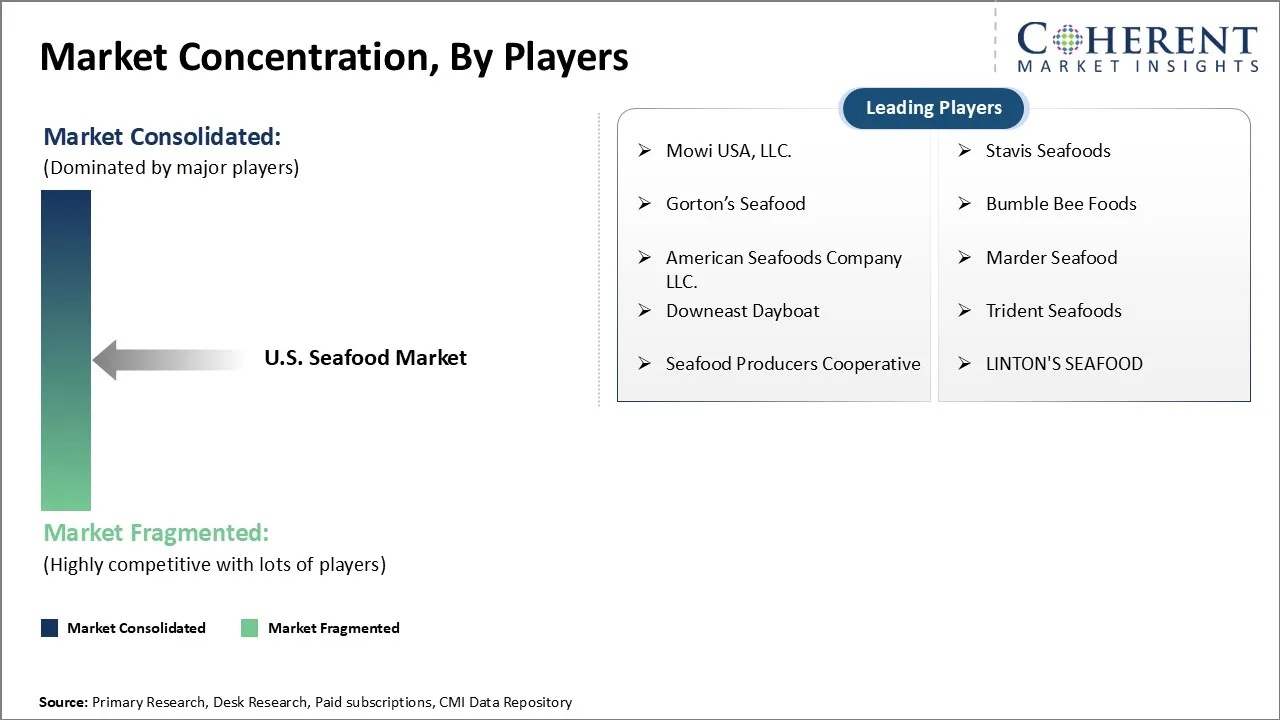
| Companies covered: | Mowi USA, LLC., Stavis Seafoods, Gorton’s Seafood, Bumble Bee Foods, American Seafoods Company LLC., Marder Seafood, Downeast Dayboat, Trident Seafoods, Seafood Producers Cooperative, and LINTON'S SEAFOOD | ||
| Growth Drivers: |
| ||
| Restraints & Challenges: |
| ||
U.S. Seafood Market Dynamics
U.S. Seafood Market Driver - Increasing Consumer Demand for Healthy, Protein-Rich Foods
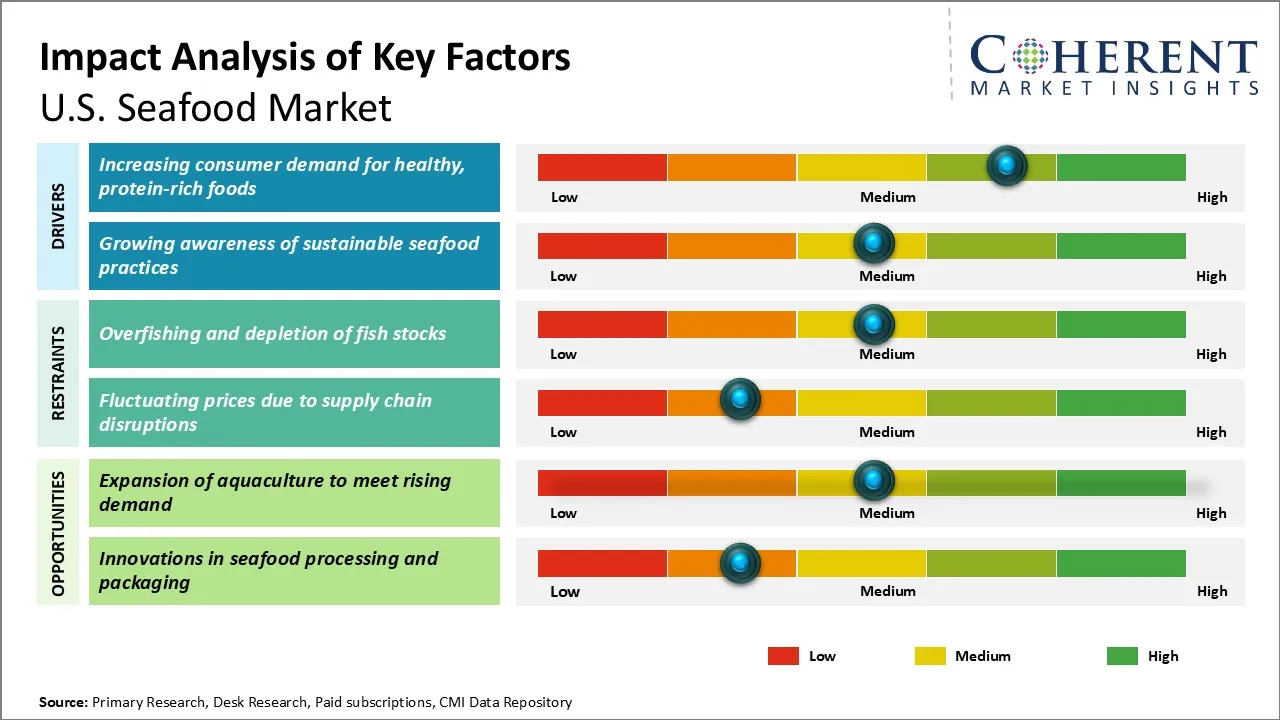
As health consciousness continues to grow among U.S. consumers, there is an increasing shift toward dietary choices that emphasize nutrient-dense and protein-rich options, positioning seafood as a preferred source of high-quality protein. Seafood offers essential nutrients such as omega-3 fatty acids, vitamins, and minerals, which are widely associated with numerous health benefits including improved heart health and cognitive function. This growing awareness about the role of diet in maintaining wellness is driving consumers to replace or supplement red meat and processed foods with fish and shellfish. Additionally, the trend toward clean eating and the popularity of diets like paleo, keto, and Mediterranean further promote seafood consumption due to its perceived natural and wholesome qualities.
For instance, data from the USDA Economic Research Service shows that demand is not just rising—it is shifting toward fresher forms. The consumption of fresh and frozen seafood grew from about 63% of all seafood consumed in 1990 to nearly 80% in 2021, signalling consumer preference for high-quality, minimally processed proteins.
U.S. Seafood Market Opportunity - Expansion of Aquaculture to Meet Rising Demand
The U.S. seafood market is witnessing a notable opportunity through the expansion of aquaculture, driven by increasing consumer demand for sustainable and locally sourced seafood products. With wild fish stocks under pressure from overfishing and environmental changes, aquaculture presents a viable and scalable solution to bridge the supply gap and ensure consistent availability of high-quality seafood. Technological advancements in farming techniques, such as recirculating aquaculture systems (RAS) and offshore aquaculture, have significantly improved production efficiency, environmental sustainability, and product quality.
Analyst Opinion (Expert Opinion)
- The U.S. seafood market is experiencing a transformative phase, driven by rising consumer demand for sustainable and health-conscious food options. Insights from the Seafood Expo North America (2023) and the National Fisheries Institute's Global Seafood Market Conference (2022) highlighted critical trends towards responsibly sourced seafood and innovative aquaculture practices.
- Brands like Wild Alaskan Company are capitalizing on this shift by offering subscription boxes of sustainably harvested fish, appealing to environmentally conscious consumers. Additionally, discussions at these conferences emphasized the importance of transparency in sourcing, with many companies adopting traceability technologies to assure consumers of the origins of their seafood.
- The increasing popularity of plant-based seafood alternatives, such as those from Good Catch, is also reshaping consumer preferences, presenting both challenges and opportunities for traditional seafood producers. As the market evolves, companies that prioritize sustainability, innovation, and consumer education will likely thrive. Ultimately, the future of the U.S. seafood market will hinge on the industry's ability to adapt to changing dietary preferences and environmental standards while fostering a culture of sustainability among consumers.
Speak to the analyst
Want personalized insights?
Take the findings above to one of our principal consultants, or have the report rebuilt around the segments, geographies and competitors you actually track.
Market Segmentation
- Product Type Insights (Revenue, USD Bn, 2021 - 2033)
- Fish
- Shellfish
- Crustaceans
- Others
- Form Insights (Revenue, USD Bn, 2021 - 2033)
- Fresh
- Processed
- Frozen
- Canned
- Smoked
- Chilled
- Distribution Channel Insights (Revenue, USD Bn, 2021 - 2033)
- B2C
- B2B
- Key Players Insights
- Mowi USA, LLC.
- Stavis Seafoods
- Gorton’s Seafood
- Bumble Bee Foods
- American Seafoods Company LLC.
- Marder Seafood
- Downeast Dayboat
- Trident Seafoods
- Seafood Producers Cooperative
- LINTON'S SEAFOOD
Sources
Primary Research Interviews
- Industry Executives – Leading U.S. Seafood Processing Companies
- Supply Chain Directors – Major National Seafood Distributors
- Category Managers – Large U.S. Grocery Retailers
- Sustainability Coordinators – Seafood Industry Certification Bodies
Stakeholders
- Manufacturers/Processors (Seafood Processing Companies)
- End-use Sectors:
- Retail (Grocery Stores, Supermarkets, Online Marketplaces)
- Foodservice (Restaurants, Cafés, Institutional Catering)
- Regulatory & Certification Bodies (e.g., NOAA, FDA, Global Seafood Alliance)
- Distributors and E-commerce Platforms
- Technology Integration (Supply Chain Digitalization, Traceability Solutions)
- Fisheries (Commercial and Aquaculture operations)
- Importers/Exporters
Databases
- NOAA Fisheries Statistics Database
- USDA Fish and Seafood Commodities Database
- UN Comtrade Database (for seafood imports/exports)
- U.S. Import Export (EXIM) Database
Magazines
- SeafoodNews – Global and U.S. seafood market news and trends
- SeafoodSource – U.S. and international seafood industry coverage
Journals
- Marine Policy – Fisheries management and policy research
- Journal of Food Science – Processing and quality trends in seafood
- Food Research International – Safety, bioavailability, and innovation
- Journal of Aquatic Food Product Technology – Production, supply chain, and product trends
- NOAA Technical Memoranda – Retail sales and market analysis
Newspapers
- The New York Times – Consumer trends, policy changes, major events
- The Wall Street Journal – Economic and trade news covering seafood
- Food Trade News – Retail sector growth, sales trends
- The Guardian – Sustainability and health issues in the seafood sector
Associations
- U.S. Seafood Distributors Association (USSDA)
- Gulf Seafood Institute
- Alaska Shellfish Growers Association, Chesapeake Bay Seafood Industries Association, Louisiana Seafood Promotion & Marketing Board, Southeastern Fisheries Association
Public Domain Sources
- FDA – Seafood safety, industry and labeling guidelines
- NOAA – U.S. fisheries production, catch, aquaculture, retail, trade data
- USDA – Seafood commodity trade
- U.S. Census Bureau – Demographic and trade influences
Proprietary Elements
- CMI Data Analytics Tool, Proprietary CMI Existing Repository of information for last 8 years.
Get access to 250+ pages report
Every segment, forecast, competitor profile and data table behind the analysis above — available for instant download.
- ESOMAR Member
- ISO 9001:2015 Certified
- D-U-N-S Registered
- GDPR & CCPA Compliant
Missing comfort of reading report in your local language? Find your preferred language:
Transform your Strategy with Exclusive Trending Reports
Frequently Asked Questions
The U.S. seafood market is estimated to be valued at USD 58.81 Bn in 2026 and is expected to reach USD 73.81 Bn by 2033.
The CAGR of U.S. seafood market is projected to be 3.3% from 2026 to 2033.
Increasing consumer demand for healthy, protein-rich foods and growing awareness of sustainable seafood practices are the major factors driving the growth of the U.S. seafood market.
Overfishing and depletion of fish stocks and fluctuating prices due to supply chain disruptions are the major factor hampering the growth of the U.S. seafood market.
In terms of Product Type, Fish is estimated to dominate the market revenue share in 2026.
Mowi USA, LLC., Stavis Seafoods, Gorton’s Seafood, Bumble Bee Foods, American Seafoods Company LLC., Marder Seafood, Downeast Dayboat, Trident Seafoods, Seafood Producers Cooperative, and LINTON'S SEAFOOD are the major players.
The largest seafood market in the United States is the Fulton Fish Market in New York City.