

Omega-3 Products Market Analysis & Forecast: 2026-2033
Omega-3 Products Market is estimated to be valued at USD 54,985.3 Mn in 2026 and is expected to reach USD 91,759.3 Mn in 2033, exhibiting a compound annual growth rate (CAGR) of 7.8% from 2026 to 2033.
Key Takeaways
- Based on Product Type, the Dietary Supplements segment is expected to capture 44.5% share in 2026, driven by convenience and targeted health benefits.
- Based on Distribution Channel, the Grocery Retail segment is expected to hold the largest share of the market in 2026, though online retailing is the fastest‑growing.
- Based on Source, the Animal-based segment is projected to account for the highest share of the market in 2026, while plant‑based options are expanding but smaller.
- Based on Region, North America is set to lead the omega-3 products market with 30.9% share in 2026. While, Asia Pacific is anticipated to be the fastest growing region.
Market Overview
Growing consumption of omega-3 based product due to its various health benefits is expected to fuel market growth. Research shows that fish oil and other omega-3 fatty acids may help reduce the risk of coronary heart disease by lowering LDL (bad) cholesterol levels, and triglycerides. Moreover, omega-3 fatty acids have been shown to support a healthy mood, sleep pattern, and stress response. Additionally, increasing focus of key players on introducing omega-3 based functional food and beverages is further expected to propel market growth.
Current Events and Its Impacts on the Global Omega-3 Products Market
Current Event | Description and its Impact |
Regulatory Harmonization and Health Claims Evolution |
|
Technological Breakthroughs in Alternative Production |
|
Global Omega‑3 Production Volumes
Source | Annual Production (Metric Tons) | Key Strengths | Applications |
Fish Oil | ~1,000,000 MT | Large supply, established market, high EPA/DHA content | Supplements, functional foods, pharmaceuticals |
Algae Oil | ~40,000–50,000 MT | Vegan, sustainable, free from contaminants, high DHA concentration | Infant nutrition, functional foods, premium supplements |
Krill Oil | ~2,000–3,000 MT | High bioavailability (phospholipid‑bound omega‑3), premium positioning | Premium supplements, niche pharma |
- Current Industry Events of 2026
- Market Size Estimation
- Regional Breakdown
- Competitive Landscape
- Customer Intelligence
- Segmental Analysis
- Pricing Analysis
- Key Market Drivers, Challenges & Future Trends
- Customized Insights Section
Segmental Insights
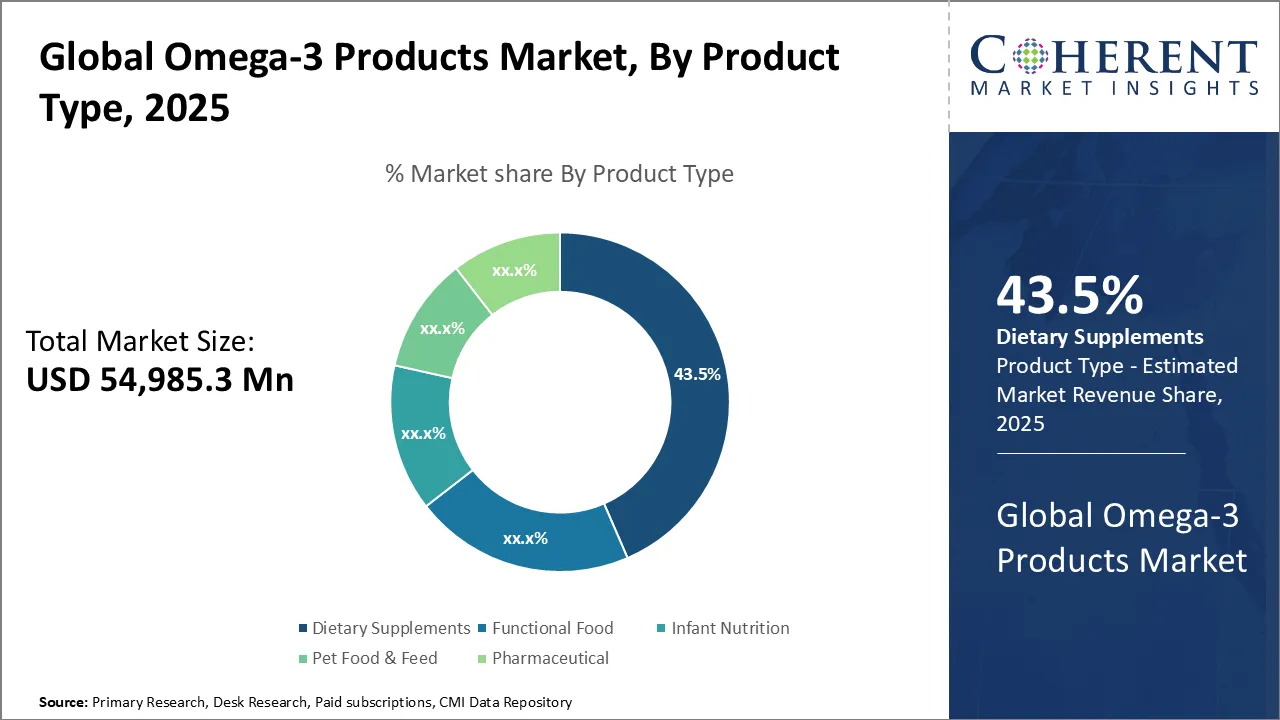
Global Omega-3 Products Market Insights, By Product Type: Dietary Supplements Dominance Is Driven by Convenience and Targeted Health Benefits
In terms of product type, the dietary supplements are expected to account for 44.5% share in 2026. People like supplements because they come in easy-to-take forms like capsules, soft gels, and powders that give them a lot of EPA and DHA at once. This group is performing well because of strong marketing and more people knowing how omega-3s can help the heart, brain, and eyes. Functional foods and infant nutrition are growing, but they are still not as popular as supplements, which are more widely available and have a better clinical reputation.
For instance, in September 2025, The ROOT Brands announced that KO3, a new and revolutionary Antarctic krill oil supplement, will be available soon. KO3 is set to launch with the first heavy-metal-free certification in the industry. Its goal is to raise the bar for premium omega-3 dietary supplements. The product is high in EPA and DHA and is aimed at health-conscious people who want purity, sustainability, and proof that it works.
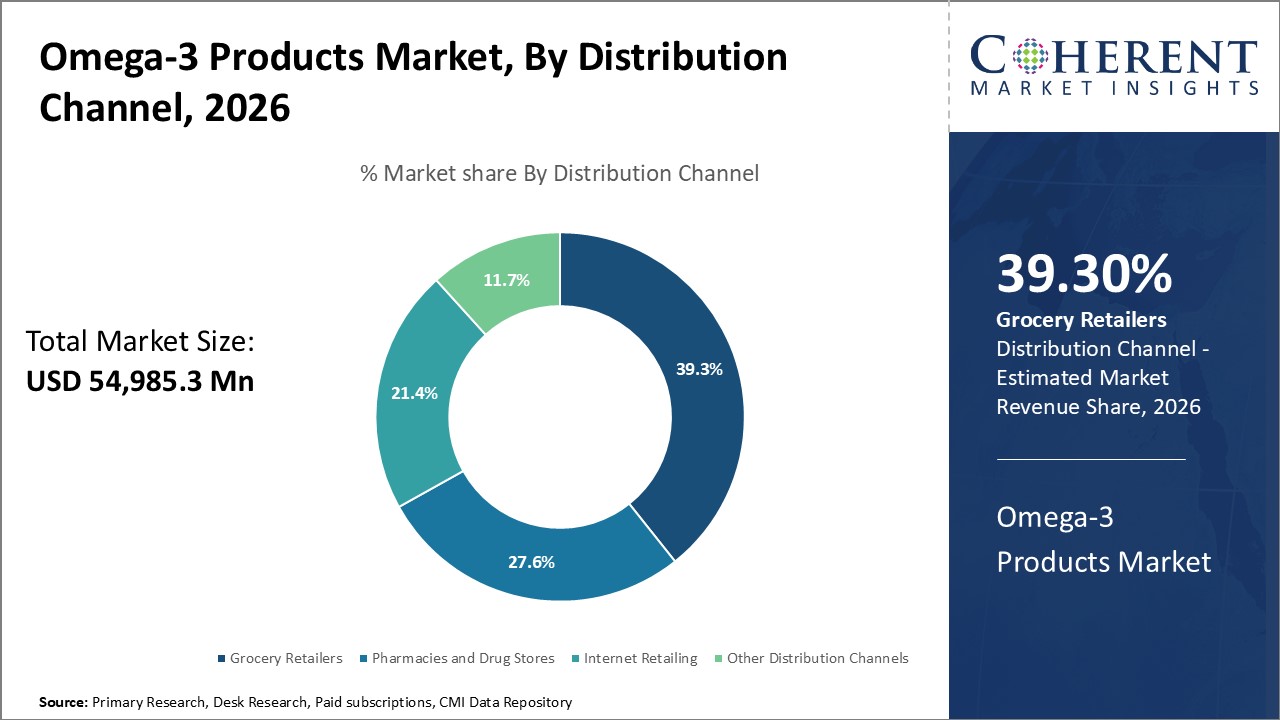
Global Omega-3 Products Market Insights, By Distribution Channel: Grocery Retailers Leads Though Online Retailing Is the Fastest‑Growing
In terms of distribution channel, the grocery retail segment is expected to hold the largest share of the market in 2026. These stores are the best places to buy omega-3 supplements and fortified foods because they reach a lot of people. Pharmacies and drug stores are still important for selling medical products. Internet retailing is the fastest-growing channel, thanks to subscription models and customers' preference for having things delivered to their door.
For instance, in December 2024, Nature's Bounty rolled out with a plant-based omega-3 supplement that uses algae oil instead of fish oil for vegetarians. Each soft gel has 1,000 mg of algae oil and 510 mg of EPA and DHA, which are good for the heart, skin, and joints. You can now buy the product at big stores like Amazon, CVS, Walgreens, Publix, and Kroger.
Global Omega-3 Products Market Insights, By Sources: Animal-Based Omega-3 Dominates While Plant-Based Options Grow Modestly
In terms of sources, the animal-based segment is projected to capture the highest share of the market in 2026. Fish oil is still the most popular source because it has a lot of EPA and DHA, works, and has well-established supply chains. Plant-based options like algae oil and flaxseed are becoming more popular, especially with vegans and people who care about the environment, but they still make up a small part of the market.
For instance, in March 2026, Nutravet released Nutramega, a strong omega-3 oil supplement made with fish oil that is high in EPA and DHA. The product is meant to help pets' joints, hearts, skin, and overall health. It also shows how important animal-based omega-3 sources are for health. Nutramega adds to Nutravet's line of veterinary supplements, with a focus on how well they work based on science.
Regional Insights
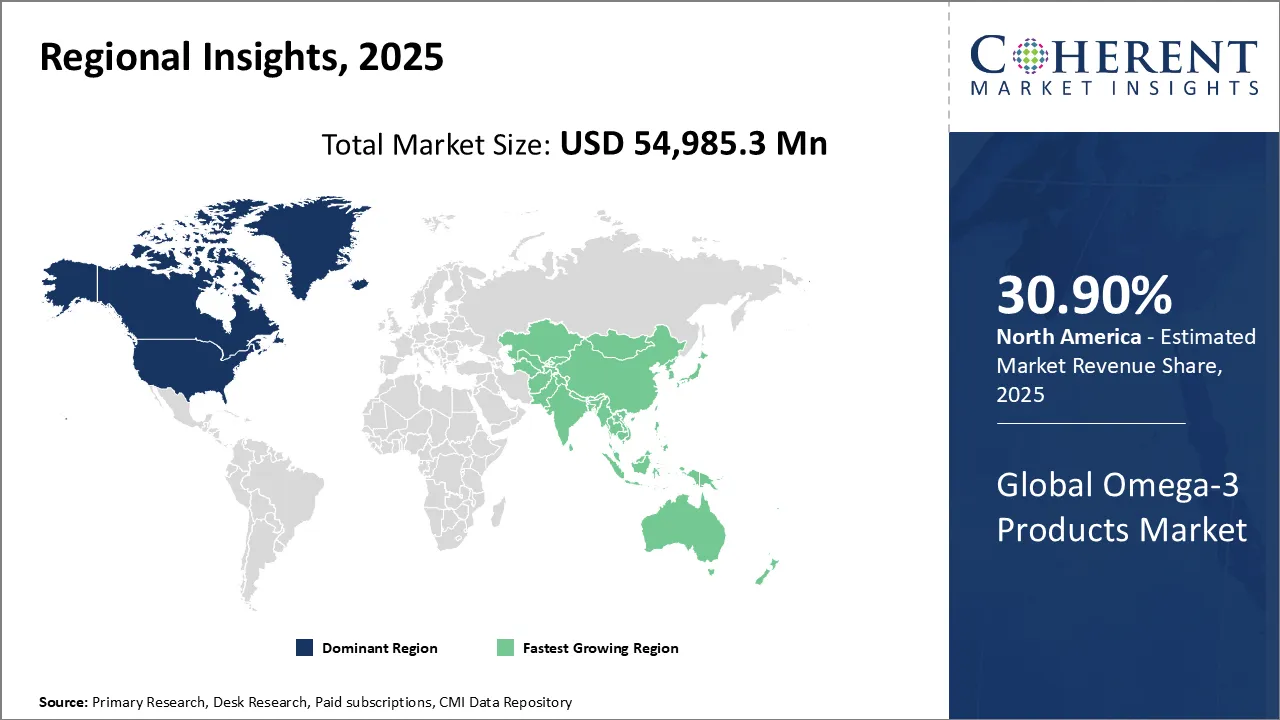
North America Omega-3 Products Market Analysis & Trends
North America is expected to dominate the global omega-3 products market with 30.9% share in 2026 owing to more people are becoming aware of the health benefits of their hearts, brains, and joints, and more people are getting lifestyle diseases. There is steady growth in the region because there is a lot of demand for dietary supplements, functional foods, and baby food, and these products are easy to find in grocery stores and pharmacies.
For instance, in October 2026, AAK added Akovita OptiSyn, a new ingredient made with omega-3 DHA to help the immune system and metabolism. The launch of these functional nutrition products shows AAK's dedication to health solutions that are backed by science. Akovita OptiSyn opens up new markets for supplements and wellness products around the world by using DHA's proven benefits for brain, heart, and immune health.
Asia Pacific Omega-3 Products Market Analysis & Trends
In Asia Pacific, the market for omega-3 products is expected to grow at rapid pace over the next five years. The region is home to many developing economies that are interested in promoting healthy lifestyles. This is why the consumption of omega-3 fatty acids is likely to increase in this region, particularly in China and India.
For instance, in April 2026, Rasayanam released a plant-based omega-3 supplement made from algae oil. This is a more environmentally friendly option than fish oil. The product is designed for overall health and is good for vegans and people who care about the environment who want to support their heart, brain, and joints. The launch shows that Rasayanam is dedicated to coming up with new ideas in plant-based nutrition and that there is a growing need for supplements that are good for the environment.
Omega-3 Products Market Outlook Country-Wise
The U.S. Omega-3 Products Market Trends
The omega-3 products market in the U.S. is very competitive in 2026 because more people are learning about the benefits of omega-3 for heart, brain, and joint health. The rise in lifestyle diseases, the popularity of dietary supplements and functional foods, and the wide availability of these products in supermarkets, pharmacies, and online stores are all driving growth. Omega-3 is one of the most popular wellness categories.
For instance, in December 2024, Coromega, which is based in Vista, California, launched Max Gold, the best way to get omega-3 fish oil in one dose. The new product is timed with New Year's health resolutions for 2026 and offers strong EPA and DHA benefits for the best health. The launch shows that Coromega is the leader in omega-3 supplements in the U.S. and that it is dedicated to improving people's health through high-quality fish oil products.
China Omega-3 Products Market Trends
The China omega-3 products market is expected to be highly competitive in 2026 because more people are becoming health-conscious, more people are learning about the heart and brain benefits, and more people are using functional foods and dietary supplements. There is a lot of consumer demand and fast market growth because algae-based sources are more environmentally friendly and have more uses in nutraceuticals, pharmaceuticals, infant nutrition, and pet food.
For instance, in July 2026, Corbion entered the Chinese market with omega-3 ingredients made from algae, which is a step toward making the world a more sustainable place to eat. The company also announced new executive hires to improve its supply chain and business operations along with the launch. This move shows how serious Corbion is about plant-based innovation and makes China a key area for growth in its omega-3 business.
Market Report Scope
Omega-3 Products Market Report Coverage
| Report Coverage | Details | ||
|---|---|---|---|
| Base Year: | 2025 | Market Size in 2026: | USD 54,985.3 Mn |
| Historical Data for: | 2020 To 2024 | Forecast Period: | 2026 To 2033 |
| Forecast Period 2026 to 2033 CAGR: | 7.8% | 2033 Value Projection: | USD 91,759.3 Mn |
| Geographies covered: |
| ||
| Segments covered: |
| ||
| Companies covered: | Nestle SA, Unilever PLC, Amway Corp., Aker BioMarine, Blackmores Group, Herbalife Nutrition Ltd, Glanbia PLC, Reckitt Benckiser Group PLC, Natrol LLC, Nordic Naturals Inc., Now Foods, and Pharmacare Laboratories Pty Ltd | ||
| Growth Drivers: |
| ||
| Restraints & Challenges: |
| ||
Global Omega-3 Products Market Drivers
Health benefits associated with omega-3 consumption to propel market growth
Eicosapentaenoic acid and docosahexaenoic acid are the most widely used omega-3 ingredients in the pharma industry. They are used to treat a number of chronic diseases and conditions, such as depression, arthritis, and atherosclerosis. The demand for these fatty acids is expected to increase as the global population grows older and more people suffer from chronic illnesses. Docosahexaenoic acids are vital for the human body, as they are responsible for cellular communication. They play a crucial role in the immune system, as well as other aspects of the body’s structure and function. They also help fight the effects of stress, cancer, aging, and depression.
Technological evolutions for better production of omega-3 products to foster market growth
Technological evolutions such as supercritical CO₂ extraction, enzymatic concentration, and algae fermentation are enhancing purity, sustainability, and scalability of omega‑3 production. These innovations reduce contaminants, improve bioavailability, and support plant‑based demand. As a result, the Omega‑3 products market size is projected to expand rapidly, fostering global growth across supplements, foods, and pharmaceuticals.
Global Omega-3 Products Market Opportunities
Various companies are focusing on introducing quality-based snacking food products for health-oriented consumers. Key players are highly focused on launching functional food and beverage products due to shifting consumer preference towards ready-to-eat snaking food such as cookies, snack bars, and others. For instance, Omega3 Innovations offers a range of omega 3 cookies, omega 3 bars which are coated with chocolate and infused with EPA and DHA ingredients. This is expected to provide significant growth opportunities for key players.
Growing demand for omega-3 in personalized nutrition is projected to offer significant growth opportunities. According to Cambridge Diagnostic Imaging (CaDi), the female fertility market serves major opportunity for the nutrition industry to offer targeted, personalized supplements that could increase birth rates and health in pregnancy.
Global Omega-3 Products Market Trends
Omega 3 infused beverages gaining immense popularity worldwide
Omega‑3 infused beverages are gaining immense popularity worldwide as consumers seek convenient functional nutrition. These fortified drinks deliver EPA and DHA benefits in accessible formats, driving innovation in dairy, juices, and sports beverages. Rising demand is boosting the Omega‑3 Products Market share, particularly within functional foods, complementing traditional supplement consumption.
Vegan pet food with functional benefits is a recent trend
Vegan pet food enriched with functional benefits, including algae‑based omega‑3, is a rising trend worldwide. Pet owners increasingly seek sustainable, plant‑based nutrition that supports joint, heart, and cognitive health. This innovation is significantly boosting Omega‑3 Products Market demand, expanding applications beyond human supplements into premium pet nutrition categories.
Analyst Opinion (Expert Opinion)
The omega-3 products market value keeps growing steadily because they are widely used in dietary supplements, functional foods, baby food, and aquaculture. Industry evaluations show a wide but consistent range of values because some reports measure ingredient-level volumes, finished supplement categories, or multi-application demand baskets. Algae-derived omega-3 ingredients have become one of the biggest drivers of market growth, thanks to a growing preference for plant-based and sustainable DHA/EPA sources.
The market's main feature is still end-use diversification. Aquaculture is a major market for omega-3 ingredients because EPA- and DHA-rich formulations are so important for fish health and feed efficiency. At the same time, mature consumer markets, especially in North America and Western Europe, are still seeing a lot of interest in high-end supplement formats and fortified nutrition products.
New delivery formats, like taste-masked gummies, high-purity concentrates, and functional drinks, are helping consumers stick with the product and supporting premium positioning. Scientific and clinical validation pertaining to cardiovascular, cognitive, and maternal health benefits enhances adoption in healthcare-oriented sectors.
On the supply side, changes in the availability of marine raw materials and the high production intensity of growing algae affect prices and profit margins, which makes companies want to get their materials from different places. In general, companies that can make sustainable ingredients, have a good reputation with regulators, and have a wide range of end-use applications are in a good position for long-term success.
Speak to the analyst
Want personalized insights?
Take the findings above to one of our principal consultants, or have the report rebuilt around the segments, geographies and competitors you actually track.
Global Omega-3 Products Market: Key Developments
- In October 2025, Naturmega released the first supercritical omega-3 product in South America, which is a big step forward in the processing of fish oil. The company's innovation, which is based in Colombia, improves the purity, sustainability, and efficiency of extracting EPA and DHA. Naturmega is now a regional leader in advanced omega-3 technology thanks to this launch. It also strengthens South America's position in the global nutraceuticals market.
- In May 2025, TopGum, which is based in Tel Aviv, released OMG3, a new line of omega-3 gummies designed for the health of pregnant women and children. The gummies, which were on display at Vitafoods Europe in Barcelona, have algae-based DHA, making them a vegan and fish-free option. The launch shows TopGum's plan to grow its business around the world and the growing need for family-friendly, plant-based omega-3 supplements in health markets around the world.
- In February 2025, GC Rieber VivoMega, which is based in Kristiansund, Norway, released two new technologies to improve the production of omega-3s. The new ideas are all about improving purity, sustainability, and efficiency in order to provide high-quality EPA and DHA for supplements and functional foods. The launch shows that Norway is a leader in marine oils and that VivoMega is dedicated to coming up with new ideas in the omega-3 industry around the world.
Market Segmentation
- Global Omega-3 Products Market, By Product Type (Revenue, USD Mn, 2021 - 2033)
- Functional Food
- Dietary Supplements
- Infant Nutrition
- Pet Food and Feed
- Pharmaceutical
- Global Omega-3 Products Market, By Distribution Channel (Revenue, USD Mn, 2021 - 2033)
- Grocery Retailers
- Pharmacies and Drug Stores
- Internet Retailing
- Other Distribution Channels
- Global Omega-3 Products Market, By Source (Revenue, USD Mn, 2021 - 2033)
- Plant-based
- Animal-based
- Global Omega-3 Products Market, By Geography (Revenue, USD Mn, 2021 - 2033)
- North America
- U.S.
- Canada
- Latin America
- Brazil
- Argentina
- Mexico
- Rest of Latin America
- Europe
- Germany
- U.K.
- Spain
- France
- Italy
- Russia
- Rest of Europe
- Asia Pacific
- China
- India
- Japan
- Australia
- South Korea
- ASEAN
- Rest of Asia Pacific
- Middle East
- GCC Countries
- Israel
- Rest of Middle East
- Africa
- South Africa
- North Africa
- Central Africa
- North America
- Key Companies Insights (Revenue, USD Mn, 2021 - 2033)
- Nestle SA
- Unilever PLC
- Amway Corp.
- Aker BioMarine
- Blackmores Group
- Herbalife Nutrition Ltd
- Glanbia PLC
- Reckitt Benckiser Group PLC
- Natrol LLC
- Nordic Naturals Inc.
- Now Foods
- Pharmacare Laboratories Pty Ltd
Sources
Primary Research Interviews
- Omega-3 Ingredient Manufacturers
- Fish Oil & Algal Oil Producers
- Nutraceutical & Dietary Supplement Companies
- Functional Food & Beverage Product Developers
- Pharmaceutical Formulation Experts
- Omega-3 Fortification Technology Specialists
- Retail & Distribution Channel Partners
- Others
Databases
- Bloomberg Terminal
- Thomson Reuters Eikon
- Others
Magazines
- Nutritional Outlook Magazine
- NutraIngredients Magazine
- Food Technology Magazine
- Dietary Supplement Industry News
- Natural Products Insider
- Others
Journals
- Journal of Nutrition
- Lipids Journal
- Food Chemistry Journal
- Nutrients Journal
- Journal of Functional Foods
- Others
Newspapers
- Financial Times
- The Wall Street Journal
- Reuters
- Bloomberg News
- The Economic Times
- Others
Associations
- Global Organization for EPA and DHA Omega-3s (GOED)
- American Oil Chemists’ Society (AOCS)
- International Fishmeal and Fish Oil Organisation (IFFO)
- Council for Responsible Nutrition (CRN)
- European Food Safety Authority (EFSA) – Scientific Panels
- Others
Public Domain Sources
- U.S. Food & Drug Administration (FDA)
- National Institutes of Health (NIH) – Office of Dietary Supplements
- Food and Agriculture Organization (FAO)
- World Health Organization (WHO)
- European Commission – Food Safety & Nutrition
- Others
Proprietary Elements
- CMI Data Analytics Tool
- Proprietary CMI Existing Repository of Information for the Last 8 Years
Definition: Omega-3 Products are a great choice to support health and prevent disease at the same time. Adding a supplement to daily routine can be an easy way to improve health. Omega-3 fatty acids are known for their anti-inflammatory properties. They can help manage inflammation by targeting and reducing the production of inflammatory compounds called TMAO (triglyceride-adjusted mucopolysaccharides). Moreover, studies show that omega-3 fatty acids help regulate blood sugar, triglycerides and cholesterol.
Get access to 250+ pages report
Every segment, forecast, competitor profile and data table behind the analysis above — available for instant download.
- ESOMAR Member
- ISO 9001:2015 Certified
- D-U-N-S Registered
- GDPR & CCPA Compliant
Missing comfort of reading report in your local language? Find your preferred language:
Transform your Strategy with Exclusive Trending Reports
Frequently Asked Questions
The Omega-3 Products Market is estimated to be valued at USD 54,985.3 Mn in 2026, and is expected to reach USD 91,759.3 Mn by 2033.
The CAGR of the Omega-3 Products Market is projected to be 7.8% from 2026 to 2033.
Health benefits associated with omega-3 consumption and technological evolutions for better production of omega-3 products are fuelling market.
The Infant Nutrition segment is the leading component segment in the market.
Gap between omega-3 awareness and omega-3 products usage is the major factors restraining the market.
Nestle SA, Unilever PLC, Amway Corp., Aker BioMarine, Blackmores Group, Herbalife Nutrition Ltd, Glanbia PLC, Reckitt Benckiser Group PLC, Natrol LLC, Nordic Naturals Inc., Now Foods, and Pharmacare Laboratories Pty Ltd.