

Food Release Agents Market Size and Share Analysis- 2026 To 2033
The Food Release Agents Market size is anticipated to grow at a CAGR of 4.9% with USD 940 Mn in 2026 and is expected to reach USD 1,310 Mn in 2033. The growth is owing to the rising consumption of bakery, confectionery, meat, and convenience foods, along with the need for cleaner processing, reduced sticking, and higher line efficiency across food manufacturing units. The cutting-edge innovations such as bio-based release agents, lecithin-based formulations, sprayable emulsions, allergen-free systems, and NSF 3H/H1-certified food-grade lubricants are assisting processors in improving product release, hygiene compliance, surface protection, and downtime reduction. For example, FAO estimated 2025 global cereal production at 3,043 Mn tonnes, supporting bakery-led demand for release agents.
Key Takeaways
- Bio-based segment is expected to account for the largest share of 68.5% in 2026. The segment’s growth is owing to the rising shift toward clean-label, plant-derived, and food-contact-safe processing aids, especially vegetable oil-, lecithin-, and wax-based release systems. U.S. FDA/eCFR permits hydroxylated lecithin as a lubricant and release agent in food at levels not exceeding 0.5%, and as a formulation aid in confections up to 3.0%.
- The bakery segment is expected to hold 44.5% market share by 2026. The growth is attributable to the high use of release agents in breads, cakes, biscuits, wafers, and confectionery lines to prevent sticking, reduce product breakage, improve surface finish, and lower cleaning downtime. India’s bakery industry was valued at around USD 13.8 billion in 2024, supporting higher consumption of bakery processing ingredients.
- Asia Pacific is expected to acquire the dominant share of 34.6% in 2026. The region’s growth is owing to the expanding packaged food (USD 7,886.62 Mn in 2024–25), bakery, confectionery, and meat-processing sectors across China, India, Japan, and Southeast Asia.
Segmental Insights
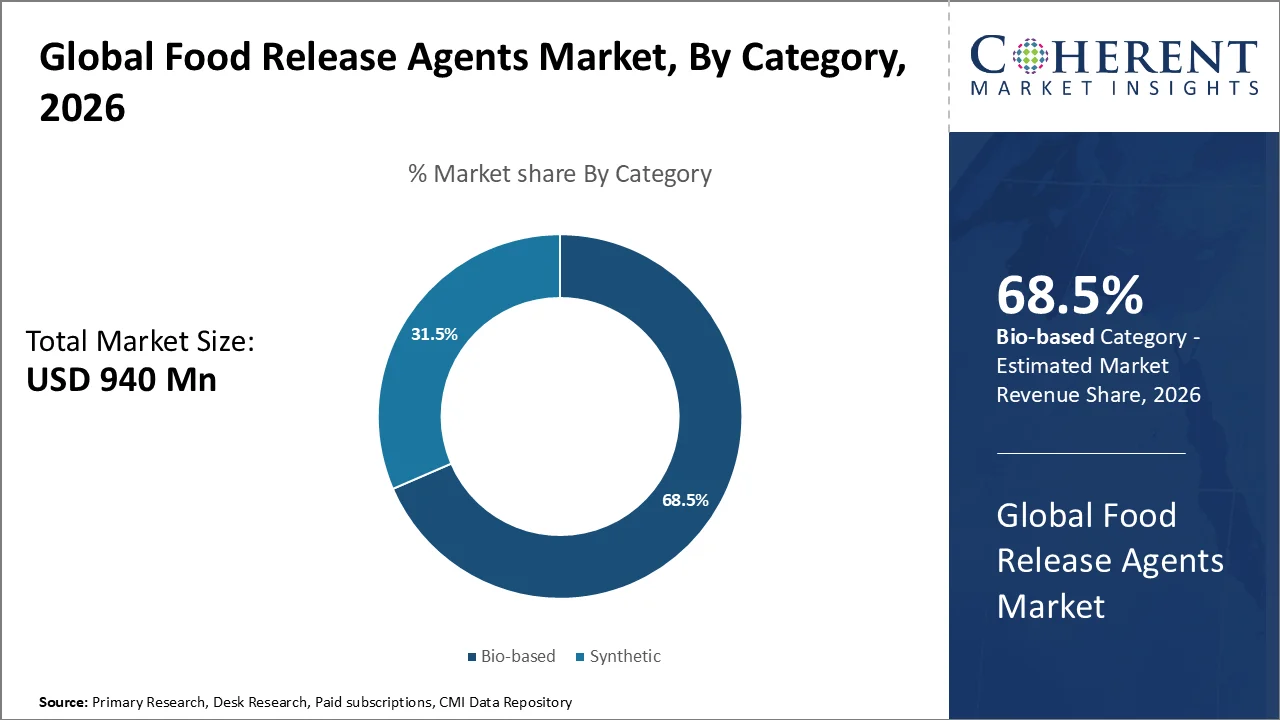
Why is Bio-based Segment Acquiring the Highest Share in the Market?
By category, bio-based segment is projected to account for the largest Food Release Agents Market share of 68.5% in 2026. The segment’s growth is owing to the growing preference for plant-derived, label-friendly, and food-contact-safe ingredients across bakery, confectionery, and processed food manufacturing. Bio-based formulations use vegetable oils, lecithin, waxes, fatty acids, and emulsifier systems, making them more aligned with clean-label and sustainability goals than conventional synthetic or mineral-oil-heavy products.
One of the relevant firm examples is DÜBÖR. The company states that its baking release agents and cutting oils for bakeries are produced from selected high-quality raw materials of 100% plant origin and are allergen-free. The firms also highlight kosher, halal, IFS, and RSPO-related credentials for its release agent portfolio. This shows how suppliers are positioning bio-based release agents as safer, cleaner, as well as more acceptable for industrial bakeries.
- Current Industry Events of 2026
- Market Size Estimation
- Regional Breakdown
- Competitive Landscape
- Customer Intelligence
- Segmental Analysis
- Pricing Analysis
- Key Market Drivers, Challenges & Future Trends
- Customized Insights Section
Bakery holds the Largest Market Share
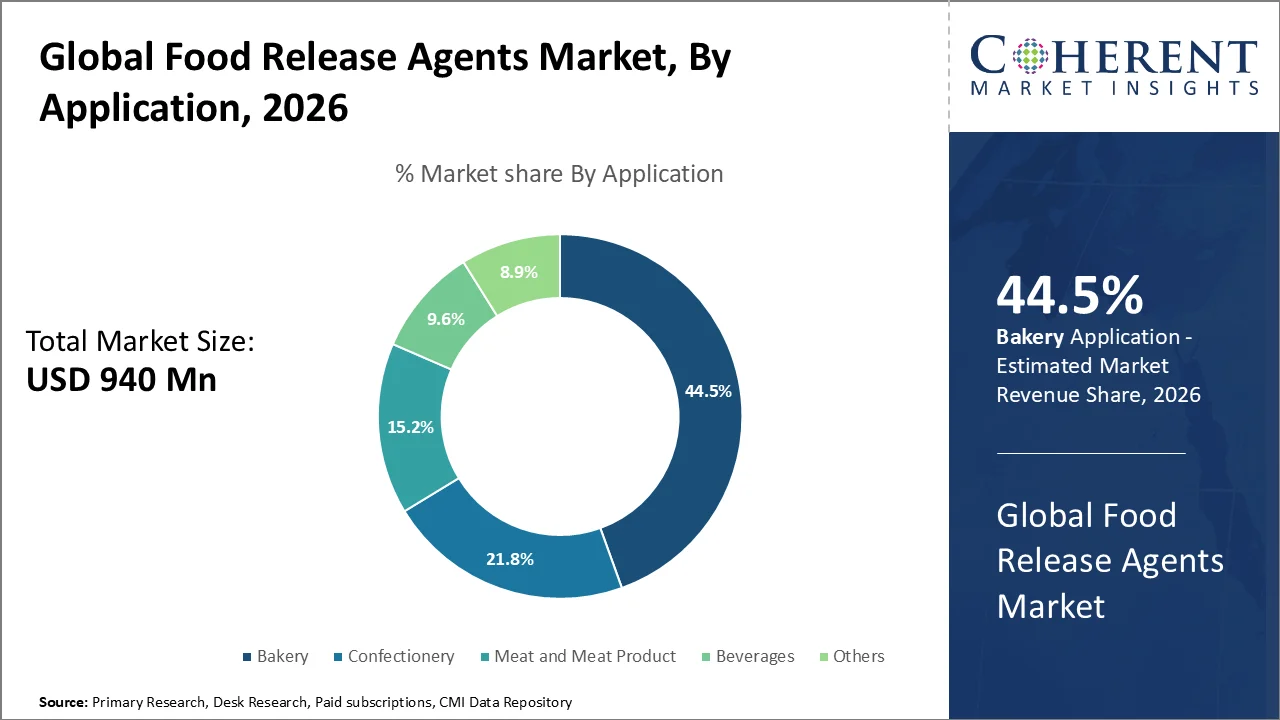
Based on application, the bakery segment is poised to dominate the market and accounts for a considerable 44.5% share in 2026. The segment’s growth is owing to the high use of release agents in industrial bread, cakes, pastries, cookies, buns, and confectionery production, where consistent depanning, tray release, belt lubrication, and surface finish are essential for product quality.
The USDA ERS estimated the U.S. per capita wheat flour use at 126.6 pounds in 2025, thereby indicating a steady demand for baked products which require oil, wax, lecithin, and emulsifier-based release systems. The BLS data also shows food manufacturing employed 1.7 million workers in May 2026, thereby reflecting the scale of processed food production capacity.
In May 2023, Zeelandia UK launched a campaign promoting hygienic release agent technology to help industrial and artisan bakers reduce food waste and improve bakery efficiency. Its Carlo and Carlex release agents support cleaner spraying, better adhesion, lower depanner waste, reduced compressed air use, as well as improved production hygiene.
Market Drivers
Rising Innovations in Food-Grade Bakery Ingredients is Transforming the Food Release Agents Industry
The rise in innovations in food-grade bakery ingredients are transforming the food release agents industry by shifting demand from pan oils toward precision-spray, residue-control, and clean-label formulations.
The opportunity is linked to industrial bakery throughput. The USDA ERS reported the U.S. wheat flour availability of 132.9 pounds per person in 2022, thereby reflecting a large processed-grain base requiring efficient depanning and equipment lubrication. At the same time, formulation innovation must stay within food-additive limits: FDA’s 21 CFR 172.878 permits white mineral oil in bakery products as a release agent and lubricant only up to 0.15% of the finished bakery product.
In May 2025, Vantage Food launched OptiRelease, a next-generation release-agent suite for industrial bakers, mainly designed for bread, cake, and pizza applications and supported by precision spray equipment. Such developments improve release strength, reduce sticking, minimize pan residue, as well as support cleaner, lower-waste bakery operations in automated high-volume lines.
PFAS-Free Dual-Certified Food-Contact Release Systems: A Major Breakthrough in Food Release Agents Market
PFAS-free dual-certified food-contact release systems are becoming a major breakthrough in the food release agents market as bakeries, confectionery lines, meat processors, and ready-meal producers shift from fluorinated grease-proofing chemistries to compliant non-stick lubrication and release platforms.
The regulatory push is strong. In January 2025, the U.S. FDA stated that 35 food contact notifications covering PFAS-based substances in paper and paperboard food packaging were no longer effective, after manufacturers ceased production, supply, or use. In Europe, authorities from five countries submitted a REACH restriction proposal covering more than 10,000 PFAS, raising compliance pressure on food-contact coatings, papers, trays, and release surfaces.
In June 2025, Interflon launched Food Lube 3H, a dual NSF 3H and H1 lubricant-release agent for direct and incidental food-contact applications. The agent helps processors simplify compliance, reduce lubricant changeovers, and maintain hygienic, PFAS-free performance in baking, cutting, freezing, and packaging operations.
Current Events and Their Impact on the Food Release Agents Market
Current Event | Description and its Impact |
EU Ongoing MOAH Regulatory Discussions Tighten Mineral Oil Contamination Scrutiny |
|
FDA and EU PFAS Restrictions Push Safer Food-Contact Release Solutions |
|
Food Release Agents Market Trends
- The rising demand for clean-label and bio-based release agents is encouraging the manufacturers to replace conventional mineral oil and synthetic additives with vegetable oil, wax, lecithin, and emulsifier-based formulations.
- The growing bakery and confectionery production is increasing the use of release agents for pans, trays, molds, belts, and packaging surfaces, thereby improving product shape, reducing breakage, and supporting high-volume output.
- Automation in food processing lines is propelling the demand for sprayable, low-residue, and accurately dosed release systems which reduce sticking, downtime, and manual cleaning in bakery, meat, and confectionery applications.
- Volatility in edible oil, cereal, and sugar prices is pushing producers toward efficient formulations that use lower application volumes while maintaining release performance and minimizing production waste.
- Strong food-contact regulations are supporting certified release agents. FDA regulations allow specified substances to be safely used as release agents under defined limits, while NSF 3H products are designed for direct food-contact release applications.
Regional Insights
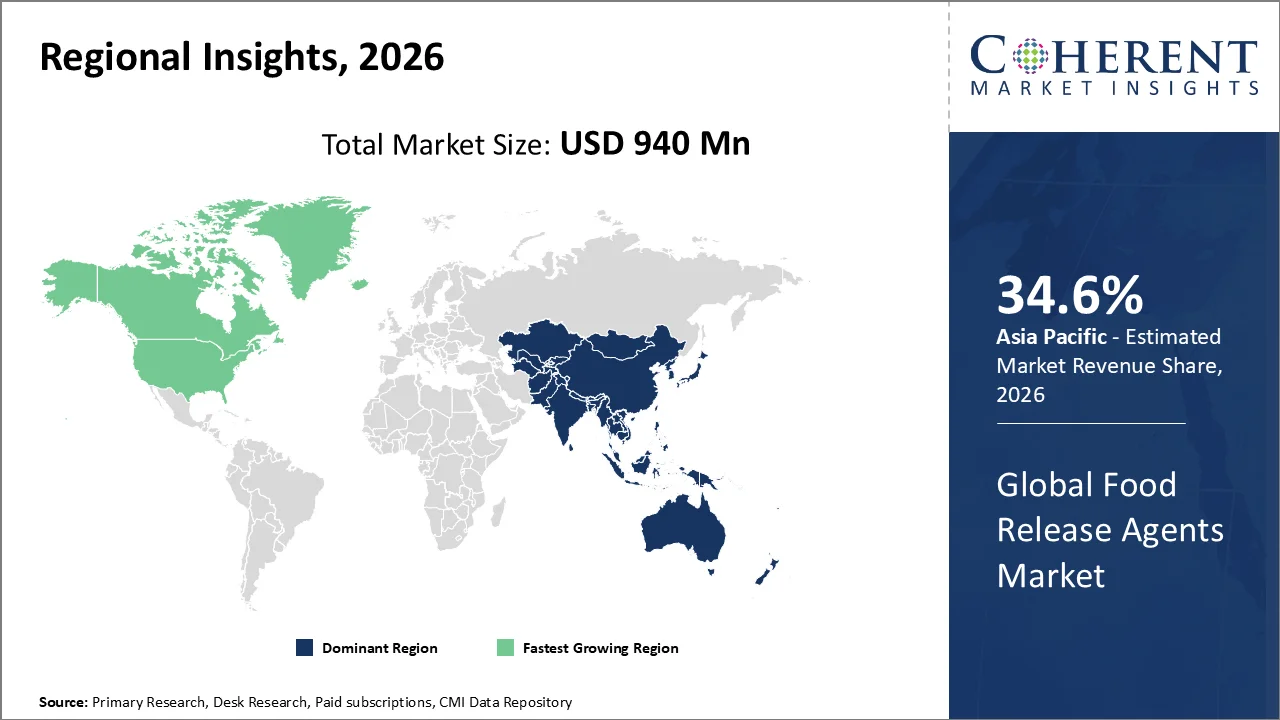
Asia Pacific Market Leadership Driven by Rapid Expansion of Industrial Bakeries and Confectionery Processing
Asia Pacific is set to account for the leading position in the Food Release Agents Market. The region occupies a substantial 34.6% share in 2026. The growth is mainly driven by the rapid expansion of industrial bakeries, confectionery processing, frozen foods, and ready-to-eat food production across China, India, Japan, South Korea, and Southeast Asia. Food release agents are used to improve depanning efficiency, reduce product breakage, prevent sticking, and maintain uniform surface quality in high-speed baking and molding lines.
In May 2026, Topwin, supported by Wynca Group, launched Siemtcoat SF211, a 100% solids solventless light release coating suitable for food-related applications. The product offers zero VOCs, stable peeling, low-temperature fast curing, and residue-free performance for baking paper, food-contact packaging, and self-adhesive food labels.
North America Food Release Agents Market Trends
The North America region is poised to be as the fastest-growing region through 2026-2033. The region’s growth is owing to the strong industrial bakery base, rising automated pan-greasing adoption, and demand for cleaner, consistent food-contact release systems.
In August 2025, Vantage Food launched the MALLET CPG 1100 Spray System for industrial bakeries. The system uses POSISPRAY smart spray technology to improve pan coverage, reduce overspray, prevent missed sprays, minimize downtime, and support consistent product quality across automated bakery operations. This strengthens the demand for precise oil, lecithin, and wax-based release formulations regionally.
Expansion of Industrial Bakery and Confectionery Accelerates Food Release Agents Adoption in China
The China Food Release Agents Market has seen robust growth. The growth is owing to the expansion of industrial bakery, confectionery, frozen food, and ready-meal production, where oils, lecithin, emulsifiers, and wax-based systems improve mould release, reduce sticking, and support faster automated lines.
In September 2025, Capol acquired Blue Pacific Flavors, which operates facilities in China, strengthening food ingredient capabilities across confectionery coatings and surface-treatment solutions for regional processors and brands.
United States Food Release Agents Market Trends
The Food Release Agents Market in United States is influenced by the scale of industrial bakery production, processed-food output, and rising need for clean, consistent pan, belt, mold, and tray release performance.
In August 2025, Vantage’s OptiRelease portfolio of next-generation release agents received IBIE “Best in Baking” honors for sustainability and plant efficiency. The solutions improve release strength, reduce product waste, lower pan washing needs, support domestic supply, and enhance efficiency for commercial bakery operations.
Who are the Major Companies in Food Release Agents Industry
Some of the major key players in Food Release Agents industry are IFC Solutions, Archer-Daniels-Midland Co., Bunge Limited, Avatar Corporation, Par-Way Tryson, Lasenor Emul SL, Maverik Oils LLC, The Bakels Group, Vantage, Specialty Chemicals, Bundy Baking Solutions, DÜBÖR Groneweg GmbH & Co. KG, and Cargill Incorporated
Key News
- In April 2026, Topwin launched Siemtcoat EM5503, a food-grade, solvent-free silicone emulsion release agent developed for baking paper and food packaging. The product supports clean demolding, heat resistance, oil and water resistance, zero-VOC production, and safe food-contact applications.
- In July 2025, Capol GmbH acquired Curt Georgi GmbH & Co. KG, expanding its flavor portfolio and strengthening food-industry capabilities. The deal complements Capol’s surface-treatment, natural-color, glazing, sealing, and release-agent solutions, supporting integrated offerings and broader international growth opportunities worldwide.
- In October 2024, ChemPoint LLC partnered with PLZ Corp to market, sell, and distribute PLZ’s food release agents and egg wash substitutes across the Americas. The collaboration expands access to Vegalene, Bak-klene, Par-Way, and Bake-Sheen through ChemPoint’s distribution network and expertise.
Market Report Scope
Food Release Agents Market Report Coverage
| Report Coverage | Details | ||
|---|---|---|---|
| Base Year: | 2025 | Market Size in 2026: | USD 940 Mn |
| Historical Data for: | 2020 To 2024 | Forecast Period: | 2026 To 2033 |
| Forecast Period 2026 to 2033 CAGR: | 4.9% | 2033 Value Projection: | USD 1,310 Mn |
| Geographies covered: |
| ||
| Segments covered: |
| ||
| Companies covered: | IFC Solutions, Archer-Daniels-Midland Co., Bunge Limited, Avatar Corporation, Par-Way Tryson, Lasenor Emul SL, Maverik Oils LLC, The Bakels Group, Vantage, Specialty Chemicals, Bundy Baking Solutions, DÜBÖR Groneweg GmbH & Co. KG, and Cargill Incorporated | ||
| Growth Drivers: |
| ||
| Restraints & Challenges: |
| ||
Analyst Opinion
- Food Release Agents Market growth is not only supported by bakery demand but by structural expansion in industrial food processing. According to the USDA ERS, U.S. food and beverage processing establishments accounted for 16.8% of sales from all U.S. manufacturing establishments in 2021. This indicates that release agents will remain recurring operational inputs because food processors need consistent product release, reduced downtime, improved sanitation, and lower rejection rates across high-speed production lines.
- The market is moving from basic pan greases toward certified, traceable, and sustainability-aligned release systems. According to the European Commission, EUDR covers palm oil, soy, and certain derived products and requires deforestation-free evidence for covered products entering or leaving the EU. This indicates that suppliers with stronger traceability, ingredient documentation, and sustainable sourcing credentials are likely to gain preference among multinational bakery and food manufacturers.
- Bio-based formulations are expected to remain strategically important because they align with clean-label, food-contact, and compliance expectations. According to the U.S. eCFR, lecithin is derived from soy, safflower, or corn oils, while FDA’s food substance inventory identifies lecithin for use as a lubricant or release agent. This suggests that plant-derived release agents will continue gaining share as food manufacturers pursue safer, more recognizable, and regulatory-compatible processing aids.
Speak to the analyst
Want personalized insights?
Take the findings above to one of our principal consultants, or have the report rebuilt around the segments, geographies and competitors you actually track.
Market Segmentation
- By Category (Revenue, USD Mn, 2021-2033)
- Synthetic
- Bio-based
- By Application (Revenue, USD Mn, 2021-2033)
- Bakery
- Confectionery
- Meat and Meat Product
- Beverages
- Others
- By Region (Revenue, USD Mn, 2021-2033)
- North America
- U.S.
- Canada
- Latin America
- Brazil
- Mexico
- Argentina
- Rest of Latin America
- Europe
- Germany
- U.K.
- France
- Italy
- Spain
- Russia
- Rest of Europe
- Asia Pacific
- China
- India
- Japan
- Australia
- South Korea
- ASEAN
- Rest of Asia Pacific
- Middle East
- GCC
- Israel
- Rest of Middle East
- Africa
- South Africa
- Central Africa
- North Africa
- North America
Sources
Primary Research Interviews
- Food Release Agent Manufacturers
- Bakery & Confectionery Product Manufacturers
- Edible Oil, Wax, and Emulsifier Suppliers
- Food Processing Technology Consultants
- Industrial Bakery Production Managers
- Food Ingredient Distributors
- Others
Databases
- Bloomberg Terminal
- Thomson Reuters Eikon
- Factiva
- Others
Magazines
- Food Business News
- Baking & Snack Magazine
- Food Engineering Magazine
- Food Ingredients First
- International Bakery Magazine
- Chemical Engineering Magazine
- Others
Journals
- Journal of Food Science
- Food Chemistry Journal
- Journal of Food Engineering
- LWT – Food Science and Technology
- International Journal of Food Science & Technology
- Journal of Cereal Science
- Others
Newspapers
- Financial Times
- The Wall Street Journal
- Reuters
- Bloomberg News
- The Economic Times
- Food Navigator News
- Others
Associations
- Institute of Food Technologists (IFT)
- American Bakers Association (ABA)
- International Association of Operative Millers (IAOM)
- European Food Safety Authority (EFSA)
- Food and Agriculture Organization (FAO)
- Specialty Food Association
- Others
Public Domain Sources
- U.S. Food and Drug Administration (FDA)
- European Food Safety Authority (EFSA)
- Food and Agriculture Organization (FAO)
- U.S. Department of Agriculture (USDA)
- World Health Organization (WHO)
- European Commission – Food Safety
- World Bank Open Data
- Others
Proprietary Elements
- CMI Data Analytics Tool
- Proprietary CMI Existing Repository of Information for the Last 10 Years
Get access to 250+ pages report
Every segment, forecast, competitor profile and data table behind the analysis above — available for instant download.
- ESOMAR Member
- ISO 9001:2015 Certified
- D-U-N-S Registered
- GDPR & CCPA Compliant
Missing comfort of reading report in your local language? Find your preferred language:
Transform your Strategy with Exclusive Trending Reports
Frequently Asked Questions
The Food Release Agents Market is expected to reach USD 940 Mn in 2033.
Major players operating in the global Food Release Agents Market include IFC Solutions, Archer-Daniels-Midland Co., Bunge Limited, Avatar Corporation, Par-Way Tryson, Lasenor Emul SL, Maverik Oils LLC, The Bakels Group, Vantage, Specialty Chemicals, Bundy Baking Solutions, DÜBÖR Groneweg GmbH & Co. KG, and Cargill Incorporated
The volatile raw material prices (such as vegetable oils and crude oil), stringent international food safety regulations, and the shorter shelf life and lower thermal stability of natural/organic alternatives compared to synthetic chemicals are the key factors hampering growth of the market.
The surging demand for processed and convenience foods, rapid expansion of the industrial bakery sector, and the necessity for enhanced manufacturing efficiency is boosting demand for Food Release Agents.
The Food Release Agents Market is anticipated to grow at a CAGR of 4.9% between 2026 and 2033.
Among regions, Asia Pacific is expected to account for a largest market share in the global Food Release Agents Market over the forecast period.
The market primarily includes oil-based agents, wax-based coatings, lecithin-based agents, emulsifier blends, and polymeric/synthetic release coatings, each suited for specific food applications like bakery, confectionery, frozen foods, and ready-to-eat products.