

Bacon Market Size and Share Analysis- Growth Trends and Forecasts (2026-2033)
The Bacon Market size is anticipated to grow at a CAGR of 2.8% with USD 76.9 Bn in 2026 and is expected to reach USD 93 Bn in 2033. The primary drivers are largely defined by rising demand for convenient protein-rich foods, growing breakfast and quick-service restaurant consumption, increasing use of bacon in burgers, sandwiches, pizzas, and ready-to-cook meals, and wider retail availability of packaged processed pork products. According to OECD-FAO, global meat consumption is projected to increase by 47.9 million tons over the next decade, supporting demand for processed pork products such as bacon across foodservice, supermarkets, specialty stores, and online retail channels.
Key Takeaways
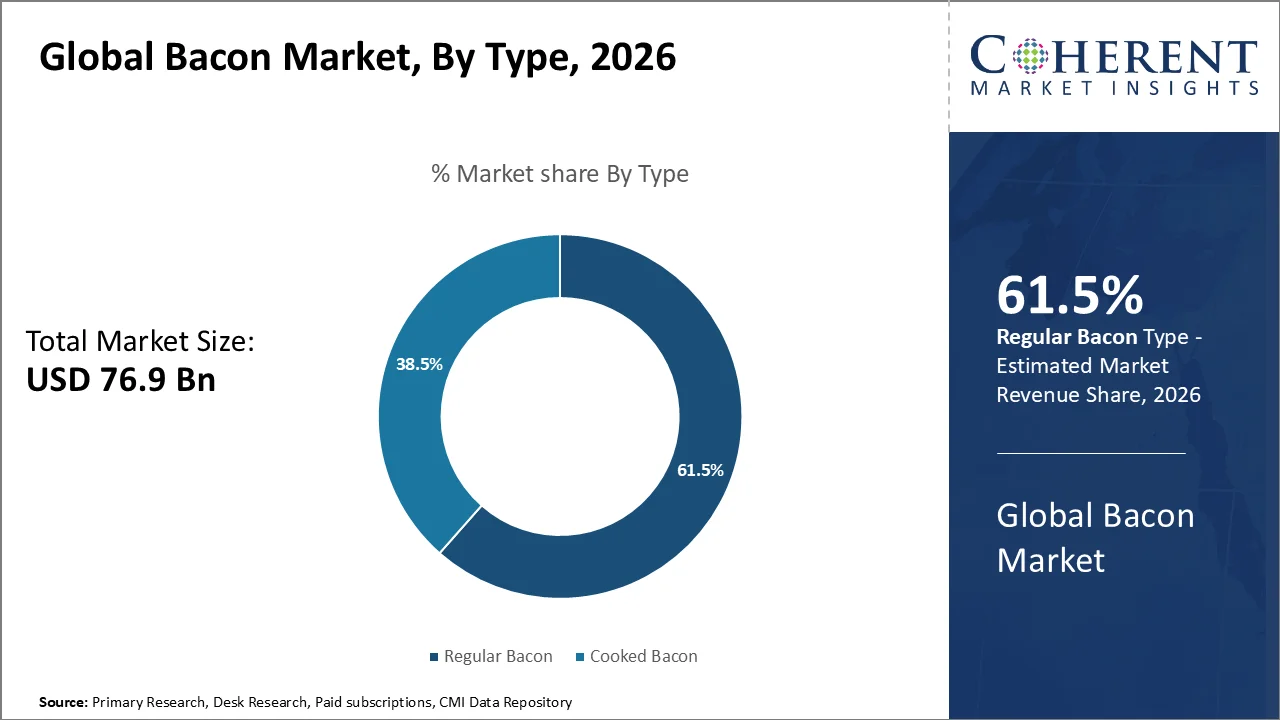
- The regular bacon is likely to dominate the market with 61.5% in 2026. The segment’s growth is owing to its wider consumer acceptance, strong use in breakfast meals, burgers, sandwiches, pizzas, and ready-to-cook food products. According to the U.S. Department of Agriculture (USDA, 2025), per capita pork consumption in the U.S. reached 50.4 lbs per person, thereby highlighting the consistent bacon consumption in the households.
- The food service channel segment is set to lead with 58.4% in 2026. The segment’s growth is owing to the rising use of bacon in restaurants, hotels, cafés, fast-food chains, and cloud kitchens. The CDC National Health and Nutrition Examination Survey (NHANES, 2024) indicates that more than 64% of the U.S. adults eat at least one meal outside home per week, thereby underscoring a strong out-of-home food demand that propels the bacon usage.
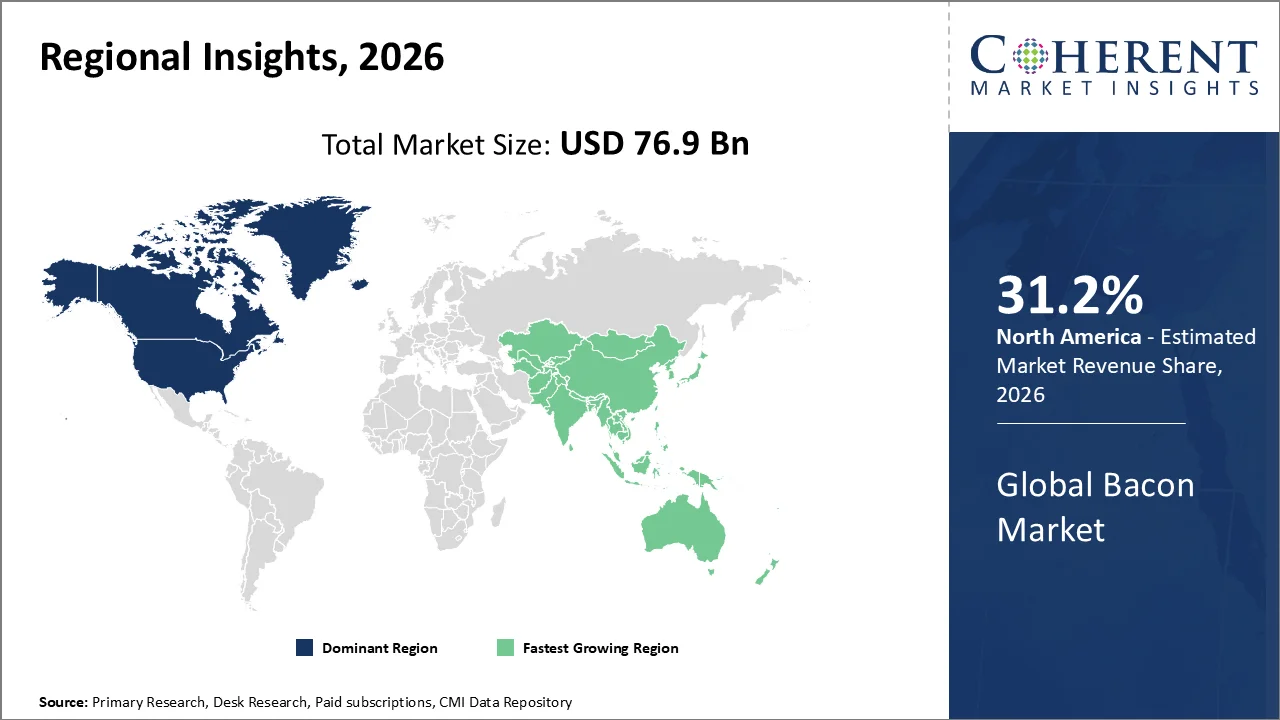
- North America is expected to acquire the prominent share of 31.2% in 2026. The region’s growth is owing to the high bacon consumption, strong processed meat culture, well-established pork processing facilities, and wide availability of packaged bacon products. The USDA Economic Research Service (ERS, Jan 2026) reports that the U.S. produced 12.52 million metric tons of pork in 2025, thereby reflecting a robust domestic supply supporting the bacon market prominence.
Segmental Insights
Why is Regular Bacon Acquiring the Largest Share?
On the basis of type, the regular bacon segment is projected to account for the largest Bacon Market share of 61.5% in 2026. The segment’s growth is owing to its strong fit with everyday breakfast, burger, sandwich, and foodservice applications, where consumers prefer familiar pork bacon formats over specialty alternatives. Its dominance is also supported by measurable retail demand and pork availability.
BLS average retail food data reported sliced bacon at USD 6.712 per lb in the U.S. city average in May 2026, confirming regular bacon’s continued tracking as a mainstream household item. USDA NASS also reported 74.3 million hogs and pigs on U.S. farms as of March 1, 2026, indicating stable raw material availability in one of the largest bacon-consuming markets.
In July 2025, Prairie Fresh introduced a naturally hardwood-smoked bacon line in Applewood Smoked, Hickory Smoked, and Hickory Smoked Thick Cut varieties. The launch strengthens Prairie Fresh’s entry into the bacon category with U.S.-sourced pork, smaller pack formats, and recipe-linked QR codes.
- Current Industry Events of 2026
- Market Size Estimation
- Regional Breakdown
- Competitive Landscape
- Customer Intelligence
- Segmental Analysis
- Pricing Analysis
- Key Market Drivers, Challenges & Future Trends
- Customized Insights Section
Food Service Channel hold the Largest Market Share
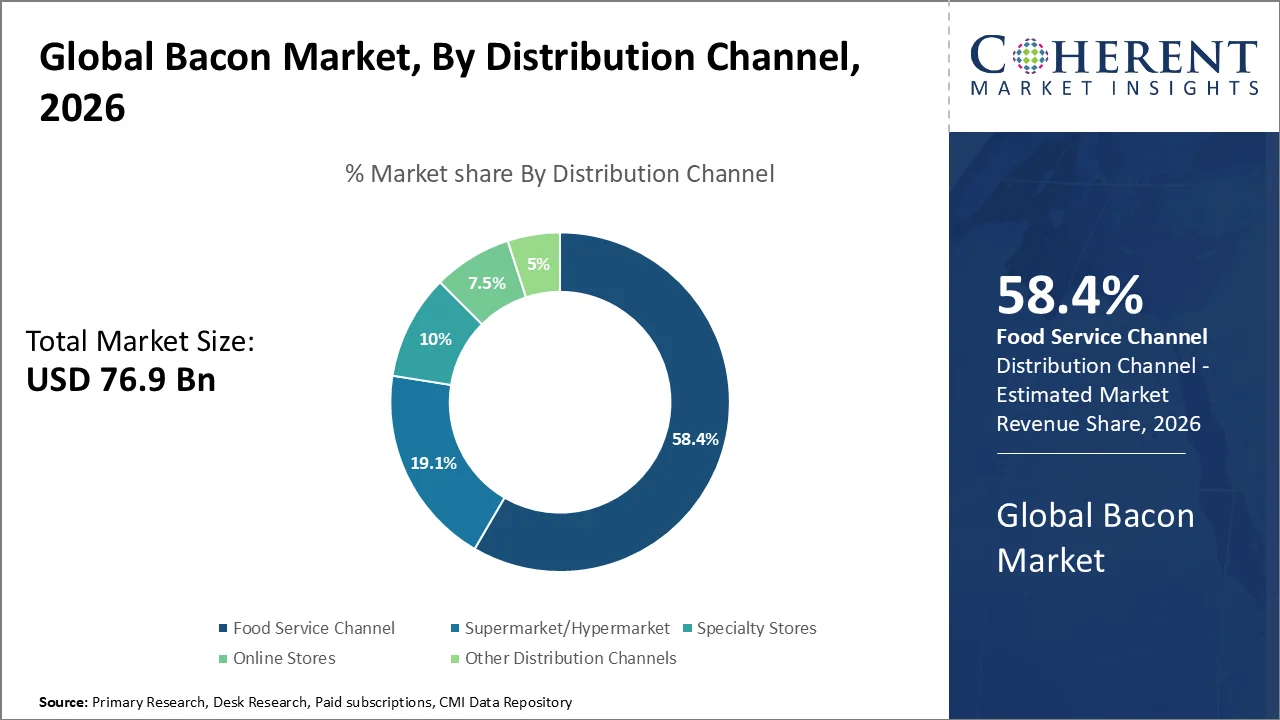
On the basis of distribution channel, the food service channel segment lead with a major 58.4% share in 2026. The segment’s growth is owing to the bacon’s high menu penetration across breakfast restaurants, cafés, quick-service restaurants, hotels, casual dining chains, cloud kitchens, and institutional catering.
As per the industrial data and recent operator discussions, bacon now appears on about 69% of menus, reflecting its strong role in breakfast platters, burgers, sandwiches, pizzas, salads, and premium side dishes. Foodservice operators use bacon because it delivers strong flavor, high perceived indulgence, and easy menu integration.
In January 2026, Denny’s launched its new “Slammin’ Meal Deals” menu starting at USD 5.99. It included breakfast items served with a choice of two crispy strips of new Applewood-smoked bacon or sausage. This shows how restaurant chains are using bacon-based value meals to attract breakfast and all-day dining customers, thereby supporting the higher bacon consumption through cafés, diners, as well as quick-service restaurants.
Rising Innovations in Flavor-Infused Bacon are Transforming the Bacon Market in the US
The U.S. bacon market is witnessing strong innovation around premium flavors, co-branded products, thick-cut formats, limited-edition launches, and convenience-led packaging. The brands are moving beyond traditional smoked bacon toward sweet, spicy, bourbon-cured, hot sauce-flavored, oven-ready, as well as foodservice-friendly formats. This innovation is assisting the bacon brands defend shelf space, attract younger consumers, and create new consumption occasions beyond breakfast. The trend is particularly important in the U.S., where bacon is deeply integrated into breakfast, burger, sandwich, and snacking occasions.
In April 2026, Oscar Mayer, a Kraft Heinz brand, launched Maple Bourbon Bacon in partnership with Evan Williams Bourbon. The product is thick-cut, expertly trimmed, cured with bourbon, and slow-smoked for 12 hours. Kraft Heinz stated that this was firm’s first bacon innovation in five years and that bacon accounts for one-third of Oscar Mayer’s business, thereby indicating the strategic importance of bacon-led portfolio expansion.
Automated Bacon Processing: A Major Breakthrough in the Bacon Market
Automated bacon processing is becoming a major breakthrough in the Bacon Market as manufacturers focus on higher throughput, worker safety, slicing consistency, packaging speed, and lower operational downtime. Bacon processing traditionally involves handling pork bellies, smoking, chilling, slicing, stacking, inspection, and packaging, all of which require precision and food safety control. Automation helps processors reduce repetitive manual handling, improve ergonomic safety, and deliver consistent bacon slices for both retail packs as well as foodservice formats.
In January 2024, Tyson Foods opened a USD 355 million food production facility in Bowling Green, Kentucky, built to expand the bacon production capacity. The 400,000-square-foot plant is expected to produce two million pounds per week of Jimmy Dean and Wright Brand bacon retail products and bacon used in foodservice. The facility also uses high-tech robots, driverless forklifts, and autonomous guided vehicles to improve production efficiency, worker safety, and logistics flow. This investment reflects how leading bacon producers are using automation to support the demand from both retail as well as foodservice customers.
Current Events and Their Impact on the Bacon Market (regulatory shifts, government policies)
Current Event | Description and its Impact |
USDA “Product of USA” Labeling Rule Takes Effect (January 2026) |
|
EU Reduces Nitrite and Nitrate Limits in Cured Meat Products (October 2025) |
|
Bacon Market Trends
- The rising demand for convenient breakfast foods and ready-to-cook meat products is strengthening the bacon consumption across retail as well as foodservice channels.
- Premium, smoked, maple-flavored, thick-cut, and dry-cured bacon variants are gaining popularity as consumers seek indulgent and differentiated meat products.
- Foodservice innovation expands the bacon usage in burgers, sandwiches, pizzas, breakfast platters, salads, and loaded side dishes across the world.
- Strong pork production and export activity is supporting the bacon manufacturing and trade. In 2024, the U.S. pork exports reached around 3.03 million metric tons, valued at USD 8.63 billion. The U.S. pork availability also stood at 47.5 pounds per person in 2021, thereby supporting the steady processed pork demand.
- Health-focused product reformulation is increasing the demand for lower-sodium, nitrate-free, uncured, turkey, as well as chicken bacon alternatives. In the U.S., average sodium consumption is over 3,300 mg per day, above the federal recommendation of less than 2,300 mg, encouraging manufacturers to introduce cleaner-label and better-for-you bacon products.
Regional Insights
North America Dominates Owing to the High Pork Availability, Strong Processing Capacity, and Flavor Innovation
The North America region accounts for 31.2% of the market share in 2026. The region’s growth is owing to the high pork availability, strong breakfast consumption culture, large-scale pork processing capacity, widespread refrigerated retail infrastructure, and strong presence of major packaged meat brands.
According to official livestock inventory data, United States and Canadian inventory of all hogs and pigs for December 2025 stood at 89.4 million head, indicating a strong regional supply base for bacon processors. The U.S. alone reported 75.5 million hogs and pigs on December 1, 2025, while Canada recorded 13.9 million head on January 1, 2026.
The region is also highly active in bacon innovation. In October 2025, This shows how North American brands are using flavor partnerships to drive premiumization and shelf differentiation.
Asia Pacific Bacon Market Trends
Asia Pacific is expected to witness strong growth in Bacon Market over the forecast period. The region’s growth is owing to the steady pork supply base, rising processed meat consumption, and expanding quick-service, hotel, and premium snacking channels.
China remains the strongest volume anchor, as the National Bureau of Statistics reported 59.38 million tons of pork output in 2025, up 4.1%, with 719.73 million pigs slaughtered, supporting raw material availability for bacon and cured pork processors. Australia also shows stable production capacity. The Australian Bureau of Statistics recorded 1.4 million pigs slaughtered and 118,084 tons of pig meat produced in the June 2025 quarter.
In July 2025, Philippine bacon snack brand Baken introduced the Baken 1104 dining platform with chefs Jordy Navarra and Johanne Siy. This positions bacon in the premium Filipino dining and on-trade applications, which supports the regional premiumization as well as new consumption occasions ahead.
Stable Hog Supply and Cultivated Fat Innovation is Accelerating the Bacon Market in United States
The U.S. remains the most important country market owing to the stable hog supply base, rising processing capacity, and consumer interest in differentiated bacon formats. The USDA NASS reported that U.S. market hog inventory reached 68.4 million head as of March 1, 2026, thereby indicating a stable domestic pork supply pipeline for bacon processors.
In July 2025, Mission Barns secured the USDA approval for its cultivated pork fat ingredient, thereby enabling the U.S. foodservice and retail launches. The milestone supports the bacon innovation through cultivated fat-based products like limited bacon offerings at Fiorella, improving taste, texture, and sustainability.
China Bacon Market Trends
In the China, the growth in the Bacon Market is driven by the steady pork availability, cold-chain retailing, and demand for Western-style breakfast, bakery, burger, and ready-meal applications. The official NBS data shows China’s pork output grew 4.2% year-on-year in Q1 2026, thereby supporting the processed pork supply for bacon producers. Shuanghui’s official portfolio also includes bacon, ham, and sausage products using imported U.S. pork and American processing technology, thus strengthening the premium processed meat positioning.
In January 2025, Smithfield Foods’ Nasdaq IPO raised about USD 236 million net proceeds, thereby supporting infrastructure, automation, and capacity expansion. It supports China-linked packaged meat growth through premium bacon innovations such as Double Thick, Double Smoked, and Maple Thick Cut products.
Who are the Major Companies in Bacon Industry
Some of the major key players in Bacon Market are Hormel Foods Corporation, Tyson Foods Inc., The Kraft Heinz Company, WH Group Limited, JBS SA, Fresh Mark Inc., Seaboard Corporation, Maple Leaf Foods, Hill Meat Company, Peer Foods Group Inc., Kunzler & Company Inc., and Jones Dairy Farm.
Key News
- In June 2026, Applegate expanded its bacon portfolio with Applegate Naturals Uncured Beef Bacon, a hickory-smoked product made from 100% grass-fed, pasture-raised beef. The launch highlights growing demand for clean-label, protein-rich bacon alternatives with differentiated sourcing and convenience-led positioning.
- In May 2026, Niman Ranch launched its 100% Grass-Fed and Grass-Finished Beef Bacon, expanding premium alternatives in the bacon aisle. The product is available at Whole Foods Markets across the South, Mid-Atlantic, and Midwest, targeting protein-conscious consumers seeking steakhouse-style bacon.
- In September 2025, Godshall’s Quality Meats launched Chicken Bacon, made from premium whole-muscle chicken and smoked in its own smokehouse as a leaner bacon alternative. The product contains 75% less fat than pork bacon, with distribution expanding to over 200 Acme and Safeway stores.
Market Report Scope
Bacon Market Report Coverage
| Report Coverage | Details | ||
|---|---|---|---|
| Base Year: | 2025 | Market Size in 2026: | USD 76.9 Bn |
| Historical Data for: | 2020 To 2024 | Forecast Period: | 2026 To 2033 |
| Forecast Period 2026 to 2033 CAGR: | 2.8% | 2033 Value Projection: | USD 93 Bn |
| Geographies covered: |
| ||
| Segments covered: |
| ||
| Companies covered: | Hormel Foods Corporation, Tyson Foods Inc., The Kraft Heinz Company, WH Group Limited, JBS SA, Fresh Mark Inc., Seaboard Corporation, Maple Leaf Foods, Hill Meat Company, Peer Foods Group Inc., Kunzler & Company Inc., and Jones Dairy Farm | ||
| Growth Drivers: |
| ||
| Restraints & Challenges: |
| ||
Analyst Opinion
- The bacon market is driven by the stable consumer demand for convenient, protein-rich breakfast and snacking products. The pork availability in the U.S. is projected at 50.9 pounds per capita in 2026, thereby supporting the steady bacon consumption across retail as well as foodservice.
- Foodservice remains a major growth engine for bacon. The U.S. food-away-from-home spending reached USD1.41 trillion in 2025, thereby strengthening the demand for bacon in burgers, sandwiches, breakfast menus, pizzas, and quick-service restaurant offerings.
- The market is not growing only because of traditional breakfast consumption. It is also benefiting from premiumization, ready-to-cook formats, smoked flavors, low-sodium variants, and wider use of bacon as a flavor enhancer. However, health concerns around processed meat and fat content may limit aggressive growth, thus making innovation in cleaner-label, portion-controlled, and better-quality bacon products important for long-term market expansion.
Speak to the analyst
Want personalized insights?
Take the findings above to one of our principal consultants, or have the report rebuilt around the segments, geographies and competitors you actually track.
Market Segmentation
- By Type (Revenue, USD Bn, 2021-2033)
- Regular Bacon
- Cooked Bacon
- By Distribution Channel (Revenue, USD Bn, 2021-2033)
- Food Service Channel
- Supermarket/Hypermarket
- Specialty Stores
- Online Stores
- Other Distribution Channels
- By Region (Revenue, USD Bn, 2021-2033)
- North America
- U.S.
- Canada
- Latin America
- Brazil
- Mexico
- Argentina
- Rest of Latin America
- Europe
- Germany
- U.K.
- France
- Italy
- Spain
- Russia
- Rest of Europe
- Asia Pacific
- China
- India
- Japan
- Australia
- South Korea
- ASEAN
- Rest of Asia Pacific
- Middle East
- GCC
- Israel
- Rest of Middle East
- Africa
- South Africa
- Central Africa
- North Africa
- North America
Sources
Primary Research Interviews
- Bacon Manufacturers
- Pork Processing Companies
- Meat Product Distributors & Wholesalers
- Retail Chain Procurement Managers
- Foodservice & HoReCa Buyers
- Cold Chain & Refrigerated Logistics Providers
- Meat Packaging Solution Providers
- Food Safety & Quality Compliance Experts
- Others
Databases
- Bloomberg Terminal
- Thomson Reuters Eikon
- S&P Global Market Intelligence
- Euromonitor International
- USDA Economic Research Service Database
- FAOSTAT
- UN Comtrade
- ITC Trade Map
- Others
Magazines
- Meat+Poultry Magazine
- The National Provisioner
- Food Business News
- Food Engineering Magazine
- Global Meat News
- Prepared Foods Magazine
- Others
Journals
- Meat Science Journal
- Journal of Food Science
- Food Control Journal
- Journal of Food Protection
- International Journal of Food Microbiology
- Foods Journal
- Others
Newspapers
- Financial Times
- The Wall Street Journal
- Reuters
- Bloomberg News
- The Guardian
- Associated Press
- Others
Associations
- North American Meat Institute
- National Pork Board
- National Pork Producers Council
- American Meat Science Association
- International Meat Secretariat
- British Meat Processors Association
- AHDB Pork
- CLITRAVI – European Association of Meat Processing Industries
- Others
Public Domain Sources
- U.S. Department of Agriculture – Economic Research Service
- U.S. Department of Agriculture – Food Safety and Inspection Service
- Food and Agriculture Organization of the United Nations
- Eurostat
- World Bank Open Data
- U.S. Food and Drug Administration
- Codex Alimentarius Commission
- Others
Proprietary Elements
- CMI Data Analytics Tool
- Proprietary CMI Existing Repository of Information for the Last 8 Years
Get access to 250+ pages report
Every segment, forecast, competitor profile and data table behind the analysis above — available for instant download.
- ESOMAR Member
- ISO 9001:2015 Certified
- D-U-N-S Registered
- GDPR & CCPA Compliant
Missing comfort of reading report in your local language? Find your preferred language:
Transform your Strategy with Exclusive Trending Reports
Frequently Asked Questions
The Bacon Market is expected to reach USD 93 Bn in 2033.
Major players operating in the global Bacon Market include Hormel Foods Corporation, Tyson Foods Inc., The Kraft Heinz Company, WH Group Limited, JBS SA, Fresh Mark Inc., Seaboard Corporation, Maple Leaf Foods, Hill Meat Company, Peer Foods Group Inc., Kunzler & Company Inc., and Jones Dairy Farm.
The rising consumer health consciousness regarding processed meats, volatility in raw material (pork) and feed prices, and the growing popularity of ethical and plant-based meat alternatives are the key factors hampering growth of the market.
The increasing consumer demand for protein-rich convenience foods, the rapid expansion of fast-food and quick-service restaurant (QSR) chains, and continuous product innovations like pre-cooked and lower-sodium variants is boosting the demand for Bacon.
The Bacon Market is anticipated to grow at a CAGR of 2.8% between 2026 and 2033.
Among regions, North America is expected to account for a largest market share in the global Bacon Market over the forecast period.
Bacon is a processed meat product, typically made from pork belly or back cuts, that is cured, smoked, or cooked to enhance flavor, texture, and shelf life. The market encompasses regular bacon, turkey bacon, beef bacon, plant-based bacon, ready-to-cook bacon, as well as fully cooked bacon sold via the retail, food service, and online channels.