

Fitness Equipment Market Size and Forecast – 2026 to 2033
Global fitness equipment market size is expected to reach USD 19.94 Bn by 2033, from USD 13.89 Bn in 2026, exhibiting a compound annual growth rate (CAGR) of 5.3% during the forecast period.
Key Takeaways
- Based on Equipment Type, the Cardiovascular Training Equipment segment is expected to lead the market holding an estimated share of 38% in 2026 due to rising demand to improve cardiovascular and respiratory system to their limits.
- Based on End User, the Home/Individual segment is expected to hold the largest share in 2026, owing to increasing consumer preference for at-home workout.
- Based on Distribution Channel, the offline segment is projected to dominate the market with highest share in 2026, driven by consumer wanting hands-on experience.
- Based on Region, North America is estimated to lead the market with a share of 39% in 2026.
Market Overview
The global fitness equipment market share is primarily driven by the increasing prevalence of obesity and lifestyle disease, growing heath consciousness and technological advancmenets. The growing disease and viruses also fuel to the demand for people to turn to home workout instead of gym closures. Fitness equipment can be classified into cardiovascular training and weight training and are widely available in online and offline stores. The health club is the largest consumers of fitness equipment but this equipment is also gaining huge demand from the homecare sector due to the rising number of people adopting a healthy lifestyle and aspiring to have a good personality.
Current Events and Its Impact
Current Events | Description and its Impact |
Health Crisis-Driven Regulatory Changes |
|
Economic Pressures Creating Dual Market Dynamics |
|
Role of AI (Artificial Intelligence) in Fitness Equipment Market
AI analyzes user data like fitness levels, goals, and performance to create customized exercise plans tailored to individual needs. In April 2025, Echelon collaborated with Amazon Web Services (AWS) to launch a generative AI-powered fitness platform that offers personalized workouts. This collaboration merges Echelon's premium fitness content with AWS's advanced AI and machine learning to deliver customized fitness experiences for each member.
- Current Industry Events of 2026
- Market Size Estimation
- Regional Breakdown
- Competitive Landscape
- Customer Intelligence
- Segmental Analysis
- Pricing Analysis
- Key Market Drivers, Challenges & Future Trends
- Customized Insights Section
Segmental Insights
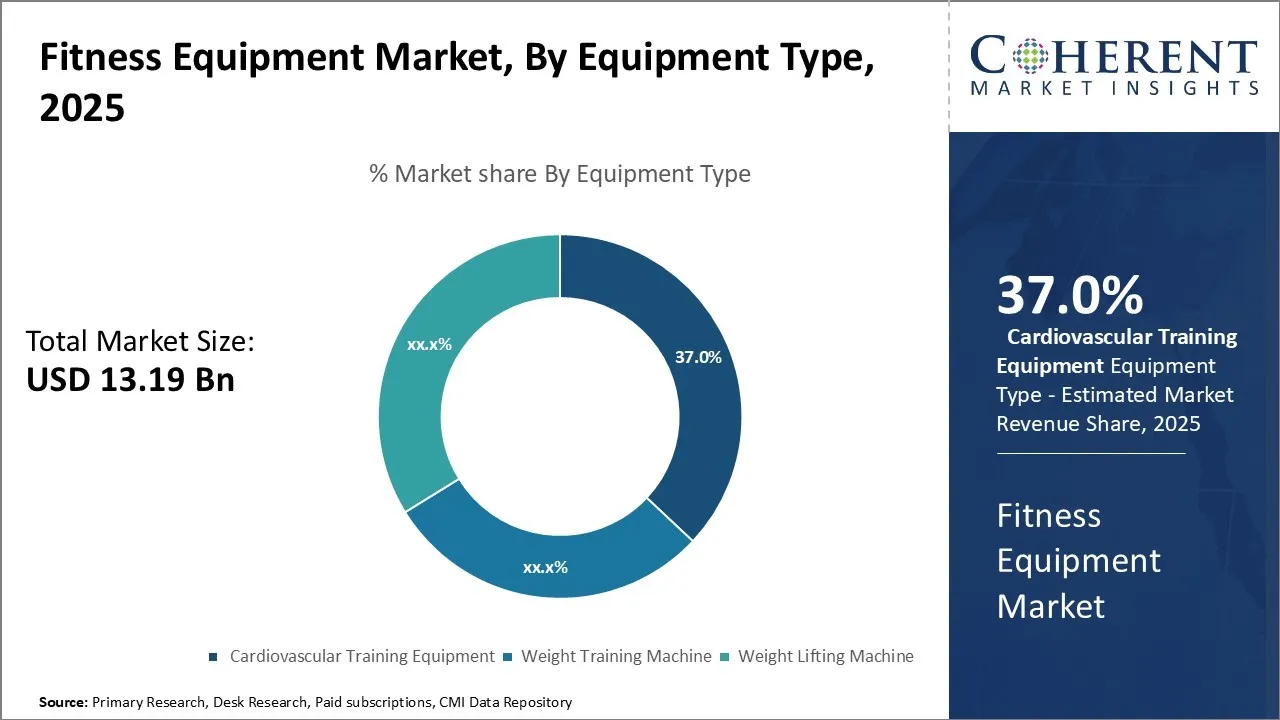
Fitness Equipment Market Insight, By Equipment Type - Cardiovascular Training Equipment Dominates the Overall Market Owing to the Growing Demand to Improve Cadiovascular and Respiratory Health
In terms of product type, the cardiovascular training equipment segment is expected to contribute the highest fitness equipment market share of 37.0% in 2025 owing to the rising demand to improve cardiovascular and respiratory system to their limits. Cardiovascular training equipment are highly demanding due to its numerous health benefits and its role in overall well-being. The regularly used cardio equipment includes treadmills, ellipticals and stationary bikes, this equipment has the potential to significantly improve cardiovascular health, increasing lunch capacity and strengthen the heart. Along with that, this equipment contributes to weight management and reduce the risk of chronic diseases such as heart disease, high blood pressure, and type 2 diabetes.
In April 2025, Core Health & Fitness launched its Next Generation 8 and 10 Series Cardio Equipment. This launch features Apex, a new connected display platform built to improve performance, usability, and facility management.
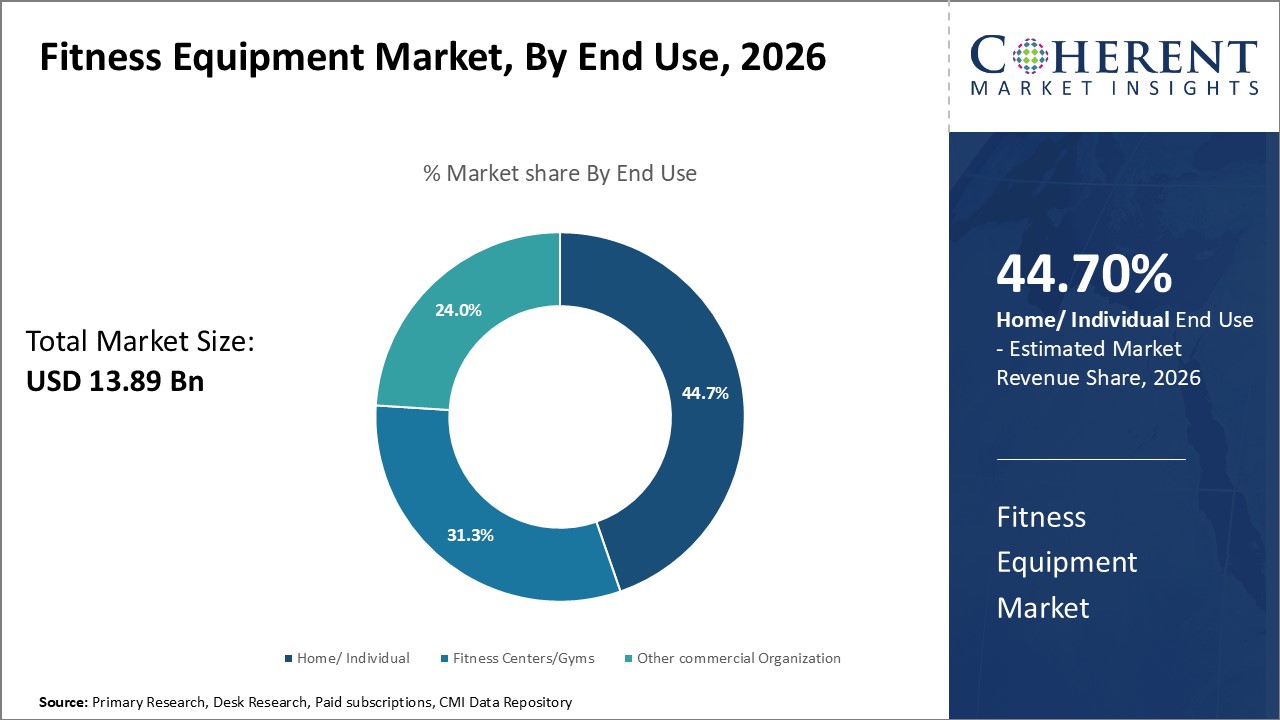
Fitness Equipment Market Insight, By End Use - Home/Individual Acquires the Dominant Share on account of the growing demand for At-Home Workout
In terms of end use, the home/individual segment is projected to contribute the highest share of the market in 2025, driven by increasing consumer preference for at-home workout. The commonly used at-home workout equipment includes dumb-bells, resistance bands, kettlebells, jump ropes, yoga mats, and exercise bikes. Other options include treadmills, ellipticals, and pull-up bars, depending on the desired workout intensity and space availability. Home workout is considered more preferable than going to the gym with its great benefits. At-home workout saves travelling time to the gym, saves money of the gym membership, contributes to be highly convenient.
In January 2025, Los Angeles–based amp Fitness introduced an AI-powered home gym machine, marking a major step in smart workout tech, launched the sleek system adapts in real-time, analyzing performance data to tailor resistance and workout routines using AI algorithms. Boasting a compact design that supports diverse modalities like HIIT, Pilates, and strength training, it targets fitness enthusiasts seeking powerful, and space-saving home solutions.
Fitness Equipment Market Insight, By Distribution Channel - Offline Segment Acquires the Dominant Share
The offline segment is expected to dominate the market with a largest share in 2025, supported by consumer wanting hands-on experience, immediate delivery and in-person supported during purchase and installation. Buying workout equipment offline, at a physical store, offers several advantages over online shopping, particularly for large items or those requiring a hands-on experience. Individual can test the equipment, get expert advice from salespeople, and avoid potential shipping damage. Offline retail stores are significantly growing due to companies such as Cultsport investing in offline stores to reach consumers.
Regional Insights
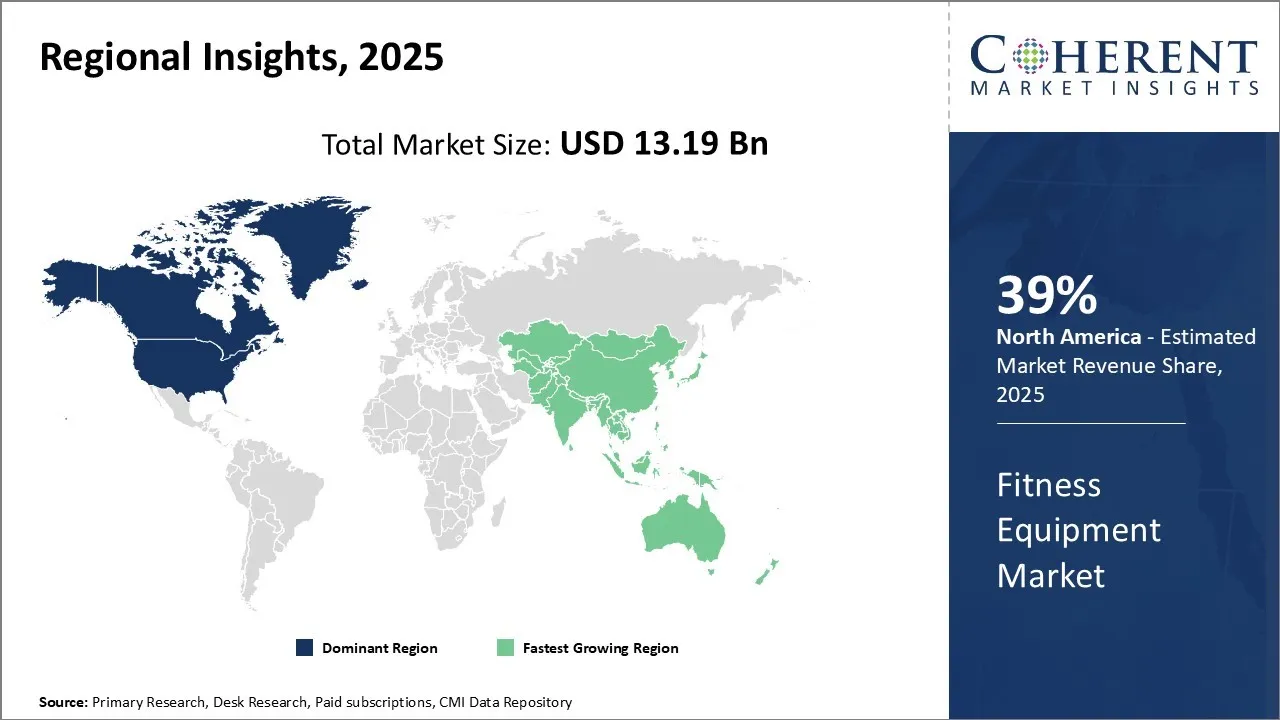
North America Fitness Equipment Market Analysis & Trends
North America is expected to be the largest market for fitness equipment during the forecast period, accounting for over 39% of the market share in 2026. The high obese or overweight population base in North America drives the demand for fitness equipment in this region. According to the National Institute of Diabetes and Digestive and Kidney Diseases, nearly 1 in 3 adults (30.7%) are overweight which includes more than 1 in 3 men (34.1%) and 1 in 4 women (27.5%). These data suggest the rising demand of fitness equipment in the North America, as people use fitness equipment to help manage their weight, improve their physical health and reduce the risk related to health problems.
Asia Pacific Fitness Equipment Market Analysis & Trends
Asia Pacific is expected to be the second-largest market for global fitness equipment machines, accounting for over 21% of the market share in 2026. Developed countries, such as Japan and South Korea, significantly drive market growth in the Asia Pacific region. Markets in countries, such as China and India, are witnessing rapid growth of urbanization. The main driver of the market in Asia Pacific region growing focus on heath and wellness. Urbanization has improved the access to gym and fitness facilities. Roughly 22 million people are members of health clubs in the Asia Pacific region, where the largest membership number is from China with 4.52 million and Japan with 4.24 million members.
Hong Kong fitness powerhouse 24/7 FITNESS inaugurated its Singapore flagship on prestigious Orchard Road, following the acquisition of local chain GymmBoxx. The new 10,000 sq ft facility features top-tier cardio, and weight-training machines. The company plans to expand to 40 clubs across Singapore within 3 years.
Europe Fitness Equipment Market Analysis & Trends
Europe is expected to be the third-largest market for global fitness equipment machines, accounting for over 15.0% of the market share in 2026. The region's overall disposable income has increased significantly, and product adoption is expected to accelerate as the youth population grows rapidly and per capita disposable income rises. The Europeans are expecting a 360° wellness experience that blends technology, wellness and fitness experiences.
Fitness Equipment Market Outlook Country-wise
The United States Fitness Equipment Market Trend
The U.S. market for fitness equipment is characterized by consumers embracing smart, at-home and strength-training gear. Strength‑training gear has overtaken cardio in popularity, reshaping gym layouts and driving demand in commercial places. Gen Z and millennials are sustaining growth, prioritizing wellness even amid economic pressures. The number of gym members in the U.S. has increased to approximately 68.9 million.
King Smith Fitness, the maker of WalkingPad® and a leader in smart home fitness equipment, has launched in the US, aiming to help Americans embrace fitness and healthy living. This is further escalating the fitness equipment market demand in the United States.
Market Report Scope
Fitness Equipment Market Report Coverage
| Report Coverage | Details | ||
|---|---|---|---|
| Base Year: | 2025 | Market Size in 2026: | USD 13.89 Bn |
| Historical Data for: | 2020 To 2024 | Forecast Period: | 2026 To 2033 |
| Forecast Period 2026 to 2033 CAGR: | 5.3% | 2033 Value Projection: | USD 19.94 Bn |
| Geographies covered: |
| ||
| Segments covered: |
| ||
| Companies covered: | Brunswick Corp, Technogym SpA, Nautilus, Inc, Amer Sports Oyj, Health & Fitness, Inc., TRUE Fitness Technology, Inc., SportsArt Fitness, Inc., Iron Grip Barbell Company, The Kurt J. Lesker Company, and Adidas AG | ||
| Growth Drivers: |
| ||
| Restraints & Challenges: |
| ||
Fitness Equipment Market Trends
- Growing popularity of connected gym equipment and IoT-based equipment: With more people wanting to stay fit and healthy while also seeking convenience, connected gym equipment and internet-of-things (IoT) based fitness solutions have been gaining immense popularity globally. This trend is having a significant impact on the overall fitness equipment market.
- Many gym goers and individual fitness enthusiasts prefer equipment that can track metrics like calories burned, heart rate, repetitions, and others share workouts on social media or sync data with various apps and platforms. This allows users to monitor progress, stay motivated, and engage in virtual fitness challenges. Equipment manufacturers are investing heavily in incorporating various smart and connected features in products. For example, popular brands offer smart treadmills, exercise bikes, and strength machines that can be unlocked and controlled through mobile apps. Some even come with integrated screens and onboard coaches or workout programs.
Fitness Equipment Market Drivers
- Growing health awareness: Growing health awareness among people across the globe is a major driver propelling the market growth. This rising interest in fitness has persuaded equipment manufacturers to innovate and launch a wide variety of technologically advanced products suitable for customers of all ages and needs. The market offers a diverse portfolio of cardiovascular and strength training machines, free weights, desktop gyms, fitness treadmills, elliptical machines, yoga mats and other flexible workout gear. Fitness apps compatible with smart equipment are also gaining popularity among new users. The choices allow people to incorporate physical exercise seamlessly into their daily routines and stick to a workout plan. The growing number of fitness centers/gyms and gyms along with convenient financing/subscription options has further boosted accessibility.
- Growing obese and overweight population: Growing issues of obesity and lack of physical activity have become a major concern globally in recent years. Various statistics show alarming increases in overweight and obese populations worldwide. This is a serious health crisis as obesity is linked to several life-threatening diseases such as diabetes, heart diseases and cancers.
Fitness Equipment Market Opportunities
- Increasing number of fitness centers and fitness centers/gyms: Increasing health awareness among people globally coupled with busy lifestyle is leading more individuals to join fitness centers and fitness centers/gyms. With rising income levels, people are willing to spend more on maintaining fitness and health. The need to tackle obesity and promote healthy living has resulted in proliferation of fitness centers worldwide. According to International Health, Racquet, and Sportsclub Association, the number of fitness centers/gyms globally grew over 4% yearly during the 2015-2020 period. This growth is expected to accelerate in coming years due to continued rising health consciousness.
- Emergence of online fitness training platforms: The rapid spread of online connectivity through smartphones and easy access to internet around the world has opened up new avenues for businesses to reach customers in innovative ways. The fitness industry which has traditionally relied on gyms and workout centers is well placed to leverage the possibilities of the digital domain. Online fitness training platforms are emerging as a promising disruption bringing personalized training experiences to people's homes.
Recent Developments
- In June 2025, Matrix Fitness launched its innovative Stretch Platform, a cutting-edge recovery solution designed to elevate flexibility and post-workout rehabilitation. The unit features an angled platform, padded bench, fixed support bars, and stable handholds—permitting users to perform deeper, more progressive stretches safely and effectively.
- In April 2025, COLOGNE, Germany Gymleco, the Swedish manufacturer of professional fitness equipment, launched the Gymleco 029 Incline Press Chest Flyes, an innovative strength machine that combines incline pressing and chest fly exercises into a single, compact unit optimized for biomechanical efficiency.
- In December 2024, Portl, a leading innovator in home fitness technology, unveiled the Portl UltraGym, an all-in-one portable strength training system designed to make strength training more accessible at home. Portl is also focusing on strengthening its presence in international markets, particularly the Middle East, while deepening partnerships with key hospitality brands.
Analyst Opinion (Expert Opinion)
- The fitness equipment market is undergoing a strategic transformation is driven less by novelty and more by ecosystem integration, performance personalization, and technology consolidation. In 2025, "smart fitness" is no longer a trend, it’s the price of entry. Manufacturers not aligning with connected ecosystems (Apple Health, Fitbit, Garmin, WHOOP) are losing relevance. Case in point: Peloton’s pivot to software licensing and third-party hardware integration, moving beyond proprietary bikes to embedding its platform into existing home gym setups, signals a shift from equipment-first to experience-first.
- Meanwhile, Technogym and Life Fitness are anchoring their growth not in hardware innovation but in data intelligence and club integrations. For example, Technogym’s Open Platform now syncs with over 100 fitness apps, offering clubs a full feedback loop on user behavior and retention, this is not hardware, it’s infrastructure.
- In strength training, free weights and selectorized machines remain essential, but demand is growing for AI-enabled resistance training platforms like Vitruvian and Tonal, especially among high-income, time-starved urban professionals. These devices offer real-time adaptive resistance, which studies have shown improves muscle engagement by up to 40% compared to static load training.
- Another overlooked trend: corporate wellness partnerships. B2B sales are surging as companies embed fitness solutions into hybrid work infrastructure. For example, NordicTrack's IFIT platform has reported a 62% increase in enterprise contracts over the past year, providing remote employee access and analytics for HR wellness dashboards.
Speak to the analyst
Want personalized insights?
Take the findings above to one of our principal consultants, or have the report rebuilt around the segments, geographies and competitors you actually track.
Market Segmentation
- By Equipment Type (Revenue, USD Bn, 2021 - 2033)
- Cardiovascular Training Equipment
- Weight Training Machine
- Weight Lifting Machine
- By (Revenue, USD Bn, 2021 - 2033) End User
- Fitness Centers/Gyms
- Home/ Individual
- Others
- By (Revenue, USD Bn, 2021 - 2033) Distribution Channel
- Offline
- Online
- By Region (Revenue, USD Bn, 2021 - 2033)
- North America
- U.S.
- Canada
- Latin America
- Brazil
- Argentina
- Mexico
- Rest of Latin America
- Europe
- Germany
- U.K.
- Spain
- France
- Italy
- Russia
- Rest of Europe
- Asia Pacific
- China
- India
- Japan
- Australia
- South Korea
- ASEAN
- Rest of Asia Pacific
- Middle East
- GCC Countries
- Israel
- Rest of Middle East
- Africa
- South Africa
- North Africa
- Central Africa
- North America
- Top Companies in This Market
- Brunswick Corp
- Technogym SpA,
- Nautilus, Inc
- Amer Sports Oyj,
- Health & Fitness, Inc.
- TRUE Fitness Technology, Inc.
- SportsArt Fitness, Inc.,
- Iron Grip Barbell Company
- The Kurt J. Lesker Company
- Adidas AG
Sources
Primary Research Interviews from the following stakeholders
Stakeholders
- Interviews with gym equipment manufacturers, gym chain operators, physiotherapists, sports facility managers, procurement heads, personal trainers, and institutional wellness program directors across global regions.
Databases
- World Bank Health and Wellness Data
- United Nations Industrial Development Organization (UNIDO)
- WHO Global Health Observatory
- U.S. Census Bureau – Fitness and Recreational Sports Centers Reports
- Eurostat – Physical Activity and Health Indicators
- China Statistical Yearbook – Fitness & Wellness Equipment
- Korea Statistical Information Service (KOSIS) – Sports Equipment Manufacturing
- Japan Ministry of Health, Labour and Welfare – Fitness Industry Statistics
- Directorate General of Commercial Intelligence and Statistics (DGCIS), India – Sports Goods Exports Data
Magazines
- Health Club Management
- Club Industry Magazine
- SNEWS (Specialty News in the Outdoor & Fitness Industry)
- Fitness Business Insider
- Athletic Business Magazine
- Men’s Health (Equipment Innovation Section)
- Women’s Health (Gear and Training Features)
- Runner’s World (Gear Reviews and Fitness Tech)
- Inside Fitness Magazine
Journals
- Journal of Strength and Conditioning Research
- International Journal of Sports Science & Coaching
- Journal of Physical Activity and Health
- Journal of Sports Engineering and Technology
- Research Quarterly for Exercise and Sport
- Journal of Science and Medicine in Sport
- Human Movement Science
- Ergonomics (Taylor & Francis)
Newspapers
- The Wall Street Journal – Personal Health & Fitness Tech
- The Economic Times – Wellness and Lifestyle Business
- Financial Times – Consumer Goods & Home Equipment
- South China Morning Post – Fitness Industry Trends
- USA Today – Health & Wellness News
- The Hindu Business Line – Fitness Retail and Startups
- Nikkei Asia – Home and Commercial Fitness Innovations
Associations
- International Health, Racquet & Sportsclub Association (IHRSA)
- Sports & Fitness Industry Association (SFIA)
- European Health & Fitness Association (EHFA)
- Physical Activity Alliance (U.S.)
- Confederation of Indian Industry (CII) – Sports & Wellness Task Force
- China Sporting Goods Federation (CSGF)
- Japan Sports Agency
- National Strength and Conditioning Association (NSCA)
- American Council on Exercise (ACE)
- International Society for Physical Activity and Health (ISPAH)
Public Domain Sources
- Ministry of Youth Affairs and Sports (India)
- U.S. Department of Health and Human Services – Physical Activity Guidelines
- Health Canada – Physical Activity and Fitness Reports
- EU Physical Activity and Sport Strategy Reports
- Reserve Bank of India (RBI) Reports – Fitness Industry Lending and MSME Support
- NITI Aayog – Fit India Movement Reports
- Japan Sports Promotion Council – Public Fitness Initiatives
- National Institutes of Health (NIH), U.S.
- India Investment Grid – Health & Fitness Infrastructure Projects
Proprietary Elements
- CMI Data Analytics Tool, and Proprietary CMI Existing Repository of information for last 8 years
*Definition: Fitness equipment refers to the machines, devices, and accessories that are used during physical activity to enhance the strength or conditioning effects of any exercise. Fitness equipment is used in various settings, such as gyms, fitness centers, and homes, to help individuals achieve their fitness goals and maintain a healthy lifestyle.
Get access to 250+ pages report
Every segment, forecast, competitor profile and data table behind the analysis above — available for instant download.
- ESOMAR Member
- ISO 9001:2015 Certified
- D-U-N-S Registered
- GDPR & CCPA Compliant
Missing comfort of reading report in your local language? Find your preferred language:
Transform your Strategy with Exclusive Trending Reports
Frequently Asked Questions
The Fitness Equipment Market is estimated to be valued at USD 13.89 Bn in 2026, and is expected to reach USD 19.94 Bn by 2033.
High setup cost of commercial gyms and lack of user knowledge about equipment functionality are the key factors hampering the growth of the global fitness equipment market.
Growing health awareness, growing obese and overweight population and growing health club memberships are the major factors driving the global fitness equipment market growth.
The cardiovascular training equipment segment is the leading equipment type segment in the global fitness equipment market.
The major players operating in the global fitness equipment market are Brunswick Corp, Technogym SpA, Nautilus, Inc, Amer Sports Oyj, Health & Fitness, Inc., TRUE Fitness Technology, Inc., SportsArt Fitness, Inc., Iron Grip Barbell Company, The Kurt J. Lesker Company, and Adidas AG.
North America will lead the global fitness equipment market.
The CAGR of the Fitness Equipment Market is projected to be 5.3% from 2026 to 2033.