

Reading Glasses Market Size and Trends
The global reading glasses market share is estimated to be valued at USD 53.80 Bn in 2026. The market is expected to reach USD 82.48 Bn by 2033, exhibiting a compound annual growth rate (CAGR) of 6.3% from 2026 to 2033.
Key Takeaways
- Based on material, the plastic segment is expected to account for 41.8%of the market share in 2026, driven by its affordability and durability.
- On the basis of type, the prescription reading glasses segment is projected to represent 66% of the market share in 2026, due to rising demand to for meet standard vision needs.
- Based on Distribution Channel, the online retail segment is expected to account for 40.2% of the market share in 2026, owing to unmatched convenience and price advantages.
- North America is projected to lead the global market with a 39.0% share in 2026, driven by factors such as an aging population, increasing awareness about eye health across the United States. While, Asia Pacific region, which is expected to hold a 32.3% share and anticipated to expand further during the forecast period.
Market Overview
The aging population globally is one of the major drivers for the increasing demand of reading glasses. As people are now staying active and working even after retirement, the need for reading glasses to aid with near-vision problems has increased significantly over the past decade. The rising prevalence of presbyopia due to increasing geriatric population is expected to push the demand for reading glasses. Additionally, the changing lifestyle and extensive use of digital devices are making young people susceptible to near-vision issues. This, in turn, is anticipated to contribute towards the market growth during the forecast timeline.
Current Events and their Impacts on the Reading Glasses Market
Current Event | Description and its Impact |
Demographic and Epidemiologic Shift |
|
Technological and Market Innovation |
|
Role of Artificial Intelligence (AI) in Reading Glasses Market
The integration of artificial intelligence into reading glasses market has significantly improved the daily life of people that are blind or have low vision providing the most intuitive and easiest way to access all kind of visual information in their surroundings. AI-powered reading glasses are incorporated with cameras and built-in speakers with read-aloud software or voice recognition tools, making it easier to identify object and navigate thought daily routine. Cameras provide with real-time visual input for text recognition (OCR), enabling the glasses to read printed or digital text aloud, especially beneficial for individuals with low vision or dyslexia. Paired with tiny speakers or bone-conduction audio, through which users can hear content discreetly without needing to look at a screen.
In June 2025, Meta formed a strategic partnership with Oakley and Prada to introduce next-generation models. The new Oakley Meta glasses, will target athletes with rugged, weather-resistant designs, a center-frame camera, and voice-activated AI features, priced around USD 360. Meanwhile, a premium Prada-branded version is in development, leveraging Prada’s thick-frame styles for housing AI technology.
- Current Industry Events of 2026
- Market Size Estimation
- Regional Breakdown
- Competitive Landscape
- Customer Intelligence
- Segmental Analysis
- Pricing Analysis
- Key Market Drivers, Challenges & Future Trends
- Customized Insights Section
Segmental Insights
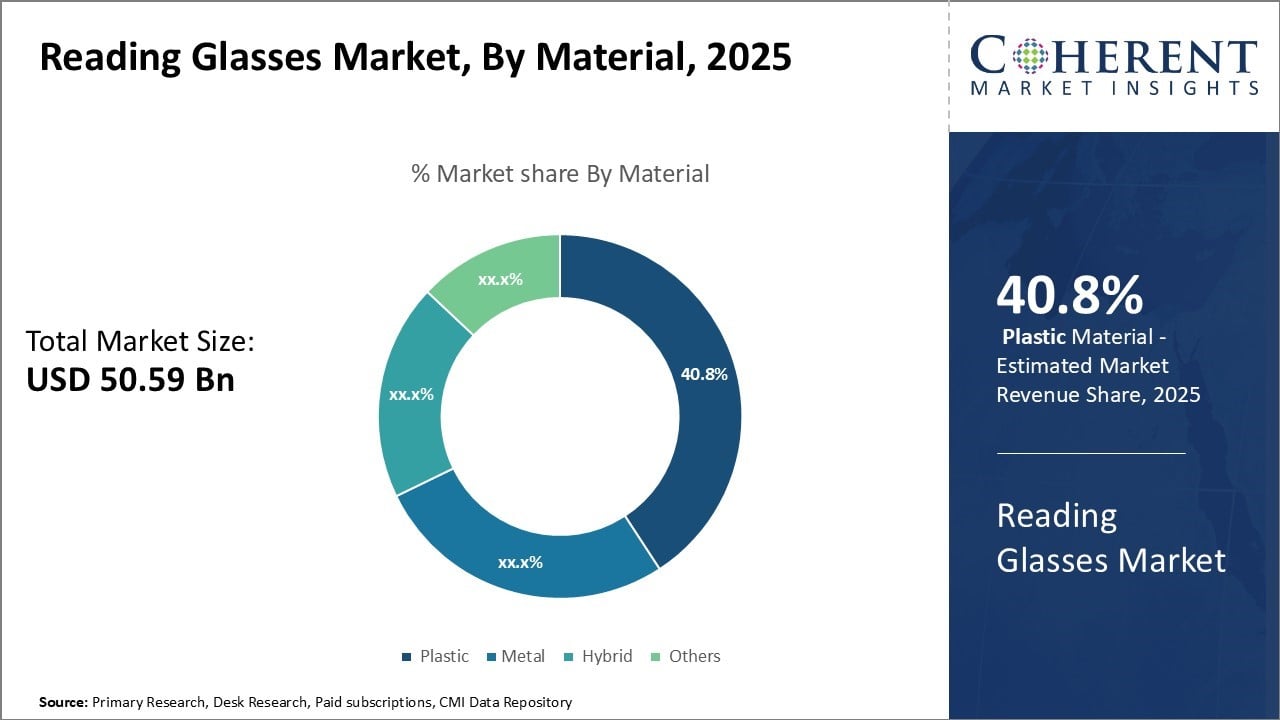
Reading Glasses Market Insights, By Material
Affordability and durability drive plastic's dominance
In terms of material, the plastic segment is expected to contribute 41.8% share of the market in 2026, owing to its affordability and durability. Being the lightest and most affordable option available, plastic reading glasses are budget-friendly for consumers. Their lightweight frame prevents fatigue over long reading sessions. Polycarbonate plastic provides strength equivalent to higher-end materials while maintaining a low price point. It withstands flexing and impact stresses without cracking or breaking. Plastic glasses are less prone to scratches and damage from daily use. Consumers prefer replacing inexpensive plastic frames rather than paying heavily for repairs on more premium options.
In June 2025, Finnish startup IXI announced its world-first autofocus glasses, blending plastic liquid-crystal lenses and infrared eye-tracking sensors to dynamically correct vision. The frames, made from lightweight plastic, adjust focus within 0.2 seconds, eliminating the need for progressive lenses or reading glasses. IXI aims to disrupt the $200 billion eyewear industry by offering plastic-frame eyewear that delivers natural, real-time vision correction without visible tech.
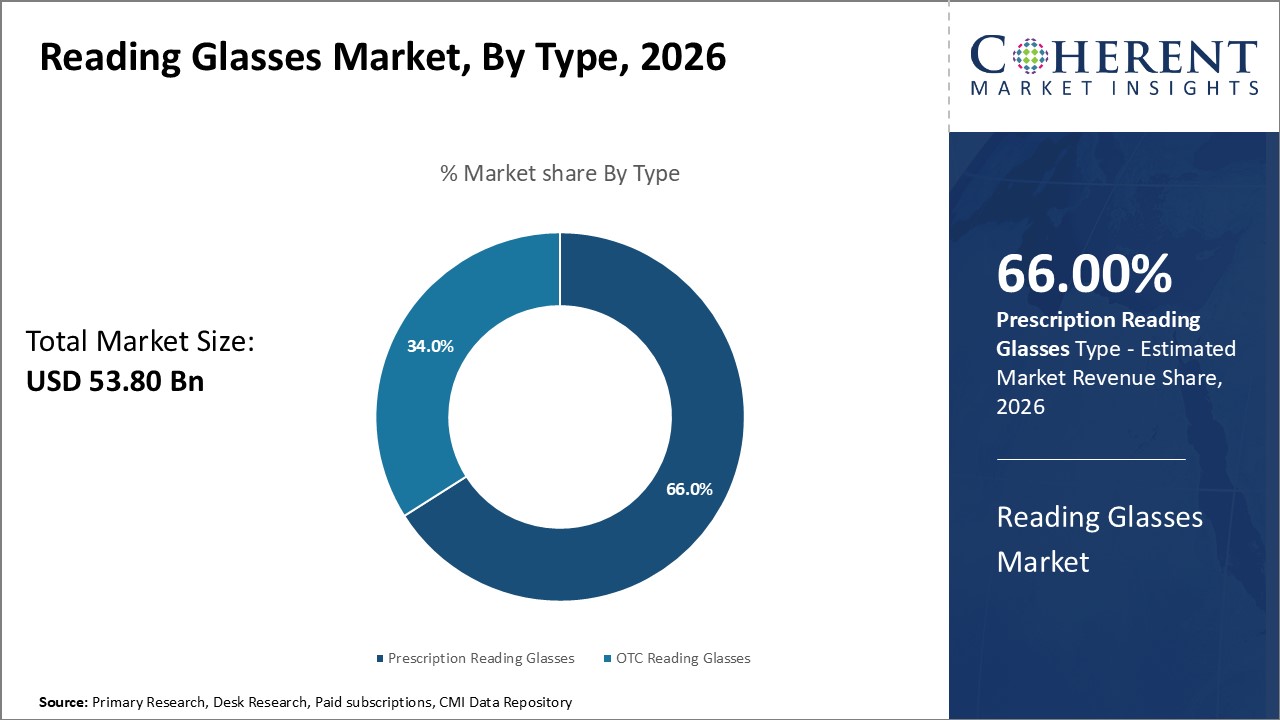
Reading Glasses Market Insights, By Type
Standard prescriptions maximize prescription reading glasses usage
In terms of type, the prescription reading glasses segment is expected to contribute 66% of the market share in 2026 for meeting standard vision needs in the market. Most readers only require a mild prescription between +1.0 to +3.0 diopters to assist with extended near focus tasks. Optometrists can quickly and affordably prescribe standard reading strengths which are readily available off the shelf or for order. Not needing customized lenses keeps costs low and supply chains streamlined. Users appreciate the ability to try different frame styles without heavy investment.
In December 2024, ThinOptics launched a “Prescription on Demand” service enabling online-customized reading glasses, while Eyenavision and Avulux released Chemistrie Avulux, clip-on lenses offering migraine protection. Surveys showed 52% of U.S. consumers prioritize “Made in USA” labels, and despite online sales growth, Healio found five out of six prescription glasses are still purchased in-store, underscoring the sustained relevance of in-person optical retail experience.
Reading Glasses Market Insights, By Distribution Channel
Online retail channels capitalize on convenience and discounts
In terms of distribution channel, the online retail segment is expected to contribute 40.2% share of the market in 2026, owing to unmatched convenience and price advantages. E-commerce platforms allow customers to research and compare a vast variety of styles, brands, and prescription options easily from any location. Online stores provide extensive product descriptions with enlarged images to assess frame details. Websites make navigation intuitive with filter functions for attributes like material, color, and size. For instance, a report from The Vision Council found that more than 44% of adults who bought eyeglasses used the internet to assist their purchases. This is further propelling the reading glasses market share.
Regional Insights
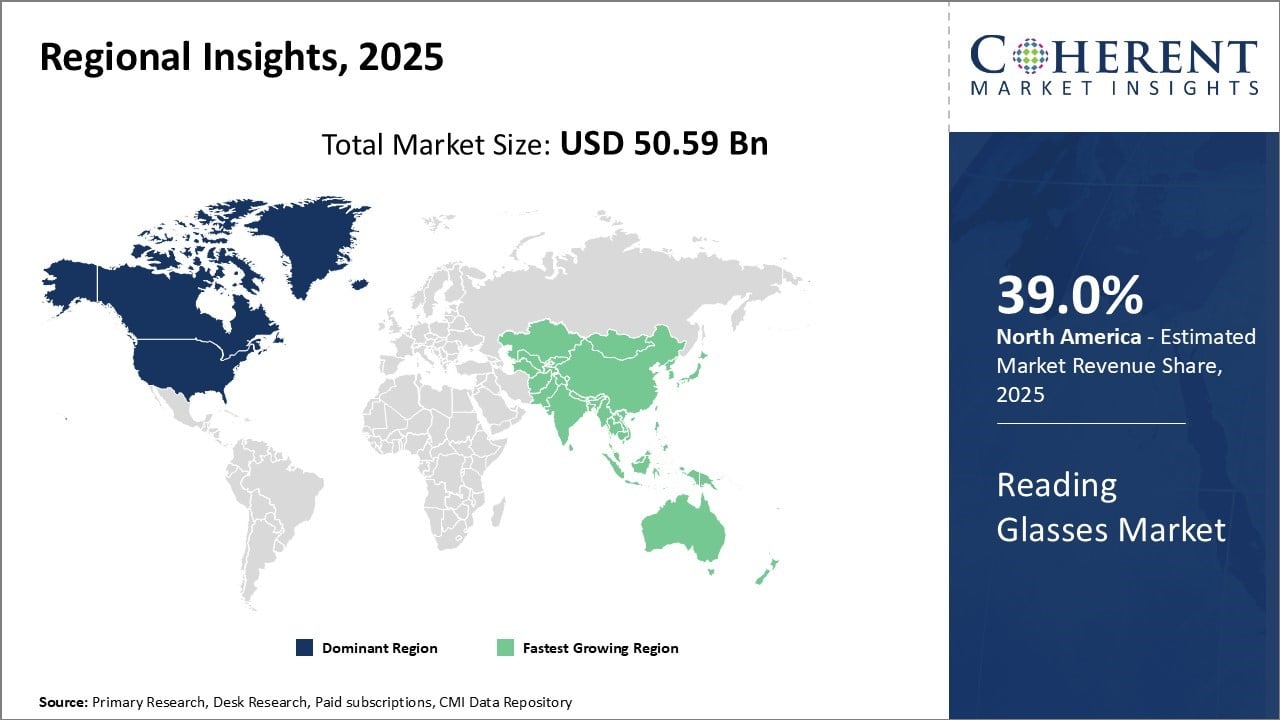
North America Reading Glasses Market Analysis & Trends
North America is projected to dominate this market, accounting for 39.0% of the market share in 2026. This leadership is driven by factors such as an aging population, increasing awareness about eye health, and supportive government initiatives to enhance eye care services. Leading companies like Johnson & Johnson Vision and Essilor have solidified their presence in the region through extensive distribution networks and strong brand reputation.
In September 2024, the American Optometric Association (AOA) unveiled “The Eye,” a public awareness campaign that frames the human eye as a technologically advanced device with 576 megapixels of resolution and 2.5 million gigabytes of capacity to resonate with younger, tech-focused audiences. Developed in collaboration with industrial designer Sebastian Arietta, the initiative aims to combat “vision neglect” among millennials and 18–25-year-olds. Since launching the broader “Eye Deserve More” campaign, AOA has seen a 188% increase in visits to its locator service, signaling growing engagement in proactive eye care
Asia Pacific Reading Glasses Market Analysis & Trends
The Asia Pacific region is anticipated to capture 32.3% of the market share in 2026 and is expected to grow at the fastest rate. This growth is fueled by an expanding middle class, higher disposable incomes, and a growing emphasis on lifestyle-oriented eyecare products. For instance, Alcon is intensifying its commitment to eye care in the Asia-Pacific region through pioneering products and partnerships. Vice President of APAC Vision Care highlighted rising digital eye strain and myopia rates, projected to reach 66% in East Asia by 2050 necessitating urgent intervention. Markets such as China and India are emerging as highly attractive opportunities, with local manufacturers actively broadening their presence.
Reading Glasses Market Outlook for Key Countries
U.S. Reading Glasses Market Trends
The U.S. reading glasses market remains highly attractive, driven by strong consumer spending on vision care and the introduction of innovative products designed to address digital eye strain. A key factor fueling growth is the rising prevalence of presbyopia among the aging population, with the American Academy of Ophthalmology noting that 1.8 billion individuals worldwide are affected by this condition, underscoring a substantial demand for vision correction solutions. Moreover, the increasing use of digital devices has exacerbated digital eye strain. According to a February 2024 CooperVision report, over 50.5% of U.S. adults aged 18-44 spend six or more hours daily on digital devices, leading to a surge in symptoms associated with digital eye strain, further proliferating the reading glasses market share.
China Reading Glasses Market Trends
The China reading glasses market is expanding rapidly due to increasing internet penetration and online sales channels. The rise of e-commerce platforms has made reading glasses more accessible, with a notable shift towards online purchasing. This trend is supported by the growing number of internet users, which reached 1 billion in 2023, facilitating easier access to eyewear products. Foreign residents in China are increasingly finding affordable, high-quality eyewear, thanks to efficient local optometry services, reports The Nanjinger. Eye tests in Nanjing follow international standards, often using advanced digital equipment, and the process. Eyewear prices are significantly lower than in Western countries, with full prescription glasses commonly available under ¥500 (~US $70). Fast service, competitive pricing, and reliable quality make purchasing glasses in China an attractive option for expats and locals alike.
Germany Reading Glasses Market Trends
Germany reading glasses market remains a significant player in the Europe reading glasses market, driven by a high awareness about ocular health and a large elderly population. The presence of major manufacturers like EssilorLuxottica enhances market growth. In October 2024, Essilor Luxottica completed the acquisition of an 80.5% stake in Heidelberg Engineering, a Germany-based company specializing in diagnostic solutions and healthcare IT for clinical ophthalmology, further strengthening its position in the German reading glasses market.
India Reading Glasses Market Trends
India reading glasses market is characterized by growing awareness about ocular disorders, yet it remains underpenetrated. A study for eye care services indicated that over 25.5% of taxi drivers were unaware they needed vision correction, emphasizing the need for increased awareness initiatives. The government is focusing on improving accessibility to eye care services, which could drive future market growth. According to the reading glasses market forecast, such initiatives, combined with rising investments, are expected to accelerate adoption across underserved segments. For instance, in September 2024, Dr. Agarwal Health Care, backed by Temasek and TPG, files IPO to raise up to Rs 600 crore. It's India's largest eye care chain with 667 doctors and plans to use the proceeds for debt repayment, general corporate purposes, and acquisitions.
U.K. Reading Glasses Market Trends
The U.K. reading glasses market benefits from a strong presence of premium brands and a high demand for fashionable eyewear. The trend towards stylish reading glasses is evident, with consumers increasingly seeking trendy designs. The market is projected to grow as brands innovate with new styles and materials, responding to consumer preferences for both aesthetics and functionality. A key player contributing significantly to this market is Specsavers, a U.K.-based multinational optical retail chain. Founded in 1984 by Doug and Mary Perkins, Specsavers has grown to operate over 1,000 stores in 11 countries, with revenues reaching US$5.04 billion in 2023. Retail outlets across the UK are reporting strong demand for boutique labels such as Finlay, Ace & Tate, Cubitts, and Izipizi, all offering chic frames under £150, representing a shift from overt luxury logos to minimalist sophistication. The British-made Finlay sunglasses, priced around £160 and favored by the Prince and Princess of Wales, have quickly become a summer staple.
Market Players, Key Development, and Competitive Intelligence
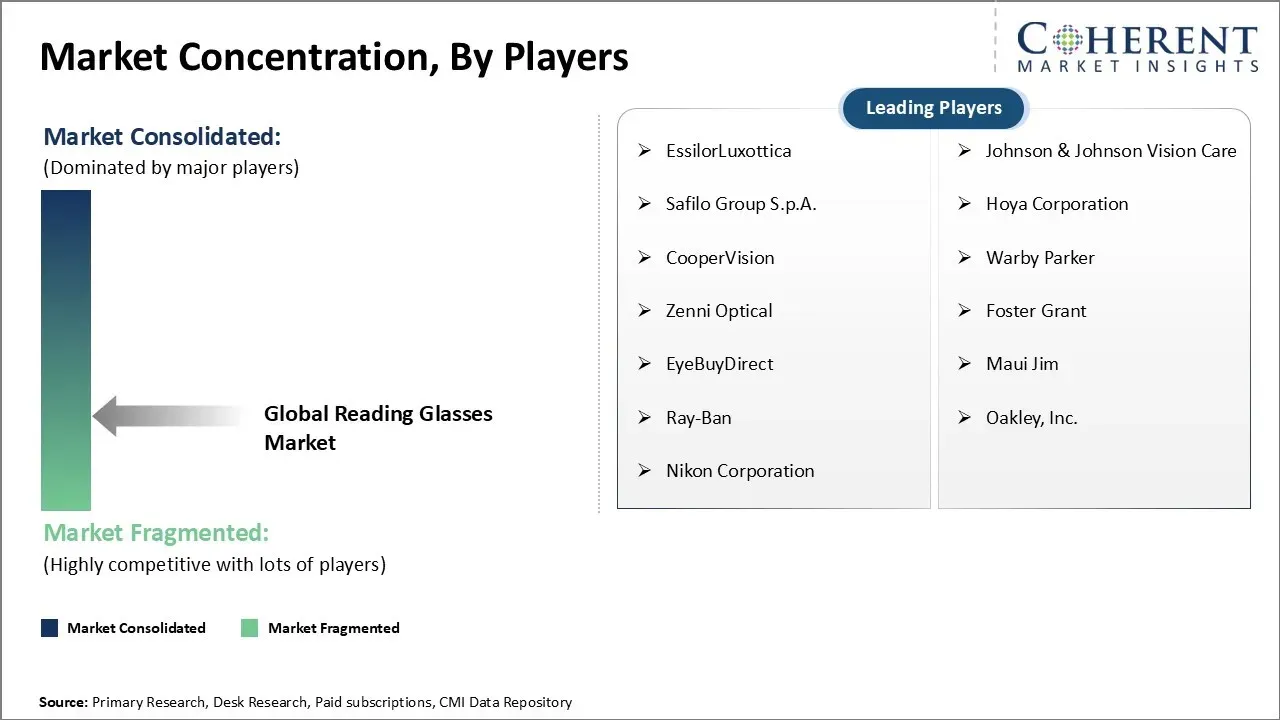
Key Developments
- In May 2025, Warby Parker Inc. partnered with Google to develop next-generation AI–powered smart glasses designed for all-day wear. This will feature prescription and non-prescription lenses, integrate multimodal AI and build on Google’s Android XR platform. Google will invest up to $150 million, including $75 million for product development and another $75 million in equity, contingent on milestone achievements.
- In October 2024, EssilorLuxottica, a dominant player in the global eyewear industry, acquired a 5.1% stake in Nikon. This investment reflects a strategic, long-term commitment to support Nikon's leadership and growth. Although EssilorLuxottica may not be a household name, it commands a significant market presence through ownership of iconic brands like Ray-Ban, Oakley, Persol, and Vogue Eyewear.
- In October 2024, Meta showcased its Orion AR smart glasses, dubbed the "most advanced" globally, at its annual Meta Connect event. Featuring miniaturised displays with wide fields of view and holographic overlays, Orion integrates Meta AI for voice commands, eye and hand tracking, and connects to smartphones via a wrist-mounted controller.
- In April 2024, ReadingGlasses.com launched “Read On Light”, an award-winning, ultra-thin reading glasses range, crafted from TR90 material, the three-millimetre-thick frames fold flat into a hard case and come in vibrant colours, making them perfect for on-the-go use. The design has earned top accolades, including the Red Dot, German Design, and Good Design Awards, and was honoured in Wallpaper* magazine’s 2024 Smart Space Awards.
Market Report Scope
Reading Glasses Market Report Coverage
| Report Coverage | Details | ||
|---|---|---|---|
| Base Year: | 2025 | Market Size in 2026: | USD 53.80 Bn |
| Historical Data for: | 2020 To 2024 | Forecast Period: | 2026 To 2033 |
| Forecast Period 2026 to 2033 CAGR: | 6.3% | 2033 Value Projection: | USD 82.48 Bn |
| Geographies covered: |
| ||
| Segments covered: |
| ||
| Companies covered: | EssilorLuxottica, Johnson & Johnson Vision Care, Safilo Group S.p.A., Hoya Corporation, CooperVision, Warby Parker, Zenni Optical, Foster Grant, EyeBuyDirect, Maui Jim, Ray-Ban, Oakley, Inc., and Nikon Corporation | ||
| Growth Drivers: |
| ||
| Restraints & Challenges: |
| ||
Reading Glasses Market Growth Driver
Increasing prevalence of vision-related issues among the aging population
As the global population ages significantly over the coming decades, more and more people are experiencing vision-related issues that requires the use of reading glasses due to the lens’s gradual loss of flexibility, which impairs near-vision focus. This contributes to surging reading glasses market demand. Aging eyes undergo a variety of changes as one grows old such as the gradual loss of elasticity of the lens inside the eyes. This means the lens becomes harder and loses its ability to flex and change focus from distance to near. Presbyopia, the medical term for age-related long or far-sightedness, is the most common such condition affecting people over the age of 40. While reading glasses cannot stop or reverse the softening of the lens, they can help compensate for it by bringing the letters or words closer so they can be seen clearly.
Growing awareness of eye health and the benefits of corrective eyewear
In recent years, awareness of eye health and corrective eyewear has surged, prompting impactful campaigns and initiatives. For instance, India’s ENTOD Pharmaceuticals led a nationwide World Sight Day 2024 campaign “Love Your Child’s Eye” reaching over 40,000 people across 12 states with free check-ups and glasses, emphasizing early detection and spectacle use. Similarly, Johnson & Johnson Vision’s “#AcuvueSePoochho” campaign featuring Ranveer Singh encouraged regular eye exams and professional guidance for contact lenses. As these high‑visibility efforts gain traction, more individuals recognize the importance of regular screenings and eyewear, driving adoption of corrective solutions that improve vision and quality of life.
Reading Glasses Market Opportunity
Expansion of e-commerce platforms for wider accessibility
The growth of e-commerce platforms presents significant opportunities for the market players to expand their customer base. Online shopping for vision care products has risen manifold over the past few years driven by ease of procuring from varied brands sitting at home and 24x7 accessibility. This expanding digital landscape allows manufacturers to connect with a wider customer demographic beyond local markets. According to recent reading glasses market research, major players such as Foster Grant are strengthening their online distribution strategies and focusing on optimizing virtual storefronts.
Analyst Opinion (Expert Opinion)
The reading glasses market value is at a pivotal inflection point, driven not by necessity alone, but by a nuanced shift in consumer behavior, retail convergence, and lifestyle branding. The days of purely functional, pharmacy-counter reading glasses are long gone. Today, the category is rapidly evolving into a fashion-forward, digitally integrated, and demographically diversified segment, one that, frankly, most players in the eyewear ecosystem still underestimate.
At the core of this transformation is the accelerated presbyopic onset in populations as young as 38–42, primarily due to digital screen fatigue. Clinical studies from the American Academy of Ophthalmology confirm that over 57% of adults aged 40–49 now report some degree of near-vision impairment. This is an unprecedented demographic: tech-native, brand-conscious, and willing to spend for quality and design. Traditional market logic, which pegs reading glasses as low-margin, commoditized goods, is utterly outdated in this context.
Consider the aggressive retail strategy by Warby Parker, which now places reading glasses at the same visibility tier as prescription eyewear. Their 2024 product refresh introduced modular readers with blue-light filtering and customizable frames, explicitly targeting early presbyopes in tech-heavy urban zones. Meanwhile, Peepers by PeeperSpecs has built an entirely lifestyle-driven brand around curated collections achieved through collaborations with designers like Vera Bradley and the rollout of seasonal lookbooks not typically seen in this product class. It’s not eyewear; it’s "facewear."
Moreover, optical e-commerce is no longer an ancillary channel, it’s the engine. Reading glasses purchases online now account for 38% of volume in the U.S., according to data from The Vision Council. This figure is significantly higher than for prescription eyewear, where trust and fitment issues persist. The implication? Readers are increasingly treated as impulse and style purchases, aided by AR-based virtual try-ons, same-day shipping, and bundled offers. Amazon’s private label readers, priced under $20 for a set of three, are disrupting the lower-end of the pyramid with sheer volume and logistics muscle which is driving traditional opticians out of that space entirely.
Yet, the real dark horse is functional integration. Brands like ThinOptics are blurring the line between convenience and tech by embedding readers into keychains and smartphone cases. Meanwhile, EssilorLuxottica has been quietly testing AI-driven “smart readers” with adaptive magnification for dynamic screen reading is something that could become standard by 2027.
Speak to the analyst
Want personalized insights?
Take the findings above to one of our principal consultants, or have the report rebuilt around the segments, geographies and competitors you actually track.
Market Segmentation
- By Material Insights (Revenue, USD Bn, 2021 - 2033)
- Plastic
- Metal
- Hybrid
- Others
- By Type Insights (Revenue, USD Bn, 2021 - 2033)
- Prescription Reading Glasses
- OTC Reading Glasses
- By Distribution Channel Insights (Revenue, USD Bn, 2021 - 2033)
- Online Retail
- Optical Stores
- Supermarkets/Hypermarkets
- Pharmacies
- Others
- Regional Insights (Revenue, USD Bn, 2021 - 2033)
- North America
- U.S.
- Canada
- Latin America
- Brazil
- Argentina
- Mexico
- Rest of Latin America
- Europe
- Germany
- U.K.
- Spain
- France
- Italy
- Russia
- Rest of Europe
- Asia Pacific
- China
- India
- Japan
- Australia
- South Korea
- ASEAN
- Rest of Asia Pacific
- Middle East
- GCC Countries
- Israel
- Rest of Middle East
- Africa
- South Africa
- North Africa
- Central Africa
- North America
- Key Players Insights
- EssilorLuxottica
- Johnson & Johnson Vision Care
- Safilo Group S.p.A.
- Hoya Corporation
- CooperVision
- Warby Parker
- Zenni Optical
- Foster Grant
- EyeBuyDirect
- Maui Jim
- Ray-Ban
- Oakley, Inc.
- Nikon Corporation
Sources
Primary Research Interviews from the following stakeholders
Stakeholders
- Interviews with optical retailers, eyewear manufacturers, optometrists, e-commerce eyewear platforms, supply chain managers, and procurement leads in global markets.
Databases
- World Health Organization (WHO) – Global Vision Impairment Data
- UN Comtrade Database
- International Trade Centre (ITC) – Trade Map
- U.S. Census Bureau – Foreign Trade Statistics
- Eurostat – Health and Consumer Statistics
- Directorate General of Commercial Intelligence and Statistics (DGCIS), India
- Korea Health Industry Development Institute (KHIDI)
- Japan External Trade Organization (JETRO)
Magazines
- Eyecare Business Magazine
- 20/20 Magazine
- Vision Monday
- Optometry Today
- Eyewear Intelligence
- Retail Focus – Optical Retail Section
- HealthTech Magazine – Vision Solutions
- Consumer Reports – Eyewear & Optical Products
Journals
- Clinical and Experimental Optometry
- Journal of Vision Research
- Investigative Ophthalmology & Visual Science (IOVS)
- Ophthalmic and Physiological Optics
- Journal of Retailing and Consumer Services
- Contact Lens & Anterior Eye Journal
Newspapers
- The Wall Street Journal – Health & Consumer Goods
- The Economic Times – Healthcare & Retail
- Financial Times – Lifestyle and Wellness Tech
- The Hindu Business Line – Health Products and Markets
- Nikkei Asia – Consumer Goods & Eyewear Trends
- South China Morning Post – Health and Consumer Products
Associations
- Vision Council (U.S.)
- International Agency for the Prevention of Blindness (IAPB)
- Optometric Association of India (OAI)
- European Council of Optometry and Optics (ECOO)
- American Optometric Association (AOA)
- Asia Pacific Council of Optometry (APCO)
- Confederation of Indian Industry (CII) – Healthcare and Optical Devices Cell
Public Domain Sources
- Ministry of Health and Family Welfare (India)
- Food and Drug Administration (FDA) – Vision Correction Devices
- Bureau of Indian Standards (BIS) – Optical Lens Regulations
- National Health Service (UK) – Vision Services Data
- U.S. National Eye Institute (NEI)
- Health Canada – Medical Devices Directorate
- EU Single Market Observatory – Optical & Medical Devices
- Reserve Bank of India (RBI) Reports on Retail and Healthcare
Proprietary Elements
- CMI Data Analytics Tool, and Proprietary CMI Existing Repository of information for last 8 years
Get access to 250+ pages report
Every segment, forecast, competitor profile and data table behind the analysis above — available for instant download.
- ESOMAR Member
- ISO 9001:2015 Certified
- D-U-N-S Registered
- GDPR & CCPA Compliant
Missing comfort of reading report in your local language? Find your preferred language:
Transform your Strategy with Exclusive Trending Reports
Frequently Asked Questions
The Reading Glasses Market is estimated to be valued at USD 53.80 Bn in 2026, and is expected to reach USD 82.48 Bn by 2033.
The CAGR of the Reading Glasses Market is projected to be 6.3% from 2026 to 2033.
Increasing prevalence of vision-related issues among the aging population and growing awareness of eye health and the benefits of corrective eyewear are the major factors driving the market growth for reading glasses.
High competition from low-cost alternatives and counterfeit products and limited consumer awareness regarding the importance of quality reading glasses are the major factors hampering the market growth for reading glasses.
In terms of material, the plastic segment is estimated to dominate the market revenue share in 2026.
EssilorLuxottica, Johnson & Johnson Vision Care, Safilo Group S.p.A., Hoya Corporation, CooperVision, Warby Parker, Zenni Optical, Foster Grant, EyeBuyDirect, Maui Jim, Ray-Ban, Oakley, Inc., and Nikon Corporation are the major players.
North America is expected to lead the global reading glasses market in 2026.